I am reading a book that is making me pull up some old Paglia stuff. The new addition is the first quote. Enjoy:
More than twenty years ago, the influential lesbian author Camille Paglia had this to say about the “born gay” myth: “Homosexuality is not normal. On the contrary it is a challenge to the norm…. Nature exists whether academics like it or not. And in nature, procreation is the single relentless rule. That is the norm…. Our sexual bodies were designed for reproduction…. No one is born gay. The idea is ridiculous… homosexuality is an adaptation, not an inborn trait.”
But she was just getting started as she asked:
“Is the gay identity so fragile that it cannot bear the thought that some people may not wish to be gay? Sexuality is highly fluid, and reversals are theoretically possible. However, habit is refractory, once sensory pathways have been blazed and deepened by repetition—a phenomenon obvious with obesity, smoking, alcoholism or drug addiction—helping gays to learn how to function heterosexually, if they wish is a perfectly worthy aim. We should be honest enough to consider whether or not homosexuality may not indeed, be a pausing at the prepubescent stage where children band together by gender…. Current gay cant insists that homosexuality is not a choice; that no one would choose to be gay in a homophobic society. But there is an element of choice in all behavior, sexual or otherwise. It takes an effort to deal with the opposite sex; it is safer with your own kind. The issue is one of challenge versus comfort.”
Michael L. Brown, Outlasting the Gay Revolution: Where Homosexual Activism Is Really Going and How to Turn the Tide (Washington, DC: WND Books, 2015), 162.
…But no subject gets her going more than when I ask if she really sees a connection between society’s attempts to paper over the biological distinction between men and women and the collapse of Western civilization.
She starts by pointing to the diminished status of military service. “The entire elite class now, in finance, in politics and so on, none of them have military service—hardly anyone, there are a few. But there is no prestige attached to it anymore. That is a recipe for disaster,” she says. “These people don’t think in military ways, so there’s this illusion out there that people are basically nice, people are basically kind, if we’re just nice and benevolent to everyone they’ll be nice too. They literally don’t have any sense of evil or criminality.”
The results, she says, can be seen in everything from the dysfunction in Washington (where politicians “lack practical skills of analysis and construction”) to what women wear. “So many women don’t realize how vulnerable they are by what they’re doing on the street,” she says, referring to women who wear sexy clothes.
When she has made this point in the past, Ms. Paglia—who dresses in androgynous jackets and slacks—has been told that she believes “women are at fault for their own victimization.” Nonsense, she says. “I believe that every person, male and female, needs to be in a protective mode at all times of alertness to potential danger. The world is full of potential attacks, potential disasters.” She calls it “street-smart feminism.”
Ms. Paglia argues that the softening of modern American society begins as early as kindergarten. “Primary-school education is a crock, basically. It’s oppressive to anyone with physical energy, especially guys,” she says, pointing to the most obvious example: the way many schools have cut recess. “They’re making a toxic environment for boys. Primary education does everything in its power to turn boys into neuters.”
She is not the first to make this argument, as Ms. Paglia readily notes. Fellow feminist Christina Hoff Sommers has written about the “war against boys” for more than a decade. The notion was once met with derision, but now data back it up: Almost one in five high-school-age boys has been diagnosed with ADHD, boys get worse grades than girls and are less likely to go to college.
Ms. Paglia observes this phenomenon up close with her 11-year-old son, Lucien, whom she is raising with her ex-partner, Alison Maddex, an artist and public-school teacher who lives 2 miles away. She sees the tacit elevation of “female values”—such as sensitivity, socialization and cooperation—as the main aim of teachers, rather than fostering creative energy and teaching hard geographical and historical facts.
By her lights, things only get worse in higher education. “This PC gender politics thing—the way gender is being taught in the universities—in a very anti-male way, it’s all about neutralization of maleness.” The result: Upper-middle-class men who are “intimidated” and “can’t say anything. . . . They understand the agenda.” In other words: They avoid goring certain sacred cows by “never telling the truth to women” about sex, and by keeping “raunchy” thoughts and sexual fantasies to themselves and their laptops.
Politically correct, inadequate education, along with the decline of America’s brawny industrial base, leaves many men with “no models of manhood,” she says. “Masculinity is just becoming something that is imitated from the movies. There’s nothing left. There’s no room for anything manly right now.” The only place you can hear what men really feel these days, she claims, is on sports radio. No surprise, she is an avid listener. The energy and enthusiasm “inspires me as a writer,” she says, adding: “If we had to go to war,” the callers “are the men that would save the nation.”
And men aren’t the only ones suffering from the decline of men. Women, particularly elite upper-middle-class women, have become “clones” condemned to “Pilates for the next 30 years,” Ms. Paglia says. “Our culture doesn’t allow women to know how to be womanly,” adding that online pornography is increasingly the only place where men and women in our sexless culture tap into “primal energy” in a way they can’t in real life.
A key part of the remedy, she believes, is a “revalorization” of traditional male trades—the ones that allow women’s studies professors to drive to work (roads), take the elevator to their office (construction), read in the library (electricity), and go to gender-neutral restrooms (plumbing)…
Are you on the wrong side or the right side of history? Is there even a “wrong side” or a “right side”? What do those terms mean and why do politicians and pundits use them? Nationally syndicated columnist and best-selling author Jonah Goldberg explains.
Some Denver City Council members have stalled consideration of Chick-fil-A’s bid for a 7-year concession to operate a restaurant at the Denver International Airport, citing the company’s stance against same-sex marriage.
According to the Denver Post, Business Development Committee member Paul Lopez believes that having the chicken chain at the airport is a “moral issue on the city.”
Openly gay councilwoman Robin Kniech, while addressing the council Tuesday, said: “We really want to look into the policies and practices of these companies, and just make sure that they conform to ours in the city, the State of Colorado. We have a marriage decision nationally. This is really about policies and it’s about practices.”
During the meeting none of the 10 members in attendance defended Chick-fil-A.
Kniech later told the Denver Post she was worried about a franchise in Denver generating “corporate profits used to fund and fuel discrimination.”….
“Modern Family” ~ Mitch & Cam Eat at a Boycotted Restaurant
Gay Patriot notes the story and comments well [as usual] on the issue facing freedom loving Americans:
…It’s kind of a sour-leftist twofer. They get to revel in that smug exclusion of alternative viewpoints the left calls “tolerance,” and they get to deny people the pleasure of eating a chicken sandwich and waffle fries.
Meanwhile, the Christians who were attacked by the Lesbian Gay Bullying Totalitarians (LGBT) and nearly lost their business for declining the opportunity to bake a cake for a lesbian wedding, in an act of charity and forgiveness, sent cakes to 10 gay rights groups with messages of love.
What do you bet at least 9 of those cakes were tossed in the dumpster amid a string of profanity that would shame a sailor?
ABC joins Fox News, MSNBC and the rest of the news media who have been attacking the games industry for decades. Their bias knows no bounds, their research knows no objectivity, and their reporters know not a damn thing. Welcome to Gaming.
It would be nice to live in a society where we could play our video games, go to our sporting events, watch our entertainment programs and not be assaulted by the dogma of Social Justice Warriors. It would be just as nice to live in a society where journalists reported facts accurately, instead of molding them to fit a narrative.
(RNS) Look around. Three in 10 people you see claim they are pretty satisfied with life, happy, healthy and moral, too.
They’re the “highly religious,” 30 percent of U.S. adults who say they pray daily and attend church at least once a week.
“Religion in Everyday Life,” a new survey from Pew Research released Tuesday (April 12), teases out the particular ways they differ from the majority of U.S. Christians who are less observant and from non-Christians, including the “nones” who claim no religious identity.
The highly religious are overwhelmingly (95 percent) Protestant, Catholic or other Christians. Nearly half (49 percent) are white evangelicals. Most of the overall group (62 percent) are women.
And many are smiling. Four in 10 highly religious people say they’re “very happy” with the way things are going in life, compared to 29 percent of those who are not highly religious.
But, “we don’t know why they are happier“ or more satisfied with their health, said Pew researcher Besheer Mohamed, a co-author of the report.
“We see the patterns but we don’t know what is causing what. Is it that regular churchgoers get something from the church practice and involvement or is it that a certain sort of person is more likely to go to worship more frequently?” he said.
Nearly three in four (74 percent) highly religious people say they’re “very satisfied with family life” compared to 67 percent of those who are not highly religious.
And 47 percent say they gather with extended family at least monthly (compared to 30 percent of those not highly religious)…
A new study suggests that joining a religious group could do more for someone’s “sustained happiness” than other forms of social participation, such as volunteering, playing sports or taking a class.
A study in the American Journal of Epidemiology by researchers at the London School of Economics and Erasmus University Medical Center in the Netherlands found that the secret to sustained happiness lies in participation in religion.
“The church appears to play a very important social role in keeping depression at bay and also as a coping mechanism during periods of illness in later life,” Mauricio Avendano, an epidemiologist at LSE and an author of the study, said in a statement. “It is not clear to us how much this is about religion per se, or whether it may be about the sense of belonging and not being socially isolated.”
Researchers looked at four areas: 1) volunteering or working with a charity; 2) taking educational courses; 3) participating in religious organizations; 4) participating in a political or community organization. Of the four, participating in a religious organization was the only social activity associated with sustained happiness, researchers found.
The study analyzed 9,000 Europeans who were older than 50. The report that studied older Europeans also found that joining political or community organizations lost their benefits over time. In fact, the short-term benefits from those social connections often lead to depressive symptoms later on, researchers say….
And we know the positive aspects of faith versus non-faith in the survival of the species/fittest:
Assuming the validity of the “underlying instinct to survive and reproduce” then, out of the two positions (belief and non-belief) available for us to choose from which would better apply to being the most fit if the fittest is “an individual… [that] reproduces more successfully…”?[1] The woman that believes in God is less likely to have abortions and more likely to have larger families than their secular counterparts.[2] Does that mean that natural selection will result in a greater number of believers than non-believers?[3]
[1]From my son’s 9th grade biology textbook: Susan Feldkamp, ex. ed., Modern Biology (Austin, TX: Holt, Rineheart, and Winston, 2002), 288; “…organisms that are better suited to their environment than others produce more offspring” American Heritage Science Dictionary, 1st ed. (Boston, MA: Houghton Mifflin, 2005), cf. natural selection, 422; “fitness (in evolution) The condition of an organism that is well adapted to its environment, as measured by its ability to reproduce itself” Oxford Dictionary of Biology, New Edition (New York, NY: Oxford University Press, 1996), cf. fitness, 202; “fitness In an evolutionary context, the ability of an organism to produce a large number of offspring that survive to reproduce themselves” Norah Rudin, Dictionary of Modern Biology (Hauppauge, NY: Barron’s Educational Series, 1997), cf. fitness, 146.
[2] Dinesh D’Souza points to this in his recent book, What’s So Great About Christianity:
Russia is one of the most atheist countries in the world, and abortions there outnumber live births by a ratio of two to one. Russia’s birth rate has fallen so low that the nation is now losing 700,000 people a year. Japan, perhaps the most secular country in Asia, is also on a kind of population diet: its 130 million people are expected to drop to around 100 million in the next few decades. Canada, Australia, and New Zealand find themselves in a similar predicament. Then there is Europe. The most secular continent on the globe is decadent in the quite literal sense that its population is rapidly shrinking. Birth rates are abysmally low in France, Italy, Spain, the Czech Republic, and Sweden. The nations of Western Europe today show some of the lowest birth rates ever recorded, and Eastern European birth rates are comparably low. Historians have noted that Europe is suffering the most sustained reduction in its population since the Black Death in the fourteenth century, when one in three Europeans succumbed to the plague. Lacking the strong religious identity that once characterized Christendom, atheist Europe seems to be a civilization on its way out. Nietzsche predicted that European decadence would produce a miserable “last man’ devoid of any purpose beyond making life comfortable and making provision for regular fornication. Well, Nietzsche’s “last man” is finally here, and his name is Sven. Eric Kaufmann has noted that in America, where high levels of immigration have helped to compensate for falling native birth rates, birth rates among religious people are almost twice as high as those among secular people. This trend has also been noticed in Europe.” What this means is that, by a kind of natural selection, the West is likely to evolve in a more religious direction. This tendency will likely accelerate if Western societies continue to import immigrants from more religious societies, whether they are Christian or Muslim. Thus we can expect even the most secular regions of the world, through the sheer logic of demography, to become less secular over time…. My conclusion is that it is not religion but atheism that requires a Darwinian explanation. Atheism is a bit like homosexuality: one is not sure where it fits into a doctrine of natural selection. Why would nature select people who mate with others of the same sex, a process with no reproductive advantage at all?
(17, 19.). Some other studies and articles of note: Mohit Joshi, “Religious women less likely to get abortions than secular women,” Top Health News, Health News United States (1-31-08), found at: http://www.topnews.in/health/religious-women-less-likely-get-abortions-secular-women-2844 (last accessed 8-13-09); Anthony Gottlieb, “Faith Equals Fertility,” Intelligent Life, a publication of the Economist magazine (winter 2008), found at: http://www.moreintelligentlife.com/story/faith-equals-fertility (last accessed 8-13-09); W. Bradford Wilcox, “Fertility, Faith, & the Future of the West: A conversation with Phillip Longman,” Christianity Today, Books & Culture: A Christian Review (5-01-2007), found at: http://www.christianitytoday.com/bc/2007/mayjun/4.28.html?start=1 (last accessed 8-13-2009); Pippa Norris and Ronald Inglehart, Sacred and Secular: Religion and Politics Worldwide (New York, NY: Cambridge University Press, 2004), 3-32, esp. 24-29 — I recommend this book for deep thinking on the issue.
[3] Adapted from a question by a student at a formal debate between Dr. Massimo Pigliucci and Dr. William Lane Craig during the Q&A portion of the debate. (DVD, Christian Apologetics, Biola University, apologetics@biola.edu, product # WLC-RFM14V).
Religious Belief Reduces Crime Summary of the First Panel Discussion Panelists for this important discussion included social scientists Dr. John DiIulio, professor of politics and urban affairs at Princeton University; David Larson, M.D., President of the National Institute for Healthcare Research; Dr. Byron Johnson, Director of the Center for Crime and Justice Policy at Vanderbilt University; and Gary Walker, President of Public/Private Ventures. The panel focused on new research, confirming the positive effects that religiosity has on turning around the lives of youth at risk.
Dr. Larson laid the foundation for the discussion by summarizing the findings of 400 studies on juvenile delinquency, conducted during the past two decades. He believes that although more research is needed, we can say without a doubt that religion makes a positive contribution.
His conclusion: “The better we study religion, the more we find it makes a difference.” Previewing his own impressive research, Dr. Johnson agreed. He has concluded that church attendance reduces delinquency among boys even when controlling for a number of other factors including age, family structure, family size, and welfare status. His findings held equally valid for young men of all races and ethnicities.
Gary Walker has spent 25 years designing, developing and evaluating many of the nation’s largest public and philanthropic initiatives for at-risk youth. His experience tells him that faith-based programs are vitally important for two reasons. First, government programs seldom have any lasting positive effect. While the government might be able to design [secular/non-God] programs that occupy time, these programs, in the long-term, rarely succeed in bringing about the behavioral changes needed to turn kids away from crime. Second, faith-based programs are rooted in building strong adult-youth relationships; and less concerned with training, schooling, and providing services, which don’t have the same direct impact on individual behavior. Successful mentoring, Walker added, requires a real commitment from the adults involved – and a willingness to be blunt. The message of effective mentors is simple. “You need to change your life, I’m here to help you do it, or you need to be put away, away from the community.” Government, and even secular philanthropic programs, can’t impart this kind of straight talk.
Sixth through twelfth graders who attend religious services once a month or more are half as likely to engage in at-risk behaviors such as substance abuse, sexual excess, truancy, vandalism, drunk driving and other trouble with police. Search Institute, “The Faith Factor,” Source, Vol. 3, Feb. 1992, p.1.
Churchgoers are more likely to aid their neighbors in need than are non-attendees. George Barna, What Americans Believe, Regal Books, 1991, p. 226.
Three out of four Americans say that religious practice has strengthened family relationships. George Gallup, Jr. “Religion in America: Will the Vitality of Churches Be the Surprise of the Next Century,” The Public Perspective, The Roper Center, Oct./Nov. 1995.
Church attendance lessens the probabilities of homicide and incarceration. Nadia M. Parson and James K. Mikawa: “Incarceration of African-American Men Raised in Black Christian Churches.” The Journal of Psychology, Vol. 125, 1990, pp.163-173.
Religious practice lowers the rate of suicide. Joubert, Charles E., “Religious Nonaffiliation in Relation to Suicide, Murder, Rape and Illegitimacy,” Psychological Reports 75:1 part 1 (1994): 10 Jon W. Hoelter: “Religiosity, Fear of Death and Suicide Acceptibility.” Suicide and Life-Threatening Behavior, Vol. 9, 1979, pp.163-172.
The presence of active churches, synagogues… reduces violent crime in neighborhoods. John J. Dilulio, Jr., “Building Spiritual Capital: How Religious Congregations Cut Crime and Enhance Community Well-Being,” RIAL Update, Spring 1996.
People with religious faith are less likely to be school drop-outs, single parents, divorced, drug or alcohol abusers. Ronald J. Sider and Heidi Roland, “Correcting the Welfare Tragedy,” The Center for Public Justice, 1994.
Church involvement is the single most important factor in enabling inner-city black males to escape the destructive cycle of the ghetto. Richard B. Freeman and Harry J. Holzer, eds., The Black Youth Employment Crisis, University of Chicago Press, 1986, p.354.
Attending services at a church or other house of worship once a month or more makes a person more than twice as likely to stay married than a person who attends once a year or less. David B. Larson and Susan S. Larson, “Is Divorce Hazardous to Your Health?” Physician, June 1990. Improving Personal Well-Being
Regular church attendance lessens the possibility of cardiovascular diseases, cirrhosis of the liver, emphysema and arteriosclerosis. George W. Comstock amd Kay B. Patridge:* “Church attendance and health.”* Journal of Chronic Disease, Vol. 25, 1972, pp. 665-672.
Regular church attendance significantly reduces the probablility of high blood pressure.* David B. Larson, H. G. Koenig, B. H. Kaplan, R. S. Greenberg, E. Logue and H. A. Tyroler:* ” The Impact of religion on men’s blood pressure.”* Journal of Religion and Health, Vol. 28, 1989, pp.265-278.* W.T. Maramot:* “Diet, Hypertension and Stroke.” in* M. R. Turner (ed.) Nutrition and Health, Alan R. Liss, New York, 1982, p. 243.
People who attend services at least once a week are much less likely to have high blood levels of interlukin-6, an immune system protein associated with many age-related diseases.* Harold Koenig and Harvey Cohen, The International Journal of Psychiatry and Medicine, October 1997.
Regular practice of religion lessens depression and enhances self esteem. *Peter L. Bensen and Barnard P. Spilka:* “God-Image as a function of self-esteem and locus of control” in H. N. Maloney (ed.) Current Perspectives in the Psychology of Religion, Eedermans, Grand Rapids, 1977, pp. 209-224.* Carl Jung: “Psychotherapies on the Clergy” in Collected Works Vol. 2, 1969, pp.327-347.
Church attendance is a primary factor in preventing substance abuse and repairing damage caused by substance abuse.* Edward M. Adalf and Reginald G. Smart:* “Drug Use and Religious Affiliation, Feelings and Behavior.” * British Journal of Addiction, Vol. 80, 1985, pp.163-171.* Jerald G. Bachman, Lloyd D. Johnson, and Patrick M. O’Malley:* “Explaining* the Recent Decline in Cocaine Use Among Young Adults:* Further Evidence That Perceived Risks and Disapproval Lead to Reduced Drug Use.”* Journal of Health and Social Behavior, Vol. 31,* 1990, pp. 173-184.* Deborah Hasin, Jean Endicott, * and Collins Lewis:* “Alcohol and Drug Abuse in Patients With Affective Syndromes.”* Comprehensive Psychiatry, Vol. 26, 1985, pp. 283-295. * The findings of this NIMH-supported study were replicated in the Bachmen et. al. study above.
“When men get in a fight, and hit a pregnant woman so that her children are born [prematurely], but there is no injury, the one who hit her must be fined as the woman’s husband demands from him, and he must pay according to judicial assessment. If there is an injury, then you must give life for life, eye for eye, tooth for tooth, hand for hand, foot for foot….”
What does this verse mean for the Judeo-Christian person in the real world — if we rightly shape our worldview according to God’s Revelation? Wayne Grudem explains with an excerpt from from his book, POLITICS ACCORDING TO THE BIBLE:
For the question of abortion, perhaps the most significant passage of all is found in the specific laws God gave Moses for the people of Israel during the time of the Mosaic covenant. One particular law spoke of the penalties to be imposed in case the life or health of a pregnant woman or her preborn child was endangered or harmed:
When men strive together and hit a pregnant woman, so that her children come out, but there is no harm, the one who hit her shall surely be fined, as the woman’s husband shall impose on him, and he shall pay as the judges determine. But if there is harm, then you shall pay life for life, eye for eye, tooth for tooth, hand for hand, foot for foot, burn for burn, wound for wound, stripe for stripe (Exod. 21:22-25). [footnote A]
This law concerns a situation when men are fighting and one of them accidentally hits a pregnant woman. Neither one of them intended to do this, but as they fought they were not careful enough to avoid hitting her. If that happens, there are two possibilities:
1. If this causes a premature birth but there is no harm to the pregnant woman or her preborn child, there is still a penalty: “The one who hit her shall surely be fined” (v. 22). The penalty was for carelessly endangering the life or health of the pregnant woman and her child. We have similar laws in modern society, such as when a person is fined for drunken driving, even though he has hit no one with his car. He recklessly endangered human life and health, and he deserved a fine or other penalty.
2. But “if there is harm” to either the pregnant woman or her child, then the penalties are quite severe: “Life for life, eye for eye, tooth for tooth …” (vv. 23-24). This means that both the mother and the preborn child are given equal legal protection. The penalty for harming the preborn child is just as great as for harming the mother. Both are treated as persons, and both deserve the full protection of the law. [footnote B]
This law is even more significant when we put it in the context of other laws in the Mosaic covenant. In other cases in the Mosaic law where someone accidentally caused the death of another person, there was no requirement to give “life for life,” no capital punishment. Rather, the person who accidentally caused someone else’s death was required to flee to one of the “cities of refuge” until the death of the high priest (see Num. 35:9-15, 22-29). This was a kind of “house arrest,” although the person had to stay within a city rather than within a house for a limited period of time. It was a far lesser punishment than “life for life.”
This means that God established for Israel a law code that placed a higher value on protecting the life of a pregnant woman and her preborn child than the life of anyone else in Israelite society. Far from treating the death of a preborn child as less significant than the death of others in society, this law treats the death of a preborn child or its mother as more significant and worthy of more severe punishment. And the law does not place any restriction on the number of months the woman was pregnant. Presumably it would apply from a very early stage in pregnancy, whenever it could be known that a miscarriage had occurred and her child or children had died as a result.
Moreover, this law applies to a case of accidental killing of a preborn child. But if accidental killing of a preborn child is so serious in God’s eyes, then surely intentional killing of a preborn child must be an even worse crime.
The conclusion from all of these verses [many are discussed in Grudem’s book] is that the Bible teaches that we should think of the preborn child as a person from the moment of conception, and we should give to the preborn child legal protection at least equal to that of others in the society.
Footnotes:
A. The phrase “so that her children come out” is a literal translation of the Hebrew text, which uses the plural of the common Hebrew word yeled, “child,” and another very common word, yātsā’, which means “go out, come out.” The plural “children” is probably the plural of indefiniteness, allowing for the possibility of more than one child. Other translations render this as “so that she gives birth prematurely,” which is very similar in meaning (so NASB, from 1999 editions onward; similarly: NN, TNIV, NET, HCSV, NLT, NKJV).
B. Some translations have adopted an alternative sense of this passage. The NRSV translates it, “When people who are fighting injure a pregnant woman so that there is a miscarriage, and yet no further harm follows …” (RSV is similar, as was NASB before 1999). In this case, causing a miscarriage and the death of a preborn child results only in a fine. Therefore, some have argued, this passage treats the preborn child as less worthy of protection than others in society, for the penalty is less. But the arguments for this translation are not persuasive. The primary argument is that this would make the law similar to a provision in the law code of Hammurabi (about 1760 BC in ancient Babylon). But such a supposed parallel should not override the meanings of the actual words in the Hebrew text of Exodus. The moral and civil laws in the Bible often differed from those of the ancient cultures around Israel. In addition, there is a Hebrew word for a miscarriage (shakal, Gen. 31:38; see also Exod. 23:26; Job 21:20; Hosea 9:14), but that word is not used here, nor is nēphel, another term for “miscarriage” (see Job 3:16; Ps. 58:8; Eccl. 6:3). However, the word that is used, yātsā’, is ordinarily used to refer to the live birth of a child (see Gen. 25:26; 38:29; Jer. 1:5). Finally, even on this (incorrect) translation, a fine is imposed on the person who accidentally caused the death of the preborn child. This implies that accidentally causing such a death is still considered morally wrong. Therefore, intentionally causing the death of a prebom child would be much more wrong, even on this translation.
Wayne Grudem, Politics According to the Bible (Grand Rapids, MI: Zondervan, 2010), 159-160.
Here is the Dennis Prager interview on this topic:
The following is just a couple reasons I am not a fan of Dr. Benjamin Carson in the 2016 Republican primaries. Now, this is of a different tone than my rejection of Ron Paul in years past. At worst Ron Paul is an anti-Semite, even going as far as thinking we were behind 9/11. At best he surrounds his professional career with anti-Semites and 9/11 conspiracy types. A “guilt by proxy” idea, which is more powerful than “guilt by association.”
This post is different however. I like Dr. Ben Carson. I think he would do great in a position like the head of NIH (National Institute of Health), or as head of HHS (Health and Human Services). He would be very effective in an area like that to be front and center in explaining how the implementation of Obama-care is devastating the health industry as well as the patient/doctor relationship.
This post is merely me saying that Dr. Ben Carson is not Presidential material. And the reasons are economics, environment, foreign policy, and being able to respond well to cultural issues.
Let’s start with economics:
Minimum Wage
Here is a recent CATO article responding to a Robert Reich video about raising the minimum wage:
…Perhaps the most remarkable flaw in this video is Reich’s manner of addressing the bedrock economic objection to the minimum wage – namely, that minimum wage prices some low-skilled workers out of jobs. Ignoring supply-and-demand analysis (which depicts the correct common-sense understanding that the higher the minimum wage, the lower is the quantity of unskilled workers that firms can profitably employ), Reich asserts that a higher minimum wage enables workers to spend more money on consumer goods which, in turn, prompts employers to hire more workers. Reich apparently believes that his ability to describe and draw such a “virtuous circle” of increased spending and hiring is reason enough to dismiss the concerns of “scare-mongers” (his term) who worry that raising the price of unskilled labor makes such labor less attractive to employers.
Ignore (as Reich does) that any additional amounts paid in total to workers mean lower profits for firms or higher prices paid by consumers – and, thus, less spending elsewhere in the economy by people other than the higher-paid workers.
Ignore (as Reich does) the extraordinarily low probability that workers who are paid a higher minimum wage will spend all of their additional earnings on goods and services produced by minimum-wage workers.
Ignore (as Reich does) the impossibility of making people richer simply by having them circulate amongst themselves a larger quantity of money. (If Reich is correct that raising the minimum wage by $7.75 per hour will do nothing but enrich all low-wage workers to the tune of $7.75 per hour because workers will spend all of their additional earnings in ways that make it profitable for their employers to pay them an additional $7.75 per hour, then it can legitimately be asked: Why not raise the minimum wage to $150 per hour? If higher minimum wages are fully returned to employers in the form of higher spending by workers as Reich theorizes, then there is no obvious limit to the amount by which government can hike the minimum wage before risking an increase in unemployment.)
Focus instead on Reich’s apparent complete ignorance of the important concept of the elasticity of demand for labor. This concept refers to the responsiveness of employers to changes in wage rates. It’s true that if employers’ demand for unskilled workers is “inelastic,” then a higher minimum wage would indeed put more money into the pockets of unskilled workers as a group. The increased pay of workers who keep their jobs more than offsets the lower pay of worker who lose their jobs. Workers as a group could then spend more in total. But if employers’ demand for unskilled workers is “elastic,” then raising the minimum wage reduces, rather than increases, the amount of money in the pockets of unskilled workers as a group. When the demand for labor is elastic, the higher pay of those workers fortunate enough to keep their jobs is more than offset by the lower pay of workers who lose their jobs. So total spending by minimum-wage workers would likely fall, not rise.
By completely ignoring elasticity, Reich assumes his conclusion. That is, he simply assumes that raising the minimum wage raises the total pay of unskilled workers (and, thereby, raises the total spending of such workers). Yet whether or not raising the minimum wage has this effect is among the core issues in the debate over the merits of minimum-wage legislation. Even if (contrary to fact) increased spending by unskilled workers were sufficient to bootstrap up the employment of such workers, raising the minimum wage might well reduce the total amount of money paid to unskilled workers and, thus, lower their spending….
Dr. Carson’s positions and responses to key issues facing our Republic are lacking depth. As a medical professional he should have had a better answer when asked about homosexuality other than:
“Because a lot of people who go into prison go into prison straight — and when they come out, they’re gay. So, did something happen while they were in there? Ask yourself that question.”
That was a bad answer, and most people would recognize that. And a person of decency and intelligence might respond to his statement by refuting it with logic and reason, by pointing out the myriad flaws in his analogy…
That is weak! And this non-professional conservative-Evangelical blogger can supply a better response than that one without throwing fellow conservatives [or conservatarians] who happen to be gay, under the bus in such a low-level response.
Foreign Policy
And this next section is merely an interview between Dr. Ben Carson and Hugh Hewitt (the transcript is here). And having a son in the military and knowing his peers that serve alongside him I want someone who is serious about the Middle-East.
Energy Policy
As an update to this post, I think HotAir does a great job in showing how Dr. Carson says one things about supporting the free market… and then in the next sentence refuting completely the previous position:
Carson, in his first speech in the state as a candidate, was asked by a voter about the Renewable Fuel Standard (RFS), the federal mandate that fuel refiners blend a certain volume of ethanol and biodiesel into their gasoline and diesel supplies.
“I don’t particularly like the idea of government subsidies for anything because it interferes with the natural free market,” Carson said, according to The Des Moines Register.
Not bad. Subsidies in general are detrimental. If he’d only stopped there. But sadly, he didn’t.
“Therefore, I would probably be in favor of taking that $4 billion a year we spend on oil subsidies and using that in new fueling stations” for 30 percent ethanol blends, he added.
How much wrong can you package into just one sentence? First of all… thirty percent blends? We’re fighting like mad to hold the line against E-15 as it is. I don’t even need to go back over all the reasons why yet again in this article. But let’s move on to the other half of that pitch.
He’s suggesting cutting subsidies for domestic energy companies in the oil and gas industry. Not for everyone, mind you. Just them. And then reallocating that money away from fossil fuels and into ethanol processing. Just five seconds before that Carson had been claiming that he didn’t want anyone interfering with the free market, but now he’s saying to cherry pick one specific set of companies in the energy sector, remove a subsidy from them, and then redirect it to benefit the ethanol industry? It’s difficult to imagine a more egregious example of the government picking winners and losers, with the winners just happening to be in the first caucus state.
Second, calling out the “subsidies for Big Oil” is the language of the Left, and as usual it’s complete horse hockey. As anyone who follows this topic knows, the subsidies received by oil and gas companies are not specific to them. They are precisely the same as subsidies given to almost anyone who sells anything, including Apple and Microsoft among so many others. In fact, you couldn’t just cancel the subsidies to the fossil fuel segment of the energy industry without rewriting the rules entirely just to exclude them. That’s a left wing, anti-energy talking point and Carson should be embarrassed to be saying it in front of an ostensibly conservative crowd.
This comes by way of Gateway Pundit, and chronicle a report showing that if you hate C02, you should love fracking.
Now, here’s something you won’t here on the mainstream news. Fracking has eliminated CO2 more than more than all of the solar panels and wind turbines in the world.
On my TV show this week, statistician Bjorn Lomborg points out that “air pollution kills 4.3 million people each year … We need to get a sense of priority.” That deadly air pollution happens because, to keep warm, poor people burn dung in their huts.
Yet, time and again, environmentalists oppose the energy production most likely to make the world cleaner and safer. Instead, they persuade politicians to spend billions of your dollars on symbolism like “renewable” energy.
“The amazing number that most people haven’t heard is, if you take all the solar panels and all the wind turbines in the world,” says Lomborg, “they have (eliminated) less CO2 than what U.S. fracking (cracking rocks below ground to extract oil and natural gas) managed to do.”
That progress occurred despite opposition from environmentalists — and even bans in places like my stupid state, New York, where activists worry fracking will cause earthquakes or poison the water….
Liberalism = Death
Ethanol is killing children around the world… Democrats! It takes 450lbs of Corn to fill one SUV tank… that is a years worth of food for multiple children, not to mention the rise of corn-based food for the poor worldwide.
And while Gateway mentions is, this is actually old news. For instance, I quoted economist Walter Williams back in March of 2008 saying,
…Ethanol is 20 to 30 percent less efficient than gasoline, making it more expensive per highway mile. It takes 450 pounds of corn to produce the ethanol to fill one SUV tank. That’s enough corn to feed one person for a year. Plus, it takes more than one gallon of fossil fuel — oil and natural gas — to produce one gallon of ethanol. After all, corn must be grown, fertilized, harvested and trucked to ethanol producers — all of which are fuel-using activities. And, it takes 1,700 gallons of water to produce one gallon of ethanol. On top of all this, if our total annual corn output were put to ethanol production, it would reduce gasoline consumption by 10 or 12 percent.
Ethanol is so costly that it wouldn’t make it in a free market. That’s why Congress has enacted major ethanol subsidies, about $1.05 to $1.38 a gallon, which is no less than a tax on consumers. In fact, there’s a double tax — one in the form of ethanol subsidies and another in the form of handouts to corn farmers to the tune of $9.5 billion in 2005 alone.
There’s something else wrong with this picture. If Congress and President Bush say we need less reliance on oil and greater use of renewable fuels, then why would Congress impose a stiff tariff, 54 cents a gallon, on ethanol from Brazil? Brazilian ethanol, by the way, is produced from sugar cane and is far more energy efficient, cleaner and cheaper to produce.
Ethanol production has driven up the prices of corn-fed livestock, such as beef, chicken and dairy products, and products made from corn, such as cereals. As a result of higher demand for corn, other grain prices, such as soybean and wheat, have risen dramatically. The fact that the U.S. is the world’s largest grain producer and exporter means that the ethanol-induced higher grain prices will have a worldwide impact on food prices….
What’s Up With That comments that corn generates “more greenhouse gases than gasoline.” Further noting from the recent study that,
The researchers, led by assistant professor Adam Liska, used a supercomputer model at UNL’s Holland Computing Center to estimate the effect of residue removal on 128 million acres across 12 Corn Belt states. The team found that removing crop residue from cornfields generates an additional 50 to 70 grams of carbon dioxide per megajoule of biofuel energy produced (a joule is a measure of energy and is roughly equivalent to 1 BTU). Total annual production emissions, averaged over five years, would equal about 100 grams of carbon dioxide per megajoule — which is 7 percent greater than gasoline emissions and 62 grams above the 60 percent reduction in greenhouse gas emissions as required by the 2007 Energy Independence and Security Act.
Jan Morgan is the first in my updated reasons for Ben Carson not getting my enthusiasm:
Dr. Ben Carson, on Fox News tonight said he and Al Sharpton have the same goal.
Carson on Fox: “Mr. Sharpton and I have the same goal: to build a brighter, stronger America that provides equal opportunities and access to the underserved and forgotten. ” (end quote)
Only an idiot would truly believe that Al Sharpton has the goal to build a brighter, stronger America that provides equal opportunities and access to the underserved and forgotten..
Al Sharpton is about himself.. period..
He has exploited black people and race for the advancement of his own personal exposure at a great expense to our country and race relations.
Al Sharpton, Jessie Jackson, and Reverend Wright are 3 people NO ONE seeking the office of President, should have ANY association with in any fashion.
All three are enemies of our Constitutional Republic… [BAM!]
2nd Amendment
This is one that bothers me, it is when politicians speak about the Second Amendment and “semi-automtic” weapons. If Carson thinks the “life” in the Declaration is immutable, why not the 2nd Amendment as an immutable right?
Answer, because Carson does not think the Constitution provides rights, but the government does. And so the government can defines these rights… “well a baby isn’t human u-n-t-i-l-l…” ~or~ “the Constitution only meant you to have a 7-round clip…” etc.
When Government see’s itself in the place of God, slippery slopes happen often. In this case, God given rights are only applicable if you live in the suburbs:
Appearing on Glenn Beck‘s radio show this past week, Dr. Benjamin Carson took a vastly different stance from most conservatives on the issue of gun control, claiming you shouldn’t be able to own semi-automatic weapons in large cities.
Carson became a newfound conservative herolast month when he spoke at the National Prayer Breakfast and laid out a series of criticisms of ObamaCare, political correctness, and tax policy right in front of the president himself. Many called the speech “inappropriate” given the apolitical nature of the event, but many conservatives lauded Carson for his “bold” and “sensible” suggestions for policy reform.
Asked by Beck for his thoughts on the Second Amendment, Carson gave the popular pro-gun argument: “There’s a reason for the Second Amendment; people do have the right to have weapons.”
But when asked whether people should be allowed to own “semi-automatic weapons,” the doctor replied: “It depends on where you live.”…
A financial report issued by state auditors finds that the state of California is in the red by an unsustainable $127.2 billion.
The report says that the state’s negative status increased that year, largely because it spent $1.7 billion more than it received in revenues and wound up with an accumulated deficit of just under $23 billion in fiscal year 2011-2012, the Sacramento Bee stated.
The response of the liberal bureaurats responsible for creating this crippling debt was both appalling and predictable:
A state panel on Wednesday approved a 5% pay raise for Gov. Jerry Brown, legislators and other state elected officials…
The panel’s action boosts the salary of Brown from $165,288 to $173,987 in December, and increases legislators’ pay from $90,520 to $95,291 at the same time. Raises will also be provided to the state attorney general, state treasurer and other constitutional officers.
By putting the cartoonishly irresponsible Jerry Brown back in office, California voters elected to go over the cliff; over the cliff they go. This happened because the population of the erstwhile Golden State has been permanently transformed by massive (and largely illegal) Third World immigration. Now that whites are a minority, whoever is most likely to keep the looting spree going right up to the point of total economic collapse is assured of election. Applying this phenomenon nationwide is the purpose of the current amnesty bill.
…The report listed the state’s long-term obligations at $167.9 billion, nearly half of which ($79.9 billion) were in general obligation bonds, with another $30.8 billion in revenue bonds, many of which were issued to build state prisons, whose “revenue” is lease payments from the state general fund.
The list of long-term obligations did not include the much-disputed unfunded liabilities for state employees’ future pensions, nor the $60-plus billion in unfunded liabilities for retiree health care. The Governmental Accounting Standards Board and Moody’s, a major bond credit rating house, have been pushing states and localities to include unfunded retiree obligations in their balance sheets and were they to be added to California’s, it could push its negative net worth down by several hundred billion dollars.
Since it’s not a web ad featuring a super cool, hipster-celebrity making suggestive analogies about President Obama’s oh-so-dreamy and glamorous political qualities, I doubt it will get nearly the same traffic as Team Obama’s recent Lena Dunham ad — which is most unfortunate, because rather than a cotton-candy, war-on-women appeal to the youths, we actually see the real-world effect that Obama’s policies have had on hardworking, middle-class Americans.
President Obama’s policies have been brutal to the business world, and small businesses in particular. An onslaught of red-tape regulations, ObamaCare, the threat of higher taxes, generally poor economic growth — none of these have been kind to entrepreneurs or owners trying to grow their outfits. Despite the Obama administration’s several showy moves to come to the aid of small business, their vital signs just haven’t picked up, via Bloomberg Businessweek:
The measure estimates employment at independent companies with fewer than 20 employees that use Intuit’s online payroll product. Companies with fewer than 20 workers make up nearly 90 percent private employers in the U.S. …
Companies with fewer than 20 employees have actually shed jobs during the economic recovery; the Intuit Small Business Employment Index was 0.9 percent lower in October 2012 than in July 2009. Moreover, since May, the index has moved in the opposite direction from BLS estimates of overall employment, with Intuit reporting a loss of 10,000 small business jobs in each of the last two months alone. …
Compensation and hours are similarly weak. Adjusting for inflation and seasonality, monthly compensation for all employees (including the owners) at businesses with fewer than 20 employees is 10.2 percent lower than when the president took office.
California is in a worse boat that Virginia, for instance, we [California] have ranked dead last 8-years in a row as far as a business friendly environment goes:
It was alarming the first three or four times California was ranked last among 50 states for business environment. Now, Chief Executive magazine’s annual ranking, based on a survey of 650 chief executives on taxation, regulation, workforce quality and living environment, again places California dead last, 50th of 50 – for the eighth year in a row.
Eight years in a row ceases to be alarming. It now is a defining status.
[….]
Gov. Jerry Brown insists those who say California is unfriendly to business are wrong. But Mr. Brown, of course, is not the chief executive officer of a private business. He is the top executive of a deficit-burdened, intrusive, bloated government bureaucracy that has perfected squandering other peoples’ money while botching delivery of services such as education and lavishing public employees with unaffordable pay and benefits.
California public school teachers are the nation’s highest-paid, while their students’ performance ranks among the worst. The state’s various unfunded pension and retirement health care benefits promise to bankrupt the already overextended government.
As chief executive opinions go, Mr. Brown’s are considerably less credible than CEO magazines’ private-sector leaders.
“California’s enduring place of perpetual decline continues in this year’s ranking,” the magazine said. “Once the most attractive business environment, the Golden State appears to slip deeper into the ninth circle of business hell.”
The CEOs aren’t alone in their harsh critique. The state got an “F” grade in January from Thumbtack.com and the Kauffman Foundation in a survey of 6,000 small businesses across the nation, and the Tax Foundation ranked California 48th worst on business taxes.
There is little prospect of improvement. Despite finding itself in a hole, state government keeps digging. This week the state Senate Judiciary Committee killed a California Chamber of Commerce-sponsored job-creator bill to protect employers from inappropriate litigation.
Mr. Brown’s Air Resources Board is ratcheting up costly new regulations and preparing an ill-advised cap-and-trade carbon-emissions auction to coerce private energy providers to do things the government’s way. The governor and other Big Government champions also are advancing proposals for the November ballot to extract upwards of another $20 billion per year in taxes.
As CEO magazine’s poll shows, the state’s failings are obvious to business people. But Mr. Brown and California’s other governmental leaders just don’t get it.
This entire article is imported from American Thinker, and even though it is dated, maybe many Californians missed this HUGE problem prior to the election?
California is the nation’s shameful example of what happens when Democrats influenced by big-government labor rule the statehouse for forty years.
With 12.5% unemployment (up from 4.5% a mere three years ago) and a “recognized” budget deficit of $21 billion, California has just found that out it is in much, much more financial trouble than anyone, especially a Democrat, really wants to admit.
California’s governor Schwarzenegger commissioned a study by Stanford University, which has found that California’s three public employee pension funds (The California Public Employees’ Retirement System [CalPERS], California State Teachers’ Retirement System [CalSTRS], and University of California Retirement System [UCRS]) lost $109.7 billion in portfolio value in one year (June ’08 to June ’09) and are currently in shortfall of “more than half a trillion dollars.”
By law, California taxpayers are required to pay the public employees’ pensions shortfalls that may occur. Local governments cannot “print money” as the federal government does to cover budget deficits.
What should have been considered a huge scandal in the state pension fund system in the past year got little attention but is more pertinent now: The two largest plans, CalPERS and CalSTRS, were reportedly near bankruptcy in 2009 after it was learned the funds had lost from 25%-41% of their value due to risky investments in real estate and the stock market. Former employees of the state plans were accused in January of getting huge fees to direct pension investments to certain banks or ventures.
There are outrageous examples of abuse in the California public pension system.
PensionTsunami.com, which has been tracking the pension fund liability issue for five years, has found that 9, 233 retired members of CalPERS or CalSTRS receive more than $100,000 per year in retirement benefits, amounting to more than a billion dollars a year.
The retired city administrator of Vernon, California, Bruce Malkenhorst, receives an annual pension of $449,675 from CalPERS. Vernon, a Los Angeles suburb, has 92 residents.
California’s state employee pension fund liabilities have ballooned for years with increased numbers of state employees, many of whom can retire at age 50, can “spike” their last years’ income with overtime to increase their retirement, and can then move on to other government or private jobs without losing their pensions.
Why should Californians care about this confusing, complicated budget problem with a huge, unfathomable invoice attached? David Crane, writing for the Los Angeles Times, says that today’s pension fund shortfall is tomorrow’s budget cut to something some Californian is likely to miss.
In California’s case, past pension underfunding means reduced funding of current programs. This explains why pension costs rose 2,000% from 1999 to 2009, while state funding for higher education declined over the same period.
Californians are feeling the pain of the budget crisis, but they often misplace their criticisms.
Let’s go to the videotape this year of the many demonstrations on the many University of California campuses, where students have rioted against proposed 32% state tuition increases and program cuts.
Approximately 22,000 California teachers have just received “pink slips” indicating that they may be laid off due to budget cuts next fall. An additional 20,000 were laid off last year. California is cutting “live” teachers out of classrooms in order to pay for retired teachers.
California schools have gone from number one in the country in the 1970s to at or near the bottom in performance and funding.
Who is to blame for this ticking-time bomb of unfunded public pension liability?
“Thank” Jerry Brown. As Governor “Moonbeam” of California in 1978, he signed the “Dill Act,” which gave California public employees the right to collective bargaining.
Brown, who has been governor, Oakland mayor, and attorney general, now wants to be California governor…again. Four big, grateful government labor unions are backing him…again.
Speaking recently to the Service Employees International Union, Jerry Brown “the populist” said he was proud to have given state employees “the choice” to belong to unions in the ’70s, and he will “take a look” at the pension funds to make sure that they are actuarially sound. Big applause line.
Speaking to another union group in Sacramento, Brown was caught on videotape asking the labor leaders to “do the dirty work” and “attack” Republican candidates who oppose him in the governor’s race. (Hear it here.)
Who else is to blame?
Since Brown gave them a green light in the 1970s, public employee unions have become a muscular, dominating force in California politics. State employee unions spent a whopping $31.7 million on state races just from 2001-2006, according to the California Fair Political Practices commission — higher than any other group, including corporations. The majority-Democrat California legislature has voted accordingly.
What can be done?
Jerry Brown the rerun, who is running technically unopposed by any other candidate in the Democratic primary, has been oddly silent on his state’s dire budgetary woes. His campaign site news releases do not mention budget problems.
At the same time, it has been noted by the tabloid media that Jerry Brown has been weirdly over-involved as California’s attorney general, his current job, in the celebrity death investigations of Anna Nicole Smith, Michael Jackson, and Corey Haim. His office spent several months investigating ACORN employees who were caught in a videotape sting organizing houses of prostitution in government housing. Brown has just determined that there will be no prosecution of ACORN in his state.
Brown also went to the unusual extra step to seal his gubernatorial records from his 1970s-’80s term for fifty years. (U.S. presidents can seal records only up to twelve years for national security purposes.)
Brown refuses to join with fourteen other states’ attorneys general in challenging the recently-passed health care reform law, even though it will mandate billions more in unfunded expenses to the financially-strapped California Medicaid program. He says that to challenge Obamacare would be to engage in “poisonous partisanship.”
Republican gubernatorial candidates are tacking the pension fund liability:
Steve Poizner says he supports a “two-tier” system for current and new state employees but doesn’t think that a new governor will be able to come in and “steamroll” the unions.
Meg Whitman has campaigned on cutting state employee rolls and advocates “401(k)” style pensions for government workers and higher retirement ages (from age 50 to 55 or 65).
What can California do?
The U.S. Constitution technically does not allow for states to go bankrupt. Vallejo, California was the first city in the country to go bankrupt and has been establishing new “tiers” of retirement plans for police and fire employees.
The newly-elected governor of New Jersey, Chris Christie, is tackling government employees’ unions to some effect. Christie has announced his intentions to cut substantially from government executive positions, privatize other state jobs, and cut positions.
There has been criticism of increased funding and budget overruns for state prisons due to the influence of the California prison guards’ union.
The Citizen Power Campaign seeks to “unplug” the public employee unions and is endorsed by many of the conservative candidates for office in California, including Republican Steve Poizner for governor.
One thing California clearly does not need is the déjà vu “hair of the dog” in the person of 1970s retread Democrat Jerry Brown.
Jane Jamison is editor news/commentary blog UNCOVERAGE.net.
Some points out of ten posted by The American Spectator: “Ten Things You Need to Know From Last Night’s GOP Debate”
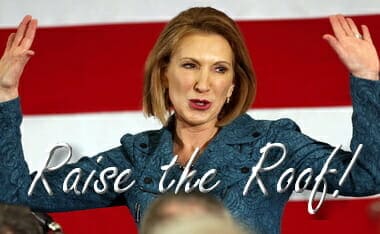
1.Carly Fiorina won. And by “won,” I mean “both debates.” She wasted everyone on stage at the “Happy Hour” kids’ table debate, managed to goad the DNC into creating her very own sexist meme, shut down Chris Matthews, and basically Ronda Rousey’ed the whole night. She punched yesterday in the face. Not a single man in the following debate seemed even remotely capable of delivering her knockout performance, and that’s something to be proud of. With a field of sixteen (eighteen? twenty? eighty?), the initial, Fox News debate — on friendly territory — was essential to solidifying your position among the front runners. Fiorina did that without hesitation. Others, in this case perpetual disappointment Rick Perry,spent the time he should have spent preparing for the debate using his surrogates to manage expectations, and made Bobby Jindal look charismatic by comparison, and Bobby Jindal is the human equivalent of notebook paper.
4.Megyn Kelly asked hardball questions of the prime time debaters, which earned her a spate of terrible Facebook fan page commentary and the honor of being called a “bimbo,” a sentiment which Donald Trump immediately endorsed. Which is convenient for Donald Trump, since he made it through the entire debate without endorsing a single policy, except, perhaps, a national program to relocate Rosie O’Donnell to an inaccessible private island. On that, he is likely to earn widespread support. But while the Donald spent the greatest amount of time yammering, among the candidates, he actually said very little. Except that you should be concerned that he intends to run third party. Which is fine. We always need more candidates to confuse elderly Floridian voters.
6. For the first time in history, observation linked Ted Cruz to Mike Huckabee, which is an intriguing development. Post-debate Luntz polling revealed that those souring on Trump were moving “back” to Cruz and Huckabee, neither of whom made a spectacular showing last night, but definitely share some of Trump’s “anti-establishment” credentials (if there is a such thing). It may turn out that the primary impetus behind Trump’s popularity was simply that neither Cruz or Huckabee had yet hit the trail — certainly Cruz seems to consider Trump his stalking horse — but if neither Cruz nor Huckabee can capitalize on the eventual Trump disengagement, the connections will sink all three. Personally, I see this as no loss. You may differ. In which case, feel free to call me a closeted liberal in the comments section as usual.
9.Marco Rubio “won” the debate itself, which is great for Marco Rubio because it’s high time he’s taken seriously as a candidate. He’s good looking, he’s got a great background story, he’s nuanced on policy and the media already hates him so much they pay for people to scour through hours of footage of Miami Zoning Commission hearings. And now he seems like he could take on the so-called “heavy hitters” he was supposed to be crushed by. Frankly, it would be fun to see him take on Carly in a one-on-one. We’d all be better for it, too.
There are two other videos at Powerline, where the following is from:
Really, this story requires no analysis or set up at all. From the Seattle Times a few hours ago…
Black Lives Matter protesters shut down Bernie Sanders speech
A Seattle speech by Democratic presidential candidate Bernie Sanders was pre-empted in a chaotic confrontation Saturday afternoon with a handful of Black Lives Matter protesters, who took the stage and refused to let him speak.
As the star attraction at a rally for expanding Social Security and Medicare, Sanders was just starting to address the crowd, thanking Seattle for being “one of the most progressive cities in the United States of America.”
That’s as far as he got, as a pair of women walked onstage and grabbed the microphone.
[….]
Actually, some commentary is deserved. That a Democratic political rally would allow “a handful” of demonstrators to shut down and hijack their event shows how deeply liberals have drunk the White Guilt Kool Aid.
[….]
Some presidential material. Once upon a time a candidate might have said, “I’m paying for this microphone you little shits.”
Pass the popcorn indeed. No extra butter necessary.