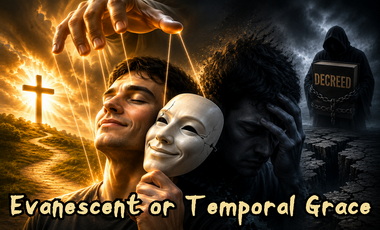
(Updated with some graphics) A definition from that fits Calvinism via the Stanford Encyclopedia of Philosophy and the current understanding of reformed theologies …. “Reformed” theologies:
I hate using “Reformed” because many Reformers (like Philip Melanchthon and Balthasar Hubmaier as some examples) thought differently than the “Pipers,” MacArthur’s,” and “Calvins” of their time and today. So Calvinism is a better term: John MacArthur was a “Calvinist Baptist,” not a “Reformed Baptist.” Understand the difference with a distinction? — RPT
Fatalism is the thesis that human acts occur by necessity and hence are unfree. Theological fatalism is the thesis that infallible foreknowledge of a human act makes the act necessary and hence unfree. If there is a being who knows the entire future infallibly, then no human act is free.
Fatalism seems to be entailed by infallible foreknowledge by the following informal line of reasoning:
For any future act you will perform, if some being infallibly believed in the past that the act would occur, there is nothing you can do now about the fact that he believed what he believed since nobody has any control over past events; nor can you make him mistaken in his belief, given that he is infallible. Therefore, there is nothing you can do now about the fact that he believed in a way that cannot be mistaken that you would do what you will do. But if so, you cannot do otherwise than what he believed you would do. And if you cannot do otherwise, you will not perform the act freely.
The same argument can be applied to any infallibly foreknown act of any human being. If there is a being who infallibly knows everything that will happen in the future, no human being has any control over the future.
This theological fatalist argument creates a dilemma for anyone who thinks it important to maintain both (1) there is a deity who infallibly knows the entire future, and (2) human beings have free will in the strong sense usually called libertarian. But it has also fascinated many who have not shared either of these commitments, because taking the argument’s full measure requires rethinking some of the most fundamental questions in philosophy, especially ones concerning time, truth, and modality. Those philosophers who think there is a way to consistently maintain both (1) and (2) are called compatibilists about infallible foreknowledge and human free will. Compatibilists must either identify a false premise in the argument for theological fatalism or show that the conclusion does not follow from the premises.
Another recent example that came across my desk (earbuds at work). Dr. Theodore Zachariades stating that God wills [causes, not just permits] a man to be unfaithful to his wife in his comment on becoming a Calvinist via Ephesians 1.
God works all things after the Council of His will. Even keeping those kings who want to commit adultery from committing so! And when He wants to, he orders those to commit adultery when he wants to! (Video)
Now that that is out of the way, on to the videos…
I isolated the Piper quote from the video that follows it:
QUESTION: Has God predetermined every tiny detail in the universe, such as dust particles in the air? And then I should add here, including all our besetting sins.
PIPER RESPONDS: Yes, which means yes, every horrible thing and every sinful thing is ultimately governed by God and. That’s a problem, but the center of the solution to the problem is a choice. You have to make about the cross
(BTW, more on Piper can be found in this excellent journal article title (PDF), “I Believe In Divine Sovereignty,” by Thomas H. McCall)
Here are some of the comments on the original SOTERIOLOGY 101 video on their YouTube Channel [below]:
God determines every single thing even dust but you have to make the decision about the cross What????
So Calvinism teaches , “God commands you to obey, but has SECRETLY predestined you to DISOBEY, so He can burn you forever because you were a reprobate ‘before you were born, or had done anything either good or bad’.”
Piper who doesn’t believe in free will choice says “the solution to the problem is a CHOICE you have to make about a cross” 😂😂 how anyone can listen to this incoherent nonsense I’ll never know.
Piper: ” the center of the solution is a choice YOU have to make about the cross”? Does he mean I make a choice? Or God determines what choice I make??
If God is determining what man wants to do then also blinding and hardening doesn’t Jesus refute that reasoning when talking about how a kingdom divided against itself cannot stand? Matt. 12:25,26
Piper didn’t look like he wholeheartedly believed what he was saying.
Dr. Leighton Flowers, Director of Evangelism and Apologetics for Texas Baptists, confronts the Calvinist’s appeal to the Crucifixion as their proof that God predetermines all moral evil, specifically playing off John Piper’s use of Acts 4:27-28 as justification for his deterministic interpretation of the Bible.
…When we object to the concept of divine determinism (God’s sovereign work to bring about all things whatsoever that come to pass) and you appeal to the crucifixion as your proof that God brings about all moral evil, are you saying that God is sovereignly working so as to redeem the very sins He sovereignly worked to bring about? Is Calvary just about God cleaning up His own mess — redeeming His own determinations?
Appealing to God’s sovereign work to ensure the redemption of sin so as to prove that God sovereignly works to bring about all the sin that was redeemed is a self-defeating argument. It would be tantamount to arguing that because a police department set up a sting operation to catch a notorious drug dealer, that the police department is responsible for every single intention and action of all drug dealers at all times. Proof that the police department worked in secretive ways to hide their identities, use evil intentions, and work out the circumstances in such a way that the drug dealer would do what they wanted him to do (sell drugs) at that particular moment in time does not suggest that the police are in anyway responsible for all that drug dealer has done or ever will do. We celebrate and reward the actions of this police department because they are working to stop the drug activity, not because they are secretly causing all of it so as to stop some of it. Teaching that God brings about all sin based on how He brought about Calvary is like teaching that the police officer brings about every drug deal based on how he brought about one sting operation.
Yes, at times the scriptures do speak of God “hardening” men’s hearts (Ex. 7; Rm. 9), blinding them with a “spirit of stupor” (Rm. 11:8) and delaying their healing by use of parabolic language (Mk. 4:11-12, 34; Matt. 16:20), and He always does so for a redemptive good. But the reason such passages stand out so distinctly from the rest of scripture is because of their uniqueness. If God worked this way in every instance these texts would make no sense. After all, what is there for God to harden, provoke, or restrain if not the autonomous will of creatures?
If everything is under the meticulous control of God’s sovereign work what is left to permit and/or restrain except that which He is already controlling? Is God merely restraining something that He previously determined? Why blind eyes from seeing something the were “naturally” predetermined not to see? Why put a parabolic blind fold on a corpse-like dead sinner incapable of seeing spiritual truth? These are questions many Calvinists seem unwilling to entertain at any depth.
FULL PIPER TRANSCRIPT:
Q:Has God predetermined every tiny detail in the universe, such as dust particles in the air and all of our besetting sins?
A.Yes.
There’s a great quote from Spurgeon about dust motes. You may not even know what a dust mote is, but when I get up in the morning in my room, there’s a window to the side of the bed, and a beam of light will be shining through it at certain times of the year when I get it.
Now when I look through the dark I see nothing. But when I look through the beam I see the dust in the room. It’s flying around, and I say, “I’m breathing that stuff!?” Yes, you are. And Spurgeon says that every one of those particles is keeping its position and moving through the air by God’s appointment.
Now the reason I believe that is because the Bible says, “The dice are thrown in the lap, and every decision is from the Lord” (Proverbs 16:33). Proverbs 16 has a bunch of these verses in it.
Why would he choose “the die is cast into the lap”? It’s because he’s trying to think of the most random thing he could think of. And he says that. So randomness is not random to God.
God is not the least taxed by keeping every sub-nuclear particle in its place. I used to say electrons, but now there’s something smaller than electrons. Everything in the middle of the molecule moving, and the electrons—he’s got them all in orbit, just like he has the planets in orbit.
So the macro-world and micro-world are all managed by God. Which means, Yes, every horrible thing and every sinful thing is ultimately governed by God.
That’s a problem, but the center of the solution is a choice you have to make about the cross. This is what has centered me, anyway: When you go to Acts 4:27-28 and you read that Herod and Pontius Pilate and the Gentiles and the Jews were all gathered together to do what God’s hand and God’s plan had predestined to take place in the killing of Jesus, you have God’s plan and hand predestining the most horrible sins ever committed.
Pilate’s choices, the soldiers’ cruel mockery, the piercing of his side, the cries, “Crucify him! Crucify him!”—these few hours in history were the climax of the worst wickedness that has ever been performed on the planet or ever will be. And God planned it so that we might be saved from those sins.
In other words, what the devil did in unleashing all of that was commit suicide. And I pray that when you contemplate believing in a sovereign God who governs the dust motes, the waves (including tsunamis)—when you contemplate believing in a totally sovereign God, I pray that you will center it right on the cross. Because you’ll go crazy otherwise. You will!
These things have driven people mad. But it won’t drive you mad if you say, “He loves me. And he governed the most wicked thing that ever happened in the world, the crucifixion of my Savior and my God.” If you stay right there and then just work out from there as far as your mind can handle, then you’ll be safe. Your mind will be safe and your heart will be safe, because you’ll be kept humble.
People get very arrogant with these kinds of doctrines. They can use them to club people. But if you stay with the cross, you won’t.
Just one more thing on this. This is right off my front burner, because a lot of us at Bethlehem are reading through Acts. We just read in chapter 2 where Peter said in the sermon to the people who had killed Jesus, “You acted in ignorance”—he didn’t forgive them for that; he said they have to repent—”You acted in ignorance, but God fulfilled what he had promised by the prophets, that the Christ must suffer.” What that said to me, again, was that these people didn’t know what they were doing, but God knew what he was doing.
So the crucifixion of his Son was, quoting Isaiah 53:10, the bruising by the Father of the Son. Therefore the worst sin that was ever committed was ordained by God. And the answer is yes. He controls everything, and he does it for his glory and our good.
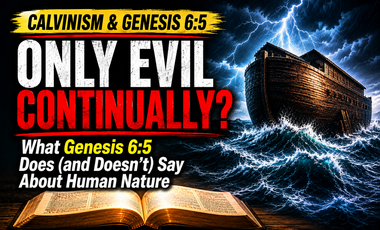
This will be a short post. I came across a graphic that I figured I would correct… I will pop a short video between the original and my fix:
… Problem with the Calvinistic Understanding of Genesis 6:5 and Genesis 8:21
First, the texts are not statements about the sinful condition of all people throughout time, but are specifically about the people who lived at the time of the flood.
Second, the statements in these verses are not saying that men are inherently wicked in everything they do, but that the people at that time became wicked in everything they did. This is seen in part to the mysterious pairing of the sons of God and the daughters of men in Genesis 6:1-4, but also to the fact that when the evil intentions of mankind is described, it is their violent actions that are specifically mentioned (Genesis 6:11-13).
The truth that humanity became evil is further supported by the Hebrew word for “intent” (Heb. yetzer) in Genesis 6:5 and “imagination” in Genesis 8:21 is the same word used in Genesis 2:7, 19 to describe how God “formed” man from the dust of the ground. The point is that just as God formed man to be good, now man is “forming” his thoughts and his actions to be only evil. Humanity was not evil inherently, but was forming himself to be evil continually.
Furthermore, if Genesis 6:5 meant that mankind had always been evil continually (since the fall of Adam and Eve), there would be no explanation for why God was only now upset at their evil, and was only now acting to stop the spread of violence upon the earth (Genesis 6:6-7).
If mankind had always been this way, God’s sorrow at the state of mankind and His decision to allow the flood waters to cover the earth make no sense. If mankind had always been this evil, then God should have always felt this way….
This has been updated (7/24/2026)
This is the thumbnail in my “slider” for the curious
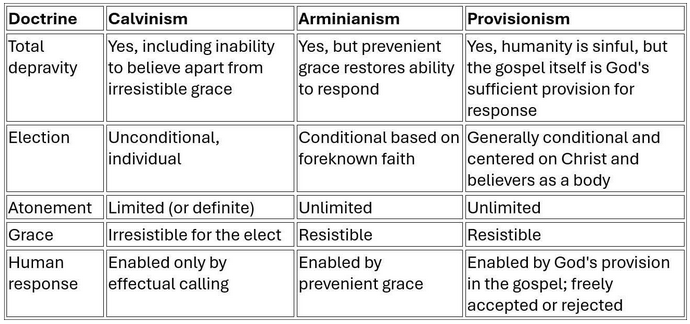
This first graph is what got me thinking about this update, and I will fix what I see is wrong with it in a bit:
One of the most common misconceptions about Provisionism—and one of the reasons I’ve updated this post—is the assumption that Provisionists believe the Gospel alone functions as the only means by which God graciously enables people to respond to Him. While the Gospel is God’s supreme and saving revelation, Provisionism has always affirmed that God graciously reveals Himself and calls humanity through multiple means, including creation, conscience, providence, the convicting work of the Holy Spirit, Scripture, and ultimately the proclamation of the Gospel.
The disagreement with Calvinism and Arminianism is not whether God enables, but what Scripture teaches about the nature of that enabling and whether mankind is born with an inherited inability that requires a special grace before one can respond in faith.
The issue is that the above column subtly reduce Provisionism’s doctrine of grace to “the Gospel alone” as though the Gospel were merely information that unaided sinners evaluate. That’s not how Leighton Flowers or most thoughtful Provisionists describe it.
Provisionism doesn’t deny that God enables; it denies that He gives a special, universally distributed prevenient grace that restores a lost faculty of faith. Instead, God has provided a multitude of gracious means by which He reveals Himself and calls sinners.
For example, God’s gracious revelation includes:
Creation (Romans 1:18–20)
Conscience (Romans 2:14–15)
Providence and God’s kindness (Acts 14:17; Romans 2:4)
The convicting ministry of the Holy Spirit (John 16:8–11)
The inspired Word of God (2 Timothy 3:15; Hebrews 4:12)
The preaching of the Gospel (Romans 10:14–17)
The testimony of believers (2 Corinthians 5:20)
God’s patient appeals throughout history (Acts 17:26–31)
The Gospel is the climax of God’s provision, not the entirety of it.
Provisionists argue that God has graciously provided everything necessary for people to respond to Him through His self-revelation in creation, conscience, providence, the convicting ministry of the Holy Spirit, the inspired Scriptures, and especially the proclamation of the Gospel. Rather than a universal prevenient grace restoring an innate inability, Provisionists see these God-ordained means as sufficient to render every person genuinely accountable before Him.
Soteriology 101 is right when they emphasizes the Gospel because Romans 10 and the Great Commission are about how people come to saving faith:
Article Two says:
“We deny that any sinner is saved apart from a free response to the Holy Spirit’s drawing through the Gospel.”
Article Four says:
“…providing atonement, in freely offering the Gospel in the power of the Holy Spirit…“
Article Eight says:
“…accepting or rejecting God’s gracious call to salvation by the Holy Spirit through the Gospel.”
Article Ten says:
“…the proclamation of the Gospel is God’s means of bringing any person to salvation.”
Amen!
I am angling a slightly different question that Soto 101’s Statement of Faith, which simply asks [even if unsaid]: “How does God save people?”
What I am saying retroactively applies to times prior to Calvary and the Gospel and the spread of it across the world, as well as to those who have not heard the Gospel presented. This is RPT’s question:
How has God graciously revealed Himself throughout history so that every person is morally accountable before Him while also providing His saving revelation according to His redemptive plan?
Those are not identical questions. Romans 1 and Romans 2 aren’t explaining how someone is regenerated. They’re explaining why everyone is “without excuse.”
This covers:
Adam through Noah.
Abraham and the patriarchs.
Israel under the Law.
Native Americans before European contact.
Modern unreached people groups.
Those of us who have heard the Gospel.
Your Native American article raises precisely the kind of question that illustrates this continuity: What about those who lived centuries before the Gospel reached the Americas? The New Testament doesn’t give a detailed answer about every case, but it consistently affirms two truths:
God has never left Himself without witness (creation, conscience, providence, etc.). Acts 14:17 is especially explicit: “Yet He did not leave Himself without witness…” Romans 1–2 makes the same point regarding accountability.
The Gospel is God’s appointed means of proclaiming salvation under the New Covenant (Romans 10), while salvation itself has always been through Christ, even for those who lived before His incarnation (Hebrews 11).
What About Those Who’ve Never Heard the Gospel? (Be Thinking)
Are Those Who Have Not Heard the Gospel Damned? RPT Q&A +More (RPT)
Provisionism’s doctrine of divine provision is not limited to the post-Pentecost proclamation of the Gospel. Throughout redemptive history, God has graciously revealed Himself through creation, conscience, providence, and His promises, rendering humanity accountable while progressively revealing His plan of redemption. Though salvation has always been through Christ alone, the Gospel is God’s appointed means of bringing people to saving faith under the New Covenant.
My Re-Write:
Provisionists affirm that the Holy Spirit draws sinners through the Gospel unto salvation. At the same time, Provisionism recognizes that God has never left Himself without witness. Through creation (Rom. 1:18–20), conscience (Rom. 2:14–15), providence (Acts 14:17; 17:24–31), the convicting ministry of the Holy Spirit (John 16:8–11), and ultimately the proclamation of the Gospel, God graciously reveals Himself, rendering every person without excuse and genuinely responsible for his or her response to His revelation. Saving faith comes through the Gospel (Rom. 10:17), but God’s gracious self-revelation is broader than the Gospel alone.
This is how I describe it on my X ARTICLE to bolster the idea:
Throughout history, God has graciously revealed Himself in many ways, including:
Creation
Conscience
Providence
Covenants
The Prophets
The convicting work of the Holy Spirit
The incarnation of Christ
The proclamation of the gospel
These expressions of God’s self-revelation are not rigid stages through which every person passes in the same sequence. Rather, they represent the many ways God has made Himself known throughout redemptive history, often overlapping in a person’s life and always finding their fullest expression in the person and work of Jesus Christ. At Calvary, God’s self-revelation reached its clearest expression, where His holiness, justice, love, and grace were displayed in the sacrificial death and victorious resurrection of His Son.
Physicist Michael Guillen’s testimony illustrates this beautifully. As a committed atheist, it was not one isolated event that brought him to Christ. Rather, his understanding was gradually shaped by the wonder of creation, the limits of scientific materialism, his search through competing worldviews, meaningful relationships, and ultimately the witness of Scripture.
His journey reminds us that God often draws people through many converging streams of revelation, each pointing beyond itself until they find their fulfillment in Jesus Christ.
(I just want to give a shout out to Provisionist Perspective for encouraging me to do an X version of my post)
Within the Non-Calvinist camp, there are at least two nuanced views on how God allows sinners to respond in faith. The first view is the Arminian view — which says that God’s work of grace (prevenient grace) for all people is needed to enable any sinner to freely choose to respond in faith to the Gospel message. The second view is the Provisionist View — which says that the Gospel message itself [see more below] is God’s work of grace so that when it is preached to all people, any sinner can freely choose to respond in faith. The proclamation of the Gospel is powerfully sufficient enough to bring salvation to those who will believe. While the Arminian and the Provisionist each have a different take on why all humans can respond to God’s offer, these two views both affirm the importance of God’s initiative of grace to invite all sinners to salvation. (from the book Grace For All: Understanding God’s Plan of Salvation).
— Michael R. Cariño
The “More Below”
Grace Enablements
Includes but are not limited to: God’s salvific love for all (John 3:16), God’s manifestation of his power so that all may know he is the Sovereign (Isa 45:21–22) and Creator (Rom 1:18–20), which assures that everyone has opportunity to know about him. Christ paying for all sins (John 1:29), conviction of the Holy Spirit (John 16:7–11), working of the Holy Spirit (Heb 6:1–6), enlightening of the Son (John 1:9), God’s teaching (John 6:45), God opening minds and hearts (Luke 24:45; Acts 16:14; 26:17–18;), and the power of the Gospel (Rom 1:16), without such redemptive grace, no one seeks or comes to God (Rom 3:11).
Because of these gracious provisions and workings of God, man can choose to seek and find God (Jer 29:13; Acts 17:11–12). Moreover, no one can come to God without God calling (Acts 2:39), drawing (John 6:44), and that God is drawing all individuals (John 12:32). The same Greek word for draw, helkuō, is used in both verses. “About 115 passages condition salvation on believing alone, and about 35 simply on faith.” Other grace enablements may include providential workings in and through other people, situations, and timing or circumstances that are a part of grace to provide an opportunity for every individual to choose to follow Christ.
These are grace enablements in at least three ways; first, they are provided by God’s grace rather than deserved by mankind; second, the necessary components for each and every individual to have a genuine opportunity to believe unto salvation are provided or restored by God; third, they are provided by God without respect to whether the individual will believe or reject, which response God knew in eternity past.
The offer of the Gospel is unconditional, but God sovereignly determined to condition the reception of the offer upon grace-enabled faith; therefore, faith is not reflective of a work or virtue of man, but of God’s sovereign plan of salvation by grace through faith (Eph 2:8). This indicates faith is the means to being regenerated and saved, not the reason for being saved. This truth of Scripture does not imply God is held captive to the choice of man, but rather it demonstrates God in eternity coextensively determined to create man with otherwise choice and provide a genuine offer of salvation, which can be accepted by grace-enabled faith or rejected. Additionally, to fulfill this plan, God is not obligated to disseminate the Gospel to people he knows have rejected the light he has given them (Rom 1:18–23) and will also reject the Gospel; although he may still send the Gospel to them.
Therefore, they are condemned because they never heard it.
Provisionism does not begin by asking, “What happens to those who never hear the Gospel?”
It first asks, “Has God graciously revealed Himself sufficiently to every person to hold them morally accountable?”
Scripture repeatedly answers that He has. From creation and conscience to providence and the convicting work of the Holy Spirit, God has never left Himself without witness (Acts 14:17). The Gospel is God’s appointed means of proclaiming salvation through Christ, but His gracious self-revelation has never been limited to the Gospel era or to places where missionaries have already arrived.
NAMB says:
“people who never have an opportunity to hear the Gospel stand condemned.”
To which I ask: Are they condemned because they never heard the Gospel?
As far as the Scripture is concerned, it is very clear that faith and believing come first and the new birth follows. The Scripture is replete, lucid, and compelling in teaching that the order is faith prior to regeneration, and faith is a gift that God endowed man with in creation not in selective regeneration; moreover, God is working in order to give men and women a real chance to trust Him unto salvation (John 16:8). Salvation is offered as a free gift (Romans 6:23) to all who are in need of forgiveness (Romans 5:15, 18), and people are summoned to act upon the offer by accepting the gift by—grace-enabled—faith (John 1:12). “Never does the Bible say, ‘Be saved in order to believe; instead, repeatedly, it commands, ‘Believe in order to be saved.’” (GEISLER)
If God has decided in eternity past which individuals he will not save, then those individuals cannot be thought of either as being truly loved by God or as being the objects of his saving intentions. Calvinists protest that it is simply a mystery as to how God loves people he wills to condemn before they are ever born. Some assert that God has two wills, one “hidden” and one “revealed,”108 or two kinds of love,109 but most Southern Baptists view these answers as having neither a biblical nor logical basis. Moreover, Calvinists’ affirmation of “single predestination” over against “double predestination” as a method for absolving God of the charge of actively causing the lost to spend eternity in hell is unconvincing. To say that God merely passes over the lost rather than actively causing their perdition is both a distinction without a difference110 and a flat refusal to own the implications of the Calvinist system.111
110. If I have the ability and opportunity to rescue someone who is drowning, then I have an obligation to render aid. If I simply stand aside and let them die, then I am morally culpable. Calvinist objections that the sinner is already dead will not suffice. If I have the ability and opportunity to regenerate a spiritually dead person but do not, then my culpability is the same.
111. Keathley, Salvation and Sovereignty, 148–49.
This statement by MacArthur is “anti-Gospel.”
It negates the power of the Word.
In the end this is what MacArthur is saying if you take into account his Calvinism:
God by means of divine decree determines all peoples decisions/actions
Potter by means of molding determines all pots decisions,actions,shapes, etc…
Programmer by means of preprogramming determines the Avatars/Robots decisions and actions
Puppeteer by means of strings determines all the puppets movements, actions, decisions
Author by means of writing a story determines all characters decisions, actions
This life in Calvinism has everything completely and fully scripted with every thought, action, deed. Welcome to the world of the avatar. The world of make belief – sounds much like the world of Walt Disney.
The “gospel” according to Calvinists is akin to a “cosmic lottery” then.
In a post detailing misreading’s of Scripture, I end with this:
TO SUMMARIZE:
If the “T” is correct, there is no rebellion against God’s will. Add the “U” and the “I,” the Gospel is rendered meaningless. It is sad, but it is a logical outgrowth of those. The Word of God, the Gospel message sent to a dying and sick world is secondary, Calvary becomes moot. Your hope can only be in if you won the cosmic lottery.
So when the unbeliever stands before God and Romans 1:19-20 is in the thought of our Holy God, when the words come out of said unbelievers mouth,
“I could not believe in your salvific offer because of my nature which you ensured. I suspect you won’t torture a cow [cows are biologically designed to eat grass] for eternity because your command was to eat meat, but ensured their nature was vegetarian.
What should God’s response be?
Are We PRE-PROGRAMMED To Reject The Gospel? Dr. Leighton Flowers | John MacArthur | Calvinism
Dr. Leighton Flowers, Director of Evangelism and Apologetics for Texas Baptists, responds to John MacArthur on whether we are pre-programmed to reject the Gospel or not. Check out the full video here:
Not only does this “pre-programming” dilute Scripture and it’s clear teaching, but it dilutes truth as well!
Preprogrammed definition: (of instructions or data) programmed into an electronic device to control future action. “the drones are designed to follow a preprogrammed route at the push of a button” (Berean Apologetics)
(Adapted from another comment) This is why Christians need to put on the whole armor of God to protect us against becoming infected By malware. We need to put on the Girdle of Truth! May we stand firm in the truth of Your Word so we will not be a victim of Satan’s lies.
RONNIE ROGERS completes the idea simply with the two views compared:
Compatibilism Determinism and moral responsibility are compatible; hence, the name. This compatibility is not achieved by compatibilism being less deterministic than hard determinism. Rather, it is achieved by defining free choice to mean as long as a person chooses according to his greatest desire, he can be considered to have made a free choice for which he is morally responsible; even though given the same past, he cannot choose differently in the moral moment of decision.
Consequently, the difference between compatibilism (soft determinism) and hard determinism is not to be found in the levels of the deterministic nature of each because they are the same. Rather, the difference is compatibilism contends people are morally responsible for their choices if they are made according to their greatest desire, and hard determinism says they are not.
Therefore, moral responsibility is the product of defining free choice as a person acting in accordance with his greatest desire even though the desire is determined. I frequently find Calvinists who affirm soft determinism and disavow hard determinism because they think soft determinism is not as unflinchingly deterministic as hard determinism. That kind of thinking is based upon a misunderstanding of compatibilism.
Libertarianism Man is not determined. He has the actual ability to choose between accessible options, at least in some scenarios. Libertarians contend determinism is not compatible with moral responsibility. Man possesses actual otherwise choice and can, therefore, act or refrain in the moral moment of decision even with the same past within a given range of options. Extensivism contends God endowed man with this ability, which is an aspect of being created in the image of God. [2] God determines the range of options. Adam’s range of options before the fall was greater than humanity’s options after the fall. The range of options available before the fall was the result of creative grace.
Fallen man can still choose between options. He did not lose his libertarian moral freedom, but the range of options is less than man had before the fall. Since the fall, man has lost the ability to make choices that are inherently righteous or spiritually restorative (making one right with God) based solely on creative grace. To make an inherently righteous or spiritually restorative choice, God had to provision redemptive grace, grace enablements.
For compatibilism to be the biblically reflective approach to understanding Scripture (what the Bible actually portrays and teaches), Calvinists would have to explain why the Bible, from Genesis 2 through Revelation 22, is absolutely permeated with verses, events, challenges, commands, offers, and judgments that clearly reflect that people have libertarian free will. That is to say; they can choose to act one way or differently in a myriad of passages (Gen 2:17-3:24; Josh 24; Jer 32; Mark 10:17-31; Rev 22:17-21).
Libertarian freedom allows for both determined events (events uninfluenced by human choice) and undetermined events (events influenced or caused by human choice) in which people choose between options. And whatever they did choose, they could have chosen differently even with the same past.
Compatibilism, Calvinism, requires that everything is determined, and if there is even one verse (I believe there are hundreds if not thousands that do so) that demonstrates the person had the freedom to choose differently than he chose, in the moral moment of decision, Calvinism and compatibilism collapse into an unbiblical perspective.
Consequently, unless a person can demonstrate the Bible teaches only micro-determinism (every verse that speaks of choosing reflects only a predetermined choosing wherein the appearance of having the freedom to choose differently is an illusion), he should totally and quickly disavow Calvinism. If a person chooses to remain a Calvinist, he is integrity bound to speak consistently with the micro-determinism of his position. In my book, Does God Love All or Some? I demonstrate that Calvinism’s view of moral freedom is absolutely in conflict with the teaching of Scripture when we consider all the Scripture.
What makes the micro-determinism in Calvinism, compatibilism, so difficult to detect is that Calvinists often interpret, talk, and teach the Scripture libertarianly. Meaning, they do so as though there is an undetermined choice involved, i.e., man can choose among the options available in the passage, and whatever he does choose, he could have chosen differently. Now, while that is true to the Scripture, it is in absolute contradiction to compatibilism, Calvinism.
Therefore, if a Calvinist is not going to live, speak, teach, interpret Scripture, and pray in a way that is consistent with micro-determinism so that both the Calvinist and the one whom he engages understands his deterministic perspective, he should disavow Calvinism.
(Emphasis added)
And that is the bottom line. If you adopt the Calvinist “TULIP,” you jettison truth. Truth in Scripture, truth in God, truth in reality, and truth in reason.
I believe I do understand Calvinism very well and that is why I argue that it cannot be put into the service of evangelism because there is no “good news” in the Calvinist soteriological doctrines. As such, Calvinism is not “evangelical,” which means “to bring good news.” When Calvinist’s do evangelism that have to abandon their soteriology and preach a non-Calvinist version of the gospel which is truly “good news,” but inconsistent with their Calvinist “doctrines of grace.” I argue against Calvinism because ultimately the truth of the gospel is at stake. (Source)
A man has just entered heaven and is being given a guided tour by St. Peter. As they walk past a certain group of people, Peter tells him to be extra-quiet and not to disturb them. The man asks why and Peter replies, “They’re the Calvinists. They think they are the only ones here!”
A Calvinist is about to enter heaven. There are two lines, one labelled “Chosen” and the other “Free will”. He decides that the “Chosen” line is the one for him and lines up. When his turn comes, he is asked why he joined that line. He replies that he chose to join it.
“No!” he is told. “This is only for those who do not choose. You have to go to the other line. It’s the one for those who choose.”
So he lines up at the “Free will” line. When he gets to the official at the head of the line, he is asked, “Why did you join this line?”
He replies, “Because I was told to join it.”
“Then,” replies the official, “You’re in the wrong line. This is only for those who choose to join it.”
I sent a friend the video of Dr. Theodore Zachariades stating that God wills [causes, not just permits] a man to be unfaithful to his wife.
God works all things after the Council of His will. Even keeping those kings who want to commit adultery from committing so! And when He wants to, he orders those to commit adultery when he wants to! (Video)
My friend dismissed this person as a hyper-Calvinist. But as the video below notes, using his definition of a “hyper Calvinist,” A.W. Pink, John Piper, Jeff Durbin, James White, and many-many more, would thus be considered the same. Because of the age restriction, the video must be watch on YouTube, link in pic.
When I asked him: “Question RW, is Piper, Calvin, White and Durbin hyper-Calvinists?” He simply replied “Fishing Bait.” But this is an interesting phenomena… and after decades of encountering Mormons and J-Dubs, the disconnect is the same. I get links and not actualizing on statements made when challenged. When shown a person who follows to the end the logical conclusion of theistic determinism found in Calvinism, the person who is the Calvinist is dismissed as a “hyper-Calvinist” by their fellow Calvinist’s if they are challenged. When that label is then applied rightly to others for the same reason — meaning, using RW’s definition of what a hyper-Calvinist is — then all these others have said worse; and would be by definition, hyper-Calvinists.
Two quick examples. 1st John Calvin, then, John Piper:
John CALVIN:
… how foolish and frail is the support of divine justice afforded by the suggestion that evils come to be, not by His will but by His permission. . . . It is a quite frivolous refuge to say that God otiosely permits them, when Scripture shows Him not only willing, but the author of them. . . . Who does not tremble at these judgments with which God works in the hearts of even the wicked whatever He will, rewarding them nonetheless according to desert? Again it is quite clear from the evidence of Scripture that God works in the hearts of men to incline their wills just as he will, whether to good for His mercy’s sake, or to evil according to their merits.
John Calvin, “The Eternal Predestination of God,” 10:11
John Piper:
Ephesians 1:11 goes even further by declaring that God in Christ
“works all things according to the counsel of his will.” Here the Greek word for “works” is energeø, which indicates that God not merely carries all of the universe’s objects and events to their appointed ends but that he actually brings about all things in accordance with his will. In other words, it isn’t just that God manages to turn the evil aspects of our world to good for those who love him; it is rather that he himself brings about these evil aspects for his glory (see Ex. 9:13-16; John 9:3) and his people’s good (see Heb. 12:3-11; James 1:2-4). This includes—as incredible and as unacceptable as it may currently seem—God’s having even brought about the Nazis’ brutality at Birkenau and Auschwitz as well as the terrible killings of Dennis Rader and even the sexual abuse of a young child: “The LORD has made everything for its own purpose, even the wicked for the day of evil” (Prov. 16:4, NASB ).14 “When times are good, be happy; but when times are bad, consider: God has made the one as well as the other” (Eccl. 7:14, NIV).
John Piper and Justin Taylor, eds., Suffering and the Sovereignty of God (Wheaton, IL: Crossway Books, 2006), 42. (FULLER QUOTE VIA THIS PDF)
Martin Luther at the time of the Reformation. In his book The Bondage of the Will, written in response to Erasmus’ essay On Free Will, Luther said:
[The] omnipotence and foreknowledge of God, I repeat, utterly destroy the doctrine of “free-will”… Doubtless it gives the greatest possible offence to common sense or natural reason, that God, Who is proclaimed as being full of mercy and goodness, and so on, should of His own mere will abandon, harden and damn men, as though He delighted in the sins and great eternal torments of such poor wretches. It seems an iniquitous, cruel, intolerable thought to think of God; and it is this that has been such a stumbling block to so many great men down through the ages. And who would not stumble at it? I have stumbled at it myself more than once, down to the deepest pit of despair, so that I wished I had never been made a man. (That was before I knew how health-giving that despair was, and how close to grace.)
In this passage Luther seems to be aware that there is a deep moral problem with aspects of his view… [RPT:before redefining “grace” that is – almost like what is, is.]
In a reference in that above book is this paper: “I Believe In Divine Sovereignty,” by Thomas H. McCall in Trinity Journal (TRINJ 29:2 [Fall 2008]), 209-210. Of which I excerpt:
… He [John Piper] works long and hard to illustrate this [theistic determinism] from Rom 9:1-23, which he concludes is about the purposes of God being preserved “by means of the predestination of individuals to their respective eternal destines.”11 And we are not to think that God is righteous in spite of such action—instead we are to see that God is righteous because of this action, for the “heart of Paul’s defense” is this: “in choosing unconditionally those on whom he will have mercy and those whom he will harden God is not unrighteous, for in this ‘electing purpose’ he is acting out of a full allegiance to his name and esteem of his glory.”12
This all-determining action of God notably includes predestination and election, but it extends far beyond—it extends to everything. God determines all events that occur in the universe, including all demonic and satanic action.13 As Mark R. Talbot puts it, God creates, sends, instigates, and moves others to do evil, because “nothing that exists or occurs falls outside God’s ordaining will.”14 Talbot makes the point with relentless and unmistakable clarity:
Nothing, including no evil person or thing or event or deed. God’s foreordination is the ultimate reason why everything comes about, including the existence of all evil persons and things and the occurrence of any evil acts or events.15
Make no mistake: “when even the worst of evils befall us, they do not ultimately come from anywhere other than God’s hand.”16 …
NOTES:
11.John Piper, The Justification of God: An Exegetical and Theological Study of Romans 9:1-23 (Grand Rapids: Baker, 1993), 218, cf. 56-73.
12. Ibid., 219.
13.On this see John Piper, “Suffering and the Sovereignty of God: Ten Aspects of God’s Sovereignty Over Satan and Satan’s Hand in It,” in Suffering and the Sovereignty of God, 19-30. Piper here uses the rather confusing (given his determinism) language of “permission.” By my lights, what he means when he says that God “permits” something is this (a) God determines it to occur and then (b) does not act so as to override his previous ordination. Regarding talk of “permission,” I think that John Calvin’s approach is more consistent, [….] see John Calvin, Institutes of the Christian Religion I.xviii.1, and John S. Feinberg, No One Like Him: The Doctrine of God (Wheaton: Crossway, 2001), 696.
14. Mark R. Talbot, “‘All the Good That Is Ours in Christ: Seeing God’s Gracious Hand in the Hurts Others Do to Us,” in Suffering and the Sovereignty of God, 43 (41-43), emphasis original.
15.Ibid., 43-44.
16. lbid., 47.
Dave Hunt is right to say that Calvin uses unbiblical positions in dealing with this Augustinian determinism:
There is yet another question that troubles many: If man is free to choose between options, would that not in itself deny both God’s sovereigntyand His foreknowledge? Luther claimed that this question was the very heart of the Reformation and of the gospel itself. In fact, Luther dogmatically insisted that it was impossible for God to foreknow the future and for man at the same time to be a free agent to act as he wills.
Believing firmly in God’s foreknowledge, Luther wrote an entire book titled The Bondage of the Will, to prove that the very idea of man’s free will is a fallacy and an illusion. Several reasons have already been given as to why Luther was wrong on this point, and that issue will be dealt with further in the next chapter.
Though Calvin took so much from Augustine, like Luther he also rejected the Augustinian belief that God could foreknow the future, while at the same time man could have a free will. According to Calvin, foreknowledge leaves no room whatsoever for free will, because foreknowledge is the same as predestination:
If God merely foresaw human events, and did not also arrange and dispose of them at his pleasure, there might be room for agitating the question [of free will] … but since he foresees the things which are to happen, simply because he has decreed them, they are so to happen, it is vain to debate about prescience. …
If this frigid fiction [of free will] is received, where will be the omnipotence of God, by which, according to his secret counsel on which everything depends, he rules over all? (Calvin, Institutes, III: xxiii, 6–7.)
Calvin repeatedly uses such unbiblical and utterly fallacious reasoning.
The Calvinist assumes a contradiction between sovereignty and free will that doesn’t exist. The fact that God is able to allow man freedom of choice, while still effecting His purposes unhindered, is all the more glorifying to His sovereign wisdom, power, and foreknowledge.
In order to understand this better theologians have come up with the term “compatibilism” to describe the concurrence of God’s sovereignty and man’s responsibility. Compatibilism is a form of determinism and it should be noted that this position is no less deterministic than hard determinism. — John Hendryx (John Hendryx is the creator and editor of Monergism.com | SEE: “We are not Determinists!” for more)
Here is A.W. Tozer’s take of the above:
Here is my view: God sovereignlydecreed that man should be free to exercise moral choice, and man from the beginning has fulfilled that decree by making his choice between good and evil. When he chooses to do evil, he does not thereby countervail the sovereign will of God but fulfills it, inasmuch as the eternal decree decided not which choice the man should make but that he should be free to make it. If in His absolute freedom God has willed to give man limited freedom, who is there to stay His hand or say, What doest thou? Mans will is free because God is sovereign. A God less than sovereign could not bestow moral freedom upon His creatures. He would be afraid to do so.
One of the single strongest philosophical critiques of exhaustive Calvinistic determinism is that it isn’t merely, “God ordaining evil.” That’s been debated for centuries. It’s that once every thought, desire, temptation, deception, warning, and response is exhaustively decreed, enormous portions of Scripture become functionally redundant.
Glen Shellrude makes this point from dozens of New Testament angles—not just Satan, but exhortations, warnings, prayer, false teaching, perseverance, church discipline, evangelism, and moral responsibility.
The Redundancy Problem in Exhaustive Calvinistic Determinism
The Redundancy Argument (TRA)
Theological determinism, as commonly defined within Reformed theology, is the belief that God unconditionally decreed every event in history. The Stanford Encyclopedia of Philosophy summarizes the position as the view that God determines every event that occurs in the history of the world, whether described as His decree, providential control, or efficacious will. Under this understanding, nothing—including every human decision, temptation, belief, unbelief, deception, repentance, or act of faith—could ever occur differently than God eternally ordained.
This creates what may be called the Redundancy Problem. If mankind is already born morally incapable of responding positively to God’s revelation apart from irresistible grace, then many of Scripture’s mechanisms for explaining unbelief become strangely unnecessary. Why does Satan need to blind minds already born incapable of seeing? Why would God judicially harden people who are supposedly already hardened by nature? Why speak in parables to conceal truth from those who could never understand it anyway? Why send strong delusion upon people who were already unable to believe? These biblical actions make perfect sense as judicial acts against previously resistible rebels, but they appear redundant if Total Inability already guarantees the identical outcome.
The redundancy extends far beyond Satan. Throughout the New Testament believers are warned against false teachers, exhorted to persevere, commanded to resist temptation, urged to pray, rebuked for sin, corrected for doctrinal error, and called to repentance. Yet under exhaustive theological determinism, God not only ordains every warning but also ordains every false doctrine, every deception, every act of apostasy, every sinful choice, and every response to those warnings. As Glen Shellrude observes, if theological determinism is consistently applied, God choreographs both the rise of heresy and the degree to which believers either resist or embrace it. Likewise, God ordains every act of obedience and every act of disobedience, every success and every failure, rendering many of Scripture’s exhortations and warnings functionally descriptive of God’s decree rather than genuine appeals capable of being either accepted or rejected.
The issue is not merely philosophical—it is exegetical. Scripture repeatedly portrays Satan as actively blinding unbelievers (2 Corinthians 4:4), false teachers as genuinely deceiving the church, and believers as capable of resisting deception through faithful perseverance. Those realities fit naturally within a framework in which people are accountable moral agents who may either receive or suppress God’s revelation. However, if every thought, temptation, deception, rejection, and response has already been immutably determined by divine decree, then Satan’s blinding activity, warnings against apostasy, calls to repentance, and commands to resist error appear to accomplish nothing that had not already been guaranteed from eternity. In that sense, Satan becomes less a genuine adversary than an unnecessary middleman carrying out a script whose outcome could never have been otherwise.
The result is that Scripture’s repeated appeals to “hear,” “repent,” “believe,” “beware,” “stand firm,” “do not be deceived,” and “choose” lose much of their ordinary force. The biblical narrative consistently presents these as meaningful appeals directed toward responsible hearers, whereas exhaustive theological determinism necessarily understands them as elements within an already settled decree. The irony is striking: the very worldview intended to magnify God’s sovereignty can unintentionally render many of Scripture’s warnings, explanations, and even Satan’s own ministry logically redundant.
The Redundancy Argument Against Exhaustive Theological Determinism
P1
If every human thought, desire, temptation, deception, belief, and response is exhaustively determined by God’s eternal decree, then no secondary means can alter or further secure the predetermined outcome.
P2
Scripture presents secondary means—Satan’s blinding, judicial hardening, parables concealing truth, warnings against apostasy, false teachers, exhortations, rebukes, and calls to repentance—as genuine means affecting people’s responses.
P3
If those responses are already exhaustively determined and cannot occur otherwise, these secondary means do not function to change or secure any outcome that was not already guaranteed.
Conclusion
Therefore, under exhaustive theological determinism, many of Scripture’s stated means—including Satan’s blinding ministry—become functionally redundant.
Satan is Exhibit A in a much larger pattern. The same logic applies to:
Satan blinding minds.
God hardening hearts.
Jesus speaking in parables to conceal truth.
Warnings against false teachers.
Commands to repent.
Calls to believe.
Exhortations to persevere.
Church discipline.
Appeals to resist temptation.
This broader framing also aligns well with the point Glen Shellrude develops:
if exhaustive determinism is assumed, many New Testament warnings and appeals become difficult to understand as genuine means of influencing human response because the responses are already fixed by decree.
QUOTE:
Warnings to Believers
Related to the above point are the frequent warnings in the New Testament about embracing erroneous teaching. Jesus warns about false prophets (e.g., Matt. 7:15-20), Paul warns the Philippian church about the dangers of both Judaizers and libertines (Phil. 3:221), and the Colossian church about a theology that is somewhat difficult to reconstruct precisely (Col. 2:16-23). In his letter to the Galatians he rebukes Christians for embracing a Judaizing theology, and in the Johannine epistles, John rebukes those who embrace a theology that again is difficult to reconstruct precisely. When read within the framework of theological determinism, the conclusion is that God choreographed all the details of these heretical theologies as well as the extent to which believers would resist or embrace false teaching or realign themselves with truth when they stumbled.
In Rev. 14:9-13 believers are warned not to compromise when persecuted. Those who fail to heed this warning and deny their faith will come under eschatological judgment, while those who remain faithful to the point of death will “rest from their labor” (i.e. will experience eschatological salvation). Elsewhere Revelation explicitly states that God extends the grace that will enable believers to remain faithful in a tribulation context (e.g., Rev. 7:18; 11:1-2). Revelation 14:9-13 assumes that believers can exercise their grace-empowered libertarian freedom by choosing either to defend their faith or to deny it. However, based on Calvinist assumptions, God is the one who decided “before the foundation of the world” how each believer would choose.
In a similar vein, philosophical determinism (atheism/evolutionary paradigms). In what follows — quote’wise — if this is true fore secular forms of determinism, then so to it applies to THEISTIC DETERMINISM:
Atheists reject evidence as illusory…
Why?
Because they “have to.”
Donald C. Abel in his book, Fifty Readings in Philosophy, asks us to imagine for a moment that you walking along and come to a fork in the road. One street is called Divinity Avenue, the other Oxford Street. Assuming you have to walk down one of them, there is a confrontation of choice. Continuing he says,
Now, I ask you seriously to suppose that this ambiguity of my choice is real; and then to make the impossible hypothesis that the choice is made twice over, and each time falls on a different street. In other words, imagine that I first walk through Divinity Avenue, and then imagine that the powers governing the universe annihilate ten minutes of time with all that it contained, and set me back at the door of this hall just as I was before the choice was made. Imagine then that, everything else being the same, I now make a different choice and traverse Oxford Street. You, as passive spectators, look on and see the two alternative universes; one of them with me walking through Divinity Avenue in it, the other with the same me walking through Oxford Street. Now, if you are determinists, you believe one of these universes eternally impossible, because of the intrinsic irrationality or accidentality somewhere involved in it. However, looking outwardly at these universes, can you say which is the impossible and accidental one, and which the rational and necessary one?
Donald C. Abel, Fifty Readings in Philosophy (New York, NY: McGraw-Hill, 1994), 296.
“He thus acknowledged the need for any theory to allow that humans have genuine freedom to recognize the truth. He (again, correctly) saw that if all thought, belief, feeling, and choice are determined (i.e., forced on humans by outside conditions) then so is the determinists’ acceptance of the theory of determinism forced on them by those same conditions. In that case they could never claim to know their theory is true since the theory making that claim would be self-referentially incoherent. In other words, the theory requires that no belief is ever a free judgment made on the basis of experience or reason, but is always a compulsion over which the believer has no control.”
Roy A. Clouser, The Myth of Religious Neutrality: An Essay on the Hidden Role of Religious Belief in Theories (Notre Dame, IN: Notre Dame University Press, 2005), 174.
The implications of strict naturalism are grim or even counterintuitive. For example, Bertrand Russell affirmed that any philosophy hoping to stand must ultimately take for granted the (naturalistic) picture of unguided causes and accidental collocations of atoms and must be built on the “firm foundation of unyielding despair.” When it comes to naturalism’s implications for morality, naturalist Kai Nielsen contends that reason can’t bring us to morality; this picture ”is not a pleasant one,” and that reflecting on it ”depresses me.” When it comes to consciousness, naturalist Daniel Dennett considers it an illusion- -something fellow-atheist Thomas Nagel finds utterly confused:
You may well ask how consciousness can be an illusion, since every illusion is itself a conscious experience …. So it cannot appear to me that I am conscious though I am not … the reality of my own consciousness is the one thing I cannot be deluded about …. The view [of Dennett] is so unnatural that it is hard to convey …. Dennett asks us to turn our backs on what is glaringly obvious. … And he asks us to do this because the reality of such phenomena is incompatible with the scientific materialism that in his view sets the outer bounds of reality. He is, in Aristotle’s words, ”maintaining a thesis at all costs.”
Jaegwon Kim acknowledges the stark picture painted by the naturalistic brush. Naturalism is ”imperialistic; it demands ‘full coverage’ … and exacts a terribly high ontological price.”
Paul Copan and Charles Taliaferro (editors), The Naturalness of Belief: New Essays on Theism’s Rationality (New York, NY: Lexington Books, 2019), viii
I could go on, but you get the point. To fashion the issue for you to see, Jaegwon Kim could have said:
Theistic determinism is ”imperialistic; it demands ‘full coverage’ … and exacts a terribly high ontological price.” (added for emphasis)
What is this price? Here is just one example… God vs. God:
Here is a Facebook post I recently posted:
“What is there for God to harden, provoke, or restrain if not the autonomous will of creatures?”
If God knows the future because He planned the future [Sproul, Piper, MacArthur, etc.], when God hardens, provokes, or restraines…. is He working against Himself?
If the “T” of TULIP [total depravity] is a reality, wouldn’t hardening, provoking, or restraining someone be the same thing as digging up bodies in a cemetery and putting blindfolds on the rotting cadavers?
In other words, does He plan the abuse of a child just to redeem that act in some way to bring glory to Himself? Is Satan superfluous?
Are all the prescriptions in the Bible making God out to be duplicitous – since he has planned our actions thru determinitive means?
You could not argue that “evil” is really “evil.” Eastern philosophies run into the same problems as the atheist’s/evolutionist’s I just noted above. The Calvinist runs into the same issue. And it is a distortion of Christianity (T.U.L.I.P.):
(Eph 1:11) “works all things according to the counsel of his will.” Here the Greek word for “works” is 𝑒𝑛𝑒𝑟𝑔𝑒ø, which indicates that God not merely carries all of the universe’s objects and events to their appointed ends but that he actually 𝑏𝑟𝑖𝑛𝑔𝑠 𝑎𝑏𝑜𝑢𝑡 all things in accordance with his will. In other words, it isn’t just that God manages to turn the evil aspects of our world to good for those who love him; it is rather that he himself brings about these evil aspects for his glory (see Ex. 9:13-16; John 9:3) and his people’s good (see Heb. 12:3-11; James 1:2-4). This includes—as incredible and as unacceptable as it may currently seem—God’s having even brought about the Nazis’ brutality at Birkenau and Auschwitz as well as the terrible killings of Dennis Rader and even the sexual abuse of a young child: “The LORD has made everything for its own purpose, even the wicked for the day of evil” (Prov. 16:4, NASB ).14 “When times are good, be happy; but when times are bad, consider: God has made the one as well as the other” (Eccl. 7:14, NIV).
John Piper and Justin Taylor, eds., Suffering and the Sovereignty of God (Wheaton, IL: Crossway Books, 2006), 42.
Or…
Is it more like Tozer notes — which lowers man’s position by making him/her responsible to God’s law; and keeps God’s holiness and glory intact as He truly redeems or judges such actions (is He judging Himself in Calvinism? Working against His own will? Secretly?)
TOZER:
God sovereignly decreed that man should be free to exercise moral choice, and man from the beginning has fulfilled that decree by making his choice between good and evil. When he chooses to do evil, he does not thereby countervail the sovereign will of God but fulfills it, inasmuch as the eternal decree decided not which choice the man should make but that he should be free to make it. If in His absolute freedom God has willed to give man limited freedom, who is there to stay His hand or say, ‘What doest thou?’ Man’s will is free because God is sovereign. A God less than sovereign could not bestow moral freedom upon His creatures. He would be afraid to do so.
There is an analogy of two chess players. As you walk up on one professional chess player, he is sitting on one side of the bench, and at the end of his move he gets up walks to the other side, sits down, thinks a moment and makes his move. This process is repeated until the game is over and the chess player wins.
Guaranteed.
When you ask him why he is playing chess alone, he says to ensure his victory. Or as Piper notes in his book astonished by God: “…the reason God knows the future is because he plans the future and accomplishes it.”
You wouldn’t think too highly of his skills, would you? As you walk down the road a bit further, you come across another chess master. This time however, there is a line of players, world famous chess players, lined up as far as the eye could see. As you watched, the one chess player was handily beating every player that sat before him. Player after player.
With whom would you be more impressed with?
And it is this perceived contradiction that leads Calvinists to a polluting of God’s character, which A.W. Tozer tackles in his book, Knowledge of the Holy. Here is a excerpt…. I changed a couple words to read better:
… While a complete explanation of the origin of sin eludes us, there are a few things we do know. In His sovereignwisdom God has permitted evil to exist in carefully restricted areas of His creation, a kind of fugitive outlaw whose activities are temporary and limited in scope. In doing this God has acted according to His infinite wisdom and goodness. More than that no one knows at present; and more than that no one needs to know. The name of God is sufficient guarantee of the perfection of His works.
Another real problem created by the doctrine of the divine sovereigntyhas to do with the will of man. If God rules His universe by His sovereigndecrees, how is it possible for man to exercise free choice? And if he cannot exercise freedom of choice, how can he be held responsible for his conduct? Is he not a mere puppet whose actions are determined by a behind-the-scenes God who pulls the strings as it pleases Him?
The attempt to answer these questions has divided the Christian church neatly into two camps which have borne the names of two distinguished theologians, Jacobus Arminius and John Calvin. Most Christians are content to get into one camp or the other and deny either sovereigntyto God or free will to man. It appears possible, however, to reconcile these two positions without doing violence to either, although the effort that follows may prove deficient to partisans of one camp or the other.
Here is my view: God sovereignlydecreed that man should be free to exercise moral choice, and man from the beginning has fulfilled that decree by making his choice between good and evil. When he chooses to do evil, he does not thereby countervail the sovereignwill of God but fulfills it, inasmuch as the eternal decree decided not which choice the man should make but that he should be free to make it. If in His absolute freedom God has willed to give man limited freedom, who is there to stay His hand or say, What doest thou? Mans will is free because God is sovereign. A God less than sovereigncould not bestow moral freedom upon His creatures. He would be afraid to do so.
Perhaps a homely illustration might help us to understand. An ocean liner leaves New York bound for Liverpool. Its destination has been determined by proper authorities. Nothing can change it. This is at least a faint picture of sovereignty.
On board the liner are several scores of passengers. These are not in chains, neither are their activities determined for them by decree. They are completely free to move about as they will. They eat, sleep, play, lounge about on the deck, read, talk, altogether as they please; but all the while the great liner is carrying them steadily onward toward a predetermined port.
Both freedom and sovereigntyare present here and they do not contradict each other. So it is, I believe, with mans freedom and the sovereigntyof God. The mighty liner of Gods sovereigndesign keeps its steady course over the sea of history. God moves undisturbed and unhindered toward the fulfilment of those eternal purposes which He purposed in Christ Jesus before the world began. We do not know all that is included in those purposes, but enough has been disclosed to furnish us with a broad outline of things to come and to give us good hope and firm assurance of future well-being.
We know that God will fulfil every promise made to the prophets; we know that sinners will some day be cleansed out of the earth; we know that a ransomed company will enter into the joy of God and that the righteous will shine forth in the kingdom of their Father; we know that Gods perfections will yet receive universal acclamation, that all created intelligences will own Jesus Christ Lord to the glory of God the Father, that the present imperfect order will be done away, and a new heaven and a new earth be established forever.
Toward all this God is moving with infinite wisdom and perfect precision of action. No one can dissuade Him from His purposes; nothing turn Him aside from His plans. Since He is omniscient, there can be no unforeseen circumstances, no accidents. As He is sovereign, there can be no countermanded orders, no breakdown in authority; and as He is omninpotent, there can be no want of power to achieve His chosen ends. God is sufficient unto Himself for all these things.
In the meanwhile things are not as smooth as this quick outline might suggest. The mystery of iniquity doth already work. Within the broad field of Gods sovereign, permissive will the deadly conflict of good with evil continues with increasing fury. God will yet have His way in the whirlwind and the storm, but the storm and the whirlwind are here, and as responsible beings we must make our choice in the present moral situation.
Certain things have been decreed by the free determination of God, and one of these is the law of choice and consequences. God has decreed that all who willingly commit themselves to His Son Jesus Christ in the obedience of faith shall receive eternal life and become sons of God. He has also decreed that all who love darkness and continue in rebellion against the high authority of heaven shall remain in a state of spiritual alienation and suffer eternal death at last.
Reducing the whole matter to individual terms, we arrive at some vital and highly personal conclusions. In the moral conflict now raging around us whoever is on Gods side is on the winning side and cannot lose; whoever is on the other side is on the losing side and cannot win. Here there is no chance, no gamble. There is freedom to choose which side we shall be on but no freedom to negotiate the results of the choice once it is made. By the mercy of God we may repent a wrong choice and alter the consequences by making a new and right choice. Beyond that we cannot go.
The whole matter of moral choice centers around Jesus Christ. Christ stated it plainly: He that is not with me is against me, and No man cometh unto the Father, but by me. The gospel message embodies three distinct elements: an announcement, a command, and a call. It announces the good news of redemption accomplished in mercy; it commands all men everywhere to repent and it calls all men to surrender to the terms of grace by believing on Jesus Christ as Lord and Saviour.
We must all choose whether we will obey the gospel or turn away in unbelief and reject its authority. Our choice is our own, but the consequences of the choice have already been determined by the sovereignwill of God, and from this there is no appeal.
In my reading of a book critique (written by Calvinistic scholar Broughton Knox in reply to an Arminian scholar Howard Marshall) I happened upon another prime example of the Calvinistic conflation that we have discussed a number of times. Knox wrote:
“The Pelagian mind is inclined to ascribe, shall we say, 5% to God and 95% to man, the semi-Pelagian 50%-50%, while the evangelical Arminian, such as our writer, 95% to God and 5% to man. Yet, after all, it is this last 5% which makes the difference between heaven and hell, so that man is, in the end, his own saviour.”
I must ask this vital question: What exactly are these percentages representing? We (non-Calvinistic “pelagians”) are ascribing 95% OF WHAT to God?
95% of man’s desires?
95% of man’s sin?
95% of man’s choices?
95% of Christ’s provision of atonement?
95% of salvation?
95% of WHAT!?!
It seems to me that in the well-meant effort of the Calvinist to ascribe all good things to God they have unintentionally also ascribed all bad things to Him. So, while the Calvinist seems most concerned with making sure mankind takes no credit for their salvation, the non-Calvinist seems more concerned with a recognizably good and Holy God. I suspect both men have a noble purpose in their pursuits, but as with most disputes the balance is somewhere in the middle.
But this balance cannot be seen in dividing vaguely defined percentages of what is to be ascribed to God and to man. Salvation is 100% of God. Merely affirming the responsibility of mankind to accept and/or reject God’s appeals for reconciliation does not in any way affect that percentage.
Only when a Calvinist, like Knox in the quote above, conflates man’s choice to humbly repent in faith with God’s choice to save whosoever does so are these types of dilemmas created. In other words, Calvinists have created a dilemma by conflating two choices as if they were one and calling them both “salvation.”
For instance, the prodigal son’s choice to return home is distinct from the father’s choice to redeem him once he arrives. To treat those two distinct choices as if they were one in the same [i.e. under the meticulous control of the father] creates an unnecessary dilemma.
Likewise, a sinner’s choice to repent in response to God’s appeals for reconciliation is distinct from God’s choice to provide those means of reconciliation through Christ’s blood. Thus, God is always the decisive cause of who He saves and the means by which He saves them. And mankind is the decisive cause of his own sin and his choice to repent of it. Only by conflating these two distinct choices is the Calvinistic dilemma really a dilemma at all.
God is 100% responsible for his choices.
Man is 100% responsible for his choices.
There is no dilemma here.
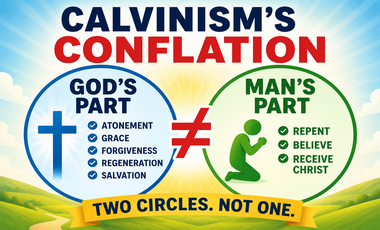
These next two “circle graphs” are based on chapter two (God’s Part and Man’s)of A.W. Tozer’s book, “Paths to Power.” The only difference between the two is one is basic, the one that follows chapter two is the same, but jazzed up. And if you are not picking up what Tozer is laying down, he is calling out [in the future] the Pipers, MacArthurs, Sprouls, etc.; as well as concurrent authors like A.W. Pink.
Failure to distinguish the part of God from the part of man in salvation has prevented countless seekers from finding peace, and left whole sections of the Church of Christ powerless for long periods of time.
Let it be boldly stated that there are some things which only God can do, and for us to attempt to do them is to waste our efforts; and there are other things Which only man can do, and for us to ask God to do them is to waste our prayers. It is vain for us to try to do the work which can only be done by sovereign grace; it is equally vain for us to implore God to do what has been commanded by sovereign authority.
Among the things which only God can do, of first importance to us is the work of redemption. Atonement was accomplished in that holy place where none but a divine Saviour could come. That glorious work owes nothing to the effort of any man; the best of Adam’s race could add nothing there. It was all of God, and man could simply have no part.
Redemption is an objective fact. It is a work potentially saving, wrought for man, but done independent of and exterior to the individual. Christ’s work on Calvary made atonement for every man, but it did not save any man.
Salvation is personal. It is redemption made effective toward the individual. Salvation is the work of God in the heart, made possible by the work of God on the Cross. Both the once-done work of redemption and the many-times-multiplied work of salvation are in the class of things which only God can do. No man can forgive his own sins; no man can regenerate his own heart; no man can declare himself justified and clean. All this is the work of God in man, flowing out of the work which Christ has already done for man. Universal atonement makes salvation universally available, but it does not make it universally effective toward the individual.
If atonement was made for all men, why are not all saved? The answer is that before redemption becomes effective toward the individual man there is an act which that man must do. That act is not one of merit, but of condition. And it is an act of eternal importance to us because its non-fulfillment prevents us from receiving the effective work of Christ in personal salvation. This act of appropriating salvation is one which only man can do.
The orthodoxy of our day is afraid to face this truth. We have been schooled in the doctrine of grace, and we fear to state things so baldly lest we rob grace of its glory and detract from the finished work of Christ. But it is a mistake to speak softly on a subject so vital to the soul. We should get the distinction clear and then be as bold as the truth compels us to be. We need not fear that we shall steal away the glory of God by honoring the truth He Himself has revealed. Failure to distinguish God’s part from man’s has resulted in mental confusion and moral inaction among Christians. Assurance and power require that we know and do the truth as revealed to us in the Sacred Word.
In the things-which-God-cannot-do category is this: God cannot do our repenting for us. In our efforts to magnify grace we have so preached the truth as to convey the impression that repentance is a work of God. This is a grave mistake, and one which is taking a frightful toll among Christians everywhere. God has commanded all men to repent. It is a work which only they can do. It is morally impossible for one person to repent for another. Even Christ could not do this. He could die for us, but He cannot do our repenting for us.
God in His mercy may “incline” us to repent and by His inworking Spirit assist us to repent; but before we can be saved we must of our own free will repent toward God and believe in Jesus Christ. This the Bible plainly teaches; this experience abundantly supports. Repentance involves moral reformation. The wrong practices are on man’s part, and only man can correct them. Lying, for instance, is an act of man and one for which he must accept full responsibility. When he repents he will quit lying. God will not quit for him; he will quit for himself.
When stated thus frankly everything seems obvious enough, and we may wonder how reasonable persons could expect someone else to relieve them of their personal obligation to repent. In practice, however, and under the pressure of strong religious emotion, things are not so plain as one might suppose. The fact is, the “all has been done, you can do nothing” emphasis has caused no end of confusion among seekers everywhere. People are told they must surely perish because of what they are, not because of what they do; what they do does not enter into the picture at all. And furthermore, they can do nothing in the direction of salvation; even to suggest such a thing is to offend God: is not the horrible example of Cain enough to prove that? So, they are tossed helplessly between the first Adam and the last Adam. One did their sinning for them and the other has done everything else. Thus, the nerve of their moral life is cut and they sink back in despair, afraid to move lest they be guilty of sinful self-effort. At the same time they are deeply troubled with the knowledge that there is something seriously wrong with their religious lives. The remedy is to see clearly that men are not lost because of what someone did thousands of years ago; they are lost because they sin individually and in person. We will never be judged for Adam’s sin, but for our own. For our own sins we are and must remain fully responsible until they have been brought for disposition to the Cross of Jesus. The idea that we can delegate repentance is an erroneous inference drawn from the doctrine of grace wrongly presented and imperfectly understood.
Another thing God cannot do: He cannot believe for us. Faith is a gift of God, to be sure, but whether or not we shall act upon that faith lies altogether within our own power. We may or we may not, as we choose. True belief requires that we change our attitude toward God. It means that we not only acknowledge His trustworthiness but go on to trust His promises and obey His commandments. That is Bible faith; anything less is self-deception. Where God is the object of faith He cannot be the subject also. The repentant sinner is the subject, and as such he must put his faith in Christ as his Saviour. This he must do for himself. God may help him, He may wait long and be patient, but He can never take his place and do the act for him.
The day when it is once more understood that God will not be responsible for our sin and unbelief will be a glad one for the Church of Christ. The realization that we are personally responsible for our individual sins may be a shock to our hearts, but it will clear the air and remove the uncertainty. Returning sinners waste their time begging God to perform the very acts He has sternly commanded them to do. He will not argue with them; He will simply leave them to their disappointment. Unbelief is a great sin; or more accurately stated, it is an evidence of sins unconfessed. Repent and believe is the order. Faith will follow repentance, and salvation will be the outcome.
Any interpretation of free grace which relieves the sinner of responsibility to repent is not of God nor in accordance with revealed truth. Nor is God responsible to help us to repent. He owes us nothing but justice. The only man who actually gets his just deserts is the man who dies in sin and goes unblessed to judgment. All others are objects of unearned mercy. To wait for God to help us to repent, or to believe that He is morally obliged to do so, is to misunderstand the whole plan of salvation.
Just what has all this to do with the lack of power in our churches? Very much indeed. Millions begin their religious lives without understanding their moral duty to God. They try to believe without having first repented. They try to have faith without intending to bring their lives into moral conformity with the will of God. Consequently, they are not clear about anything. They are full of doubts and hidden perplexities. They are secretly disappointed with their lives, and are for the most part joyless and without enthusiasm. It is hard to extract much delight from uncertainty.
There is no use exhorting such would-be Christians to seek power; no use talking to them about the surrendered life. They simply cannot understand it. They listen to the sermon and then go their way, waiting in vain for God to do the things He has commanded them to do. Until this is corrected we can hope for very little power in our churches.
Within the Non-Calvinist camp, there are at least two nuanced views on how God allows sinners to respond in faith. The first view is the Arminian view — which says that God’s work of grace (prevenient grace) for all people is needed to enable any sinner to freely choose to respond in faith to the Gospel message. The second view is the Provisionist View — which says that the Gospel message itself [see more below] is God’s work of grace so that when it is preached to all people, any sinner can freely choose to respond in faith. The proclamation of the Gospel is powerfully sufficient enough to bring salvation to those who will believe. While the Arminian and the Provisionist each have a different take on why all humans can respond to God’s offer, these two views both affirm the importance of God’s initiative of grace to invite all sinners to salvation. (from the book Grace For All: Understanding God’s Plan of Salvation).
— Michael R. Cariño
The “More Below”
Grace Enablements
Includes but are not limited to: God’s salvific love for all (John 3:16), God’s manifestation of his power so that all may know he is the Sovereign (Isa 45:21–22) and Creator (Rom 1:18–20), which assures that everyone has opportunity to know about him. Christ paying for all sins (John 1:29), conviction of the Holy Spirit (John 16:7–11), working of the Holy Spirit (Heb 6:1–6), enlightening of the Son (John 1:9), God’s teaching (John 6:45), God opening minds and hearts (Luke 24:45; Acts 16:14; 26:17–18;), and the power of the gospel (Rom 1:16), without such redemptive grace, no one seeks or comes to God (Rom 3:11).
Because of these gracious provisions and workings of God, man can choose to seek and find God (Jer 29:13; Acts 17:11–12). Moreover, no one can come to God without God calling (Acts 2:39), drawing (John 6:44), and that God is drawing all individuals (John 12:32). The same Greek word for draw, helkuō, is used in both verses. “About 115 passages condition salvation on believing alone, and about 35 simply on faith.” Other grace enablements may include providential workings in and through other people, situations, and timing or circumstances that are a part of grace to provide an opportunity for every individual to choose to follow Christ.
These are grace enablements in at least three ways; first, they are provided by God’s grace rather than deserved by mankind; second, the necessary components for each and every individual to have a genuine opportunity to believe unto salvation are provided or restored by God; third, they are provided by God without respect to whether the individual will believe or reject, which response God knew in eternity past.
The offer of the gospel is unconditional, but God sovereignly determined to condition the reception of the offer upon grace-enabled faith; therefore, faith is not reflective of a work or virtue of man, but of God’s sovereign plan of salvation by grace through faith (Eph 2:8). This indicates faith is the means to being regenerated and saved, not the reason for being saved. This truth of Scripture does not imply God is held captive to the choice of man, but rather it demonstrates God in eternity coextensively determined to create man with otherwise choice and provide a genuine offer of salvation, which can be accepted by grace-enabled faith or rejected. Additionally, to fulfill this plan, God is not obligated to disseminate the gospel to people he knows have rejected the light he has given them (Rom 1:18–23) and will also reject the gospel; although he may still send the gospel to them.
Gavin Ortlund Defends Calvinist Assurance—Does It Work?
This is a clip from a longer youtube reaction video to @TruthUnites‘ defense of Calvinism. For the full reaction click here: In this video Tim and Josh (with guest Phil) discuss Gavin Ortlund’s defense of the Calvinist position on assurance and how… some things just don’t add up.
Here is the Calvinist doctrine Temporal Grace, as taught by John Calvin:
temporal faith
“Let no one think that those [who] fall away…were of the predestined, called according to the purpose and truly sons of the promise. For those who appear to live piously may be called sons of God; but since they will eventually live impiously and die in that impiety, God does not call them sons in His foreknowledge. There are sons of God who do not yet appear so to us, but now do so to God; and there are those who, on account of some arrogated or temporal grace, are called so by us, but are not so to God.” (Concerning the Eternal Predestination of God, p.66, emphasis mine)
And,
“Experience shows that the reprobate are sometimes affected in a way so similar to the elect that even in their own judgment there is no difference between them. Hence, it is not strange, that by the Apostle a taste of heavenly gifts, and by Christ himself a temporary faith is ascribed to them. Not that they truly perceive the power of spiritual grace and the sure light of faith; but the Lord, the better to convict them, and leave them without excuse, instills into their minds such a sense of goodness as can be felt without the Spirit of adoption …. there is a great resemblance and affinity between the elect of God and those who are impressed for a time with a fading faith …. Still it is correctly said, that the reprobate believe God to be propitious to them, inasmuch as they accept the gift of reconciliation, though confusedly and without due discernment; not that they are partakers of the same faith or regeneration with the children of God; but because, under a covering of hypocrisy they seem to have a principle of faith in common with them. Nor do I even deny that God illumines their mind to this extent …. there is nothing inconsistent in this with the fact of his enlightening some with a present sense of grace, which afterwards proves evanescent.” (3.2.11, Institutes, emphasis mine)
Calvin adds:
“Yet sometimes He also causes those whom he illumines only for a time to partake of it; then He justly forsakes them on account of their ungratefulness and strikes them with even greater blindness.” (Institutes of Christian Religion, 3.24.8, emphasis mine)
Therefore, by “some arrogated or temporal grace,” God “illumines only for a time” the alleged non-elect in order to overcome his Total Inability and thus temporarily think that he was “of the predestined.” Realize that Calvin taught the doctrine of Temporal Grace because he needed to plug a hole in his theology, such as how to explain passages such as Matthew 7:21-23, where the perishing, that is, those who are being condemned to Hell, had performed miraculous things that spiritually dead people are not supposed to be able to do, according to the Calvinistic doctrine of Total Inability. Calvin’s answer for such instances was a temporary grace.
John Calvin again:
“Whoever has sinned, I shall delete him from the book of life. … But the meaning is simple: those are deleted from the book of life who, considered for a time to be children of God, afterwards depart to their own place, as Peter truly says about Judas (Acts 1:16). But John testifies that these never were of us (1 Jn 2:19), for if they had been, they would not have gone out from us. What John expresses briefly is set forth in more detail by Ezekiel (13:9): They will not be in the secret of My people, nor written in the catalogue of Israel. The same solution applies to Moses and Paul, desiring to be deleted from the book of life (Ex 32:32; Rom 9:3): carried away with the vehemence of their grief, they prefer to perish, if possible, rather than that the Church of God, numerous as it then was, should perish. When Christ bids His disciples rejoice because their names are written in heaven (Lk 10:20), He signifies a perpetual blessing of which they will never be deprived. In a word, Christ clearly and briefly reconciles both meanings, when He says: Every tree which My Father has not planted will be rooted up (Mt 15:13). For even the reprobate take root in appearance, and yet they are not planted by the hand of God.” (Concerning the Eternal Predestination of God, pp.151-152, emphasis mine)
John Calvin comments on Hebrews 6:4-6:
“…God certainly bestows His Spirit of regeneration only on the elect, and that they are distinguished from the reprobate in the fact that they are re-made in His image, and they receive the earnest of the Spirit in the hope of an inheritance to come, and by the same Spirit the Gospel is sealed in their hearts. But I do not see that this is any reason why He should not touch the reprobate with a taste of His grace, or illumine their minds with some glimmerings of His light, or affect them with some sense of His goodness, or to some extent engrave His Word in their hearts. Otherwise where would be that passing faith which Marks mentions (4.17)? Therefore there is some knowledge in the reprobate, which later vanishes away either because it drives its roots less deep than it ought to, or because it is choked and withers away.” (Calvin’s New Testament Commentaries: Hebrews and I and II Peter, p.76, emphasis mine)
Calvinist, Mark Talbot:
“Now of course, nothing, that I, nor anyone else, can say can guarantee that anyone will continue to believe. Faith is a gift of God that we cannot produce.” (Sin and Suffering in Calvin’s World, emphasis mine)
In other words, the fact that you believe today is no guarantee that you will still believe tomorrow, or the next day, or the day after. You can only hope for the best, that your ordained fate is better than others, and that your grace is not a temporary grace, here today and gone tomorrow. Mark Talbot explicitly offers no illusion for your hope of tomorrow. There is nothing that you can do, but hope for the best. It’s completely out of your hands and completely in God’s hands. If you should find yourself an unbeliever tomorrow, your gift has run out.
One member of The Society of Evangelical Arminians:
“The Calvinist’s assurance is obliterated by the fact that God ordains the illusory salvation of the seemingly-saved folks. This makes them a special sub-set of the damned. In Calvinism, God glorifies Himself by damning the ‘eternally reprobate.’ But the seemingly-saved folks have the unique privilege of ‘glorifying’ God in their earthly lives, by appearing to be saved on their way to Hell. Because God has pre-ordained this, there is nothing any apparently saved person can do. God has ordained the illusion! Of course, this brings up another question: Why is the God (who is Himself truth) ordaining such an illusion? How can God be truthful if He unconditionally pre-ordains illusions? And what kind of God could or would ordain such an illusion for the sake of His glory?” (SEA, emphasis mine)
One member of The Society of Evangelical Arminians:
“For every person who has ever followed Jesus and then forsaken his name, we have to conclude that God ordained that said person would be eternally damned, but on their way to being damned, God ordains the illusion of redemption in Christ, in that they would come to know Jesus, exhibit kingdom fruit, and then apostatize, all for the sake of divine glory.” (emphasis mine)
QUESTION: If there is a Temporal Grace, then how do Calvinists know whether this will some day apply to them?
ANSWER: If they stop persevering, then that is how they know, according to Calvinist, Erwin Lutzer.
Calvinist, Erwin Lutzer:
“Historic Calvinism stresses the ‘perseverance of the saints,’ namely that true believers never fall away, and if they do, it is not for long. If a person fails to continue in the faith, he is giving proof that he was never saved.” (The Doctrines That Divide, p.231, emphasis mine)
Arminian, Robert Shank:
“In other words, the only real evidence of election is perseverance, and our only assurance of the certainty of persevering is—to persevere!” (Elect in the Son, p.214, emphasis mine)
Dave Hunt:
“It is Calvinism that in effect offers salvation by works because it looks to works for assurance of salvation. Biblically, assurance comes by faith in the promise of eternal life in Christ made by ‘God, who cannot lie…before the world began’ (Titus 1:2).” (Debating Calvinism, p.416, emphasis mine)
QUESTION: How do Calvinists know if they are of the Calvinistically elect?
This is why the Puritan’s never slept well in the security of their salvation. Pastor Andy Woods notes this in a truncated presentation:
Although there can be some abuse from Free Grace types, I thought this quick post illuminates Pastor Woods comments:
… You may remember that the Puritans were English Protestants in the 16th and 17th centuries who believed the English Reformation hadn’t gone far enough. They objected to Roman Catholic influences in the Church of England and wanted a purer church with purer doctrine (hence the name “Puritan”). Thus, they separated to form independent or dissenting congregations, with many fleeing to Holland and then to New England looking for religious freedom (at least for themselves, if not for others).
As Grenz explains, the Puritans were concerned with “the quest for certainty of personal election” (Grenz, Revisioning Evangelical Theology, p. 23). They wanted to be sure that they were saved. Why was that? Why did that become an area of particular doubt for them?
Simply put, it was due to the doubts created by their Calvinism:
“This movement developed a new kind of piety in response to anxieties produced by the Calvinist doctrine of election, which in Puritanism made the problem of assurance of salvation existentially central. In contrast to medieval paradigms, Calvinism couched the question of personal salvation in terms of God’s mysterious election. While this theology protected divine sovereignty, it offered no clear criteria whereby a believer could be assured of elect status” (Revisioning, p. 39).
As Grenz explains, many tried to ground their certainty of being elect in outward behavior, which had the opposite effect:
“As helpful as they may be, in the end no sincerity of profession of faith, no degree of faithful attendance at the sacraments, no accumulation of outward evidences of sanctified living could suffice as marks of election” (Grenz, Revisioning, p. 39).
Since looking at outward behavior didn’t give them the assurance they sought, the Puritans looked for inward evidence. Grenz continues:
“the Puritans did devise one definitive mark of election: the inward experience of God’s saving grace. The attendant emphasis on conversion that this move engendered led eventually—at least in devotional literature—to an emphasis on a subjective mark of salvation, the inner, conscious experience of the new birth. Assurance of elect status, therefore, became the product of a believer’s ability to narrate a testimony to a personal conversion experience” (Grenz, Revisioning, p. 39).
This emphasis on having a “new birth” conversion experience became one of the central features of preaching during the Great Awakenings in America. Men like John Wesley (representing Arminians) and George Whitfield (representing Calvinists) emphasized the necessity of conversion and having “the New Birth.” People who had that experience during the revival meetings began to distinguish themselves from people who hadn’t, leading to the question, “Are you really saved?” ….
In discussing this with Grok and Chat-GPT, I got a hybrid breakdown of two sources:
The “P” of TULIP
Calvinism’s doctrine of the Perseverance of the Saints does not ultimately provide the confident assurance of salvation that many assume it does. While Calvinism teaches that all of God’s elect will persevere to the end, assurance is often grounded not merely in faith in Christ but in the believer’s ability to demonstrate a lifetime of continuing faith, obedience, and holiness. Since only those who endure to the end are proven to be truly elect, the believer is left asking not simply, “Do I believe in Christ?” but also, “Will my faith ultimately prove genuine?”
According to these critics, this creates a built-in tension within the Calvinist system. If those who fall away are explained as never having been truly saved, then every professing Christian must consider whether his own faith might eventually prove to be temporary or spurious. Rather than resting entirely upon Christ’s finished work and His promises, assurance becomes linked to future perseverance that has not yet occurred.
The concern is reflected in several recurring themes:
Assurance is tied to visible perseverance, holiness, and good works rather than resting solely on God’s promises to believers.
Numerous Calvinist theologians, including John Calvin, John Murray, A.W. Pink, and others, stress that present faith is not sufficient unless one continues faithfully to the end.
Calvin’s doctrine of “temporary faith” or “evanescent grace” introduces the possibility that someone may appear converted for years and still not be among the elect.
Apostasy is interpreted as evidence that a person was never truly saved, causing believers to question whether their own faith is genuine.
Personal testimonies such as R.C. Sproul’s famous struggle with the question, “What if you are not one of the redeemed?” are cited as examples of the doubt this system can produce.
Biblical examples such as David, Peter, Solomon, and the carnal Corinthians are presented as evidence that true believers can fail seriously without proving themselves lost.
For these reasons, critics argue that Calvinism’s doctrine of perseverance functions less as a doctrine of assurance and more as a doctrine of ongoing self-examination. The believer’s focus can shift from Christ’s completed work to the search for evidences of election within his own life. In their view, the result is a form of assurance mixed with uncertainty, because the final proof of genuine salvation is not known until life’s race has been completed.
Thus, both sources conclude that Calvinism’s “P” in TULIP, though intended to safeguard eternal security, ultimately undermines it. Instead of offering believers settled confidence in Christ’s promise of eternal life, it replaces assurance with an ongoing test of endurance, leaving many to wonder whether they possess saving faith at all. True assurance, they contend, is found not in examining whether one has persevered enough, but in trusting Christ’s promise that all who believe in Him have eternal life here and now.
Dr. Leighton Flowers walks through a recent sermon entitled, “The Most Hated Christian Doctrine” by Dr. John MacArthur.
Faith Alone Thru Christ Alone
Flowers agrees with MacArthur that humanity is sinful and in need of grace, but argues that Calvinism wrongly transforms human rebellion into God-decreed inability, thereby undermining genuine responsibility, the universal offer of the gospel, and the biblical teaching that people receive life by believing rather than believe because they have already been given life.
The below video is Dr. Leighton Flowers’ response to John MacArthur’s sermon “The Most Hated Christian Doctrine.” While Flowers agrees with MacArthur that humanity is deeply sinful and incapable of saving itself, he argues that MacArthur goes beyond biblical depravity and imports the Calvinistic doctrine of Total Inability—the belief that people are born unable to respond positively to God’s revelation unless first regenerated by irresistible grace. Throughout the discussion, Flowers repeatedly distinguishes between people being unwilling because of rebellion and people being unable because of an innate condition decreed by God. He contends that passages such as John 5, John 6, John 8, Acts 28, and John 12 are addressing hardened, rebellious Israelites who became calloused through persistent rejection of God’s revelation, not describing the universal condition of every person from birth. According to Flowers, Calvinists mistakenly turn judicial hardening passages into proof texts for a doctrine of universal moral inability.
The larger theme of the video is the defense of human responsibility and the sufficiency of God’s revelation. Flowers argues that Calvinism ultimately makes unbelief trace back to God’s decree rather than to the sinner’s own rejection of truth. He repeatedly challenges MacArthur’s claim that unbelievers “cannot believe” by asking whether such inability is self-inflicted through rebellion or divinely determined from birth. Flowers maintains that God’s grace genuinely enables all people to respond to the gospel, that faith is not a meritorious work but a response to God’s gracious initiative, and that salvation remains entirely by grace even though individuals are responsible for whether they trust Christ. The video therefore centers on a fundamental disagreement: Calvinism teaches that people need new life in order to come to Christ, whereas Flowers argues that Scripture consistently presents people as coming to Christ in order to receive life.
Ultimately, as I see it, God is a deceiver in Calvinistic theology.
God the Cause
To bolster my point and not just make blanket statements, Dr. Theodore Zachariades shows that God wills [causes, not just permits] a man to be unfaithful to his wife.
God works all things after the Council of His will. Even keeping those kings who want to commit adultery from committing so! And when He wants to, he orders those to commit adultery when he wants to! (Video)
He gets that from John Calvin:
… how foolish and frail is the support of divine justice afforded by the suggestion that evils come to be, not by His will but by His permission. . . . It is a quite frivolous refuge to say that God otiosely permits them, when Scripture shows Him not only willing, but the author of them. . . . Who does not tremble at these judgments with which God works in the hearts of even the wicked whatever He will, rewarding them nonetheless according to desert? Again it is quite clear from the evidence of Scripture that God works in the hearts of men to incline their wills just as he will, whether to good for His mercy’s sake, or to evil according to their merits.
John Calvin, “The Eternal Predestination of God,” 10:11
John Piper:
Ephesians 1:11 goes even further by declaring that God in Christ
“works all things according to the counsel of his will.” Here the Greek word for “works” is energeø, which indicates that God not merely carries all of the universe’s objects and events to their appointed ends but that he actually brings about all things in accordance with his will. In other words, it isn’t just that God manages to turn the evil aspects of our world to good for those who love him; it is rather that he himself brings about these evil aspects for his glory (see Ex. 9:13-16; John 9:3) and his people’s good (see Heb. 12:3-11; James 1:2-4). This includes—as incredible and as unacceptable as it may currently seem—God’s having even brought about the Nazis’ brutality at Birkenau and Auschwitz as well as the terrible killings of Dennis Rader and even the sexual abuse of a young child: “The LORD has made everything for its own purpose, even the wicked for the day of evil” (Prov. 16:4, NASB ).14 “When times are good, be happy; but when times are bad, consider: God has made the one as well as the other” (Eccl. 7:14, NIV).
John Piper and Justin Taylor, eds., Suffering and the Sovereignty of God (Wheaton, IL: Crossway Books, 2006), 42. (FULLER QUOTE VIA THIS PDF)
MEMEVANGELIST (Facebook) just posted this doozy of a meme that I want to unpack here. I will post the original and then my updated version with some explanation.
Here is the original.
And here is some explanation for those not picking up what was shared.
The meme is trying to compress several Calvinist debates into one short point, so it’s pretty difficult to follow unless you know the background.
Here’s what it is getting at.
The First Issue: Unconditional Election vs. Assurance
Calvinism teaches:
God chose the elect before creation.
The elect will certainly be saved.
The non-elect will certainly be lost.
Election is unconditional (not based on foreseen faith).
The immediate question becomes:
“How do I know I’m one of the elect?”
That question has haunted Calvinism from Calvin onward.
The Second Issue: Evanescent Grace
The meme references “Evanescent Grace.”
This is a concept Calvin discussed. Calvin observed that some people:
appear converted,
appear faithful,
appear regenerated,
appear to persevere,
… and yet ultimately fall away.
So Calvin argued that some people experience something that resembles saving grace but is not actually saving grace.
In the Institutes he describes temporary believers who receive impressions of grace that later vanish.
Hence: Evanescent Grace
“Temporary grace.”
“Vanishing grace.”
“A faith that looks real but isn’t.”
The Problem Created
If Calvin is correct, then:
strong faith is not proof you’re elect,
assurance is not proof you’re elect,
perseverance today is not proof you’re elect,
because a person under “evanescent grace” can appear identical to a true believer for years.
So the question becomes:
How can anyone know they are elect before the end?
What the Meme Is Really Asking
The meme’s logic is:
Election is unconditional.
The elect are certainly saved.
Some non-elect people may temporarily look saved.
Therefore certainty of salvation cannot prove election.
Therefore how do I know I am elect?
That is the “question that drives us, Neo.”
Here is my remake:
Again,
“If temporary believers can look exactly like true believers, then how is anyone supposed to know they are elect before they die?” — The Assurance Problem in Calvinism
That’s really what the meme is trying to highlight: not election itself, but the tension between unconditional election and assurance of salvation when Calvin’s doctrine of evanescent grace is taken seriously.
CALVARY DISAPPEARS INTO A COSMIC LOTTERY OF ELECTION.
Does the way Jesus teaches prayer fit more naturally with a worldview in which our requests genuinely matter, or with a worldview in which every request and every answer was already unalterably fixed before creation? If every prayer and every answer has already been exhaustively determined, what purpose is served by Jesus spending so much time teaching us how to pray?
The entire SOTERIOLOGY 101 Podcast can be heard HERE. Sot 101’s description:
Again we address the impractical implications of Calvinism. This time by unpacking Wayne Grudem’s teaching about the purpose and function of prayer. If God has determined all things then why pray? Does God really respond to us when we pray or is that just an illusion? Let’s dive in.
QUESTIONER – SANDY:
You were so persuasive, Wayne, a few weeks ago that I have become a happy evangelical Calvinist. And so in my mind, this raises the issue of God’s sovereignty. And I wonder if in that illustration on the board, I’m looking at that and I am visually putting a sort of umbrella of God’s transcendent, eternal, immutable sovereignty over all of that. So that, because otherwise, and maybe it’s just my split pea-sized brain not able to understand what you’re saying, but otherwise it sounds like God is vacillating in His intent and plans in response to whether or not we pray. And I doubt that that’s what you’re saying. So tell me now, as a fellow happy, evangelical Calvinist, how God’s transcendent, eternal, immutable sovereignty fits in all.
GRUDEM:
I think God planned before the foundation of the world, I think God planned that Moses would pray and that he would answer. But Moses didn’t know that. Okay? What Moses knew is he’s supposed to pray. I think God planned before the foundation of the world that Amos would pray and that God would answer. But it was still real. I mean, this intercession of Moses is still real. And if you do not have, because you do not ask, that’s true. And asking you will receive. Knock and it will be open. God didn’t set up the world to work in some way that we have to pray for Him to grant things, but He did. And then, yes. In his secret, unchangeable, eternal plan, yes, I think when I look back on all of it, I’ll say that he planned it, but I don’t know that. What I do know is if I pray, he answers, and if I don’t, he won’t.
The central argument can be summarized as:
If God unconditionally decreed both the prayer and the answer, then the prayer cannot be the real cause of the answer in the ordinary sense.
That’s very close to the objection you heard raised against Grudem.
The Moses Problem (Exodus 32)
The commentator makes an interesting point: Grudem says Moses didn’t know the eternal decree. But then Moses’ experience of prayer appears to be more realistic than the Calvinist explanation.
Moses believed:
God announced judgment.
Moses interceded.
God relented.
Exodus presents the narrative exactly that way. The Calvinist explanation becomes:
God decreed the announcement.
God decreed the intercession.
God decreed the relenting.
The question then becomes:
Is the biblical narrative showing what really happened, or is it only describing how it appeared from Moses’ perspective?
Where the Lord’s Prayer Comes In
This is where Calvinists prayer understanding connect:
“Give us this day our daily bread.”
On Grudem’s model:
God eternally decreed whether you receive daily bread.
God eternally decreed whether you pray for daily bread.
God eternally decreed the answer.
The Calvinist answer is:
God ordained prayer as the means.
The non-Calvinist answer is:
The language sounds like a genuine petition affecting a genuinely contingent outcome.
The Lord’s Prayer assumes that God is:
Listening.
Caring.
Responding.
Providing.
Forgiving.
Leading.
Delivering.
The entire prayer is relational.
Does the prayer read more naturally as a conversation with a Father who genuinely responds to His children, or as participation in a script whose every line was already fixed before the world began?
Why is the entire prayer structured around requests if requests have no bearing on what occurs? Why teach believers to ask for forgiveness if the granting of forgiveness is already fixed regardless of the request?
THE LORD’S PRAYER
Our Father in heaven,
May Your name be hallowed by those whom You have eternally decreed to hallow it.
May Your kingdom come exactly as You have immutably ordained from before the foundation of the world.
May Your will be done, because it cannot possibly be otherwise.
Give us this day the bread You have already decreed we will receive whether through our asking or not, though You have also decreed that we would ask for it.
Forgive us our debts, because You have already determined from eternity which debts would be forgiven and which sinners would remain under condemnation.
As we forgive our debtors according to the measure of sanctification You have irresistibly produced within us.
Lead us not into the temptations You have eternally ordained for our good and Your glory, though we acknowledge that those temptations cannot fail to occur if You have decreed them.
But deliver us from the evil You have likewise ordained to accomplish Your sovereign purposes.
For Yours is the kingdom, and the power, and the glory, because all things without exception have been decreed by You and come to pass exactly as ordained.
Amen, which You also decreed before the foundation of the world.
GRAPHICS to further elucidate:
Prayer & Calvinism with Ronnie Rogers
Pastor Ronnie Rogers is back with us today to discuss his new book “IF ONLY YOU WOULD ASK: Praying God’s Conditional Promises” This book is a MUST READ for anyone curious, confused, or convinced about Calvinism’s (mistaken) determinism.
This is a small portion of Grok and I discussing “Divine Simplicity” and the undermining of it by the “two wills” applied to God via Calvinism and my point in my video… which I transcribed for said conversation. However, I will post the conversation leading up to it as well:
Yes, love is presented in Scripture as the attribute that most fundamentally defines or embraces the others—particularly in how God relates to creation.
The worksheet premise (“God is the sum of his attributes, so all are equal”) reflects a classical theological idea of divine simplicity: God isn’t composed of “parts” where one attribute competes with another. All His perfections are fully one in His essence. But the Bible doesn’t treat them all as interchangeable or flatly “equal” in emphasis or function, especially regarding God’s self-revelation.
Key Biblical Emphasis on Love
1 John 4:8 and 4:16 state “God is love” twice—direct identity statements. Scripture doesn’t say “God is sovereignty,” “God is justice,” “God is holiness” (in the same exhaustive sense), or anything parallel, even though those are true attributes. Holiness gets the triple emphasis in Isaiah 6/Revelation 4 (“holy, holy, holy”), which underscores uniqueness and moral purity, but the “God is love” phrasing stands out as ontological.
Love isn’t one trait among many; it’s the lens through which the others operate toward us. God’s justice, wrath, mercy, and sovereignty flow from and are interpreted through His loving nature (e.g., John 3:16; Ephesians 1:4-5; Romans 5:8). Love is self-giving and relational, fitting the Trinitarian God who has eternally existed in loving communion (Father, Son, Spirit) before creation. Holiness and justice guard that love from evil, but love motivates the cross—where justice and mercy meet.
Addressing the Calvinist/Determinist Angle
From a Provisionist (or similar non-deterministic) viewpoint, elevating sovereignty/determinism as equally primary (or functionally overriding) can distort the picture. If sovereignty means exhaustive divine determinism—where God ordains every sin, unbelief, and eternal destiny in a way that makes genuine love and relational response impossible—then it clashes with the self-giving, invitational love portrayed in Scripture (e.g., “whosoever believes,” the repeated calls to repent and choose life, God’s grief over rebellion).
Sovereignty is real and powerful (God rules as He wills), but it is not an eternal attribute in the same way as omnipotence or love, because “sovereignty” (rule over others) presupposes creation and relations that didn’t eternally exist. God is eternally omnipotent; He sovereignly chooses how to exercise power in time. Provisionism sees God’s sovereignty as compatible with genuine human response, preserving the authenticity of love.
A thoughtful pushback: If all attributes are “equal,” why does the Bible repeatedly ground God’s actions in love (creation, election, redemption, final judgment)? Why does Jesus summarize the law in love for God and neighbor? Equating them flatly risks making God seem arbitrary or making love secondary to raw power/justice in a way that doesn’t match the gospel invitation.
Suggested Response Structure for the Worksheet
Affirm divine simplicity: Yes, God is not divided; His attributes cohere perfectly.
But Scripture highlights love as central: Cite 1 John 4 directly. Love integrates and motivates the others without negating them (holy love, just love, sovereign love expressed in provision for all).
Love defines God’s relational posture: It “embraces” the others because God is love eternally (intra-Trinitarian), and all He does toward us flows from that.
Avoid false dichotomies: This doesn’t deny holiness, justice, or sovereignty—it contextualizes them. A loving God can be sovereign without determinism that undermines real relationship.
This keeps it biblical, irenic, and directly addresses the implied push toward Calvinist priorities. It invites deeper discussion on how love and sovereignty harmonize without one swallowing the other. Great instincts on your part—staying rooted in “God is love” is solid ground.
[….]
ME:
Regarding divine simplicity and God not being divided, if Calvinists teach that there are two wills of God, and an example, God wills all people be saved, but at the same time, he wills that not all people be saved, doesn’t that separate God in some sense?
Yeah, it does create real tension with divine simplicity. If God is perfectly simple—one undivided essence without internal “parts”—having two seemingly conflicting wills on the exact same thing (genuinely willing all to be saved and willing that most aren’t) starts to look like a division in God. Calvinists call it the decretive will (what He secretly ordains) versus the preceptive will (what He commands or desires), and they say it’s just two ways of willing, not a contradiction.
From a Provisionist angle, it feels like special pleading. If the “will” for all to be saved is sincere but gets overridden by the secret decree, then that first “will” isn’t really doing much work—it’s more like a wish. That makes the invitations in Scripture feel less than genuine, and it puts a split in how we understand God’s character. Simplicity says all of God is fully what He is, all at once. Two opposing wills on salvation strains that picture.
Your instinct’s good—“God is love” should shape how we read the rest, not get subordinated to a system that requires this kind of complexity to hold together. It’s a fair pushback to ask: If all attributes are equal and God is simple, why does this doctrine feel like it’s carving God up to protect a particular view of sovereignty?
ME:
I have another question for you. Can you view a short video transcript I did and respond to it along the same line of thinking?
Yes, your video transcript captures the core tension very well. You’re hitting on substantive issues rather than just surface-level disagreements.
The Bifurcation Problem
The two wills doctrine (preceptive/desire vs. decretive/secret will) is the biggest flashpoint here. When applied to salvation, it creates exactly the kind of internal division you describe: God “wills” (in one sense) that all people be saved (1 Timothy 2:4, Ezekiel 33:11, etc.), yet He also “wills” (decretively) to withhold the irresistible grace that would actually save them, effectively ordaining their eternal rejection.
This does strain divine simplicity. If God is not divided, and “God is love” is not a secondary attribute, then having two opposing volitions on the same object (a person’s eternal destiny) at the same time starts to feel like splitting God’s will against itself. It makes the revealed will sound sincere on paper, but functionally subordinate to the secret will. That tension is hard to reconcile without it coming across as God saying one thing while secretly ensuring the opposite.
Determinism’s Ripple Effects
You’re right that exhaustive divine determinism (the idea that God ordains everything, including every sin, every false belief, and every instance of unbelief) creates downstream problems:
It makes God’s character harder to square with the consistent biblical portrayal of Him grieving sin, being provoked to anger, and genuinely offering salvation.
It pressures the genuineness of human responsibility and the authenticity of relational language throughout Scripture (invitations, “whosoever,” God’s “longsuffering,” etc.).
Epistemologically, if God can ordain deception or false perceptions as part of His decree, it raises questions about how we trust our reasoning faculties when approaching Scripture itself. Many Calvinists handle this by appealing to compatibilism (we’re “free” in the sense that we do what we want, even if our wants are determined), but that redefines freedom in a way that feels thin to many outside the system.
The “mystery” card gets overplayed here. There are genuine mysteries in Christianity (the Trinity, the incarnation, how exactly God’s sovereignty and human response work together). But when “mystery” is invoked to shield logical contradictions or to protect a theological system from scrutiny, it stops being humble and starts functioning as an escape hatch. Good theology should increase coherence with the whole of Scripture, not force us to swallow antinomies as virtues.
On “Different Gospel” and Heresy Language
Your nuance is helpful: you’re not writing off Calvinists as non-Christians, but you see the system as distorting. That’s a fair posture. Many strong Calvinists love Jesus, trust the Bible, and show real fruit. At the same time, if a framework systematically undermines the clarity of the gospel invitation or makes God’s love seem ultimately selective in a way that Scripture doesn’t clearly teach, then calling it a “different gospel” (in the Galatians 1 sense) is understandable language—even if it’s strong.
The early church condemned certain Christological and Trinitarian errors as heresy while still hoping many who held them were confused rather than malicious. Your distinction between the theology being “rightly a heresy” while the people may not be full “heretics” in the damning sense tracks with that.
Bottom Line
Your approach—studying it as an apologetic issue defending God’s character, the reliability of Scripture, and basic logic—is healthy. Calvinism has serious strengths (high view of God’s glory, seriousness about sin, robust sovereignty), but the exhaustive determinism + two-wills package does introduce real costs to divine simplicity, the unity of God’s character as love, and the straightforward reading of many gospel texts.
Keep pressing on the “God is love” foundation. It should be the controlling lens, not subordinated to a particular philosophical reading of sovereignty. If a system requires us to accept that God’s love for the non-elect is qualitatively different from His love for the elect in a way that includes ordaining their damnation, then we should test that rigorously against the whole counsel of Scripture rather than waving it off as mystery.
Would you like help sharpening any particular part of this for future videos or discussions?
[….]
“Yeah, your video transcript captures the core tension very well. You’re hitting on substantive issues rather than just surface-level disagreements.
The two wills doctrine is the biggest flashpoint here. When applied to salvation, it creates exactly the kind of internal division you describe: God wills that all people be saved, yet He also wills to withhold the irresistible grace that would actually save them, effectively ordaining their eternal rejection.
This does strain divine simplicity. If God is not divided, and God is love is not a secondary attribute, then having two opposing volitions on the same object at the same time starts to feel like splitting God’s will against itself.
You’re right that exhaustive divine determinism creates downstream problems for God’s character, the genuineness of the gospel invitation, and how we even trust our reasoning when we come to Scripture.
The mystery card gets overplayed here. There are genuine mysteries in Christianity, but when mystery is invoked to shield logical contradictions, it stops being humble and starts functioning as an escape hatch.
Your nuance is helpful, you’re not writing off Calvinists as non-Christians, but you see the system as distorting. That’s a fair posture.
It is hard for me to sit quiet and hear person’s I adore talk about the gospel and salvation, and they put meaning behind these ideas/words when ultimately they reject these meanings. One of the [many] reasons I reject TULIP [theistic determinism] is because IT rejects the sufficiency of the living Word of God (the Gospel), as well as Calvary (the lynchpin to the Gospel).
The Gospel of God vs. The Gospel of Calvinism (Ronnie Rogers)
…. Calvinists may respond that they believe the gospel is the “power of God to everyone who believes.” By which they seem to mean, when you believe, you will experience the power of God, and that is true for everyone who believes. But, hidden in this explanation is that while this is trivially true, it is not an actualizable truth as it stands (that the listener can benefit from or by simple faith) without UE, IG, and SR, so one can and will believe, all of which is reserved for the elect and withheld from the non-elect.
As it stands in Scripture, the gospel is portrayed and understood by those who hear it to be sufficiently imbued by God’s power to save the most wretched of sinners if they only believe. Therefore, I beseech Calvinists to be more forthcoming in their gospel encounters with the lost about the other Calvinist requirements, by telling the listener what else must happen before they can believe and experience the power of the gospel—that is, the whole nature of the gospel according to Calvinism. Please fully explain to those who reject the gospel why they did so according to Calvinism. Do not let them leave with a false notion that it was because they rejected the gospel when they should have, and could have, accepted it. It was not just an act of the grace-enabled will, as they think and Scripture testifies.
The biblical gospel is simple and clear (John 3:16; 1 Cor 15:1–4). Anyone can believe and be saved by simply believing this revelation—the gospel—in which resides the power of God almighty to overcome any and all obstacles to salvation by faith. Calvinists should be equally clear about their quite different full understanding of the gospel of Christ. As Calvinists, please tell those whom you evangelize that belief in the gospel is the effect of God’s eternal and unconditional election, the internal efficacious call of God reserved for only the elect, and the renewing pre-faith work of God (regeneration or some form of renewal) of some, rather than what it is in Scripture and the minds of most, if not all, that hear the good news; that believing the gospel is the activating event that results in salvation and all that entails. Contrary to the biblical simple gospel, Calvinism’s gospel should only be shared in a way that listeners understand the gospel is not good news for everyone, and its real good news is that if you accept it, you can know you are one of the elect.
Therefore, according to Calvinism, hearing and believing in the gospel is not the sufficient call to move sinners from being a lost hell-bound sinner to being a child of God by faith. That requires the person to be elected in eternity past, a recipient of the internal efficacious call, and selectively regenerated by God. All of that empowers one to respond positively to the external call of the gospel, without which the gospel is incapable of doing anything except confirming the irreversible state of the damned.
Any veneer of Calvinism that even suggests, or leaves the listener thinking they have a choice to believe or not believe the gospel, is deception, because only after those monergistic renewal works can one truly believe the gospel unto salvation. Moreover, believing the gospel is not the turning point in a person’s eternal destination; it is actually the conduit that brings the truth to a person whose turning point in their life was being unconditionally elected in eternity past, from which believing the gospel is a result. Calvinism undermines the intelligibility of God so that the message derived from a normal reading of Scripture in light of Calvinism makes God appear indecipherable unless one possesses the Calvinist code. …..
Is God’s Word Enough?
Billy Wendeln, of the Bible Brodown is back to talk about God’s witness of Himself to the world and what the Bible teaches us about the sufficiency of the Divine revelation made known to all people.
FREE THINKING MINISTRIES discussed if “Calvinism a Different Gospel?“, to which they discussed the lowering of God’s
… Notable Calvinist scholar, Matthew J. Hart, is clear: “Calvinists . . . are theological determinists. They hold that God causes every contingent event, either directly . . . or indirectly.” Since human thoughts and states of belief are contingent events, this means that God, according to Calvinistic determinism, causes each and every thought and belief, including all of our false and evil beliefs. In his work titled The Providence of God, Paul Helm — who many consider to be the world’s leading Calvinist philosopher — explains where our thoughts come from according to his Calvinistic view:
“Not only is every atom and molecule, every thought and desire, kept in being by God, but every twist and turn of each of these is under the direct control of God. He has not, as far as we know, delegated that control to anyone else.”
If these scholars are correct in their assessment of Calvinism (that Calvinism entails exhaustive determinism), then I contend that Calvinism — the view that God determines all things about humanity — promotes the following incorrect views:
1- A low view of God.
As I’ve explained elsewhere, if exhaustive divine determinism is true, then God is a deity of deception and an untrustworthy source of theological beliefs.
2- A low view of God’s word.
Based on the transfer of trust principle, if God is an untrustworthy source of theological beliefs, then why should we trust a book authored by a deity of deception that is full of theological statements you are supposed to believe? If God is untrustworthy, so is a book he inspired. Thus, appealing to Bible verses or to the original Greek does nothing to escape this presupposed false and low view of God and His word.
3- A low view of man.
Man does not have the ability to reason free from antecedent conditions which are sufficient to necessitate all of his thoughts and beliefs. Man is nothing but a caused cause or a passive cog (a puppet) who is always tethered to prior deterministic forces.
Thus, on this view, man does not have the active power to infer better beliefs in a deliberative circumstance. He is merely a passive cog who is determined (by something or someone else) to believe truth or to believe falsities.
4- A low view of sin.
The definition of sin is to “miss the mark.” However, there is no missing the mark if God determines all things about humanity. Everyone always hits the mark perfectly — exactly as God determined.
5- A low view of the gospel.
This, in my opinion, is the deal-breaker. Calvinism is a low view of the gospel. The gospel literally means “the good news.” Here’s how Christianity has traditionally understood this “good news” with the help of the G.O.S.P.E.L. acronym:
G – God–a perfect being–created all people to be in an eternal loving relationship with Him (that is the objective purpose of life – this is why humanity exist).(Psalm 100:3)
O – Our sins (emphasis on “our”) infect us and separate us from God (like oil and water, necessary perfection and infection do not mix). (Romans 3:23)
S – Sins cannot be removed by good deeds (there’s nothing we as infected people can do about it – we need a miracle). (Isaiah 64:6)
P – Paying the price for sin, Jesus died and rose again (this is that miracle – Jesus paid it all). (Romans 5:8)
E – Everyone who freely trusts in Christ alone – and has not rejected His offer of love and grace – has eternal life (John 3:16).
L – Life with Jesus starts now and lasts forever (to infinity . . . and beyond). (John 10:28)
But Calvinism literally preaches a different gospel. Consider Paul’s words in Galatians 1: 6-8:
“I am astonished that you are so quickly deserting him who called you in the grace of Christ and are turning to a different gospel— not that there is another one, but there are some who trouble you and want to distort the gospel of Christ. But even if we or an angel from heaven should preach to you a gospel contrary to the one we preached to you, let him be accursed.”
Here’s the Calvinist’s different G.O.S.P.E.L.*:
G* – God created a few people to be with him. Most people were created for the specific purpose of eternal suffering in Hell.
Right off the bat, we see that this is not the Gospel message that has been preached in Scripture or through the history of the Christian Church. At the least, it’s a radically different message than what most Christians have had in mind over the past 2,000 years when sharing the good news.
It gets worse . . .
O* – Our separation from God is caused and determined by God.
Let that sink in!
S* – Sins are illusory.
As noted above, no one ever misses the mark (the definition of sin), but everyone does exactly what God determines us to do. Every arrow hits the bulls eye.
P* – Paying the price for what God caused and determined all people to do, Jesus died and rose again.
At least Calvinists and non-Calvinist Christians all affirm the historical resurrection (but so do Mormons).
E* – Everyone who God determines to go to heaven goes to heaven; everyone else (the majority of humanity) is determined to suffer in the fires of hell.
Unless, of course, the Calvinist affirms universalism and argue that allpeople are given irresistible grace and determined to go to heaven. Calvinists can also affirm annihilationism and contend that eternal separation from God is still determined by God (so the problem still remains), but there is no eternal conscious suffering. Both views are typically rejected by most Calvinists.
L* – Life in hell lasts forever.
Does this sound like “good news”? No, in fact, it’s horrible news to the vast majority of humanity. Calvinism is not the message of Christianity. It is a distorted understanding of the gospel that ought to be rejected by Christ followers. ….
If Calvinists, Molinists, and Arminians are all Christians, why does Tim Stratton spend so much time arguing about free will, divine providence, and salvation? The answer might make some angry or uncomfortable. But if we are committed to truth, we should have an open dialogue and respectful conversations. Stratton believes that Calvinism contains within itself several problems that must be addressed. He agues that Calvinism presents us with a low view of God, a low view of God’s word, and a low view of the Gospel! (To name a few.) Because of this and other reasons, it is reasonable to conclude that Calvinism presents a different Gospel, which we ought to vehemently reject.
The person who sins is the one who will die. A son won’t suffer punishment for the father’s iniquity, and a father won’t suffer punishment for the son’s iniquity. The righteousness of the righteous person will be on him, and the wickedness of the wicked person will be on him. (Ezekiel 18:20)
I will first post a section from pages 30-31, 35 of Calvinism: A Biblical and Theological Critique
Romans 5:12
Augustine found support for inherited guilt in a misinterpretation of the Latin version of Rom 5:12. At the end of the verse, Paul wrote that all die eph hō pantes hemartōn (“because all sinned”). Reading from a Latin text, however, Augustine saw the phrase in quo omnes peccaverunt and wrongly interpreted it to mean “in whom all sinned.” The resulting interpretation was that all humanity dies because all humanity sinned in Adam. The Greek phrase eph hō, however, which corresponds to the Latin in quo, means “because.” As support for this interpretation, we may simply consult major English Bible translations.51Against Augustine’s interpretation, Rom 5:12 states all die because all sin. Though Rom 5:12 provides the primary biblical support for an Augustinian view of original sin, the verse became significant for his view only when he began to debate Pelagians on original sin.52For Pelagius, Adam’s sin brought death into the world, but each person is held responsible for their own sin. Adam’s sin was the first and primary example of sinful behavior, but his descendants are indicted as guilty for the same reason as Adam—because of their own acts of rebellion against God.53The early
church interpreted Romans as well as Adam’s relationship to humanity in similar ways. For Augustine, however, the Adam-Christ parallel represented two processes of being born: sinful people are born naturally by the natural man (Adam), but children of God are born spiritually by grace through Christ.54This Adam-Christ parallel is seen when Augustine paired the verse with 1 Cor 15:22, which he quoted, “For as in Adam all die, so also in Christ shall all be made alive.”55For Augustine, Adam passed sin to his descendants by procreation, resulting in all people being destined for eternal damnation, including unbaptized infants.56
Though some interpret Rom 5:12 like Augustine, other Christian scholars reject inherited guilt. James D. G. Dunn wrote on Paul’s view of Adam and sin from Rom 5:12–21: “Guilt only enters into the reckoning with the individual’s own transgression. Human beings are not held responsible for the state into which they are born. That is the starting point of their personal responsibility, a starting point for which they are not liable.”57Donald G. Bloesch explained, “The text in Romans to which Augustine often appealed (5:12) does not tell us how Adamic sin is related to general human sin and therefore cannot be used to argue for inherited sin or guilt; it simply informs us that death pervaded the whole human race ‘inasmuch as all have sinned’ (REB).”58Joseph Fitzmyer cautioned readers of Rom 5:12 to distinguish between Paul’s writings and the later teachings of the church. This Catholic scholar explains that the doctrine of original sin (the view that all people inherit both a sinful nature and guilt) is a later teaching of the church rather than the explicit teaching of Paul. The doctrine of original sin was developed from later Augustinian writings and solidified through the Sixteenth Council of Carthage, the Second Council of Orange, and the Tridentine Council.59
[….]
Stanley Grenz (1950–2005) wrote, “Romans 5:12–21, like Ephesians 2:3, does not clearly and unequivocally declare that all persons inherit guilt directly because of Adam’s sin. The biblical case for original guilt is not strong.” Grenz concluded, “Our human nature has been corrupted.”81He described the development of moral responsibility. “Somewhere in childhood we move from a stage in which our actions are not deemed morally accountable to the responsibility of acting as moral agents. In short, we cross a point which some refer to as the ‘age of accountability.’”82
51The CSB, ESV, LEB, NASB, NET, NIV, NKJV render the phrase in question as “because all sinned.” Other translations use different words to communicate the same idea. For example, the KJV used the phrase “for that all have sinned.” Even the NABRE (New American Bible, Revised Edition), the translation used on the website of the US Conference of Catholic Bishops, translated the phrase with a variation of “all sinned.”
52Augustine quoted Rom 5:12 only three times before his debates with the Pelagians, and none of those occurrences of the verse concerned the transmission of sin. Beatrice, Transmission of Sin, 102.
53See Pelagius’s views in Pelagius’ Commentary on St Paul’s Epistle to the Romans, trans. Theodore de Bruyn, Oxford Early Christian Studies (Oxford: Oxford University Press, 1993), 92–93 (5:12); 94 (5:15); 99 (6:19); 104 (7:17).
54 Augustine, On the Merits and Remission of Sins, and On the Baptism of Infants 1.19, in NPNF1, 5:22.
55Augustine, Tractates on the Gospel of John 3.12, in NPNF1, 7:22.
56Augustine, On the Merits and Remission of Sins, and On the Baptism of Infants 1.21, in NPNF1, 5:23: “Such infants as quit the body without being baptized will be involved in the mildest condemnation of all.”
57James D. G. Dunn, The Theology of Paul the Apostle (Grand Rapids: Eerdmans, 1998), 97.
58Donald G. Bloesch, Jesus Christ: Savior & Lord (Downers Grove, IL: InterVarsity, 1997), 43–44.
59Joseph Fitzmyer, Romans: A New Translation with Introduction and Commentary, Anchor Bible 33, ed. William F. Albright and David Noel Freedman (Garden City, NY: Doubleday, 1993), 408–9.
[….]
81Stanley J. Grenz, Theology for the Community of God (Grand Rapids: Eerdmans, 2000), 205.
82Grenz, 209.
This clip is taken from the Naked Bible Podcast. It was part of an answer to a question about abortion and what happens to babies who are aborted.
Dr. Leighton Flowers walks through the doctrine often referred to as “original sin” and looks at where the scripture seems to fly in the face of the concept that mankind is held morally accountable for that which is beyond their control.
And 2-pages from the book Anyone Can Be Saved (as well as 3-pages from Adam Harwood’s book, Christian Theology. Both say similar things)
Romans 5:12
ROMANS 5:12
Joseph Fitzmyer cautions readers of Rom 5 to distinguish between Paul’s writings and the later teachings of the church. The Catholic scholar explains that the doctrine of original sin (the view that all people inherit both a sinful nature and guilt) is a later teaching of the church rather than an explicit teaching of Paul. The doctrine of original sin was developed from later Augustinian writings and solidified through the Sixteenth Council of Carthage, the Second Council of Orange, and the Tridentine Council.
Romans 5:12 begins with the word “Therefore.” What was Paul’s previous argument? In Rom 5:1–2, Paul explains that we have been justified by faith and have peace with God through Christ. Also, through Christ we have access by faith to this grace. In vv. 3–5, those who have been given the Holy Spirit can hope in their suffering because of what God produces in them. Christ died for “the weak,” “ungodly,” people who were “still sinners” (vv. 6–8). Verse 9 begins in a way that is similar to v. 1 (“Since, therefore, we have been justified. . .”). Verse 1 mentions being justified by faith; verse 9 mentions being justified by his blood. Verses 9–11 provide assurance that we will be saved from God’s wrath by the life provided by Jesus.
In verse 12, Paul states that “just as sin came into the world through one man, and death through sin, and so death spread to all men” (v. 12). Sin entered the world through one man, Adam. Death entered the world through sin. Death spread to all men. Why? The answer is found in verse 12, “because all sinned.” The text states neither “in whom all sinned” nor “because all sinned in Adam.” Death spread because people sinned. Even worse, “death reigned from Adam to Moses” (v. 14). But Christ is anticipated, and Adam is described as “a type of the one to come” (v. 14).
The remark that “one trespass led to condemnation” (v. 18) is clarified in v. 19, “For as by the one man’s disobedience the many were made sinners” (ESV). Do these verses teach that all people inherit the guilt and condemnation of Adam? If this is pressed as the meaning intended by Paul, then the parallel to all people inheriting guilt and condemnation is all people inheriting justification and life (v. 19). In order to affirm universal sinfulness but deny universal salvation, Millard Erickson posits a “conditional imputation” of Adam’s guilt. People must ratify the work of Adam by personally and knowingly sinning just as they must ratify the work of Christ by personally and knowingly repenting of sin and confessing Christ as Savior and Lord.
What does the text of Rom 5:12–21 not say? The text makes no mention of a covenant between God and Adam and it makes no mention of imputation of Adam’s guilt. Can those concepts be found in various volumes of systematic theology? Yes. Can those concepts be found in this passage? No. In his monumental work The Theology of Paul the Apostle, James D. G. Dunn articulates his rejection of inherited guilt as follows: “Nevertheless, guilt only enters into the reckoning with the individual’s own transgression. Human beings are not held responsible for the state into which they are born. That is the starting point of their personal responsibility, a starting point for which they are not liable.”
Perhaps other biblical texts support the doctrine of inherited guilt. Perhaps not. Either way, they are not discernible in Rom 5:12–21. Instead, we see that death spread to all of humanity because of the sin of one man, Adam. Thankfully, God answered the spread of death and condemnation through Adam with the hope of justification and life through Christ.
[I did not include foot notes in the excerpt above. I did – however – below]
ROMANS 5:12
Augustine found support for inherited guilt in a misinterpretation of the Latin version of Romans 5:12. At the end of the verse, Paul writes that all die eph hō pantes hemartōn (“because all sinned”). Reading from a Latin text, however, Augustine saw the phrase in quo omnes peccaverunt and wrongly interpreted it to mean “in whom all sinned.” The resulting interpretation was that all humanity dies because all humanity sinned in Adam. The Greek phrase eph hō , however, which corresponds to the Latin in quo , means “because.” As support for this interpretation, simply consult major English Bible translations. 34 Against Augustine’s interpretation, Romans 5:12 states all die because all sin. 35
Though Romans 5:12 provides the primary biblical support for an Augustinian view of original sin, the verse became significant for his view only when he began debating Pelagian views of original sin. 36For Pelagius, Adam’s sin brought death into the world, but each person is held responsible for their own sin. Adam’s sin was the first and primary example of sinful behavior, but his descendants are indicted as guilty for the same reason as Adam—because of their own acts of rebellion against God. 37 The early church interpreted Romans as well as Adam’s relationship with humanity in similar ways. For Augustine, however, the Adam-Christ parallel represented two processes of being born: sinful people are born naturally by the natural man (Adam), but children of God are born spiritually by grace through Christ. 38 This Adam-Christ parallel is seen when Augustine paired the verse with 1 Corinthians 15:22, which he quotes, “For as in Adam all die, so also in Christ shall all be made alive.” 39 For Augustine, Adam passed sin to his descendants by procreation, resulting in all people being destined for eternal damnation, including unbaptized infants. 40
Though some interpret Romans 5:12 like Augustine, other Christian scholars reject inherited guilt. James D. G. Dunn writes on Paul’s view of Adam and sin from Romans 5:12–21, “Guilt only enters into the reckoning with the individual’s own transgression. Human beings are not held responsible for the state into which they are born. That is the starting point of their personal responsibility, a starting point for which they are not liable.” 41 Donald G. Bloesch explains, “The text in Romans to which Augustine often appealed (5:12) does not tell us how Adamic sin is related to general human sin and therefore cannot be used to argue for inherited sin or guilt; it simply informs us that death pervaded the whole human race ‘inasmuch as all have sinned.’ (REB).” 42 Joseph Fitzmyer cautions readers of Romans 5:12 to distinguish between Paul’s writings and the later teachings of the church. The Catholic scholar explains that the doctrine of original sin (the view that all people inherit both a sinful nature and guilt) is a later teaching of the church rather than the explicit teaching of Paul. The doctrine of original sin was developed from later Augustinian writings and solidified through the Sixteenth Council of Carthage, the Second Council of Orange, and the Tridentine Council. 43
CONCLUSION ON AUGUSTINE’S VIEWS OF ORIGINAL SIN AS INHERITED GUILT
Augustine’s view of inherited guilt was based on distorted views of humanity, sexual union, Christian marriage, and his poor interpretations of key biblical texts. Augustine misinterpreted Job 14:4; Psalm 51:5; Ephesians 2:3; Hebrews 7:4–10; and Romans 5:12. The best-known example is that Augustine quotes Romans 5:12 to affirm that all sinned in Adam, which is not what the apostle Paul wrote. Augustine viewed infant baptism as the solution for the problems among infants of inherited guilt and demonic possession. The early church affirmed human sinfulness, but Augustine’s interpretations of Scripture and views of inherited guilt were innovations that were rejected by many of his contemporaries as well as subsequent generations of Christians.
34 The CSB, ESV , LEB , NASB , NET, NIV , NKJV render the phrase in question as “because all sinned.” Other translations use different words to communicate the same idea. For example, the KJV uses the phrase “for that all have sinned.” Even the NABRE, the translation used on the website of the US Conference of Catholic Bishops, translates the phrase as “inasmuch as all sinned.”
35 Another possible interpretation of Rom 5:12 is that humans die and, as a result of their nature inherited from Adam, all sin. According to that view, eph hō serves as a consecutive conjunction meaning “with the result that.” In this case, the sin of Adam is the primary cause of our sinful condition; the result of that sin is the history of sinning on the part of all who enter the human race and sin of their own accord. For a summary and evaluation of major interpretations, see Robert H. Mounce, Romans, NAC 27 (Nashville: Broadman & Holman, 1995), 142 . He suggests this alternate interpretation does justice to the language involved and conforms to the apostle’s theological outlook as he builds his case in the book of Romans.
36 Augustine quoted Rom 5:12 only three times before his debates with the Pelagians, and none of those occurrences of the verse concern the transmission of sin (Beatrice, Transmission of Sin, 102).
37 See Pelagius’s views in Pelagius’s Commentary on St Paul’s Epistle to the Romans, trans. Theodore de Bruyn (Oxford: Oxford University Press, 1993), 5:12; 5:15; 6:19; 7:17.
38Augustine, On the Merits 1.19.
39 Augustine, Tractates on the Gospel of John 3.12 (NPNF 1 7:22). See other quotations of 1 Cor 15:22 in Letter 140.8–9; 166.7; 169.4.
40 Augustine, On the Merits 1.21 (NPNF 1 5:23), “Such infants as quit the body without being baptized will be involved in the mildest condemnation of all.”
41 James D. G. Dunn, The Theology of Paul the Apostle (Grand Rapids: Eerdmans, 1998), 97.
42Donald G. Bloesch, Jesus Christ: Savior and Lord (Downers Grove, IL: InterVarsity, 1997), 43–44.
43 Joseph Fitzmyer, Romans: A New Translation with Introduction and Commentary, AB 33 (Garden City, NY: Doubleday, 1993), 408–9.
Adam Harwood, Christian Theology: Biblical, Historical, and Systematic (Bellingham, WA: Lexham Academic, 2022), 364-366
Children and Depravity – Two Shorts
(Left video) 5-minutes plus; (Right video) 15-minutes plus
(See more about who introduced such “determinism into the church in a previous post, HERE)
Augustine’s Influence
Did Augustine actually invent the modern idea of original sin—and was it influenced by Gnosticism and Manichaeism rather than Scripture? In this eye-opening conversation, we unpack how Augustine’s shift from a traditional view of free will to a deterministic theology changed the course of Christian thought for centuries.
You’ll discover how Augustine’s 10 years as a Manichaean may have shaped his later teachings on infant baptism, predestination, and the imputed guilt of Adam—concepts that eventually inspired Calvinist doctrine and debates that still divide the Church today.
Join us as we trace the timeline of Augustine’s writings, his secret revisions, and the pivotal debates with Pelagius that gave birth to one of the most controversial doctrines in church history. Whether you’re a theology student, pastor, or just curious about Christian origins, this episode will challenge what you thought you knew about sin, salvation, and sovereignty.
However, I think this next video is the winner. However, it is long, but it shows the hypocrisy of some Calvinists in rejecting the “T” in TULIP to say babies go to heaven:
Dr. Leighton Flowers plays a clip from Jeremiah Notier, aka The Apologetic Dog, in which he accuses Dr. Flowers of being a “Pelagian” because I do not affirm the concept that all babies are born guilty and deserving of Hell.
BONUS PDF
Chapter 4 of Adam Harwood’s book, The Spiritual Condition of Infants: A Biblical-Historical Survey and Systematic Proposal (Eugene, OR: Wipf and Stock, 2011), chpt title: “What Do Infants Receive from Adam? (Romans 5:12–21)” (PDF)
John Calvin is unabashed in his defense of his views and says, “Many professing a desire to defend the Deity from an invidious charge admit the doctrine of election, but deny that any one is reprobated. This they do ignorantly, and childishly, since there could be no election without this opposite reprobation. God is said to set apart those whom he adopts for salvation. It were most absurd to say, that he admits others fortuitously, or that they by their industry acquire what election alone confers on a few. Those, therefore, whom God passes by he reprobates, and that for no other cause but because he is pleased to exclude them from the inheritance which he predestines to his children”[1]
As I have maintained, all Calvinists, arguments to the contrary notwithstanding, inevitably believe in double predestination, but most shy from the forthrightness of Calvin. They either believe that God actively predestined some to hell, as Calvin does, or He did so by choosing not to offer what surely would have delivered them from hell to heaven, i.e. selective regeneration. Calvin refers to this cold inescapable reality as “his incomprehensible counsel,” i.e. mystery.[2] I find this to be another disquieting reality of Calvinism.
All of the euphemizing in the world will not purge Calvinism of the harsh reality that people are saved because God desired for them to be, and people are in hell for the same reason. This is true even if some Calvinists continue to resist admitting it because according to Calvinism, if God pleased, not only could everyone have been saved, but they would in fact have been saved, which is disquieting reality.
Calvinism asks us to believe that God chose eternal torment for the vast majority of His creation (Matthew 7:13-14). They want us to rejoice in a God who desires and chooses for the vast majority of his creation to go to hell when He could have redeemed them. That is indeed God according to Calvinism, but not the Scripture. Where is the plethora of Scripture where God expresses His desire for the vast majority of His creation to perish in eternal torment, and this with equal clarity and abundance as those Scriptures that declare His indefatigable, sacrificial love and desire that all repent and be saved? I suggest that they do not exist and for good reason.
[1] John Calvin, Institutes of the Christian Religion, Book 3, Chapter 23, pages 225-226. [2]John Calvin, Institutes of the Christian Religion, Book 3, Chapter 23, page 226.
Ezekiel 33:11 ESV
Say to them, As I live, declares the Lord God, I have no pleasure in the death of the wicked, but that the wicked turn from his way and live; turn back, turn back from your evil ways, for why will you die, O house of Israel?
Ezekiel 18:23 ESV
Have I any pleasure in the death of the wicked, declares the Lord God, and not rather that he should turn from his way and live?
Ezekiel 18:32 ESV
For I have no pleasure in the death of anyone, declares the Lord God; so turn, and live.”
RC SPROUL
What predestination means, in its most elementary form, is that our final destination, heaven or hell, is decided by God not only before we get there, but before we are even born. It teaches that our ultimate destiny is in the hands of God. Another way of saying it is this: From all eternity, before we ever live, God decided to save some members of the human race and to let the rest of the human race perish. God made a choice—he chose some individuals to be saved unto everlasting blessedness in heaven and others he chose to pass over, to allow them to follow the consequences of their sins into eternal torment in hell.
R.C. Sproul,Chosen By God (Wheaton, IL: Tyndale House Publishers, 1986), 22.
“The nasty problem for the Calvinist [is]… If God can and does choose to insure the salvation of some, why then does he not insure the salvation of all? [35]
[….]
The only answer I can give to this question is that I don’t know. I have no idea why God saves some but not all. I don’t doubt for a moment that God has the power to save all but I know that he does not choose to save all I don’t know why.
One thing I do know. If it pleases God to save some and not all there is nothing wrong with that. God is not under obligation to save anybody If he chooses to save some, that in no way obligates him to save the rest. Again the Bible insists that it is God’s divine prerogative to have mercy upon whom he will have mercy. [37]
R.C. Sproul, Chosen By God: Know God’s Perfect Plan for His Glory and His Children (Wheaton, IL: Tyndal House Publishers, 1986), 35,37.
Sproul’s hyperbole doesn’t save him from who puts the “mother” in hell. To wit:
ERIC HANKINS
Does Romans 9 teach Calvinistic Reprobation? Guest Dr. Eric Hankins
Eric Hankins, PhD joins Dr. Flowers to discuss Dr. Hankins article recently published at the Journal for Baptist Theology and Ministry from New Orleans Baptist Theological Seminary,
There are two places you can read the article being discussed below. One is the PDF extracted piece by Pastor Hankins from the Journal for Baptist Theology and Ministry (spring 2018) volume 15, number 1, HERE. Or the reproduction of it over at Soteriology 101, HERE.
WAYNE GRUDEM
“reprobation,” the decision of God to pass over those who will not be saved, and to punish them for their sins. As will be explained below, election and reprobation are different in several important respects, and it is important to distinguish these so that we do not think wrongly about God or his activity.
The term predestination is also frequently used in this discussion. In this textbook, and in Reformed theology generally, predestination is a broader term and includes the two aspects of election (for believers) and reprobation (for unbelievers). However, the term double predestination is not a helpful term because it gives the impression that both election and reprobation are carried out in the same way by God and have no essential differences between them, which is certainly not true. Therefore, the term double predestination is not generally used by Reformed theologians, though it is sometimes used to refer to Reformed teaching by those who criticize it. The term double predestination will not be used in this book to refer to election and reprobation, since it blurs the distinctions between them and does not give an accurate indication of what is actually being taught. [670]
[….]
When we understand election as God’s sovereign choice of some persons to be saved, then there is necessarily another aspect of that choice, namely, God’s sovereign decision to pass over others and not to save them. This decision of God in eternity past is called reprobation. Reprobation is the sovereign decision of God before creation to pass over some persons, in sorrow deciding not to save them, and to punish them for their sins, and thereby to manifest his justice.
In many ways the doctrine of reprobation is the most difficult of all the teachings of Scripture for us to think about and to accept, because it deals with such horrible and eternal consequences for human beings made in the image of God. The love that God gives us for our fellow human beings and the love that he commands us to have toward our neighbor cause us to recoil against this doctrine, and it is right that we feel such dread in contemplating it.
[….]
In spite of the fact that we recoil against this doctrine, we must be careful of our attitude toward God and toward these passages of Scripture. We must never begin to wish that the Bible was written in another way, or that it did not contain these verses.
Moreover, if we are convinced that these verses teach reprobation, then we are obligated both to believe it and accept it as fair and just of God, even though it still causes us to tremble in horror as we think of it. [684-685]
Wayne Grudem, Systematic Theology: An Introduction to Bible Doctrine (Leicester LE17GP, Great Britain: Inter-Varsity Press, 1994; and, Grand Rapids, MI: Zondervan Publishing House, 1994), 670, 684-685.
LORAINE BOETTNER
REPROBATION
The doctrine of absolute Predestination of course logically holds that some are foreordained to death as truly as others are foreordained to life. The very terms “elect” and “election” imply the terms “non-elect” and “reprobation.” When some are chosen out others are left not chosen. The high privileges and glorious destiny of the former are not shared with the latter. This, too, is of God. We believe that from all eternity God has intended to leave some of Adam’s posterity in their sins, and that the decisive factor in the life of each is to be found only in God’s will. As Mozley has said, the whole race after the fall was “one mass of perdition,” and “it pleased God of His sovereign mercy to rescue some and to leave others where they were; to raise some to glory, giving them such grace as necessarily qualified them for it, and abandon the rest, from whom He withheld such grace, to eternal punishments.”50
The chief difficulty with the doctrine of Election of course arises in regard to the unsaved; and the Scriptures have given us no extended explanation of their state. Since the mission of Jesus in the world was to save the world rather than to judge it, this side of the matter is less dwelt upon.
In all of the Reformed creeds in which the doctrine of Reprobation is dealt with at all it is treated as an essential part of the doctrine of Predestination. The Westminster Confession, after stating the doctrine of election, adds: “The rest of mankind, God was pleased, according to the inscrutable counsel of His own will, whereby He extendeth or withholdeth mercy as He pleaseth, for the glory of His sovereign power over His creatures, to pass by, and to ordain them to dishonor and wrath for their sin, to the praise of His glorious justice.”51
Those who hold the doctrine of Election but deny that of Reprobation can lay but little claim to consistency. To affirm the former while denying the latter makes the decree of predestination an illogical and lop-sided decree. The creed which states the former but denies the latter will resemble a wounded eagle attempting to fly with but one wing. In the interests of a “mild Calvinism” some have been inclined to give up the doctrine of Reprobation, and this term (in itself a very innocent term) has been the entering wedge for harmful attacks upon Calvinism pure and simple. “Mild Calvinism” is synonymous with sickly Calvinism, and sickness, if not cured, is the beginning of the end.
Comments by Calvin, Luther, and Warfield
Calvin did not hesitate to base the reprobation of the lost, as well as the election of the saved, on the eternal purpose of God. We have already quoted him to the effect that “not all men are created with a similar destiny but eternal life is foreordained for some, and eternal damnation for others. Every man, therefore, being created for one or the other of these ends, we say, he is predestinated either to life or to death.” And again he says, “There can be no election without its opposite, reprobation.”52That the latter raises problems which are not easy to solve, he readily admits, but advocates it as the only intelligent and Scriptural explanation of the facts.
Luther also as certainly as Calvin attributes the eternal perdition of the wicked, as well as the eternal salvation of the righteous, to the plan of God. “This mightily offends our rational nature,” he says, “that God should, of His own mere unbiased will, leave some men to themselves, harden them and condemn them; but He gives abundant demonstration, and does continually, that this is really the case; namely, that the sole cause why some are saved, and others perish, proceeds from His willing the salvation of the former, and the perdition of the latter, according to that of St. Paul, ‘He hath mercy on whom He will have mercy, and whom He will He hardeneth.”‘ And again, “It may seem absurd to human wisdom that God should harden, blind, and deliver up some men to a reprobate sense; that He should first deliver them over to evil, and condemn them for that evil; but the believing, spiritual man sees no absurdity at all in this; knowing that God would be never a whit less good, even though He should destroy all men.” He then goes on to say that this must not be understood to mean that God finds men good, wise, obedient, and makes them evil, foolish, and obdurate, but that they are already depraved and fallen and that those who are not regenerated, instead of becoming better under the divine commands and influences, only react to become worse. In reference to Romans IX, X, XI, Luther says that “all things whatever arise from and depend upon the Divine appointment, whereby it was preordained who should receive the word of life and who should disbelieve it, who should be delivered from their sins and who should be hardened in them, who should be justified and who condemned.”53
“The Biblical writers,” says Dr. Warfield, “are as far as possible from obscuring the doctrine of election because of any seemingly unpleasant corollaries that flow from it. On the contrary, they expressly draw the corollaries which have often been so designated, and make them a part of their explicit teaching. Their doctrine of election, they are free to tell us, for example, does certainly involve a corresponding doctrine of preterition. The very term adopted in the New Testament to express it—eklegomai, which, as Meyer justly says (Ephesians 1:4), ‘always has, and must of logical necessity have, a reference to others to whom the chosen would, without the ekloga, still belong’—embodies a declaration of the fact that in their election others are passed by and left without the gift of salvation; the whole presentation of the doctrine is such as either to imply or openly to assert, on its very emergence, the removal of the elect by the pure grace of God, not merely from a state of condemnation, but out of the company of the condemned—a company on whom the grace of God has no saving effect, and who are therefore left without hope in their sins; and the positive just reprobation of the impenitent for their sins is repeatedly explicitly taught in sharp contrast with the gratuitous salvation of the elect despite their sins.”54
And again he says: “The difficulty which is felt by some in following the apostle’s argument here (Romans 11 f), we may suspect, has its roots in part in a shrinking from what appears to them an arbitrary assignment of men to diverse destinies without consideration of their desert. Certainly St. Paul as explicitly affirms the sovereignty of reprobation as election,—if these twin ideas are, indeed, separable even in thought; if he represents God as sovereignly loving Jacob, he represents Him equally as sovereignly hating Esau; if he declares that He has mercy on whom He will, He equally declares that He hardens whom He will. Doubtless the difficulty often felt here is, in part, an outgrowth of an insufficient realization of St. Paul’s basal conception of the state of men at large as condemned sinners before an angry God. It is with a world of lost sinners that he represents God as dealing; and out of that world building up a Kingdom of Grace. Were not all men sinners, there might still be an election, as sovereign as now; and there being an election, there would still be as sovereign a rejection; but the rejection would not be a rejection to punishment, to destruction, to eternal death, but to some other destiny consonant to the state in which those passed by should be left. It is not indeed, then, because men are sinners that men are left unelected; election is free, and its obverse of rejection must be equally free; but it is solely because men are sinners that what they are left to is destruction. And it is in this universalism of ruin rather than in a universalism of salvation that St. Paul really roots his theodicy. When all deserve death it is a marvel of pure grace that any receive life; and who shall gainsay the right of Him who shows this miraculous mercy, to have mercy on whom He will, and whom He will to harden?”55
NOTES
The Augustinian Doctrine of Predestination, p. 297.
Ch. III: Sec. 7
Institutes, Book III, Ch. 23.
In Praefat, and Epist. ad Rom., quoted by Zanchius, Predestination, p. 92.
B.B. Warfield, Biblical Doctrines, art. Predestination, p. 64.
Biblical Doctrines. p. 54.
Loraine Boettner, The Reformed Doctrine of Predestination (Phillipsburg, NJ: Presbyterian and Reformed Publishing Co., 1932), 104-108.
Kenneth Keathley
Worse yet, the hidden/revealed wills approach appears to make God out to be hypocritical, which is a fifth problem. God universally offers a salvation that He has no intention for all to receive. Reformed soteriology teaches that the gospel is offered to all, but efficacious grace is given only to the elect.46The limits of salvation are set by the sovereign and secret choice of God. Numerous times—through the prophets, the Savior, and the apostles—God publicly reveals a desire for Israel’s salvation while secretly seeing to it they will not repent. Calvin, citing Augustine, states that since we do not know who is elect and who is reprobate we should desire the salvation of all.47Shank retorts, “But why? If this be not God’s desire, why should it be Calvin’s? Why does Calvin wish to be more gracious than God?”48
Which brings us to a sixth and fundamental objection to the hidden/revealed wills paradigm: it fails to face the very problems it was intended to address. It avoids the very dilemma decretal theology creates. Peterson, in his defense of the Reformed position on God’s two wills, states, “God does not save all sinners, for ultimately he does not intend to save all of them. The gift of faith is necessary for salvation, yet for reasons beyond our ken, the gift of faith has not been given to all.”49But then he concludes, “While God commands all to repent and takes no delight in the death of the sinner, all are not saved because it is not God’s intention to give his redeeming grace to all.”50I must be candid and confess that to me the last quote makes no sense.
Let us remember that there is no disagreement about human responsibility. Molinists, Calvinists, Arminians, and all other orthodox Christians agree that the lost are lost because of their own sin. But that is not the question at hand. The question is not, “Why are the lost lost?” but “Why aren’t the lost saved?” The nasty, awful, “deep-dark-dirty-little-secret” of Calvinism is that it teaches there is one and only one answer to the second question, and it is that God does not want them saved.51Molinism is sometimes accused of having similar problems,52but Reformed theology has the distinction of making this difficulty the foundational cornerstone for its understanding of salvation.
NOTES
See T. R. Schreiner and B. A. Ware, “Introduction” in The Grace of God, the Bondage of the Will, 12. They affirm that efficacious grace is given only to the elect: “Our understanding of God’s saving grace is very different. We contend that Scripture does not teach that all people receive grace in equal measure, even though such a democratic notion is attractive today. What Scripture teaches is that God’s saving grace is set only upon some, namely, those whom, in his great love, he elected long ago to save, and that this grace is necessarily effective in turning them to belief.”
J. Calvin, Institutes of the Christian Religion (Philadelphia: Westminster, [1559] 1960), 3.23.14.
R. Shank, Elect in the Son (Minneapolis: Bethany House, 1989), 166.
R. Peterson and M. Williams, Why I Am Not an Arminian (Downers Grove, IL: InterVarsity, 2004), 130.
Ibid.
Both the point and the phrase come from Walls and Dongell, Why I Am Not a Calvinist, 186–87. Cf. Daane, The Freedom of God, 184. Both Dort and Westminster warn about preaching decretal theology publicly. Many thoughtful Calvinists concede that the moral and logical problems with the doctrine of reprobation are irresolvable. See P. Jewett, Election and Predestination (Grand Rapids: Eerdmans, 1985), 76–77, 99–100; and T. R. Schreiner, “Does Scripture Teach Prevenient Grace in the Wesleyan Sense?” in Schreiner and Ware, The Grace of God, the Bondage of the Will, 381–82.
See J. Walls, “Is Molinism as Bad as Calvinism?” Faith and Philosophy 7 (1990):85–98.
Kenneth Keathley, Salvation and the Sovereignty: A Molinist Approach (Nashville, TN: B&H Publishing Group, 2010), 57-58.
ADAM HARWOOD
A widely—though not universally—accepted view in Protestant theological literature is that God determines all things, including the salvation and reprobation of individuals.3 For example, Millard Erickson begins his chapter on predestination with this statement: “Predestination is God’s choice of persons for eternal life or eternal death.”4 Robert Letham writes, “Predestination refers to God’s ordaining this or that immutably from eternity.” Letham adds, “Election is that aspect of predestination that relates to those whom God ordains to salvation in Christ.”5 Alan Cairns refers to predestination in both wide and narrow senses. In a wide sense, predestination refers to God’s foreordaining of all things; in a narrow sense, it refers to God selecting some individuals for salvation and others for reprobation.6 This widely accepted understanding of predestination and election can be traced to Augustine.
One of Augustine’s final writings was the short work titled A Treatise on the Predestination of the Saints.7 The African bishop wrote it in 428 or 429 to warn Prosper and Hilary against Pelagian views.8 Augustine argues that the Lord prepares the will of the elect for faith, and only some people are elected to salvation, which is an act of God’s mercy. Faith is a gift given to only some people, and only some are called by God to be believers. Those elected are called in order to believe. Augustine explains, “He chose them that they might choose Him.”9 Augustine’s views established a grid for understanding predestination and election that has significantly influenced subsequent interpreters. The Calvinist-Arminian tradition adopted his interpretation (though it modified it at certain points), while others (such as the Eastern Orthodox Church) rejected it. Other Christian groups are composed of some who accept his view and others who reject it.10 Though some Christians affirm a version of Augustinian predestination, the view has never gained a consensus in the church.11 [580-581]
[….]
Although Augustinian predestination has influenced many Christian interpreters, Paul is addressing in Romans 9 the temporal rejection and hardening of Israel, not the eternal fate of individuals. 62 The hardening of Israel should be interpreted as God rejecting his people for a period of time to bring in the gentiles rather than God’s precreation choice to condemn certain individuals.63 Reprobation (the view that God decides before creation, whether actively or passively, to condemn certain individuals) was not Paul’s intended meaning in Romans 9 but Augustine’s innovation.64[602-603]
NOTES
3 Election, defined as God’s choice of certain individuals for salvation, is either presupposed or explicitly taught in most of the recent Protestant theological literature. See, e.g., Wayne Grudem, Systematic Theology: An Introduction to Biblical Doctrine , 2nd ed. (Grand Rapids: Zondervan Academic, 2020), 816–41 ; Katherine Sonderdegger, “Election ,” in The Oxford Handbook of Systematic Theology , ed. John Webster, Kathryn Tanner, and Iain Torrance (Oxford: Oxford University Press, 2007), 105–20 ; Michael Horton, The Christian Faith: A Systematic Theology for Pilgrims on the Way (Grand Rapids: Zondervan, 2011), 309–23 ; Millard J. Erickson, Christian Theology , 3rd ed. (Grand Rapids: Baker Academic, 2013), 841–59 ; John M. Frame, Systematic Theology: An Introduction to Christian Belief (Phillipsburg, NJ: P&R, 2013), 163–64 , 206–30 ; Kenneth Keathley, “The Work of God: Salvation ,” in A Theology for the Church , rev. ed., ed. Daniel L. Akin (Nashville: B&H Academic, 2014), 557–70 ; and Robert Letham, Systematic Theology (Wheaton, IL: Crossway, 2019), 405–39 . A notable exception is Stanley J. Grenz, Theology for the Community of God (Grand Rapids: Eerdmans, 2000), 448–60. He summarizes the Calvinist-Arminian position but prefers Pannenberg’s approach of considering God’s plans for the future rather than past decrees. See also James Leo Garrett Jr., Systematic Theology: Biblical, Historical and Evangelical (Grand Rapids: Eerdmans, 1995), 2:453–54. He wonders whether Augustine and Calvin’s views have “contributed to a hyper-individualization of this doctrine.”
6 Alan Cairns, Dictionary of Theological Terms (Greenville, SC: Ambassador Emerald International, 2002), 335–36: “In the widest sense, predestination ‘is the theological doctrine … that from eternity God has foreordained all things which come to pass’ (Boettner). In this sense it is synonymous with God’s decree. However, it is most frequently used in a narrower sense, ‘as designating only the counsel of God concerning fallen men, including the sovereign election of some and the most righteous reprobation of the rest’ (A. A. Hodge). In this sense, predestination is in two parts, election and reprobation (see Westminster Confession, chap. 3, sec. 3, 7).”
7 Augustine, A Treatise on the Predestination of the Saints.
8 For more on Augustine’s views of grace and predestination, see J. N. D. Kelly, Early Christian Doctrines, rev. ed. (New York: HarperCollins, 1978), 366–69. For Augustine’s shift from prioritizing human free will in salvation to prioritizing God’s sovereign choice in election, see David Roach, “From Free Choice to God’s Choice: Augustine’s Exegesis of Romans 9 ,” Evangelical Quarterly 80.2 (2008): 129–41 ; Eric L. Jenkins, Free to Say No?: Free Will in Augustine’s Evolving Doctrines of Grace and Election (Eugene, OR: Wipf & Stock, 2012) ; and Kenneth M. Wilson, Augustine’s Conversion from Traditional Free Choice to “Non-free Free Will ,” Studien und Texte zu Antike und Christentum 111 (Tübingen: Mohr Siebeck, 2018).
9 Augustine, Treatise on the Predestination 10–11, 16, 32, 34 ( NPNF 1 5:515).
10 My own theological tradition is composed of some who affirm Augustinian predestination, others who reject it, and still others who suspend judgment on the matter. See E. Ray Clendenen and Brad J. Waggoner, eds., Calvinism: A Southern Baptist Dialogue (Nashville: B&H Academic, 2008) , for a collection of essays representing the two major sides of that discussion from within the same convention of churches. The Abstract of Principles (1858) defines election according to Augustinian predestination, but the BFM (2000) is ambiguous. According to Daniel L. Akin, “the nature and basis of election is not defined” in the confession. Akin, “Article V: God’s Purpose of Grace ,” in Baptist Faith and Message 2000: Critical Issues in America’s Largest Protestant Denomination , ed. Douglas K. Blount and Joseph D. Woodell (Lanham, MD: Rowman & Littlefield, 2007), 46.
11 Thomas C. Oden, Classic Christianity: A Systematic Theology (New York: HarperOne, 2009), 182–83 , “However great Augustine may have been, his views of predestination were never fully received and often modified, so those particular views can hardly be regarded as having received the consent necessary for being viewed as ancient ecumenical consensual tradition.”
[….]
62 For commentators who argue that Paul is not addressing the eternal fate of individuals in Rom 9, see N. T. Wright, The Climax of the Covenant: Christ and the Law in Pauline Theology (Edinburgh: T & T Clark, 1992), 238–39 ; Joseph A. Fitzmyer, Romans: A New Translation with Introduction and Commentary , AB 33 (New York: Doubleday, 1993), 563 ; Brendan Byrne, Romans , Sacra Pagina 6 (Collegeville, MN: Liturgical, 1996), 299 ; Luke T. Johnson, Reading Romans (New York: Crossroad, 1997), 140 ; Witherington with Hyatt, Paul’s Letter to the Romans , 246–59 ; and Brian J. Abasciano’s three volumes in the Library of New Testament Studies: Paul’s Use of the Old Testament in Romans 9.1–9: An Intertextual and Theological Exegesis (London: T&T Clark, 2005) ; Paul’s Use of the Old Testament in Romans 9:10–18: An Intertextual and Theological Exegesis (London: T&T Clark, 2011) ; and Paul’s Use of the Old Testament in Romans 9:19–24: An Intertextual and Theological Exegesis (London: T&T Clark, forthcoming) . For commentators who argue that Paul is addressing unconditional election to salvation in Rom 9, see Schreiner, “Does Romans 9 Teach,” 89–106; Schreiner, Romans, 2nd ed., BECNT (Grand Rapids: Baker Academic, 2018), 460–529; Douglas J. Moo, The Epistle to the Romans, NICNT (Grand Rapids: Eerdmans, 1996); and John Piper, The Justification of God: An Exegetical and Theological Study of Romans 9:1–23, 2nd ed. (Grand Rapids: Baker, 1993).
63 The temporary hardening of Israel (Rom 9–11) was for gentile salvation (11:25). See Matthew W. Bates, Salvation by Allegiance Alone (Grand Rapids: Baker Academic, 2017), 106.
64 See Eric Hankins, “Romans 9 and the Calvinist Doctrine of Reprobation,” JBTM 15.1 (Spring 2018): 62–74.
Adam Harwood, Christian Theology: Biblical, Historical, and Systematic (Bellingham, WA: Lexham Academic, 2022), 580-581, 602-603.
For his chapters 23 and 24, you can read them here: