Many people who don’t read the Muslim sources assume that Muhammad was dark-skinned. However, according to Islam’s most trusted sources, Muhammad was white. These same sources show that Muhammad also owned black slaves. How can we reconcile these facts with the spread of Islam among African-Americans in recent decades? David Wood discusses the issue.
Islam

The Qur’an vs. the Bible’s Transmission
This is an addition to the recently discovered oldest piece of a Qur’an manuscript... dating to before Muhammad. Many will ask what the difference is between how the Bible and the Qur’an were “compiled” into the books we read today. Here is a bit of the difference.
This is the quote Dr. Wallace was roughly referring to via Ehrman in the video above:
In the appendix to Misquoting Jesus, added to the paperback version, there is a Q&A section. I do not know who the questioner is, but it is obviously someone affiliated with the editors of the book. Consider this question asked of Ehrman:
- Bruce Metzger, your mentor in textual criticism to whom this book dedicated, has said that there is nothing in these variants of Scripture that challenges any essential Christian beliefs (e.g., the bodily resurrection of Jesus or the Trinity). Why do you believe these core tenets Of Christian orthodoxy to be in jeopardy based on the scribal errors you discovered in the biblical manuscripts?
Note that the wording of the question is not “Do you believe…” but “Why do you believe these core tenets of Christian orthodoxy to be in jeopardy…?” This is a question that presumably came from someone who read the book very carefully. How does Ehrman respond?
- The position I argue for in Misquoting Jesus does not actually stand at odds with Prof. Metzger’s position that the essential Christian beliefs are not affected by textual variants in the manuscript tradition of the New Testament.
Suffice it to say that viable textual variants that disturb cardinal doctrines found in the NT have not yet been produced.
Daniel B. Wallace, Revisiting the Corruption of the New Testament (Grand Rapids, MI: Kregal Publications, 2011), 54-55.
The below LARGE excerpt comes from: Daniel B. Wallace, Revisiting the Corruption of the New Testament (Grand Rapids, MI: Kregal Publications, 2011), 34-40.
Ehrman has asserted, “If we have very few early copies—in fact, scarcely any—how can we know that the text was not changed significantly before the New Testament began to be reproduced in such large quantities?”38 I am not sure what large quantities he is speaking about, since there are more MSS from the third century than there are from the fourth or fifth century.39
But how can we know? It is a legitimate question. There is a way to be relatively confident that the text of the fourth century looked remarkably like the earliest form of the text. P75 has large portions of Luke and John in it—and nothing else. Codex B has most of the NT in it. If B and P75 are very close to each other yet B often has the more primitive reading, we can extrapolate that the text of B is pretty decent for the rest of the NT. When it agrees with a MS such as Codex Sinaiticus, which it usually does, that combined reading almost surely goes back to a common archetype from deep in the second century.40
Nevertheless, Ehrman has carefully and ably described the transmission of the text. He has detailed how the winners succeeded in conquering all with their views and emerged as the group we might call “orthodox.” What he has said is fairly accurate overall. The only problem is that his is the right analysis but for the wrong religion. Ehrman’s basic argument about theological motives describes Islam far more than Christianity. Recent work on the transmissional history of both the NT and the Qur’an shows this clearly. Consider the following points:
1. Within just a few decades of the writing of the Qur’an, it underwent a strongly controlled, heavy-handed editing, geared toward “orthodoxy” that weeded out variants that did not conform.
But the NT, as even Ehrman argues, did not suffer this sort of control early on. Instead, Ehrman has often suggested that the earliest decades were marked by free, even wild copying.41
2. Calif Uthman was in charge of the earliest segment of this heavy-handed editing of the Qur’an. He systematically gathered up any nonconforming MSS and destroyed them. The originals were destroyed as well.42 Uthman then claimed that his “canonical” text was the exact equivalent of the autographs.
There is no real evidence that inexact copies of the NT were destroyed by ecclesiastical authorities.43 Indeed, there is evidence that just the opposite took place: defective or deteriorating copies might be placed in a jar or storage room but not destroyed.44
3. The closest we come to heavy-handed control for NT MSS did not occur until at least the ninth century, long after the major Christological disputes had ended.45 Even then, we do not see defective MSS getting destroyed.
4. One cannot have it both ways; there cannot be wild copying by untrained scribes and a proto-orthodox conspiracy simultaneously producing the same variants. Conspiracy implies control, and wild copying is anything but controlled.
On the one hand, there was uncontrolled copying of MSS in the earliest period, but this was largely restricted to the Western text form.46 On the other hand, there was a strand of early copying that may appear to be controlled. This is the Alexandrian family of MSS. Yet the reason that MSS of this text form look so much like each other is largely because they were in a relatively pure line of transmission.47 There was no conspiracy, just good practices.
5. The reason why Islam has Qur’an MSS that so closely resemble each other is precisely because this was official dogma, there was overzealous control in the copying of the MSS, and there were severe repercussions to any who erred significantly in their scribal duties. All MSS ultimately derived from a single copy—a copy that was not identical to the original text.48
Contrast this with the NT: from the earliest times, the NT was translated into a multitude of languages.49 The transmission of the text was a growing, living thing, not constrained by ecclesiastical controls until long after Christianity became legalized. Even then, we know of nothing like what we see in Islam: scribes not only made plenty of mistakes, but they even complained in the margins of their manuscripts about the weather, the length of the MS they were copying, the clogging of the ink, and so on.50 This sort of living, hands-on, messy relationship of the scribes to their holy scriptures is unheard of in Islam. In short, the Qur’an copying practices were more related to apologetics, while the NT practices were more related to life.
6. Further, ever since canon was a term meaningfully applied to the NT, there was never a sense that only the Greek MSS were Scripture. To be sure, the Reformation sparked a return to the original languages of the Bible, but the reason was not only purity of the text but clarity in the proclamation of the message. It is no accident that the Reformers were the catalyst for the great European translations of the Bible—translations into the language of the people that could be considered the very Word of God by the average layman. By way of contrast, the only true Qur’an is the Arabic Qur’an. All translations are officially suspect. Thus what Ehrman is describing is right on target but for the wrong religion. He is describing what has occurred in Islam, not in Christianity.
7. What Westcott said over a century ago is relevant to this discussion:
When the Caliph Othman fixed a text of the Koran and destroyed all the old copies which differed from his standard, he provided for the uniformity of subsequent manuscripts at the cost of their historical foundation. A classical text which rests finally on a single archetype is that which is open to the most serious suspicions.51
What we see in the NT copies is absolutely nothing like this. Ehrman tries to make a case for significant theological alterations to the text of the NT by a group that did not have control over the text from the beginning, but the historical ingredients for his hypothesis are missing. It is like trying to bake a cake with romaine lettuce and ranch dressing.
As Small points out,
The original NT text (the autographic text-form in Epp’s categories) has been kept remarkably well, and one form of the Qur’an text, a strongly edited one (a canonical text-form in Epp’s words), has been preserved remarkably well. This Qur’anic text form (the one attributed to Uthman though probably a little later—ca. 700 AD) preserves authentic material, but not in the forms in which it was originally used or in the complete collection assembled in writing or orally during Muhammad’s lifetime. Instead, it is a very selective, heavily edited text. In contrast, the NT is not really the product of an official process of intentional editing and so preserves more of the original text within the extant manuscripts. This can be said just on the basis of Islamic tradition concerning the collections attributed to have been made by the companions of Muhammad. In the twenty years after Muhammad’s death until Uthman’s project to standardize the text, these versions were used extensively in other parts of the growing Islamic empire, apparently as authoritative scripture. Some of these are reported to have been in use into the 900’s AD until they were finally suppressed around 934. My research in the manuscripts also demonstrates that the majority of the earliest manuscripts contain this edited text, with the handful of palimpsests pointing to other textual traditions that were successfully suppressed. These palimpsests contain the same variety of textual variants that one can see between the Western and Alexandrian text-types in the NT tradition—showing that there was a period when the Qur’an text was more fluid than the majority of manuscripts and Islamic dogma would lead one to believe. Muslims assume and state that this Uthmanic text was the original text, though even their traditions go against the view. It contains original material, but the original form of that material cannot be reconstructed because Uthman destroyed the autographs and had his authoritative version written in a defective script which allowed the growth of competing written versions and oral recitation systems. Their theological view of mechanical inspiration keeps them from adequately engaging with their own historical sources. What they have done instead is selectively choose reports that they can use to construct a straight line of “perfect” transmission while ignoring the facts which disagree with the theological construct they want to hold of an eternal book perfectly transmitted. I think Uthman’s version does probably represent the main lines of Muhammad’s teaching, though for political reasons certain parts may have been left out. But we can’t tell for sure because the autographs were destroyed, not that they wore out in use. And the main point to get to in all of this is still that the NT and the Qur’an teach very different things. Also, for whatever integrity one wants to grant to the transmission of the Qur’an, the NT needs to be regarded as having more integrity in its transmission process since there was not such an official editing process after the books were written. In light of all of this, I think Bart Ehrman’s arguments are much more appropriate for the Qur’an because for it there can be demonstrated an official program of textual standardization which was maintained over three centuries, and in some respects to this day.52
Concerning conforming the text to the Medieval standard, though there is a general parallel to this situation to the Qur’an’s, I see it having a fundamental difference, that while the changes to the NT were gradual, relatively late in the history of transmission, and primarily for liturgical reasons and to improve the style, the Qur’an’s form of the consonantal text was determined and maintained from very early on (within 30-70 years after Muhammad’s death) for reasons which had a large ideological/dogmatic component at the outset, and then that form was further shaped and developed with diacritics and vowels to maintain and serve various agendas during the next 200 years until the Sunnis came out on top politically in the 900’s and were able to canonize their version of the text.53
In another respect, when Ehrman discusses whether God has preserved the text of the NT, he places on the NT transmissional process some rather unrealistic demands—demands that Islam traditionally claims for itself with respect to the Qur’an but that no bona fide Christian scholar would ever claim was true of the NT MSS. As is well known, most Muslims claim that the Qur’an has been transmitted perfectly, that all copies are exactly alike. This is what Ehrman demands of the NT text if God has inspired it. Methodologically, he did not abandon the evangelical faith; he abandoned a faith that in its biblio-logical constructs is what most Muslims claim for their sacred text. Or as C. S. Lewis put it,
The moment [the miracle] enters [nature’s] realm, it obeys all her laws. Miraculous wine will intoxicate, miraculous conception will lead to pregnancy, inspired books will suffer all the ordinary processes of textual corruption, miraculous bread will be digested.54
To sum up the evidence on the number of variants, there are a lot of variants because there are a lot of manuscripts. Even in the early centuries, the text of the NT is found in a sufficient number of MSS, versions, and writings of the church fathers to give us the essentials of the original text.
Footnotes
38) Lost Christianities, 219.
39) The next line, however, suggests that he is speaking about medieval MSS: “Most surviving copies were made during the Middle Ages, many of them a thousand years after Paul and his companions had died” (ibid.). The juxtaposition of this sentence with the one questioning whether we can know how significant the changes were prior to this time is, at best, misleading. Ehrman would acknowledge, as would most textual critics, that the MSS produced in the Middle Ages are hardly our most reliable witnesses to the NT text and that we have several sufficient witnesses prior to that time on which to reconstruct the wording of the earliest form of the text.
40) Cf., e.g., Metzger and Ehrman, Text of the New Testament, 277-78, 312. Hort believed that when K and B agreed, their reading went back to a very ancient common ancestor. That it was not a near ancestor was demonstrated by the thousands of disagreements between these two manuscripts, suggesting that there were several intermediaries between the common ancestor and these two majuscule documents (B. F. Westcott and F. J. A. Hort, The New Testament in the Original Greek, vol. 2, Introduction [and] Appendix [Cambridge: Macmillan, 1882], 212-50). Cf. also Metzger and Ehrman, The Text of the New Testament, 312: “With the discovery . .. of T66 and P75, both dating from about the end of the second or the beginning of the third century, proof became now available that Hort’s Neutral text goes back to an archetype that must be put early in the second century.”
41) Cf., e.g., Ehrman, Misquoting Jesus, 124. I will discuss the nature of the early copying soon enough, but for now I simply point out that according to Ehrman, there was extensive uncontrolled copying of the NT in the earliest period.
42) Ehrman opines that perhaps the NT autographs were destroyed. Not only is there no evidence that this was the case, there is second-century evidence that the autographs would have been revered.
43) See nn. 34 and 44 for discussion.
44) Colin H. Roberts (Manuscript, Society, and Belief in Early Christian Egypt [London: Oxford University Press, 1979], 6-8) gives ample evidence that early Christians took over the practice of Jews to “dispose of defective, worn-out, or heretical scriptures by burying them near a cemetery, not to preserve them but because anything that might contain the name of God might not be destroyed” (ibid., 7). He was dealing with the earliest period of Christian copying but noted that the Nag Hammadi MSS (“outside our period”) seem to fit this pattern as well. In addition, he cited the Dead Sea Scrolls, the Chester Beatty papyri, as well as several other examples. In more modern times, it is noteworthy to mention the New Finds manuscripts at St. Catherine’s Monastery of Mt. Sinai. Discovered in 1975, quite by accident, was a geniza that housed about 1,200 manuscripts and 50,000 fragments of manuscripts. The latest date of any of the MSS was from the eighteenth century; the earliest was the fourth century (about two dozen leaves or fragments from Codex Sinaiticus). Among the less orthodox MSS were the Protevangelium of James and the Assumption of the Virgin. When I visited the monastery in September 2002, Archbishop Damianos expressed surprise to me that the Protevan-gelium was among the New Finds manuscripts. I discovered the Assumption of the Virgin inside the Protevangelium, occupying a new quire.
What the New Finds illustrate is that the practice of burying MSS at Mt. Sinai was taking place after the eighteenth century and sufficiently prior to modern times to have been forgotten by the monks. After Tischendorf’s last visit in 1859, the monastery became increasingly flooded with visitors. This suggests that the geniza was filled prior to this time. And the fact that leaves from Sinaiticus were buried there—both from the Pentateuch and from the Apostolic Fathers (i.e., the outer leaves of the codex, which would be most prone to be loosed from the book)—may imply that Tischendorf was mistaken when he said that the monks were burning leaves of this codex. For our purposes, it is enough to note that the normative practice of ancient Christians, even perhaps to modern times, was to bury or hide sacred texts rather than destroy them.
45) T. J. Ralston (“The Majority Text and Byzantine Texttype Development: The Significance of a Non-Parametric Method of Data Analysis for the Exploration of Manuscript Traditions” [PhD diss., Dallas Seminary, 1994]) notes (in agreement with von Soden’s assessment) that there was a large editorial push by at least one scriptorium in the ninth and eleventh centuries, resulting in carefully produced copies that were very close to each other.
46) It is not entirely insignificant that Ehrman’s preferred reading in several places that seem to impact Christology is found in the Western text (e.g., Luke 3.22; John 20.28). The burden of proof certainly rests with the one who would argue that such a textual tradition has the original wording when the carefully copied tradition of Alexandria does not. He admits that the Western text is less likely to preserve the best reading when it lacks support of the Alexandrian witnesses (Misquoting Jesus, 131). I do agree with Ehrman in at least one Western reading, however. But ὀργισθείς in Mark 1.41 has compelling internal evidence in its favor.
47) Ehrman, Misquoting Jesus, 131.
48) This is not at all what the NT transmission was like. See the following discussion of the work of Uthman in canonizing the Qur’an by starting with his own MS as the progenitor of all that would follow. Ehrman speculates, without a shred of evidence, that this same phenomenon occurred for NT books: “[W]hat if only one of the copies served as the copy from which all subsequent copies were made…?” (Misquoting Jesus, 59).
49) Keith Small, a scholar in the United Kingdom who has recently completed his doctoral thesis on a comparison of the NT textual transmission and the Qur’an textual transmission (“Mapping a New Country: Textual Criticism and Qur’an Manuscripts” [London School of Theology, 2008]), noted in an email on March 25, 2008, “There was not a program of translation to spread Islam through having people read the Qur’an, like there was with the Christian Scriptures. Though one early jurist, Abu Hanifah (d. AD 767), did rule that a person could recite a vernacular translation in their prayers, he also is said to have retracted that ruling. The earliest extant translation I know of is one done into Persian about AD 956 (Ekmeleddin Ihsanoglu, World Bibliography of Translations of the Meanings of the Holy Qur’an, Printed Translations 1515-1980 [Istanbul: Research Centre for Islamic History, Art and Culture], xxiii).”
50) See Metzger and Ehrman, Text of the New Testament, 29, for illustrations. Having this sort of marginal note in the Qur’an is unheard of. But some of the marginal notes in the NT MSS are rather impious, showing that the copying was meant more for the masses than for apologetic reasons.
51) Brooke Foss Westcott, Some Lessons of the Revised Version of the New Testament, 2nd ed. (London: Hodder and Stoughton, 1897), 8-9 (italics added). Credit is due to Keith Small for pointing this reference out to me.
52) Email from Keith Small, Mar. 11 2008,
53) Email from Keith Small, Dec. 30, 2007. For an excellent survey on the transmission of the Qur’an, see now Keith E. Small, Textual Criticism and Qur’an Manuscripts (Idaho Falls, Idaho: Lexingon, 2011).
54) C. S. Lewis, Miracles: A Preliminary Study, 1st Touchstone ed. (New York: Touchstone, 1996) 95 (italics added).
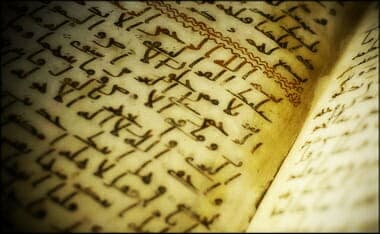
“This will be a revolution in studying Islam” ~ Oldest Qur’an Found
This post is an important part of this post detailing the differences in how the Bible and Qur’an were transmitted.
(Via Jihad Watch) “This gives more ground to what have been peripheral views of the Quran’s genesis, like that Muhammad and his early followers used a text that was already in existence and shaped it to fit their own political and theological agenda, rather than Muhammad receiving a revelation from Heaven.” Or that others later used a text that was already in existence and shaped it to fit their own political and theological agenda — which is what I argue in my book Did Muhammad Exist?.
(Via The Telegraph) …The Prophet Muhammad is thought to have founded Islam sometime after 610AD and the first Muslim community was founded in Medina in 622AD.
During this time the Koran was memorised and recited orally but Caliph Abu Bakr, the first leader of the Muslim community after Muhammad’s death, ordered the Koranic material to be collected into a book.
The final authoritative written form was not completed until 650AD under the third leader Caliph Uthman.
Professor Nadir Dinshaw, who studies interreligious relations at the University of Birmingham, described the discovery as ‘startling’.
When it was found last month he said: ‘This could well take us back to within a few years of the actual founding of Islam.
‘According to Muslim tradition, the Prophet Muhammad received the revelations that form the Qur’an, the scripture of Islam, between the years AD 610 and 632, the year of his death.
‘At this time, the divine message was not compiled into the book form in which it appears today. Instead, the revelations were preserved in ‘the memories of men’…
Prior to this new find, this fragment was the oldest:
(Via Breitbart) …Some academics now say that the impact of the text could be comparable to finding a copy of the Gospels dating back to before the time of Christ.
Historian Tom Holland told the Sunday Times that evidence was now mounting that traditional accounts of Islam’s origins are wrong.
“It destabilises, to put it mildly, the idea that we can know anything with certainty about how the Koran emerged — and that in turn has implications for the historicity of Muhammad and the Companions [his followers],” he said.
Other very old Korans also seem to confirm that written texts were circulating before Mohammed’s death.
Needless to say, Muslim academics have disputed the claims. Mustafa Shah of London’s School of Oriental and African Studies (SOAS) said: “If anything, the manuscript has consolidated traditional accounts of the Koran’s origins.”
[….]
“If the [carbon] dates apply to the parchment and the ink, and the dates across the entire range apply, then the Koran — or at least portions of it — pre-dates Muhammad, and moves back the years that an Arabic literary culture is in place well into the 500s.
“This gives more ground to what have been peripheral views of the Koran’s genesis, like that Muhammad and his early followers used a text that was already in existence and shaped it to fit their own political and theological agenda, rather than Muhammad receiving a revelation from heaven.
“This would radically alter the edifice of Islamic tradition and the history of the rise of Islam in late Near Eastern antiquity would have to be completely revised, somehow accounting for another book of scripture coming into existence 50 to 100 years before, and then also explaining how this was co-opted into what became the entity of Islam by around AD700.”

Republicans Reject Trump’s Religious Test ~ Rightly So
In Starbucks I overheard a conversation mentioning Republicans not saying much against Trump’s position of a religious test for people coming into the U.S. I wanted to post some audio of Lindsey Graham and Carly Fiorina (from the Michael Medved Show) where they very clearly and strongly deny Trumps position. In fact, as of today, ALL the other Republican Presidential candidates have come out against Trump on this issue.
What Trump has right is that we can (and have) stopped immigration at times from countries… but what he has wrong is that we cannot [Constitutionally] ban people entry from the world who are Muslim. You could stop immigration (all immigration) Constitutionally from, say, Syria and Pakistan… but not, as Medved points out, from Saudi Arabi — who are our “allies.” Here is that audio that includes some challenging phone calls. Take note Zuhdi Jasser was the guest during this hour:
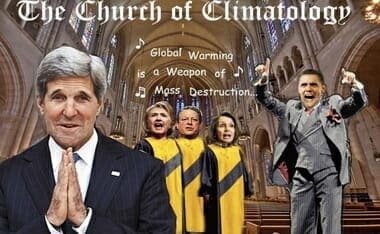
Bible Calls U.S. To Guard Muslims From “Global Warming” ~ Kerry
“…you can see this duty, or responsibility, laid out in scriptures clearly…” (Truth Revolt)
Via One News Now
Already under fire for many of his anti-Christian and pro-Muslim sentiments expressed during his relatively short time in serving under the Obama administration, United States Secretary of State John Kerry made another fairly recent assertion that has many Christians up in arms, as he attempted to interpret Scriptures to say that America is commanded by the Bible to protect the Muslim world from “global warming.”
[….]
America’s chief foreign diplomat contended that both religions scripturally share a common bond to the environment, asserting that because most Muslim countries are “vulnerable” to the effects of “climate change,” the United States is obligated to safeguard them by implementing green policies to protect them from the so-called effects of pollutants.
“Our faiths are inextricably linked on any number of things that we must confront and deal with in policy concepts today,” Kerry proclaimed late last year, according to Freedom Outpost. “Our faiths are inextricably linked on the environment. For many of us, respect for God’s creation also translates into a duty to protect and sustain His first Creation, Earth, the planet.”
Staying true to much of the environmentalist messaging and rhetoric used to promote the green movement’s endorsement of global warming-based policies and industries, Kerry used the Book of Genesis to imply that “Mother Earth” and nature should come before man.
“Before God created man He created Heaven and Earth,” Kerry stressed at the ceremony.
Fighting the greatest threat to humanity?
Kerry argues that fighting the highly contested global warming is perhaps the biggest threat to the world — and he attempted to use the Bible to prove his point, commanding America to use green technology and policies to “aid” Islamic nations.
“Confronting climate change is, in the long run, one of the greatest challenges that we face, and you can see this duty or responsibility laid out in Scriptures, clearly, beginning in Genesis,” Kerry insisted. “And Muslim-majority countries are among the most vulnerable. Our response to this challenge ought to be rooted in a sense of stewardship of Earth. And for me and for many of us here today, that responsibility comes from God.”
Islam’s Golden Age vs. Christian Medieval Science
Here is the excerpt from Dr. Chapman’s book:
Christianities Advancement vs. Islam’s Stalling
…But what I would argue is that science entered early Christian and medieval Europe by a process of cultural osmosis. For one of the formative and enduring features of Christianity, from the AD 30s and 40s onwards, was its social and cultural flexibility. One did not have to belong to any given racial or cultural group, wear any approved style of clothing, cut one’s beard in a prescribed way, speak a special holy language, or follow essential rituals to be a Christian. Women in particular, amazingly, considering their limited social role in antiquity, were drawn to Christianity in large numbers, as the Gospels and the Acts of the Apostles make clear, where they are shown as openly expressing their views. They were even the original witnesses of the resurrection, while St Paul’s first European convert was Lydia of Thyatira, a Greek merchant woman.
In fact Christianity moved into the pre-existing social, legal and administrative structures of Greco-Roman paganism, as Greek civic virtue became infused with Judeo-Christian charity. Roman legal objectivity absorbed key aspects of the teachings of the Sermon on the Mount and the Beatitudes to create a concept of social justice; even the modes of dress of late Roman officials became the vestments of Christian priests; while words like “bishop” and “diocese” derived from classical administrative sources. Christianity, instead of overthrowing the genius of Greece and Rome, simply absorbed its best practical components, and allied them with the teachings of Jesus. The law codes of Christendom, moreover, came to develop non-theological components. The circuit judge system set up by King Henry II in the twelfth century, for instance, might have carried resonances of the assistant judges of Israel appointed by Moses in Exodus, or the judgment towns visited by the prophet Samuel in 1 Samuel, but in practice it administered a new, practical English “Common Law”, and the judges often sat with that innovation of the age, a twelve-man lay jury.
This is how medieval students in Oxford, Paris, Bologna, or Salamanca came to study the pagan philosophies of Plato and Aristotle, the classical Latin poetry of Virgil, and the humane ethics of Cicero along with the Gospels. And very important for the rise of a civil society in which there was an acknowledged saeculum or non-theological exclusivity, the law students at the medieval Inns of Court in London, then as today, learned a pragmatic, case-based evolving civil law that was not especially theological in its foundation. For medieval Christendom was open to non-Christian ideas, provided that they could be reconciled in their broader principles with Christianity.
Exactly the same thing happened with science. The astronomy of Ptolemy, the physics of Aristotle, and the medicine of Hippocrates became part of the curriculum in Europe’s great new universities by 1250. Indeed, it was generally accepted that many honest pagans had glimpsed key truths of God’s creation, and who could blame the wise Socrates and Aristotle if they happened to have been born 400 years before Jesus, for their wisdom and honest contributions to learning were beyond question. This is how ancient science came to slide effortlessly into the Christian world, for it was useful for making calendars, treating diseases, and explaining the physical nature of things from the facts then available.
But, you might ask, when talking about science and Christendom, what happened in monotheistic Islam? It is an evident fact of history that, after its initial military conquests in the century after AD 622, Muslim scholars in Baghdad, Cairo, and southern Spain encountered the scientific and medical writings of the Greeks, which they translated into Arabic. And amidst a galaxy of figures such as Ibn Jabir in chemistry, Ibn Sina (Avicenna) in medicine, Ibn Tusi in astronomy, and Al-Haythem (Alhazen) in optics, Arabic science took the Greek scientific tradition further, research-wise, than anyone in Europe over the centuries AD 800-1200. But then, due to a variety of factors embedded within Islamic culture, it stalled and came to a standstill, especially after their last great scientist, the astronomer Ulugh Beigh of Samarkand, was murdered, it was said, by one of his own sons in 1449.
There has been much discussion among scholars as to why Islamic science declined as an intellectual and technical force, and why Christian Europe after 1200 developed a momentum which absorbed — with full acknowledgment — the achievements of the great Muslim scholars and scientists, and accelerated in an unbroken line of development down to the present day. For Islam, just like Judaism and Christianity, is a monotheistic faith, seeing the God of Abraham as the original and only creative force behind the universe. So why did the Islamic monotheistic tradition stall scientifically, while the Judeo-Christian tradition flourished? I think much has to do with a broader receptivity to classical Greco-Roman culture.
As was shown above, Christianity grew directly out of a combination of Judaism and wider Greco-Roman culture. Jesus the man was incarnated as a Jewish rabbi who preached in vernacular Aramaic and could read Hebrew, yet whose teachings, not to mention the commentaries of his disciples, were committed to posterity in Greek and, somewhat later, in Latin. The Jesus of the Gospels, moreover, respected Caesar, the Roman state and its officials; and his disciples even held an election to decide whether Barnabas or Matthias should be co-opted into the Twelve after Judas’s treachery; while St Paul, a Jewish native of the Hellenized “university town” of Tarsus in Cilicia (now Turkey), argued like a Socratic philosopher in his letters and was deeply proud of being a hereditary Roman citizen. Islam, on the other hand, came about in a very different way. The Prophet Mohammed’s roots lay in the essentially tribal society of the seventh-century-AD Arabian peninsula, east of the Red Sea. Tribal custom and not Greco-Roman “civic virtue” moulded its social and cultural practices, and Islam’s lack of a theology of free grace and atonement gave emphasis to an internal legalism that could all too easily generate centuries long sectarian disputes, such as those between the Shi’ites and the Sunnis. And while I fully admit that Christendom has had its own spasms of internal violent reprisal, most recently witnessed in the Troubles in Northern Ireland, I would suggest that Christendom’s classically derived constitutional, negotiated, approach to politics has always provided mechanisms for containment and reconciliation. This has been seen most notably in the active cooperation between the Roman Catholic and Protestant mainstreams, often on an overtly religious level, although splinter groups can remain active until changes in public attitudes eventually render them obsolete.
Islam took from Greco-Roman culture what it found useful in the territories it conquered. These included Greek astronomy, optics, medicine, chemistry, and technology, each of which it amplified and expanded, producing major treatises, often based upon freshly accumulated and carefully classified observational data. Chemistry came to owe an enormous debt to Arabic researchers, as would astronomical, medical, and botanical nomenclature. Indeed, well over a dozen major Arabic works made their way into Europe, where they were translated into Latin, influencing figures like Bishop Robert Grosseteste and Friar Roger Bacon of Oxford, and began to be widely studied in detail in the post-1100 European universities. (On the other hand, I am not aware of the foundational works of European science, such as those of Copernicus, Kepler, Galileo, Vesalius, or Harvey, being translated into Arabic until recent times.) And among other things, that astronomical computing instrument known as the astrolabe, upon which the poet Geoffrey Chaucer wrote the first technical “workshop manual” in the English language around 1381, was a sophisticated Arabic development of a device first outlined by Ptolemy in the second century AD.
Yet while Greek ideas were profoundly formative upon Arabic concepts of the natural world, Islam did not absorb other key ideas of Greek and Roman culture which would become formative to Christian Europe. Greek democratic political ideals, “civic virtue”, and legal monogamy (divorce and mistresses notwithstanding) never became an integral part of Islam as they did of Christendom. Nor did the descent of kingship through holy anointing, which began with Samuel, Saul, and David in 1 Samuel in the Old Testament and entered early Christian kingship practices as the act of coronation, and is still enshrined in the person of HM Queen Elizabeth II.
It is for these reasons, I would argue, that modern science is a child of Judeo-Christian, Greco-Roman parentage, and why I speak of Western science as becoming the dominant style of thinking about the natural world and humanity’s inquisitive relationship with it. Indeed, it is not just about the science and technology, but about the social, intellectual, and cultural assumptions and practices in which modern science is embedded. The very institutions within which science has grown up over the last 900 years, moreover, testify to this inheritance: universities with enduring corporate structures borrowed from Greek and Roman linguistic and civic practice; learned societies — such as the Royal Society of London after 1660 — which were self-electing, self-governing bodies modelled on the “collegiate”, “civic virtue” style Oxford and Cambridge colleges; and rich, free-trading merchant-driven cities such as London, Florence, Venice, Nuremberg, Amsterdam, Antwerp, and Hamburg.
As will be shown in more detail in the following chapters, historical Christianity has never been rigidly literalistic in its interpretation of the physical world of Scripture, and it is that very flexibility that has made the faith so versatile and adaptive in its social expression over 2,000 years. A faith that made its first utterance among Aramaic-speaking fishermen and farmers around Galilee (occupying a land surface area no bigger than modern Birmingham), quickly went on to enchant Greek-writing scholars, led to the conversion of the Roman Empire, encompassed people between Mesopotamia, Spain, Britannia, and Ethiopia by AD 600, would inspire the new Latin-speaking universities of Europe by 1200, would engraft onto itself the science, philosophy, legal and social practices of the high classical Mediterranean, would explore possible connections between the teachings of Jesus and the writings of Plato and Virgil, and whose Scriptures would be translated into the vernacular languages of Europe by 1550. Christianity would then go on to inspire the natural theology of the Royal Society Fellows, be the driving force behind the abolition of slavery, supply the moral and spiritual tools that constitute the best and noblest aspects of what we now call “human rights” — and become the prime target for some of the bitterest abuse that many twenty-first-century sceptics feel compelled to heap upon religious belief (and I have heard a good deal of that at first hand!).
Indeed, considering the magnitude of Christianity’s moulding influence upon Western civilization, and its provision of that rich soil in which post-classical science could flourish and grow, it is hardly surprising that, in this imperfect world, it has detractors…
Allan Chapman, Slaying the Dragons: Destroying the Myths in the History of Science and Faith (Oxford, England: Lion Publishing, 2013), 18-23.
ISLAM’s “Golden Age” revisited
The Golden Age of Islam – A Second Look
…Victor Davis Hanson has taken down Obama’s version of the Golden age of Islam:
In his speech last week in Cairo, President Obama proclaimed he was a “student of history.” But despite Mr. Obama’s image as an Ivy League-educated intellectual, he lacks historical competency in both facts and interpretation. … Obama … claimed that “Islam . . . carried the light of learning through so many centuries, paving the way for Europe’s Renaissance and Enlightenment.” [In fact] medieval Islamic culture … had little to do with the European rediscovery of classical Greek and Latin values. Europeans, Chinese, and Hindus, not Muslims, invented most of the breakthroughs Obama credited to Islamic innovation. … Much of the Renaissance, in fact, was more predicated on the centuries-long flight of Greek-speaking Byzantine scholars from Constantinople to Western Europe to escape the aggression of Islamic Turks. Many romantic thinkers of the Enlightenment sought to extend freedom to oppressed subjects of Muslim fundamentalist rule in eastern and southern Europe.
Andrew Bostom has skewered the myth that Cordoba was a model of ecumenism:
Expanding upon Jane Gerber’s thesis about the “garish” myth of a “Golden Age,” the late Richard Fletcher (in his Moorish Spain) offered a fair assessment of interfaith relationships in Muslim Spain and his view of additional contemporary currents responsible for obfuscating that history:
The witness of those who lived through the horrors of the Berber conquest, of the Andalusian fitnah [ordeal] in the early eleventh century, of the Almoravid invasion — to mention only a few disruptive episodes — must give it [i.e.: the roseate view of Muslim Spain] the lie.
The simple and verifiable historical truth is that Moorish Spain was more often a land of turmoil than it was of tranquility. … Tolerance? Ask the Jews of Granada who were massacred in 1066, or the Christians who were deported by the Almoravids to Morocco in 1126 (like the Moriscos five centuries later). … In the second half of the twentieth century a new agent of obfuscation makes its appearance: the guilt of the liberal conscience, which sees the evils of colonialism — assumed rather than demonstrated — foreshadowed in the Christian conquest of al-Andalus and the persecution of the Moriscos (but not, oddly, in the Moorish conquest and colonization). Stir the mix well and issue it free to credulous academics and media persons throughout the Western world. Then pour it generously over the truth … in the cultural conditions that prevail in the West today, the past has to be marketed, and to be successfully marketed, it has to be attractively packaged. Medieval Spain in a state of nature lacks wide appeal. Self-indulgent fantasies of glamour … do wonders for sharpening its image. But Moorish Spain was not a tolerant and enlightened society even in its most cultivated epoch.
Serge Trifkovic also has a general take-down of the overblown account of the accomplishments and comity of the Islamic Golden Age in his FrontPage article, The Golden Age of Islam is a Myth.
And now we have Emmet Scott, in a soon to be released study, Mohammed & Charlemagne Revisited: An Introduction to the History of a Controversy, advancing the thesis that Rather than preserving the Classical heritage, the expanding Islamic empire destroyed it and brought about the Dark Ages.
Armed with new archaeological evidence, Scott makes the compelling case, originally put forward in 1920 by Henri Pirenne, a Belgian historian, that Classical civilization did not collapse after the fall of the Roman empire but was gradually attrited by the onslaught of Arab armies and raiders. The Islamic Golden Age came close to permanently destroying the classical humanistic culture of the West.
Hanson has pointed out the factual errors in Obama’s paean to Islam’s Golden Age. Andrew Bostom has skewered the myth that Cordoba was a model of ecumenism Trikovic has shown that the continuation of learning, science, technology of the “Golden age of Islam” prospered in spite of Islam and not because of Islam and now we have Emmet Scott skewering the myth that the Golden Age of Islam saved Classical humanistic Western culture. What is next? The glory of Sharia?
See also my past posts on the topic:
Parents In Florida Upset About Embalance of Islam Represented in a World History high School Textbook
This comes via Creeping Sharia:
via Protest over Islam lovefest high school history textbook | The Daily Caller.
On Florida’s Atlantic Coast, some 200 or more local parents and activists have announced plans to show up at Tuesday’s Volusia County school board meeting to protest the public school use of a world history textbook that devotes a whole chapter to Islam but exactly zero chapters to any other religions.
The textbook, called simply “World History,” contains a 32-page chapter fondly devoted to “Muslim Civilizations.” Sections include descriptions of the Koran, the growth of the Muslim empire and the Five Pillars of Islam.
The planned protest will include a demand that students rip out the 32 pages of the Islam chapter unless the school district agrees to provide students with a similar amount of officially-sanctioned material concerning other religions, reports local ABC affiliate WFTV.
The seeds for the Wednesday protest were reportedly planted after an unidentified local mother started a Facebook page demanding that local, taxpayer-funded schools stop using the textbook.
The district indicated that it will continue to use the controversial book.
School district officials in Volusia County insist that there’s no problem because other religions come up as a matter of course in the book. Thus, the argument goes, there’s no need to have a single chapter dedicated to, say, the Gospels or the Pentateuch—or, for that matter, Hindu or Buddhist religious traditions.
“Christianity and Judaism is [sic] spread throughout the book,” a school district spokeswoman told WFTV.
The book’s supporters also argue that students know about Christianity but need to learn more about Islam because of its crucial importance in international affairs.
On Monday, the Council on American-Islamic Relations (CAIR) issued a statement criticizing the protesters.
“This group is displaying an alarming level of intolerance and brazen disregard of minority religions here in the US. We find their actions Un-American and against every core principal that makes this country so great,” CAIR said.
Critics of the textbook include District 2 Deltona commissioner Webster Barnaby, who told WFTV that he is only seeking equal time for other religions, specifically Christianity.
“The problem is: there needs to be balance. In America today, Christianity is being relegated to the trash heap,” Barnaby told the station.
“Why relegate Christianity to a footnote in an entire history book, and you give an entire chapter on the teachings of Islam?” he added.
“To suggest that everybody knows about Christianity, that is total ignorance,” Barnaby also said.
The “World History” textbook is one of three textbooks covering similar material that meet Florida’s criteria for adoption by the state’s public schools.
As a school district spokeswoman noted, one reason school districts select this book is because it covers information required under Florida’s Next Generation Sunshine State Standards—the state’s version of the Common Core.
Why do media outlets continue to reach out for comments from the same terror-linked infiltrators who helped get Islam in and other religions out of U.S. textbooks?
Nabeel Qureshi: Jesus of Islam vs Jesus of Christianity (Serious Saturday) Biola Masters in Christian Apologetics

Obama’s Grandfather NOT Tortured by British
 Some new information about Obama’s grandfather and his treatment by the British may be another lie penned by Obama. MAIL ONLINE HAS THIS:
The Many Lies of Obama
…Continuing, the DAILY MAIL notes the fiction around the narrative well:
A new biography of Barack Obama has established that his grandfather was not, as is related in the President’s own memoir, detained by the British in Kenya and found that claims that he was tortured were a fabrication.
‘Barack Obama: The Story’ by David Maraniss catalogues dozens of instances in which Obama deviated significantly from the truth in his book ‘Dreams from My Father: A Story of Race and Inheritance’. The 641-page book punctures the carefully-crafted narrative of Obama’s life.
One of the enduring myths of Obama’s ancestry is that his paternal grandfather Hussein Onyango Obama, who served as a cook in the British Army, was imprisoned in 1949 by the British for helping the anti-colonial Mau Mau rebels and held for several months.
Obama’s step-grandmother Sarah, Onyango wife, who is still living, is quoted in the future President’s memoir, as saying: ‘One day, the white man’s askaris came to take Onyango away, and he was placed in a detention camp.
‘But he had been in the camp for over six months, and when he returned to Alego he was very thin and dirty. He had difficulty walking, and his head was full of lice. He was so ashamed, he refused to enter his house or tell us what happened.’
In a 2008 interview, Sarah Obama claimed that he was ‘whipped every morning and evening’ by the British. ‘They would sometimes squeeze his testicles with metal rods. They also pierced his nails and buttocks with a sharp pin, with his hands and legs tied together. He was lucky to survive. Some of his fellow inmates were mutilated with castration pliers and beaten to death with clubs.’
But Maraniss, who researched Obama’s life in Kenya, Indonesia, Hawaii and the mainland United States, found that there were ‘no remaining records of any detention, imprisonment, or trial of Hussein Onyango Obama’. He interviewed five people who knew Obama’s grandfather, who died in 1979, who ‘doubted the story or were certain it did not happen’.
This undermines the received wisdom that Obama’s grandfather was a victim of oppression, an assumption that has in turn fuelled theories that Obama harbours an animus towards Britain based on a deeply-rooted rage about the way Onyango was treated.
John Ndalo Aguk, who worked with Onyango before the alleged imprisonment and was in touch with him weekly afterwards said he ‘knew nothing’ about any detention and would have noticed if he had gone missing for several months.
AMERICAN THINKER has a few of Buzz Feeds 9-Lies of Obama:
1. Hussein Onyango, Barack’s grandfather, wasn’t really imprisoned and tortured by the British. Interestingly, this destroys the case that some conservatives have made about Obama’s hatred of Great Britain – or at least the primary reason for it.
2. The father of his Indonesian stepfather, Soewarno Martodihardjo, wasn’t killed by Dutch soldiers in the fight for independence.
3. Regina, a friend at Occidental who Obama writes about as a symbol of the authentic African-American experience turns out to be based on Carolina Boss, who is white. Regina was the name of her Swiss grandmother.
5. Obama wrote that he broke up with his New York girlfriend in part because she was white. But his next girlfriend, an anthropologist in Chicago, was also white.
7. Obama wrote about his high school friends as an alienated, ne’er-do-well “club of disaffection.” In fact, most members of the “Choom Gang” were “decent students and athletes” who went on to successful careers.
8. Obama’s mother left his father, not the other way around.
And it was Barack Obama’s grandfather was the one that introduced Islam to the family:
What your grandfather respected was strength. Discipline. This is why, even though he learned many of the white man’s ways, he always remained strict about Luo traditions. Respect for elders. Respect for authority. Order and custom in all his affairs. This is also why he rejected the Christian religion, I think. For a brief time, he converted, and even changed his name to Johnson. But he could not understand such ideas as mercy towards your enemies, or that this man Jesus could wash away a man’s sins. To your grandfather, this was foolish sentiment, something to comfort women. And so he converted to Islam—he thought its practices conformed more closely to his beliefs.
Barack Obama, Dreams of my Father: A Story of Race and Inheritance (New York, NY: Crown Publishers, 2004), 395. (PDF version)
- See also AMERICAN SPECTATOR

Same-Sex Matters (Race and Gender in Marriage)
(This audio is a FLASHBACK from JUNE 17, 2008) The only reason I know that is because of the reference to this L.A. Times article, “The Right to Love” (Reproduced in full in the appendix)
I wanted to share here some conversation and further thinking on a topic that was discussed vigorously amongst friends while partaking in choice hops this past Halloween weekend. The below is written in conversation style (almost all my posts are like this) for friends. So it will seem personal at times.
A plea for friends who are in relationships… this is meant for continued deeper reflection. Take your time and reflect thoughtfully and if discussed amongst yourselves, discuss civilly. Through all the conversation, know that right now in California civil partnerships hold all the legal equality (taxes, health-care coverage, hospital visits, etc) to marriage. So the push to have “same-sex marriage” isn’t about “equality,” it’s about ideology.
Also keep in mind that I am not in any way under the impression that a simple conversation like this will undue many years of thinking on a matter/subject. (You or Myself.) I would rather you at the least be introduced to a side of an issue that maybe you haven’t heard of before. This introduction to other arguments may be long and tedious. TAKE YOUR TIME (*caps not yelling but said for impact*). Great theories and coming to positions (spiritual and political) on a matter take time and evolve, sometimes over years. Or at least they should be considered with weightiness and not merely adopted from university or parental influence.
I have no idea either what you may have been introduced to (for instance: Howard Zinn, the self admitted Marxist and historian whose historical viewpoint was born from Marx and Engels writings – on other words, his historical philosophy didn’t exist prior to the Communist Manifesto). This view of history tends to be popular at the university campus. In other words, many of our views are rooted in deeper worldviews and the peripheral views we hold may never change until you look a bit deeper into our worldview.
- (What does a worldview entail? Any “coherent worldview must be able to satisfactorily answer four questions: that of origin, meaning, morality, and destiny.” Another writer outs it thusly: “A Worldview is how one views or interprets reality. The German word is Weltanschauung, meaning a ‘world and life view,’ or ‘a paradigm.’ It is a framework through which or by which one makes sense of the data of life. A worldview makes a world of difference in one’s view of God, origins, evil, human nature, values, and destiny.” Raising one’s self-consciousness [awareness] about worldviews is an essential part of intellectual maturity.)
In my mind’s eye we are talking about peripheral positions that would be impacted more by a deeper look into how we view reality… something not often looked into by the general populace today (see my first chapter in my book). So again,
- I am more concerned about clarity than agreement in this conversation.
Many positions we hold as fact can be based in fallacious thinking. I will exemplify this by a topic that was brought up the other night, anthropogenic global warming (man caused global warming). History and science come together to disprove this theory. Not only has the “hockey stick” model that gave birth to this giant theory which was popularized by Al Gore [Britain’s courts referenced many lies in his presentation to not show it in public schools] has been torn to shreds science-wise, history shows the complete breakdown of the premise. For instance:
(1) Mars (Uncommon Descent h/t) has had a bout of global warming… last I checked Exxon doesn’t drill there;
(2) In the 8th century AD, the Roman Empire grew grapes used for wine on the slopes of Salisbury Plain (about 80 miles southwest of London) in the United Kingdom;
(3) The Vikings raiding and traveling the seas was made possible by the now frozen “Greenland”actually living up to its name;
(4) NASA‘s “fact” that 1998 was the warmest year (used by Al Gore) was disproved by an amateur mathematician;
(5) In 1970’s, at the first Earth Day rally, scientists, meteorologists and politicians all pushed a theory that there was Global Cooling (Time magazine for instance). While this theory wasn’t as embedded in popular thinking and scientific literature as is global warming, it was still the dominant theory of that time;
(6) There is more ice now that 29-years ago; Antarctic sea ice more than in 1979;
(7) In the 1500’s till the late 1800’s passages that are now iced over allowed for what is termed as the Northwest Passage… Exxon or cars weren’t around then?
“If you are like me and bit foggy on the Northwest Passage, here is a five cent refresher. The British coined the term Northwest Passage for the potential northern oceanic pass that would allow vessels to move between the Atlantic and Pacific Oceans. The earliest explorations for the fabled passage were by Cortes in 1539. The late 1500’s were marked by British explorers, Martin Frobisher, Humphrey Gilbert, and John Davis. Several expeditions followed, all with little success of finding the passage but tempered by the acquisition of new lands. Some attempts lead to deaths of entire crews. Notable of these is the Sir John Franklin expedition in which all of the crew members were lost to starvation, scurvy, cannibalism, and lead poisoning from food sealed in tins. The first to transverse the Northwest Passage was Sir Robert McClure using a combination of both sledge and ship. Ironically this was done during the search for Franklin’s team in which McClure’s own ship became trapped in the ice for three winters. The passage was finally conquered entirely by sea by the Norwegian Amundsen in 1906.”
(8) Acid rain scares of the 1980’s were mostly unfounded and not man-caused;
(9) On the northern side of Mammoth (in California), there are tree-lines that were preserved by a volcanic eruption in A.D. 1350. In this preserved tree-line there were seven species of tree that grew well above the current tree-line in this mountainous range. The Earth would have to be 3.2 degrees warmer (Celsius) in order for these particular trees to grow in this higher altitude.
So one can believe in man caused Global Warming, but the facts speak for themselves. (See my son’s 6th grade debate for Toast Masters for instance.) What would drive this view then? Patrick Moore, who you’ll remember is the co-founder of Green Peace, answers this important query, saying:
“I now find that many environmental groups have drifted into self-serving cliques with narrow vision and rigid ideology…. many environmentalists are showing signs of elitism, left-wingism, and downright eco-fascism. The once politically centrist, science-based vision of environmentalism has been largely replaced with extremist rhetoric. Science and logic have been abandoned and the movement is often used to promote other causes such as class struggle and anti-corporatism. The public is left trying to figure out what is reasonable and what is not.”
MOVING ON.
I almost wrote on the topic we spoke a bit about the other night back in September and wish I had, but instead I switched gears and wrote on the Left’s support for pedophilia (explicit and implicit) in their support of many groups who promote it – here in the united states and abroad (See: The Left / Islamo-Nazis / Homosexuality / Womens Rights / and Contradictions). I would like us to stay on just this topic if we can work though it.
Before getting to the main topic that we left last night about interracial marriage being illegal on the basis of color and homosexuality being equated to that [i.e., race], I wish to post some of what I said last night for record sake. This comes from a question asked of me by one of my son’s friends. He asked “What is your views on gays? Are they bad? Are they going to hell? Are you born this way?” (Question #3 from Q & A Session – PapaG Style) Most of what I talked about last night can be found in this post for clarity [updated a bit]:
….However, there is a “created order,” or, even a natural order (if you do not believe in God). My argument for heterosexual (between a man and a woman) unions is usable both by the atheist (non believer) and the theist (a believer in God – in the Judeo-Christian sense). Here is the crux of the matter in regards to “nature’s order:”
“…take gold as an example, it has inherent in its nature intrinsic qualities that make it expensive: good conductor of electricity, rare, never tarnishes, ease of use (moldability), and the like. The male and female have the potential to become a single biological organism, or single organic unit, or principle. Two essentially becoming one. The male and female, then, have inherent to their nature intrinsic qualities that two mated males or two mated females never actualize in their courtship… nor can they ever. The potential stays just that, potential, never being realized…..
“….Think of a being or animal or even an insect that reproduces, not by mating, but by some act performed by individuals. Imagine that for these same beings, movement and digestion is performed not by individuals, but only by the complementary pairs that unite for this purpose. Would anyone acquainted with such beings have difficulty understanding that in respect to movement and digestion, the organism is a united pair, or an organic unity? They thus become an entirely new organism when joined together — fulfilling what was only ‘potential’ when apart”
(adapted from Prof. George)
So you see, the two heterosexual organisms that join in a sexual union cease being two separate organisms for a short time and become one organism capable of reproduction. This is what the state and the church are sealing in a marriage, this intrinsic union. The homosexual couple can never achieve this union, so “natures order” has endowed the heterosexual union with an intrinsic quality that other relationships do not have or could never attain. Both the atheist and theist can argue from this point, because either we were created this way or we evolved this way. Either way, nature has imposed on the sexual union being discussed.
Also, I do not think it is wholly genetic. I believe choice is involved as well as violence. For instance, take this thought from a pro-choice, lesbian woman, Tammy Bruce:
“ . . . . and now all manner of sexual perversion enjoys the protection and support of once what was a legitimate civil-rights effort for decent people. The real slippery slope has been the one leading into the Left’s moral vacuum. It is a singular attitude that prohibits any judgment about obvious moral decay because of the paranoid belief that judgment of any sort would destroy the gay lifestyle, whatever that is…. I believe this grab for children by the sexually confused adults of the Gay Elite represents the most serious problem facing our culture today. . . . Here come the elephant again: Almost without exception, the gay men I know (and that’s too many to count) have a story of some kind of sexual trauma or abuse in their childhood — molestation by a parent or an authority figure, or seduction as an adolescent at the hands of an adult. The gay community must face the truth and see sexual molestation of an adolescent for the abuse it is, instead of the ‘coming-of-age’ experience many [gays] regard it as being. Until then, the Gay Elite will continue to promote a culture of alcohol and drug abuse, sexual promiscuity, and suicide by AIDS.”
What she is basically saying is that there are emotional reasons, usually trauma, or circumstances that push these young boys into the choices they make in regards to their sexuality. For instance, one of my co-workers is a homosexual man. He is a wonderful guy; I would invite him to my wedding if I could go back in time. He is very open about his past, he was “initiated” into the homosexual lifestyle by a grown black man when he was 14. In other words, he was raped. Whether he feels at this point in time that he consented is of no value to the conversation. He was not old enough to consent neither would this act by a family member, friend, or complete stranger be anything but rape. And this rape, at an age where boys are having surges of hormones and confused about a lot of things is what Tammy Bruce was speaking to. It is a psychological trauma that if not dealt with has negatively reverberating results in one’s life. To ignore the traumatic effects on a person’s life that an event like this has simply by “rubber stamping” the lifestyle that all too often is a consequence of violence does more harm (trauma) to the individual than simply asking society to stay within the classic definition of marriage.
This “trauma” sometimes works its way into sexual matters. There are many homosexual people, Al Rantel, to name a more popular one, that believe marriage should be kept between a man and a woman. Tammy Bruce wants it, but she, like most Republicans, want the states to decide, and not the Supreme Court.
Also, in 1993, the biggest march by the “gay” community (much thanks to a reader leaving a link to this article!) on Washington was held, and they had this as part of their platform:
The implications of homosexual, bisexual, and transgendered curriculum at all levels of education.
The lowering of the age [12 years old to be exact] of consent for homosexual and heterosexual sex.
The legalization of homosexual marriages.
Custody, adoption, and foster-care rights for homosexuals, lesbians, and transgendered people.
the redefinition of the family to include the full diversity of all family structures.
The access to all programs of the Boy Scouts of America.
Affirmative action for homosexuals.
The inclusion of sex-change operations under a universal health-care plan.
Obviously the Elite gay community Tammy Bruce spoke of knows which age is best for “recruiting,” e.g., traumatizing.
I will post three quotes from Tammy Bruce (a pro-choice lesbian):
Even if one does not necessarily accept the institutional structure of “organized religion,” the “Judeo-Christian ethic and the personal standards it encourages do not impinge on the quality of life, but enhance it. They also give one a basic moral template that is not relative,” which is why the legal positivists of the Left are so threatened by the Natural Law aspect of the Judeo-Christian ethic. (Tammy Bruce, The Death of Right and Wrong: Exposing the Left’s Assault on Our Culture and Values [Roseville: Prima, 2003], 35.)
…these problems don’t remain personal and private. The drive, especially since this issue is associated with the word “gay rights,” is to make sure your worldview reflects theirs. To counter this effort, we must demand that the medical and psychiatric community take off their PC blinders and treat these people responsibly. If we don’t, the next thing you know, your child will be taking a “tolerance” class explaining how “transexuality” is just another “lifestyle choice”…. After all, it is the only way malignant narcissists will ever feel normal, healthy, and acceptable: by remaking society – children – in their image (Ibid., 92, 206)
… and now all manner of sexual perversion enjoys the protection and support of once what was a legitimate civil-rights effort for decent people. The real slippery slope has been the one leading into the Left’s moral vacuum. It is a singular attitude that prohibits any judgment about obvious moral decay because of the paranoid belief that judgment of any sort would destroy the gay lifestyle, whatever that is…. I believe this grab for children by the sexually confused adults of the Gay Elite represents the most serious problem facing our culture today…. Here come the elephant again: Almost without exception, the gay men I know (and that’s too many to count) have a story of some kind of sexual trauma or abuse in their childhood — molestation by a parent or an authority figure, or seduction as an adolescent at the hands of an adult. The gay community must face the truth and see sexual molestation of an adolescent for the abuse it is, instead of the ‘coming-of-age’ experience many [gays] regard it as being. Until then, the Gay Elite will continue to promote a culture of alcohol and drug abuse, sexual promiscuity, and suicide by AIDS. (Ibid., 90. 99)
Many homosexuals stand against same-sex marriage. I document some in-depth views by a couple of politically astute gay persons reasons on why they stand against same-sex marriage (so it isn’t homophobia [#1], and [#2] it isn’t about a lack of “rights,” because these homosexual writers believe they are equal now). I also quote a well-known Canadian homosexual psychologist and sociologist on this topic:
Paul Nathanson, a sociologist, a scholar, and a homosexual writes that there are at least five functions that marriage serves–things that every culture must do in order to survive and thrive. They are (source):
- Foster the bonding between men and women
- Foster the birth and rearing of children
- Foster the bonding between men and children
- Foster some form of healthy masculine identity
- Foster the transformation of adolescents into sexually responsible adults
Note that Nathanson considers these points critical to the continued survival of any culture. He continues “Because heterosexuality is directly related to both reproduction and survival, … every human societ[y] has had to promote it actively . … Heterosexuality is always fostered by a cultural norm “that limits marriage to unions of men and women.” He adds that people “are wrong in assuming that any society can do without it.”
Read more: RPT Joy Behar vs. Homosexuals on Same-Sex Marriage
These are considerations often not addressed by the Left. But all this is not the main point I want to deal with, which is, race and sexual orientation.
Dennis Prager mentions the power of this argument with one of his few refutations of it:
The most effective of all morality-based arguments for same-sex marriage, the one that persuades more people than any other argument, is the one that equates opposition to same-sex marriage with the old opposition to interracial marriage.
The argument, repeated so often that it sounds incontestable, is this: Just as parts of American society once had immoral laws that forbade whites and blacks from marrying, so, today, society continues to have immoral laws forbidding men from marrying men and women from marrying women. And just as decent people overthrew the former, decent people must overthrow the latter.
Thanks in large part to widespread higher education — the higher the educational level, the more one is likely to hold this view — vast numbers of Americans believe in this equation of sex (gender) and race.
But the equation is false.
First, there is no comparison between sex and race.
There are enormous differences between men and women, but there are no differences between people of different races. Men and women are inherently different, but blacks and whites (and yellows and browns) are inherently the same. Therefore, any imposed separation by race can never be moral or even rational;
on the other hand, separation by sex can be both morally desirable and rational. Separate bathrooms for men and women is moral and rational; separate bathrooms for blacks and whites is not….
Read more: False Equation: Opposing Same-Sex Marriage and Opposing Interracial Marriage
(In the audio to the right, this first caller should be listened to, below is the visual of the discussion.)
That first reason is why almost all the black civil rights leaders that marched with Martin Luther King Jr. do not support this comparison. For instance,
APPENDIX
Average Household Income:
Homosexuals – $55,430 / African Americans – $12,166
Percentage of College Graduates:
Homosexuals – 60% / African Americans – 5%
Holding Professional Positions:
Homosexuals – 49% / African Americans – 1%
Taken Overseas Vacations:
Homosexuals – 66% / African Americans – 1%
Ever Denied the Right to Vote:
Homosexuals – No / African Americans – Yes
Ever Faced Legal Segregation:
Homosexuals – No / African Americans – Yes
Ever Denied Access to Public Restrooms:
Homosexuals – No / African Americans – Yes
Ever Denied Access to Businesses and Restaurants:
Homosexuals – No / African Americans – Yes
(Wall Street Journal, 7/18/91, B1)
Read more: RPT Homosexuality: Is It Good For Society? For The Individual?
In a New York Times article entitled, “Blacks Rejecting Gay Rights As a Battle Equal to Theirs,” we find some interesting supposed parallels made by the Left taken to task. For instance, Vernetta Adams, A balck 24-year-old woman and history major at the University of the District of Columbia said this, “I can’t go in a closet and hang up my race when it’s convenient…. Gays hid in the closet when they wanted to advance. Now they’re out and demanding rights and yelling ‘discrimination.'” The The Rev. Lou Sheldon intimates the reasons he thinks many in the gay community are making this parallel:
- “The reason gays are making parallels,” Mr. Sheldon said, “is that it may bring empathy from white men like me, who feel a collective sense of guilt about the way blacks have been treated. The fact remains that this is not a civil rights issue but a moral issue.”
This is the point that separates race from gender. That is, homosexuals have not been discriminated against:
Another argument for gay rights laws depends upon an analogy between homosexuals today and blacks before the civil rights movement. It claims that homosexuals similarly constitute a distinct and oppressed minority and that, although they do enjoy many civil liberties, they are nonetheless second-class citizens because people scorn and reject them out of prejudice. Hence, gay rights laws, modeled on civil rights statutes for blacks, should be enacted to correct this.
Yet the analogy is not sound. Homosexuals are not an oppressed minority in the way that blacks were. They have not suffered from imposed segregation, systematic economic deprivation, or denial of educational opportunities. Furthermore, they do not suffer from an inherited pattern of deprivation, since the homosexual condition is not passed from generation to generation like race or ethnicity. Rather, it has been well documented that homosexuals have, on average, incomes much higher than the national norm and that, on average, they receive several years more formal schooling than the typical American. They occupy thousands of positions of prestige and influence in business, academia, the professions, and the media. It cannot plausibly be maintained that they are an oppressed minority.
Michael Pakaluk, “Homosexuality and the Principle of Nondiscrimination,” 77-78, found in Christopher Wolfe, ed., Same-Sex Matters: The Challenge of Homosexuality [Dallas, TX: Spence Publishing, 2000].
Some discussion of the 3/5ths Clause in the Constitution came up as well. Frederick Douglas in his early years thought that this proved a “race bias” embedded in our country. Until that is, he read the Constitution and those writings of the authors of these sections and the debates (history) on such clauses:
Another point I make (in the post Homosexuality: Is it good for society? For the individual?) is that there is an issue before us:
- A liberal society might, then, find it prudent to ignore homosexuality. It might well deem it unwise to peer into private bedrooms. However, this is not the issue before us. Today the demand is that homosexuality be endorsed and promoted with the full power of the law. This would require us to abandon the standard of nature, the one standard that can teach us the difference between freedom and slavery, between right and wrong.
What is the “issue before us?” I will let professor Robert George talk about it further:
….Lawyers challenging traditional marriage laws liken their cause to Loving v. Virginia (which invalidated laws against interracial marriages), insinuating that conjugal-marriage supporters are bigots. This is ludicrous and offensive, and no one should hesitate to say so.
The definition of marriage was not at stake in Loving. Everyone agreed that interracial marriages were marriages. Racists just wanted to ban them as part of the evil regime of white supremacy that the equal protection clause was designed to destroy.
Opponents of racist laws in Loving did not question the idea, deeply embodied in our law and its shaping philosophical tradition, of marriage as a union that takes its distinctive character from being founded, unlike other friendships, on bodily unity of the kind that sometimes generates new life. This unity is why marriage, in our legal tradition, is consummated only by acts that are generative in kind. Such acts unite husband and wife at the most fundamental level and thus legally consummate marriage whether or not they are generative in effect, and even when conception is not sought.
Of course, marital intercourse often does produce babies, and marriage is the form of relationship that is uniquely apt for child-rearing (which is why, unlike baptisms and bar mitzvahs, it is a matter of vital public concern). But as a comprehensive sharing of life—an emotional and biological union—marriage has value in itself and not merely as a means to procreation. This explains why our law has historically permitted annulment of marriage for non-consummation, but not for infertility; and why acts of sodomy, even between legally wed spouses, have never been recognized as consummating marriages.
Only this understanding makes sense of all the norms—annulability for non-consummation, the pledge of permanence, monogamy, sexual exclusivity—that shape marriage as we know it and that our law reflects. And only this view can explain why the state should regulate marriage (as opposed to ordinary friendships) at all—to make it more likely that, wherever possible, children are reared in the context of the bond between the parents whose sexual union gave them life.
If marriage is redefined, its connection to organic bodily union—and thus to procreation—will be undermined. It will increasingly be understood as an emotional union for the sake of adult satisfaction that is served by mutually agreeable sexual play. But there is no reason that primarily emotional unions like friendships should be permanent, exclusive, limited to two, or legally regulated at all. Thus, there will remain no principled basis for upholding marital norms like monogamy….
(Gay Marriage, Democracy, and the Courts: The Culture War Will Never End If Judges Invalidate The Choices Of Voters – Wall Street Journal)
While the following may be a bit graduate level, it is worth reading and digesting, as it makes similar points to the above comments by Robert George in the article he wrote, but it looks at the health of society. Like I said, you should take your time, follow through on some of the links, which would be equivalent to a small book being read. The following is taken from the chapter of my book entitled, Roman Epicurean’ism – Natural Law and Homosexuality (this section starts on page 14 if you wish to follow the references):
“Civil” Wars
The very heart of natural law is the family, for the distinction of male and female is at the very origin of our divinely ordained (e.g., created) social nature.[85] “Deviation from the ordained goal of heterosexual intercourse within marriage therefore strikes at the very heart of natural law.”[86] Civil marriage, then, exists merely to recognize a pre-existing social institution presupposing a created order vis-à-vis natural law tradition. “The state does not create marriage – it merely recognizes it. Marriage, in its truest sense, is neither a civil institution nor a religious one, but a natural institution. The complimentarity of male and female is an essential part of its nature.”[87] You see, the state has a vested interest in the family unit. If people could not have children, then the state would not be involved in the legal aspect of such a private contract. Michael Pakaluk, Associate Professor of Philosophy, Clark University, uses Justice John Harlan’s[88] dissention in the Poe v. Ullman to point out that “society… has traditionally concerned itself with the moral soundness of its people.”[89] He continues:
The laws regarding marriage which provide both when the sexual powers may be used and the legal and societal context in which children are born and brought up, as well as laws forbidding adultery, fornication, and homosexual practices which express the negative of the proposition, confining sexuality to lawful marriage, form a pattern so deeply pressed into the substance of our social life that any Constitutional doctrine in this area must build upon that basis.[90]
Professor Pakaluk builds on theme of societal interest in the moral framework of the family structure and why it matters to a healthy society. He gives three areas of concern that said healthy society should be involved:
1. the state has an interest in promoting the family because the family is the only reliable source of good citizens—of men and women with civic virtues, goodwill towards others, peaceable habits of association, and virtues of thrift and hard work. It therefore has an interest in discouraging sexual activity that is harmful to family life.
2. the state needs to insure that the rights of all of its citizens are protected, especially those of children, but children have a right to be raised within an intact family (or, strictly speaking, being deprived of an intact family without grave reason). It follows that the state has an interest in regulating sexual activity so that children are conceived and raised within stable families.
3. the state has an interest in encouraging its citizens to master their sexual desires. This is an obvious and important point, but strangely it is frequently overlooked today. Inordinate sexual desire is clearly as capable of dominating and enslaving people as are greed, power, alcohol, and drugs. Desire not infrequently drives people to neglect their responsibilities, to use power illicitly, to abuse the rights of others, to betray others, to lie, even to commit murder. Disordered sexual desire is often directly linked to depression, listlessness, and rage. Clearly, a tranquil civic order can be established only among citizens who have achieved a good degree of sexual self-control, and the state clearly has an interest in promoting this.[91]
This interest for a healthy society was born out of how pagan societies crumbled under the weight of licentiousness and the view of women as second-class citizen’s. Harold Berman makes this point when he writes that,
In pagan cultures in which polygamy, arranged marriages, and oppression of women predominated, the church promoted the idea of monogamous marriage by free consent of both spouses. In the West this idea had to do battle with deeply rooted tribal, village, and feudal customs. By the tenth century ecclesiastical synods were promulgating decrees concerning the matrimonial bond, adultery, legitimacy of children, and related matters; nevertheless, children continued to be married in the cradle and family relations continued to be dominated by the traditional folkways and mores of the Germanic, Celtic, and other peoples of western Europe. In the folklaw of the European peoples, as in the classical Roman law, marriage between persons of different classes (for example, free and slave, citizens and foreigners) was prohibited. Also divorce was at the will of either spouse—which usually meant, in practice, at the will of the husband. There were not even any formal requirements for divorce. Paternal consent was required for a marriage to be valid. Few obligations between the spouses were conceived in legal terms.[92]
 So there was a progression from Pagan rights for women, which were basically none, to a protection and equalization under a more Christianized system. It is this system that is being undermined in redefining marriage. What is meant by this is that marriage between a man and woman is not an institution created by the state. As philosopher Michael Pakaluk argues, “[it] is an objective reality prior to the state.” If it is merely an institution created by the state, the case used by same-sex advocates (Loving v. Virginia) to equate homosexual marriage to race falls apart:
There are several implications that follow from this. For example, Pakaluk points out that “parental authority must stand or fall with marriage.” For “if the bond of husband and wife is not by nature, then neither is the government of those who share in that bond over any children that might result.” Consequently, “laws recognizing gay marriage imply, similarly, that parents have no objective and natural authority over their children, prior to the state.”6 This would mean that parents would have no natural right, no actual moral grounds, to object to the public schools teaching their children lessons about human sexuality that are contrary to the lessons taught in church and home. The state, of course, may grant an exception to these “backward” parents, but not because they have a prelegal obligation to care for and nurture their children in shaping their character and directing their moral compass. Rather, the state may consider it politically wise to tolerate these families and their religious traditions. But it would not be as a matter of principle based on the order and nature of things.
Ironically, if this view of marriage were dominant in our legal culture when the Supreme Court rejected the prohibition of interracial marriage in the case of Loving v. Virginia (1967), the moral grounds for its opinion would have been lost.7 That is, in order for the Court to have concluded that forbidding interracial marriage is wrong, it would have to know what marriage is. But if marriage is merely a social construction and not a natural institution, the state of Virginia could have argued, like contemporary same-sex marriage proponents, that marriage is merely a social construction subject to our will and nothing more. It is only because the Court knew that marriage is between a man and a woman that it could say that race, like height, geography, or place of residence, is not a relevant characteristic for two people to marry.
Francis Beckwith, “Legal Neutrality and Same-Sex Marriage,” Philosophia Christi [vol. 7, no. 1]: Downloadable PDF
This “right to love” (which is separate from marriage) is discussed further by Dennis Prager and others. Before ending with some audio, another issue that may be embedded in your mind is that Christianity has enslaved women more than freed them. This misconception – common on the university campus – is another historical misconception. You may see this on pages 12-18 of my chapter entitled Gnostic Feminism – Empowered to Fail. A very important read to understand the protections that came from the Judeo-Christian worldview ultimately afforded to women almost from the conception of the Christian faith and later embedded in Western legal tradition. It is this tradition being undermined and the human rights homosexual persons and women have fought so hard for for centuries. If one rejects this American experiment founded in the rights of their Creator, then one rejects the rights found in this same document. Reverting back to the same positions that treated women and homosexuals in a less than demeaning manner is self-destructive and well, if you will forgive me, juvenile. Juvenile not in a negative way, but needing more input that is outside you normative “sounding board.”
Some important audio. Again, this topic is one I expect you to set aside some time for. Maybe a year even? I will politely keep you on track. The reason for this is that the typical position is reached on the Left some say merely by feeling. I am challenging you to leave the world of feelings and to put your feelings up against reasoned positions. Some of this will be religious in nature, but not in legal terms. What do I mean by this? Theologian Wayne Grudem explains the often mischaracterized cross-pollination of the religious with legal:
1. It fails to distinguish the reasons for a law from the content of the law
Such “exclude religion” arguments are wrong because marriage is not a religion! When voters define marriage, they are not establishing a religion. In the First Amendment, “Congress shall make no law respecting an establishment of religion, or prohibiting the free exercise thereof,” the word “religion” refers to the church that people attend and support. “Religion” means being a Baptist or Catholic or Presbyterian or Jew. It does not mean being married. These arguments try to make the word “religion” in the Constitution mean something different from what it has always meant.
These arguments also make the logical mistake of failing to distinguish the reasons for a law from the content of the law. There were religious reasons behind many of our laws, but these laws do not “establish” a religion. All major religions have teachings against stealing, but laws against stealing do not “establish a religion.” All religions have laws against murder, but laws against murder do not “establish a religion.” The campaign to abolish slavery in the United States and England was led by many Christians, based on their religious convictions, but laws abolishing slavery do not “establish a religion.” The campaign to end racial discrimination and segregation was led by Dr. Martin Luther King Jr., a Baptist pastor, who preached against racial injustice from the Bible. But laws against discrimination and segregation do not “establish a religion.”
If these “exclude religion” arguments succeed in court, they could soon be applied against evangelicals and Catholics who make “religious” arguments against abortion. Majority votes to protect unborn children could then be invalidated by saying these voters are “establishing a religion.” And, by such reasoning, all the votes of religious citizens for almost any issue could be found invalid by court decree! This would be the direct opposite of the kind of country the Founding Fathers established, and the direct opposite of what they meant by “free exercise” of religion in the First Amendment.
(Wayne Grudem, Politics According to the Bible [Grand Rapids, MI: Zondervan, 2010],31.)
In other words, one needs to make some “subject” “object” distinctions herein. Knowing that just because one’s view is religious or secular does not necessarily exclude her of his view from the panoply of legal tradition. A quick note about another small topic that cropped up. If you are unaware of the horrible consequences of polygamy, I have some books and DVD documentaries that you are more than welcome to borrow that can increase your understanding of the psychological and positional destruction of children and women in these cultures:
- Escape, by Carolyn Jessop;
- Shattered Dreams: My Life as a Polygamist Wife, by Irene Spencer;
- Stolen Innocence: My Story of Growing Up in a Polygamouse Sect, Becoming a Teengae Bride, and Breaking Free of Warren Jeffs, by Elissa Wall;
- Banking on Heaven: Polygamy in the Heartland of the American West (DVD);
- Lifting the Veil of Polygamy (DVD);
- Escaping Polygamy: ABC Primetime Investigation (DVD).
APPENDIX ~ L.A. TIMES
Across California today, in mass public weddings and in small, private services, gay and lesbian couples will exchange official vows of undying love and wedlock. With the sanction of the state Supreme Court, these couples stand together as full citizens at last.
Their long odyssey to reach this day serves to remind us why people marry at all, especially in an era of casual relationships. As any married person can attest, marriage is significant precisely because it is difficult. True, it confers certain public protections, but even more, it requires personal sacrifices. If mutual affection and appreciation were enough to sustain relationships across the years, there would be no need for solemn vows of fidelity. Those vows protect many a marriage through many a rough patch; when two people agree to enter into such a union, it by rights should carry the name and honor of marriage, whether it’s between people of opposite sex or between a man and a man, or a woman and a woman.
Opponents of same-sex marriage often deplore this expansion of the meaning of marriage because they view it as threatening to traditional unions. As they use this day as a rallying point for a proposed amendment to the state Constitution to ban such marriages, it’s time to ask them directly: How does marriage of one type threaten others? Why do many heterosexuals feel that the beauty of their own marriage vows is in no way changed by today’s weddings, while others feel theirs have somehow been diminished?
Perhaps the next few months will ease these fears, as same-sex couples begin their married lives together. Those couples will settle into communities without disorder or threat; they will bring legal protection to their bonds of love. Those bonds can only be good for society — children gain from being raised by married parents, and communities are stronger when residents are legally committed to one another. As more and more Californians marry, society will grow stronger, not weaker.
That’s no doubt why opponents sought a stay of the court’s ruling until after the election. They know that as same-sex marriages become commonplace, the fears about them will fade, and eventually we will wonder what all the fuss was about. In the meantime, opponents will resort to hyperbole and fear. Take this missive last week from the Alliance for Marriage, issued in response to the announcement that the state of New York would recognize the unions performed in California:
“The governor of New York state will declare hundreds of years of marriage law in New York to be null and void. … The governor of New York state will force California-style ‘gay marriage’ on all the families and children of his own state.”
It’s a fairly reliable indicator of a bad argument when its proponent is forced to overstate the case in order to make it. The above surely qualifies. Same-sex couples are not upending the institution of marriage; nor are their supporters. Rather, they are engaged in a profoundly conservative act: They ask not to abolish marriage but to uphold it.
Some religious organizations won’t perform these marriages or recognize these unions — that’s their constitutional right. But the government, which has obligations of equity, may not engage in the discrimination that religions are allowed. As long as it bestows the privileges of marriage on some couples, it must bestow them on all.
In California, the initiative process allows voters to amend the state Constitution directly, and unfortunately, a measure on the November ballot will give them the chance. The question won’t be whether same-sex marriage is right or wrong — that’s a matter of personal conviction — but whether those who believe it is wrong should have the power to deny marriage to those who seek its protections.
Put another way: Many Californians undoubtedly object to unwed couples who have and raise children together, but no constitutional amendment prevents that, whatever the moral calculus.
To those who insist that an unevolving morality undergirds our state and federal constitutions, we remind them that not so long ago, many Americans believed with passionate conviction that it was a sin, a threat to families and a violation of the law for people of different races to marry.
The 1959 ruling of a Virginia state court judge to deny this right to a black woman and a white man aptly summarized the fervor with which opponents of miscegenation drew on tradition and religion to support their views:
“Almighty God created the races white, black, yellow, malay and red, and he placed them on separate continents,” trial judge Leon Bazile wrote. “And but for the interference with his arrangement there would be no cause for such marriages. The fact that he separated the races shows that he did not intend for the races to mix.”
The U.S. Supreme Court struck down that ruling in 1967; on that happy day, 16 states were forced to abandon their laws banning interracial marriage. Today, interracial couples go about their lives without legal threat; some no doubt still feel the sting of disapproval. But those who would look askance on those lawfully wedded couples do so without the state to reinforce their bigotry. Our courts, certainly our supreme courts, exist not to assess God’s will but to enforce the precepts of our constitutions, including the insistence that all Americans — black or white, male or female, straight or gay — are entitled to equal protection and the due process of our laws.
The California Supreme Court affirmed that principle last month and delivered the eloquent basis for today’s ceremonies. As the state’s voters watch the celebrations in the coming months, they should enjoy the sight of fellow citizens availing themselves of a public institution, that of marriage. These celebrations allow us to share in the newlyweds’ happiness, to join in acknowledging a milestone of joy and lifelong commitment. And they prompt at least one more question for those who disapprove: How can the state’s blessing on these acts of love in any way diminish us?
Taped Interviews Hints At Obama`s Confused Understandings of Religious Categories ~ Ed Klein Wright on Obamas Christianity
BREAKING NEWS, via Gateway Pundit:
The Daily Caller reported:
Klein also said Wright told him he “made it comfortable” for Obama to accept Christianity without having renounce his “Islamic background,” which Klein said he has on tape.
Here is Ed Klein on Hannity talking about his interview with Rev. Jeremiah Wright:

Nobel Prize Winner’s Treatment Prime Example of “Scientism”
On this episode of ID the Future, host David Boze examines the plight of Dr. Daniel Shechtman, recent winner of the Nobel Prize in Chemistry for his discovery of quasicrystals, who had previously suffered much rejection and ridicule for threatening the consensus of the scientific establishment. Listen in and consider the parallels between Shechtman’s once-heretical science and the modern-day rejection and scorn of the ID movement. http://www.idthefuture.com/
- 3 of 4
- « Previous
- 1
- 2
- 3
- 4
- Next »