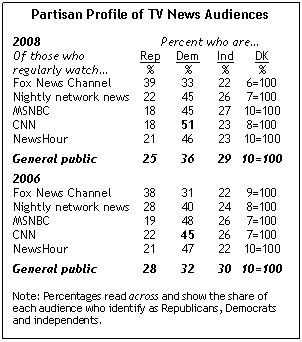
From the crisis in Ferguson, Mo., to the cultural impact of Robin Williams‘and Joan Rivers‘ sudden deaths and all the way up to recent round-the-clock coverage of U.S. strikes on ISIS, cable news has been heavily occupied. The last three months have been so big, Fox News Channel just clocked its first quarter with the most-watched primetime across all of cable in more than a decade — even besting USA and ESPN.
The average 1.79 million viewers between 8 p.m. and 11 p.m., Monday through Friday, gave FNC its first quarter atop the dial since the Iraq War broke out in 2003. Expanding that block by an hour, which includes Greta Van Susteren at 7 p.m., FNC was the most watched in primetime for the first time ever. And in the targeted demographic of adults 25-54, FNC was up 12 percent from the same period a year ago, with an average 313,000 viewers.
It’s the last time the cable network will be compared to its previous primetime. Oct. 7 marks the one-year anniversary of FNC revamping a decade-old lineup with Megyn Kelly‘s move to 9 p.m. The third quarter marked Kelly’s best since launch, up a significant 27 percent (year over year) in the time period previously occupied by Sean Hannity. (Hannity, who airs at 10 p.m., enjoyed a high of his own).
Bill O’Reilly remained the top performer across cable news, despite Kelly’s advances, and 14 FNC shows continued to sit atop the cable news roster — while the only other network to see year-to-year improvement, CNN, saw a rather unexpected series perched atop its own rankings. Documentary series The Sixties stands as CNN’s most-watched show of the quarter, edging pasting Anderson Cooper with an average 650,000 viewers — 186,000 of them in the key demo. After ratings spikes for the anchor’s on-the-ground coverage of Ferguson, his show ranked as CNN’s top show in the demo.
CNN’s gains from the comparable quarter last year were modest, but they were still gains. Its 186,000 adults 18-49 in primetime (8-11 p.m.) marked a 4 percent improvement and even outpaced MSNBC — now back in third place. MSNBC, still holding slight second-place edge in total viewers, was down 21 percent in the key demo compared to last year. Pulling just an average 150,000 adults 25-54 in primetime, it meant quarterly lows for Chris Hayes, Rachel Maddow and Lawrence O’Donnell in the key demo.
The wondrous anomaly of Shark Tank encores also continues. With the ABC reality competition in heavy off-net rotation on CBNBC, those repeats are outperforming much of cable news and ranking No. 14 in primetime where adults 25-54 are concerned — besting every telecast on MSNBC.
Third-Quarter 2014 Primetime Averages
FNC: 1,797,000 viewers, up 12 percent (313,000 adults 25-54, up 12 percent) CNN: 555,000 viewers, up 2 percent (186,000 adults 25-54, up 4 percent) MSNBC: 557,000 viewers, down 2 percent (150 adults 25-54, down 21 percent) HLN: 352,000 viewers, down 4 percent (120 adults 25-54, down 12 percent)
Once I heard the name, that he was a convert to Islam, and that he beheaded a person… I knew. But almost immediately from the time I posted this, I got flack to “slow down” in my judgment. Not. I stuck to my guns, and was proven correct. Here are some of the “red-flags” that show his religious belief played a vital role in his behavior. I just wished he had followed the example of the man tattooed on his chest, Jesus, rather than Islam’s founder, Muhammad.
—————————
Alton Nolen’s Facebook Page Depicted Beheading a Month Before Release from Probation (http://tinyurl.com/l2ekqpe);
Oklahoma Beheading Suspect’s Facebook Page Features Image of Militants, Religious Rants (http://tinyurl.com/q2lclhn).
—————————
Dennis Prager discusses MSNBC’s coverage of this story and shows how vapid these people are. For more clear thinking like this from Dennis Prager… I invite you to visit: http://www.dennisprager.com/
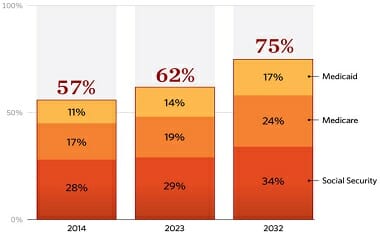
Everyone complains about America’s debt, and rightly so, but how do we get out of it? As Cato’s Michael Tanner explains, spending on entitlement programs — Social Security, Medicare and Medicaid — has exploded in recent decades. We must slow their growth or they will soon swallow the entire federal budget. In five minutes, learn how America can preserve these programs and get out of debt.
(Video Description) “How To Be a Real Skeptic” ~ Mitch Stokes, PhD. Mitch Stokes, professor at New Saint Andrews College, gives a talk on skepticism at Collegiate Reformed Fellowship’s weekly meeting.
Can there be dueling theories for the same observable evidence? Can BOTH be true? In this smaller portion of his larger talk (http://tinyurl.com/jwm3lcd), Dr. Stokes explains with a story of two theories that at the time were equally true.
BTW: This fuller presentation is applicable not only to religious, or origin type debates, but especially to the current flap over global warming, or climate change… or, er… climate disruption. Whatever its called.
Opinions are bountiful, testing one’s opinions in today’s age? Not so much.
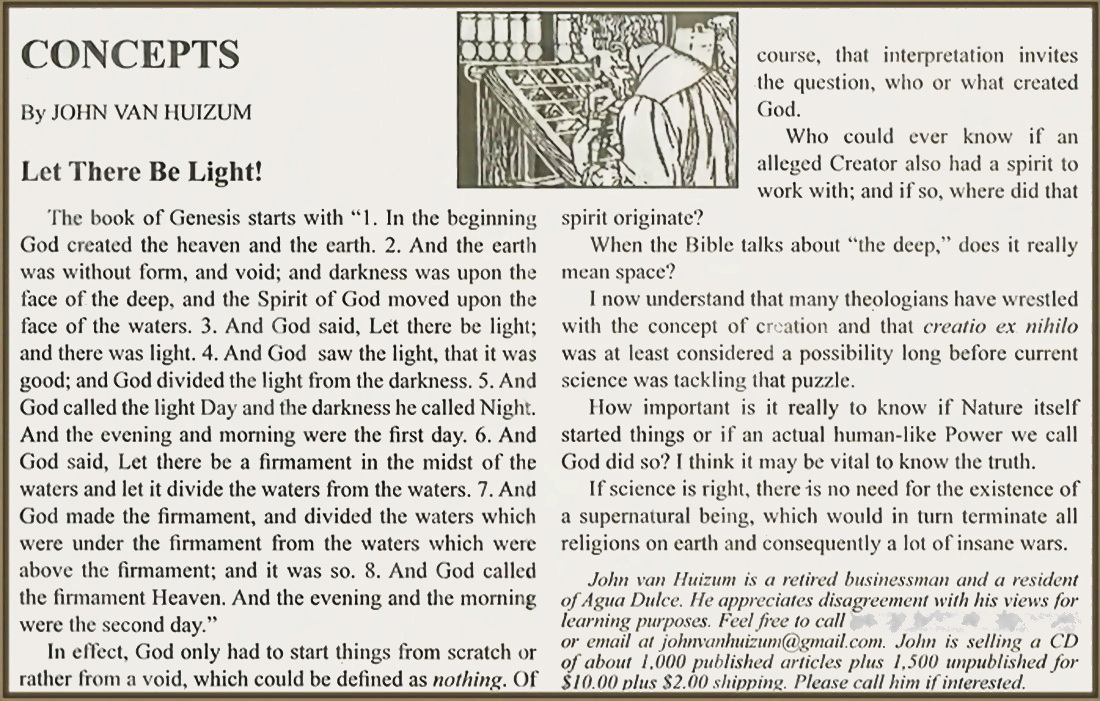
I will explain the issues I have with John’s latest article, and as usual, you can click it to enlarge the above. In this latest opinion slurry, John asks questions that I doubt he even has one single book by a leading philosopher/theologian/scientist from either the Intelligent Design camp or creation positions to search for how Christianity answers these questions. For instance, my favorite treatise to introduce people to ideas expressed above in a broad sense, “Unshakable Foundations: Contemporary Answers to Crucial Questions about the Christian Faith.” Or a more in-depth treatise of the same, “I Don’t Have Enough Faith to Be an Atheist.” Or one more specific to his questions, “The Case For A Creator: A Journalist Investigates Scientific Evidence That Points Toward God.” All are readable, and all answer his questions in a way that a mature seeker to these answers would do if seeking to inform one’s own opinion.
One of the queries proffered above is this one: “Of course, that interpretation invites the question, who or what created God.” I wonder if John has actually spent the time finding an answer to this position that has surely passed his lip many times in conversation. I do have a POWER POINT that deals with this in a very layman-like manner. Also, a more in-depth treatise of it as well HERE. But in a short conversation I had with another gentleman, I responded briefly this way — showing that this has been squarely dealt with many hundreds of years ago:
Tim, you asked:
“What created God? Who created the thing that created the thing that created the thing that created God? It’s an infinite regression.”
Again, “What created God.”
You are basically saying that:
“if everything needs a cause, then so does God, in which case he would not be God. And if God does not need a cause, then neither does the world. But if the world needs no cause then there is no God. Hence, whether everything needs a cause or does not need a cause, there is no God.”
Did I sum up the “gist” of the matter? (Who made God, in other words.)
The criticism, “if everything needs a cause, then there must be an infinite regress” is built on a misconception of the principle of causality. Or better, it is a confusion of the principle of existential causality and the principle of sufficient reason. The latter affirms that everything needs a cause.
That it would seem, as atheists observe, leads to a contradiction of God being his own cause.
Aquinas dealt with this long ago. He held that only finite, changing, dependent beings need a cause. This does not lead to a contradictory self-caused being but to a non-contradictory un-caused Being. For if only finite beings need a cause then one arrives at a nonfinite (i.e. infinite) being that does not need a cause. Hence, from Aquinas’ principle of causality the series would legitimately stop at the first, un-caused Cause of all finite beings.
If one is confused in regards to the above: here is a response geared towards 5th grader; and one geared towards adults. John’s article[s] surely exemplify philosopher Mortimer Adler’s point about formulating good questions based on coherent starting point:
Mortimer J. Adler rightly points out that while many Christians are quick in responding to the conclusions in an argument often times the Christian is unaware that the point of departure is not in the conclusion, but in the starting premise, the foundational assumptions.
This “point of departure” is answered two separate times by Christian philosopher Dr. William Lane Craig ~ in less than 2-minutes in each case. I mention the time factor because it seems Mr. Huizum hasn’t even taken 2-minutes to get an answer to his “point of departure”:
WILLIAM LANE CRAIG: Who Made God
John states that searching for answers to his questions in the article is “vital” in “‘knowing’ the truth.” That is fine, and he is right, it is an important question that from the Greeks to us has been a grand Western tradition. But even 1,000’s of years ago the Greeks thought it important enough to debate “how” even to ask the question properly. All that aside however, my last point that needs to be made in one that undermines John’s presuppositions. In John’s closing statement, he says this:
If science is right, there is no need for the existence of a supernatural being, which would in turn terminate all religions on earth and consequently a lot of insane wars.
In a previous installmentI respond to John also writing that “Atheism has been aided by scientific discoveries and rigorous questioning.” In the much longer response I quote two agnostics as saying this;
✪ “The essential element in the astronomical and biblical accounts of Genesis is the same; the chain of events leading to man commenced suddenly and sharply, at a definite moment in time, in a flash of light and energy…. The Hubble Law is one of the great discoveries in science; it is one of the main supports of the scientific story of Genesis.”
~ Robert Jastrow: American astronomer and physicist. Founding director of NASA’s Goddard Institute for Space Studies, he is the director of the Mount Wilson Institute and Hale Solar Laboratory. He is also the author of Red Giants and White Dwarfs (1967) and God and the Astronomers (2nd ed., 2000).
✪ “Certainly there was something that set it all off. Certainly, if you are religious, I can’t think of a better theory of the origin of the universe to match with Genesis.”
~ Robert Wilson: is an American astronomer, 1978 Nobel laureate in physics, who with Arno Allan Penzias discovered in 1964 the cosmic microwave background radiation (CMB)…. While working on a new type of antenna at Bell Labs in Holmdel Township, New Jersey, they found a source of noise in the atmosphere that they could not explain. After removing all potential sources of noise, including pigeon droppings on the antenna, the noise was finally identified as CMB, which served as important corroboration of the Big Bang theory.
So John seems to be making the same misguided statements, maybe based on his misunderstanding of the weight of the logical conclusions found in a “non-God” universe, where truth cannot be known. Or not spending 2-minutes to see where his starting premise may be errant, and so his conclusions even worse. In other words, questions seeking a truthful response or statement of fact are impossible considering Johns epistemology (“the branch of philosophy concerned with questions about knowledge and belief and related issues such as justification and truth”).
To which I end with a call for John to internalize if he can even ask what he has in this column and others and expect to find an answer to his “probing” [sophomoric] questions:
Even Darwin had some misgivings about the reliability of human beliefs. He wrote, “With me the horrid doubt always arises whether the convictions of man’s mind, which has been developed from the mind of lower animals, are of any value or at all trustworthy. Would any one trust in the convictions of a monkey’s mind, if there are any convictions in such a mind?”
Given unguided evolution, “Darwin’s Doubt” is a reasonable one. Even given unguided or blind evolution, it’s difficult to say how probable it is that creatures—even creatures like us—would ever develop true beliefs. In other words, given the blindness of evolution, and that its ultimate “goal” is merely the survival of the organism (or simply the propagation of its genetic code), a good case can be made that atheists find themselves in a situation very similar to Hume’s.
The Nobel Laureate and physicist Eugene Wigner echoed this sentiment: “Certainly it is hard to believe that our reasoning power was brought, by Darwin’s process of natural selection, to the perfection which it seems to possess.” That is, atheists have a reason to doubt whether evolution would result in cognitive faculties that produce mostly true beliefs. And if so, then they have reason to withhold judgment on the reliability of their cognitive faculties. Like before, as in the case of Humean agnostics, this ignorance would, if atheists are consistent, spread to all of their other beliefs, including atheism and evolution. That is, because there’s no telling whether unguided evolution would fashion our cognitive faculties to produce mostly true beliefs, atheists who believe the standard evolutionary story must reserve judgment about whether any of their beliefs produced by these faculties are true. This includes the belief in the evolutionary story. Believing in unguided evolution comes built in with its very own reason not to believe it.
This will be an unwelcome surprise for atheists. To make things worse, this news comes after the heady intellectual satisfaction that Dawkins claims evolution provided for thoughtful unbelievers. The very story that promised to save atheists from Hume’s agnostic predicament has the same depressing ending.
It’s obviously difficult for us to imagine what the world would be like in such a case where we have the beliefs that we do and yet very few of them are true. This is, in part, because we strongly believe that our beliefs are true (presumably not all of them are, since to err is human—if we knew which of our beliefs were false, they would no longer be our beliefs).
Suppose you’re not convinced that we could survive without reliable belief-forming capabilities, without mostly true beliefs. Then, according to Plantinga, you have all the fixins for a nice argument in favor of God’s existence For perhaps you also think that—given evolution plus atheism—the probability is pretty low that we’d have faculties that produced mostly true beliefs. In other words, your view isn’t “who knows?” On the contrary, you think it’s unlikely that blind evolution has the skill set for manufacturing reliable cognitive mechanisms. And perhaps, like most of us, you think that we actually have reliable cognitive faculties and so actually have mostly true beliefs. If so, then you would be reasonable to conclude that atheism is pretty unlikely. Your argument, then, would go something like this: if atheism is true, then it’s unlikely that most of our beliefs are true; but most of our beliefs are true, therefore atheism is probably false.
Notice something else. The atheist naturally thinks that our belief in God is false. That’s just what atheists do. Nevertheless, most human beings have believed in a god of some sort, or at least in a supernatural realm. But suppose, for argument’s sake, that this widespread belief really is false, and that it merely provides survival benefits for humans, a coping mechanism of sorts. If so, then we would have additional evidence—on the atheist’s own terms—that evolution is more interested in useful beliefs than in true ones. Or, alternatively, if evolution really is concerned with true beliefs, then maybe the widespread belief in God would be a kind of “evolutionary” evidence for his existence.
Current liberal dogma that gender is fluid and mutable rather than innate in every cell in our bodies has been very liberating for some. For example, it has freed Fallon Fox to become a highly effective MMA fighter. All he had to do was subject himself to grotesque sexual mutilation and then declare himself to be a woman:
Transgender mixed martial arts (MMA) competitor Fallon Fox is facing new criticisms after breaking the eye socket of his last opponent. …
Fox defeated Tamikka Brents by TKO at 2:17 of the first round of their match. In addition to the damaged orbital bone that required seven staples, Brents received a concussion. In a post-fight interview this week, she told Whoa TV that “I’ve never felt so overpowered ever in my life.”
“I’ve fought a lot of women and have never felt the strength that I felt in a fight as I did that night.”
That’s because men are stronger than women, regardless of what ideology is in fashion.
Fox’s gender controversy is not new. In March 2013, after a 39-second knockout victory, it was revealed that Fox had not told the MMA community about his sex-change operation, which took place in 2006. That bout was the fifth straight first-round victory for the then-37-year old Fox, including his three amateur bouts, and his second victory as a professional fighter.
A video of the Brents fight taken by a ringside fan shows Fox throwing several powerful knees to the face and torso of Brents at the start of the match, who pulled guard to protect herself. Soon, Brents turned her back to avoid damage, where she took approximately 45 seconds of elbow and fist strikes – many blocked by her hands and arms – before the referee stopped the fight.
If you are twisted enough to feel like doing that to a woman, then maybe a sex change operation is the right move for you.
House Republicans and Democrats started Friday morning’s debate over whether to defund last year’s healthcare law, and as part of this debate sparred over whether members should be allowed to call that law “ObamaCare.”
After two House Republicans called it “ObamaCare,” Rep. Debbie Wasserman Schultz (D-Fla.) asked the chairman whether these “disparaging” remarks should be allowed on the House floor.
“That is a disparaging reference to the president of the United States; it is meant as a disparaging reference to the president of the United States, and it is clearly in violation of the House rules against that,” she said.
I’ve found myself referring to the health care reform law in different ways depending on the context or mood of the post I’m writing. Sometimes, it’s appropriate to use the legal name of the bill, but as James Joyner pointed out a couple months ago, that’s as much a product of political propaganda as the term Obamacare is:
Patient Protection and Affordable Care Act is a great example of propagandistic bill naming. What heartless bastard could oppose protecting patients? And who doesn’t want care to be affordable? That the act in question will provide very little in the way of protection and even less to ensure affordability, though, makes it a rather silly name. And PPACA doesn’t exactly roll off the tongue as an acronym or initialism.
ObamaCare, by contrast, is short, memorable, and nonjudgmental. It has a nice parallelism with Medicare, a very popular program with similar goals, and correctly identifies the president who pushed it through Congress. And, even as one who opposed Obama’s election and the passage of this act, the term “ObamaCare” doesn’t conjure up negative imagery.
Indeed. Besides, who could think that “ObamaCare” is disparaging? It’s got “Obama” and “Care” in there….
House Republicans and Democrats started Friday morning’s debate over whether to defund last year’s healthcare law, and as part of this debate sparred over whether members should be allowed to call that law “ObamaCare.”
After two House Republicans called it “ObamaCare,” Rep. Debbie Wasserman Schultz (D-Fla.) asked the chairman whether these “disparaging” remarks should be allowed on the House floor.
“That is a disparaging reference to the president of the United States; it is meant as a disparaging reference to the president of the United States, and it is clearly in violation of the House rules against that,” she said.
Because Wasserman Schultz only asked if it would be appropriate to curb the use of the term “ObamaCare,” the chairman said he would not rule on a hypothetical. But he did urge members to “refrain from engaging in personalities or descriptions about personalities in general.”
The indirect warning had no effect on Republicans. Rep. Denny Rehberg (Mont.), who sponsored the amendment to defund the law, said he refers to it as ObamaCare and said, “You would think he wants his name attached to his signature legislation.
“So we call it what it is,” he continued. “It is ObamaCare. It’s a travesty. It is big government. It is not controlling healthcare costs, and it needs to be repealed and today we’re going to try to defund it to the best of our ability. And if we’re not successful this time, we’re going to try again and again and again until we either have a Senate that’s willing to pass it or a president that understands that we cannot do this to the American people.”
Rep. Steve King (R-Iowa) followed Rehberg, and within minutes also called the law “ObamaCare.”
Dennis Prager reads from another New York Times column about how the Left views nature. How does the Left view nature Papa Giorgio? Through a kaleidoscope of “crazy.”
Dr. Nadine Unger, in her column (http://tinyurl.com/l9ds4ql), basically tells all those kids planting trees that they are murderers.
Well… maybe Miss Unger didn’t, but they did: “At one point, the march [in NY] briefly came to a halt, as demonstrators held a moment silence for what they described as victims of the climate crisis” (http://tinyurl.com/m9jmnk7). I guess elementary student are now on the same level as Pol-Pot, Mao, and Stalin? Following conclusions to their logical end.