Real Socialism Has Never Been Tried (Mantra’s of the Left)

ORIGINALLY POSTED OCT 3, 2013 — JUST UPDATED “DEAD” MEDIA

I wish to post some ideas and thoughts by others here that will allow a framework to reply to such a challenge. Many professors will infect young minds with this idea, which is, “you cannot criticize Marxism, socialism, or the like because its ‘pure form[s]’ have never been implemented on earth.” To which I would reply to said professor that he then would not be able to criticize Christianity, Republicans, Capitalism, etc…. because the ideal they hold has never been purely implemented on earth. [In Christianity I would note that the faith was modeled perfectly in the man of Christ Jesus.]

So if you have a professor who is harping on Capitalism, Bush, Republicans, Reagan, Newt, Ted Cruz, whomever…, you just need to point out that since  FDR’s “New Deal” and Johnson’s “Great Societyall they are really criticizing is regulation and redistribution. Because we are far from a truly free-market.

So, what are some good resources to build a cumulative case or allow deeper — non-sophomoric thinking as the author of The Politically incorrect Guide would say — on this subject? While I responded to the person where I work with the quick answer of, “that is essentially copping out of dealing with what is produced by such beliefs,” my thinking on the matter goes beyond how I could or can express it in the work environment. This frustration of quick interactions has led me partly to blog on various topics so not only myself, but others can access this “nugget” if-you-will for both personal edification and learning or linking to friends, co-workers, and family that you discuss this issue with. Especially young people at university.

I do wish to note that just because I am posting items by others below, it does not imply I fully agree with their position stated or worldview. For instance I use Student of Objectivism’s (SO) video (spliced with a quick “baked in the cake” precursor), while I enjoy and agree with Ayn Rand on many points… on many others I disagree. I CAN recommend wholeheartedly — for the lover of theology that really wishes to understand the political divide — a book by Thomas Sowell entitled, A Conflict of Visions: Ideological Origins of Political Struggles. While this is a must read for any political junkie, it is all the more powerful for one who believes in The Fall of mankind, objective grounding of ethics, man’s spark of life/creativity as well as mankind’s depravity. So to all the pastors and apologists that read this… add that book into your reading hopper.

Okay, I wanted to begin with this chapter, at least the opening pages of it, the chapter can be seen below.

In it the author notes that “baked into” socialism is serfdom… by violence if necessary. Scott Huber of Brightlight Books comments well on this idea and the book:


Williamson ended Chapter 1 (see that summary here) with the observation (from Hayek) that socialist planners always lead an economy on the “road to serfdom”. This is because socialist economic planning cannot work because the planners cannot have enough information or knowledge to make the proper economic decisions. So, in lieu of having enough knowledge to properly make economic decisions, they opt for varying and escalating levels of coercion to enforce their Plan.

In Chapter 2, he begins by refuting what he calls the high school debater’s trick of claiming that socialism in “theory” is great (and true and just and compassionate, etc.) but it just gets screwed up in practice.

Not so, he says:

In truth, the theory behind socialism is deeply flawed: it is intellectually narrow, inhumane, and deeply irrational in that it fails to account for the ways in which knowledge works in a society. Socialism in theory is every bit as bad as socialism in practice, once you understand the theory and stop mistaking it for the common and humane charitable impulse.

Here is a key question? How is economic value determined? Next, we can ask a slightly different set of questions: How should economic value be determined and, perhaps more importantly, by whom?

Williamson argues that on the issue of determining economic value Marx (and every socialist) is a moralist. How so?

Because for Marx, and every other socialist, the value of economic activity, which is to say the value of any product or service, is (or more precisely should) be objectively related to the labor of the worker who produces it. This contrasts with the subjective approach of the capitalist marketplace which basically says that the value of a product or a service is related to how people in the marketplace subjectively value it.

In other words, let’s say you spend a lot of time, human labor, and other resources to produce something. The socialist approach to value says that your product is, at least roughly, worth the sum of the costs required to produce it especially the labor costs. To price it higher or lower is an injustice.

Marx’s analysis is morally normative [i.e. what should be] in that he insists that, since labor is the measure of value, wages must equal the price of the product. The mere existence of profits – squeezing economic value out of a product beyond what workers are paid – for Marx was proof of capitalist’s exploitation of workers. It was indistinguishable from outright theft.

And, according to Williamson, it’s this moral (and moralizing) context that fuels Marxists’ and other socialists’ revolutionary fervor. Note Marx’s most famous quote: The point of philosophy is not merely to understand the world, but to change it. And at the point of a gun if necessary, which it usually is since free people do not readily cooperate with the revolution.


“Communism is a great idea, it just hasn’t been tried properly.” Leftist fellow travelers rush to embrace every Marxist experiment, champion the system and agitate for it to be copied in their own country. …and then walk away when it inevitably fails; searching once again for the next soon to fail utopia. Communism has been tried over 40 times in the last 100 years and has produced egregious results in every iteration. This video shows every application and deep dives into half a dozen examples, comparing before and after Communism was tried as well as comparing examples directly with free and mixed market neighbors.(Via VOTE NIXON)

And one should note that ALL of the above have a current application to what we are seeing the Democrats implementing. Socialized Medicine. And who better to explain this to us that the Gipper himself:

Walter Williams makes this real for us in a way that should perk the interest of those who love and cherish freedom:

Mao Zedong has been long admired by academics and leftists across our country, as they often marched around singing the praises of Mao and waving his little red book, “Quotations From Chairman Mao Tse-tung.” President Barack Obama’s communications director, Anita Dunn, in her June 2009 commencement address to St. Andrews Episcopal High School at Washington National Cathedral, said Mao was one of her heroes.

Whether it’s the academic community, the media elite, stalwarts of the Democratic Party or organizations such as the NAACP, the National Council of La Raza, Green for All, the Sierra Club and the Children’s Defense Fund, there is a great tolerance for the ideas of socialism — a system that has caused more deaths and human misery than all other systems combined.

Today’s leftists, socialists and progressives would bristle at the suggestion that their agenda differs little from those of Nazi, Soviet and Maoist mass murderers. One does not have to be in favor of death camps or wars of conquest to be a tyrant. The only requirement is that one has to believe in the primacy of the state over individual rights.

The unspeakable horrors of Nazism didn’t happen overnight. They were simply the end result of a long evolution of ideas leading to consolidation of power in central government in the quest for “social justice.”

Social Justice. This social justice always leads to repression, from the NAACP asking the rodeo clown who wore an Obama mask to be investigated, to, Dr. Benjamin Carson being audited after his prayer breakfast speech by the IRS. These are murmurings of the greater end that always ends in violent repression. From pro-lifers being threatened on university campuses, to suppression of free speech, to… eventualy, the outgrowth — naturally — to violent repression. The difference between Marxism, Socialism, Communism, and Fascism, is a matter of degrees, only:

A Marxist will scream at you, argue and fist-fight you down the road to his dream, as he carries your belongings and says, “They belong to the collective”.

A Socialist will grab you by the hand or the hair, and beat you on the head with a stick and drag you along, as they make you carry your own belongings and tell you they, “Belong to the collective”.

A Communist will get behind you and make you carry your own belongings to his dream, as he points a gun to the back of your head, and kicks you in the back and screams at you, “They belong to the State”… as in the collective.

A Fascist will will have your neighbor carry your belongings, and shoot you if you do not agree with his dream of “Centralized Authority, and it all belongs to the State”,… the collective”.

…a matter of degrees.

(I cry every time I watch the beginning of this.) This footage is a great example of how Democrats are joined at the hip with radicals. The example comes by way of the two radical Democrat women making my point:

Question is, which is our temperature to stop this from going further in our country?

And any person should acknowledge why someone should “fear” government more than business. In fact, I made this point on my FB outgrowth of this blog in talking to my liberal friend:

…the point was to show how the Obama admin is stacking the books with GM. You see, when the government chooses winners-and-losers instead of getting contracts with private companies (like Ford, GM, etc.), they are invested to [i.e., forced to] only choose a government run business and stock their fish (so-to-speak) with GM fleets… leaving the non-government company to flounder.

This next audio deals with the differences of the Koch brothers, in comparison to the Left’s version of them, Soros. There are many areas that one can discuss about the two… but let us focus in on the main/foundational difference. One wants a large government that is able to legislate more than just what kind of light-bulbs one can use in the privacy of their own home. Soros wants large government able to control a large portion of the economy (see link to chart below), and he has been very vocal on this goal. The other party always mentioned are the Koch brothers. These rich conservatives want a weak government. A government that cannot effect our daily lives nearly as much (personal, business, etc) as the Soros enterprise wants. And really, if you think about it, what business can really “harm” you, when people come to my door with pistols on their hip… are they a) more likely to be from GM, or, b) from the IRS?

The possibility of them being from the IRS is even more possible with the passing of Obama-Care [i.e., larger government]. So the “fear” (audio in next comment) I think the Left has of “Big-Business” is unfounded, and the problem comes when big-business gets in bed with big-government. Here I am thinking of (like with the penalties that were found to be Constitutional in the recent SCOTUS decision) a government that can penalize you if you do not buy a Chevy Volt, or some other green car in order to save the planet. When this happens, guys coming to my door because of unpaid (hypothetical… but historical examples abound of the tax history of our nation) “fines” are likely to be IRS agents because of a personal choice made in the “free-market.”

Appendix: If the above example didn’t inspire any liberal fear (forced to go green or be penalized), maybe this one will?

…First, the government needs to issue a mandate that all households must own at least one firearm. We will need a federal agency to ensure that people aren’t just buying cheap BB guns or .22 pistols, even though that may be all they need or want. It has to be 9mm or above, with .44 magnums getting a one-time tax credit on their own. Let’s pick an agency known for its aptitude on firearms and home protection to issue required annual certifications each year, without which the government will have to levy hefty fines. Which agency would do the best job? Hmmmm … I know! How about TSA? With their track record of excellence, we should have no problems implementing this mandate.

Don’t want to own a gun? Hey, no worries. Supreme Court Chief Justice John Roberts says citizens have the right to refuse to comply with mandates. The government will just seize some of your cash in fines, that’s all. Isn’t choice great? Those fines will go toward federal credits that will fund firearm purchases for the less well off, so that they can protect their homes as adequately as those who can afford guns on their own. Since they generally live in neighborhoods where police response is appreciably worse than their higher-earning fellow Americans, they need them more anyway. Besides — gun ownership is actually mentioned in the Constitution, unlike health care, which isn’t. Obviously, that means that the federal government should be funding gun ownership….

…read more…

(See More)

The Pilgrims could have benefited from sound theology which would have dissuaded their (and should ours) experiment with “communal” activities:


Many Americans believe socialism to be a form of social kindness by the government. But true socialism isn’t a social safety net. It is when the government controls most prices, businesses, property, and other aspects of economic life. The historical record of socialism has been wrecked or stagnating economies and flagrant human rights violations. The truth borne of a hundred years of hard experience is that people do not prosper in socialist countries.

A. PRIVATE PROPERTY

According to the teachings of the Bible, government should both document and protect the ownership of private property in a nation.

The Bible regularly assumes and reinforces a system in which property belongs to individuals, not to the government or to society as a whole.

We see this implied in the Ten Commandments, for example, because the eighth commandment, “You shall not steal” (Exod. 20:15), assumes that human beings will own property that belongs to them individually and not to other people. I should not steal my neighbor’s ox or donkey because it belongs to my neighbor, not to me and not to anyone else.

The tenth commandment makes this more explicit when it prohibits not just stealing but also desiring to steal what belongs to my neighbor:

“You shall not covet your neighbor’s house; you shall not covet your neighbor’s wife, or his male servant, or his female servant, or his ox, or his donkey, or anything that is your neighbor’s” (Exod. 20:17).

The reason I should not “covet” my neighbor’s house or anything else is that these things belong to my neighbor, not to me and not to the community or the nation.

This assumption of private ownership of property, found in this fundamental moral code of the Bible, puts the Bible in direct opposition to the communist system advocated by Karl Marx. Marx said:

The theory of the Communists may be summed up in the single sentence: abolition of private property.

One reason why communism is so incredibly dehumanizing is that when private property is abolished, government controls all economic activity. And when government controls all economic activity, it controls what you can buy, where you will live, and what job you will have (and therefore what job you are allowed to train for, and where you go to school), and how much you will earn. It essentially controls all of life, and human liberty is destroyed. Communism enslaves people and destroys human freedom of choice. The entire nation becomes one huge prison. For this reason, it seems to me that communism is the most dehumanizing economic system ever invented by man.

Other passages of Scripture also support the idea that property should belong to individuals, not to “society” or to the government (except for certain property required for proper government purposes, such as government offices, military bases, and streets and highways). The Bible contains many laws concerning punishments for stealing and appropriate restitution for damage of another person’s farm animals or agricultural fields (for example, see Exod. 21:28-36; 22:1-15; Deut. 22:1-4; 23:24-25). Another com­mandment guaranteed that property boundaries would be protected: “You shall not move your neighbor’s landmark, which the men of old have set, in the inheritance that you will hold in the land that the LORD your God is giving you to possess” (Deut. 19:14). To move the landmark was to move the boundaries of the land and thus to steal land that belonged to one’s neighbor (compare Prov. 22:28; 23:10).

Another guarantee of the ownership of private property was the fact that, even if property was sold to someone else, in the Year of Jubilee it had to return to the family that originally owned it:

It shall be a Jubilee for you, when each of you shall return to his property and each of you shall return to his clan (Lev. 25:10).

This is why the land could not be sold forever: “The land shall not be sold in perpetuity, for the land is mine. For you are strangers and sojourners with me” (Lev. 25:23).

This last verse emphasizes the fact that private property is never viewed in the Bible as an absolute right, because all that people have is ultimately given to them by God, and people are viewed as God’s “stewards” to manage what he has entrusted to their care.

The earth is the LORD’S and the fullness thereof, the world and those who dwell therein (Ps. 24:1; compare Ps. 50:10-12; Hag. 2:8).

Yet the fact remains that, under the overall sovereign lordship of God himself, property is regularly said to belong to individuals, not to the government and not to “society” or the nation as a whole.

When Samuel warned the people about the evils that would be imposed upon them by a king, he emphasized the fact that the monarch, with so much government power, would “take” and “take” and “take” from the people and confiscate things for his own use:

So Samuel told all the words of the LORD to the people who were asking for a king from him. He said, “These will be the ways of the king who will reign over you: he will take your sons and appoint them to his chariots and to be his horsemen and to run before his chariots. And he will appoint for himself commanders of thousands and commanders of fifties, and some to plow his ground and to reap his harvest, and to make his implements of war and the equipment of his chariots. He will take your daughters to be perfumers and cooks and bakers. He will take the best of your fields and vineyards and olive orchards and give them to his servants. He will take the tenth of your grain and of your vineyards and give it to his officers and to his servants. He will take your male servants and female servants and the best of your young men and your donkeys, and put them to his work. He will take the tenth of your flocks, and you shall be his slaves. And in that day you will cry out because of your king, whom you have chosen for yourselves, but the LORD will not answer you in that day” (1 Sam. 8:10-18).

This prediction was tragically fulfilled in the story of the theft of the vineyard of Naboth the Jezreelite by Ahab the wicked king and Jezebel, his even more wicked queen (see 1 Kings 21:1-29). The regular tendency of human governments is to seek to take control of more and more of the property of a nation that God intends to be owned and controlled by private individuals.

Wayne Grudem, Politics According to the Bible (Grand Rapids, MI: Zondervan, 2010), 261-263.
RC Sproul and Adams Fall | Calvinist Obfuscations

(There are only two types of Calvinists/”Reformed” models: consistent and inconsistent. Double predestination is consistent.) In the video that follows these two quotes, you will see the quote by John Calvin… but I wanted to put an old quote by RC Sproul — who — apparently hasn’t read John Calvin:

DO YOU SCHOLAR MUCH RC?

  • Herein lies the problem. Before a person can commit an act of sin he must first have a desire to perform that act. The Bible tells us that evil actions flow from evil desires. But the presence of an evil desire is already sin. We sin because we are sinners. We were born with a sin nature. We are fallen creatures. But Adam and Eve were not created fallen. They had no sin nature. They were good creatures with a free will. Yet they chose to sin. Why ? I don’t know. Nor have I found anyone yet who does know.

RC Sproul, Chosen By God (Wheaton, IL: Thomas Nelson Inc., Publishers, 1986), 30-31

  • “God not only foresaw the fall of the first man, and in him the ruin of his posterity; but also at His own pleasure arranged itThough their perdition depends on the predestination of God, the cause and matter of it is in themselves Man therefore falls, divine providence so ordaining, but he falls by his own fault.”

John Calvin, Institutes of the Christian Religion, 3.23.7; 3.23.8

What if Calvin was more extreme than most Calvinists today? In this clip, Austin Fischer and Leighton Flowers unpack the forgotten (or ignored) parts of Calvin’s own words—especially around God ordaining the Fall and reprobation. If you’ve ever been told Calvinism is misrepresented, this is the clip you need to see.

MORE:

  • “Even the fall of Adam, and through him the fall of the race, was not by chance or accident, but was so ordained in the secret counsels of God.”1
  • “Surely, if God had not willed the fall, He could, and no doubt would, have prevented it; but He did not prevent it: ergo He willed it. And if He willed it, He certainly decreed it”2
  • “Plainly it was God’s will that sin should enter this world, otherwise it would not have entered, for nothing happens except what God has eternally decreed. Moreover, there was more than a simple permission, for God only permits things that fulfill His purpose.”3
  • “Not only did God have a perfect foreknowledge of the outcome of Adam’s trial; not only did His omniscient eye see Adam eating of the forbidden fruit, but He decreed beforehand that he should do so.”4
  • “Also, Calvinists often affirm that Adam was free before the Fall. But again, I always speak of freedom relative to God, and from this perspective, I would say that Adam had no freedom whatsoever even before the Fall. To be “free” from sin is irrelevant. The issue is whether Adam was free from God to choose to remain free from sin – he was not. In addition, I would not say that God permitted Adam to fall, but that God caused it.”5

1 Loraine Boettner, The Reformed Doctrine of Predestination, p. 234

2 Jerome Zanchius, The Doctrine of Absolute Predestination, Ch. II, Sec. II, Par. 4 (Link)

3 A.W. Pink, The Sovereignty of God, p. 162

4 A.W. Pink, The Sovereignty of God, Appendix II, The Case of Adam, p. 283

5 Vicent Cheung, The Author of Sin (WEBSITE), last accessed 7/29/2025.

In an excellent post, Robin Phillips explains the reasoning behind the “Reformers” positing WHY God HAD TO make mankind fall:

…. As already mentioned, this theory says that God hates evil so much that He must ensure its eternal perpetuation, for if in a trillion years from now there was even a millisecond of time in which God didn’t have a group of sinners to be angry at, then this would be tragic as one whole part of His character (justice) would be unable to be expressed.

As Douglas Wilson once put it on his blog,

In a world without sin, two of God’s most glorious attributes—His justice and His mercy—would go undisplayed. This, obviously, would be horrible In a world without sin and evil, at least two attributes of God would have gone unrevealed and unmanifested, those attributes being wrath and mercy. Since this is obviously intolerable, God determined to direct our affairs the way that He did.

Jonathan Edwards expressed a similar idea when he wrote:

It is a proper and excellent thing for infinite glory to shine forth; and for the same reason, it is proper that the shining forth of God’s glory should be complete; that is, that all parts of his glory should shine forth, that every beauty should be proportionably effulgent, that the beholder may have a proper notion of God. It is not proper that one glory should be exceedingly manifested, and another not at all Thus it is necessary, that God’s awful majesty, his authority and dreadful greatness, justice, and holiness, should be manifested. But this could not be, unless sin and punishment had been decreed; so that the shining forth of God’s glory would be very imperfect, both because these parts of divine glory would not shine forth as the others do, and also the glory of his goodness, love, and holiness would be faint without them; nay, they could scarcely shine forth at all. If it were not right that God should decree and permit and punish sin, there could be no manifestation of God’s holiness in hatred of sin, or in showing any preference, in his providence, of godliness before it. There would be no manifestation of God’s grace or true goodness, if there was no sin to be pardoned, no misery to be saved from. How much happiness soever he bestowed, his goodness would not be so much prized and admired So evil is necessary, in order to the highest happiness of the creature, and the completeness of that communication of God, for which he made the world; because the creature’s happiness consists in the knowledge of God, and the sense of his love. And if the knowledge of him be imperfect, the happiness of the creature must be proportionably imperfect.

The same notion is present in the works of Saint Augustine:

if all had remained condemned to the punishment entailed by just condemnation, then God’s merciful grace would not have been seen at work in anyone, on the other hand, if all had been transferred from darkness to light, the truth of God’s vengeance would not have been made evident. —City of God 21.11

[….]

The problem with Calvinism is that its quest for rationalistic clarity does away with this necessary mystery. Calvinism asserts that evil exists because God wants it to be there—end of story. As Calvin put it in his Institutes of the Christian Religion, “I say with Augustine that the Lord has created those who, as He certainly foreknew, were to go to destruction, and He did so because He so willed,” while later Calvin extends this idea to its consistent corollary, which is that “man by the righteous impulsion of God does that which is unlawful.” In other words, according to Calvin, the sinner sins because God impels him to do so.

Calvin picked up on this same theme later when he wrote that:

[M]an falls, the Providence of God so ordaining …that by the will of God all the sons of Adam fell into the state of wretchedness in which they are now involved … Nor ought it to seem absurd when I say, that God not only foresaw the fall of the first man, and in him the ruin of his posterity; but also at his own pleasure arranged it.

God, in His own pleasure, arranged evil?

These are difficult words, especially since they appear to directly implicate God in all the wickedness of the world. It easily solves the problem of evil, but does so at the expense of other scriptural teaching. For example, Psalm 5:5. In the Septuagint—the Old Testament text quoted by the New Testament writers and the canonical text of the ancient Church—Psalms 5:4 reads “For You are not a God who wills (thelon) lawlessness (anomian).”

In fairness to Calvin, he was able to maintain some degree of dialectical balance that would be lacking in his followers. That is why my critique of Calvinism recognizes that Calvinism is larger than simply the teachings of John Calvin. This was impressed upon me when our former church put on a family camp and invited R.C. Sproul, Jr. to speak. The younger Sproul has taken Calvin’s teachings to such an extreme, going even further than his father—let alone Calvin himself. For example, Sproul took particular delight in describing to us in detail how God desired sin to come about, and how God forced the devil to sin like a man operating a remote control. In his book Almighty Over All, Sproul expands on this point, writing, “I am suggesting that he [God] created sin … Where, I must ask, does the law of God forbid the creation of evil? I would suggest that it just isn’t there.”

This leads to what I consider to be a trivialization of evil.

R.C. Sproul, Jr. posted a Facebook status saying that since God is sovereign, even those things which are not as they ought to be really are just as things ought to be. He went on to say that there are ultimately no “bad” things, since God is completely sovereign. Now if all he means is that even bad things work out ultimately for good, then I have no problem. But there is a great difference between saying, on the one hand, that God works good out of evil, and on the other hand, saying that that since God is the author of all things, evil isn’t really bad (or that everything which happens ought to be).

If, as Sproul maintains, God is the author of evil, then we would have to say that He fosters wickedness in people’s hearts. But if so, then God is sinful by the Biblical definitions of sin and evil. Consider that in the Proverbs, the ones who incite and tempt to evil (like the fool’s friends or the prostitute) are as morally guilty as the simple man who falls prey to those temptations. James says that God does not tempt us, but if God is the author of evil then He is doing a lot more than merely tempting us: He is fostering the evil in our hearts and inciting us to sin.

Under this scheme, the words “God is good” are no longer intelligible, as God is violating His own self-revelation of what constitutes “goodness.” Consequently, if God really is the energizing principle behind both the seed of the woman and the seed of the serpent, then we would have to conclude that the Biblical categories used to describe God are ultimately non-descriptive. Moreover, it would make a mockery of the antithesis that we find throughout the war-Psalms, if God is the causal force behind both sides.

Moreover, if God is the author of evil, then we would have to conclude that evil is just as much an intrinsic part of God’s character as His goodness. But in that case, we are left without a standard for distinguishing between good and evil. Using God’s character as the standard would then be akin to using a tape measure on which inches and centimeters are all mixed up. God can only be the standard for distinguishing between good and evil if the former and not the latter is fundamental to His character. …

I will finish the thought I have…

GOD NEEDED TO CREATE MAN TO BE WHOLE

… according to Calvinism. A theological “heresy” in my mind at least.


An Amazing Tale Of God Protecting a Woman of Faith

Originally Posted September 2013

I watched this the other day, and now here is the back-story. This man had a chance offered to him to repent, and surrender… he will stand before his Judge without excuse. Via The Blaze:

Police say Charlie “Chris” Bates had just finished raping four women at gunpoint after tying up the four men who were with them in a Tampa, Fla. apartment.

Bates then found what he thought was his next victim, a woman sitting on her porch at another apartment complex.

Police say Bates forced the woman inside her unit, made her undress and kiss him, and was about to rape her, according to the Tampa Tribune.

Then she did something amazingly bold and faithful: She began praying.

And she recited John 3:16 from the Bible, the Tampa Bay Times reports.

For God so loved the world

Police say Bates’ whole demeanor transformed.

He apologized to the woman, gave her a shirt, and they prayed together.

She tried to hand him her Bible, but when Bates wouldn’t take it, she ripped pages out and gave them to him, the Times says.

After he left, she called 911.

The prayers probably saved the woman’s life, police said.

Twelve hours later on Friday Bates, 24, was fatally wounded by police after a high-speed chase in which authorities exchanged at least 100 bullets with him. Bates is also suspected of shooting at another man, stealing a friend’s car, and threatening a large group of partygoers during his 14-hour rampage, authorities told the Tribune.

“Jesus was an immigrant” | Nancy Pelosi & the Bible

Originally posted August of 2014

(See also Bill Whittle’s video) This great commentary via Godfather Politics:

Nancy Pelosi keeps appealing to the Bible in support of her lunatic policies. Her fellow liberals don’t seem to mind. Whatever happened to opposing “mixing religion and politics”? Only liberals can mix religion and politics. We know this because of the way liberal black churches endorse candidates seemingly in violation of IRS regulations and no one seems to protest.

On Tuesday, Pelosi appealed to how Mary and Joseph escaped the impending slaughter of the children under Herod (Matt. 2:13, 16-18):

“I reference the conference of bishops’ statement in which they say baby Jesus was a refugee from violence. Let us not turn away these children and send them back into a burning building. That’s the bishops, so we have to do this in a way that honors our values but also protects our border and does so in a way that the American people understand more clearly.”

Are we to assume that all the unaccompanied children coming across our border will be murdered by their political leaders if they stay in their home countries?

Isn’t it rather odd that many of these minor children were abandoned by their parents? If a mother leaves her unaccompanied child to play in a park for a few others, she is cited for child endangerment. But if parents send their children a thousand miles away on a trek to an unknown future, that’s praise worthy.

Let’s keep in mind that the infant Jesus was accompanied by his parents. The family remained in Egypt “until the death of Herod” (2:15, 19-21; Hosea 11:1). They then returned as an intact family back to their home country even though danger still existed (Matt. 2:22-23).

Pelosi’s most recent biblical analogy about immigration is the story of Moses:

“These are children coming over the border. They are children,” adding “what would we do if Moses had not been accepted by the Pharaoh’s family. We would not have the Ten Commandments for starters. You understand my point, historically we have a challenge and we have examples of humanitarian assistance that should guide us.”

In the case of Moses, there was a willing family to take in the baby. The mother of Moses actually nursed her own child (Ex. 2:7-10). This is hardly analogous to what’s happening today.

I’m glad Nancy Pelosi has some regard for the Ten Commandments, and by extension, the other laws that were given through Moses (John 1:17; 7:19), including those condemning abortion (Ex. 21:22-25)[1] and homosexuality (Lev. 18:22; 20:13). These laws were also given through Moses. But that’s a topic for another day.

…read it all… (GODFATHER POLITICS, where the quote above is from,  is now a dead site. Sad)


I am glad to see Pelosi endorses Moses, maybe she will follow his example and clear Biblical teaching on abortion now:

Exodus 21:22-24

  • “When men get in a fight, and hit a pregnant woman so that her children are born [prematurely], but there is no injury, the one who hit her must be fined as the woman’s husband demands from him, and he must pay according to judicial assessment. If there is an injury, then you must give life for life, eye for eye, tooth for tooth, hand for hand, foot for foot,….

What does this verse mean for the Judeo-Christian person in the real world — if we rightly shape our worldview according to God’s Revelation? Wayne Grudem explains with an excerpt from from his book, Politics According to the Bible:

For the question of abortion, perhaps the most significant passage of all is found in the specific laws God gave Moses for the people of Israel during the time of the Mosaic covenant. One particular law spoke of the penalties to be imposed in case the life or health of a pregnant woman or her preborn child was endangered or harmed:

When men strive together and hit a pregnant woman, so that her children come out, but there is no harm, the one who hit her shall surely be fined, as the woman’s husband shall impose on him, and he shall pay as the judges determine. But if there is harm, then you shall pay life for life, eye for eye, tooth for tooth, hand for hand, foot for foot, burn for burn, wound for wound, stripe for stripe (Exod. 21:22-25). [footnote A]

This law concerns a situation when men are fighting and one of them accidentally hits a pregnant woman. Neither one of them intended to do this, but as they fought they were not careful enough to avoid hitting her. If that happens, there are two possibilities:

1. If this causes a premature birth but there is no harm to the pregnant woman or her preborn child, there is still a penalty: “The one who hit her shall surely be fined” (v. 22). The penalty was for carelessly endangering the life or health of the pregnant woman and her child. We have similar laws in modern society, such as when a person is fined for drunken driving, even though he has hit no one with his car. He recklessly endangered human life and health, and he deserved a fine or other penalty.

2. But “if there is harm” to either the pregnant woman or her child, then the penalties are quite severe: “Life for life, eye for eye, tooth for tooth …” (vv. 23-24). This means that both the mother and the preborn child are given equal legal protection. The penalty for harming the preborn child is just as great as for harming the mother. Both are treated as persons, and both deserve the full protection of the law. [footnote B]

This law is even more significant when we put it in the context of other laws in the Mosaic covenant. In other cases in the Mosaic law where someone accidentally caused the death of another person, there was no requirement to give “life for life,” no capital punishment. Rather, the person who accidentally caused someone else’s death was required to flee to one of the “cities of refuge” until the death of the high priest (see Num. 35:9-15, 22-29). This was a kind of “house arrest,” although the person had to stay within a city rather than within a house for a limited period of time. It was a far lesser punishment than “life for life.”

This means that God established for Israel a law code that placed a higher value on protecting the life of a pregnant woman and her preborn child than the life of anyone else in Israelite society. Far from treating the death of a preborn child as less significant than the death of others in society, this law treats the death of a preborn child or its mother as more significant and worthy of more severe punishment. And the law does not place

any restriction on the number of months the woman was pregnant. Presumably it would apply from a very early stage in pregnancy, whenever it could be known that a miscarriage had occurred and her child or children had died as a result.

Moreover, this law applies to a case of accidental killing of a preborn child. But if accidental killing of a preborn child is so serious in God’s eyes, then surely intentional killing of a preborn child must be an even worse crime.

The conclusion from all of these verses [many are discussed in Grudem’s book] is that the Bible teaches that we should think of the preborn child as a person from the moment of conception, and we should give to the preborn child legal protection at least equal to that of others in the society.

Footnotes:

A. The phrase “so that her children come out” is a literal translation of the Hebrew text, which uses the plural of the common Hebrew word yeled, “child,” and another very common word, yātsā’, which means “go out, come out.” The plural “children” is probably the plural of indefiniteness, allowing for the possibility of more than one child. Other translations render this as “so that she gives birth prematurely,” which is very similar in meaning (so NASB, from 1999 editions onward; similarly: NN, TNIV, NET, HCSV, NLT, NKJV).

B. Some translations have adopted an alternative sense of this passage. The NRSV translates it, “When people who are fighting injure a pregnant woman so that there is a miscarriage, and yet no further harm follows …” (RSV is similar, as was NASB before 1999). In this case, causing a miscarriage and the death of a preborn child results only in a fine. Therefore, some have argued, this passage treats the preborn child as less worthy of protection than others in society, for the penalty is less. But the arguments for this translation are not persuasive. The primary argument is that this would make the law similar to a provision in the law code of Hammurabi (about 1760 BC in ancient Babylon). But such a supposed parallel should not override the meanings of the actual words in the Hebrew text of Exodus. The moral and civil laws in the Bible often differed from those of the ancient cultures around Israel. In addition, there is a Hebrew word for a miscarriage (shakal, Gen. 31:38; see also Exod. 23:26; Job 21:20; Hosea 9:14), but that word is not used here, nor is nēphel, another term for “miscarriage” (see Job 3:16; Ps. 58:8; Eccl. 6:3). However, the word that is used, yātsā’, is ordinarily used to refer to the live birth of a child (see Gen. 25:26; 38:29; Jer. 1:5). Finally, even on this (incorrect) translation, a fine is imposed on the person who accidentally caused the death of the preborn child. This implies that accidentally causing such a death is still considered morally wrong. Therefore, intentionally causing the death of a prebom child would be much more wrong, even on this translation.

Wayne Grudem, Politics According to the Bible (Grand Rapids, MI: Zondervan, 2010), 159-160.

A Recent Sermon Maligning God’s Character/Holiness

My visual video response:

Yes, this is from the church I attend. A wonderful place to attend, but definitely Calvinistic. This is a newer pastor, and I must say, even though I vehemently disagree, at least he is preaching honestly. Another pastor months before preached a sermon where he quoted Joshua 24:15 and said:

  • “Make a choice. Choose this day. In fact, you can choose one of the… He’s not saying that he’s happy if you choose the pagan gods, but he says, in fact, pick one of the pagan gods. Do you know that something that God is extremely kind and gracious to us and that he gave us free will? Did you know that? He didn’t force a relationship on us. He gave us free will. Do you remember what he gave Adam and Eve? Free will. You can make a choice. I’m not gonna force it. Hey, you choose, yeah, you, make the choice.”

When I asked an elder if this pastor really believed this statement he made regarding free will from the pulpit, I got an honest answer of “No.”

So I love the almost Provisionist preaching and call to come to God in faith — but this is not what is REALLY believed as these pastors overlay TULIP on to their understanding of Biblical text. I struggle with the good that can come from the “alter call” type preaching of the “Armininian style” while they sleep as a Calvinist. That being said, it is a duplicitous preaching like they make God out to be by overlaying a 16th century philosophy onto God. A Jaundiced view at best. AND, I can truly appreciate the rawness of the logical outcomes being honestly preached from the pulpit. Although even this pastor does not follow his own thinking to their ends without hemming and hawing with a myriad of qualifiers and nuances.

Here is my FACEBOOK comments on this sermon:

So, in the past I have praised good sermons from my church… if I do that, should I at times not critique [as publicly] a bad one? I will be clipping the main idea of it from the video for my site [like I have uploaded some clips from the good ones], but that is in the future tense. I am thankful, however, that this pastor was so forthright, and didn’t hide behind the “preaching as an Arminian, sleep as a Calvinist” idea.

Honest preaching is laudable. This was essentially the sermon:

(a) God decrees and ordains all evil for His glory
(b) God saves us from the evil He decreed and ordained…. for His glory.

In other words, while this pastor didn’t follow his sermon to its logical conclusion, it is essentially God saving us from Himself. So, all the pain and suffering mentioned in stories and text are all God caused. Remember, this pastor chose AW Pink’s book for the last Monday men’s service series. [It could have been more in the pastorate choosing Pink’s book, as far as I know — because I do not actually know how these books are approved.] Pink is a hyper Calvinist, like this Pastor publicly is.

All I was thinking was,

  • “well, people who don’t get the raw [5-point, Calvinist] truth from other pastors are hearing it now.”

On the flip side of that “positive”, the new people on the “faith fence” — which only makes sense to those of the non-Calvinist soteriological bent — may have wrote off Crossroads as their home. Or worse yet, wrote off God.

Which in this pastor’s view, was also ordained.

The same pastor here eisegetes into Scripture a 16th century doctrine not understood as being the Bible before Calvin popularized it via his doctrinal hero:

  • The reason I added the SNL skit was to note that right when the sermon was starting to state some good position or truth, it was dashed shortly after by the “doctrines of grace.”

Why Both Atheists and Christians Need to Believe in Free Will

The audio at the start from Jeff Durbin is bad… so one has to put up with it a little when the initial audio is played. But the same arguments against atheistic determinism can be used against Augustinian/Calvinistic [theistic] determinism:

Dr. Braxton Hunter, President of Trinity Seminary and host of Trinity Radio, joins Dr. Flowers to talk about how the main arguments against naturalistic determinism can apply against theistic determinism, as held by Compatibilistic Calvinists. They demonstrate this by engaging a clip from Apologia Studios with Jeff Durbin which references a quote from Calvinistic apologist, Greg Bahnsen.

 Justin Brierley drives this point home in his article:

Atheist Determinism 

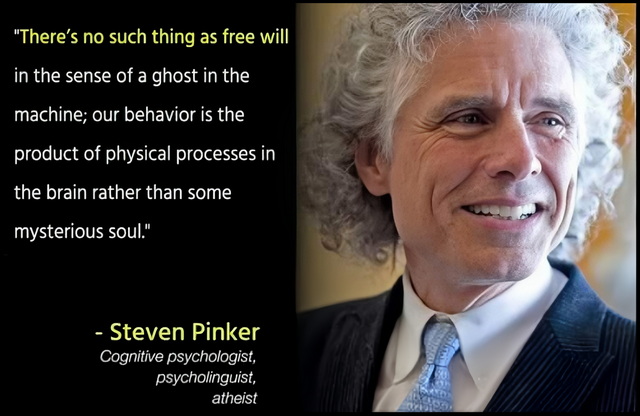
Calvinistic Christians have more in common with many atheists than they may realize. Determinism has also become a very popular philosophy among their godless counterparts. For some time, prominent voices in atheist circles have also been announcing that the notion of free will is past its sellby date.

Popular atheist author Sam Harris wrote a book titled Free will (Free Press) which, drawing on research in neuroscience, argued that our innate sense of freedom is merely an illusion foisted on us by nature. None of us is actually in control of what we do. So far so Calvinist. But rather than believing God has predestined us, atheists like Harris say the universe is responsible.

Atheist determinism springs from a ‘materialist’ worldview. All that exists is the ‘material’ stuff of the universe. Everything about us and the world we live in can ultimately be explained by the physics of atoms, electrons, quarks and neutrons, interacting according to the predictable regularity of natural laws.

Think of it like this: the skill of the snooker player is in predicting as accurately as possible how the balls will ricochet off each other in order to find the pockets on the table. But, theoretically, if a snooker player lined up their very first shot with perfect precision and perfect force, they could clear the table in one shot. The universe is like that, but on a much bigger scale.

Every single physical event, from the movements of electrons to the orbits of the planets, follows predictable laws of cause and effect. Therefore, the way the universe is now is a direct result of the way it was when it first began. If you rewound the clock by 13 billion years to the exact same physical state of affairs, things would roll out in exactly the same way they already have.

But, in such a universe, the idea that we have any measure of free will evaporates. Every aspect of our existence was predestined by a cosmos blindly following the laws of cause and effect.

READ IT ALL: “Why Both Atheists and Christians Need to Believe in Free Will

You cannot have LOVE with people made into dolls with a pull string that say, “I love you.” This is evidence that Calvinists/”Reformed” make Calvary useless.

Here is a favored adapted combination of mine:

One of the most intriguing aspects mentioned by Ravi Zacharias of a lecture he attended entitled “Determinism – Is Man a Slave or the Master of His Fate,” given by Stephen Hawking, who is the Lucasian Professor of Mathematics at Cambridge, Isaac Newton’s chair, was this admission by Dr. Hawking’s, was Hawking’s admission that if “we are the random products of chance, and hence, not free, or whether God had designed these laws within which we are free.”[1] In other words, do we have the ability to make choices, or do we simply follow a chemical reaction induced by millions of mutational collisions of free atoms? Michael Polyni mentions that this “reduction of the world to its atomic elements acting blindly in terms of equilibrations of forces,” a belief that has prevailed “since the birth of modern science, has made any sort of teleological view of the cosmos seem unscientific…. [to] the contemporary mind.”[2]

[1] Ravi Zacharias, The Real Face of Atheism (Grand Rapids, MI: Baker Books, 2004), 118, 119.

[2] Michael Polanyi and Harry Prosch, Meaning (Chicago, IL: Chicago university Press, 1977), 162.

This is one of the biggest reasons I [about half-a-year-ago] have rejected the 5-Points of Calvinism. Which is, determinism. I have written, posted, and debated this with atheists for years on the WWW., and when I saw that people like Al Mohler refute the atheist versions of this but does not apply the same thinking to his position — my apologetic bug was brought alive. Here is the video that started this rabbit trail:

Here is the full Al Mohler article: “So . . . Why Did I Write This? The Delusion of Determinism

The subversion of moral responsibility is one of the most significant developments of recent decades. Though this subversion was originally philosophical, more recent efforts have been based in biology and psychology. Various theorists have argued that our decisions and actions are determined by genetics, environmental factors, or other forces. Now, Scientific American is out with a report on a study linking determinism and moral responsibility.

The diverse theories of determinism propose that our choices and decisions are not an exercise of the will, but simply the inevitable outcome of factors outside our control. As Scientific American explains, determinists argue that “everything that happens is determined by what happened before — our actions are inevitable consequences of the events leading up to the action.”

In other words, free will doesn’t exist. Used in this sense, free will means the exercise of authentic moral choice and agency. We choose to take one action rather than the other, and must then take responsibility for that choice.

This link between moral choice and moral responsibility is virtually instinctive to humans. As a matter of fact, it is basic to our understanding of what it means to be human. We hold each other responsible for actions and choices. But if all of our choices are illusory — and everything is merely the “inevitable consequence” of something beyond our control, moral responsibility is an exercise in delusion.

Scientific American reports on a study performed by psychologists Kathleen Vohs and Jonathan Schooler. The psychologists found that individuals who were told that their moral choices were determined, rather than free, were also more likely to cheat on an experimental examination.

As Shaun Nichols reports:

The Western conception idea of free will seems bound up with our sense of moral responsibility, guilt for misdeads and pride in accomplishment. We hold ourselves responsible precisely when we think that our actions come from free will. In this light, it’s not surprising that people behave less morally as they become skeptical of free will. Further, the Vohs and Schooler result fits with the idea that people will behave less responsibly if they regard their actions as beyond their control. If I think that there’s no point in trying to be good, then I’m less likely to try.

Even if giving up on free will does have these deleterious effects, one might wonder how far they go. One question is whether the effects extend across the moral domain. Cheating in a psychology experiment doesn’t seem too terrible. Presumably the experiment didn’t also lead to a rash of criminal activity among those who read the anti-free will passage. Our moral revulsion at killing and hurting others is likely too strong to be dismantled by reflections about determinism. It might well turn out that other kinds of immoral behavior, like cheating in school, would be affected by the rejection of free will, however.

There are limitations to this kind of research, of course, but the report is both revealing and unsurprising. If we are not responsible for our actions, they why would people do the right thing? The most immediate result of such thinking is the subversion of moral accountability.

Of course, this pattern of thought also renders human existence irrational. How can we understand ourselves, our children, our spouses, our friends, or our neighbors if moral responsibility is undermined by determinism. Our legal system would completely collapse, as would the entire experience of relating to other human beings.

Shaun Nichols explains that “the Western conception of free will seems bound up with our sense of moral responsibility.” That “Western conception” is a product of the Christian inheritance and the biblical worldview. The Bible clearly presents human beings as morally responsible. Christians of virtually all theological traditions — including Reformed theology, Arminianism, and Catholicism — affirm moral and spiritual responsibility and the authenticity of the experience of choice.

As a matter of fact, this capacity and accountability is rooted in the biblical concept of the imago Dei — the image of God. Our Creator made us as moral creatures and planted within us the capacity of conscience. All this refutes the concept of moral determinism.

In its most modern forms, determinism is a product of naturalism — the belief that everything must be explained in purely natural terms. Naturalism explains the human mind (including the experience of moral choice) as a matter of chemical reactions in the brain, and nothing more.

Determinism is implied by naturalism and relieves human beings of moral responsibility. There is no moral revolt against the Creator, no Fall, and no need for the Gospel. This subversion of moral responsibility is both a delusion and a trap. And, as the Scientific American report indicates, even those who say they believe in moral determinism are unable to live consistently with this assumption. We know we are responsible.

SOME QUOTES CONNECTING THIS IDEA MORE

ATHEISTS:

THEISTS:

If Mohler applies that to his own theological determinism, he would have to reject it.

THERE IS NO GOSPEL IN TULIP

In other words, a person accepts Christ’s death and Resurrection as secondary to being ELECTED.

Here is more on this via this excerpt of an article and short video:

ARMINIAN PERSPECTIVE:

Calvinist: “That is why Christ said that you must be born again in order to even see the kingdom of God. The new nature must come before faith. God making us willing is not mind control in the sense that you describe it but giving us a new nature and a new mind. Of course the analogy isn’t perfect but it does illustrate the fact that we can be made to love without it being against our will.”

Me: “No it doesn’t. If we were God haters that wanted nothing to do with Christ prior to His irresistible act of “giving us a new heart” that “makes us willing”, then it was certainly “against our will” because our will was to hate and reject God prior to His irresistible working in us. It would be like a man meeting a girl at a bar and the girl doesn’t like him and wants nothing to do with him. In fact, she finds him repulsive. So the man slips a pill in her drink that removes her inhibitions and causes her to begin to find him attractive, even to the point of “making her willing” to sleep with him. Now if this incident was brought before the court, would the court say that the man is not liable for violating the woman against her will, since the pill he put in her drink “made her willing”? Of course not. Nobody would say that she freely chose to be with the man under such circumstances, and no one would say that her will was not violated.”

“As distasteful as this illustration might be, it illustrates the exact same principle behind your claims that while God “makes us willing” this making us willing by “giving us a new heart” is not a violation of the person’s will. Instead of dropping a pill into our drink, God drops a “new heart” into our God hating chest. The only difference would be that in your view of how God works, the “effects” of the “drug” would never wear off. But that doesn’t change the fact that a person’s will has been obviously violated in the process.”

“It really is pretty simple. If God’s working faith into us is not resistible, but irresistible, then it certainly violates freedom and the will. That is so obvious, it shouldn’t even need to be pointed out. If you want to say that God irresistibly brings sinners to faith and love and devotion to Him (by irresistibly removing their “hate God heart” and putting in a “love God heart”) because you think the Bible teaches that, then fine. But trying to then claim that God does this in such a way that we freely come to him in such a way that our wills are not violated is clearly incoherent. You can’t have it both ways. Sorry.”

Dr. Leighton Flowers talk about martyrs who stood against the Calvinists of their day and what happened to them.

Kwanzaa

(Don’t have a lot of time to read? Here is a quick take.) Kwanzaa is a complete fabrication. A make-believe holiday invented by an ex-convict, Ron N. Everett, who is known today as Dr. Maulana Karenga. In addition to having a nasty penchant for torture, Karenga was described by a prison psychiatrist as “both paranoid and schizophrenic with hallucinations.” Not exactly Santa Claus, eh?

QUICK NOTES:

  • The creator of Kwanzaa is Maulana Ndabezitha Karengaa 77-year-old professor of Africana studies at California State University, Long Beach. His real name is Ronald Everett. He was born in rural Maryland, the fourteenth child of a sharecropping Baptist minister.
  • Karenga was convicted in 1971 for brutally torturing two naked women. The weapons of torture included a soldering iron, a vise and, of course, a toaster.
  • Karenga concocted Kwanzaa in 1966 as a secular, “nonreligious” pan-African holiday. At the time, he was a twenty-something graduate student living in Los Angeles.
  • Members of Karenga’s US Organization murdered two Black Panthers in cold blood. The murders occurred in 1969 when the US Organization and the Black Panthers were fighting over which group would control the then-new Afro-American Studies Center at the University of California, Los Angeles (UCLA).
  • Karenga spent just four years in prison. He received a sentence of between one and 10 years for felonious assault and false imprisonment in 1971, related to the torture of Deborah Jones and Gail Davis.
  • The name change. At some point in the 1960s, Karenga decided he didn’t want to be Ron Everett any longer. Instead, he gave himself the name “Maulana,” which is Swahili for “master teacher.” Karenga means “keeper of tradition” in Swahili.

(Originally posted here Dec 25, 2010 at 06:21)

  • [What’s The Bottom Line?] This holiday season, spend your time celebrating real holidays like Christmas or Hanukkah, not a fake holiday invented by a Marxist, racist, violent criminal.


Kwanzaa: Racism in Disguise

Preface

This was a “clarification letter” written to my son’s fifth-grade teacher. The in-class activity was to break the kids up into groups and learn about the various holidays, so I politely asked that my son sit in on the Hanukah or Christmas table, as he had been assigned to the Kwanzaa table. I gave some reasoning behind this decision – as I often do about most decisions I make (my wife would beg to differ).

The reason I felt it necessary to clarify the original letter was because the teacher gave the original letter over to the Principle, and I heard through the grape-vine that the Principle called the letter, ergo me, racist. While I sympathized with the Principle a bit… because, well, I “look” like a racist (shaved head and all)… I just couldn’t let this pass by. I am sure that this sixties – Berkley attending – gentleman had gotten away with such a canard before, he unfortunately hadn’t researched his statement in my particular case enough.

First of all, while I look like a racist, I in fact have a wonderful black grandmother. Not only do I have a black grandmother, I also grew up in Detroit, where white kids at the public school and in my neighborhood were a minority. I didn’t just “have a black friend,” I, in fact, had very few white friends… my friends in other words had “a white friend.” Not only did the cultural and geographic peoples and places have an impact on me, but so to did theology. You see, I am a young earth creationist.  Young earther’s believe that Adam and Eve were the originators of the human population and that from these first persons came the darker (say, Ethiopians) and person’s like myself (Irish).  The Hebrew word for “Adam” is rooted in the word meaning “red-clay.” In fact, out of the 220-or-so stories of a world-wide flood from various cultures (Australian, southern/central/northern Native-Americans, Chinese, Russian, Welsch/British, etc., etc.) about half have a creation story of the first man being made as being red in color.

Not only did this principle not know my history or theology, he apparently didn’t realize that I quoted mainly from either black authors as well as from the L. A. Times for the letter. In fact, after having a sit down meeting with my son’s fifth-grade principle, I realized that he had not even read the original paper, he just assumed that any person who spoke out against Kwanzaa (whether rationally or illogically) was a bigot.

Unfortunately this old-school “sweeping-under-the-carpet” argument that I’m sure guided this gentlemen through many a brushing off of a parent just didn’t work in this case.

I made sure he read this second letter.

Enjoy, Papa Giorgio

A Letter from a Concerned Parent

(Fifth-Grade/2002 ~ updated 11-11-05)

Who Created Kwanzaa?

Kwanzaa was invented by Ron Kerenga in 1966 as a means to foster and help the Black Nationalist movement in their goal to segregate and separate the races. Ron Kerenga, thus, views people of Jewish decent, much like the Nation of Islam, as “devils,” to be stamped out like weeds. His views towards whites are very similar ~ racist, in-other-words. Let’s look at some of this history.

Kerenga founded and led the United Slaves, a Black Nationalist organization, which got into gun battles with the Black Panthers on occasion with people murdered as a result.

The biggest dispute between the United Slaves and the Panthers was for the leadership of the new African Studies Department at UCLA, with each group backing a different candidate. Panthers John Jerome Huggins and Alprentice “Bunchy” Carter verbally attacked Karenga at the meeting, which infuriated Karenga’s followers. After the meeting ended, two United Slaves members, George and Larry Stiner, reportedly confronted Huggins and Carter in a hallway, shooting and killing them.[1] [2]

In 1970, Kerenga and two of his followers were arrested by authorities for the torture of two of his female followers, Debra Jones and Gail Davis. Kerenga did time in prison for disrobing these two women at gunpoint and having them beaten severely. Kerenga told them that “Vietnamese torture is nothing compared to what we know,” whereupon he forced a hot soldering iron into the mouth of one while the other had a toe squeezed in a vice.

The Los Angeles Times described the events:

“Deborah Jones, who once was given the title of an African queen, said she and Gail Davis were whipped with an electric cord and beaten with a karate baton after being ordered to remove their clothes at gunpoint. She testified that a hot soldering iron was placed in Miss Davis’ mouth and placed against Miss Davis’ face and that one of her own big toes was tightened in a vice. Karenga, head of US, also put detergent and running hoses in their mouths, she said.” [1]

Karenga was sentenced to one-to-ten years in prison on counts of felonious assault and false imprisonment. At his trial, the question arose as to Karenga’s sanity. The psychiatrist’s report stated:

“This man now represents a picture which can be considered both paranoid and schizophrenic with hallucinations and illusions, inappropriate affect, disorganization, and impaired contact with the environment.” The psychiatrist reportedly observed that Karenga talked to his blanket and imaginary persons, and he believed he’d been attacked by dive-bombers.

Eight years later, California State University Long Beach named Karenga the head of its Black Studies Department. By this time, Karenga had “repented” of his black nationalism and had become just a harmless garden variety Marxist. This must be our esteemed university system’s idea of repentance![3]

How terrifying for these two women! According to the July 27, 1971 Los Angeles Times, a psychological profile of Kerenga described him “as a danger to society who is in need of prolonged custodial treatment in prison.” The profile noted that Kerenga, while legally sane, was “confused and not in contact with reality.”

The “seven principles” of Kwanzaa that Kerenga created as part of the Nguzo Saba are little more than Marxism transposed into afrocentric key.[4] Therefore, the Kwanzaa celebration, unlike – for instance – the Martin Luther King holiday, celebrates separatism and Black Nationalism. It would be the same as the school teaching and celebrating a holiday created by the Ku Klux Klan, or an offshoot thereof. (I would just as vehemently speak out against this as well, for when the school sets its seal of approval on a celebration, you teach all its goals and aims ~ whether religious or political.)

Created Equal

My point is that I teach my children that all men are created equal and that all men are equal in the eyes of God. This is what Christmas is all about! Jesus came to save the world (John 3:16-17), God’s Word has always stated that He has “made of one blood [i.e. from one man, Adam] all nations of men” (Acts 17:26, cf. 1 Cor. 15:45). Kerenga created Kwanzaa to shun the world and display racism as their main goal for the holiday season, in place of Christmas. In fact, when asked why he designed Kwanzaa to take place around Christmas, Karenga explained, “People think it’s African, but it’s not. I came up with Kwanzaa because black people wouldn’t celebrate it if they knew it was American. Also, I put it around Christmas because I knew that’s when a lot of bloods would be partying.” Great values!

Again, trying to tie in African culture and beliefs with this holiday celebration is a stretch, to say the least. Kwanzaa was created in 1966 by a revolutionary Marxist and racist man – Kerenga – who took here and there from the African culture as well as the Menorah from Judaism[5], and created a new celebration with socialist/Marxist overtones.

I have long-standing family friends who are native-born Africans (Kenyans), who have given their entire life to the mission field. They vehemently oppose this holiday because it creates subversion between the races when love is needed most. Neither do they find a connection with it and African culture. Mason Weaver points out the bottom line:

Professor Ron Karenga made up Kwanzaa in 1961 to counter the Western celebration of Christmas. Dr. Karenga made up a word, made up its definitions and then made up the elements we recognize today as “traditions.” First, “Kwanzaa” does not spell “first fruits” in Swahili or any other language. When I interviewed Dr. Karenga a few years ago, he admitted that the word was changed from the Swahili word “Kwanza” to “Kwanzaa” because he needed seven letters to represent his seven children. Because I spoke Swahili (and he apparently did not) Dr. Karenga was forced to admit that the word “Kwanza” was a Swahili adverb for “first,” and he added the extra “a” and “fruits” because it fit his story. And for all of you who wish to celebrate “first fruits,” the proper Swahili noun would be “Limbuko,” which would have given Dr. Karenga his seven letters for his children had he understood the language. (from Chapter 7 of It’s Okay to Leave the Plantation)

(Updated quote) Ann Coulter, likewise, points out the bottom line:

It is a fact that Kwanzaa was invented in 1966 by a black radical FBI stooge, Ron Karenga — a.k.a. Dr. Maulana Karenga — founder of United Slaves, a violent nationalist rival to the Black Panthers. He was also a dupe of the FBI.

In what was ultimately a foolish gamble, during the madness of the ’60s, the FBI encouraged the most extreme black nationalist organizations in order to discredit and split the left. The more preposterous the group, the better.

By that criterion, Karenga’s United Slaves was perfect. In the annals of the American ’60s, Karenga was the Father Gapon, stooge of the czarist police.

[….]

United Slaves were proto-fascists, walking around in dashikis, gunning down Black Panthers and adopting invented “African” names. (That was a big help to the black community: How many boys named “Jamal” are currently in prison?)

It’s as if David Duke invented a holiday called “Anglika,” which he based on the philosophy of “Mein Kampf” — and clueless public school teachers began celebrating the made-up, racist holiday.

Origins vs. Current Beliefs

Do the millions of black Americans who celebrate Kwanzaa think of it as the ritualization of socialism? Doubtful. Do they object to the mainstreaming of Kwanzaa symbols and products? Probably not. Do they know anything about Karenga and his past? It doesn’t seem so. When Karenga spoke at the Million-Man March, he went virtually unnoticed. However, the holiday’s origins in a terrible time and with a terrible person are certainly relevant to its legitimacy.

Neutrality?

I do not mind if the school teaches my son true history, which includes the history of Africa, as well as other Continents. However, having said this, I do not pay my hard earned tax dollars for the school to meet some need of trying to teach and include all the cultural holidays of the world, which apparently must include racist holidays founded right here in California’s radical [recent] past. That is not the schools job; it is mine, if I so choose!

This is why this subject is so “political,” you have in a sense undermined my family’s values and put it upon yourselves to teach my son “multi-culturalism” in a “politically-correct” fashion. This, then, requires the school to make value judgments on how to teach this to my child. Which is why I pointed out that by doing so, you have strayed from being neutral to taking a position on how to present other peoples cultural mores (which now includes racism as mainstream) to my child (in rejection of America’s cultural mores… which is Christmas and Hanukah, i.e., Judeo-Christian).

Back to the Original Premise!

So again, I restate my three points in the original letter[6] on why I asked to have my son join either the Christmas table or Hanukah table in class; in contradistinction to Kwanzaa or the Chinese New Year:

It [Kwanzaa] promotes and supports ethnic separation and segregation. For instance, Hallmark Cards and Giant Foods have a policy of any items related to Kwanzaa be produced and sold only by blacks (William A. Henry III, “The Politics of Separation,” Time Magazine [fall 1993]: 75).

This was also the intent of the founder of Kwanzaa, Dr. Maulana Kerenga, separation, not healing. Christmas promotes the latter.

It is not practiced equally with the traditional (Judeo-Christian) practices. For example: one public schools students and parents were asked to come in and share with the class about Kwanzaa, and other religious holiday practices of their Buddhist faith and Muslim faith as well as the traditions and practices of Hanukkah. When one parent attempted to share the true meaning Christmas, using a Nativity scene as a visual aid, the presentation was prohibited. (Ravi Zacharias, Deliver Us from Evil: Restoring the Soul in a Disintegrating Culture, p. 57).

It takes a political and moral stance. This type of multi-cultural “politically-correct” inclusive teaching takes a moral and political stance that requires value judgments to be made that are at variance with my (and many others) particular political and moral stance on afro-centric history and teaching… as well as putting one set of moral pre-suppositions (Marxism, racism, segregation) above others. Thus, taking a non-neutral position.


Notes


[1] “Kwanzaa — Racist Holiday from Hell” By Reverend Jesse Lee Peterson; FrontPageMagazine.com | December 29, 2004 –

http://www.frontpagemag.com/Articles/ReadArticle.asp?ID=16474

[2] Rev. Jesse Lee Peterson (a black-American) is the Founder and President of BOND (the Brotherhood Organization of A New Destiny, www.bondinfo.org). He is also the author of the book SCAM: How the Black Leadership Exploits Black America. For more information, please call 1-800-411-BOND (2663), or e-mail bond@bondinfo.org.

[3] Ibid.

[4] Afrocentrism is a political movement that believes Greek culture was borrowed from Black Africans. Among others on the Afrocentrist side is Emeritus Professor of Near Eastern History Martin Bernal who wrote Black Athena. Among others opposing him is Mary Lefkowitz, classical scholar and author of Not Out of Africa who denies the Greeks stole culture from Black Egyptians. There are some moderate positions, but the whole Afrocentrism controversy is based on concepts of race and racism, and is therefore very difficult to discuss without enraging someone.

From: http://ancienthistory.about.com/od/afrocentrism/g/afrocentrism.htm

[5] Kerenga believes that the black race are the real Jewish peoples, much like Christian Identity – the religious movement of the KKK – believes the white race to be the true Jewish peoples. The bottom line is this: both views are founded in racist ideology!

[6] Carlotta Morrow, the main author I quoted from heavily in my first letter to the school, (a black-American woman) began her research on Kwanzaa in the early 1980’s after her sister, who was a member of Dr. Karenga’s black activist group called the United Slaves (US) Organization, denounced her faith in Christ, claiming that Christianity was a white man’s religion.

Determined to find out the teachings that persuaded her sister’s complete change in faith, she went with her sister to “the Center” to hear what was being taught. She was deeply disturbed at the “us””white man” against the attitude that seeped through the meetings, and especially at the negativity directed toward the Christian and Jewish religions.

Seeing the spiritual and racial harm being subtly encouraged, Carlotta began her trek in learning, researching and exposing the real truth and spiritual seductiveness of the principles behind Kwanzaa.

She has had articles on Kwanzaa appear in the Southern California Christian Times, the Twin City Christian Magazine of Minnesota, Tout Timoun Nou Yo also of Minnesota, (a quarterly for families with children adopted from Haiti) and has been a guest on radio talk shows in the Southern California area which included an on-air discussion with Dr. Karenga on the Mason Weaver Show of KPRZ in San Diego, where the author resides.

In case you have never seen or heard Mason Weaver, he has a website called The Mason Weaver Show, as well as writing a book entitled It’s Okay To Leave the Plantation. Carlotta’s site is below.

* Following are some highly recommended resources for the historian/sociologist at heart:

1)  Tunde Adeleke, The Case Against Afrocentrism (Jackson, MS: Univ. Press of Mississippi, 2009);

2)  Stephen Howe, Afrocentrism: Mythical Pasts and Imagined Homes (New York, NY: Verso, 1999);

3)  Mary Lefkowitz, Not Out Of Africa: How “Afrocentrism” Became An Excuse To Teach Myth As History (New York, NY: Basic Books);

4)  An audio chapter from Black Rednecks and White Liberals.

5)  Race and Culture: A Worldview (This is really part of a trilogy). Dr. Sowell’s page at Amazon can be found here;

6)  Video of the American Black History videos:

http://videorow.blogspot.com/2010/08/amercias-racial-history-in-black-and.html;

7)  Many, many links to much more here.


UPDATE


(Updated via GATEWAY PUNDIT)

Kwanzaa was created in 1966 as a holiday celebration of African culture and heritage but there’s more to the story. See below.

The Hill reported:

Obamas extend Kwanzaa greetings

President Obama and first lady extended their “warmest wishes” to those celebrating Kwanzaa, the week-long holiday as it began Saturday.

“Today begins a week-long celebration of African-American heritage and culture through family and community festivities,” the couple said in a statement.

“Kwanzaa’s seven principles – unity, self-determination, collective work and responsibility, cooperative economics, purpose, creativity and faith – are also shared values that bind us as Americans.”

Ann Coulter recently wrote about the origins of Kwanzaa at Townhall:

Happy Kwanzaa! The Holiday Brought to You by the FBI

I will not be shooting any Black Panthers this week because I am Kwanza-reform, and we are not that observant. Kwanzaa, celebrated exclusively by white liberals, is a fake holiday invented in 1966 by black radical/FBI stooge Ron Everett — aka Dr. Maulana Karenga, founder of United Slaves, the violent nationalist rival to the Black Panthers. In the annals of the American ’60s, Karenga was the Father Gapon, stooge of the czarist police.

In what was ultimately a foolish gambit, during the madness of the ’60s, the FBI encouraged the most extreme black nationalist organizations in order to discredit and split the left. The more preposterous the group, the better. By that criterion, Karenga’s United Slaves was perfect.

Despite modern perceptions that blend all the black activists of the ’60s, the Black Panthers did not hate whites. Although some of their most high-profile leaders were drug dealers and murderers, they did not seek armed revolution.

Those were the precepts of Karenga’s United Slaves. The United Slaves were proto-fascists, walking around in dashikis, gunning down Black Panthers and adopting invented “African” names.

And hasn’t that been a huge help to the black community?

THE LID has a good post on Kwanzaa: “Kwanzaa: A Fraud Holiday With A Racist Goal, Created By Criminal Madman”

Those who are around my age woke up one December and discovered that the “holiday season” of Christmas and New Year’s became a trio, with the addition of something called Kwanzaa.  Oh, sure there were rumblings of a new holiday. But strangely in this country where political correctness is on overload, a day invented in 1966 by a rapist who ran a Black separatist group is considered by some as a holiday on par with Christmas, or New Year’s. Kwanzaa is exclusively an American holiday and is not celebrated in any other part of the world (including Africa). The name Kwanzaa comes from a phrase of Swahili origin, “Matunda Ya Kwanza”, and translates as “First Fruits of the Harvest.” That’s right it’s supposed to be spelled with only one “a,” the very name of this supposed holiday is a typo.

Kwanzaa runs from December 26th-January 1st. It’s supposed to be a week-long holiday honoring African culture and traditions but is tainted by its founder and original purpose.

The man who created the holiday, Maulana Karenga was convicted in 1971  of torturing two women who were members of US (United Slaves), a black nationalist cult he had founded. A May 14, 1971, article in the Los Angeles Times related the testimony of one of the women:

“Deborah Jones, who once was given the Swahili title of an African queen, said she and Gail Davis were whipped with an electrical cord and beaten with a karate baton after being ordered to remove their clothes. She testified that a hot soldering iron was placed in Miss Davis’ mouth and placed against Miss Davis’ face and that one of her own big toes was tightened in a vise. Karenga, head of US, also put detergent and running hoses in their mouths, she said.”

Karanga was convinced that the women were trying to poison him. He and three members of his cult had tortured the women in an attempt to find some nonexistent “crystals” of poison. Karenga thought his enemies were out to get him.

Now I am not a doctor, nor have I ever played one on television, but this Karenga guy sounds like a paranoid psycho.

Somehow I cannot see rational people wanting to observe a holiday created by such a sick violent man (but then again, Al Sharpton led two anti-Semitic pogroms and he is considered a civil rights leader). Especially this year when sexual assault of women has been in the headlines almost consistently for months, why would anybody want to celebrate a holiday invented by a man who tortured women?

Perhaps Kwanzaa is observed because this part of the Kwanzaa story is rarely mentioned by the mainstream media.

When he invented the holiday, Karenga said his goal was to

“give Blacks an alternative to the existing holiday and give Blacks an opportunity to celebrate themselves and history, rather than simply imitate the practice of the dominant society.”

Arguably, this holiday raised by some to the level of Christmas has the totally opposite purpose. While Christmas is meant to unify, Kwanzaa is meant to divide. Or as the then 16-year-old Rev. Al Sharpton explained the feast would perform the valuable service of “de-whitizing” Christmas.

Heck even the scam’s creator, Maulana Karenga admitted it was a fraud.  In 1978 he told the Washington Post’s Hollie West:

“I created Kwanzaa,” laughed Ron Karenga like a teenager who’s just divulged a deeply held, precious secret. “People think it’s African. But it’s not. I wanted to give black people a holiday of their own. So I came up with Kwanzaa. I said it was African because you know black people in this country wouldn’t celebrate it if they knew it was American. Also, I put it around Christmas because I knew that’s when a lot of bloods (blacks) would be partying!”

The late Tony Snow laid out what was so wrong about the holiday 33 years after it was founded:

There is no part of Kwanzaa that is not fraudulent. Begin with the name. The celebration comes from the Swahili term “matunda yakwanza,” or “first fruit,” and the festival’s trappings have Swahili names — such as “ujima” for “collective work and responsibility” or “muhindi,” which are ears of corn celebrants set aside for each child in a family.

Unfortunately, Swahili has little relevance for American blacks. Most slaves were ripped from the shores of West Africa. Swahili is an East African tongue.

To put that in perspective, the cultural gap between Senegal and Kenya is as dramatic as the chasm that separates, say, London and Tehran. Imagine singing “God Save the Queen” in Farsi, and you grasp the enormity of the gaffe.

Worse, Kwanzaa ceremonies have no discernible African roots. No culture on earth celebrates a harvesting ritual in December, for instance, and the implicit pledges about human dignity don’t necessarily jibe with such still-common practices as female circumcision and polygamy. The inventors of Kwanzaa weren’t promoting a return to roots; they were shilling for Marxism. They even appropriated the term “ujima,” which Julius Nyrere cited when he uprooted tens of thousands of Tanzanians and shipped them forcibly to collective farms, where they proved more adept at cultivating misery than banishing hunger.

Even the rituals using corn don’t fit. Corn isn’t indigenous to Africa. Mexican Indians developed it, and the crop was carried worldwide by white colonialists.

The fact is, there is no Ur-African culture. The continent remains stubbornly tribal. Hutus and Tutsis still slaughter one another for sport.

() Our treatment of Kwanzaa provides a revealing sign of how far we have yet to travel on the road to reconciliation. The white establishment has thrown in with it, not just to cash in on the business, but to patronize black activists and shut them up.

So what is Kwanzaa? It’s the ultimate fraud.  It is a holiday created by a man responsible for violently torturing two women–and it has a fascist goal of separating the races……..

(THE REST IS WORTH READING)

THE FEDERALIST as well opined in 2020:

Spanning from Dec. 26 to the first of January is Kwanzaa, the invented African American holiday celebrated solely by white liberals and clueless public school teachers. Overblown by leftist claiming the holiday has immense cultural significance, a survey by the National Retail Foundation discovered only 1.6 percent of Americans celebrate Kwanzaa.

The “holiday” was created in 1966 by Ron Karenga, who renamed himself Maulana. Karenga, the founder of the United Slaves, a violent rival organization to the Black Panthers, created the holiday for black Americans and derived the name “Kwanzaa” from the Swahili phrase “matunda y kwanza,” meaning “first fruits of the harvest.” That’s about the extent of the deep African roots the official Kwanzaa website claims.

The history of the holiday and Karenga has been seamlessly suppressed by leftists who find the facts inconvenient. Since few know its origins, the current definitions of the celebration are usually nonsensical and made up, much like the holiday itself.

The Guardian asserts Kwanzaa is simply an “opportunity [for black people] to celebrate themselves and their history rather than indulge in the customary traditions of a white Christmas.” The Los Angeles Times says it is “a way to honor African heritage and bring Black families and communities together.”

FrontPage Magazine’s Paul Mulshine writes that “the history of the founder of Kwanzaa has disappeared into an Orwellian time warp.” Indeed, CNN informs readers that Kwanzaa’s violent, racist founder was “a black nationalist and professor of Pan-African studies at California State University at Long Beach,” omitting his criminal and misogynistic past.

Kwanzaa, the “African feast,” really has “nothing to do with Africa and everything to do with California in the 1960s,” writes Mulshine. He contends it was made up to divide Americans, not unite them.

Mulshine explains that the paramilitary organization Karenga ran in Los Angeles in the late 1960s was involved in murder and torture: “In 1967, Karenga was accused of having his thugs beat up a student who asked him an impertinent question at a college forum. In 1969, [United Slaves] got involved in a struggle with the Black Panthers for control of the black studies program at UCLA. All involved carried guns on campus. The US guys were quicker on the draw; they killed two Panthers in a shootout at the student center.”

Karenga himself is a convicted torturer. Here is an excerpt from an article about the May 1971 trial of Karenga for torturing two members of his group:

‘Deborah Jones, who once was given the Swahili title of an African queen, said she and Gail Davis were whipped with an electrical cord and beaten with a karate baton after being ordered to remove their clothes. She testified that a hot soldering iron was placed in Miss Davis’ mouth and placed against Miss Davis’ face and that one of her own big toes was tightened in a vise. Karenga, head of [United Slaves], also put detergent and running hoses in their mouths, she said.

Karenga served only four to five years in a state prison.

Karenga is currently a black studies professor at California State University, Long Beach where the administration is apparently untroubled by the fact that this radical racist is also a convicted torturer of women. Despite the troubling past of Kwanzaa’s founder, leftists continue to shove this fake holiday down America’s throat every Christmas.

Woke liberals preach that Christmas in the classroom is intolerant and isolates students who don’t celebrate it. Yet Kwanzaa is permitted because the left argue it is a “cultural” holiday. Tons of teacher aids on the web provide elementary instructors with Kwanzaa coloring prints, songs, games, and crafts. But Kwanzaa isn’t actually a cultural holiday. It is best described as a political product of the 1960s, which should qualify it as inappropriate to impose on young and impressionable students.

The seven pillars of Kwanzaa (unity, self-determination, collective work and responsibility, cooperative economics, purpose, creativity, and faith), said College Fix editor Jennifer Kabbany, “reads like a communist manifesto.”

Patrick S. Poole also noted that the pillars’ claimed “cooperative economics” is an obvious Marxist reference. Poole noted the principle of “collective work and responsibility” is “why Masai and Zulu tribesmen still live in grass huts, wear animal skins and must walk everywhere.”

“It is a good thing that today we do not have to grow our food, build our houses and tend to our own lands,” wrote Poole. “Division of labor and specialization has fueled the prosperity and progress in the West that all Africans envy. And yet it is the express denial of these important economic tools that Kwanzaa lauds.”

“Karenga said [Kwanzaa] practitioners believe one’s racial identity ‘determines life conditions, life chances and self-understanding,’” wrote Ann Coulter.

Incoming Vice President Kamala Harris recently shared a “Happy Kwanzaa” video in which she says her favorite Kwanzaa pillar is self-determination, or “kujichagulia.” Harris says kujichagulia means “be, be and do. Be the person you want to be and do the things you want to do and do the things that need to be done” — whatever that means.

[….]

This holiday season, spend your time celebrating real holidays like Christmas or Hanukkah, not a fake holiday invented by a Marxist, racist, violent criminal.

The Amazing History of Christmas

How much do you know about Christmas – about its origins and its many beloved traditions? Do you know where the idea of stocking-stuffers comes from? Or how lights found their way onto the Christmas tree? Or why we all have the jolly, red-suited, white-haired image of Santa Claus in our heads? In this video, historian William Federer explores the holiday’s rich and unique history.

  • “This is a full-blown, four-alarm holiday emergency here. We’re gonna press on, and we’re gonna have the hap, hap, happiest Christmas since Bing Crosby tap-danced with Danny fucking Kaye. And when Santa squeezes his fat white ass down that chimney tonight, he’s gonna find the jolliest bunch of assholes this side of the nuthouse.” — Clark W. Griswold Jr.

Is The Christmas Tree A Pagan Symbol?

(Video Description from YT Channel) Bobby unpacks the history of the Christmas Tree and whether it has pagan roots or not.

To begin this two part series we are looking at if the Bible forbids Christmas or Christmas customs.

This video looks at the history of Christmas and argues there is no evidence it comes from paganism.

(Video Description from YT Channel) Is Christmas pagan? Many Christians celebrate the birth of Christ on December 25, even though Jesus was almost certainly not born on December 25. Since pagan groups in the ancient world had celebrations that coincided with the Christian celebration of the birth of Christ, are Christians who celebrate Christmas today engaging in pagan activities? In this video, Marie Wood discusses the issue. Merry Christmas!

(Video Description from YT Channel) In this video I discuss the origin of the Christmas tree. Some think it’s condemned by the Bible, in Jeremiah 10:3-5. Others think it’s a Pagan idol. There were Pagan cultures that kept tree branches in their homes during the Winter Solstice, including the Egyptians, Druids, Romans (who also celebrated Saturnalia) and Vikings around the time of Christmas. Martin Luther kept a Christmas tree in his home. The Germans brought it to America. Americans at first protested against it, but if afterwards became popular. [Editor’s Note: A decent channel, but do not agree with all his presentations – to be clear]

The above were short presentations… below is an excellent, more in-depth interview detailing Greek Myths and other topics:

  • Is Christmas pagan? Was Christianity based on pagan celebrations on December 25? In this interview, I talk with Dr. Louis Markos, expert on Greek and Roman mythology.

See Dr. Markos’ book: The Myth Made Fact: Reading Greek and Roman Mythology through Christian Eyes

The Ninth Wave (Assisting Grace)

“The Ninth Wave”
(1850 painting by Ivan Aivazovsky)

The above painting is mentioned in the below excerpt of “Calvinism: A Biblical and Theological Critique” by David L. Allen (Editor), Steve W Lemke (Editor), pages 175-182

All images added by RPT

The Alternative of Prevenient or Assisting Grace. What alternative is there to affirming irresistible grace? The most common alternative to irresistible grace is usually called prevenient or assisting grace.107 In assisting or enabling grace, God through the Holy Spirit convicts, convinces, and impels the unsaved toward repentance and faith. God can exert powerful influences through the Holy Spirit to incline unbelievers toward faith and obedience without literally forcing them to do so or changing their wills (John 15:26–27; 16:7–15; 1 Thess 1:5).

Humans cannot save themselves. This situation was depicted powerfully in an 1850 painting by Ivan Aivazovsky, “The Ninth Wave,” which hangs in the Russian Museum in St. Petersburg. The painting on an enormous canvas depicts the aftermath of a sunken sailing ship. Only the mast of the ship remains afloat. The survivors of the sunken ship cling to the mast of the ship, buffeted by high waves. Like much of earlier Russian art, the painting communicates a powerful spiritual message. Like most sailing ship masts, this mast is in the shape of a cross. Only those who cling to the cross will be saved. No one can save themselves. It is only by the grace of God that the mast can save them, though they must take hold of it.

While driving home from preaching one Sunday night years ago, I experienced a terrible wreck. The car rolled off the road out of my control, making me feel as if I was being tossed round and round like clothes in a dryer. The airbag crushed my glasses, so I could not find the brake as the vehicle rolled. Since I knew I had been going at interstate highway speed and never touched the brake, I simply waited for the last crash that I thought would end my life. However, when the vehicle stopped rolling, I was alive but in pain. I crawled out of the car into the ditch. I was hurting and alone on this cold night in a remote area. But drivers who saw the wreck called 911, and an ambulance came to get me. I couldn’t even get up myself because of the pain. They put me on a stretcher and took me to the hospital. There the doctors ministered to me, diagnosed the problem, and put me on a path toward healing. But before the medical staff helped me, they first asked me to sign a consent form. I had to consent before I could receive care. I was delighted to receive from them what I could not do for myself!108

Eternal salvation has some similarities to my physical rescue. We cannot save ourselves. We can do no good “works” to rescue ourselves (Eph 2:8–9). The only thing humans can do is assent to be rescued, or at least not resist being rescued. Giving one’s assent to be saved is not a “good work.” Unfortunately, in the world of salvation, all too many refuse to accept Jesus’s gracious offer of salvation. Most do not even recognize they are drowning and reject all efforts to warn them. Some foolishly think they can save themselves, but they cannot. In the end, because of their rejection of the persistent witness of the Holy Spirit and the salvation proffered through Christ, God reluctantly allows them to drown eternally in their own sins (Matt 12:32; Mark 3:29; Luke 12:10; Rom 1:21–32; 5:6–21).

Billy Graham put it so well:

There is also volitional resolution. The will is necessarily involved in conversion. People can pass through mental conflicts and emotional crises without being converted. Not until they exercise the prerogative of a free moral agent and will to be converted are they actually converted. This act of will is an act of acceptance and commitment. They willingly accept God’s mercy and receive God’s Son and then commit themselves to do God’s will. In every true conversion the will of man comes into line with the will of God. Almost the last word of the Bible is this invitation: “And whosoever will, let him take of the water of life freely” (Rev 22:17). It is up to you. You must will to be saved. It is God’s will, but it must become your will, too.109

We have it from God’s own Word—God chooses how he wants to exercise his sovereignty. We should understand sovereignty from God’s perspective, not from a sinful human perspective. If we truly believe in the sovereignty of God, we must be obedient to the criteria he has laid down. We should let God be God and rule the world and bring about salvation as he has sovereignly established in his Word.

Irresistible Grace Gives God More Glory

Non-Calvinists are happy to affirm the strong emphasis that glorifying God should be our primary vocation, as John Piper has articulated so well.110 However, while agreeing that God’s people should give him the praise he rightfully deserves, we should be mindful that (a) God does not need our praise, and (b) our praise does not make God more glorious. God is glorious! His shekinah glory radiates from him every moment of eternity. There is nothing you or I could do to make him more glorious. We can and should simply join in the heavenly chorus giving him the praise and glory he rightfully deserves. Praising God is one of our responsibilities and privileges as believers, but he is already perfectly glorious. The key question is, what gives God maximal glory?

Moral Problems with Monergism. Many Calvinists believe that only monergistic salvation gives God the maximal glory. According to Matthew Barrett, “Monergism preserves God’s glory”:111

If God’s work in calling and regenerating the sinner is conditioned upon man’s will, then God cannot receive all the glory in salvation. But if God works alone, effectually to call and regenerate dead sinners, then He does receive all of the glory in our salvation. . . . [O]nly monergism can do justice to the glory of God in salvation.112

Let there be no doubt what monergism entails. It entails God’s culpability for reprobation because he predestines a few to heaven and most to hell. Hear the words of John Calvin himself:

God not only foresaw the fall of the first man, and in him the ruin of his posterity, but also at His own pleasure arranged it.113

We say, then, that Scripture clearly proves this much, that God by his eternal and immutable counsel determined once for all those whom it was his pleasure one day to admit to salvation, and those whom, on the other hand, it was his pleasure to doom to destruction.114

First, how do Calvin’s words align with God’s Word? Calvin’s words stand in sharp contrast to the words of God recorded in Ezek 33:11: “Tell them, ‘As I live—this is the declaration of the Lord GOD—I take no pleasure in the death of the wicked, but rather that the wicked person should turn from his way and live. Repent, repent of your evil ways! Why will you die, house of Israel?’” as well as the repeated assertions in the New Testament that God desires that all persons be saved (Matt 18:14; 1 Tim 2:4; 2 Pet 3:9; 1 John 2:2).

Second, is God’s refusal to save the majority of persons praiseworthy for God? I think not! Imagine a fireman who goes into a burning orphanage to save some young children because they are unable to escape by themselves and can be saved only if he rescues them. Only the fireman can save them because he has an asbestos suit. He comes back in a few minutes, bringing out three of the thirty children; but rather than going back in to save more children, the fireman goes over to the news media and brags about how praiseworthy he is for saving the three children. He believes he should be glorified for saving a few. Indeed, saving the three children was a good, heroic deed. But the pressing question on everyone’s mind is, What about the other twenty-seven children? Since he has the means to rescue the children and, indeed, is the only one who can save the children since they cannot save themselves, do we view the fireman as morally praiseworthy? We would not. In fact, probably he would be charged with depraved indifference homicide. He had the means to help them, but he would not. If we do not find that praiseworthy in a human, why would we find it praiseworthy in God? If God deliberately decided not to save (i.e., give irresistible grace to) anyone in your family (your parents, siblings, spouse, or children), indeed, if he took a pernicious pleasure in dooming them to destruction, would that make him more glorious for you? For most of us, it would make him less glorious.

[….]

[….]

Questions about Conflict within God’s Will. Second, the notion of irresistible grace also creates questions about the character of God that present him as less glorious. The two callings (the outward and inward, effectual and ineffectual, serious and not serious callings) correspond to two apparently contradictory wills within God (the revealed and secret wills of God). The revealed will of God issues the Great Commission that the gospel should be preached to all nations, but the secret will is that only a small group of elect will be saved through irresistible grace. The revealed will commands the general, outward call to be proclaimed, but the secret will knows that only a few will receive the effectual, serious calling from the Holy Spirit. The God of hard Calvinism is either disingenuous, cynically making a pseudo-offer of salvation to persons whom he has not given the means to accept, or there is a deep inner conflict within the will of God. If he has extended a general call to all persons to be saved, but has given the effectual call irresistibly to just a few, the general call seems rather misleading. This conflict between the wills of God portrays him as having a divided mind. In response to this challenge, Calvinists appeal to mystery. Is that a successful move? No, because God’s revealed will is not a mystery; it is revealed in his Word.

The Remonstrants, against whom the Synod of Dort was directed, raised the concern that the hard Calvinist perspective advocated by the Synod of Dort portrayed God as riddled by inner conflict. The Remonstrants later affirmed in a response written after the Synod of Dort:

  1. All those whom God calls to salvation, those he calls seriously, that is, with an upright and altogether unfeigned purpose and will to save. And we do not agree with those who hold that God externally calls some whom He does not will to call internally, that is, does not will that they be actually converted, even before they have rejected the grace of the calling.
  2. There is not in God such a hidden will which stands over against His will which is revealed in the Word, that He according to that will (that is, the hidden will) does not will the conversion and the salvation of the greater part of those whom He through the Word of the gospel, and according to the revealed will, is seriously calling and inviting unto faith and salvation; neither do we here acknowledge, as some speak, a holy dissimulation, or a double person in God.115

Some Calvinists attempt to downplay this criticism by advocating the “well-meant offer” or “free offer” of the gospel to the lost. As the Synod of Dort affirmed in Doctrine 2, article 5:

Moreover, the promise of the gospel is, that whosoever believes in Christ crucified shall not perish, but have everlasting life. This promise, together with the command to repent and believe, ought to be declared and published to all nations, and to all persons promiscuously and without distinction, to whom God out of His good pleasure sends the gospel.116

However, such a claim appears to be not only logically contradictory but also mean-spirited to proclaim a false offer of salvation to persons who have no possible chance to receive it because they were not one of the lucky ones to get irresistible grace. Obviously, portraying God as having a divided mind and will is not the way we want to go. It seems disingenuous for God to offer a definitive, serious calling to some but not at all offer a serious calling to others. This does not make God appear more glorious!

Irresistible Grace Is Impersonal. The biblical image of God is based on God as love (1 John 4:7–8) and God as holy (1 Pet 1:16). A God who says he loves all people and desires to save all people but intentionally saves just a few is not the God of the New Testament. The God of the Bible deals with persons as persons, as F. Leroy Forlines articulated; for us to be in a relationship with God, we must be dealt with as persons rather than as machines:

In the relationship of the physical to the physical, or the relationship of the parts of a machine to one another, we are dealing with cause and effect relationships. . . . When a hammer hits a nail, the hammer is active and the nail is passive. The hammer causes the nail to be driven into the wood. The nail had no choice. A force outside the nail caused the nail to be driven into the wood. Interpersonal relationships do not submit to such a simple analysis. Influence and response provide more appropriate terms. . . . [T]he inability of one person to cause another person to do something grows out of the nature of what it means to be a person. . . . There is no such thing as a person doing or not doing something without having made a decision. . . . [I]t has been a mistake over the centuries to focus the conflict between Calvinists and Arminians on whether fallen or redeemed man has a free will. The real question is: Is fallen man a personal being, or is he sub-personal? Human beings are personal beings, by God’s design, and were made for a personal relationship with a personal God. God will not violate His own plan.117

The same concern pertains to the distinction that Calvinists make between the “universal” (ineffective) call and the “particular” (effective) call. Suppose we had a “will changer” machine or pill that turned its victim into a mindless robot who always did what he or she was instructed. The 1975 cult movie The Stepford Wives told this story, often repeated with variations in various science fiction story lines. The Stepford, Connecticut Men’s Association had the technology to turn their wives into subservient, robotic women who existed only to please their husbands. If taken to court, the Men’s Association members would definitely not be held up for praise. They would be accused and tried for crimes such as kidnapping, enslavement, and brainwashing. We would not consider the men to be glorious. We would consider them to be depraved. Is this not how Calvinists are portraying God? He is changing people’s will so they will glorify him? Why would the omnipotent Lord of the universe even care about that? To even suggest such a thing is to view the Bible from a radically anthropocentric point of view in which God desperately needs people to give their approval to him, even if he has to force them to do so. Love is only meaningful when it is chosen. Therefore, if we are concerned about God’s greater glory, it would be in a world of free persons, not persons whose will was mechanically overridden.

What understanding of sovereignty gives God greater glory? Does this notion of sovereignty as total control bring the greatest glory to God? No. Suppose a couple desires to have a baby. They have at least two options. Option one is that they can go down to Walmart and purchase a doll. That plastic doll, for every time they pull its string, will say, “Daddy, I love you!” Now that is total control. They can have that doll say, “I love you” anytime they want. They just pull its string; the doll has no decision but to react the way it has been programmed to react. Option two, however, is to have a real baby. Now, they know from the beginning that the baby is going to be more trouble. Babies do not come home from the hospital housebroken. They cry all night. They break their toes, and they break your hearts. But when that child of his or her own volition says, “Daddy, I love you,” it really means something. The parents are more glorified with a real child than with a doll that could not have praised them had they not pulled its string. So, then, which gives God the greater glory—a view that the only persons who can praise God are those whose wills he changes without their permission, or the view that persons respond to the gracious invitation of God and the conviction of the Holy Spirit to praise God truly of their own volition?

NOTES

[107] Although “prevenient grace” is the term most often used in the non-Calvinist tradition, I prefer to use the term “assisting grace,” “enabling grace,” or to simply use the biblical language as in John 16:7–15. For further exploration of the concept of prevenient grace see W. Brian Shelton, Prevenient Grace: God’s Provision for Humanity (Wilmore, KY: Francis Asbury Press, 2014).

[108] For another version of this “ambulatory” model, see Cross, “Resistibility of Grace,” 199–210; and Keathley, Salvation and Sovereignty, 103–5. Cross and Keathley use this example to argue that one can affirm both that salvation is monergistically brought about by God and that God’s grace is resistible. My position adds to their view that a positive response is necessary, which, regarding salvation, requires responding in faith to Jesus Christ.

[109] Billy Graham, The World Aflame (Minneapolis: Billy Graham Evangelistic Association, 1967), 134.

[110] John Piper, God’s Passion for His Glory: Living the Vision of Jonathan Edwards (Wheaton, IL: Crossway, 1998).

[111] Barrett, “Monergism,” 186.

[112] Barrett, 120–21.

[113] Calvin, Institutes, trans. H. Beveridge, 232 (3.23.7); emphasis added.

[114] Calvin, 210 (3.21.7); emphasis added.

[115] “The Opinions of the Remonstrants,” Responses to article 3 of the Synod of Dort, comments 8– 9, in Vance, The Other Side of Calvinism, rev. ed. (Pensacola, FL: Vance Publications, 1999), appendix 3, 604; also available online at “C. The Opinion of the Remonstrants regarding the third and fourth articles, concerning the grace of God and the conversion of man,” The Arminian Opinions (Heretical), A Puritans Mind.

[116] “The Canons of the Synod of Dort,” in Schaff, Creeds of Christendom, 3:586 (II, art. 5); available online.

[117] F. Leroy Forlines, The Quest for Truth: Answering Life’s Inescapable Questions (Nashville: Randall House, 2001), 313; italics in the original.