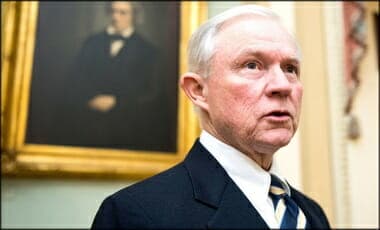
Gregg Jarrett filled in for Sean Hannity, and I liked this snippet discussing the idea that Jeff Sessions had to recuse himself as Attorney General. Great refutation of a mantra.
Author: Papa Giorgio

Rebel Media Asks Ilhan Omar About Her Marriages/Taxes
Love me some Rebel Media! Hat-tip to WEASEL ZIPPERS:
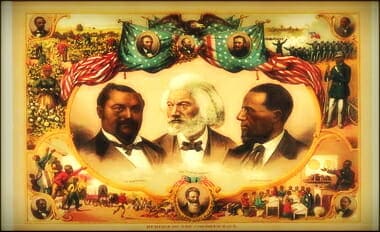
Did “Republicans” Own Slaves? (Dinesh D’Souza)
Larry Elder has Dinesh D’Souza on his radio show to discuss the apparent folly of his [Dinesh’s] absolute statement that is thus:
- Do you know how many Republicans owned slaves in 1860, the year before the Civil War started? The answer may surprise you if you listen to progressive (fake) historians. (DINESH)
While I have been following this somewhat closely, this is the best response yet by Dinesh. (For clarity, here is the other side — Princeton’s Kevin Kruse) An article out yesterday by Walter Williams is also noted: “REPARATIONS FOR SLAVERY“. A great back-n-forth by the two. I truncated the exchange just a bit.

GOOGLE Caught Kicking Conservatives to the Curb (UPDATED)
The video was uploaded to Project Veritas’ YouTube, but… wait for it… YouTube/Google took it down. First was the PINTEREST revelations (that video also removed), now this… and I hope more people come forward. An intro to it by BREITBART:
Google-owned video platform YouTube took down a video from Project Veritas showing a senior employee at the company appearing to admit that the company plans to interfere in the next presidential election to stop Donald Trump.
The video, which is still available on the Project Veritas website featured undercover footage of a top Google employee, Jen Gennai, stating that the company shouldn’t be broken up because only they can prevent the “next Trump situation.”
Via the video:
Elizabeth Warren is saying we should break up Google. And like, I love her but she’s very misguided, like that will not make it better it will make it worse, because all these smaller companies who don’t have the same resources that we do will be charged with preventing the next Trump situation, it’s like a small company cannot do that.
The above brought something to my mind… related to Facebook’s attempt at making a cryptocurrency called Libra (THE SUN | CBS) — and all these algorithms brings to mind a time when “…no one can buy or sell unless he has the mark…” (Rev. 13:17a). They are [whether they know it or not] cutting their teeth on this future evil. (UPDATE) Steve Forbes wrote an OPEN LETTER to Mark Zuckerberg to rename the the Libra, “Mark.”
…And, by the way, you might consider changing the Libra’s name. The “Libra” was a measure of weight from the Roman Empire, and we know where that ended up. Don’t be bashful; call it the “Mark.” Germany ditched its mark—which it had been using since it created it after WWII—for the euro 20 years ago, so the name is up for grabs.
A gold-backed Mark would be a transformative move in the history of money. It would blow bitcoin out of the water and would generate an enthusiastic “Like” from billions of businesses and people, now and forever….

1960’s Democrats Compared To Current (Eggs vs. Milkshakes)
I like to take you back to 1960: pic.twitter.com/60daUJdkso
— Timothy, The Angry Homo (@ncanarchist) June 23, 2019

The Muslim Brotherhood Exposed (Ami Horowitz)
(MOONBATTERY hat-tip) Ami Horowitz investigated the mother of many Islamic terror groups, the umbrella group known as the Muslim Brotherhood, and unsurprisingly found that it is devoted to the imposition of a global caliphate. This sinister organization has already established a secure beachhead in the USA.
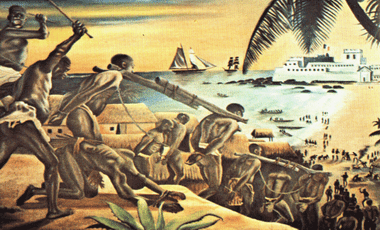
Burgess Owens: “Democrats Should Pay Restitution”

WEASEL ZIPPERS hat-tip… great stuff. I posted the entire video below this clip:
Burgess Owens: “I used to be a Democrat until I did my history and found out the misery that that party brought to my race … slavery, KKK, Jim Crow, killed over 40 percent of our black babies, 20 million of them. How about [Democrats] pay for all the misery brought to my race?” pic.twitter.com/PDUCR89zx5
— Ryan Saavedra (@RealSaavedra) June 20, 2019
Here is a snippet from THE DAILY CALLER:
“I used to be a Democrat until I did my history and found out the misery that that party brought to my race,” Owens said. “I do believe in restitution. Let’s point to the party that was part of slavery, KKK, Jim Crow, that has killed over 40 percent of our black babies, 20 million of them.”
“State of California, 75 percent of our black boys cannot pass standard reading and writing tests: a Democratic state,” Owens continued. “So yes, let’s pay restitution. How about a Democratic Party pay for all the misery brought to my race and those — after we learn our history — who decide to stay there, they should pay also. They are complicit. And every white American, Republican or Democrat, that feels guilty because of your white skin, you should need to pony up also. That way we can get past this reparation and recognize that this country has given us greatness.”
Note also this Democrat getting booed for common sense:
Rep. Mike Johnson’s Constitutional Case Against Reparations
(DAILY CALLER) “The reason for that is a legal question,” Johnson continued after the chairman gaveled for silence. “See, the legal question is: the federal government can’t constitutionally provide compensation today to a specific racial group because other members of that group, maybe several generations ago, were discriminated against and treated inhumanely.”
The House Republican Study Committee chairman further explained that the United States Supreme Court would likely consider the proposal to be an unconstitutional racial preference.
“The holding of the 1995 case Richmond v. J.A. Croson Co. is that racial set asides and other entitlements are only constitutionally permissible to remedy the present effects of the government’s own widespread in recent discrimination,” Johnson explained. “The federal government is not allowed to provide race-based remedies that are ‘ageless in their region of the past and timeless in their ability to effect the future.’”
“Barack Obama opposed reparations when he ran for president in 2008,” he said. “Hillary Clinton and Bernie Sanders did as well eight years later.”
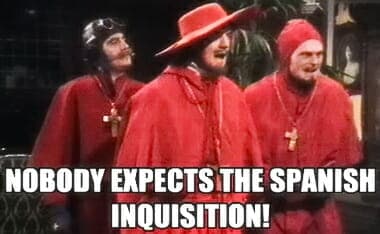
John Cleese on Brexit, The MSM, and Leaving The UK
John Cleese (Monty Python star) explains to Emily Maitlis why newspapers have driven him to the Caribbean. Some comments via YouTube (just a sample):
- John Cleese laughing in her face is priceless.
- Great interview. He basically shat all over the BBC while on the BBC.
- The BBC is a farce … absolutely not an independent news media .. very biased and not informative
- Hey BBC we’re clicking like because John Cleese 1: BBC 0
- John Cleese knows the score, lying scumbags the MSM.
- This presenter is so annoyingly rude, a true BBC presenter. She is exactly why he is leaving, too many liars.
- He seems like just a nice guy who wants to chat, she’s a robot trying to get through the list of questions. Interesting contrast between a genuine personality and an artificial one.
- “Can I have my standard living money back, its about £20 living a month for a concentration camp ???” ~ G.L. Proffitt ~ Thank You John Cleese ?
- Watching Cleese dismantle the lying press puppet is just delicious!
Liz Cheney’s AOC History Smackdown (CNN UPDATE)
(DAILY WIRE hat-tip) Below Liz Cheney’s linear thinking are some of the original videos which leads to Rep. Cheney on FOX… and may I say, AOC’s response to Cheney is bat-shit-crazy! (And may I say this emboldens VICTOR DAVIS HANSON”S article on Why We Should Study War!)
CONTEXT BELOW
Please @AOC do us all a favor and spend just a few minutes learning some actual history. 6 million Jews were exterminated in the Holocaust. You demean their memory and disgrace yourself with comments like this. https://t.co/NX5KPPb2Hl
— Liz Cheney (@Liz_Cheney) June 18, 2019
Socialist Rep. Alexandria Ocasio-Cortez (D-NY) is angry that Rep. Liz Cheney (R-WY) correctly described the horrors of the Holocaust by noting that the evil Nazis systematically targeted 6,000,000+ Jews for extermination pic.twitter.com/iAzYGxrAL2
— Ryan Saavedra (@RealSaavedra) June 19, 2019
CNN CRAZINESS UPDATE!
CNN's Angela Rye says America is headed toward implementing the same "death camps" that Nazi Germany used during the Holocaust pic.twitter.com/kkWEa0eZgo
— Ryan Saavedra (@RealSaavedra) June 19, 2019
Katie Hopkins Answers Objection To Trump
(LANGUAGE WARNING) Best Answer Eva! TESTY TARHEEL ™️ ⭐️ ⭐️ ⭐️ Hat-Tip
“I’d rather be grabbed by the pussy than have one as President”.
#Trump2020 pic.twitter.com/2S3CJ31hgb
— Katie Hopkins (@KTHopkins) June 16, 2019
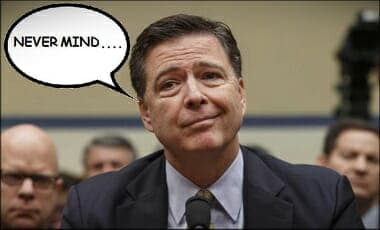
James Comey Is A Felon! Period
This is an excerpt from Gregg Jarrett’s book, The Russia Hoax: The Illicit Scheme to Clear Hillary Clinton and Frame Donald Trump (hardcover | paperback). It is merely for showing that Comey broke the law. This breaking of the law by Comey — unlike the “witch hunt” against our President — is clearly explicit and in violation of law. Enjoy:
QUOTE
COMEY’S THEFT OF GOVERNMENT DOCUMENTS
For years, James Comey carefully cultivated a public portrait of himself as a grown-up Boy Scout—honest and morally straight. The truth is quite different. His actions belie the virtuous image he sought. It was all an illusion designed to mask the kind of conduct that most people find reprehensible. The record shows that he was less than honest, engaged in acts of questionable legality, and abused his power to further his ambitions.
One of the more stunning moments during Comey’s testimony before the Senate Intelligence Committee in June 2017 occurred when he confessed that he deliberately leaked to “a friend” the contents of the presidential memorandums memorializing his conversations with Trump.59 He directed that friend, Daniel Richman of Columbia Law School, to leak the information to the New York Times with the objective that it would trigger the appointment of a special counsel to investigate the man who had just fired him. It was a devious scheme, to be sure. Comey knew the media would be more than willing to trash Trump by contorting the memos’ contents and misconstruing the law to accuse the president of obstruction of justice. Journalists and pundits did not disappoint.
The opening sentence in the Times story on May 16, 2017, did not recite facts derived from the memos, but drew an unsupported conclusion that “President Trump asked the FBI director, James Comey, to shut down the federal investigation into Mr. Trump’s former national security adviser, Michael T. Flynn, in an Oval Office meeting in February.”60 Ipso facto, obstruction. The headline was nearly identical to the first line. Thus, anyone who did not read past the title of the story or the opening sentence was led to believe that Trump had probably committed a crime.
Of course, this is not what happened in the February meeting, according to Comey, who testified on June 8 about his conversation with Trump, narrating the encounter from his memos. Indeed, at the congressional hearing, Comey specifically quoted Trump’s vague comments about Flynn as “hoping” he would be cleared.61 That is not the same thing as “asking to shut down” an investigation, as the Times would have its readers believe. The Times story went on to raise the specter of obstruction and, sure enough, the next day Comey’s longtime friend and ally Robert Mueller was appointed special counsel. For the fired FBI director, it was mission accomplished. His media leak achieved his desired purpose.
In defense of his actions, Comey offered an explanation that was, in equal parts, erroneous and obtuse. He claimed that the seven presidential memos he took with him when he was fired were his personal property. If he believed that, he is not much of a lawyer. The FBI’s policy manual states quite clearly that documents or records generated during official duties are government property.62 The FBI Employment Agreement, to which Comey was bound, mandates that “all information acquired by me in connection with my official duties… remain the property of the United States of America.”63
Under both the Federal Records Act and the Privacy Act, any document or record composed by government employees during the course and scope of their employment is not the property of the person who authored the document, but the property of the government.64 This is especially true if the material was prepared on a government-owned computer and written during the normal work hours while the employee is on the job performing the duties of his job, as was the case with Comey’s presidential memos. His discussions with the president arose directly from his position as head of the FBI. These records laws apply to classified and unclassified documents alike. Furthermore, in his testimony before the Senate Intelligence Committee on June 8, 2017, Comey admitted that he wrote the memos so that they could be “discuss(ed) within the FBI and the government.”65 This is an admission that these documents were not his personal property. Records that are composed for government use are automatically government property.
The fact that Comey did not want to leak the memos himself, but chose a conduit or middleman to do so covertly at his behest, is substantial proof that he knew what he was doing was wrong and illegal. By using a third-party to do the dirty work, Comey was trying to circumvent the law to insulate himself from criminality. He failed.
18 U.S.C. 641 makes it a felony punishable by up to ten years in prison to give someone outside of government an unclassified, but protected, record without authorization:
Whoever embezzles, steals, purloins, or knowingly converts to his use or the use of another, or without authority, sells, conveys or disposes of any record… of the United States or of any department or agency thereof… shall be fined under this title or imprisoned not more than ten years.66
This is precisely what Comey appeared to have done “converting” to his own use and in conveying to his friend, without authorization, his presidential memos which were government records.
Having been fired, Comey stole government records with the intent to leak them for his benefit. In an obvious act of retribution, he wanted the documents to inculpate Trump in a special counsel investigation and, he hoped, generate a criminal charge of obstruction of justice. This scheme to benefit himself and harm the president also may have violated at least two federal regulations, including this one identified in the Code of Federal Regulations:
An employee shall not engage in a financial transaction using nonpublic information, nor allow the improper use of nonpublic information to further his own private interest or that of another, whether through advice or recommendation, or by knowing unauthorized disclosure.67
Under the law, it does not matter that Comey was an ex-employee when he leaked the documents because he maintained custody of them when he was still employed, then took them out of the FBI building to use for his own devices. This was a direct violation of FBI regulations which state, “FBI personnel must surrender all materials in their possession that contain FBI information upon FBI demand or upon separation from the FBI.”68 Comey did not do this. He converted government property to his own use, then disseminated it to the public.
Comey must have known that he was likely breaking several laws and committing felonies. As FBI director, he was legally obligated to adhere to the bureau’s standard nondisclosure contract in which all personnel promise not to disclose the very type of records and information Comey leaked. The agreement specifically warned that employees are subject to “criminal sanctions… and personal liability in a civil action at law… and the disgorging of any profits arising from any unauthorized publication or disclosure.”69 Separation upon termination did not render the contract null and void. It was a binding, enforceable, and actionable contract regardless of job status. Under the terms, Comey agreed he could be sued and face criminal prosecution. Since his firing, Comey published a book quoting from the memos he filched. This enabled him to profit handsomely from his wrongful actions, pocketing millions of dollars. If the FBI contract were to be enforced, Comey could—and should—lose earnings derived therefrom.
The Comey-composed memos themselves recited discussions with the president that were both privileged and contained information involving an ongoing FBI investigation into Flynn’s contacts with Russia. This means Comey appeared to have broken yet another law, punishable by up to ten years in prison. 18 U.S.C. 793 makes it a crime to “willfully communicate or transmit national defense information,” even though it is not necessarily classified when written.70 While the full contents of the partially redacted memos made public so far do not deal directly with national defense matters, the overall Flynn investigation did.
Comey’s chicanery was laid bare in his congressional testimony when he told the Senate Intelligence Committee that he deliberately wrote some of his memos as “unclassified” documents. Making them classified, he told the committee, “would tangle them up.”71 In other words, he manipulated the classification system to exploit the political damage his documents might cause, while concomitantly attempting to shield himself from criminal charges. But this may be a moot point if any of the seven memos Comey took with him contained classified information, regardless of how he might have labeled them or, more aptly, mislabeled them. Under law, the content dictates classification, not the markings.
Sometime in late 2017 or early 2018, the FBI advised the Senate Judiciary Committee that the majority of the memos were, in fact, “classified.”72 Chairman Charles Grassley, one of the few people who gained access to the memos, revealed that four of them were “marked classified at the ‘Secret’ or ‘Confidential’ levels,” a fact that was confirmed when the memos were released.73 Richman told Fox News that he received four of the seven memos.74 This means that Comey appears to have given his “friend” at least one “classified” document.
Giving “classified” records to an unauthorized person and/or storing them in an unsecured venue constitutes several felonies—the same crimes Hillary Clinton surely committed. For example, 18 U.S.C. 1924 states as follows:
Whoever, being an officer, employee of the United States… becomes possessed of documents or materials containing classified information of the United States, knowingly removes such documents or materials without authority and with the intent to retain such documents or materials at an unauthorized location shall be fined under this title or imprisoned for not more than five years, or both!75
Comey appears to have done this. He admitted he knowingly removed presidential memos without authority from FBI headquarters, kept them in what must have been an unauthorized location, then conveyed at least four of them to his “friend,” Richman. As director of the FBI, he knew that at least some of their contents were both privileged and might well be classified. It would be folly for Comey to argue they were not classified since the FBI insists they are. If Comey deliberately mismarked them, he cannot use his own wrongful act to insulate himself from criminal prosecution.
In the alternative, let’s assume for the sake of argument that Comey’s handling of the documents was “grossly negligent,” instead of “knowing” or “intentional.” That would be the same crime for which Clinton should have been charged, 18 U.S.C. 793(f).76 The irony is lost on no one. Comey appears to have committed the identical felony as Clinton, and it was Comey who contorted the law to absolve her of this crime, as explained in chapter 2.
But the story of Comey’s machinations does not end there. Days after the presidential memos were released to the public, it was learned that Richman had worked for Comey at the FBI as an unpaid “special government employee.”77 Comey concealed this important information from Congress during his June 2017 testimony, later dismissing this fact as “irrelevant.”78 Moreover, Comey failed to disclose that another person, Patrick Fitzgerald, also reportedly received memos.79 Fitzgerald is a former U.S. Attorney and special counsel who, like Richman, is a friend of Comey. Both Richman and Fitzgerald have since been hired by Comey as his lawyers.80 And so, too, has another lawyer, David Kelly, to whom Comey gave one or more memos.81 This means that the fired director can invoke the attorney-client privilege to try to protect some or all of their communications about the memos.
The FBI was sufficiently concerned about Comey’s dissemination of classified information that agents conducted a search of Richman’s office to retrieve documents and contain the leak.82 It is unknown whether the same “spillage clean-up” occurred at Fitz gerald’s office and, perhaps, Kelly’s, as well. These corrective actions by the FBI suggest that classified information may well have been shared by Comey in violation of federal law.
When Comey was questioned by senators in a June 2017 hearing before the Intelligence Committee, he omitted these relevant and important details in his answers about his leak of the memos. Under 18 U.S.C. 1001, it is a crime to give false or misleading statements in a legislative proceeding.”83 Concealing material facts” in response to questions under oath before Congress would constitute misleading statements in violation of that statute.
Congress has been investigating Comey for a series of other suspected deceptions made during testimony before various congressional committees. In one instance, he told the House Judiciary Committee, under oath, that he decided not to refer criminal prosecution of Clinton only after she was interviewed.84 Yet, documents uncovered later indicated he made the decision well before the interview.85
Comey insisted that Loretta Lynch, the attorney general, never knew of his decision to clear Clinton in advance of his public announcement.86 Yet, text messages exchanged between Peter Strzok and Lisa Page suggested that Lynch had been apprised in advance.87 Comey also testified that, while FBI director, he never authorized leaks to the media about the two presidential candidates.88 Yet, a subsequent statement by his deputy director, Andrew McCabe, appeared to contradict Comey.89
Finally, the Senate Judiciary Committee sent a letter to the Justice Department’s inspector general accusing Comey of “apparent material discrepancies” in his testimony about the FISA warrant applications, asking whether this was “a deliberate attempt to mislead.”90
There is substantial evidence that Comey did not tell the truth on several occasions and may have violated numerous federal statutes governing the theft of government documents, including classified material. He may also have obstructed justice in the Hillary Clinton email case and violated the law by deceiving the FISA court in a warrant to spy on an American citizen.
Days after Comey published his book and commenced his publicity tour, it was learned that the inspector general at the Department of Justice was investigating whether Comey mishandled classified information contained in the presidential memos he gave to his “friend” that was then leaked to the media.91 If he broke the law, he should be held accountable.
Former independent counsel and U.S. Attorney Joe diGenova was blunt in his assessment of Comey:
I don’t think there’s any doubt that Comey committed multiple crimes. If the Justice Department wants to pursue them vigorously and fairly like they would with any other citizen, he should be indicted for his false testimony on Capitol Hill and for his obstruction of an investigation.92
Far from the image of an honest and honorable Boy Scout, the evidence is compelling that James Comey sought to mislead, deflect, and deceive. He also appears to have abused the powers of his office to exact punishment on the president who fired him. His plan to convert presidential memos for his own use, then leak them to the media to damage Trump suggests a willingness to defy rules, regulations, and federal laws with impunity.
Perhaps Comey felt he could get away with it because he successfully engineered the appointment of his close friend Robert Mueller as special counsel to pursue potential charges against the president.
FOOTNOTES (I removed the URLS, they did not translate well with my OCR program)
59. Politico Staff, “Full Text: James Comey Testimony Transcript on Trump and Russia,” pp. 32 and 33, Politico, June 8, 2017.
60. Michael S. Schmidt, “Comey Memo Says Trump Asked Him to End Flynn Investigation,” New York Times, May 16, 2017.
61. James B. Comey, “Statement for the Record,” Senate Select Committee on Intelligence, p. 5, June 8, 2017; Politico Staff, “Full Text: James Comey Testimony Transcript on Trump and Russia,” Politico, June 8, 2017.
62. Federal Bureau of Investigation, “Manual of Investigative Operations and Guidelines (MIOG),” available at …
63. FBI Employment Agreement, Including Provisions and Prohibited Disclosures, FD-291, available at …
64. 44 U.S.C. 3101, “Records Management by Agency Heads, General Duties”; 5 U.S.C. 552a, “Records Maintained on Individuals”; 28 U.S.C. 1732, “Record Made in Regular Course of Business.”
65. Politico Staff, “Full Text: James Comey Testimony Transcript on Trump and Russia,” Politico, 16, June 8, 2017; available at …
66. 18 U.S.C. 641, “Public Money, Property or Records.”
67. 5 C.F.R. 2635.703, “Use of Nonpublic Information”; 29 C.F.R. 71.14, “Use of Non Public Information.”
68. Federal Bureau of Investigation, Records Management Division, 0792PG, p. 1, June 4, 2015.
69. FBI Employment Agreement, Including Provisions and Prohibited Disclosures, FD-291, available at …
70. 18 U.S.C. 793, “Gathering, Transmitting or Losing Defense Information.”
71. Politico Staff, “Full Text: James Comey Testimony Transcript on Trump and Russia.”
72. Letter from Charles E. Grassley, chairman of Committee on the Judiciary Committee, to Rod J. Rosenstein, deputy attorney general, January 3, 2018, available at …
73. Ibid.
74. Brooke Singman, “Comey Memos Reportedly Had Classified Info,” Fox News, July 10, 2017.
75. 18 U.S.C. 1924, “Unauthorized Removal and Retention of Classified Documents or Material.”
76. 18 U.S.C. 793(f), “Gathering, Transmitting or Losing Defense Information.”
77. Catherine Herridge, Pamela K. Browne, and Cyd Upson, “Comey Memos Shared More Broadly Than Previously Thought,” Fox News, April 25, 2018.
78. Transcript of “James Comey on Clinton Probe, Russia Investigation,” Fox News, “Special Report With Bret Baier.” April 26, 2018, available at …
79. Catherine Herridge, Pamela K. Browne, and Cyd Upson, “Comey Memos Shared More Broadly Than Previously Thought.”
80. Ibid.; Sean Davis, “Comey ‘Friend’ Who Leaked FBI Memos Now Claims to Be His Attorney,” Federalist, January 23, 2018.
81. Transcript of “James Comey on Clinton Probe, Russia Investigation,” Fox News, “Special Report With Bret Baier.” April 26, 2018; available at …
82. Michael D. Shear and Nicholas Fandos, “GOP Push on Comey Files May Have Backfired,” New York Times, April 21, 2018.
83. United States Code, 18 U.S.C. 1001, “Statements or Entries Generally.”
84. Hearing Before the Committee on the Judiciary, “Oversight of the Federal Bureau of Investigation,” Testimony of James B. Comey, September 28, 2016, available at …
85. Senate Judiciary Committee letter to FBI Director Christopher Wray, August 30, 2017, available at …
86. Statement by FBI Director James B. Comey on the Investigation of Secretary Hillary Clinton’s Use of a Personal Email System, FBI National Press Office, July 5, 2016.
87. Brooke Singman, Alex Pappas, and Jake Gibson, “More Than 50,000 Texts Exchanged Between FBI Officials Strzok and Page, Sessions Says,” Fox News, January 22, 2018.
88. Washington Post Staff, “Read Full Testimony of FBI Director James Comey in Which He Discusses Clinton Email Investigation.”
89. CNN Staff, “Read: Former FBI Deputy Director Andrew McCabe’s Statement on His Firing,” CNN, March 17, 2018, available at ….
90. Letter from Sen. Charles E. Grassley and Sen. Lindsey 0. Graham, Judiciary Committee, to Michael Horowitz, Inspector General, Department of Justice, February 28, 2018, available at ….
91. Byron Tau and Aruna Viswanatha, “Justice Department Watchdog Probes Comey Memos Over Classified Information,” Wall Street Journal, April 20, 2018.
92. Interview with Joseph diGenova, former U.S. attorney for the District of Columbia and former independent counsel, January 26, 2018.
- Gregg Jarrett, The Russia Hoax: The Illicit Scheme to Clear Hillary Clinton and Frame Donald Trump (New York, NY: Broadside Books, 2018), 244-254, 325-327.