A Lawrence O’Donnell Screed Fact-Checked

Originally Posted December 2019 (Updated with some graphics and editing)

A HISTORICAL FACT-CHECK:

  • Who really deserves credit for women’s suffrage, civil rights, social security, medicare, and environmental legislation?

A graphic attributed to Lawrence O’Donnell presents a familiar political narrative: liberals won women the right to vote, secured Black voting rights, ended segregation, created Social Security and Medicare, and passed the Clean Air and Clean Water Acts—while conservatives opposed these accomplishments.

[The fixed graphic will be before the APPENDIX – JUMP]

There are important historical facts behind several of these claims. But the presentation leaves out essential context, overlooks significant Republican contributions, and treats political parties as though their identities and coalitions have remained unchanged throughout American history.

The historical record is considerably more complicated. Let’s examine the claims individually.

“Liberals got women the right to vote.”

The Nineteenth Amendment was the culmination of decades of activism by women who organized, marched, petitioned, lobbied, and endured imprisonment to secure voting rights. No political party can fairly claim sole ownership of that movement.

However, the congressional history does not support the implication that Democrats were primarily responsible for its passage.

  • The proposed amendment was introduced in the Senate in 1878 by Republican Senator Aaron A. Sargent of California.
  • The Republican Party’s 1872 platform had already expressed support for women’s demands for additional rights.
  • In 1919, Republicans controlled both the House and Senate when the amendment finally passed Congress.
  • The Senate approved it 56–25. According to Washington Post fact-checker Glenn Kessler, 36 Republicans and 20 Democrats voted in favor; eight Republicans and 17 Democrats voted against it.
  • President Woodrow Wilson, a Democrat, eventually supported the amendment, but his support came after years of opposition and pressure from suffrage activists.

The Washington Post’s 2015 fact-check of Carly Fiorina’s claim that Republicans were the party of women’s suffrage concluded that the Republican Party was generally more supportive of suffrage, particularly its progressive wing, while acknowledging that Republican support had often been symbolic and inconsistent.

The point is not that every Republican championed women’s rights or that Democrats contributed nothing. The point is that the congressional record does not support assigning this achievement exclusively to liberals or Democrats.

Historical source:

Additional documentation:

“Liberals got Black Americans the right to vote.”

This claim leaves out one of the most consequential developments in Republican history: Reconstruction.

Following the Civil War, Republicans in Congress spearheaded the effort to abolish slavery, establish citizenship, and protect the civil and political rights of formerly enslaved Americans.

The Fifteenth Amendment, ratified in 1870, prohibited denying or abridging a citizen’s right to vote on account of race, color, or previous condition of servitude.

The Republican Party played a central role in passing the Reconstruction amendments and the legislation intended to protect the rights of Black Americans. Black Americans subsequently served in Congress, state legislatures, and local offices during Reconstruction.

That history is documented by the U.S. House of Representatives’ own historical archives.

Of course, the Fifteenth Amendment did not end discrimination. Southern states later employed poll taxes, literacy tests, intimidation, and other methods to disenfranchise Black voters. The federal government would eventually have to intervene again.

The Voting Rights Act of 1965, signed by Democratic President Lyndon B. Johnson, was a major achievement in that later struggle. It also received bipartisan congressional support.

The honest historical account includes both chapters: Republican leadership during Reconstruction and the bipartisan coalition that helped enact modern voting-rights protections.

Historical sources:

“Liberals ended segregation and passed the Civil Rights Act.”

The Civil Rights Act of 1964 was one of the most important legislative achievements in American history. President John F. Kennedy proposed the legislation, and President Lyndon B. Johnson used considerable political influence to secure its passage.

But the voting record reveals something missing from the graphic: Republicans supported the legislation at a higher percentage than Democrats did.

According to The Daily Signal’s examination of congressional voting records:

House of Representatives:

  • Democrats: 152 voted in favor, approximately 60% of their party.
  • Republicans: 138 voted in favor, approximately 78% of their party.

Senate:

  • Democrats: 46 voted in favor, approximately 69% of their party.
  • Republicans: 27 voted in favor, approximately 82% of their party.

Both parties supplied votes, but the percentage of Republicans supporting the legislation was higher.

The Senate filibuster is particularly important. Southern Democrats organized the opposition and attempted to prevent the bill from reaching a final vote. Republican Senate Minority Leader Everett Dirksen worked with Democratic leaders Hubert Humphrey and Mike Mansfield to negotiate a compromise and secure the Republican votes needed to invoke cloture.

On June 10, 1964, the Senate voted 71–29 to end the filibuster. Twenty-seven Republicans and 44 Democrats supported cloture.

Without those Republican votes, the necessary supermajority would not have been reached.

The Civil Rights Act was ultimately passed through a bipartisan coalition, with important leadership from Democratic presidents and legislators as well as Republican lawmakers.

It is therefore misleading to present it as an accomplishment belonging exclusively to liberals.

Historical sources:

“Liberals created Social Security.”

Franklin D. Roosevelt and the Democratic Congress deserve recognition for establishing Social Security in 1935. That was a major New Deal legislative accomplishment.

But the claim that Republicans opposed it or contributed nothing to its passage is not supported by the voting record.

The Social Security Administration’s historical congressional tally records the following votes on the original House bill:

  • 284 Democrats voted in favor.
  • 81 Republicans voted in favor.
  • 15 Democrats voted against.
  • 15 Republicans voted against.

In the Senate, 60 Democrats and 16 Republicans voted in favor, while one Democrat and five Republicans voted against.

Republican support was substantial. The legislation was a Democratic-led initiative, but it was not passed without Republican votes.

Historical source:

“Liberals created Medicare.”

Medicare was established under President Lyndon B. Johnson in 1965, and the Democratic administration deserves credit for its passage.

But, once again, the congressional voting record shows bipartisan support. According to the Social Security Administration’s historical tally for the final Medicare legislation:

House of Representatives:

  • Democrats: 237 in favor, 48 opposed.
  • Republicans: 70 in favor, 68 opposed.

Senate:

  • Democrats: 57 in favor, 7 opposed.
  • Republicans: 13 in favor, 17 opposed.

This is an important distinction. Medicare was primarily a Democratic legislative achievement, but a substantial number of Republicans supported it. In the House, Republican votes were almost evenly divided.

The historical record should not be rewritten to suggest that every Republican opposed Medicare or that the legislation passed without Republican participation.

Historical source:

“Liberals passed the Clean Air Act and Clean Water Act.”

This is another example of how political labels can obscure the actual historical record.

The Clean Air Act of 1970 was signed into law by Republican President Richard Nixon. Nixon also signed the reorganization plan that established the Environmental Protection Agency.

The New Atlantis article, “The Conservative Record on Environmental Policy,” by Jonathan H. Adler, points out that the modern federal environmental regulatory structure was largely established during Republican administrations, particularly under Nixon.

There is an important distinction regarding the Clean Water Act.

The 1972 amendments that became known as the modern Clean Water Act passed Congress with broad bipartisan support. However, Nixon vetoed the legislation. Congress overrode his veto by votes of 247–23 in the House and 52–12 in the Senate.

So it would be inaccurate to say Nixon signed the Clean Water Act. It would also be inaccurate to erase the bipartisan congressional support behind it.

The environmental record does not fit neatly into the claim that liberals accomplished everything while conservatives opposed everything.

It is true that modern conservatism became increasingly skeptical of expansive federal environmental regulation. That ideological development deserves acknowledgment. But it does not erase the environmental legislation enacted under Republican administrations or the role Republican lawmakers played in establishing the federal environmental framework.

Historical sources:

The missing historical context: Political parties and their coalitions changed over time.

See Appendix

A final problem with the graphic: It treats political history as a partisan trophy case.

There is a difference between acknowledging that a political party led a particular legislative initiative and claiming that an entire political movement or party deserves exclusive credit for the achievement.

Democrats deserve credit for the New Deal and Social Security. Johnson and Democratic congressional leaders deserve credit for Medicare and for their work securing the Civil Rights Act of 1964 and Voting Rights Act of 1965.

But Republicans also played consequential roles:

  • Republican leadership in Reconstruction and the Fifteenth Amendment.
  • Republican sponsorship and congressional support for women’s suffrage.
  • Republican votes that helped pass the Civil Rights Acts of the 1950s and 1960s.
  • Republican Senate Minority Leader Everett Dirksen’s pivotal role in breaking the 1964 filibuster.
  • Republican votes supporting Social Security and Medicare.
  • Republican President Richard Nixon’s role in signing the Clean Air Act and establishing the EPA.

None of this means Republicans were consistently on the right side of every civil-rights question. They were not. Nor does it mean Democrats were uniformly opposed to civil rights. They were not.

The history is more complicated than either party’s preferred political narrative.

THE BOTTOM LINE: If we are going to discuss American history, we should discuss the actual votes, legislation, party platforms, regional divisions, and political coalitions—not selectively assign historical achievements to whichever modern political label best serves an argument.

History is not a partisan trophy case. And historical accuracy should not depend on which political party happens to benefit from the telling.

FIXED GRAPHIC:


APPENDIX


For more, see my “Racial Mantra Page“

  • “…virtually every significant racist in American political history was a Democrat.” — Bruce Bartlett, Wrong on Race: The Democratic Party’s Buried Past (New York, NY: Palgrave MacMillan, 2008), ix;
  • “…not every Democrat was a KKK’er, but every KKK’er was a Democrat.” — Ann Coulter, Mugged: Racial Demagoguery from the Seventies to Obama (New York, NY: Sentinel [Penguin], 2012), 19.

The Evolution of the Two Major Political Parties: A Realignment, Not an Overnight Switch

Perhaps the most important omission in the original graphic is its failure to explain how the two major political parties actually evolved.

It is tempting to take today’s political labels and apply them indiscriminately to people and political movements from the 1800s and early 1900s. That creates a distorted picture. The Republican Party of Abraham Lincoln’s era, the Democratic Party of Andrew Jackson’s era, and the political coalitions of the 1930s, 1950s, and 1960s cannot simply be treated as identical to today’s parties.

There were conservative Democrats, liberal Democrats, conservative Republicans, and liberal Republicans. Regional divisions were especially important. The Democratic Party, in particular, contained increasingly divergent Northern and Southern factions. Northern Democrats were becoming more supportive of civil rights, while influential Southern Democrats continued defending segregation.

The historical record demonstrates that the parties’ coalitions and positions changed. But that is not the same thing as claiming that every segregationist Democrat became a Republican or that the parties simply exchanged identities in 1964.

To understand what happened, we need to distinguish among four different developments: individual politicians changing party affiliation, voters changing their electoral preferences, state and national party platforms evolving, and the ideological coalitions within the parties changing over time.

The 1948 Dixiecrat revolt: A Democratic Party rebellion, not a Republican migration

The 1948 election is an important starting point.

President Harry Truman’s Democratic Party adopted a stronger civil rights plank at its national convention. This angered segregationist Southern Democrats, several of whom walked out and organized the States’ Rights Democratic Party, commonly known as the Dixiecrats.

They nominated South Carolina Governor Strom Thurmond for president and Mississippi Governor Fielding L. Wright for vice president.

Their platform was not ambiguous about segregation. It explicitly defended racial segregation, opposed federal civil rights enforcement, and rejected federal anti-lynching and anti-poll-tax legislation. The movement was a rebellion within the Democratic Party against the national party’s increasingly pro-civil-rights direction.

The Dixiecrats carried Alabama, Louisiana, Mississippi, and South Carolina, receiving 39 electoral votes. But their third-party organization did not survive as a continuing national political party after the election.

This distinction is crucial:

  • the Dixiecrats did not collectively transfer their organization into the Republican Party.

According to historian Kari Frederickson’s entry in the South Carolina Encyclopedia, some former Dixiecrats returned to the Democratic Party, while others remained politically independent. In South Carolina, many former Dixiecrats joined the Independents for Eisenhower movement in 1952. Some of those independents eventually joined the Republican Party during the 1960s.

The movement therefore became a transitional stage in Southern politics. Former Dixiecrats did not all follow the same political path.

Source: Kari Frederickson, “Dixiecrats,” South Carolina Encyclopedia.

Strom Thurmond: The famous exception—and the 16-year gap

Strom Thurmond is the most prominent example used to support the popular party-switch narrative.

But the chronology is important.

Thurmond ran for president as a segregationist Democrat on the Dixiecrat ticket in 1948. After losing, he returned to Democratic politics. He was elected to the United States Senate as a Democrat and continued serving in the Democratic Party for years.

He did not become a Republican until September 16, 1964.

That was 16 years after his 1948 Dixiecrat presidential campaign.

His 1948 running mate, Fielding L. Wright, remained a Democrat until his death in 1956. The official U.S. Senate biography confirms Thurmond’s party history, including his September 1964 change of affiliation.

Source: U.S. Senate, “Strom Thurmond: A Featured Biography”.

Thurmond’s career is historically significant, and there is no reason to minimize it. He was a segregationist Democrat who later became a Republican. But one prominent politician’s eventual party change cannot establish that an entire political movement changed parties.

What do the four books actually say about the number who switched?

Several of the books examining the Democratic Party’s segregationist history address this question directly. Their numbers are useful, but their denominators must be understood correctly.

Dinesh D’Souza — Hillary’s America: The Secret History of the Democratic Party (2016), pp. 23–24

D’Souza says he assembled a list of approximately 1,500 people he classified as racist Democrats, including members of Congress, governors, judges, and other political figures. He reports that 14 eventually switched to the Republican Party—less than one percent.

That is D’Souza’s own tally, not a published, independently audited database. It is a broader category than the formal 1948 Dixiecrat leadership.

Dinesh D’Souza — Death of a Nation: Plantation Politics and the Making of the Democratic Party (2018), pp. 233–235

D’Souza makes a more specific argument about the Dixiecrats and segregationist politicians. He identifies Strom Thurmond as the sole defection in a group he describes as numbering more than 200.

However, his discussion combines the 1948 Dixiecrat movement with a wider collection of segregationist politicians and opponents of civil rights legislation. It should not be mistaken for a verified census of every person who participated in the 1948 convention.

Ann Coulter — Mugged: Racial Demagoguery from the Seventies to Obama (2012), pp. 189–192

Coulter makes a related argument using Southern segregationist senators. She identifies 12 other segregationist senators besides Thurmond and documents that they remained Democrats. Among the 13 senators discussed in her account, Thurmond was the only one who changed his affiliation from Democrat to Republican. Her argument concerns this specific group of senators, not every segregationist politician or every participant in the 1948 Dixiecrat movement.

Her list is a comparison of segregationist senators, not a complete roster of the 1948 Dixiecrat organization.

Bruce Bartlett — Wrong on Race: The Democratic Party’s Buried Past (2008), especially pp. 143–145 and 171–176

Bartlett documents the 1948 Dixiecrat revolt, the continuing influence of segregationist Democrats, and the gradual political changes that followed. His discussion of the Southern realignment is particularly useful because it considers economic development, the changing Democratic coalition, and the impact of civil rights legislation rather than reducing the entire process to one cause.

Taken together, these books support an important conclusion: the familiar claim that segregationist Dixiecrats simply moved en masse into the Republican Party is not supported by the political careers of the prominent figures these authors examine.

But there is a necessary qualification. Thurmond was not the only segregationist Southern Democrat who ever became a Republican. There were later party changes among other Southern politicians. Those individuals should not automatically be counted as formal members of the 1948 Dixiecrat Party.

For example, Mills E. Godwin Jr. was a segregationist “Byrd Democrat” who later became a Republican and was elected governor of Virginia again in 1973. Jesse Helms was a conservative Democrat who later switched to the Republican Party before his 1972 Senate campaign. Neither should be casually presented as a leader of the 1948 Thurmond-Wright ticket.

This is why the definition of the group matters. A formal 1948 Dixiecrat, a segregationist Democrat, a conservative Southern Democrat, and a politician who changed parties in the 1970s are not necessarily the same category.

Sources: Library of Virginia biography of Mills Godwin; William J. Clinton Presidential Library biography of Jesse Helms.

What happened to the 1948 Dixiecrat voters?

This is another area where political commentary frequently confuses election results with individual voter behavior.

Thurmond received more than one million votes in 1948 and carried four Southern states. But the secret ballot means we cannot simply follow every individual who voted for Thurmond in 1948 and determine how that same person voted in 1952, 1956, 1960, or 1964. Election returns show how states and counties voted. They do not, by themselves, establish that the same individuals changed party affiliation. What we can establish is that Southern voting patterns began changing well before 1964.

Republican presidential gains were already evident during the 1920s, 1930s, and 1940s. Dwight Eisenhower made substantial inroads in 1952 and 1956. In 1956, he became the first Republican since Reconstruction to win a plurality of the Southern vote.

Political analyst Sean Trende documents this longer development in his RealClearPolitics article, “Southern Whites’ Shift to the GOP Predates the ’60s.” He notes that the Republican presidential vote in the South had been increasing for decades before the Civil Rights Act of 1964.

That does not prove that racial politics played no role in later Republican gains. It demonstrates that the Southern political transformation was already underway.

The 1948 Dixiecrat vote did not simply turn into a Republican vote in 1964. Some former Dixiecrat supporters returned to the Democrats. Others voted independently. Some supported Eisenhower. Over time, subsequent generations of Southern voters increasingly supported Republican candidates.

Source: Sean Trende, “Southern Whites’ Shift to the GOP Predates the ’60s,” RealClearPolitics, April 30, 2013.

The 1968 presidential election provides another useful example. Richard Nixon did not simply inherit the entire segregationist Southern vote. George Wallace ran as an independent and carried Alabama, Arkansas, Georgia, Louisiana, and Mississippi. Nixon’s Southern support was concentrated elsewhere.

The election returns demonstrate that the Southern electorate was divided among competing political coalitions rather than moving as one unified bloc.

Source: American Presidency Project, 1968 Presidential Election Results.

Economics, race, and the Southern realignment: The evidence is not one-dimensional

One of the more interesting aspects of this debate is that researchers have reached different conclusions about the relative importance of economic and racial motivations.

Bruce Bartlett emphasizes economic development and the growing appeal of Republican economic policies. His account describes how the postwar South became more industrialized, wealthier, and increasingly receptive to Republican positions on taxes, government spending, and economic policy.

Bartlett also recognizes that civil rights legislation changed the political environment. The dismantling of segregation weakened the old political structures that had maintained Democratic dominance, while increased Black political participation changed the Democratic Party’s electoral coalition.

D’Souza draws heavily on the work of political scientists Byron E. Shafer and Richard Johnston, particularly their 2006 study, The End of Southern Exceptionalism: Class, Race, and Partisan Change in the Postwar South. Their research lends substantial support to D’Souza’s argument that economic development and the emergence of class-based politics were the primary engines driving partisan change in the postwar South. That is a significant finding—and one that is often minimized by accounts that reduce the entire Southern realignment to racial politics.

In other words, economics mattered, but race did not disappear from the equation. And there is important research that directly challenges the claim that Southern white voters changed their political identification for racial reasons rather than economic ones. The most responsible conclusion is that the Southern realignment involved both changing political coalitions and changing voter preferences. The precise weight assigned to economics, race, cultural conservatism, and party leadership remains a subject of scholarly debate.

The Southern Strategy: A real debate, not an excuse to erase the earlier history

The Republican Southern Strategy is often presented as the single event that transformed the Republican Party into the party of segregationists.

That explanation is too simplistic.

There is another distinction worth making: the existence of a political strategy does not automatically establish that every voter attracted by that strategy shared the same motivations. Some Southern voters were influenced by racial attitudes and opposition to federal civil-rights policies. Others were attracted by economic conservatism, religious and cultural issues, anti-communism, national defense, or dissatisfaction with the changing Democratic Party.

These motivations could overlap, but they should not be treated as interchangeable.

Pat Buchanan’s own description of the strategy is revealing. He spoke of building the Republican Party around states’ rights, human rights, limited government, and national defense, while contrasting that approach with openly segregationist Democratic politicians. That statement does not settle the debate over racial appeals, but it illustrates why the strategy should be examined in its historical context rather than reduced to a single explanation.

This is the “Southern Strategy” explained by it’s author at the time he fashioned it. Below that is an adaptation by Larry Elder of what Pat Buchanan was saying at the time.
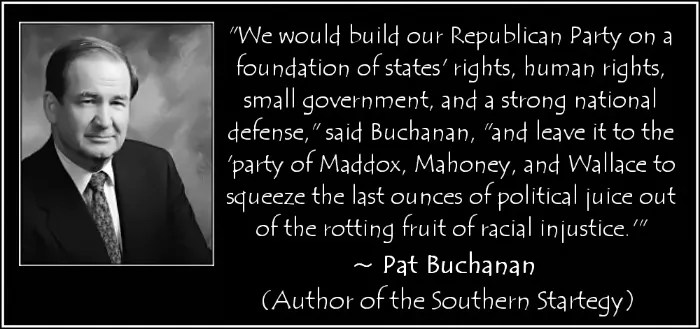
Translation via Larry Elder: (here and here)

  • Pat Buchanan, former Richard Nixon speechwriter, invented the term “Southern strategy.” “We would build our Republican Party,” he said, “on a foundation of states’ rights, human rights, small government, and a strong national defense, and leave it to the ‘party of [Democratic Georgia Gov. Lester] Maddox, [1966 Democratic challenger against Spiro Agnew for Maryland governor George] Mahoney and [Democratic Alabama Gov. George] Wallace to squeeze the last ounces of political juice out of the rotting fruit of racial injustice.’”

Here is a summary of the article
“Nixon’s ‘Southern Strategy’ and a Liberal Big Lie“

Pat Buchanan’s Defense of Nixon and the Southern Strategy

In his 2014 article, “Nixon’s ‘Southern Strategy’ and a Liberal Big Lie,” former Nixon speechwriter Pat Buchanan challenges the popular account that Richard Nixon simply exploited racial resentment to transfer the segregationist South into the Republican Party.

Buchanan points to the Democratic Party’s long history of segregationist political power, including the Southern Manifesto of 1956, the actions of segregationist Democratic governors, and the continued influence of Southern segregationists within the national Democratic coalition.

He also highlights Nixon’s civil-rights record. Nixon supported the Civil Rights Acts of 1964, 1965, and 1968, criticized segregationist candidates during the 1966 campaign, and presided over significant federal school-desegregation efforts. Buchanan argues that Nixon attracted Southern voters through a broader appeal to patriotism, conservatism, and opposition to liberal policies—not simply through racial politics.

Buchanan’s perspective deserves consideration, particularly given his experience inside Nixon’s political circle. However, his defense should not be mistaken for proof that racial appeals played no role in Nixon’s electoral strategy. A president’s civil-rights record and the political calculations of his campaign are related, but they are not identical questions.

The historical record therefore requires more than either simplified explanation. Nixon’s Southern appeal cannot be understood solely as a campaign to attract segregationists, but neither can the racial dimensions of Republican electoral strategy be dismissed. The broader realignment involved changing party coalitions, civil-rights conflicts, economic development, ideology, and the gradual movement of Southern voters away from their traditional Democratic identification.

His argument has several parts:

  1. The Democratic Party had a substantial segregationist history. Buchanan points to Woodrow Wilson, Franklin Roosevelt, Southern segregationist governors, the 1956 Southern Manifesto, and Democratic congressional opposition to civil-rights measures.
  2. Nixon had a documented civil-rights record. Buchanan notes Nixon’s support for the Civil Rights Acts of 1964, 1965, and 1968, his criticism of segregationist candidates in 1966, and his administration’s civil-rights enforcement and school-desegregation efforts.
  3. Nixon’s Southern appeal was broader than race. Buchanan argues that Nixon attracted Southern voters through patriotism, conservatism, and opposition to what those voters viewed as liberal hypocrisy.
  4. The Democratic Party’s historical record complicates the popular narrative. Buchanan challenges the idea that Democrats were uniformly the party of civil rights and Republicans simply inherited the segregationist electorate.

The Claremont Review of Books essay “The Myth of the Racist Republicans” makes an argument against treating the Southern Strategy as the defining explanation for modern Republican politics. Importantly, the essay acknowledges that Republicans pursued a Southern Strategy and that local Republican candidates sometimes worked with segregationist elements in the 1960s.

That acknowledgment matters. A credible historical argument should not deny inconvenient evidence simply because it complicates the conclusion.

Likewise, Bruce Bartlett’s Wrong on Race argues that economic development and the growing ideological divide between conservative Southern Democrats and the national Democratic Party were important factors in the movement toward Republicanism. Bartlett also documents Nixon’s civil rights policies, including school desegregation and affirmative action.

The competing interpretations should be evaluated against the evidence rather than reduced to slogans.

The Southern Strategy was part of the realignment, but it was not the entire realignment. Nor can the realignment be explained without considering the civil rights movement, racial attitudes, the collapse of segregationist political structures, economic changes, and the changing positions of both national parties.

Sources: “The Myth of the Racist Republicans,” Claremont Review of Books; Bruce Bartlett, Wrong on Race, pp. 171–176.

What actually changed?

When we put the evidence together, several developments become clear.

  • The Democratic coalition changed. Northern Democrats increasingly supported civil rights, while segregationist Southern Democrats continued to wield considerable influence.
  • The Republican coalition changed. Republicans attracted increasing numbers of conservative Southern voters, and the party’s positions on civil-rights-related policies evolved over time.
  • African American voters changed their political allegiance. The movement toward Democratic presidential candidates began during the New Deal era, well before the 1960s.
  • Southern white voters changed their political allegiance. Republican presidential gains began before 1964 and continued over several decades.
  • Some segregationist Democrats became Republicans. Thurmond is the most prominent example from the 1948 Dixiecrat leadership. Other Southern Democratic politicians changed parties in later decades, but they should not automatically be labeled 1948 Dixiecrats.
  • Many segregationist Democrats remained Democrats. Politicians such as George Wallace, James Eastland, John Stennis, and Robert Byrd did not become Republicans.
  • The Southern Strategy became part of the later Republican electoral story. Its racial implications and its importance relative to economic, cultural, and ideological factors remain subjects of historical debate.

These developments are connected, but they are not interchangeable.

The bottom line

Did every Dixiecrat, every segregationist Southern politician, or every Southern white voter suddenly become a Republican in 1964? Not even close

The historical record does not support that simplistic account.

The 1948 Dixiecrat movement was a rebellion within the Democratic Party. Its formal organization did not survive beyond that election. Some of its supporters returned to Democratic politics, some became independents, only a small minority of the segregationist Democrats discussed in these accounts eventually changed their party affiliation to Republican. Thurmond’s eventual party change was important, but it occurred 16 years after his presidential campaign.

Meanwhile, the broader Southern realignment unfolded over decades. It involved economic development, changing racial attitudes, civil rights legislation, new generations of voters, and changing national party coalitions.

We should acknowledge the Democratic Party’s historical responsibility for slavery’s political defense, segregationist Southern power, and Jim Crow. We should also acknowledge the Republican Party’s historic role in abolition, Reconstruction, and major civil rights legislation.

Neither party gets to erase its history. Neither party gets to claim that its identity has remained unchanged for two centuries.

The parties experienced a genuine realignment. But a realignment is not a mass conversion, and it is not a historical eraser.

The facts deserve better than the slogan that “the parties switched.”

Sources and Further Reading

The four books examined

  1. Dinesh D’Souza, Hillary’s America: The Secret History of the Democratic Party (Regnery, 2016), especially pp. 23–25.
  2. Dinesh D’Souza, Death of a Nation: Plantation Politics and the Making of the Democratic Party (All Points Books, 2018), especially pp. 233–236.
  3. Ann Coulter, Mugged: Racial Demagoguery from the Seventies to Obama (Sentinel, 2012), especially pp. 189–192.
  4. Bruce Bartlett, Wrong on Race: The Democratic Party’s Buried Past (Palgrave Macmillan, 2008), especially pp. 143–145 and 171–176.

RPT.NET resources

Historical and political analysis supplied for this research

Academic research and primary historical records

Correcting the Humorless Social Media “Fact-Checkers”

So the lack of cartoonish humor on social media is upsetting. So much so I am going to do a “fact-check” on a “fact-check.”

Yes, it is true with the original cartoon I posted on Facebook that 5-year-old’s do not get hormone therapy to prepare for sex-transitions, yet, very young children do in fact get hormone blockers and surgery.

Did I mention VERY YOUNG?

So, I decided to make a cartoon of my own with the current FACTS I know of.

I am curious if I will get “fact-checked” when I upload this to my SSM Facebook page.

Here is what I will post with the cartoon… and a larger version will be available when you click the below cartoon for better reading:


NEW FB POST


The “fact-checks” are missing the humor of the original cartoon I posted. Both Reuters and PolitiFact would probably say the same if I changed this to an 11-year-old. However, we know that,

  • A brief report from four doctors at Vanderbilt University, “Gender-Affirming Chest Reconstruction Among Transgender and Gender-Diverse Adolescents in the US From 2016 to 2019” appeared in JAMA Pediatrics earlier this week. It is “the largest investigation to date of gender-affirming chest reconstruction in a pediatric population” to date. [….] An estimated 1,130 “top jobs” were performed during those four years on girls as young as 12. [….] According to the data, based on the Nationwide Ambulatory Surgery Sample, the Vanderbilt doctors calculated that 5.5 percent of the children were under 14, 21.5 percent under 15, and 56 percent under 16. I assume if a double mastectomy is done at 12 or 13, a penectomy would be done as well to that age-group? [I assume a penectomy has more health consequences for this age-group, so this may be a later stage surgery.] (See more at RPT)

Typically, hormone therapies/puberty blockers are required a year before surgery, so it is reasonable to assume girls [and boys] as young a 11-years-old have had these “therapies” [child abuse] done to them. I say, “to them” because 11-year-olds cannot consent to such medical procedures and “therapies.”

Checking Facebook Factcheckers (and More Dammit!)

JUMP TO….


(These are articles and excerpts — with some additional edits here — from my SITE’S FACEBOOK PAGE)

Okay, I have been doing posts here-n-there with a montage of recent articles about the Covid-1984 gang and what I call “vaccine wars.” In this edition I will start out with a fact check of Facebook’s (FB) “fact check” of a linked article. This is the article with a slight excerpt, followed by my fact check (with a couple additional article links in it for my readers here). The article is titled, “COVID-19 Vaccines: Scientific Proof of Lethality,” and all it is is links to journal articles or papers by specialists calling for caution in whatever aspect they studied of the vaccines. Some are mild observations, others are potentially lethal. But they link mainly to medical journal articles.

FACT-CHECKING FACEBOOK FACT-CHECKERS

Here is the “Fact Check” — on my site’s wall they blurred the links graphic, and when you press “See Why” it brings you to a pop out window where you can link to the article refuting what you (I) put on your FB wall:

Here is my own fact/fact check” if you will. Again, I will add articles for my readers to have more resources:

RUSHED

FACEBOOK says FALSE: because clinical trials under emergency use authorization showed them to be safe.

THREE THINGS.

First is that the trials were not nearly as long or under years long watch before fully approved, they were rushed. (CNN | WEB MD | HISTORY CHANNEL)

And nothing says “we trust these products” like not being able to sue or be compensated for severe side effects (CNBC | NEWS18)

55-YEARS

Two, the FDA has actively tried to block the “clinical trials” paperwork and studies from becoming public.

  • IN FACT: in November of 2021 the FDA has asked a federal judge to give them 55 years to release data related to the Pfizer COVID vaccines (ISRAEL NATIONAL NEWS); and later Pfizer ditched 55-years and asked for 75 years of secrecy (WASHINGTON EXAMINER)

These are from MEDIA’ITE

So for FACEBOOK to say this without the public having any insight into the clinical trials is itself FALSE. (SEE: WINNING: A Court Victory for Transparency on Pfizer Covid Vaccine Data | First 500-Pages Released In December Showed Problems [PDF])

And I will add a third. We do know that there have been many — publicly verified — issues with perfectly healthy people on a sports field that just drop dead or healthy young persons within days of the vaccine having major medical issues. One example is a young teen who was part of the clinical trials: https://tinyurl.com/yc6ehybj

(See also Pfizer Whistleblowers [RPT] | See more stories: 1000 COVID STORIES)

Nathan Emmanuel Esparza

HERE IS A STORY ABOUT A LOCAL KID

Nathan Emmanuel Esparza – Pfizer July 2021

Died 13th July 2021 – Heart Attack Aged 16 Years Old

Nathan was a young healthy 16 year old who was newly vaccinated with Pfizer.

Nathan Esparza, a Castaic High School student and football player, tragically and passed away in his home of a Heart Attack on the evening of Tuesday, July 13th.

Mauro Esparza (Nathan’s Dad) said “As I sit here and grieve for the loss of my best friend, and continue to hear my son, he left a great lasting impression on so many amazing souls….. this brings me some sort of comfort”.

Castaic, California, USA

I can personally confirm through neighbors he had just received the Pfizer vaccine. (More at NO MORE SILENCE)

JOHN STOSSEL

MORE EXAMPLES OF FB CHECKS:

(See more at REASON)

  • The 11 Worst Fact-Checks By Facebook’s New Fact-Checkers (DAILY WIRE, December 2016)
  • Here’s Where The ‘Facts’ About Me Lie — Facebook Bizarrely Claims Its ‘Fact-Checks’ Are ‘Opinion’ (NEW YORK POST, December 2021)
  • Facebook Fact-Checkers Caught Making Wrong Fact Checks, Exposing Liberal Bias (LIES.NEWS, July 2020)
  • Facebook’s Lab-Leak Censors Owe The Post, And America, An Apology (NEW YORK POST, May 2021)
  • Facebook Fact Checkers Just Censored Peer Reviewed Science (WATTS UP WITH THAT, September 2021)
  • Candace Owens Sues Facebook Fact-Checkers For Defamation: ‘I’m Sick Of The Censorship’ (WASHINGTON EXAMINER, November 2020) ||| Candace Owens Challenges Fact-Checker, And Wins (DAILY WIRE, November 2020)
  • Covid-19: Researcher Blows The Whistle On Data Integrity Issues In Pfizer’s Vaccine Trial — Open Letter From The BMJ To Mark Zuckerberg (BRITISH MEDICAL JOURNAL, Decmber 2021)
  • Medical Journal Blasts Facebook For Using Fake ‘Fact Checks’ To Justify Censorship (THE FEDERALIST, December 2021)
  • Facebook VP Concedes ‘Fact Checkers’ Have Own Agenda (VISION TIMES, June 2021)
  • et cetera, et cetera, et cetera

…MOVING ON…

I found this interesting… I came across info regarding FDA “approval” that shows the swarmy nature of government run procedures.

VACCINES ARE FDA APPROVED (LOL)

Here is the intro to the story via JUST THE NEWS:

Pfizer’s vaccine against COVID-19 has been fully approved by the Food and Drug Administration, yet the pharmaceutical giant is still providing distributors across the country with an earlier version of the vaccine that predates FDA’s full approval.

The Pfizer-BioNTech vaccine allowed under federal Emergency Use Authorization (EUA) in December 2020 and the Comirnaty vaccine approved by the FDA in August are identical, according to Pfizer and several experts.

However, the two vaccines are legally distinct, raising questions over the legality of vaccine mandates….

SEN. RON JOHNSON

Here is Senator Ron Johnson’s key claim from the above interview:

  • SEN. RON JOHNSON: We do not have an FDA-approved vaccine being administered in the U.S. The FDA played a bait and switch. They approved the Comirnaty version of Pfizer drugs. It’s not available in the U.S. They even admit it. I sent them a letter three days later going “What are you doing?” What they did is they extended the emergency use authorization for the Pfizer drug vaccine that’s available in the U.S., here that’s more than 30 days later, they haven’t asked that very simple question. If you’re saying that the Pfizer drug is the same as the Comirnaty, why didn’t you provide FDA approval on that? So, there’s not an FDA-approved drug and, of course, they announced it so they could push through these mandates so that people actually think, “Oh, OK now these things are FDA approved.” They are not and again, maybe they should be, but the FDA isn’t telling me why. 

Another posting on this notes the BAIT-N-SWITCH aspect of this whole thing via Jordan Schachtel at his SUBSTACK: Shell Game? There remains no FDA approved COVID vaccine in the United States

I fact checked the fact checkers and couldn’t believe what I found. Despite the corporate press, Big Pharma, and the federal government telling us otherwise, it is absolutely true that there is no FDA approved COVID-19 vaccine available in the United States today. And there are no plans to make one available any time soon.

I know it’s hard to believe, but it’s 100% true. And this reality hints at an incredible scandal within both Big Pharma and the U.S. Public Health bureaucracy.

On August 23, the FDA granted full approval for a COVID-19 vaccine to Pfizer-BioNtech for a specific product sold under the brand name Comirnaty. The landmark moment — the “full approval” endorsement from the FDA — was heralded by the Biden Administration and countless states, and quickly leveraged to coerce millions into taking the shots. This product, Comirnaty, was fully authorized for the “prevention of COVID-19 disease in individuals 16 years of age and older.”

Yet Comirnaty itself has never made its way into the United States. The fully-approved version is nowhere to be found within our borders.

A separate product, which remains under emergency use authorization (EUA), is the only “Pfizer shot” available in the United States.

Early on, Pfizer and its government allies seemed to have a reasonable explanation for this issue. They claimed that Comirnaty was not yet available because the EUA shots were still lining the shelves, and claimed that the FDA-approved version would be available to all soon.

Now, it’s been over 4 months since full approval, and Comirnaty is still not being distributed…..

There is this story as well that I posted on my site’s Facebook that caught my eye, and it starts out by noting “There is a tectonic shift underway in the medico-scientific establishment: they are starting to walk back boosters.”

BACKING AWAY FROM BOOSTERS?

AMERICAN THINKER continues:

The first indication of this dramatic change of attitude came from the United Kingdom last week.

On January 7, Reuters ran a wire titled UK Says 4th COVID Jabs Not Needed for Now As Booster Effect Lasts. That piece featured the following sentence in its opening paragraph: “there is no need for now for people to have a fourth shot, British health officials said on Friday.”

Three days later, the UK Mirror published a piece titled What Is ‘Living With Covid’? Boris Johnson Drawing Up Plans ‘To Be Rolled Out In March. The article quoted Dr. Clive Dix, the former head of the UK’s vaccine task force, who said:

“It is pointless keeping giving more and more vaccines to people who are not going to get very ill. We should just let them get ill and deal with that.”

A mere day later, Bloomberg put out an article titled Repeat Booster Shots Spur European Warning on Immune-System Risks. The piece opened as follows:

European Union regulators warned that frequent Covid-19 booster shots could adversely affect the immune system and may not be feasible. Repeat booster doses every four months could eventually weaken the immune system and tire out people, according to the European Medicines Agency.

The piece goes on to quote Marco Cavaleri, the Head of Biological Health Threats and Vaccines Strategy at the European Medicines Agency (EMA), who said that boosters “can be done once, or maybe twice, but it’s not something that we can think should be repeated constantly.”

Cavaleri then went on to say something we had not yet heard from a high-level public health official:

“We need to think about how we can transition from the current pandemic setting to a more endemic setting.”

Around the same time, the World Health Organization (WHO) put out a statement which included this astounding sentence:

“[A] vaccination strategy based on repeated booster doses of the original vaccine composition is unlikely to be appropriate or sustainable.”

This was a truly startling development since until a week before medical authorities world over were speaking about the need for the fourth (and even subsequent) shots. In fact, some countries like Britain and Israel have already started their administration.

This sudden change of course indicates that there is something in the data that has the powers that be seriously worried. When it came to the Covid vaccines, the medical authorities have displayed an astonishing level of tolerance for side effects and collateral damage. So much so that they were even willing to let some children die unnecessarily for the sake of their vaccine agenda…….

If true, then this IS BIG NEWS. Maybe this is why??

The vaccinated population in the UK account for nearly 75% of alleged Covid-19 deaths, according to the UK Health Security Agency.

Out of the over 3700 deaths reported from Dec. 6 to Jan. 2, over 2600 of them were fully vaccinated – over 70%, according to the data, and an additional 130 deaths attributed to the “partly vaccinated” brings the total up to nearly 75%.

(PDF: COVID-19 vaccine surveillance report [Week 1] 6 January 2022)

…TO WIT:

The NEW YORK POST says that the “UK Health Security Agency said people who received three doses of Pfizer’s vaccine saw their protection drop from 70 percent to 45 percent within 10 weeks.” CNBC notes the fact that:

Albert Bourla (PFIZER’S CEO and veterinarian)

…Two-doses of Pfizer’s or Moderna’s vaccines are only about 10% effective at preventing infection from omicron 20 weeks after the second dose, according to the U.K. data.

A booster dose, on the other hand, is up to 75% effective at preventing symptomatic infection and 88% effective at preventing hospitalization, according to the data.

However, Bourla said it’s unclear how long a booster dose will provide protection against Covid. The U.K. Health Security Agency also found that boosters are only 40% to 50% effective against infection 10 weeks after receiving the shot….


CONSPIRACIES BECOME REALITY

MRNA CHANGES DNA

BLOOMBERG has an article touching on this once “conspiracy” becoming reality. (The full article is HERE):

….In the biggest of the trio, the drug giant agreed to pay as much as $1.35 billion, including $300 million upfront, to Beam Therapeutics to partner on a technique for editing DNA. Two other deals will give Pfizer access to technology for synthesizing genetic material and delivering it to cells.

“Clearly this is one of the top priorities that Pfizer and I myself have for this year,” said CEO Albert Bourla in an interview with Bloomberg Television. The New York-based drugmaker will “invest a lot of capital that has accumulated” through the sales of its Covid-19 vaccine back into this space, Bourla said.

Developed with German partner BioNTech, Pfizer’s Covid vaccine has become one of the biggest-selling and most important pharmaceutical products of all time. While relatively difficult to ship and store because of temperature requirements, the messenger RNA shot is expected to bring in more than $36 billion for 2021, far outselling inoculations from AstraZeneca and Johnson & Johnson that use other means to raise antibodies against Covid.

Producing an mRNA-based Covid vaccine gave Pfizer expertise to apply to other mRNA opportunities, such as base editing, Beam CEO John Evans said Monday in an interview with Bloomberg Television. Pfizer and Beam plan to use mRNA to deliver edits that, if successful, would change a person’s DNA to fix or possibly even cure genetic disease….

WITH OR OF COVID

RED STATE brings us this gem:

Since the beginning of the pandemic, a debate over the accuracy of the COVID-19 death totals has existed, with the attempt being to delineate who died directly from the virus vs. who died while having an incidental infection.

That debate emerged because there have been numerous examples of people wrongly labeled as dying of the coronavirus when they clearly died by other means and would have done so regardless of infection. Typically, when a limited dive into the data produces such results (such as just looking at Palm Beach County), you can bet there are a lot more examples out there that just haven’t been discovered.

Yet, for the better part of two years, any discussion of such miscategorizations resulted in a litany of derogatory responses. Either you were a conspiracy theorist, weren’t taking the pandemic seriously, or both. The press wrote countless articles insisting that the totals were completely accurate, especially during the Trump administration. The Washington Post even managed to call Sen. Joni Ernst, who is about as milquetoast of a Republican as you can get, a conspiracy theorist for asking questions. Meanwhile, social media companies would ban people for suggesting the totals were inaccurate.

But as has been the pattern the last few months, from the admission that the lab leak theory is probable to revisions about the vaccines not stopping the spread of COVID-19, another major shift is taking place. Per CDC Dir. Rochelle Walensky, the government is preparing to release revised COVID death figures that will show those who died from the virus instead of the broader total of those who died with it.

When taken in a vacuum, this announcement is a very good thing. Who wouldn’t want more accurate data regarding the pandemic? Especially when our inflated COVID death numbers are used to disparage the United States worldwide while other countries undercount their death totals.

Yet, I can’t help but notice how politically convenient this is. Literally, just a few days after Joe Biden took the mantle of presiding over the most COVID deaths from Donald Trump, the government suddenly decides now is the time to revise the numbers? Yeah, there’s no way that’s a coincidence.……

More and more evidence is showing what was called a conspiracy theory or xenophobia shows to be in fact reality.

COVID ENGINEERED IN LABORATORY 

TECHNO FROG has an excellent post on the matter — of which I will excerpt a portion from, but the ENTIRE article is worth your time:

Since the start of the COVID-19 pandemic, NIAID Director Anthony Fauci and NIH Director Francis Collins have decried the theory that the virus escaped from the Wuhan Institute of Virology as a conspiracy theory.

Back in March 2020, Collins said claims that COVID-19 was engineered in a lab were “outrageous.” He pointed to a new study that “debunks such claims by providing scientific evidence that this novel coronavirus arose naturally.” Notably, one of the study’s authors, Kristian Anderson, had previously informed Fauci that some features of the virus “look engineered.”

Never to be outdone, in May 2020, Fauci told National Geographic that this virus “could not have been artificially or deliberately manipulated.” Could not. He left no room for doubt:

Everything about the stepwise evolution over time strongly indicates that [this virus] evolved in nature and then jumped species

Today, Congressional Republicans released e-mails revealing scientists and researchers – people who are certainly not conspiracy theorists – informing Fauci and Collins of their beliefs that the virus was man-made.

Notes from a February 1, 2020 conference call were forwarded to Fauci and Collins on February 2, 2020. Here are the excerpts from the Republican release.

Regarding the same February 1, 2020 phone conference, notes (likely communicating the position of Collins) state that experts needed to be convened to support the theory of “natural origin” or the “voices of conspiracy will quickly dominate, doing great harm to science and international harmony…” There was no concern for actually getting to the truth.

Another February 2 email (to which Fauci and Collins were copied) from Dr. Andrew Rambaut states “from a (natural) evolutionary point of view the only thing here that strikes me as unusual is the furin cleavage site.” Importantly, he observed the insertion “resulted in an extremely fit virus in humans.”

Then there were efforts to completely shut down debate. Dr. Ron Fouchier remarked that debate on the origins of the virus would be a distraction and cause harm to science.

And then in April 2020, we see Collins again asking government officials at NIH to “put down” the “very destructive conspiracy” that the virus was engineered…….

(READ IT ALL!)

Rep. Jim Jordan (R-OH)

  • “If the American people put us back in charge, we are definitely going to do this because we now know without a doubt that Dr. Fauci knew on Jan. 31 and Feb. 1 that this thing [the COVID 19 virus] came from a lab,” said Rep. Jordan. (POST MILLENNIAL)

And PROJECT VERITAS had a huge release of what is weightier than The Pentagon Papers.

  • Military documents state that EcoHealth Alliance approached DARPA in March 2018 seeking funding to conduct gain of function research of bat borne coronaviruses. The proposal, named Project Defuse, was rejected by DARPA over safety concerns and the notion that it violates the gain of function research moratorium.
  • The main report regarding the EcoHealth Alliance proposal leaked on the internet a couple of months ago, it has remained unverified until now. Project Veritas has obtained a separate report to the Inspector General of the Department of Defense, written by U.S. Marine Corp Major, Joseph Murphy, a former DARPA Fellow.
  • “The proposal does not mention or assess potential risks of Gain of Function (GoF) research,” a direct quote from the DARPA rejection letter.
  • Project Veritas reached out to DARPA for comment regarding the hidden documents and spoke with the Chief of Communications, Jared Adams, who said, “It doesn’t sound normal to me,” when asked about the way the documents were buried.

[WASHINGTON, D.C. – Jan. 10, 2022] Project Veritas has obtained startling never-before-seen documents regarding the origins of COVID-19, gain of function research, vaccines, potential treatments which have been suppressed, and the government’s effort to conceal all of this.

The documents in question stem from a report at the Defense Advanced Research Projects Agency, better known as DARPA, which were hidden in a top secret shared drive.

DARPA is an agency under the U.S. Department of Defense in charge of facilitating research in technology with potential military applications.

Project Veritas has obtained a separate report to the Inspector General of the Department of Defense written by U.S. Marine Corp Major, Joseph Murphy, a former DARPA Fellow.

The report states that EcoHealth Alliance approached DARPA in March 2018, seeking funding to conduct gain of function research of bat borne coronaviruses. The proposal, named Project Defuse, was rejected by DARPA over safety concerns and the notion that it violates the basis gain of function research moratorium.

According to the documents, NAIAD, under the direction of Dr. Fauci, went ahead with the research in Wuhan, China and at several sites across the U.S.

Dr. Fauci has repeatedly maintained, under oath, that the NIH and NAIAD have not been involved in gain of function research with the EcoHealth Alliance program. But according to the documents obtained by Project Veritas which outline why EcoHealth Alliance’s proposal was rejected, DARPA certainly classified the research as gain of function. 

“The proposal does not mention or assess potential risks of Gain of Function (GoF) research,” a direct quote from the DARPA rejection letter.

Major Murphy’s report goes on to detail great concern over the COVID-19 gain of function program, the concealment of documents, the suppression of potential curatives, like Ivermectin and Hydroxychloroquine, and the mRNA vaccines……

FEMINIST FATALE, NAOMI WOLF

And GATEWAY PUNDIT covers Steve Bannon’s WAR ROOM discussion about this with the old guard feminist Naomi Wolf:

On Tuesday morning Dr. Robert Malone, the inventor of the mRNA vaccine, and Dr. Naomi Wolf, a former Clinton adviser and democracy activist, joined Steve Bannon on The War Room to respond to the Project Veritas bombshell.

Dr. Malone called it “bigger than the Pentagon Papers.”

Dr. Wolf called it “manslaughter of millions of people coordinated at the highest levels.”
Boom!

NAOMI WOLF: The fact that Dr. Fauci grossly perjured himself is hugely apparent. It is the least of the crimes if indeed these are verified documents… I can’t overstate this, this is a premeditated kind of manslaughter of millions of people coordinated at the highest levels according to these documents. Treatments that would have saved lives were intentionally or reportedly intentionally suppressed.

Via The War Room:

[….]

READ THE DOCUMENTS

The DAILY WIRE joins the mix as well with an excellent article documenting “Top U.S. and British scientists reportedly thought that SARS-CoV-2, the coronavirus that causes COVID-19, likely escaped from a laboratory in Wuhan, China.” Continuing with their article, the reason they kept quite about it was due to international relations: “but some were hesitant to let the debate play out in the media because they were concerned about ‘international harmony.'”

THEY KNEW

“An email from Sir Jeremy Farrar, director of the Wellcome Trust, on February 2 2020 said that ‘a likely explanation’ was that Covid had rapidly evolved from a Sars-like virus inside human tissue in a low-security lab,” The Telegraph reported. “The email, to Dr Anthony Fauci and Dr Francis Collins of the US National Institutes of Health, went on to say that such evolution may have ‘accidentally created a virus primed for rapid transmission between humans.’”

However, a top Dutch scientist and a top U.S. public health official warned that discussing the lab leak theory could cause serious geopolitical issues and could harm China.

Dr. Francis Collins, the then-director of the National Institutes of Health (NIH), replied to Farrar, writing: “I share your view that a swift convening of experts in a confidence-inspiring framework is needed or the voices of conspiracy will quickly dominate, doing great potential harm to science and international harmony.”

Another scientist, Dr. Ron Fouchier, a Dutch virologist and Deputy Head of the Erasmus MC Department of Viroscience, responded to Farrar, “Further debate about such accusations would unnecessarily distract top researchers from their active duties and do unnecessary harm to science in general and science in China in particular.”

The report added:

In the emails, Sir Jeremy said that other scientists also believed the virus could not have evolved naturally. One such scientist was Professor Mike Farzan, of Scripps Research, the expert who discovered how the original Sars virus binds to human cells.… The emails also show that Bob Garry, of the University of Texas, was unconvinced that Covid-19 emerged naturally.

Viscount Ridley, co-author of Viral: the search for the origin of Covid, said that the emails showed “a lamentable lack of openness and transparency among Western scientists who appear to have been more interested in shutting down a hypothesis they thought was very plausible, for political reasons.”….

BABYLON BEE’S PROPHECY

And here is a WEASEL ZIPPER’S story regarding hospital shortages due to laying workers off due to no vaccinations:

Science science and more science.

Via Politico:

Hospitals and long-term care facilities are so short staffed that many are compelling Covid-positive doctors and nurses to return to work, arguing that bringing back asymptomatic or even symptomatic staff is the only way they can keep their doors open amid a spike in hospitalizations.

The practice, allowed by the most recent CDC guidance, underscores the dire situation in which many facilities find themselves as more than 120,000 people nationwide are now hospitalized with the virus — almost three times the total from Thanksgiving when Omicron was first detected.

Keep reading…

See more at: 5 Recent Babylon Bee Headlines That Were Surprisingly Believable

Hospital beds in some of the largest cities have cut beds:

And seemingly another political move to protect Biden, and that is to….

STOPPING REPORTING OF COVID-CASES

The WORLD SOCIALIST WEBSITE has the story:

The US federal government will no longer require hospitals to report the number of people who die from COVID-19 every day, according to new guidelines from the US Department of Health and Human Services (HHS).

On January 6, the HHS published updated guidelines on which information hospitals provide to the agency. The guidelines note the “retirement of fields which are no longer required to be reported,” among which is “Previous day’s COVID-19 deaths.”

The guidelines note, “This field has been made inactive for the federal data collection. Hospitals no longer need to report these data elements to the federal government.” This change goes into effect February 2.

Another Biden Admin CYA was the hospitalization rates, which I dealt with just last week. ELECTION CENTRAL 

If you’re paying attention, you’ll notice that Covid-19 hospitalizations appear to be skyrocketing to new heights around the country. Hospital after hospital is suddenly once again filled with Covid patients, or so it seems. As it turns out, the numbers are not only lying, they’re being distorted in such a way that further lessens public trust in agencies like the Centers for Disease Control (CDC) to accurately and objectively provide information.

The issue has to do with what types of hospital admissions actually get counted as Covid-19 patients. Obviously, patients suffering from severe illness due to Covid are included in this count. However, so are patients who visit the hospital for a scheduled procedure or another acute emergency, yet then test positive for Covid-19 while they’re there. They could be asymptomatic, having no Covid issues, but suddenly they become a “Covid hospitalization” and greatly inflate and exaggerate the numbers.

[….]

In a recent interview, CDC Director Rochelle Walensky admitted that hospitalization numbers are greatly exaggerated, and the actual number of attributed Covid-19 deaths since the start of the pandemic may be exaggerated as well, but she doesn’t know by how much:

CNN anchor Jake Tapper has criticized as “misleading” the admission by the head of the Centers for Disease Control and Prevention that it counted COVID patients who had been admitted to hospital for something else.

Tapper was reacting to comments CDC director Rochelle Walensky made on Fox News on Sunday that “up to 40 percent” of patients had been admitted to hospitals with another medical emergency but had been later detected as having COVID.

When asked by Fox News anchor Bret Baier if there was a breakdown of how many of the 836,000 deaths in the U.S. were “from COVID” or “with COVID,” Walensky gave a non-committal answer in which she said “our death registry…takes a few weeks to collect,” and that “those data will be forthcoming.”

The numbers are repeating around the country, with at least 40%, perhaps higher, of non-Covid hospital admissions in New York City being incorrectly included in the count:…..

MEDIA BIAS TO PROTECT BIDEN

AMERICAN GREATNESS has an article about the Associate Press ordering “its staff to stop covering the total number of coronavirus cases in the country and around the globe.” Saying it is a “dramatic shift in focus… apparently shifting the parameters of what a ‘case’ truly means.” CONTINUING:

Fox News reports that the sudden change can be seen in a recent article from the AP titled “Omicron wave prompts media to rethink which data to report,” by author David Bauder. In the article, published on Wednesday, Bauder claims that, while the number of positive coronavirus cases and hospitalizations had previously been “barometers of the pandemic’s march across the world,” the ongoing spread of the Omicron variant from South Africa “is making a mess of the usual statistics, forcing news organizations to rethink the way they report such figures.”

“The number of case counts soared over the holidays, an expected development given the emergence of a variant more transmissible than its predecessors,” Bauder wrote. “Yet these counts only reflect what is reported by health authorities. They do not include most people who test themselves at home, or are infected without even knowing about it. Holidays and weekends also lead to lags in reported cases.”

As a result, the AP speculates that if every single positive test was included, then the total number of cases would be “substantially higher” as a result of dramatic inflation and exaggeration of many instances.

“For that reason, The Associated Press has recently told its editors and reporters to avoid emphasizing case counts in stories about the disease,” Bauder continued. “That means, for example, no more stories focused solely on a particular country or state setting a one-day record for number of cases, because that claim has become unreliable.”…..

LEFTIE MOMS RAGE AGAINST THEIR MACHINE!

This first article is via THE ATLANTIC: Why I Soured on the Democrats: COVID school policies set me adrift from my tribe.

MOM #1

Until recently, I was a loyal, left-leaning Democrat, and I had been my entire adult life. I was the kind of partisan who registered voters before midterm elections and went to protests. I hated Donald Trump so much that I struggled to be civil to relatives on the other side of the aisle. But because of what my family has gone through during the pandemic, I can’t muster the same enthusiasm. I feel adrift from my tribe and, to a certain degree, disgusted with both parties.

I can’t imagine that I would have arrived here—not a Republican, but questioning my place in the Democratic Party—had my son not been enrolled in public kindergarten in 2020.

Late that summer, the Cleveland school system announced that it would not open for in-person learning the first 9 weeks of the semester. I was distraught. My family relies on my income, and I knew that I would not be able to work full-time with my then-5-year-old son and then-3-year-old daughter at home.

Still, I was accepting of short-term school closures. My faith in the system deteriorated only as the weeks and months of remote-learning dragged on long past the initial timeline, and my son began refusing to log on for lessons. I couldn’t blame him. Despite his wonderful teacher’s best efforts, online kindergarten is about as ridiculous as it sounds, in my experience. I remember logging on to a “gym” class where my son was the only student present. The teacher, I could tell, felt embarrassed. We both knew how absurd the situation was.

Children who had been present every day the year before in preschool, whose parents I had seen drop them off every morning, just vanished. The daily gantlet of passwords and programs was a challenge for even me and my husband, both professionals who work on computers all day. About 30 percent of Cleveland families didn’t even have internet in their home prior to the pandemic.

I kept hoping that someone in our all-Democratic political leadership would take a stand on behalf of Cleveland’s 37,000 public-school children or seem to care about what was happening. Weren’t Democrats supposed to stick up for low-income kids? Instead, our veteran Democratic mayor avoided remarking on the crisis facing the city’s public-school families. Our all-Democratic city council was similarly disengaged. The same thing was happening in other blue cities and blue states across the country, as the needs of children were simply swept aside. Cleveland went so far as to close playgrounds for an entire year. That felt almost mean-spirited, given the research suggesting the negligible risk of outdoor transmission—an additional slap in the face.

Things got worse for us in December 2020, when my whole family contracted COVID-19. The coronavirus was no big deal for my 3- and 5-year-olds, but I was left with lingering long-COVID symptoms, which made the daily remote-schooling nightmare even more grueling. I say this not to hold myself up for pity. I understand that other people had a far worse 2020. I’m just trying to explain why my worldview has shifted and why I’m not the same person I was.

By the spring semester, the data showed quite clearly that schools were not big coronavirus spreaders and that, conversely, the costs of closures to children, both academically and emotionally, were very high. The American Academy of Pediatrics first urged a return to school in June 2020. In February 2021, when The New York Times surveyed 175 pediatric-disease experts, 86 percent recommended in-person school even if no one had been vaccinated.

But when the Cleveland schools finally reopened, in March 2021—under pressure from Republican Governor Mike DeWine—they chose a hybrid model that meant my son could enter the building only two days a week.

My husband and I had had enough: With about two months left in the academic year, we found a charter school that was open for full-time in-person instruction. It was difficult to give up on our public school. We were invested. But our trust was broken.

Compounding my fury was a complete lack of sympathy or outright hostility from my own “team.” Throughout the pandemic, Democrats have been eager to style themselves as the ones that “take the virus seriously,” which is shorthand, at least in the bluest states and cities, for endorsing the most extreme interventions. By questioning the wisdom of school closures—and taking our child out of public school—I found myself going against the party line. And when I tried to speak out on social media, I was shouted down and abused, accused of being a Trumper who didn’t care if teachers died. On Twitter, mothers who had been enlisted as unpaid essential workers were mocked, often in highly misogynistic terms. I saw multiple versions of “they’re just mad they’re missing yoga and brunch.”

Twitter is a cesspool full of unreasonable people. But the kind of moralizing and self-righteousness that I saw there came to characterize lefty COVID discourse to a harmful degree. As reported in this magazine, the parents in deep-blue Somerville, Massachusetts, who advocated for faster school reopening last spring were derided as “fucking white parents” in a virtual public meeting. The interests of children and the health of public education were both treated as minor concerns, if these subjects were broached at all.

Obviously, Republicans have been guilty of politicizing the pandemic with horrible consequences, fomenting mistrust in vaccines that will result in untold numbers of unnecessary deaths. I’m not excusing that.

But I’ve been disappointed by how often the Democratic response has exacerbated that mistrust by, for example, exaggerating the risks of COVID-19 to children. A low point for me was when Virginia Democratic gubernatorial candidate Terry McAuliffe inflated child COVID-hospitalization numbers on the campaign trail. It was almost Trumplike. (If I lived in Virginia, I admit I probably would have had to sit out the recent gubernatorial election, in which the Republican candidate beat McAuliffe.)

(READ IT ALL!)

MOM #2

And another Leftie mom wrote about an almost identical experience[s] in POLITICO: How School Closures Made Me Question My Progressive Politics: I’ve never felt more alienated from the liberal Democratic circles I usually call home.

June 26, 2020, was the day I went public with just how angry I was about my son’s school closing down for Covid, and my life hasn’t been the same since.

I had begun to sense a difference between my own feelings and those of my mom’s text group, which included nine of us whose kids had gone to preschool together since they were 2 years old; the kids were 8 at the time. These were the parents of my son’s closest friends. We even had a name for our group, the “mamigas”— as most of us were either Latinas or married to Latinos and shared a commitment to bilingual education.

I tweeted, “Does anyone else feel enraged at the idea that you’ll be homeschooling in the fall full-time? Cuz my moms group text is in full-blown acceptance mode and it bugs the shit out of me.” I didn’t know it yet, but this would be my first foray into school reopening advocacy, which eventually included helping lead a group of Oakland parents in pushing the school district to be more transparent about the process of reopening (particularly in negotiations with the teachers union) and writing several pieces on the topic.
I probably should have inferred that becoming a school-reopening advocate would not go over well in my progressive Oakland community, but I didn’t anticipate the social repercussions, or the political identity crisis it would trigger for me. My own experience, as a self-described progressive in ultra-lefty Oakland, is just one example of how people across the political spectrum have become frustrated with Democrats’ position on school reopenings.

Parents who advocated for school reopening were repeatedly demonized on social media as racist and mischaracterized as Trump supporters. Members of the parent group I helped lead were consistently attacked on Twitter and Facebook by two Oakland moms with ties to the teachers union. They labelled advocates’ calls for schools reopening “white supremacy” called us “Karens,” and even bizarrely claimed we had allied ourselves with Marjorie Taylor Greene’s transphobic agenda.

There was no recognition of the fact that we were advocating for our kids, who were floundering in remote learning, or that public schools across the country (in red states) opened in fall 2020 without major outbreaks, as did private schools just miles from our home. Only since last fall, when schools reopened successfully despite the more contagious Delta variant circulating, have Democratic pundits and leaders been talking about school closures as having caused far more harm than benefit.

Some progressive parents now admit they were too afraid of the blowback from their communities to speak up. And they were right to be wary. We paid a price.

So did Democrats, even if they didn’t realize it until later, or still don’t. Glenn Youngkin’s surprise gubernatorial win in Virginia in November was a wake-up call for the party. As has been recognized, Youngkin’s focus on school-related issues, especially after Terry McAuliffe made a dismissive remark about parents, was an effective tactic. Still, all over Twitter I saw progressives denying that parent anger at prolonged school closures was a major issue in that election — they claimed it was all about anti-critical race theory sentiment, despite research showing school pandemic policies were more to blame. Even more disturbing, as evidenced in the comments on a recent tweet by Sen. Brian Schatz (D-Hawaii), is that many still believe shutting down schools for a year or more was justified.
Some progressive parents now admit they were too afraid of the blowback from their communities to speak up. And they were right to be wary. We paid a price.

So did Democrats, even if they didn’t realize it until later, or still don’t. Glenn Youngkin’s surprise gubernatorial win in Virginia in November was a wake-up call for the party. As has been recognized, Youngkin’s focus on school-related issues, especially after Terry McAuliffe made a dismissive remark about parents, was an effective tactic. Still, all over Twitter I saw progressives denying that parent anger at prolonged school closures was a major issue in that election — they claimed it was all about anti-critical race theory sentiment, despite research showing school pandemic policies were more to blame. Even more disturbing, as evidenced in the comments on a recent tweet by Sen. Brian Schatz (D-Hawaii), is that many still believe shutting down schools for a year or more was justified.

Some unions and districts are now using last year’s closures as a precedent. Recently, with the Omicron surge, several major school districts announced they were switching to remote learning for a week or more, including Newark and dozens of other New Jersey districts, Ann Arbor and Cleveland. Then last week, the Chicago teachers union voted for a sickout, followed by teachers in San Francisco and Oakland engaging in similar actions.

Spring 2020 had been a disaster for my son when his school in the Oakland Unified School District switched to emergency remote learning. He had recently been diagnosed with ADHD and did not do well with me at home — he often flatly refused to do any work. Although I saw a range of reactions by teachers to emergency remote learning that spring, and know that some went to great lengths to keep their students engaged, my son’s teacher only met with the kids one-on-one on Zoom for 15 minutes a week. Beyond that, parents were given worksheets to do with our kids; there was no actual instruction that spring.

When the new school year began in August 2020, Oakland provided only fully remote instruction. My incredibly bright but impulsive son found the temptation of having a computer screen in front of him irresistible — and would often open other windows or try to surf the internet.

By January 2021, with my son increasingly disengaged as Zoom school dragged on and no hope of an imminent return to school in Oakland, I promised him I wouldn’t make him go through another year like this. I knew that he desperately needed to learn alongside other kids.

I had until then resisted my dad’s suggestion that I consider sending him to private school. I was a proud alumna of San Francisco public schools and planned for my kids to attend Oakland public schools, despite their reputation for behavioral and academic problems. As an interracial, bilingual/bicultural family, what we wanted was for our son to attend a dual-language immersion program with plenty of other kids of color. My family was also in no way able to pay for private school.

But I began to fear that even in-person school in fall 2021 was at risk because of the impossible demands of the teachers union (that schools remain fully remote until there were “near-zero” Covid cases in Oakland) and apathy of the school board and district; even after teachers were prioritized for vaccination, there was no urgency to get kids back to the classroom. My dad offered to help pay for private school, and we applied. In March we were notified that my son was admitted to a private dual-language immersion school, and that we had been granted a 75 percent scholarship. There was still no deal in place between Oakland’s school district and the union to return to in-person school. I had lost all faith in the decision-makers to do what was best for my kid. So I made the only logical decision.

Even then, I feared what fellow parents might think of me. I’m well aware of the stereotypes of white parents choosing the private-school option when the going gets tough at public schools. I told myself that prioritizing being a “good leftist” at the expense of my son’s well-being wasn’t good parenting, but as a red-diaper baby myself, the white guilt dies hard. My own parents had sent me to an elementary school with a huge majority of Black and Pacific Islander students; while many might assume the white parents documented in the New York Times podcast “Nice White Parents” were pioneers, my parents reverse-integrated me into a “failing” school 40 years ago. Sending my kid to private school was accompanied by a lot of angst.

My fears were amplified by the backlash I and other school reopening advocates had faced throughout the school year, particularly on social media. There were a range of insults lobbed at us: We were bad parents who didn’t care about our own kids or teachers dying, we only wanted our babysitters back and our frustrations about school closures were an example of “white supremacy.” Los Angeles teachers union head Cecily Myart-Cruz stated that reopening schools was “a recipe for propagating structural racism.”

(READ IT ALL!)

CNN FAILS THE #SCIENCE TEST