[UPDATED TODAY — REPLACED A DEAD VIDEO — ADDED AN APPENDIX | ORIGINAL POST: 7/09/2016]
The reason for this post is to respond to the idea that the NAZIs were in any way Christian or were supported by the Church or that Hitler was friends with the church. This post should be connected with my updated post, “GOD vs. HITLER.” As well as a post discussing Luther’s anti-Semitism and the distinction between [conservative] Confessing Lutheran’s in Germany at the time and the more socially liberal socialist [state-run] Lutherans: Defending “Lutheranism” from Martin Luther’s Fall from Grace
Between these three posts one should be equipped to respond to this lack of knowledge in regards to history.
Here is a good compendium of NAZI symbols with their occult connections:
- Scott Lively and Kevin Abrams, The Pink Swastika: Homosexuality in the NAZI Party (Sacemento, CA: Veritas Aeterna Press, 2002), adapted from chapter two.
Many of the Nazi emblems, such as the swastika, the double lightning bolt “SS” symbol, and even the inverted triangle symbol used to identify classes of prisoners in the concentration camps, originated among homosexual occultists in Germany (some, such as the swastika, are actually quite ancient symbols which were merely revived by these homosexual groups). In 1907, Jorg Lanz Von Liebenfels (Lanz), a former Cistercian monk whom the church excommunicated because of his homosexual activities,[1] flew the swastika flag above his castle in Austria.[2] After his expulsion from the church, Lanz founded the Ordo Novi Templi (“Order of the New Temple”), which merged occultism with violent anti-Semitism. A 1958 study of Lanz called, “Der Mann der Hitler die Ideen gab” – or, “The Man Who Gave Hitler His Ideas” – by Austrian psychologist Wilhelm Daim, called Lanz the true “father” of National Socialism.
List, a close associate of Lanz, formed the Guido Von List Society in Vienna in 1904. The Guido Von List Society was accused of practicing a form of Hindu Tantrism, which featured sexual perversions in its rituals (the swastika is originally from India). A man named Aleister Crowley, who, according to Hitler biographer J. Sydney Jones, enjoyed “playing with black magic and little boys,” popularized this form of sexual perversion in occult circles.[3] List was “accused of being the Aleister Crowley of Vienna”.[4] Like Lanz, List was an occultist; he wrote several books on the magic principles of rune letters (from which he chose the “SS” symbol). In 1908, List “was unmasked as the leader of a blood brotherhood which went in for sexual perversion and substituted the swastika for the cross”.[5] The Nazis borrowed heavily from Lis’s occult theories and research. List also formed an elitist occult priesthood called the Armanen Order, to which Hitler himself may have belonged.[6]

[TO THE RIGHT] THE FIRST SWASTIKA KNOWN TO BE DISPLAYED IN PRE-WAR GERMANY ON A POLITICAL POSTER BY THE THULE SOCIETY WAS IN 1919.
CORRECTED INFO IN APPENDIX
— JUMP —
The Nazi dream of an Aryan super-race was adopted from an occult group called the Thule Society, founded in 1917 by followers of Lanz and List. The occult doctrine of the Thule Society held that the survivors of an ancient and highly developed lost civilization could endow Thule initiates with esoteric powers and wisdom. The initiates would use these powers to create a new race of Aryan supermen who would eliminate all “inferior” races.
Hitler dedicated his book, Mein Kampf, to Dietrich Eckart, one of the Thule Society’s inner circle and a former leading figure in the German Worker’s Party (when they met at the gay bar mentioned earlier).[7]
“…And among them I want also to count that man, one of the best, who devoted his life to the awakening of his, our people, in his writings and his thoughts…”[8]
After the above dedication, the notes in this edition of Mein Kampf read, “Dietrich Eckart was the spiritual founder of the National Socialist Party.”[9] The various occult groups mentioned above were outgrowths of the Theosophical Society, whose founder, Helen Petrovna Blavatsky, was a lesbian,[10] and whose “bishop” was a notorious pederast Charles Leadbeater. Heinrich Himmler, head of the SS, was obsessed with Freemasonry,[11] which is full of occultic influences and practices.[12]
[1] Dusty Sklar, The Nazis and the Occult ,(New York, NY: Dorset Press, 1989), 19
[2] Nicholas Goodrick-Clarke, The Occult Roots of Nazism: Secret Aryan Cults and their Influence on Nazi Ideology (New York, NY: New York University Press, 1985) p. 109
[3] J. Sydney Jones Hitler in Vienna 1907-1913 (New York, NY: Stein & Day,1983), 123.
[4] ibid., 123
[5] Dusty Sklar, The Nazis and the Occult (New York, NY: Dorset Press,1989), 23.
[6] Robert G. L. Waite, The Psychopathic God Adolf Hitler, Signet Books; New York [1977], p. 91
[7] Wulf Schwarzwaller, The Unknown Hitler: His Private Life and Fortune, National Press Book; Washington D. C. [1989], p. 67
[8] Adolf Hitler, Mein Kampf (translated by Ralph Manheim: New York, NY: Houghton Mifflin, 1971), 687.
[9] Ibid.
[10] James Webb, The Occult Underground (LaSalle, IL: Open Court Pub, 1974), 94.
[11] G. S. Graber, The History of the SS: A Chilling Look at the Most Terrifying Arm of the Nazi War Machine (New York, NY: David McKay Company, 1978), 81.
[12] see: Andre Nataf, The Wordsworth Dictionary of the Occult (France: Wordsworth Refernce, 1994), 58-60; Debra Lardie, Concise Dictionary of the Occult and New Age (Grand Rapids: MI: Kregal Publishers, 2000), 108; D. Michael Quinn, Early Mormonism and the Magic World View (Salt Lake City, UT: Signature Books, 1998), cf.“freemasonry, 604.
Nazi Occultism 1: The Thule Society | European History | WW2 | Extra History
SERIES:
 • Nazi Occultism 1: The Thule Society | • Nazi Occultism 2: Weird Science | • Nazi Occultism 3: Hitler vs Magic
• Nazi Occultism 4: The Indiana Jones Stuff | • Nazi Occultism 5: Thor’s Hammer
Here is another excerpt from another book discussing the occult symbols in the “SS”
- Michael Moynihan and Stephen E. Flowers, The Secret King: Karl Maia Wiligut, Himmler’s Lord of the Runes: The Real Documents of NAZI Occultism (Waterbury Center, VT: Dominion Press, 2001), 22-31.
Important areas in which Wiligut worked for Himmler included his conceptualization of the Wewelsburg castle as the “center of the world”; the design of the SS-ring; creation of various rituals and design of ritual objects to be used in SS ceremonies; and a steady stream of reports on esoteric matters of theology, history and cosmology issued for the most part privately to Himmler.
The Wewelsburg castle is a 17th century structure located near Buren in Westphalia. Himmler first viewed the castle in 1933 while on a campaign trip of the Party. It is uncertain as to whether Wiligut accompanied him on this trip; however, it is certain that the colonel influenced him greatly on the conceptualization of the castle as a worldwide headquarters for an order of knights — the SS. (Hüsser 1982: 33, 40) Shortly after the Wewelsburg was transferred to the SS, it became the headquarters of the Gesellschaft zur Förderung and Pflege deutscher Kultur-denkmäler (Society for the Promotion and Care of German Cultural Monuments) and was subsequently transformed into a “Nordic academy” for the ideological education —or initiation — of SS leaders. It was increasingly conceptualized as an Order-Castle (Ordensburg) and was remodeled to become the ritual space for ceremonies particular to Himmler’s elite circle within the SS.

Central to this cult was the northern tower of the castle. The lowest space in this tower, the vault, came to be referred to as the “Walhalla” — the Hall of the Slain. Above this vault is the colonnade chamber, on the floor of which is emblazoned the most distinctive single symbol of the Wewelsburg:

The colonnade hall was to become the central ritual chamber of the order of SS knights which Himmler and Wiligut envisioned.
This castle was to be the ultimate command center for cultural as well as military campaigns for the spread of a new Aryan empire, and, in the conception of Himmler and Wiligut, a bulwark against the invading “subhumans” from the east — the Bolsheviks.
The Wewelsburg became a great repository for all kinds of SS traditions, rituals and objects. At the end of the war, as American troops approached the region, the castle was blown up on 31 March 1945 by SS-men acting on orders from Himmler. Three days later American troops moved in and secured the site. As to what happened to much of the material and documents originally housed in the Ordensburg, there are three answers: some of it must have been removed before the detonation of the building; some of it was looted by locals of the nearby village in the three days between the detonation and the arrival of the Americans; and the rest was looted by American soldiers.

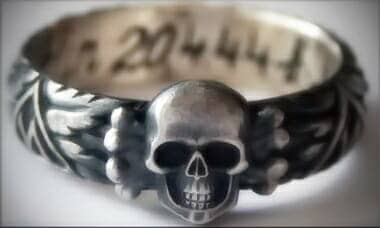
The most important cult-object of the SS is the “death’s head ring” [Totenkopfring]. [PICTURED ABOVE ~ SEE MORE BELOW] Wiligut is widely credited with its design. (Hunger 1985: 164) The text of a document which was presented the SS-men with the ring reads:
I bestow upon you the death’s head ring of the SS. It is:
A sign of our loyalty to the Führer, our unwavering obedience to our superiors and our unshakable solidarity and comradery.
The death’s head is an admonition to be prepared at any time to risk our own individual lives for the life of the collective whole.
The runes opposite the death’s head are holy signs from our past, with which we have been newly reconnected through the philosophy of National Socialism.
The two Sig-runes symbolize the name of our protection-squad [Schutzstaffel].
The Swastika and Hagall-rune are to keep our attention on our unshakable faith in the victory of our philosophy.
The ring is crowned all around with oak-leaves, the leaves of the old German tree.
This ring may not be sold, and is not allowed to be transferred to others.
Upon your withdrawal from the SS or from life, this ring is to be returned to the Reichsfiihrer-SS.
Copies and imitations are punishable by law and you are to protect it from same.
Wear the ring with honor!
~ Heinrich Himmler
According to Hüser (1982: 66-67), the rings of the SS-men who died in battle were stored in a special place in the Walhalla; those of SS-men who departed under other circumstances were generally melted down. Husker also reports that the store of “hundreds” of rings, which had resisted the explosion and fire, as well as local efforts to loot the castle, was eventually looted by American soldiers.
It also seems that Wiligut was instrumental in creating SS-rituals and designing ceremonial objects to be used in the performance of such rituals. A complete transcript has been uncovered in SS archives for a name-giving rite that Wiligut conducted for the newborn son of SS officer Karl Wolff, and at which Himmler himself was also present. A translation of the document appears as Appendix C in this book. Wiligut also presided over related rituals at the Wewelsburg. (Goodrick-Clarke 1985: 187) Much of the ritual design seems to have centered on marriage ceremonies for SS-men and their brides. There was a eugenic aspect to these ceremonies in that leading SS-men and their brides had to demonstrate their Aryan heritage by tracing it back at least to 1750. One object which Wiligut designed was a bowl in which bread and salt were presented to the bride and groom — the cover of this vessel was decorated with a “word-sigil for Got” [TO THE RIGHT]:
This is a bind-rune for  (GOT). (Hunger 1984: 164) The commandant of the Wewelsburg, Manfred von Knobbelsdorff, was an enthusiastic follower of Wiligut and enacted many rituals of Wiligut’s tradition.One of the most important, and mysterious, aspects of Wiligut’s operative “magical” work came in the form of the aforementioned enigmatic Halgarita-Sprüche (Halgarita-Sayings), which were mantras from the Wiligut-tradition intended to enhance ancestral memory and facilitate the reemergence of the Irminist faith. A complete collection of these, excerpted from archival material, is printed on pages 103-110 of this book.
Throughout the years 1933-1939, Wiligut produced a number of reports for Himmler on a variety of topics relevant to esoteric religion, theology, history, and even political policy. One document outlines Wiligut’s ideas on the necessity of re-confiscating properties appropriated by the Church from the indigenous followers of the ancient faith. (Hüser 1982: 205)
During these years of high activity, Wiligut was already an elderly man in his late sixties and early seventies. His health and general level of energy were apparently not well-suited to the hectic pace at the center of the German National Socialist bureaucracy, so he was “treated” with drugs by SS physicians. It seems that these drugs had the effect of causing certain personality changes, including the colonel’s increasing dependance on tobacco and alcohol.
In the course of Wiligut’s life he had encounters with a number of other well-known esoteric nationalists. Some of these appear to have been his teachers, many were his students and others his colleagues. It is uncertain as to how well Wiligut knew men such as Guido von List and Lanz von Liebenfels. His ties to the latter seem to have been stronger, as so many of his own contacts were members of the ONT. Of course, Wiligut’s chief students were Emil Rudiger and Friedrich Teltscher, who further developed and published ideas rooted in Wiligut’s system. But beyond these there are others whom Wiligut encountered during his SS years and who merit discussion.
One of the most enigmatic figures of the SS was Otto Rahn (1904-1939). As a young man, Rahn spent time in the late 1920s and early 1930s in the Pyrenees region of southern France conducting research on the Cathar sect and the possibility of the Holy Grail being a part of their still-hidden treasure. In 1933 he published his most important work: Kreuzzug gegen den Gral (The Crusade against the Grail). But toward the mid-1930s financial problems forced him back to Germany where, in April of 1936, swept up in the Movement, he joined the SS. Rahn had been in personal contact with Wiligut and was a civilian employee of the SS for about a year before this. He was immediately made part of the Reichsführer-SS personal staff, and so worked closely with Wiligut. Rahn, like “Weisthor,” entered the SS with a personal secret. Rahn was a homosexual, which could result in a death-sentence if discovered. While in the SS Rahn undertook research trips to locations in Germany and even to Iceland, although he was never on an official SS expedition to southern France as is sometimes reported. In 1937 Rahn published his second book: Luzifers Hofgesind: Eine Reise zu Europas guten Geistern (Lucifer’s Retinue: A Journey to the Good Spirits of Europe). This is a kind of esoteric travelogue in which Rahn recounts the significance of various landscapes and monuments from southern France, Italy, Germany and Iceland. Rahn lectured within SS-circles on the theme of Luzifers Hofgesind, i.e., that Lucifer is the bringer of enlightenment and the enemy of the Jewish God, and that the retinue of Lucifer includes all those “good spirits” who fight for this enlightenment. Rahn was very well-liked by both Wiligut and Himmler. Himmler tried to give Rahn every opportunity to survive in the SS in the face of persistent reports of his homosexual activity. It is most likely that Rahn came to believe he would meet a dishonorable end in the SS, so to prevent this he wandered into the mountains near Soil, Austria, drank a bottle of liquor and allowed the winter cold to take his life. Himmler personally mourned the loss of Rahn.
Another esotericist with whom Wiligut had positive relations was Gunther Kirchhoff (1892-1975). On the surface this might appear to be an unlikely alliance since Kirchhoff was a member of the Guido von List Society. Wiligut had begun to correspond with Kirchhoff in the spring of 1934, and reported enthusiastically to Himmler about Kirchhoff’s writings. With Wiligut’s good recommendation, Himmler supported Kirchhoff, but the Ahnenerbe, which had a higher level of scholarly standards, rejected Kirchhoff’s writings as “fanciful.” However, Himmler continued to support Kirchhoff, who wrote reports on esoteric matters for the Reichsführer-SS as late as 1944. Many of Kirchhoff’s ideas seem to have been drawn from List and/or Wiligut; however, his geomantic studies, which he blended with an esoteric geopolitics, are what make his works noteworthy. Toward the end of his life, Kirchhoff wrote an analysis of events based on his theories entitled “Das politische Ratsel Asien aus Ortung erschlossen” (The Political Riddle of Asia Solved through Location). (See Mund 1982: 260-274) Based on the idea that certain power-points on the surface of the earth are arranged in hexagonal patterns, those who know this secret could use it to their advantage. This theory explains the Austrian city of Vienna as the key to controlling Asia, and explains the secret relationship of Vienna to certain “power points” in central Asia.
Other esotericists of the day were not so well-received by Wiligut. It is said that it was the influence of Wiligut which had Ernst Lauterer arrested and interned in a concentration camp. As observers have noted, Lauterer was a man with a personal mythology similar to that of Wiligut. In 1911 — under the name “Tarnhari” (the Hidden-High-One) — Lauterer wrote to the old master, Guido von List, and told him how he was the head of the secret Volsung-clan of the semi-divine hero Siegfried. This correspondence is outlined in J. Balzli’s official biography of Guido von List published in 1917. Lauterer-Tarnhari subsequently became a member of the Guido von List Society. One may speculate on the nature of the friction between Wiligut and Lauterer.
 |
 |
Here is another book speaking to what could be considered demonic forces at work in Hitler’s life. Earlier I posted an episode witnessed that also hints at that: Some of Hitlers Demonic Episodes Penned In a 1940 Book
- Walter C. Langer, The Mind of Adolf Hitler: The Secret Wartime Report (New York, NY: Basic Books, 1972), 35-37.
Hitler’s guide is something different entirely. It seems certain that Hitler believes that he has been sent to Germany by Providence and that he has a particular mission to perform. He is probably not clear on the scope of this mission beyond the fact that he has been chosen to redeem the German people and reshape Europe. Just how this is to be accomplished is also rather vague in his mind, but this does not concern him greatly because an “inner voice” communicates to him the steps he is to take. This is the guide that leads him on his course with the precision and security of a sleepwalker.
I carry out the commands that Providence has laid upon me.
No power on earth can shake the German Reich now, Divine Providence has willed it that I carry through the fulfillment of the Germanic task.
But if the voice speaks, then I know the time has come to act.
It is this firm conviction that he has a mission and is under the guidance and protection of Providence that is responsible in large part for the contagious effect he has had on the German people.
Many people believe that this feeling of destiny and mission have come to Hitler through his successes. This is probably false. Later in our study (Part V) we will try to show that Hitler has had this feeling for a great many years although it may not have become a conscious conviction until much later. In any case it was forcing its way into consciousness during the last war and has played a dominant role in his actions ever since. Mend (one of his comrades), for example, reports: “In this connection a strange prophecy comes to mind: Just before Christmas (1915) he commented that we would at sometime hear a lot from him. We had only to wait until his time had come.” Then, too, Hitler has reported several incidents during the war that proved to him that he was under Divine protection. The most startling of these is the following:
I was eating my dinner in a trench with several comrades. Suddenly a voice seemed to be saying to me, “Get up and go over there.” It was so clear and insistent that I obeyed automatically, as if it had been a military order. I rose at once to my feet and walked twenty yards along the trench carrying my dinner in its tin can with me.
Then I sat down to go on eating, my mind being once more at rest. Hardly had I done so when a flash and deafening report came from the part of the trench I had just left. A stray shell had burst over the group in which I had been sitting, and every member of it was killed.
Then, also, there was the vision he had while in hospital at Pasewalk suffering from blindness allegedly caused by gas. “When I was confined to bed, the idea came to me that I would liberate Germany, that I would make it great. I knew immediately that it would be realized.”
These experiences must later have fit in beautifully with the views of the Munich astrologers, and it is possible that, underneath, Hitler felt that if there was any truth in their predictions they probably referred to him.
(See also “The Secret Wartime Report on the Mind of Hitler.”) While reading another book, I came across some smaller excerpts, of which I include slightly larger swaths of (getting a used edition of the 1940 book, The Voice of Destruction, it has to do with an expansion of how Hitler viewed the Church as well as what could be understood as demonic episodes:
Our nocturnal conversation arose out of our anxieties regarding such a development. The two Bavarian Gauleiter, Streicher of Franconia and Wagner of Munich, had brought us the tale. It was Streicher who gave Hitler his cue in the conversation. I had not listened to the beginning of it and became attentive only when I heard Hitler’s voice behind me getting louder.
“The religions are all alike, no matter what they call themselves. They have no future—certainly none for the Germans. Fascism, if it likes, may come to terms with the Church. So shall I. Why not? That will not prevent me from tearing up Christianity root and branch, and annihilating it in Germany. The Italians are naïve; they’re quite capable of being heathens and Christians at the same time. The Italians and the French are essentially heathens. Their Christianity is only skin-deep. But the German is different. He is serious in everything he undertakes. He wants to be either a Christian or a heathen. He cannot be both. Besides, Mussolini will never make heroes of his Fascists. It doesn’t matter there whether they’re Christians or heathens. But for our people it is decisive whether they acknowledge the Jewish Christ-creed with its effeminate pity-ethics, or a strong, heroic belief in God in Nature, God in our own people, in our destiny, in our blood.”
After a pause, he resumed:
“Leave the hair-splitting to others. Whether it’s the Old Testament or the New, or simply the sayings of Jesus, according to Houston Stewart Chamberlain—it’s all the same old Jewish swindle. It will not make us free. A German Church, a German Christianity, is distortion. One is either a German or a Christian. You cannot be both. You can throw the epileptic Paul out of Christianity—others have done so before us. You can make Christ into a noble human being, and deny his divinity and his role as a savior. People have been doing it for centuries. I believe there are such Christians today in England and America—Unitarians they call themselves, or something like that. It’s no use, you cannot get rid of the mentality behind it. We don’t want people who keep one eye on the life in the hereafter. We need free men who feel and know that God is in themselves.”
Streicher or Goebbels made some remark which I did not catch—a question perhaps.
“You can’t make an Aryan of Jesus, that’s nonsense,” Hitler went on. “What Chamberlain wrote in his Principles is, to say the least, stupid. What’s to be done, you say? I will tell you: we must prevent the churches from doing anything but what they are doing now, that is, losing ground day by day. Do you really believe the masses will ever be Christian again? Nonsense! Never again. That tale is finished. No one will listen to it again. But we can hasten matters. The parsons will be made to dig their own graves. They will betray their God to us. They will betray anything for the sake of their miserable little jobs and incomes.
“What we can do? Just what the Catholic Church did when it forced its beliefs on the heathen: preserve what can be preserved, and change its meaning. We shall take the road back: Easter is no longer resurrection, but the eternal renewal of our people. Christmas is the birth of our savior: the spirit of heroism and the freedom of our people. Do you think these liberal priests, who have no longer a belief, only an office, will refuse to preach our God in their churches? I can guarantee that, just as they have made Haeckel and Darwin, Goethe and Stefan George the prophets of their Christianity, so they will replace the cross with our swastika. Instead of worshiping the blood of their quondam savior, they will worship the pure blood of our people. They will receive the fruits of the German soil as a divine gift, and will eat it as a symbol of the eternal communion of the people, as they have hitherto eaten of the body of their God. And when we have reached that point, Streicher, the churches will be crowded again. If we wish it, then it will be so—when it is our religion that is preached there. We need not hurry the process.”
[….]
I cannot judge whether Hitler is near madness in the clinical sense. My own experience of him and what I have learned from others indicate a lack of control amounting to total demoralization. His shrieking and frenzied shouting, his stamping, his tempests of rage—all this was grotesque and unpleasant, but it was not madness. When a grown-up man lashes out against the walls like a horse in its stall, or throws himself on the ground his conduct may be morbid, but it is more certainly rude and undisciplined.
Hitler, however, has states that approach persecution mania and dual personality. His sleeplessness is more than the mere result of excessive nervous strain. He often wakes up in the middle of the night and wanders restlessly to and fro. Then he must have light everywhere. Lately he has sent at these times for young men who have to keep him company during his hours of manifest anguish. At times these conditions must have become dreadful. A man in the closest daily association with him gave me this account: Hitler wakes at night with convulsive shrieks. He shouts for help. He sits on the edge of his bed, as if unable to stir. He shakes with fear, making the whole bed vibrate. He shouts confused, totally unintelligible phrases. He gasps, as if imagining himself to be suffocating.
My informant described to me in full detail a remarkable scene—I should not have credited the story if it had not come from such a source. Hitler stood swaying in his room, looking wildly about him. “He! He! He’s been here!” he gasped. His lips were blue. Sweat streamed down his face. Suddenly he began to reel off figures, and odd words and broken phrases, entirely devoid of sense. It sounded horrible. He used strangely composed and entirely un-German word-formations. Then he stood quite still, only his lips moving. He was massaged and offered something to drink. Then he suddenly broke out—
“There, there! In the corner! Who’s that?”
He stamped and shrieked in the familiar way. He was shown that there was nothing out of the ordinary in the room, and then he gradually grew calm. After that he lay asleep for many hours, and then for some time things were durable.
[….]
There is an instructive parallel—mediums. Most of these are ordinary, undistinguished persons; yet suddenly they acquire gifts that carry them far above the common crowd. These qualities have nothing to do with the medium’s own personality. They are conveyed to him from without. The medium is possessed by them. He, himself, however, is uninfluenced by them. In the same way undeniable powers enter into Hitler, genuinely daemonic powers, which make men his instruments. The common united with the uncom-mon—that is what makes Hitler’s personality so desperate a puzzle to those who come into contact with him. Dostoevsky might well have invented him, with the morbid derangement and the pseudo-creativeness of his hysteria.
I have frequently heard men confess that they are afraid of him, that they, grown men though they are, cannot visit him without a beating heart. They have the feeling that the man will suddenly spring at them and strangle them, or throw the inkpot at them, or do something senseless.
Hermann Rauschning, The Voice of Destruction (New York, NY: G.P. Putnam’s Sons, 1940), 49-51, 255-257, 258.
APPENDIX – HISTORICAL CORRECTION
With the advent of AI searches, I can say the Swastika was already popular in some circles before 1919, although I believe the Thule Society poster was political in nature, and so may be the first use of it in that regard.
The following are still persons known in German culture of the time to be involved in the occult.
Order of the New Templars
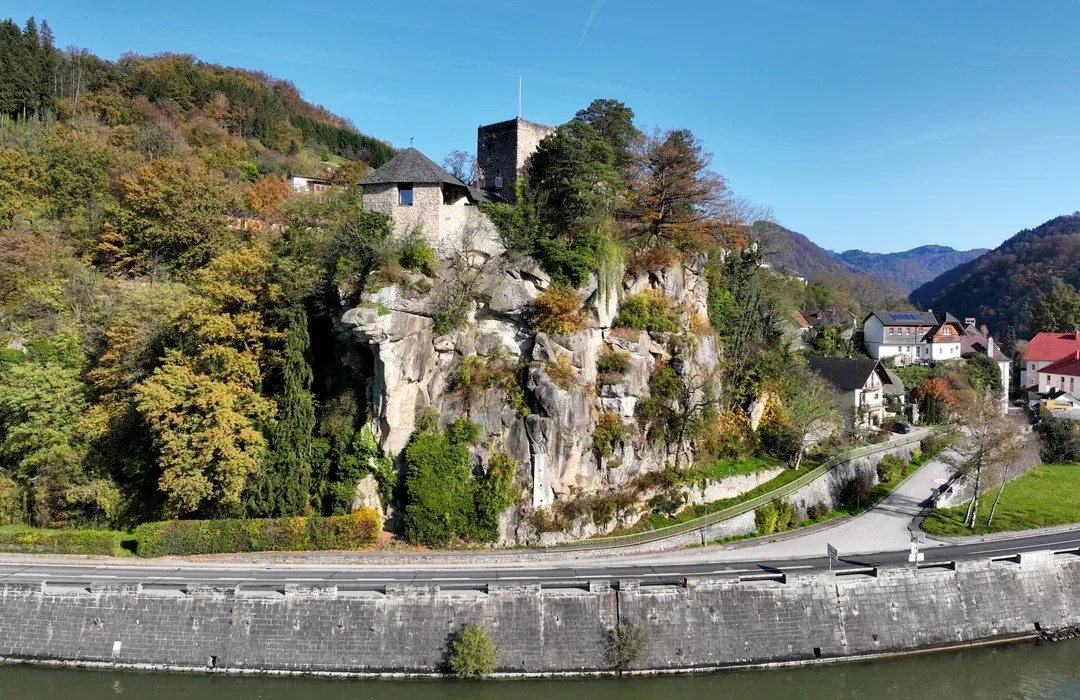
In 1907 Lanz von Liebenfels’s Order of the New Templars flew a yellow flag with a swastika and fleurs-de-lis at Werfenstein Castle, also in Austria. That reconstruction shows a yellow field, a red right-facing swastika, and four blue fleurs-de-lis. Secondary accounts, including Nicholas Goodrick-Clarke, describe the order’s device that way: gold for eternity, lilies for racial purity, the red swastika for the “rising Aryan.” German accounts of Christmas Day 1907 are a little plainer. Jörg Lanz von Liebenfels, born Adolf Joseph Lanz, hoisted two flags on the tower of Burg Werfenstein:
- one with the arms of the extinct von Liebenfels family, which he claimed, and one with a right-angled swastika already common in völkisch circles.
The castle is real. Lanz bought the ruined Burg Werfenstein, above the Danube near Grein in Upper Austria, in 1907 and made it the priory of the Ordo Novi Templi, which he had founded in Vienna in 1900. From 1908 he held public festivals there; guests came upriver by steamboat and were greeted with cannon shots. The order survived a generation and went underground after the 1938 annexation of Austria.
League of German Educators
The same year Wilhelm Schwaner put a Hakenkreuz on the title page of Der Volkserzieher (“The People’s Educator”) and made it the badge of the Bund deutscher Volkserzieher (“League of German Educators”). His 1913 book was titled Unterm Hakenkreuz.
Unterm Hakenkreuz translates literally as:
“Under the Swastika”
Depending on context, it could also be rendered:
“Under the Swastika Banner”
“Under the Sign of the Swastika”
Here is the original along with the translated picture:

A related survivor is Das Lichtsucherbuch unterm Hakenkreuz (Volkserzieher-Verlag, 1919).
- Wilhelm Schwaner, The Light-Seeker’s Book Under the Swastika (Berlin-Schlachtensee: Volkserzieher Publishing House, 1919).
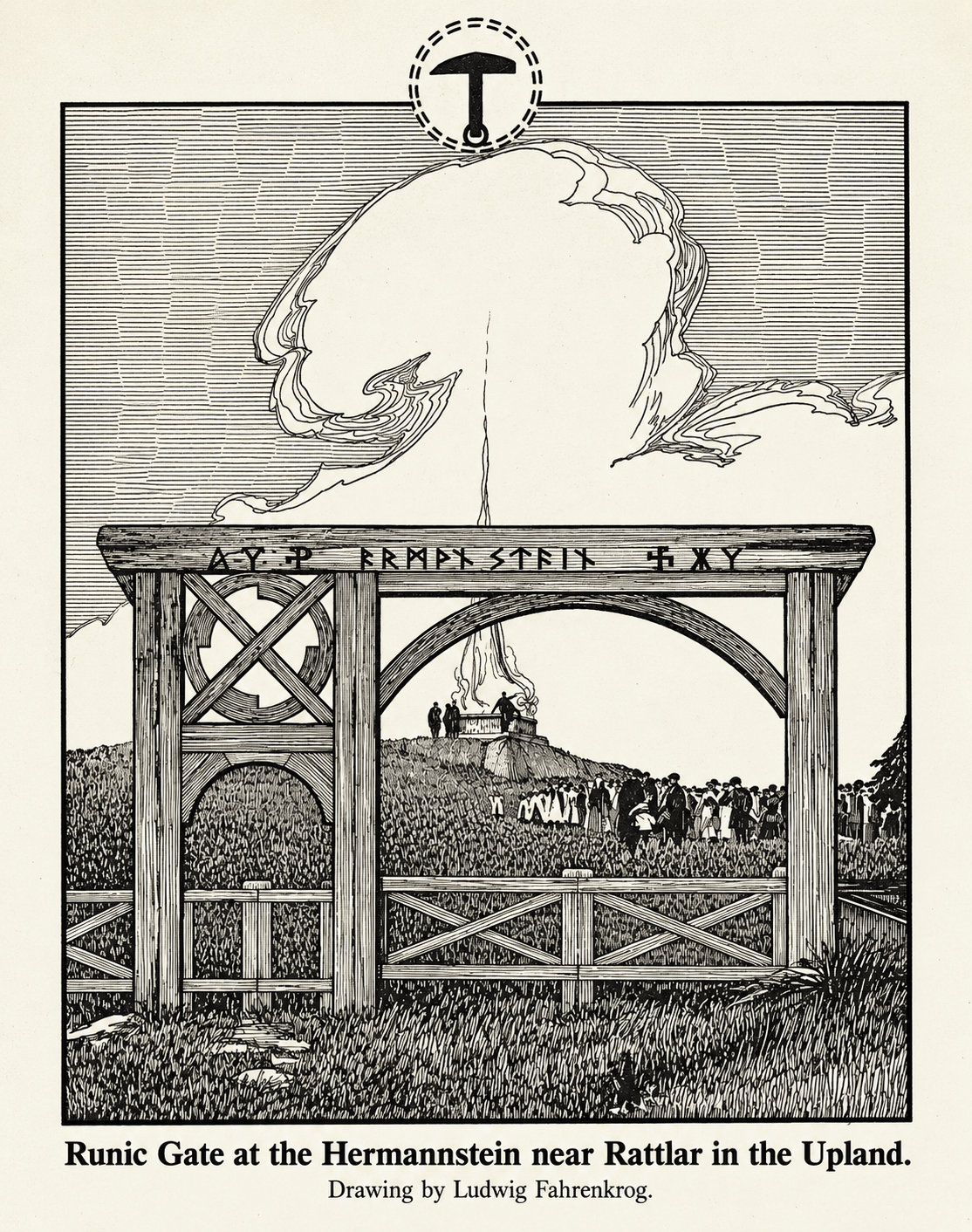
The Light-Seeker’s Book Under the Swastika (1919) is Wilhelm Schwaner’s heavily revised and expanded version of his earlier Schulmeisterbuch. It combines Germanic history, mythology, religion, education, and cultural renewal, presenting Schwaner’s vision of a distinctly Germanic religious and educational worldview. The book includes discussions of the Germanic peoples, the swastika, “old and new” religion, Germanic rulers and migrations, and the history of the Volkserzieher movement, with numerous illustrations, including works by Fidus and Ludwig Fahrenkrog.
This opening, drawn by Fidus, shows the paper’s device: a couple under the words “Uplandzeichen der Volkserzieher,” the swastika on the man’s belt.
[BTW, this emboldens the “Pink Swastika’s” ideas of the homo-erotic aspect of the German path to the Third Reich].


Wandering Youth
A 1916 photograph shows Wandervogel (“Wandering Youth” or “Hiking Youth Movement”) soldiers with a swastika flag, griffin in the center, at a forest camp near Verdun. In 1917 the Wandervogel adopted a swastika badge, and the Deutschvölkische Blätter used one as a title emblem.
- Wandervogel soldiers: “Wandering Youth” or “Hiking Youth Movement” — Wandervogel (“wandering bird”) — a German youth movement centered on hiking, nature, folk culture, and a rejection of modern urban life. (As an aside, I don’t think the youth were treated “well” by the adults.)
No cloth flag from the 1907 Werfenstein hoisting is known to survive, and there is no photograph of it. What exists are later printed photographs of other right-angled swastika flags already in use in the same circles.
The earliest clear photograph is from 1916, reproduced in Jörg Lechler’s 5000 Jahre Deutschland (1936). It shows Wandervogel soldiers with a pennant at a forest camp near Verdun. The flag is a right-angled swastika in a circle, with the flying griffin of the Wandervogel in the center. Otger Gräff, a Wandervogel leader later killed in the war, is at the far left. Walter Laqueur noted that the Wandervogel used the sign often, and that it became a badge of the movement in 1917; he dated its shift into extreme antisemitic politics to after 1918.


A second surviving image is a flag associated with Freikorps Roßbach, a postwar volunteer formation organized in November 1918 and active in 1919. Jörg Lechler reproduced the photograph in his 1934 Vom Hakenkreuz and captioned the formation as 1919. The cloth shows a right-angled swastika in a wreath, with “R” and death’s-head motifs at the corners. A different Roßbach flag is also documented as black with two silver diagonal stripes and a silver “R.”
Before the NSDAP adopted its party flag, the Hakenkreuz was already appearing in German völkisch and nationalist organizations. Wilhelm Schwaner’s Der Volkserzieher displayed a Hakenkreuz on its title page beginning in 1907, while the Bund deutscher Volkserzieher used the symbol as an organizational badge. The German gymnastics movement had long used the visually similar Turnerkreuz, formed from four F’s representing “Frisch, fromm, fröhlich, frei”—a symbol that predates the later völkisch Hakenkreuz. The Germanenorden, founded in 1912, incorporated the Hakenkreuz into its ritual symbolism, and beginning in January 1917 the Deutschvölkische Blätter carried one on its masthead. These uses predated the NSDAP’s formal adoption of its familiar red-white-black swastika flag on 7 August 1920, although that design had already appeared at a Starnberg NSDAP meeting on 20 May 1920.


A PICTORIAL PROGRESSION OF THE THIRD REICH FLAG:

From Germanenorden to the NSDAP: The Development of the Hakenkreuz
The history depicted here traces a line of organizational development within the völkisch, antisemitic, and occult milieu of early 20th-century Germany, before the swastika became internationally identified with Nazi Germany.
Germanenorden — 1912–1916
The Germanenorden emerged in 1912 from the antisemitic Reichshammerbund associated with Theodor Fritsch. It was organized as a secret, lodge-like society and required prospective members to demonstrate supposed “Aryan” ancestry. Its ideology combined racial antisemitism, völkisch nationalism, and occult/esoteric elements. By 1916, its publications were displaying the Hakenkreuz as part of the organization’s symbolism. Historisches Lexikon Bayerns
Germanenorden-Walvater — 1916
During the First World War, internal power struggles fractured the Germanenorden. Hermann Pohl, who had previously led the organization, lost the leadership and established the Germanenorden-Walvater faction. Pohl’s new organization retained the völkisch and antisemitic character of the Germanenorden. In autumn 1916, Pohl met Rudolf von Sebottendorff, who subsequently became an important figure in rebuilding the Bavarian branch. Historisches Lexikon Bayerns
Sebottendorff’s Bavarian organization — 1917–1918
Sebottendorff was tasked in December 1917 with rebuilding the Ordensprovinz Bayern. In Munich he developed the organization that would soon operate under the name Thule-Gesellschaft. The “Thule” designation served as a cover name connected with the Germanic/Northern mythology surrounding the movement. Historisches Lexikon Bayerns
Thule Society — 1918
In August 1918, Sebottendorff established the Thule Society in Munich. The Bavarian Historical Lexicon describes it as a cover organization emerging from the Germanenorden, while the German Historical Museum likewise describes the Thule Society as having emerged from the Germanenorden founded in 1912. Its emblem was a Hakenkreuz behind a vertical sword. Historisches Lexikon Bayerns
The Thule Society subsequently became an important meeting point for Munich’s völkisch and counterrevolutionary circles. It also supported the development of the Deutsche Arbeiterpartei (DAP), which later became the NSDAP. Its newspaper, the Münchener Beobachter, was eventually renamed the Völkischer Beobachter and was acquired by the NSDAP in December 1920. Historisches Lexikon Bayerns
NSDAP — 1920
The final panel represents the transition from these earlier völkisch organizations to the National Socialist German Workers’ Party (NSDAP). The NSDAP adopted its familiar red-white-black swastika flag in 1920, transforming a symbol that had already circulated among various German nationalist, völkisch, and esoteric groups into the principal emblem of the Nazi movement.
The important historical point
The graphic does not mean that the Germanenorden “invented” the swastika or that there was a single uninterrupted organization from 1912 to the NSDAP. The swastika had a much older history and was being used by numerous groups before National Socialism.
Rather, the graphic illustrates a specific organizational genealogy (AGAIN):

The German Historical Museum summarizes the broader relationship by stating that the Thule Society emerged from the 1912 Germanenorden and that the Thule emblem was a swastika with a sword.

FINNISH AIRFORCE:

American Military Swastikas Before World War II
The swastika was used by several American military organizations before its association with Nazi Germany became dominant. These uses had different origins and meanings and should not be confused with the later Nazi emblem.
Three different American uses:
- 1917–1918 — Lafayette Escadrille / 103rd Aero Squadron: swastika incorporated into the Sioux-head aircraft insignia as a good-luck motif.
- 1924–1939 — 45th Infantry Division: swastika used as a Native American-associated division insignia; replaced by the Thunderbird in 1939. Holocaust Encyclopedia
- 1930–1932 — 55th Pursuit Squadron: yellow swastika on a blue disc used as a U.S. Army Air Corps squadron insignia on Boeing P-12 aircraft.
U.S. Army Air Corps — 55th Pursuit Squadron
The aircraft shown above is a Boeing P-12 of the U.S. Army Air Corps. The 55th Pursuit Squadron, part of the 20th Pursuit Group, used a yellow swastika superimposed on a medium-blue disc with a yellow border as its squadron insignia. The insignia remained in use until May 4, 1932. A U.S. Army Air Corps photograph from about 1931 documents the insignia on the squadron’s P-12 aircraft. Wikimedia Commons
This was a U.S. military squadron insignia, not the Nazi party emblem. The photograph is particularly useful because it demonstrates that the swastika was still appearing on American military aircraft in the early 1930s, before its Nazi association had completely displaced its earlier uses.
U.S. Army — 45th Infantry Division
The 45th Infantry Division provides another example. The division was organized in 1924 from National Guard units in Arizona, New Mexico, Colorado, and Oklahoma, and its original insignia incorporated a swastika as a Native American-associated symbol. In 1939, the division adopted the golden Thunderbird as its insignia, replacing the earlier swastika because the symbol had become closely associated with the Nazi Party. The U.S. Holocaust Memorial Museum documents this change and identifies the Thunderbird as the division’s 1939 symbol. Holocaust Encyclopedia
The change illustrates how dramatically the meaning and public perception of the symbol had changed by the late 1930s.
Lafayette Escadrille / 103rd Aero Squadron — World War I
An earlier American military example dates to World War I. The French Lafayette Escadrille used a Sioux-head insignia on its aircraft. A swastika was incorporated into the design as a good-luck motif associated with American pilot Raoul Lufbery, who used the symbol as a personal insignia. The French Army Museum identifies the swastika as a good-luck motif whose origins extended back to ancient India. Army Museum News Blog
In late 1917 the unit came under American command and was subsequently redesignated the 103rd Aero Squadron of the U.S. Army Air Service. The Sioux-head tradition continued with the unit. Army Museum News Blog