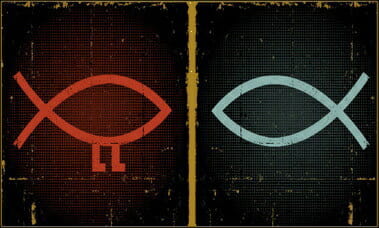
Humbly Ecstatic To Learn Existence Has No Meaning

From the BABYLON BEE with a h-t to Dave B.

DENVER, CO—At a Friday local chapter meeting of anti-religion group Atheist Friends United, skeptic and freethinker Michelle Newberry reportedly delivered a powerful, inspiring testimony, recounting her journey from hoping in God to finally realizing that she is nothing but a carbon-based cosmic accident whose existence is of utterly zero consequence.

“At one time, I foolishly believed I was here for a reason, that there was a higher purpose and plan for me in the midst of joy and even suffering,” Newberry told her fellow atheist and agnostic brothers and sisters in the entirely non-religious meeting. “I am humbled and so grateful that I finally came to believe the soul-crushing idea that my existence is a complete accident with absolutely no ultimate meaning.”

Witnesses say there wasn’t a dry eye in the house as Newberry thoughtfully told the touching story of how she finally “saw the light,” when she realized at long last that her existence is the result of an impossibly complex series of inexplicable, incalculable errors, and that she is nothing but a carbon robot devoid of any hope or meaning, barreling toward the absolute nothingness whence she originated.

“I’m here as a witness to the power of atheism—the only reasonable worldview,” she declared. “Things like right and wrong, love and beauty, passion and empathy, ecstasy and heartbreak—these are but leftover, superfluous, physiological baggage from our completely naturalistic journey to being. They don’t mean anything.”

[….]

…the group was ecstatic to learn that four new converts were won over to the idea that life is meaningless.

(BTW, the Babylon Bee is a satirical news-site)

See more here.

Logical Consequences of Atheism (e.g., Silly Syllogisms) [Updated a Tad]

Here is a thoughtful challenge by someone a friend is in conversation with:

I’ll jump into this message by addressing the assertion that suffering is related to sin. I understand that this is what the Bible says, and during the infancy of the human species, when religion was our first attempt at making sense of the world, it might have made sense to attribute suffering to violating the will of a god. However, to make such an assertion in 2016 seems rather ridiculous. Nine million children die every year before they reach 5 years old. Remember that tsunami in 2004 that killed 250,000 people? Imagine one of those every ten days, only killing children under the age of five. We’re talking about a thousand dead children per hour, or about 17 every minute. This means that before you reach the end of this paragraph, some few children will likely have died in terror and agony somewhere in the world. The parents of these children almost certainly believe in God, and are praying at this very moment for their children to be spared. You and I both know that these prayers will go unanswered. The classic position taken by nonbelievers is that any god who would allow children by the millions to suffer and die in this way, and their parents to suffer and grieve in this way, either can do nothing to help them, or doesn’t care to. This conception of a deity is therefore either evil or impotent.

The very first thing that pops into my mind is the idea Dr. Clouser pulls from many positions taken by people who profess to “think well,”

The program of rejecting logic in order to accept mutually contradictory beliefs is not, however, just a harmless, whimsical hope that somehow logically incompatible beliefs can both be true…it results in nothing less than the destruction of any and every concept we could possess. Even the concept of rejecting the law of non-contradiction depends on assuming and using that law, since without it the concept of rejecting it could neither be thought nor stated.

Roy A. Clouser, The Myth of Religious Neutrality: An Essay on the Hidden Role of Religious Belief in Theories (Notre Dame, IN: Notre Dame Press, 2005), 178.

(More can be see in this regard in my intro chapter to my book, here)

We will venture into how this challenge is void of “thoughtfulness” — which is why I italicized this word in the first sentence at the top of this post. The main laws of logic will show that if the skeptics viewpoint is “true,” then “truth” does not exist. But I digress ingress.

…continuing…

In the challengers paragraph we find him inferring the classically and oft used syllogism that follows:

  • Premise 1: God is all-good (omnibenevolent)
  • Premise 2: God is all-powerful (omnipotent)
  • Premise 3: Suffering and evil exist
  • Conclusion: An all-good, all-powerful God could not exist since there is so much suffering and evil in the world. If he did, he would eradicate this evil.

However, not many atheists use this any longer since the excellent work of Alvin Plantinga in his book, God, Freedom, and Evil. This syllogism changes a bit and looks like this:

  • An omnipotent, omniscient, omnibenevolent God created the world.
  • God creates a world containing evil and has a good reason for doing so.
  • Therefore, the world contains evil.

Ronald Nash comments further, and a larger excerpt can be found in my detailing Greg Gutfeld’s agnosticism:

Numbers 1 and 2 taken together do, of course, entail 3. Therefore, the propositions from our original theistic set that now make up 1 are logically consistent with the existence of evil. The only relevant question regarding 2 is whether it is possibly true. Obviously it is since it is not logically false. Therefore, the theistic set is logically consistent from which follows the impossibility of anyone’s ever demonstrating that it is not.

Ronald Nash, Faith & Reason: Searching for a Rational Faith (Grand Rapids, MI: Zondervan Publishing House, 1988), 189.

So we see that by using logic found in philosophical principles that the challenger alluded to, especially in his last sentence, saying “This conception of a deity is therefore either evil or impotent,” that the challenge is defeated.

Not only that however, is, HOW does the challenger come to a conclusion that he can judge something to be wrong, outside of his personal opinion that is. In other words, he is saying that an action or inaction constitutes evil. He uses this moral presupposition bound up in “evil” to insert into a syllogistic formula to disprove God (at least God in the Judeo-Christian sense… for “evil” being negative is absent from every other religious viewpoint).

He, the challenger, is saying that I, that my neighbor, someone in Bangledesh, or Papua New Guinea [etc.] should see this formula, understand what “evil” action or inaction is, and agree with him. He is – in other words – inserting an absolute principle in the formulation. This is where I want to challenge such an idea.

CS Lewis once reflected on himself doing the same thing as an atheist when he said:

My argument against God was that the universe seemed so cruel and unjust. But how had I got this idea of just and unjust? A man does not call a line crooked unless he has some idea of a straight line. What was I comparing this universe with when I called it unjust? If the whole show was bad and senseless from A to Z, so to speak, why did I, who was supposed to be part of the show, find myself in such violent reaction against it? A man feels wet when he falls into water, because man is not a water animal: a fish would not feel wet. Of course I could have given up my idea of justice by saying it was nothing but a private idea of my own. But if I did that, then my argument against God collapsed too–for the argument depended on saying that the world was really unjust, not simply that it did not happen to please my fancies. Thus in the very act of trying to prove that God did not exist–in other words, that the whole of reality was senseless -I found I was forced to assume that one part of reality–namely my idea of justice–was full of sense. Consequently, atheism turns out to be too simple. If the whole universe has no meaning, we should never have found out that it has no meaning: just as, if there were no light in the universe and therefore no creatures with eyes, we should never know it was dark. Dark would be a word without meaning.

C.S. Lewis, Mere Christianity (San Francisco, CA: Harper San Francisco, 1952), 38-39.

To further draw out this idea, Ravi Zacharias responded to a questioner at Harvard where a moral principle was inserted into the premise of the question:

You see… when an absolute is brought into the equation, the challenger ceases being an atheist or skeptic. UNLESS they pause and explain to others why they should accept what they consider to be an “evil” act. ~These presuppositions also assume a goal or end to life, inserting meaning and purpose that the skeptic EXPECTS others to see and agree with.~ Let us see a little about what atheists consider to be “evil.” Again, these are people bringing their worldview to their logical ends (for references, see, 26 Brutally Honest Atheist Quotes Worth A Read):

  • “When one gives up Christian belief one thereby deprives oneself of the right to Christian morality. For the latter is not self—evident. . . Christianity is a system.” ~ Friedrich Nietzsche
  • “…to say that something is wrong because… it is forbidden by God, is… perfectly understandable to anyone who believes in a law-giving God. But to say that something is wrong… even though no God exists to forbid it, is not understandable….” “The concept of moral obligation [is] unintelligible apart from the idea of God. The words remain but their meaning is gone.” ~ Richard Taylor
  • “There is no objective moral standard. We are responsible for our own actions….” | “The hard answer is it [moral decisions] is a matter of opinion.” ~ David Silverman
  • “There is no purpose to life, and we should not want there to be a purpose to life because if there was that would cheapen life.” ~ Dan Barker

Here is my “AFTERTHOUGHT” to two examples proffered by myself in regards to a meme floating around the internet:

AFTERTHOUGHT

Just as an afterthought. A skeptic who rejects God and accepts naturalism cannot say rape is wrong like the theist can say this:

RAPE:

  • THEISM: evil, wrong at all times and places in the universe — absolutely;
  • ATHEISM: taboo, it was used in our species in the past for the survival of the fittest, and is thus a vestige of evolutionary progress… and so may once again become a tool for survival — it is in every corner of nature;
  • PANTHEISM: illusion, all morals and ethical actions and positions are actually an illusion (Hinduism – maya; Buddhism – sunyata). In order to reach some state of Nirvana one must retract from this world in their thinking on moral matters, such as love and hate, good and bad. Not only that, but often times the person being raped has built up bad karma and thus is the main driver for his or her state of affairs (thus, in one sense it is “right” that rape happens).
[….]

In other words they have to BORROW FROM ethics the worldview that they are trying to disprove (again referencing CS Lewis and Ravi Zacharias’ work above).

For more on this, see my post noting many more atheist/evolutionary (philosophical naturalism) positions followed to their logical conclusions here:

Here we see the logical consequences of the “God Is Dead” movement and Nietzsche’s prophecy concerning the outcome:

Nihilism can take more than one form. There is, for instance, passive nihilism, a pessimistic acquiescence in the absence of values and in the purposelessness of existence. But there is also active nihilism which seeks to destroy that in which it no longer believes. And Nietzsche prophesies the advent of an active nihilism, showing itself in world-shaking ideological wars. “There will be wars such as there have never been on earth before. Only from my time on will there be on earth politics on the grand scale.

The advent of nihilism is in Nietzsche’s opinion inevitable. And it will mean the final overthrow of the decadent Christian civilization of Europe. At the same time it will clear the way for a new dawn, for the transvaluation of values, for the emergence of a higher type of man. For this reason “this most gruesome of all guests”, who stands at the door, is to be welcomed.

Frederick Copleston, S.J., A History of Philosophy, Volume VII (New York, NY: Image Books, 1994), 405-405.

And so, the Twentieth Century was indeed the bloodiest ever. In fact, non-God [atheistic] governments killed more people in 100-years than all religion did the previous nineteen. See my “Religious Wars” post for more.

Again, even truth is called into question, as the many quotes in the above link show, if God is extant from our discussion about reality.

“If the solar system was brought about by an accidental collision, then the appearance of organic life on this planet was also an accident, and the whole evolution of Man was an accident too. If so, then all our thought processes are mere accidents – the accidental by-product of the movement of atoms. And this holds for the materialists and astronomers as well as for anyone else’s. But if their thoughts — i.e. of Materialism and — are merely accidental by-products, why should we believe them to be true? I see no reason for believing that one accident should be able to give a correct account of all the other accidents. It’s like expecting that the accidental shape taken by the splash when you upset a milk-jug should give you a correct account of how the jug was made and why it was upset.”

C. S. Lewis, God In the Dock (Grand Rapids: Eerdmans Publishing Co., 1970), pp. 52–53.

Do you see? If atheism is true, then these absolute statements entwined in these skeptical position vanish. In fact, “consciousness” is a problem for this discussion:

Atheist Daniel Dennett, for example, asserts that consciousness is an illusion. (One wonders if Dennett was conscious when he said that!) His claim is not only superstitious, it’s logically indefensible. In order to detect an illusion, you’d have to be able to see what’s real. Just like you need to wake up to know that a dream is only a dream, Daniel Dennett would need to wake up with some kind of superconsciousness to know that the ordinary consciousness the rest of us mortals have is just an illusion. In other words, he’d have to be someone like God in order to know that.

Dennett’s assertion that consciousness is an illusion is not the result of an unbiased evaluation of the evidence. Indeed, there is no such thing as “unbiased evaluation” in a materialist world because the laws of physics determine everything anyone thinks, including everything Dennett thinks. Dennett is just assuming the ideology of materialism is true and applying its implications to consciousness. In doing so, he makes the same mistake we’ve seen so many other atheists make. He is exempting himself from his own theory. Dennett says consciousness is an illusion, but he treats his own consciousness as not an illusion. He certainly doesn’t think the ideas in his book are an illusion. He acts like he’s really telling the truth about reality.

When atheists have to call common sense “an illusion” and make self-defeating assertions to defend atheism, then no one should call the atheistic worldview “reasonable.” Superstitious is much more accurate.

Frank Turek, Stealing from God: Why Atheists Need God to Make Their Case (Colorado Springs, CO: NavPress, 2014), 46-47.

These are meta-narratives just assumed by the skeptic with no regard to how they arrived there. I liken it to an analogy of driving a car. The atheist thinks he has gotten in his car, backed out of the drive-way, and is a few turns into his trip to the market of reason. I am merely pointing out that the car is not starting when the key is turned. One may wish to go through another post of mine entitled, “Is Evil Proof Against God? Where Does It Come From?

Remember, always ask yourself if the question or challenge is a proper one to begin with…

Mortimer J. Adler rightly points out that while many Christians are quick in responding to the conclusions in an argument often times the Christian is unaware that the point of departure is not in the conclusion, but in the starting premise, the foundational assumptions.

Norman L. Geisler & Peter Bocchino, Unshakable Foundations: Contemporary Answers to Crucial Questions About the Christian Faith (Minneapolis: Bethany House, 2001), 20-21.


Classic Syllogism – Simple Change


This is how it is often presented:

★ If God is all-powerful, He can prevent evil.
★ If God is good, He would want to prevent evil.
★ Evil exists.
★ Therefore, there is no God. (Or: God is either not all-powerful, or He is not good.)

All that is really being done is this simple change, and it is sound:

★ If God is all-powerful, He can prevent evil.
★ If God is good, He would want to prevent evil.
★ Evil exists.
★ Therefore, the world contains evil.

The conclusion that the world contains evil has no explanatory power on why it does or even if this impacts the existence of God in any way.

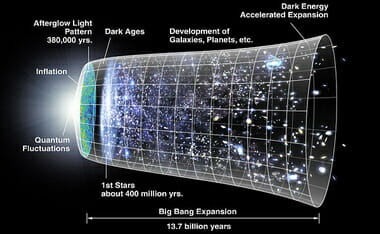
Theistic Implications of Big-Bang Cosmology

Please see my post on the “Scientific and Anecdotal Evidence for the Beginning of the Universe

WINTERY KNIGHT notes some of the topics via the above video/lecture:

Topics:

  • Up until the the last 100 years or so, everyone agreed that the universe was eternal
  • This is at odds with the traditional Christian view that God created the universe
  • Materialism, the view that matter is all there is, requires eternally existing matter
  • Discovery #1: Hubble discovers that the universe is expanding (redshift observation)
  • The expanding universe was resisted by proponents of the eternal universe, like Einstein
  • Some naturalists even proposed speculative static models like the steady-state model
  • However, not of the speculative models fit with observations and experimental results
  • Discovery #2: Penzias and Wilson discover the cosmic microwave background radiation
  • Measurements of this background radiation confirmed a prediction of the Big Bang theory
  • The steady-state theory was falsified of by the discovery of this background radiation
  • The oscillating model was proposed to prevent the need for an absolute beginning
  • But the oscillating model is not eternal, it loses energy on each “bounce”
  • A paper by Alan Guth and Marc Sher from 1982 proved that our universe will not bounce
  • In addition, experiments reveal that the universe will expand forever, and not contract
  • The beginning of the universe is more at home in a theistic worldview than an atheistic one
  • The beginning of the universe fits in well with the Bible, e.g. – Genesis 1, Titus 1, etc.

In case you are wondering about what the evidence is for the Big Bang, here are that are most commonly offered:

Three main observational results over the past century led astronomers to become certain that the universe began with the big bang. First, they found out that the universe is expanding—meaning that the separations between galaxies are becoming larger and larger. This led them to deduce that everything used to be extremely close together before some kind of explosion. Second, the big bang perfectly explains the abundance of helium and other nuclei like deuterium (an isotope of hydrogen) in the universe. A hot, dense, and expanding environment at the beginning could produce these nuclei in the abundance we observe today. Third, astronomers could actually observe the cosmic background radiation—the afterglow of the explosion—from every direction in the universe. This last evidence so conclusively confirmed the theory of the universe’s beginning that Stephen Hawking said, “It is the discovery of the century, if not of all time.”

(MORE)

Is History “Testable, Repeatable, Falsifiable”

Just a quick response to a skeptic elsewhere online…

A person in a group I am a part of posted the following link as a challenge. I focus on number three in my response:

(Site linked in above graphic)

I responded thus…

Already #3 is an issue. Most of what we as a society determine to be truth, especially from ancient documents that discuss history, is not is testable, repeatable, and falsifiable in scientific terms. For instance:

✦ “What are the distinctive sources for our beliefs about the past? Most of the beliefs we have about the past come to us by the testimony of other people. I wasn’t present at the signing of the Declaration of Independence. I didn’t see my father fight in the [S]econd [W]orld [W]ar. I have been told about these events by sources that I take to be reliable. The testimony of others is generally the main source of our beliefs about the past…. So all our beliefs about the past depend on testimony, or memory, or both.” (Philosophy for Dummies, by Tom Morris, pp. 57-58)

✦ “In advanced societies specialization in the gathering and production of knowledge and its wider dissemination through spoken and written testimony is a fundamental socio-epistemic fact, and a very large part of each persons body of knowledge and belief stems from testimony.” (The Cambridge Dictionary of Philosophy, edited by Robert Audi [2nd ed.], p. 909)

✦ “But it is clear that most of what any given individual knows comes from others; palpably with knowledge of history, geography, or science, more subtly with knowledge about every day facts such as when we were born..” (The Oxford Companion to Philosophy, edited by Ted Honderich, p. 869)

An example of this is discussed many years ago by CS Lewis, when he writes:

➤ “what Napoleon did at the battle of Austerlitz by asking Mr. Bonaparte to come and fight it again in a “laboratory with the same combatants, the same terrain, the same weather, and in the same age…. You have to go to the records. We have not, in fact, proved that science excludes miracles: we have only proved that the question of miracles, like the innumerable other questions, excludes laboratory treatment” ~ C. S. Lewis, God in the Dock: Essays on Theology and Ethics (Grand Rapids, MI: William B. Eerdmans, 1970), 134.

In a more modern/wry example on FB is from a group described thus:

★ “A page for freethinking, rational skepticism toward the myth of Abraham Lincoln’s existence and the stories attributed to him…. Belief in Abraham Lincoln is the most malevolent of all mind viruses.” 

May I also note the lack of anything historically sound in this anti-theist site about Hitler. Their page on Hitler is really bad: “Hitler, atheist or Christian?“. I LOL’ed at the pic of Hitler and Christmas. I bet with a simple google search I can find a Satanist celebrating Christmas. At any rate, I did a final update to a post on my site discussing Hitler and these very subjects:

This site [Truth Saves] is all-in-all really disappointing as a refutation of Christianity.

An Excerpt From “The Atheist Who Didn’t Exist”

The Stanford Encyclopedia of Philosophy defines Atheism as: the negation of theism, the denial of the existence of God —

  • The “a-” in “atheism” must be understood as negation instead of absence, as “not” instead of “without”. Therefore, in philosophy at least, atheism should be construed as the proposition that God does not exist (or, more broadly, the proposition that there are no gods).

There is a subtle, but important difference between not believing in something and believing that something is not (does not exist). Atheism adopts the latter position in holding that God does not exist. Atheism is more than mere lack of belief, it is the denial of the existence of God. Mere lack of belief makes the atheist no different from a newborn baby or my Chevy. (Added to a bit — but from APOLOGETICS 315) | Via my post on SPAGHETTI MONTERS

Here is an excerpt from Any Banister’s wonderful new book:


  • Andy Banister, The Atheist Who Didn’t Exist: Or, The dreadful Consequences of Bad Arguments (Oxford, England: Monarch Books, 2015), 13-20. More of the book can be accessed here at Amazon!

I remember the first time that I saw the bus. An old friend of mine had telephoned me out of the blue a few days before, and in a conspiratorial whisper had hissed: “You need to get down to London. There are atheist buses here.”

“Atheist buses?” I replied, bleary-eyed. It was long past midnight “How much have you drunk, Tom?”

“Only four pints,” Tom replied indignantly.

“Well, I’ve always personally thought that the slightly devil-may-care attitude of many London bus drivers to road safety tends to bring people closer to God, rather than drive them away.”

“This bus didn’t try to drive me away; it tried to drive over me. Admittedly, I was lying semi-comatose in the road at the time —”

“I knew it!”

“— at Hammersmith, and the atheist bus almost ran me over.”

“You do realize”, I explained, in the patient tone I reserve for small children and airline check-in agents, “that just because a London bus almost flattens a liberal Anglican lying on a zebra crossing, it doesn’t necessarily mean that Richard Dawkins is resorting to hit-and-run attempts to keep the religious affiliation statistics favourable.”

“I’m used to being nearly run over, I’ve holidayed in France many times,” snapped Tom. “But this was an atheist bus, I tell you.”

“You’re sure about this?”

“Yes! Now come down to London and see. Besides, you owe me a beer from that time when you lost the bet about the Archbishop’s beard.”

And so it was that I found myself, on a rainy July afternoon a few weeks later, standing among a crowd of damp tourists outside Oxford Circus tube station. We watched the traffic as cars, taxis, lorries, and the occasional sodden cyclist trundled past. And then, at last, a bus rounded the corner. A big, red London bus sporting a huge advertisement on the side, which announced in large friendly letters: “There’s Probably No God. Now Stop Worrying and EnjoyYour Life.”

Later, back in the comfort of a nearby pub, I did a little research. It turned out that the bus advertisements had been sponsored by The British Humanist Association along with a group of secular celebrities, including the well-known Oxford atheist Richard Dawkins, and represented, in their words, an attempt to provide a “peaceful and upbeat” message about atheism. The advertisements promoted a website where those who browsed could while away their journey on the number 137 bus to Battersea reading about the joys of life without belief in a god.

The atheist bus is a good place to begin our journey, because it illustrates two reasons why this book exists. First, because the slogan, despite its friendly pink letters, is a perfect example of a really bad argument. An argument so bad, so disastrous, in fact, that one has to wonder what its sponsors were thinking. More on that in a moment. But, second, it illustrates how quickly bad arguments can disseminate, spreading like an infestation ofJapanese knotweed into popular culture. For while many critics — including many atheist critics — were quick to point out the flaws in “There’s Probably No God. Now Stop Worrying and Enjoy Your Life”, it has nevertheless continued to pop up on the sides of buses not just in London but also around the world.

The bus advertisement typifies what’s come to be termed the “New Atheism”, a phrase coined back in 2006 by Wired magazine to describe the group of media-savvy atheists — men such as Richard Dawkins, Sam Harris, Daniel Dennett, and the late Christopher Hitchens — whose books attacking religion in general and Christianity in particular have sold by the truckload. What’s new about the “New Atheism”? As many have pointed out, not so much its arguments, which tend to be old ones, as its tone — which is one of apoplectic anger. Why the anger? Well, I suspect partly because God was supposed to have disappeared a long time ago, as the Great Secular Enlightenment trundled inexorably onward. As far back as 1966, Time magazine could slap a question like “Is God Dead?” on the cover (with the strong implication that the answer was “Yes”). Today, however, religion is alive and well and shows little sign of disappearing. The failure of God to roll over and die on cue has led to the denial, disappointment, and anger that can be seen underpinning much of today’s more popular form of atheism.

And, my word, has the New Atheism become a popular movement Richard Dawkins’s book The God Delusion alone has sold several million copies. Atheism has gained a voice and a confidence, and that’s fine — in the past, it was tough to be an atheist, when most societies were overwhelmingly religious. Recently, however, there’s been a cultural volte-face in many Western countries, with atheism now seen as the default position. Many people assume that atheism is, indeed, the only position for somebody who wishes to be considered educated, sophisticated, urbane, and rational. This is precisely the way the media often treats the issue too: atheism is portrayed as scientific, contemporary, and for those with brains, whereas religion is characterized as stuffy, outmoded, and irrational, something for old ladies or fuddy-duddies.

But there’s a problem. Well, several problems. Chief among them is this: that much of contemporary atheism thrives on poor arguments and cheap sound bites, advancing claims that simply don’t stand up to scrutiny. Like a cheaply made cardigan, they’re full of loose threads that, if tugged firmly, quickly begin to unraveL Let me demonstrate what I mean by returning to that notorious bus advertisement, “There’s Probably No God. Now Stop Worrying and Enjoy Your Life”. Let’s ask a few critical questions about that claim for a moment. What’s wrong with it? Well, one might begin by noting the preachy, condescending, and hectoring tone. I’ve known many atheists over the years whose chief beef with religion has been that they can’t escape it. If it’s not televangelists with perfect teeth, it’s church billboards with dodgy graphic design or giant advertising hoardings warning of hellfire and damnation. “You religious types insist on preaching at us” is the complaint Well, now the boot is very much on the other foot and the New Atheism is zealously evangelistic, not merely content with denying deities but offering health benefits at the same time (No worries! Enjoyment! Good hair!).

But there’s a deeper problem, too. For atheists like Richard Dawkins, God does not exist, right? That, after all, is what the very term “a-theist” means. Of course, there’s a myriad of other things that don’t exist: fairies, unicorns, the Flying Spaghetti Monster, successful England soccer squads. But here’s my question: what’s the connection between the non-existence of something and any effect, emotional or otherwise? There probably aren’t any unicorns, so cheer up. The Flying Spaghetti Monster is just a secular parody, so take heart. There’s no God, so quit worrying. How, precisely, does that work? Somebody once remarked that a nonsensical statement doesn’t become coherent simply because you insert the term “God” into it, so let’s illustrate the problem by rewording the atheist bus slogan for a moment:

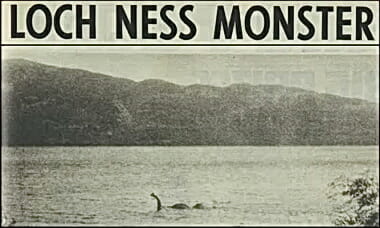
  • There’s Probably No Loch Ness Monster. So Stop Worrying and Enjoy Your Life.

Imagine, for a moment, that you’re down on your luck. Life has dealt you a series of terrible hands and nothing seems to be going your way. You’ve recently lost your job. Your wife has just left you and taken the kids with her. This very morning, a letter from your bank has arrived, declaring you bankrupt The doctor’s surgery has just rung to inform you that those worrying headaches are actually Creutzfeldt-Jakob disease. Oh, and you’re a Bradford City FC fan. Life really sucks. Have no fear, however. Put all that aside. Fret no more. For there is hope. There is an end to all worries. “There is?” I hear you cry, wiping back the tears. Yes, there is. Because (are you ready for this?) the Loch Ness Monster doesn’t exist. Never mind the fact that you may be jobless, loveless, penniless, and hopeless, doesn’t it warm the cockles of your heart to know that holidaymakers in Scotland can munch their sandwiches by Urquhart Castle and paddle their feet in Loch Ness, safe in the certain knowledge that no monster from the Jurassic era Will rear up from the deep and drag them off to a watery grave. So, are you feeling better now? No, probably not

So the first half of the claim — no God, no worry — fails spectacularly. The second half doesn’t fare much better either: “Enjoy your life.” What could be wrong with that, unless you’re one of those masochistic religious types who prefer guilt to glee? Well, Francis Spufford nails this one perfectly:

I’m sorry — enjoy your life? Enjoy your life? I’m not making some kind of neo-puritan objection to enjoyment Enjoyment is lovely. Enjoyment is great The more enjoyment the better. But enjoyment is one emotion. The only things in the world that are designed to elicit enjoyment and only enjoyment are products, and your life is not a product … To say that life is to be enjoyed (just enjoyed) is like saying that mountains should have only summits, or that all colours should be purple, or that all plays should be by Shakespeare. This really is a bizarre category error.

In other words, there is considerably more to life than just enjoyment Indeed, the full gamut of human emotions spans the alphabet To be fully, authentically human is to have experienced anger, boredom, compassion, delight, expectation, fear, guilt, hope, insecurity, joy, kindness, love, malice, nonchalance, obligation, peace, queasiness, relief, sensuality, thankfulness, uneasiness, vulnerability, wistfulness, yearning, and zealousness. Given all this, why does the atheist bus advertisement zero in on “enjoyment”? Now obviously I’m not privy to the interior mental state of those who penned the slogan, but I do wonder if it’s a symptom of a more general trend in our culture — one that says that the purpose of human life is simply to be happy, to flit merrily from one experience to another in an effervescence of ecstatic enjoyment Product after product is sold to us this way: buy this coffee, take that holiday, wear this shade of lip gloss, and you’ll be successful, popular, and joyful. The atheist bus is simply riding the cultural wave — think like this, it says, and you’ll be happy.

But what if you’re not happy? What if you’re like my earlier example — jobless, friendless, penniless, and hopeless? What if you’re at a point in your life where all is smelling not of roses, but rather suspiciously like a sewage farm on a hot afternoon? Indeed, half the world’s population lives on less than $2.50 a day and that amount is not going to keep you in lattes, lipstick or trips to Lanzarote, which means that, if the advertisers are correct about where enjoyment is located, you’re in trouble, so you’d better pull yourself together. I stress you, second person singular, had better pull yourself together, because, if the atheist bus slogan is right and there is no God, there’s nobody out there who is ultimately going to help with any pulling. You’re alone in a universe that cares as little about you (and your enjoyment) as it does about the fate of the amoeba, the ant or the aardvark. There’s no hope, there’s no justice, and there’s certainly nothing inherently wrong with poverty, incidentally, so quit protesting. Life favours the winners; some get the breaks, and others get the sticky end of the stick. Still others get to make millions selling books on atheism, enough fora lifetime of lattes. Enjoy your life? Nice work if you can get it.

Quantum Mechanics Meet Outdated Biological Models

  • “Biology today is at a crossroads. The molecular paradigm, which so successfully guided the discipline throughout most of the 20th century, is no longer a reliable guide. Its vision of biology now realized, the molecular paradigm has run its course.”….

The cells we know are not just loosely coupled arrangements of quasi-independent modules. They are highly, intricately, and precisely integrated networks of entities and interactions. … To think that a new cell design can be created more or less haphazardly from chunks of other modern cell designs is just another fallacy born of a mechanistic, reductionist view of the organism.

Carl Woese – A New Biology for a New Century – Microbiology and Molecular Biology Reviews – 2004

(See more at Common Descent)

The neo-Darwinian view of biology is being undermined by the emerging evidence in quantum mechanics (QM). Now, I do not accept the QM as many atheists do… however, the deterministic view of QM is giving theism a boost in an area atheists once thought they had a new foothold. One of my favorite critics of Darwin notes as much in his referencing a 2004 article and commenting on it:

As Carl Woese explained in 2004:

  • The cells we know are not just loosely coupled arrangements of quasi-independent modules. They are highly, intricately, and precisely integrated networks of entities and interactions. … To think that a new cell design can be created more or less haphazardly from chunks of other modern cell designs is just another fallacy born of a mechanistic, reductionist view of the organism.

In a previous uploaded audio and commentary of the many QM models to choose from and the one’s theist see as beneficial to scientific discovery delineates the chasm between fruitful views of science and unhealthy views in scientific modeling and their subsequent impact on scientific apologetics. The first paragraph below notes the philosophical naturalist default (so-to-speak), followed by two points related to this discussion:

These oddities prompt some observers to conclude that QM overturns natural law and rationality, leaving us with an incomprehensible, uncreated universe. Standard physics says matter can be neither created nor destroyed by natural means, but some scientists (falsely) claim that quantum particles naturally pop in and out of existence. From this, leading atheists claim the whole universe “sprang” into existence naturally. No Creator necessary. Furthermore, they say that even if God exists and created the universe, QM shows He made a world He cannot control. Once He uncorked this world, not even God knows what will come of it. Theologians who favor science fads over Scripture conclude the same thing: QM implies God cannot govern creation or know the future….

[….]

I suggest the following starting points for the Christian response: First, for all the wild attributes that may hold true in QM, we note that macroscopic reality behaves in a predictable, law-like fashion and everywhere presents us with evidence of its fundamentally rational construction and operation. So even if quantum particles could do lawless things like pop in and out of existence naturally, no such thing happens in the realm of everyday objects. Quantum oddities, whatever you make of them, are detained at the door to the larger realities we experience.

Second, many of the astounding behaviors attributed to QM occur only in highly artificial laboratory settings. There is no certainty that these things can actually happen in real-world settings. Thus, we are justified in casting an indifferent eye on many of the zany headlines coming from physics laboratories….

The very non-deterministic models are the ones liked by atheists and they support the idea of randomness. The other “orderly” — if you will — models show an order on the quantum level that is “supra-ordered,” and thus, the theistic view of QM is emboldened by the evidence.

In other words… order and function in the DNA is guided also by laws being discovered on the quantum level… that without these strict mechanical rules life would be impossible… something “randomness” cannot account for. In other words there seems to be more going on here that the simplified “DAN to RNA to Protein” quip. And this increasing complexity equals hard-times for atheism.

While Philip Cunningham may be hard to listen to at times… I love his slow, methodical contributions to this field of learning/debate:

Again, to note the idea here:

  • The other model that show rules and order on the quantum level is being supported by these discoveries, and thus, the theistic view of QM is emboldened by the evidence. In other words… order and function in the DNA is guided also by laws being discovered on the quantum level… that without these strict mechanical rules life would be impossible… something “randomness” cannot account for.

Here is the posted text under Phillip’s video on his Facebook:

Physicists Discover Quantum Law of Protein Folding: Quantum mechanics finally explains why protein folding depends on temperature in such a strange way.

First, a little background on protein folding. Proteins are long chains of amino acids that become biologically active only when they fold into specific, highly complex shapes. The puzzle is how proteins do this so quickly when they have so many possible configurations to choose from.

To put this in perspective, a relatively small protein of only 100 amino acids can take some 10^100 different configurations. If it tried these shapes at the rate of 100 billion a second, it would take longer than the age of the universe to find the correct one. Just how these molecules do the job in nanoseconds, nobody knows.

[….]

Today, Luo and Lo say these curves can be easily explained if the process of folding is a quantum affair. By conventional thinking, a chain of amino acids can only change from one shape to another by mechanically passing though various shapes in between.

But Luo and Lo say that if this process were a quantum one, the shape could change by quantum transition, meaning that the protein could ‘jump’ from one shape to another without necessarily forming the shapes in between.

[….]

Their astonishing result is that this quantum transition model fits the folding curves of 15 different proteins and even explains the difference in folding and unfolding rates of the same proteins. That’s a significant breakthrough. Luo and Lo’s equations amount to the first universal laws of protein folding. That’s the equivalent in biology to something like the thermodynamic laws in physics

Bottom line! What has been a buttressed hideout/club of evolutionary thought — biology in general — is now in it’s early throes of bowing it’s knee to intelligent design, i.e., it’s Creator!

What’s Behind it all? God, Science and the Universe

A post appeared on an I.D. Facebook group with this introduction:

Given the fact that he is a staunch Darwinist who fully accepts the basic tenets of the mainstream theory of evolution, you might expect Larry Moran (who, after all, did coin the derisive term “IDiots” in reference to Intelligent Design proponents) to have nothing but sneering contempt for Stephen Meyer.

Turns out, however, he met Stephen Meyer and the two got along surprisingly well, despite their deep ideological divide.

I went to the Moran’s blog and wanted to post his thoughts on Lawrence Krauss:

  • Krauss tried to hammer Meyer on the “ID is not science” issue using quotes from a judge based on things said by lawyers in the Dover trial….. Lawrence Krauss is an expert on cosmology but he’s very weak on biology. I know it’s common for physicists to think they are experts in everything but that’s just not true. It was demonstrated in last night’s debate.