FLASHBACK: Media Mislabels LaRouche Activists Right-Wing

(A GOOD PORTION OF THIS DATES FROM 2010)

(BTW, Lyndon LaRouche died in February 2019 at 96-years old.) This is the political cult I always forget about, Lyndon LaRouche (pronounced le-ru). She won her candidacy even with the fact that “during the campaign, she was photographed carrying an oversized portrait of the President with a Hitler-style mustache penciled on his lip.” Remember the news broadcasts on the poster with Obama and a Hitler mustache? Well, all the posters that say this on them:

OBAMA NAZI SIGNS

Life is truly stranger than fiction. Not only does this picture show Kesha Rogers holding the Obama/Hitler sign, but it even says it is paid for by her campaign on the bottom (click to enlarge):


“Houston, We Have A Problem”
is so appropriate

This story (the LaRouche movement and recent political activity) is an old one… one that I commented on quite a while ago. These person’s even visited my old job once (Whole Foods). 

NAZI OBAMA @DEMOCRAT CAMPAIGN

Here is the BREITBART post on her:

the state-run media won’t run this photo.

They won’t publish this photo because it doesn’t fit their narrative. Remember last year when the Democratic-Media Complex reported that the tea party protesters were waving Obama-Hitler signs? What the media purposely omitted from their stories was the fact that the protesters waving these astroturfed Obama-Hitler signs were radical left-wing extremists. They were radical activists from the LaRouche organization. But, this didn’t fit the state-run media’s narrative that tea party activists were radicals and racists so they omitted this from their reports.

Earlier this year, the corrupt media and prominent democrats continued to smear tea party activists by reporting that the conservative protesters on Capitol Hill harassed Black Caucus members, called them the n-word, and spit at these Dems as they paraded though the tea party crowd on their way to ram nationalized health care through Congress. This was a lie. It never happened as video later revealed. However, the corrupt national media never retracted their story nor did they apologize despite the overwhelming amount of evidence that proved their racist accusations were complete fiction.

That’s why the media won’t show this photo of Democrat Kesha Rogers. It doesn’t fit their narrative.

Kesha won her primary last week. This Texas Democrat wants to impeach Obama and “take our troops out of the war zone and put them into space.” This makes about as much sense as the Obama-Pelosi “spend your way to wealth” plan, only not as dangerous. Don’t look for the media to give this Texas loon much attention in the months ahead.

Could you imagine the outrage if this was at a Tea Party? And if it is, it is because of a LaRouchite! Do you not know who Lyndon Lerouche is, there is a good WIKI ARTICLE on him. Here is the HOTAIR’s dig on this story:

The nominee for the Texas’ CD-22 has publicly called for Barack Obama’s impeachment and wants to abolish the UN.  Democrats would have a field day making Kesha Rogers the face of the Republican Party across the entire nation if it weren’t for the fact that Rogers is a Democrat (TIME MAGAZINE):

South Carolina’s unexpected Democratic nominee for the US Senate, mystery man Alvin Greene, says he wants to play golf with Barack Obama. But in Texas, another surprise Democratic primary winner, congressional nominee Kesha Rogers, wants to impeach the President. So while South Carolina party officials are still unsure of what to do about Greene’s success at the ballot box, Texas Democrats have no such reservations — they wasted little time in casting Rogers into exile and offering no support or recognition of her campaign to win what once was Republican Majority Leader Tom DeLay’s old seat.

Rogers, 33, told TIME she is a “full time political activist” in the Lyndon LaRouche Youth Movement, a recruiting arm of the LaRouche political organization that is active on many college campuses. The LYM espouses LaRouche opposition to free trade and “globalism” (the UN, the World Bank, the International Monetary Fund) and it also calls for a return to a humanist classical education, emphasizing the works of Plato and Leibnitz. On her professional looking campaign website, kesharogers.com, she touts the LaRouche political philosophy — a mix of support for the economic policies of President Franklin D. Roosevelt and the impeachment of President Obama — and calls Obama a “London and Wall Street backed puppet” whose policies will destroy the Democratic Party.

Well, maybe Texas Democrats in the 22nd district just got fooled from another Greene-like stealth candidacy.  I’m sure they didn’t hear about Rogers’ nutty, LaRouchian politics before casting their ballots.  Rogers probably got listed first on the ballot, right?  Actually she was, but that’s not why she won:

Unlike South Carolina’s Greene, Rogers ran a high profile campaign, staking out a corner on a major intersection in the district to appear almost daily with a large sign: “Save NASA. Impeach Obama.” She garnered 7,467 votes, 53% of the vote, in a three way race that included a local information systems analyst Doug Blatt, who gained endorsements from local Democratic clubs and labor groups, and Freddie John Weider Jr., a preacher and onetime Libertarian candidate; Blatt came in second with 28% of the vote and Weider won 20%.

Now Democrats have refused to provide her any support, Time reports, accusing her of racism because of her connection to the LaRouche movement — which is an interesting allegation, considering that Rogers is African-American.  Maybe someone should have looked at her picture before leaping immediately to the race-baiting smear.  They would have been better off questioning her sanity…..

(read more)

Here is Kesha being interviewed by “LaRouche TV.”

MORE EXAMPLES OF SIGNS

The below signs are from the Democratic Linden LaRouche camp. There was one photo that made it into the mainstream media that was at times cropped so you wouldn’t see the race of the young man, but as you can see, the guy holding this sign up is a young black man:

Kesha is in a political cult, and putting a LaRouchite into office, considering their across the board acceptance of just about every conspiracy theory available, is an option I will campaign against. There is also concerted cultish aspects of brainwashing as well. The reason you here this push to support NASA is that the LaRouchite’s want to (or wanted to) have a permanent colony on Mars by 2025, this is now pushed back to 2027. 

One thing I wish to supplant is the idea that this is some sort of “Right Wing” group.

LAROUCHE PRESIDENTIAL RUNS

NEWSBUSTERS “busted” this liberal myth when they pointed out the following:

….For written at the poster’s bottom is the web address “LaRouchePAC.com,” the political action committee website for Communist and perpetual Presidential candidate Lyndon LaRouche.

No right-winger he. And neither he nor his acolytes are likely ones to be “stoked by the provocative megaphone of Rush Limbaugh.” In fact (from Wikipedia):

In 1979, LaRouche formed a Political Action Committee called the National Democratic Policy Committee (NDPC). LaRouche has run for the Democratic nomination for President of the United States seven times, beginning in 1980….

(read more)

CROOKS & LIARS

I think the mainstream media and bloggers who think themselves erudite enough to broadly claim political affiliation of this movement, should think twice. For instance, CROOKS & LIARS (a Leftist site) said this after showing Bill O’Reilly’s comments on it (sorry for the cuss word, typical though of the Left) [I combined this old Bill O’Reilly with two other videos]:

Crooks & Liars “did an interesting thing the day after last night,” they lied about the LaRouche’ites!

Bill O’Reilly did an interesting thing last night when he reran that footage of Barney Frank castigating that woman carrying an Obama-as-Hitler sign at his town-hall meeting on health care: He completely omitted the fact that the woman who Frank was castigating was in fact a member of the FAR-RIGHT Lyndon Larouche cult.

All O’Reilly could muster was to mention that the woman was “a political activist.” But that’s like calling a Great White Shark a fish.

No, right-wingers like O’Reilly have been eagerly airbrushing out the existence of right-wing extremists from their worldview for some time now, embodied by their reaction to that DHS bulletin. But it’s getting harder and harder to do all the time now.

Because, as we’ve noted, the far-right extremists are bubbling up everywhere in supposedly mainstream conservative circles these days — particularly at the tea parties and their associated health-care protests.

Most recently, it turns out that the guys who brought those guns to a health-care forum in Arizona in fact were longtime members of the old Arizona Vipers Militia. These were characters who, prior to their arrests in 1996, had stockpiled close to 2,000 pounds of ammonium nitrate and conducted field training exercises, practiced bomb-making, and trained with illegal automatic weapons.

Now, all the Fox talkers have been in heavy denial about extremists showing up for their tea-party protests, even making a regular joke out of it by asking the protesters they have on their show if they’re Klan members and the like.

But it’s becoming clearer all the time that, while not everyone at these events is an extremist, the percentages of them keep going up and up. And with them, so does the threat to public safety.

AGAIN:

  • He completely omitted the fact that the woman who Frank was castigating was in fact a member of the FAR-RIGHT Lyndon Larouche cult.

(*Annoying Buzzer Noise*) Nope, this needs a rewrite. 

The medias lack of care for the LaRouchites showing up at meetings with Obama/Hitler signs is pointed out by the WEEKLY STANDARD as well:

CNN’s Larry King showed the above video of Barney Frank laying the smack down on a woman at a townhall meeting who compared Obama to Hitler. CNN left out the fact that this woman is a Lyndon LaRouche Democrat.

[….]

No one disputes that LaRouchites are on the fringe — but it’s indisputable that they are fringe Democrats. They oppose Obamacare because they want a single-payer plan.

While Nancy Pelosi and liberal talk-show host Bill Press have been smearing protesters as fascists and Nazis, left-wing bloggers have been attacking protesters for comparing Obama to Hitler. It seems townhall attendees just can’t win….

AGAIN, RAN 8-TIMES AS LEFTY

Lyndon LaRouche Presidential/political runs:

  • LaRouche was a presidential candidate from 1976 to 2004. He campaigned for one such election while serving his sentence for fraudulence. He had run once for his ‘US Labor Party’ and seven times for the ‘Democratic Party.’ (THE FAMOUS PEOPLE)

Some “Right-Wing” guy? Ran first for a self made Marxist Organization, then seven more times as a Democrat.

FASCIST? OR SOCIALIST?

Ideological Swings:

In 1977-78, LaRouche initiated an ideological change, an evolution from “socialism” to “nationalism”, well documented by Denis King and Chip Berlet.

This “evolution” was marked by a radical re-definition of “Fascism”. To this purpose he wrote in 1977 “What Actually Is Fascism?” where he said:

“The Nazi propaganda emphasis on “Krupp steel” and other symbols of industrial development points up the fact that to rule Germany the Nazis were obliged to play upon the deep desire for industrial and technological progress within even the ranks of numerous layers of nominal Nazi supporters and party members. There was a profound discrepancy between the systematic destruction of industry and the labor force under Schacht and the nationalist impulses of important varieties of German citizens who went over to support of the Nazis largely on the basis of hatred of Versailles and a commitment to restoration of Germany’s industrial progress.” “In short, all of those features of Nazi Germany’s policy which are generally attributed to fascism are not the ideological excretion of a fascist “sociological phenomenon” but are properly termed Schachtianism in its natural course and consequences. The essence of fascism, if we mean by fascism the deprecated features of the Nazi order, is Schachtian economics.”

In other words there are “good” and “bad” Nazis:

“The majority of Nazi supporters were not fascists, but nationalists.”

and consequentially:

“What is to be stressed most emphatically in this connection is the fallacy of the “conservatism tends to fascism” argument.”

To confirm his ideological move from “socialism” to “nationalism”, he wrote that year:

“I never had the conception of founding a “true Marxist” association. […] We have never been Marxists, except as regarding Marx as the highest preceding advancement of essential human knowledge. […] More profoundly, as we change we do not change.”

contradicting himself from what he wrote a year earlier:

“Labor Committee and allied Communist forces within the capitalist sector generally are working overnight, constantly, to bring into being a new Marxist International throughout the capitalist sector.” 

when he wanted to establish “socialism” world-wide:

“The important point to be added to that, is that such a form of society is within reach during this century. We have before us the immediate need and possibility to establish an intermediate form of society known as workers’ government, out of which in approximately a generation’ s time, an actual socialist form of human existence can emerge.”

LaRouche redefined Marxism from a “higher”, philosophical standpoint; “higher” Marxism meant “good” industrial Capitalism, Marx and Benjamin Franklin were said to share the same, common ancestry and philosophical outlook: Plato’s Republic, trying to combine “socialism” (Soviet Republics) and… the Republican party! ({“republican” in LaRouche’s code-words, meaning Plato’s “Republic”).

In his “Creating a Republican Labor Party” pamphlet, LaRouche wrote:

“The republican party is thousands of years old. It is traced in terms of formal historical knowledge available to us today to the writings of Plato and Plato’s Academy at Athens, and to Alexander the Great’s city-building policies.”

The “new” Karl Marx was redefined in “The Karl Marx Karl Marx Did Not Know” (Fall 1977).

His 1980 U.S. presidential election was based on an alliance between “labor” (socialist) forces and “republican” (nationalist) forces and geopolitically between the “East” (USSR) and the “West”.

This ideological and philosophical reshaping can be measured with help of three key-documents during that period: 1/ “The Case of Walter Lippmann” (May 1977), 2/ “Two Tactics of the Inner PCI” (April 1978) and 3/ “The Secret Known Only to the Inner Elites” (May-June 1978). This last document is still considered by the LaRouchies as the real founding document of LaRouche’s Organisation.

In this 1977 revisionist document “What Actually Is Fascism?” he explained that “Fascism” was in fact synonymous with… “financial austerity” imposed by Hjalmar Schacht, a “cannibalization” of the German economy which led to Hitler’s war!

Capitalism therefore still leads to Fascism/Imperialism…

The “real enemy” is still “Capitalism” or rather “Capitalists”, not Fascists who are victims of these “Capitalists”.

But who was Schacht? What really happened to the German economy under his influence? Why does LaRouche focuses exclusively on somebody who was a German financial expert and Minister of Economics from 1935 until 1937 only (and who began to lose power after the implementation of the Four Year Plan in 1936 by Hermann Göring which put Germany on the brink of bankruptcy)?

Because by reducing “nazism” only to one single cause: “Hjalmar Schacht”, it is more convenient to re-write History. Forget about Hitler’s and the Nazis’ open intentions to start a war against their neighbors from the onset…\\ LaRouche only needs to claim Hjalmar Schacht was a “British agent”, an “environmentalist” or a “Jewish protege” and then, LaRouche could conclude that “Nazism” was an “ecologist”, a “British” or a “Jewish” conspiracy (and vice-versa)! Consequently, any economic policy or economist or politician could be labeled as “schachtian” or “nazi”!…

SOME HISTORY ON WHO JOINED FASCIST MOVEMENT

on March 23, 1919, one of the most famous socialists in Italy founded a new party, the Fasci di Combattimento, a term that means “fascist combat squad.” This was the first official fascist party and thus its founding represents the true birth of fascism. By the same token, this man was the first fascist. The term “fascism” can be traced back to 1914, when he founded the Fasci Rivoluzionari d’Azione Internazionalista, a political movement whose members called them­selves fascisti or fascists.

In 1914, this founding father of fascism was, together with Vladimir Lenin of Russia, Rosa Luxemburg of Germany, and Antonio Gramsci of Italy, one of the best known Marxists in the world. His fellow Marx­ists and socialists recognized him as a great leader of socialism. His decision to become a fascist was controversial, yet he received congratu­lations from Lenin who continued to regard him as a faithful revolution­ary socialist. And this is how he saw himself.

That same year, because of his support for Italian involvement in World War I, he would be expelled from the Italian Socialist Party for “heresy,” but this does not mean he ceased to be a socialist. It was common practice for socialist parties to expel dissenting fellow social­ists for breaking on some fine point with the party line. This party reject insisted that he had been kicked out for making “a revision of socialism from the revolutionary point of view.” For the rest of his life—right until his lifeless body was displayed in a town square in Milan—he upheld the central tenets of socialism which he saw as best reflected in fascism.

Who, then, was this man? He was the future leader of fascist Italy, the one whom Italians called Il Duce, Benito Mussolini.

Mussolini’s socialist credentials were impeccable. He had been raised in a socialist family and made a public declaration in 1901, at the age of eighteen, of his convictions. By twenty-one, he was an orthodox Marx­ist familiar not only with the writings of Marx and Engels but also of many of the most influential German, Italian, and French Marxists of the fin de siecle period. Like other orthodox Marxists, Mussolini rejected religious faith and authored anti-Catholic pamphlets repudiating his native Catholicism.

Mussolini embarked on an active career as a writer, editor, and political organizer. Exiled to Switzerland between 1902 and 1904, he collaborated with the Italian Socialist Party weekly issued there and also wrote for Il Proletario, a socialist weekly published in New York. In 1909 Mussolini made another foreign sojourn to Trento—then part of Austria-Hungary—where he worked for the socialist party and edited its news­paper. Returning the next year to his hometown of Forli, he edited the weekly socialist publication La Lotta di Classe (The Class War). He wrote so widely on Marxism, socialist theory, and contemporary politics that his output now fills seven volumes.

Mussolini wasn’t just an intellectual; he organized workers’ strikes on behalf of the socialist movement both inside and outside of Italy and was twice jailed for his activism. In 1912, Mussolini was recognized as a socialist leader at the Socialist Congress at Reggio Emilia and was appointed to the Italian Socialist Party’s board of directors. That same year, at the age of twenty-nine, he became editor of Avanti!, the official publication of the party.

From the point of view of the progressive narrative—a narrative I began to challenge in the previous chapter—Mussolini’s shift from Marxian socialism to fascism must come as a huge surprise. In the pro­gressive paradigm, Marxian socialism is the left end of the spectrum and fascism is the right end of the spectrum. Progressive incredulity becomes even greater when we see that Mussolini wasn’t just any socialist; he was the recognized head of the socialist movement in Italy. Moreover, he didn’t just climb aboard the fascist bandwagon; he created it.

Today we think of fascism’s most famous representative as Adolf Hitler. Yet as I mentioned earlier, Hitler didn’t consider himself a fascist. Rather, he saw himself as a National Socialist. The two ideologies are related in that they are both based on collectivism and centralized state power. They emerge, one might say, from a common point of origin. Yet they are also distinct; fascism, for instance, had no intrinsic connection with anti-Semitism in the way that National Socialism did.

In any event, Hitler was an obscure local organizer in Germany when Mussolini came to power and, following his famous March on Rome, established the world’s first fascist regime in Italy in 1922. Hitler greatly admired Mussolini and aspired to become like him. Mussolini, Hitler said, was “the leading statesman in the world, to whom none may even remotely compare himself.” Hitler modeled his failed Munich Putsch in November 1923 on Mussolini’s successful March on Rome.

When Hitler first came to power he kept a bust of Mussolini in his office and one German observer termed him “Germany’s Mussolini.” Yet later, when the two men first met, Mussolini was not very impressed by Hitler. Mussolini became more respectful after 1939 when Hitler conquered Austria, Poland, Czechoslovakia, Belgium, Norway, and France. Hitler continued to uphold Mussolini as “that unparalleled statesman” and “one of the Caesars” and confessed that without Italian fascism there would not have been a German National Socialism: “The brown shirt would probably not have existed without the black shirt.”

Hitler was, like Mussolini, a man of the Left. Hitler too was a social­ist and a labor leader who founded the German Socialist Workers’ Party with a platform very similar to that of Mussolini’s fascist party. Yet Hitler came to power in the 1930s while Mussolini ruled through most of the 1920s. Mussolini was, during those years, much more famous than Hitler. He was recognized as the founding father of fascism. So any account of the origin of fascism must focus not on Hitler but on Mus­solini. Mussolini is the original and prototypical fascist.

From Socialism to Fascism

So how—to return to the progressive paradigm—do progressives account for Mussolini’s conversion from socialism to fascism, or more precisely for Mussolini’s simultaneous embrace of both? The problem is further deepened by the fact that Mussolini was not alone. Hundreds of leading socialists, initially in Italy but subsequently in Germany, France, and other countries, also became fascists. In fact, I will go further to say that all the leading figures in the founding of fascism were men of the Left. “The first fascists,” Anthony James Gregor tells us, “were almost all Marxists.”

I will cite a few examples. Jean Allemane, famous for his role in the Dreyfus case, one of the great figures of French socialism, became a fascist later in life. So did the socialist Georges Valois. Marcel Deat, the founder of the Parti Socialiste de France, eventually quit and started a pro-fascist party in 1936. Later, he became a Nazi collaborator during the Vichy regime. Vacques Doriot a French communist, moved his Parti Populaire Francais into the fascist camp.

The Belgian socialist theoretician Henri de Man transitioned to becoming a fascist theoretician. In England. Oswald Mosley, a socialist and Labor Party Member of Parliament, eventually broke with the Labor Party because he found it insufficiently radical. He later founded the British Union of Fascists and became the country’s leading Nazi sympa­thizer. In Germany, the socialist playwright Gerhart Hauptmann embraced Hitler and produced plays during the Third Reich. After the war, he became a communist and staged his productions in Soviet-dominated East Berlin

In Italy, philosopher Giovanni Gentile moved from Marxism to fas­cism, as did a host of Italian labor organizers: Ottavio Dinale, Tullio Masotti, Carlo Silvestri, and Umberto Pasella. The socialist writer Agos­tino Lanzillo joined Mussolini’s parliament as a member of the fascist party Nicola Bombacci, one of the founders of the Italian Communist Party, became Mussolini’s top adviser in Salo. Gentile’s disciple Ugo Spirito, who also served Mussolini at Salo, moved from Marxism to fascism and then back to Marxism. Like Hauptmann, Spirito became a communist sympathizer after World War II and called for a new “syn­thesis” between communism and fascism.

Others who made the same journey from socialism to fascism will be named in this chapter, and one thing that will become very clear is that these are not “conversion” stories. These men didn’t “switch” from socialism to fascism. Rather, they became fascists in the same way that Russian socialists became Leninist Bolsheviks. Like their Russian coun­terparts, these socialists believed themselves to be growing into fascism, maturing into fascism, because they saw fascism as the most well thought out, practical form of socialism for the new century.

Progressivism simply cannot account for the easy traffic from social­ism to fascism. Consequently, progressives typically maintain complete silence about this whole historical relationship which is deeply embar­rassing to them. In all the articles comparing Trump to Mussolini I searched in vain for references to Mussolini’s erstwhile Marxism and lifelong attachment to socialism. Either from ignorance or from design, these references are missing.

Progressive biographical accounts that cannot avoid Mussolini’s socialist past nevertheless turn around and accuse Mussolini—as the Socialist Party of Italy did in 1914—of “selling out” to fascism for money and power. Other accounts contend that whatever Mussolini’s original convictions, the very fact that his fascists later battled the Marxists and traditional socialists clearly shows that Mussolini did not remain a social­ist or a man of the Left.

But these explanations make no sense. When Mussolini “sold out” he became an outcast. He had neither money nor power. Nor did any of the first fascists embrace fascism for this reason. Rather, they became fascists because they saw fascism as the only way to rescue socialism and make it viable. In other words, their defection was within socialism—they sought to create a new type of socialism that would actually draw a mass following and produce the workers’ revolution that Marx antic­ipated and hoped for.

Vicious fights among socialist and leftist factions are a recognized feature of the history of socialism. In Russia, for example, there were bloody confrontations between the rival Bolsheviks and Mensheviks. Later the Bolsheviks split into Leninists and Trotskyites, and Trotsky ended up dead on Lenin’s orders. These were all men of the Left. What these bloody rivalries prove is that the worst splits and conflicts some­times arise among people who are ideologically very similar and differ on relatively small—though not small to them—points of doctrine.

In this chapter I will trace the development of fascism by showing precisely how it grew out of a doctrinal division within the community of Marxian socialists. In short, I will prove that fascism is exclusively a product of the Left. This is not a case of leftists who moved right. On the contrary, the fascists were on the left end of the socialist movement. They saw themselves not as jettisoning Marxism but as saving it from obsolescence. From their perspective, Marxism and socialism were too inert and needed to be adjusted leftward. In other words, they viewed fascism as more revolutionary than traditional socialism.

[….]

Mussolini didn’t believe in race and he wasn’t initially a nationalist; rather, he was a revolutionary syndicalist. The term syndicalism refers to the associations or syndicates to which workers belonged. These were autonomous workers organizations that resembled unions, but they were not unions because the syndicates were organized regionally rather than by corporation or occupation. As dedicated Marxists, the revolutionary syndicalists agreed with Marx that class associations were primary, and that they must be the organizing principle of socialist revolution.

Very much in keeping with this class emphasis that was so central to Marx, the syndicalists, strongly influenced by Sorel, sought to rally the labor syndicates through a general strike that would overthrow the ruling class and establish socialism in Italy. This is what made them “revolutionary.” They intended to foment revolution, not wait for it to happen. They were considered the smartest, most dedicated people in the Italian Socialist Party and they occupied the left wing of the party.

The big names in revolutionary syndicalism were Giuseppe Prezzolini, Angelo O. Olivetti, Arturo Labriola, Filippo Corridoni, Paolo Orano, Michele Bianchi, and Sergio Panunzio. Most of them were writ­ers or labor organizers. All of them were socialists, and shortly all of them would be camelascists, even though Labriola opposed Mussolini’s regime when it came to power and Corridoni, who was killed in World War I, didn’t live to see it.

Mussolini was their acknowledged leader. He knew them well and conspired with them at meetings and rallies. He read their books and articles and published in their magazines like the Avanguardia Socialista, founded by Laboriola, which was the leading journal of syndicalist thought. Mussolini also reviewed and published the leading syndicalists in his own socialist publications.

Like all revolutionary socialists, the syndicalists had little faith in democratic parliamentary procedures and, consistent with Sorel and Lenin, they sought a charismatic leader who would inspire the workers to action. Mussolini, more than anyone else, fit their prescription. Mus­solini was the one who led the syndicalists into a union with the nation­alists in order to form the new socialist hybrid called fascism in Italy and (with some modifications) National Socialism in Germany.

The syndicalists organized three general strikes in Italy in 1904, 1911, and 1913. Mussolini supported the strikes. The 1904 strike began in Milan and spread across the country. Five million workers walked off their jobs. The nation was paralyzed: there was no public transportation, and no one could buy anything. Even so, the strike ended without caus­ing either the fall of the government or the installation of socialism.

Dinesh D’Souza, The Big Lie: Exposing the NAZI Roots of the American Left (Washington, DC: Regnery Publishing, 2017), 65-70, 82-83.
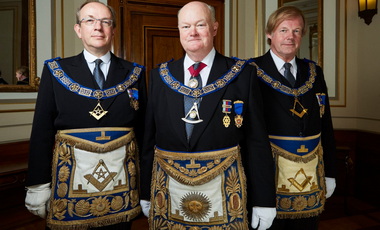
 

Occult, Anti-Christian Roots of Freemasonry

MAIN POINT OF THE BELOW IN ONE SENTENCE:

  • The serpent of the garden is consistently portrayed as one day defeating the God of the Bible in Masonic literature.

John Weldon lists five ways in which Freemasonry fosters occultic involvement among its members (via EQUIP.ORG):

  • First, Freemasonry supports the now-popular New Age dictum that man houses within himself unlimited power that can be unlocked using specific procedures.
  • Second, Freemasonry espouses a philosophy and a system of symbols which bear a striking resemblance to many of the occultic arts — for example kabbalism, Rosicrucianism, and hermetic philosophy.
  • Third, Freemasonry encourages its members to discover the deeper significance (or “esoteric truths”) lying beneath its ceremonies and symbols.
  • Fourth, Freemasonry promotes the development of altered states of consciousness, an exercise rooted in mysticism.
  • Finally, a number of Masons regard their organization as the vehicle that will lead the world into an age of occultic enlightenment.

In that same article linked above, Hank Hanegraaff askes: “Why are so many Masons unaware of this side of Freemasonry?” His answer?

The reason is that a large portion of Masons seldom strive to advance beyond the initial ranks or degrees offered within their organization. But as one progresses to higher degrees, more and more details about the underlying foundations of Masonic ideology are gradually revealed, including its occultic dimensions. It is therefore imperative that we warn others about the dangers brewing beneath the surface of the Masonic Lodge. 

In my copy of Morals and Dogma this was in the back of this copy…. upper Masons signing the back of the Morals and Dogma signifying they have read it:

Though Freemasons claim otherwise, Freemasonry and Christianity are incompatible:

By taking the Masonic oaths, the Mason is swearing to uphold Masonry and its teachings. Swearing to uphold Masonic oaths is sinful, unscriptural and should not be part of the Christian’s life for the following reasons

  1. They make a Christian man swear by God to doctrines which God has pronounced false and sinful. For example, Masonry teaches a universalist doctrine of “the Fatherhood of God” (John 8:42)
  2. The Christian man is made to swear his acceptance of the lie that salvation, the reward of Heaven, can be gained by main’s good works (Ephesians 2:8-9)
  3. The Christian man swears to accept and promote the Masonic lie that Jesus is just one of many equally revered prohets in the world. He does this when agreeing that all religions can lead a man to God (Acts 4:12; Philippians 2:9-11; Colossians 1:16-18)
  4. The Christian man swears he will remain silent in the Lodge and not talk of Christ when God commands every Christian to be a witness (Matthew 28:19)
  5. The Christian man swears that he is approaching the Lodge while he is in spiritual ignorance and moral darkness, when the Bible says that Christians are children of light and are indwelt by the Light of the world (John 8:12; Ephesians 5:8)
  6. By taking the Masonic oath, the Christian is guilty of taking the name of the Lord is vain, because he has sworn unlawfully to things God has forbidden him to swear to. God says He will not leave such a person unpunished (Exodus 20:7)
  7. The Christian falsely swears that the God of the Bible is equally present in all religions (1 Timothy 2:5-6)
  8. The Christian falsely swears to the teaching that true worship can be offered in to Lodge to God without the mediatorship of Jesus (Hebrews 9:14)
  9. By swearing the Masonic oath, Christians are perpetuating a false gospel to other Lodge members who look only to the gospel of Masonry to get them to Heaven (Galatians 1:6-8)
  10. The Christian’s spirit, mind and body are the temple of the Holy Spirit, “bought with a price” (1 Corinthians 6:19-20). By taking the Masonic obligations he could be agreeing to allow the pollution of his mind and spirit by pagan religion or even occult practices.

John Ankerberg and John Weldon, Encyclopedia of Cults and New Religions (Eugene, Or: Harvest House Publishers,  1999), 255-256. (Via APOLOGETICS INDEX)

See more from John Weldon (PDF).

And, I note the “Masonic” view of Jesus is very Gnostic-like when in a conversation with actor Michael Berryman. I posted the full conversation here. In that long exchange Freemasonry came up. Here is what I noted then:

7. What “is” Freemasonry?

Below/right is a scan from page 567 of my copy of Morals and Dogma. What you have here is an example of Gnostic thinking on spirit-material dualism; Freemasons are merely modern day Gnostics. Roles are reversed in comparison to how historic Christianity has viewed them since its inception. I will explain, but first look at page 567 (click on it to enlarge):

So let’s get into the meat of the matter. Gnostic thinking is a combination of Judaism, Platonism, Zoroastrianism, and Christianity. (By-the-by, the below is much to do with a professor’s input I had, Dr. Wayne House.)

Judaism – early Gnostics followed the thinking of Marcian, and Marcian taught that the God of the Old Testament was a demiurge. A demiurge would be what we would typically call the “devil.” Since anything 100% spirit is “good,” anything material is “bad.” So the God of the Old Testament created the world, which is material, and so this God is the Gnostic’s mortal enemy (pun intended). So Judaic thought and Judaism’s God is what Gnostics are “fighting” against. This is Judaism’s contribution.

Platonism – plutonic thought is basically the codifying of Hindu thinking into Grecian thought. He taught that innate ideas (that is: existing in one from birth; inborn; native) were the ideas the mind beheld in the world of pure Forms before birth. This world, then, is but a shadow of reality… pure spirit. This is Platonic contribution to Gnostic thinking.

An aside here for clarity of thought. Platonic thinking shares a point in common with Gnostic thinking, so you could be a Platonist and not a Gnostic. You couldn’t be, however, a Gnostic without being a Platonist. This is important because many “scholars” get this concept mixed up when describing the points of contact between Gnostic thinking and Christianity. Okay, on we go.

Zoroastrianism – Zoroastic thought has contributed what is called ethical dualism. It has said that there is a battle between good and evil, light and dark. Its addition to this is that anything material in nature is evil, and anything spiritual is good.

Christianity – Christian theology provided a “vehicle” in which to express the above. It is then, the “vehicle of expression” for Gnostics. Jesus becomes the way in which they Gnostics explain the working of impersonal deity in human existence and the offering of salvation through secret knowledge, or, Gnosis. Gnosis means knowledge of spiritual matters; mystical knowledge.

Gnostic’s, then, only have a complete “system of thought” when they combine all four of these major aspects into their thinking. If their thinking were to lack any one of these, they would cease to be Gnostic. The combining of the major aspects of these four lines thought, then, make up the Gnostic “worldview.” What do Gnostics believe then? I will explain a bit more in this crude drawing taken during notes from a class at seminary. one should note as well that “Eon” should be spelled “Aeon.”:

Much like Eastern philosophy, there is an impersonal spirit which is 100% spirit. Brahma as it is referred to in Hindu thought. Out of this impersonal force emanated “Eons.” These Eons were 99.9% spirit and .01% material, to put it layman terms. (Also, the percentages are not to explain exactly what Gnostic’s believe, I am just using these numbers as examples to get the analogy across.) These less impersonal, or more corrupted Eons, created other Eons who themselves were more deficient in their spirit/matter balance. Until finally you have very “diluted” beings. One diluted being — referred to as a “Demiurge,” what we would sometimes call the “Devil” — created our world. He also created smaller more diluted beings called “Archons.” These archons would be what we view as demons; Gnostics would say Paul referred to them in Ephesians 6:12 when he said:

“For we wrestle not against flesh and blood, but against principalities, against powers, against rulers of the darkness of this world, against spiritual wickedness in high places.”

Jesus comes into the picture as an Aeon who has a higher percentage of spirit left and sneaks past the demiurge and the archons and enters our world. He is “born,” not physically, but is an ethereal image of mankind (hard to explain) to point the way to a saving knowledge that is secret or hidden.

Freemasons are the most modern day representation of Gnostics; they have symbols that as you climb to higher degrees become clearer in their real meaning and are explained more-so as you climb this “knowledge ladder.” Secret handshakes, elaborate rituals and secrecy until finally at the 33rd-degree you are presented with a true understanding (a Gnostic one) of reality and “God.”

From three separate Mason’s saying each part of the name of God, “Ja-bul-on,” to the meaning of the dot or “G” in the square and compass symbol. All these serve as layers for the initiates to come to realize that this material world is evil.

The Gnostics and hence, Masons, believe that there is a war going on with the God of the Old Testament and the God of the New Testament. As this thinking has progressed throughout history it has adopted other philosophies and has become more and more convoluted in its history and thinking. The New Age, much of your occultism, cults, and even Christianity (Trinity Broadcasting Network for instance) has been influenced by this thinking in one way or another. From Madam Blavatsky and her influence on Germany’s occultism that led to the Aryan philosophy of Hitler to Benny Hinn’s healing crusades.

All sorts of writers, especially conspiratorial writers, have had a plethora of facts to misuse and misrepresent and to twist to their own agendas. Their agenda have resulted in many people believing that “secret societies” control both parties and were behind the Twin Towers so they could implement a world government. This view that combines, “sun” worship from the ancient Egyptians to the Illuminate, from the Knights Templars and Rosicrucians, to today’s Skull and Bones and Council on Foreign Relations ~ is defunct mainly due to the lack of understanding gnosis and the philosophy that has driven it.

(Read More)

In an article by Dave Hunt preserved over at The John Ankerberg Show, we read a great short expose of the occultic roots of Freemasonry:

The Occult Influence In Freemasonry

Occultism has gained a new respectability both in the world and the church through its acceptance and promotion by numerous business and civic leaders and pastors. Among the latter, none was more influential than Norman Vincent Peale. A prolific and popular “Christian” author, Peale’s writings have introduced millions in the world and church to the occult. There are at least two sources of Peale’s occultism: the writings of occultist Flo­rence Scovel Shinn, and Freemasonry.

A 33rd degree Mason, Peale was pictured on the cover of the Masonic magazine, New Age.[1] He was inducted into the Scottish Rite [Masonic] Hall of Honor on September 30,1991, and his portrait now hangs in the Washington DC Masonic Temple.[2] He was often held up by Masons as an example of Masonic character. Yet instead of honestly acknowl­edging the truth about Masonry, Peale perpetuated its deceits.

According to its own documents, Masonry involves occultism. Its influence permeates both the world and the church. Although many professing Christians are Masons, Masonry is an anti-Christian religious cult rooted in paganism. Masonry contains much of the mysti­cism of Hinduism and Buddhism, and is Luciferian. Yet Peale declared, “I have never seen the slightest word or expression [in Masonic rituals] that is anything a Christian could not endorse.”[3]

Such an obviously false statement sheds further light upon Peale’s perversion of Chris­tianity. No one who has reached the 33rd degree could be so ignorant. Declarations by Masonic authorities expose Peale’s dishonesty on that subject. Albert G. Mackey, coauthor of Encyclopedia of Freemasonry, is one of Masonry’s highest authorities. In Manual of the Lodge, Mackey traces Masonic teaching back to “the ancient rites and mysteries practiced in the very bosom of pagan darkness….[4]

Albert Pike, Sovereign Grand Commander of the Southern Supreme Council of Scottish Rite Freemasonry in the USA, was “an honorary member of almost every Supreme Council in the world.”[5] He authored Morals and Dogma of the Ancient and Accepted Scottish Rite of Freemasonry for the Supreme Council of the Thirty-Third Degree, which was published by its authority. This compendium of official Masonic lore traces Masonry to Hinduism, Bud­dhism, Zoroastrianism, and other Eastern religions. In that volume Pike declared:

Masonry, like all the Mysteries, Hermeticism and Alchemy, conceals its secrets from all except the Adepts and Sages, or the Elect, and uses false explanations and misinterpretations of its symbols to mislead those who deserve only to be misled.[6]

Part of the symbols are displayed [in the Blue Degrees] to the Initiate [Mason], but he is intentionally misled by false interpretations. It is not intended that he shall understand them, but that he shall imagine he understands them.[7]

Secrecy and occultism go hand in hand. At the heart of Masonry is a secret Luciferian doctrine which a Mason comes to understand only when he reaches the higher levels. Manly Palmer Hall, another of the greatest authorities on Masonry, writes, “When the Ma­sonhas learned the mystery of his Craft, the seething energies of Lucifer are in his hands….[8]Nevertheless, Masonry is highly respected in today’s world and Masons constitute a high percentage of those in leadership both in the world and in the church.

Those who deny that Jesus is the only Christ and that He came once-and-for-all in the flesh have embraced the spirit of Antichrist (1 John 4:1-3). Such is the teaching of Eastern mysticism and the mind science cults: that Jesus had attained to the state of “Christ con­sciousness” available to all mankind. Masonry declares the same:

Jesus of Nazareth had attained a level of consciousness, of perfection, that has been called by various names: cosmic consciousness, soul regeneration, philosophic initiation, spiritual illumination, Brahmic Splendor, Christ-consciousness.[9]

FOOTNOTES

[1] For many years the magazine of Scottish Rite Freemasonry in the United States was called New Age. That title accurately described Masonic beliefs and rites. In order to hide that fact (because the truth about the New Age is becoming known), the name has been changed to Scottish Rite of Freemasonry Southern Jurisdiction USA, or The Scottish Rite Journal.

[2] Scottish Rite Journal, May 1992.

[3] The Miami Herald, July 28, 1995, p. 1F.

[4] Albert G. Mackey, Manual of the Lodge (Macoy and Sickles, 1802), p. 96.

[5] Albert G. Mackey, 33rd degree, and Charles T. McClenachan, 33rd degree, Encyclopedia of Free­masonry (The Masonic History Company, 1921), revised ed., vol. II, p. 564.

[6] Albert Pike, Morals and Dogma of the Ancient and Accepted Scottish Rite of Freemasonry (Su­preme Council of the Thirty-Third Degree, 1964), pp. 104-05.

[7] Ibid., p. 819.

[8] Manly Palmer Hall, The Lost Keys of Freemasonry (Macoy Publishing, 1976), p. 48.

[9] Lynn F. Perkins, The Meaning of Masonry (CSA Press, 1971), p. 32.

The Evils of Freemasonry – A Christian Perspective

Masonry… Occultic? / Albert Pike, The Root!

In any religious – philosophical – political system of belief, or trust, one must always go to the root (source) of the particular structured belief.  Almost always a person[s]. Whether it be the political wrangling behind Russia (Marx), or, Jehovah Witnesses (Charles Russel), Christianity (Jesus).  We must always get to the bottom of the basic philosophical construct, always. In the case of modern Masonry, we find a man by the name of Albert Pike. Although many Masons deny knowing him, upper Masons highly revere him.  I will give a few modern examples of this reverence before we get into what he believed.

In the Short Talk Bulletin, which was reprinted in 1988 by the Masonic Service Association of the United States, this was said about Albert Pike:

“He was the Master genius of Masonry in America, both as scholar and artist.  No other mind of equal power ever toiled so long in the service of the Craft in the New World.  No other has left a nobler fame in our annals.”  Speaking of Pike’s book, Morals and Dogma, this booklet maintains that it is: “… a huge manual for the instruction of the [Scottish] Rite…  It ought to be revised… since it is too valuable to be left in so cumbersome o form, containing as it does much of the best Masonic thinking and writing in our literature.”  The booklet continues: “No purer, nobler man has stood at the alter of Freemasonry or left his story in our traditions.  He was the most eminent mason in the world….  Nor will our craft ever permit to grow dim the memory of that stately, wise, and gracious teacher….”

The following praise is even more recent – this time coming from the head of the Southern Jurisdiction of Masonry, C. Fred Kleinknecht, who is the Sovereign Grand Commander.  In the January 1989 issue of The New Age magazine (an official publication of the Supreme Council of the Thirty-Third and Last Degree, Southern Jurisdiction), Kleinknecht mentioned that the “apex of our teachings has been the rituals of our degrees and Morals and Dogma….”

By the way, Pike wrote some and rewrote others of all the rituals from the 4th through the 33rd degrees.  In the November 1992 issue of The Scottish Rite Journal (known as The New Age from 1903 until 1990), Kleinknecht again heaps praise on Pike and his book.  He brags:

“Correctly understood, Albert Pike’s Morals and Dogma provides our Brethren a stimulus to thought, a source of inspiration, and even an aid to Scottish Rite growth.  Pike’s great work is not the book of an hour, a decade, or a century. It is a book for all time….  Abandon Morals and Dogma?  Never!”

Who Is The Light

Let’s switch gears and talk about what the end of the Masons journey entails for him and his understanding.  Albert Pike in Morals and Dogma had this to say – (paying attention to the original capitalization’s from hear-on out):

“And the Mason is familiar with these doctrines…that the Supreme Being is a centre [center] of Light whose rays or emanations pervade the Universe; for that is the Light for which all Masonic journeys are a search, and of which the sun and moon in our Lodges are only emblems.”

Notice that Mr. Pike says that this light-bringer is a god; in fact, he capitalizes the “s” and the “b” in “Supreme Being.”  He further deifies “Light” by capitalizing the letter “l”. And then he added these thoughts about the nature of this “Light:” “Behold, it said, the light, which emanates from an immense centre [center] of Light, that spreads everywhere its benevolent rays; so do the spirits of Light emanate from the Divine Light.”

The Royal Masonic Cyclopedia, written in 1877, said this after the entry: Sons of Light: “Masons by their tenure are necessarily Sons of Light, and are so accepted even by their opponents, who are Sons of Darkness.”

Albert Mackey wrote these comments in his Encyclopedia of Masonry (which was published by The Masonic History Company, an official Masonic Co.):

“Freemasons are emphatically called the ‘sons of light,’ because they are, or at least are entitled to be, in possession of the true meaning of the symbol.  Light is an important word in the Masonic system. It conveys a far more recondite [defined as being beyond the grasp of the ordinary mind] meaning that it is believed to possess by the generality of readers….  It contains within itself a far more abstruse allusion to the very essence of Speculative Masonry.”

Perhaps the very reason that the Masons conceal a great truth in the word “light,” or “Light,” can be best summarized in this single statement of Albert Pike in his book Morals and Dogma: “…  Light will finally overcome Darkness.”

Lucifer is the Light

So if the student of esoteric knowledge wishes to understand the language, it becomes important to determine, if possible who the “light-bearer” is. And the student can know for certain who that is, because one of the greatest seekers of light has told the world.  That writer is Albert Pike, a Mason, and he has described whom this individual is in his book entitled Morals and Dogma.  Mr. Pike identified the “Light-bearer” on page 321 of that book.  “Lucifer, the Light-bearer!  Lucifer, the Son of the Morning!  Is it he who bears the Light…?  Doubt it not!”

Albert Pike has admitted that the Masons seek Light!  He has now admitted that the “Light-bearer” is Lucifer!  The Masons ask for “Light” from the “Light-bearer,” Lucifer.

However, Mr. Pike is not the only Mason who has admitted that in easily understandable language.  Another Masonic writer is Manly P. Hall who has said the same in his book The Lost Keys of Freemasonry.  This book has been included in a “list of the best Masonic books available” in a Masonic magazine called The Royal Arch Mason, an official Masonic publication. The list says that “it [the list] is the finest basic library available to Freemasons.”  The Masonic Lodge for reading and understanding its philosophy has approved this book.  Page 48 of the book says this:

“When the Mason learns the key to the warrior on the block is the proper application of the dynamo of living power, he has learned the mystery of his Craft. The seething energies of Lucifer are in his hands [the Master Mason’s hands] and before he may step upward he must prove his ability to properly apply energy.”

How does Scottish Rite Masonry feel about Manly Hall?  You can judge for yourself from the following obituary notice that appeared in the November 1990 issue of The Scottish Rite Journal:

“Illustrious Manly Palmer Hall, often called ‘Masonry’s greatest philosopher,’ departed his earthly labors peacefully in his sleep on August 7, 1990, in Los Angeles, California….  Brother Hall… devoted his life to lecturing, teaching, editing, and writing on all aspects of Freemasonry….  He is best known for writing The Lost Keys of Freemasonry (1923), The Dionysian Artificers (1926), Masonic Orders of Fraternity (1950), and of course, his monumental Encyclopedic Outline of Masonic history, philosophy and related subjects….  Brother Hallreceived the Scottish Rite’s highest honor, the Grand Cross in 1985 because of his exceptional contributions to Freemasonry, the Scottish Rite, and the public good.  Like Grand Commander Albert Pike before him, Hall did not teach a new doctrine but was an ambassador of an ageless tradition of wisdom that entrenches us to this day….  The world is a far better place because of Manly Palmer Hall, and we are better persons for having known him and his work.”

Page 287 of Morals and Dogma Pike states:

“You see, my brother, what is the meaning of Masonic ‘Light.’  You see why the East of the Lodge, where the initial letter of the name of the Deity overhangs the Master, is the place of Lightit is that light, the true knowledge of Deity [in-other-words, the truth that Lucifer is god!] the eternal Good,…

How can Lucifer be good?  I do not want to go in depth about the switched roles of the God of the Bible and Lucifer, the Masonic god.  Nevertheless, I will let Mr. Pike explain it a bit before we move on.  Page 567 of Morals and Dogma says this:

“To prevent the light from escaping at once, the Demons forbade Adam to eat the fruit of ‘knowledge of good and evil,’ by which he would have known the Empire of Light and that of Darkness.  He obeyed; an Angel of Light induced him to transgress, and gave him the means of victory; but the Demons created Eve

Everyone knows that the God of the Judeo-Christian faith is the one who created Eve and forbade Adam to eat. In Pike’s dictates though, Lucifer is the hero of the plot.  The serpent of the garden is consistently portrayed as one day defeating the God of the Bible in Masonic literature.

Judge Rejects Attempt to Remove Trump From Colorado Ballot

THE FEDERALIST has an article again noting what my last three topics (first, second, and third posts) regarding the issue are: “the President is not included in the 14th Amendment.”

The Minnesota Supreme Court and the Michigan Court of Claims threw out challenges attempting to strike former President Donald Trump’s name from 2024 presidential primary election ballots. However, the courts left open the possibility of his removal from general presidential election ballots. Similar cases are pending across the country, and a decision is expected to be made today in a Colorado lawsuit.

The lawsuits, brought by leftist activist organizations, argue that because Trump was giving a speech to his supporters near the White House while protesters flooded the Capitol in a supposed “insurrection” on Jan. 6, 2021, Section 3 of the 14th Amendment disqualifies him from appearing on ballots.

Section 3 of the 14th Amendment reads:

“No person shall hold any office, civil or military, under the United States who, having previously taken an oath as an officer of the United States to support the Constitution of the United States, shall have engaged in insurrection or rebellion against the same, or given aid or comfort to the enemies thereof.”

There are several issues with the lawsuits attempting to brazenly interfere in the next presidential election, starting with the fact that Trump did not “engage in an insurrection or rebellion.” No federal court has convicted Trump of such a thing. Moreover, the Senate acquitted Trump of the second impeachment resolution, which charged him with “Incitement of Insurrection.”

According to Hans von Spakovsky, a senior legal fellow at The Heritage Foundation, there is also “a serious question of whether the disqualification provision of Section 3 even still exists as a constitutional matter.” As Spakovsky explained, “Section 3 gives Congress the ability to remove the disqualification provision and void Section 3 by a two-thirds vote of both houses of Congress,” and in 1872 and 1898, “Congress did just that” by passing two Amnesty Acts.

In Minnesota, the state Supreme Court refused to even consider Trump’s removal from the general election ballots because the issue is “neither ripe, nor is it ‘about to occur.’” Indeed, no one technically knows whether Trump will win the Republican primary and therefore be eligible to appear on general election ballots.

As for the primary election, the court concluded Section 3 is irrelevant. “[T]his is an internal party election to serve internal party purposes,” stated the court, “And there is no state statute that prohibits a major political party from placing on the presidential nomination primary ballot, or sending delegates to the national convention supporting, a candidate who is ineligible to hold office.”

However, the court did leave open the possibility of Trump’s disqualification in the general election if he wins the primary.

In Michigan, state Court of Claims Judge James Redford ruled that Trump could not be removed from primary ballots because the primaries are an internal political party affair. Like in Minnesota, Redford left the door open for Trump’s removal from the general election, but he also strongly suggested that no court can rule on Trump’s eligibility in the general election because that decision should be left up to Congress.

“The questions involved are by their nature political,” Redford wrote. “It takes the decision of whether there was a rebellion or insurrection and whether or not someone participated in it from the Congress, a body made up of elected representatives of the people of every state in the nation, and gives it to but one single judicial officer, a person who no matter how well intentioned, evenhanded, fair and learned, cannot in any manner or form possibly embody the represented qualities of every citizen of the nation—as does the House of Representatives and the Senate.”

[….]

Legal experts predict that this boldest ploy yet to interfere in a presidential election will likely reach the U.S. Supreme Court.

JUST THE NEWS notes the same at the end of their article: “Activist group Free Speech for People has since asked the Wolverine State’s top bench to intervene.”

RED STATE shows the Judge involved believes Trump met the rules for the 14th, but that the 14th doesn’t apply to the President:

There’s a new decision among the cases making their way through the nation’s judicial system that seek to bar former President Donald Trump from 2024 presidential ballots by using section three of the 14th Amendment to the Constitution — but it’s complicated. So bear with me.

Let’s start with the basics of what Colorado District Judge Sarah B. Wallace wrote in her ruling: First, she rejected the plaintiffs’ argument that the 14th Amendment was intended to be read as the President of the United States is ““an officer of the United States.” Judge Wallace decided that by finding that “Section 3 did not include the presidential oath in that category.”

The clause does not explicitly name the presidency, so that question hinged on whether the president was included in the category “officer of the United States.”

The complication comes in after that. Yes, in the end, the decision by this state judge is that this cannot be used to keep the former president off Colorado’s ballot. But that wasn’t all that she determined in her ruling — and this part will likely please the leftists and Never Trump antagonists:

With his actions before and during the Jan. 6, 2021, attack on the U.S. Capitol, Judge Sarah B. Wallace ruled, Mr. Trump engaged in insurrection against the Constitution, an offense that Section 3 of the 14th Amendment — which was ratified in 1868 to keep former Confederates out of the government — deems disqualifying for people who previously took an oath to support the Constitution.

In other words, she said Trump “incited” the people who took part in entering the Capitol.

[….]

This isn’t over, in other words, and it’s believed that the Colorado case will likely end up at the Supreme Court……

Muslim Goes Silent When He Has To Admit Allah’s a Pedophile

I say Allah is a pedophile IF the Qur’an is the word of Allah, sent word for word and preserved perfectly by the perfect man [obviously a false god].

I found this video pretty amazing. Firstly, I dig the patience GodLogic has. But the main thing about this video is that when the Muslim goes silent he is testifying to the conscience the Real God has placed in us — and by doing so, he is showing that “Allah” is not God, but an evil creation of the groupthink of Islam inspired by demons. When the truth comes in, the cover up begins. The long silence proves this:

  • For His invisible attributes, that is, His eternal power and divine nature, have been clearly seen since the creation of the world, being understood through what He has made. As a result, people are without excuse. (Romans 1:20)

Thirdly, the funny line in the video is this: “No Hitta – No Iddah” You will see what I mean. This seems long and drawn out, but it is not if you understand what is going on.

Israel and The End Times Prophecies of Ezekiel 38-39

Israel faces war both in the North and South, and in this conflict antisemitism is on the rise in every nation. Alliances with Iran and Russia a few years ago unthinkable are now iron clad. Many in Israel and around the world are looking at the prophecies of Ezekiel 38-39 and asking are we in this war or in the precursor to these end times events? Dr. Erez Soref and Dr. Golan Broshi dive into the scripture and the events of our days and seek to answer where we are in this prophetic time.

The Nazi Nuremberg Case For Hamas

  • Nuremberg enforced a fundamental distinction. All civilian lives are equal, but not so all ways of taking them. The deliberate and purposeful killing of civilians is a crime; not so the taking of civilian lives that is undesired, unintended, but unavoidable. (Martin Kramer)

EXCELLENT READ, I suggest reading it in it’s entirety: The Nazi Case For Hamas

I am a historian (like Khalidi), interested in the origins of ideas and arguments. It turns out that Khalidi’s premier talking point has a very specific genesis.

It figured in the case for the defense in the Einsatzgruppen Trial, conducted by the Nuremberg Military Tribunal from late 1947 to the spring of 1948. The Einsatzgruppen were the paramilitary death squads of Nazi Germany, which carried out mass murder by shooting in Nazi-occupied Europe. They destroyed well over a million Jews, and two million people all told. After the war, their surviving senior commanders were put on trial at Nuremberg, charged with crimes against humanity and war crimes.

The chief defendant, SS-Gruppenführer Otto Ohlendorf, had been commander of Einsatzgruppe D, which carried out mass murders in Moldova, southern Ukraine, and the Caucasus. An economist and father of five, he had supervised the killing of 90,000 Jews. Ohlendorf imagined that he had a moral conscience. The killers under his command, he told a U.S. Army prosecutor, were prohibited from using infants for target practice, or smashing their heads against trees.

During trial testimony, the prosecutor pressed Ohlendorf: “You were going out to shoot down defenseless people. Now, didn’t the question of the morality of that enter your mind?” Ohlendorf referred to the Allied bombings of Germany as a context:

I am not in a position to isolate this occurrence from the occurrences of 1943, 1944, and 1945 where with my own hands I took children and women out of the burning asphalt myself, and with my own hands I took big blocks of stone from the stomachs of pregnant women; and with my own eyes I saw 60,000 people die within 24 hours.

A judge immediately pointed out that his own killing spree preceded those bombings. But this would become known as the “Dresden defense,” to which Ohlendorf resorted still another time, in this exchange:

Ohlendorf: I have seen very many children killed in this war through air attacks, for the security of other nations, and orders were carried out to bomb, no matter whether many children were killed or not.

Q: Now, I think we are getting somewhere, Mr. Ohlendorf. You saw German children killed by Allied bombers and that is what you are referring to?

Ohlendorf: Yes, I have seen it.

Q: Do you attempt to draw a moral comparison between the bomber who drops bombs hoping that it will not kill children and yourself who shot children deliberately? Is that a fair moral comparison ?

Ohlendorf: I cannot imagine that those planes which systematically covered a city that was a fortified city, square meter for square meter, with incendiaries and explosive bombs and again with phosphorus bombs, and this done from block to block, and then as I have seen it in Dresden likewise the squares where the civilian population had fled to—that these men could possibly hope not to kill any civilian population, and no children.

Ohlendorf thought this defense so powerful that he invoked it yet another time:

The fact that individual men killed civilians face to face is looked upon as terrible and is pictured as specially gruesome because the order was clearly given to kill these people; but I cannot morally evaluate a deed any better, a deed which makes it possible, by pushing a button, to kill a much larger number of civilians, men, women, and children.

(The chief prosecutor, an American, called this particular iteration “exactly what a fanatical pseudo-intellectual SS-man might well believe.”)

At Nuremberg, this sort of tu quoque defense (“I shouldn’t be punished because they did it too”) wasn’t admissible. Still, in the verdict of the Einsatzgruppen Trial, the judges chose to refute it. “It was submitted,” the judges wrote, “that the defendants must be exonerated from the charge of killing civilian populations since every Allied nation brought about the death of noncombatants through the instrumentality of bombing.” The judges would have none of it:

A city is bombed for tactical purposes… it inevitably happens that nonmilitary persons are killed. This is an incident, a grave incident to be sure, but an unavoidable corollary of battle action. The civilians are not individualized. The bomb falls, it is aimed at the railroad yards, houses along the tracks are hit and many of their occupants killed. But that is entirely different, both in fact and in law, from an armed force marching up to these same railroad tracks, entering those houses abutting thereon, dragging out the men, women and children and shooting them.

The tribunal sentenced Ohlendorf to death. He was hanged in June 1951.


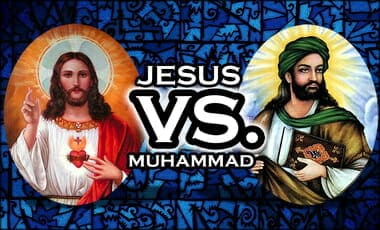
Jesus vs Muhammad | Jordan Peterson

“All of the nine founders of religion, with the exception of Jesus Christ, are reported in their respective sacred scriptures as having passed through a preliminary period of uncertainty, or of searching for religious light. All the founders of the non-Christian religions evinced inconsistencies in their personal character; some of them altered their practical policies under change of circumstances. Jesus Christ alone is reported as having had a consistent God-consciousness, a consistent character himself, and a consistent program for his religion.”

Robert Hume, The World’s Living Religions (New York, NY: Charles Scribner’s Sons, 1959), 285-286.

SEE MY PDF: “MUHAMMAD vs. JESUS

MUHAMMAD

MUHAMMAD – Ordered his followers, as well as personally participating in, both digging their graves and cutting the throats of between 600-to-900 men, women, and children. Jews. Some of the women and children were taken as property. He was a military tactician that lied and told others to use deception that ultimately led to the death of many people (taqiyya): The word “Taqiyya” literally means: “Concealing, precaution, guarding.”

  • In the West, what is said and done more or less corresponds to the intentions of the speaker and the doer. Liars and cheats abound, of course, but generally they can go only so far before being caught out in the contractual relationships of their society. Lying and cheating in the Arab world is not really a moral matter but a method of safeguarding honor and status, avoiding shame, and at all times exploiting possibilities, for those with the wits for it, deftly and expeditiously to convert shame into honor on their own account, and vice versa for their opponents. If honor so demands, lies and cheating may become absolute imperatives. In Shia practice, a man is allowed what is called “precautionary dissimulation,” a recognition that truth may be impossible in some contexts.
  • Pierre Bourdieu, the French social anthropologist, has pointed out that no dishonor attaches to such primary transactions as selling short weight, deceiving anyone about quality, quantity or kind of goods, cheating at gambling, and bearing false witness. The doer of these things is merely quicker off the mark than the next fellow; owing him nothing, he is not to be blamed for taking what he can.[1]

Islamic ethics include deceiving the Kafir. The doctrine of deception is found in the Sunna and the Koran. The Arabic name for sacred deception is called taqiyya.

We never see any depictions of Muhammad with children, we just know that he most likely acquired a child bride at age six and consummated that “marriage” when she was nine[2]  — he was a pedophile in other words. While the Qu’ran states that a follower of this book should have no more than 4 wives, we know of course that he had many more, about 5 more in fact. And “Just War Theory” cannot apply to Muhammad and Muslim’s since when he said:

“I have been ordered by Allah to fight against people until they testify that none has the right to be worshipped but Allah and that Muhammad is Allah’s Apostle and offer prayers perfectly and give the obligatory charity…then they will save their lives and property from me” (Sahih Muslim 1.24).

He ordered his followers to raid caravans, “This is the caravan of the Quraysh possessing wealth. It is likely that Allah may give it to you as booty.”[3] As he was dying, he said these now famous words, “I have been made victorious with terror.”[4]

Many more examples could be provided! Even when it comes to “salvation,” the most ardent/obedient Muslim still leaves his or her entrance into “heaven” is, in the end, an impersonal act of arbitrary divine power.… no story of love and sacrifice or assurance is provided.

[1] David Pryce-Jones, The Closed Circle: An Interpretation of the Arabs (Chicago, IL: Ivan R, Dee Publishers, 2009), 4, 38.

[2] Bukhari, vol. 5, book 63, no. 3896; cf. Bukhari, vol. 7, book 67, no. 5158.

[3] Ibn Sa’d, Kitab Al-Tabaqat Al-Kabir, translated by S. Moinul Haq and H. K. Ghazanfar, vol. 2 (Kitab Bhavan, n.d.), 9.

[4] Muhammed Ibn Ismaiel Al-Bukhari, Sahih al-Bukhari: The Translation of the Meanings, translated by Muhammad M. Khan, vol. 4, bk. 56, no. 2977 (Darussalam, 1997).

I was reading through some passages in the Quran not too long ago and came across Quran chapter 79, verse 42. I immediately noticed how similar this verse in the Quran is to Mark 13:31-32 … So, I started to do some more research on who Muhammad REALLY thought he was compared to Jesus. The findings are quite shocking!

JESUS

JESUS – When Peter struck off the ear of the soldier, healed it. Christ said if his followers were of any other kingdom, they would fight to get him off the cross. He also told Peter if he lived by the sword, he would die by it.; Christ invited and used children as examples of how Jewish adults should view their faith… something culturally radical – inviting children into an inner-circle of a group of status-oriented men such as the Pharisees was unheard of. Especially saying to them their faith must be similar; Jesus, and thusly us, can access true love because the Triune God has eternally loved (The Father loves the Son, etc. ~ unlike the Unitarian God of Islam).

Love between us then has roots in our Creator… [examples]:

  1. my wife and I for instance, as well as family,
  2. the love in community/Body of Christ,
  3. love for our enemies, …etc…

…has eternal foundations in God; This love from God towards us has caused a Sacrifice to ensure our salvation (John 3:16-17; 5:25; 6:47). Jesus said as well that he has “spoken openly to the world… always teaching in synagogues or at the temple, where all the Jews come together. ‘I said nothing in secret’” (John 18:20). The Bible also states that God cannot lie (Numbers 23:19; Titus 1:2; Hebrews 6:18) … and Jesus is God in orthodoxy (i.e., Jesus cannot lie). The love of Christ and the relationship he offers is bar-none the center piece of our faith… something the Muslim does not have. Which is why the Church evolved because they have a point of reference in Christ to come back to. In Matthew chapter 5 we find Jesus’ teaching and commending us to the following:

THE BEATITUDES | BELIEVERS ARE SALT AND LIGHT | CHRIST FULFILLS THE LAW | MURDER BEGINS IN THE HEART | ADULTERY BEGINS IN THE HEART | DIVORCE PRACTICES CENSURED | TELL THE TRUTH | GO THE SECOND MILE | LOVE YOUR ENEMIES

Muhammad would never be able to speak of these things that Christ did in the record of Matthew. Which is why whenever given the chance I say to a Muslim I pray they emulate Jesus’ life and follow Him rather than Muhammad. I wish Muhammad had read and followed Jesus’ teachings as well.

This is a segment of a Muslim caller into the Michael Medved Show and both Mosab Yousef and Michael Medved respond. Yousef compares Christians to Muhammad, the caller compares Muslims to Christians:

AQUINAS THOUGHTS ON MUHAMMAD

St. Thomas Aquinas is one of the most prolific thinkers in Western history; his words should not be taken lightly, regardless of your cultural/religious background. Subscribe now to stay updated with excellent content.

BREITBART has a neat story about Aquinas and his views on Islam… here is a portion of it:

In one of his most significant works, the voluminous Summa contra gentiles, which Aquinas wrote between 1258 and 1264 AD, the scholar argued for the truth of Christianity against other belief systems, including Islam.

Aquinas contrasts the spread of Christianity with that of Islam, arguing that much of Christianity’s early success stemmed from widespread belief in the miracles of Jesus, whereas the spread of Islam was worked through the promise of sensual pleasures and the violence of the sword.

Mohammad, Aquinas wrote, “seduced the people by promises of carnal pleasure to which the concupiscence of the flesh goads us. His teaching also contained precepts that were in conformity with his promises, and he gave free rein to carnal pleasure.”

Such an offer, Aquinas contended, appealed to a certain type of person of limited virtue and wisdom.

“In all this, as is not unexpected, he was obeyed by carnal men,” he wrote. “As for proofs of the truth of his doctrine, he brought forward only such as could be grasped by the natural ability of anyone with a very modest wisdom. Indeed, the truths that he taught he mingled with many fables and with doctrines of the greatest falsity.”

Because of the weakness of Islam’s contentions, Aquinas argued, “no wise men, men trained in things divine and human, believed in him from the beginning.” Instead, those who believed in him “were brutal men and desert wanderers, utterly ignorant of all divine teaching, through whose numbers Muhammad forced others to become his followers by the violence of his arms.”

Islam’s violent methods of propagation were especially unconvincing to Aquinas, since he found that the use of such force does not prove the truth of one’s claims, and are the means typically used by evil men.

“Mohammad said that he was sent in the power of his arms,” Aquinas wrote, “which are signs not lacking even to robbers and tyrants.”

At the time Aquinas was writing, Islam was generally considered a Christian heresy, since it drew so heavily on Christian texts and beliefs. Aquinas wrote that Mohammed “perverts almost all the testimonies of the Old and New Testaments by making them into fabrications of his own, as can be seen by anyone who examines his law.”

According to the noted historian Hilaire Belloc, Islam “began as a heresy, not as a new religion. It was not a pagan contrast with the Church; it was not an alien enemy. It was a perversion of Christian doctrine. Its vitality and endurance soon gave it the appearance of a new religion, but those who were contemporary with its rise saw it for what it was—not a denial, but an adaptation and a misuse, of the Christian thing.”

MUCH MORE

Here are some ways to deal with Muslim apologists questioning Jesus’ Divinity:

(Above) Nabeel Qureshi, a former Muslim, answers a question from a faithful Muslim about how Jesus could have both a Divine (God) nature and a human nature without confusion or contradiction. See more from Nabeel HERE  (He has passed away)

Nabeel is battling stomach cancer, so any prayers would be a gracious help.

Here is a more in-depth presentation dealing with how the question is typically raised.

Muslims around the world are being trained to ask Christians, “Where did Jesus say, ‘I am God, worship me,’ in those exact words?” However, if Muslims are suggesting that Jesus could only claim to be God by uttering a specific sentence, we may reply by asking, “Where did Jesus say, ‘I am only a prophet, don’t worship me,’ in those exact words?” The unreasonable demand for a particular statement, if applied consistently, would thus force Muslims to reject their own view!

Fortunately, we have a simple way to examine what Jesus said about himself. According to both the Bible and the Qur’an, there are certain claims that only God can truly make. For instance, God alone can correctly state that he created the universe. Of course, a mere human being can pronounce the words, “I created the universe,” but the statement would be false coming from anyone other than God.

Hence, if Jesus said things that can only truly be said by God, we must conclude that Jesus claimed to be God. Interestingly, Jews, Christians, and Muslims agree on many of the claims that cannot be properly made by (or about) mere human beings. In this video, we consider several examples of such claims.

For more on the deity of Christ, watch these videos by David Wood:

Among the major differences between Islam and Christianity is that of the character and nature of God as understood by the Bible and the Qur’an. For the Bible, Yahweh is a relational God, a God who appears to his people throughout the Old Testament, who took on flesh in the incarnation of Jesus Christ in the New Testament, and who will be present, the Bible claims, in heaven with us once again: “For now we see through a glass, darkly,” wrote the apostle Paul; “but then face to face.” [76] This is very different from Allah in the Qur’an, a God who is distant and remote, transcendent and lofty, who does not deign to step down into his creation, and is not present in Paradise. As Muslim theologian Isma’il al Faruqi writes:

Allah does not reveal Himself to anyone in any way. Allah reveals only his willAllah does not reveal himself to anyonethat is the great difference between Christianity and Islam.[77]

Central, too, to the Christian understanding of God is that Yahweh is loving; indeed, the Bible goes as far as to boldly make the claim that God is love,[78] the one whose character and nature define what love actually is. You will commonly hear people opine that all religions teach that God is love, but this is simply not true – for instance, nowhere does the Qur’an claim that “Allah is love.”[79]

Finally, at the heart of Christianity stands the belief that, in Jesus, God has experienced suffering, paying the price of the cross in order to reconcile humanity to himself. Now atheists may choose to dismiss, laugh at, or even scoff at that claim, but it is a claim unique to Christianity.[80] It is certainly not an idea found in Islam, where the Qur’an goes as far as to deny that the historical event of Jesus’ crucifixion ever happened.

It has long fascinated me that when Christianity talks about the cross and the suffering of God, it is doing something quite startling, namely reversing the traffic pattern of every other religion, world view, and belief system. All other religions of which I am aware tend to work in one of three basic ways: they claim that if you know the right things, do the right things, or experience the right things, then you will achieve paradise, nirvana, wisdom, a higher state of consciousness, good teeth — whatever it is you are looking for. Islam adopts this model (“Keep the commandments”), as does, incidentally, the New Atheism, whose message is that if you think the right way — think good, secular, scientific thoughts — you’ll be one of the smart ones, one of the brights,[81] one of the elite, the elect.


[76] 1 Corinthians 13:12 (KJV).

[77] Isma’il al Faruqi, Christian Mission and Islamic Da’wah: Proceedings of the Chambésy Dialogue Consultation, Leicester: The Islamic Foundation, 1982, pp. 47-48.

[78] 1 John 4:16.

[79]  And many Muslim theologians argue that Muslims should not use the word “love” when talking about Allah; see e.g. Murad Wilfried Hofmann, “Differences between the Muslim and the Christian Concept of Divine Love” in 14th General Conference of the Royal Aal al-Bayt Institute for Islamic Thought, Amman, Jordan, 2007. See also Gordon Nickel, “The Language of Love in Qur’an and Gospel” in Juan Pedro Monferrer-Sala and Angel Urban, (eds), Sacred Text: Explorations in Lexicography, Frankfurt: Peter Lang, 2009, pp. 223-248.

[80] If you wish to understand this idea (which, whatever you make of it, is the central claim at the heart of Christianity), a great place to start is John Stott, The Cross of Christ, Leicester: IVP, 2006.

[81] A nauseatingly self-congratulatory term coined by some of the New Atheists to mark themselves off from the rest of the world, whom they clearly perceive as dimwits. See Daniel Dennett, “The Bright Stuff“, The New York Times, 12 July 2003.


Andy Banister, The Atheist Who Didn’t Exist: Or, The Dreadful Consequences of Bad Arguments (Oxford, England: Monarch Books, 2015), 62-63.

I am not a fan of the show… I think it is borderline blasphemous; but was listening to him (Neil Saavedra, AKA, “Jesus Christ”) on the way to get coffee for the wife and I while we were watching the niece. I enjoyed the call. I may start listening and uploading stuff like it in the future. BUT KNOW that a dude who responds like Jesus, is, …well… creepy and again ~ borderline blasphemous in my mind.

“Muhammad” Talks to “Jesus Christ”

I am not a fan of the show… I think it is borderline blasphemous; but was listening to him (Neil Saavedra, AKA, “Jesus Christ”) on the way to get coffee for the wife and I while we were watching the niece. I enjoyed the call. I may start listening and uploading stuff like it in the future. BUT KNOW that a dude who responds like Jesus, is, …well… creepy and again ~ borderline blasphemous in my mind.

The Last Line of Defense | Bari Weiss

This is via a hat-tip to Ayaan Hirsi Ali who says: “Very Powerful. Do as Bari urges us to do: Get Up and Fight.” The introduction by Mr. Theodore W. Ullyot, Co-Chairman, Board of Visitors, The Federalist Society — is here.

Barbara K. Olson Memorial Lecture | The Federalist Society, November 10, 2023 (Washington, D.C.)

The Last Line of Defense By Bari Weiss

Marine Corps Birthday | The Fat Electrician

The United States Military, which includes the Armed Forces and the National Guard, consists of various branches all birthed at different times throughout U.S. history. The Armed Forces consists of the following six military branches:

  • Army – June 14, 1775
  • Navy – October 13, 1775
  • Marine Corps – November 10, 1775
  • Coast Guard – August 4, 1790
  • Air Force – September 18, 1947
  • Space Force – December 20, 2019

The Genealogies of Jesus | A Supposed Contradiction, Explained

(This was originally posted in May of 2015, updated in Oct of 2022, and  Nov 2023)

This first video is the why the genealogies of Christ in Matthew and Luke are important. It is in Hebrew with English text underneath, so you may need a larger home computer screen for it. If the text moves too fast, there is a tool in the lower right of the YouTube video to slow it down. This helps. But this is a powerful video, a must watch. (Video Description) Is Jesus a descendant of the line of David? Or is His lineage full of contradictions as the Rabbis claim?? (This is my 2022 addition)

2022

This is my original post, I will note the addition I will add to it after.

2015

The “Genealogy” of Jesus

Norman Geisler explains the apparent contradiction between Matthew and Luke’s genealogies.

This is one of the more popular examples of a Biblical contradiction that is for the most part brought up by Muslims to show the Bible is a document riddled with problems. However, if one gives this document the same attestation as one gives to any other text of history, say, Livy’s History of Rome or Caesar’s Gallic Wars, then the alleged contradictions disappear. On this test John Warwick Montgomery writes that literary critics still follow Aristotle’s dictum that “the benefit of the doubt is to be given to the document itself, not arrogated by the critic himself.” With this in mind, lets see what some have to say about this “contradiction.”


Matthew 1:1-16 gives the genealogy of Jesus through Joseph, who was himself a descendant of King David. As Joseph’s adopted Son, Jesus became his legal heir, so far as his inheritance was concerned. Notice carefully the wording of verse 16: “And Jacob begat Joseph the husband of Mary, of whom was born Jesus, who is called Christ [messiah]” (NASB). This stands in contrast to the format followed in the preceding verses of the succession of Joseph’s ancestors: “Abraham begat [egennesen] Isaac, and Isaac begat Jacob, etc.” Joseph is not said to have begotten Jesus: rather he is referred to as “the husband of Mary, of whom [Gk. feminine genitive] Jesus was born.”

Luke 3:23-38, on the other hand seems to record the genealogical line of Mary herself, carried all the way back beyond the time of Abraham to Adam and the commencement of the human race. This seems to be implied by the wording of verse 23: “Jesus… being (as was supposed) the son of Joseph.” This “as was supposed” indicates that Jesus was not really the biological son of Joseph, even though this was commonly assumed by the public. It further calls attention to the mother, Mary, who must of necessity have been the sole human parent through whom Jesus could have descended from a line of ancestors. Her genealogy is thereupon listed, starting with Heli, who was actually Joseph’s father-in-law, in contradistinction to Joseph’s own father, Jacob:


And Jesus himself began to be about thirty years of age, being (as was supposed) the son of Joseph, which was the son of Heli – Luke 3:23 [Mary]

And Jacob begat Joseph the husband of Mary – Matthew 1:16 [Joseph]

Mary’s line of descent came through Nathan, a son of Bathsheba (or “Bathshua,” according to 1 Chronicles 3:5), the wife of David. Therefore, Jesus was descended from David naturally through Nathan and legally through Solomon.

The coming Messiah of Israel had to be able to prove this lineage as it was prophesied in the Old Testament that He would in fact be a descendant of David. The Jews kept meticulous records at the temple mount of all the genealogical records of the Hebrew people. This information was “public knowledge,” or, verifiable by even the Pharisees. The Romans destroyed these records in A.D. 70. (This is very important – prophetically speaking – because the Orthodox Jews [as opposed to the Messianic Jews] are still awaiting their Messiah, however, he cannot be traced to David or Abraham! A prerequisite for Messiah clearly stated in the Old Testament.) Also of importance is the fact that Luke is very close to Mary, remember that Jesus gave him charge of her while shortly before he died.

Here is Norman Geisler and Thomas Howe in their book, When Critics Ask: A Popular Handbook on Bible Difficulties, explaining the dealio:

LUKE 3:23 —Why does Luke present a different ancestral tree for Jesus than the one in Matthew?

PROBLEM: Jesus has a different grandfather here in Luke 3:23 (Heli) than He does in Matthew 1:16 (Jacob). Which one is the right one?

SOLUTION: This should be expected, since they are two different lines of ancestors, one traced through His legal father, Joseph and the other through His actual mother, Mary. Matthew gives the official line, since he addresses Jesus’ genealogy to Jewish concerns for the Jewish Messiah’s credentials which required that Messiah come from the seed of Abraham and the line of David (cf. Matt. 1:1). Luke, with a broader Greek audi­ence in view, addresses himself to their interest in Jesus as the Perfect Man (which was the quest of Greek thought). Thus, he traces Jesus back to the first man, Adam (Luke 3:38).

That Matthew gives Jesus’ paternal genealogy and Luke his maternal genealogy is further supported by several facts. First of all, while both lines trace Christ to David, each is through a different son of David. Matthew traces Jesus through Joseph (his legal father) to David’s son, Solomon the king, by whom Christ rightfully inherited the throne of David (cf. 2 Sam. 7:12ff). Luke’s purpose, on the other hand, is to show Christ as an actual human. So he traces Christ to David’s son, Nathan, through his actual mother, Mary, through whom He can rightfully claim to be fully human, the redeemer of humanity.

Further, Luke does not say that he is giving Jesus’ genealogy through Joseph. Rather, he notes that Jesus was “as was supposed” (Luke 3:23) the son of Joseph, while He was actually the son of Mary. Also, that Luke would record Mary’s genealogy fits with his interest as a doctor in mothers and birth and with his emphasis on women in his Gospel which has been called “the Gospel for Women.”

Finally, the fact that the two genealogies have some names in common (such as Shealtiel and Zerubbabel, Matt. 1:12; cf. Luke 3:27) does not prove they are the same genealogy for two reasons. One, these are not uncommon names. Further, even the same genealogy (Luke’s) has a repeat of the names Joseph and Judah (3: 26, 30).

Matthew and Luke each record a different Genealogy for the family of Jesus, so is this a Bible contradiction that cannot be resolved? This video addresses this Supposed Bible Contradiction.

This a a partial excerpt from a great article over
at APOLOGETIC PRESS, enjoy. Click to enlarge:

First, Matthew reported the lineage of Christ only back to Abraham; Luke traced it all the way back to Adam. Second, Matthew used the expression “begat;” Luke used the expression “son of,” which results in his list being a complete reversal of Matthew’s. Third, the two genealogical lines parallel each other from Abraham to David. Fourth, beginning with David, Matthew traced the paternal line of descent through Solomon; Luke traced the maternal line through Solomon’s brother, Nathan.

A fifth factor that must be recognized is that the two lines (paternal and maternal) link together in the intermarriage of Shealtiel and Zerubbabel. But the linkage separates again in the two sons of Zerubbabel—Rhesa and Abiud. Sixth, the two lines come together once again for a final time in the marriage of Joseph and Mary. Joseph was the end of the paternal line, while Mary was the last of the maternal line as the daughter of Heli.

The reason Joseph is said to be the “son” of Heli (Mary’s father) brings forth a seventh consideration: the Jewish use of “son.” Hebrews used the word in at least five distinct senses: (1) in the sense used today of a one-generation offspring; (2) in the sense of a descendant, whether a grandson or a more remote descendant many generations previous, e.g., Matthew 1:1; 21:9; 22:42 (“begat” had this same flexibility in application); (3) as a son-in-law (the Jews had no word to express this concept and so just used “son”—e.g., 1 Samuel 24:16; 26:17); (4) in accordance with the Levirate marriage law (Deuteronomy 25:5-10; cf. Matthew 22:24-26), a deceased man would have a son through a surrogate father who legally married the deceased man’s widow (e.g., Ruth 2:20; 3:9,12; 4:3-5); and (5) in the sense of a step-son who took on the legal status of his step-father—the relationship sustained by Jesus to Joseph (Matthew 13:55; Mark 6:3; Luke 3:23; 4:22; John 6:42).

Notice carefully that Joseph was a direct-line, blood descendant of David and, therefore, of David’s throne. Here is the precise purpose of Matthew’s genealogy: it demonstrated Jesus’ legal right to inherit the throne of David—a necessary prerequisite to authenticating His Messianic claim. However, an equally critical credential was His blood/physical descent from David—a point that could not be established through Joseph since “after His mother Mary was betrothed to Joseph, before they came together, she was found with child of the Holy Spirit” (Matthew 1:18, emp. added). This feature of Christ’s Messiahship was established through His mother Mary, who was also a blood descendant of David (Luke 1:30-32). Both the blood of David and the throne of David were necessary variables to qualify and authenticate Jesus as the Messiah

Here is Dr. Archer getting into the technical aspects of another part of the genealogy lineage:

Does not Matthew 1:9 err in listing Uzziah as the father of Jotham?

Matthew 1:9, which gives the gene­alogy of Jesus through His legal father, Joseph, states, “Ozias begat Joatham.” These are the Greek forms of Uzziah and Jotham. Some are con­fused by this mention of Uzziah, be­cause Jotham’s father is called Azariah in 2 Kings 15:1-7 and in 1 Chronicles 3:12. On the other hand, 2 Kings 15:32,34 calls him Uzziah rather than Azariah and refers to him as the father of Jotham. The same is true of 2 Chronicles 26:1-23; 27:2; Isaiah 1:1: 6:1; 7:1. The names are different. but they refer to the same king. `” zaryah (“Azariah”) means “Yahweh has helped,” whereas `uzzi-yahu (“Uzziah”) means “Yahweh is my strength.” The reason for the two names is not given in the biblical record, but the fact that he bore them both (perhaps Azariah was later replaced by Uzziah) is beyond dispute.

There are various reasons for the acquisition of second names in the case of Israel’s leaders. Gideon acquired the name Jerubbaal because of his destruc­tion of the altar of Baal at Ophrah (Judg. 6:32; 7:1; 8:29, etc.). Rehoboam’s son Abijam was also called Abijah (cf. 1 Kings 14:31; 15:1,7-8 for Abijam and 1 Chron. 3:10; 2 Chron. 12:16 for Abijah). Jehoahaz son of Josiah also bore the name of Shallum (2 Kings 23:21 and 1 Chron. 3:15; Jer. 22:11). Jehoiakim, Josiah’s oldest son, was originally named Eliakim; but Pharaoh Necho changed his name to Jehoiakim (i.e., “Yahweh will establish” rather than “God will establish”), ac­cording to 2 Kings 23:34. Likewise Jehoiachin son of Jehoiakim was also known as Jeconiah, and Zedekiah’s original name was Mattaniah.

Gleason Archer, Encyclopedia of Bible Difficulties (Grand Rapids, MI: Zondervan, 1982), 316-317.

The above comes from:

RECOMMENDED:

2023

WHAT IS NEW is the information I recently came across by THE BIBLE PROJECT (TBP). Their opening part of their Matthew video is informative in the genealogical aspect as to the deeper meaning.

But they got me on to another tangent as well. And it made me think, that to the Jewish mind at the time, it was like a flashing sign in the background of Matthews adept work. Here is a portion of the commentary by TBP:

Just think about the separated sections of the genealogy of Matthew. It is broken up into three parts that cover 14 generations each. But why 14?

Within the written language of Hebrew, the letters are also used as their numbers, and so each letter is assigned a numerical value. The name of David in Hebrew is “דוד,” and from here you just do the math. The numerical value of the first and third letter “ד” (called dalet) is 4. The middle letter “ו” (called waw) has a numerical value of 6. Put it into your mental calculator: 4+6+4=14, the numerical value of the name of “David.”

Matthew has created the genealogy so that it links Jesus to David both explicitly and in the very literary design of the list. In fact, Matthew wants to highlight this “14=David” idea so much that he’s intentionally left out multiple generations of the line of David (three, to be exact) to make the numbers work.

Wait, Matthew has taken people out of the genealogy?

Yes, but this is not a scandal. Leaving out generations to create symbolic numbers in genealogies is a common Hebrew literary practice, going all the way back to the genealogies in Genesis (the 10 generations of Genesis 5, or the 70 descendants of Genesis 46). Ancient genealogies were ways of making theological claims, and Matthew’s readers would have understood exactly what he was doing and why.

Matthew didn’t make numerical adjustments only. He also adjusted a few letters in some names for the same purpose. For example, he changed the names of Asa and Amon to Asaph (the poet featured in the book of Psalms) and Amos (the famous prophet). Matthew is winking at us here, knowing that his readers would spot these out of place names. The point, of course, is that Jesus doesn’t just fulfill Israel’s royal hopes, but also the hope of the Psalms (Asaph) and the Prophets (Amos). Jesus is from a line of kingly succession that also culminates the rich tradition of worship and prophecy of Israel. This way, readers are thinking about all of Israel and her history as they meet Jesus for the first time. The irony is that some modern translations haven’t gotten the pun, and so have changed the names back to their “original” referents. Ah, well.

Let me just break out here and note Ligonier’s comment of the number 14 being used. They simply state:

  • “fourteen” is likely intended as an aid for memorization.

This may be the only reason behind Matthew’s use of 14, but, I believe it is a bit more than just that. I tend to side a bit with Hank Hanegraaff’s comments being added as “and another reason”…

  • Matthew employs the practice of gematria and orders the genealogy according to the numerical equivalent of the Hebrew letters in King David’s name (4 + 6 + 4 = D + V + D). Matthew highlights the most significant names in the lineage of Jesus, artistically emphasizing Jesus as Messiah, who forever sits upon the throne of David. 

Some Christians may think this is “numerology” in some occultic sense, it is not that at all.

A word of warning however, the Kabbalistic tradition does take this to an occultic level. For instance, Christian Apologetics and Research Ministry (CARM) has this notation to their “Gematria” post:

  • Though it does seem that there are some very legitimate and interesting Gematria relationships found in the Bible, we can also see that Kabbalists could take the phenomena too far in their esoteric and mystical explanations of Scripture.

 I will “highlight” the portion below in one of the Biblical dictionaries noting this, as well as putting in the APPENDIX more info on Kabbalism.

gematria

Here is Biblical critic, Bart Ehrman talking about this section (yes, I paid the man to open up this section for this post. I donated to an atheist critic, lol). The second theory here is the one I think is in Matthews wheelhouse:

…..I pointed out in the previous post that Matthew presents a numerically significant genealogy of Jesus in order to show that something of major significance happen every fourteen generations:  from Abraham, the father of the Jews, to David, the greatest king of the Jews: fourteen generations; from King David to the Babylonian Captivity, the greatest disaster for the Jews: fourteen generations; and from the Babylonian Captivity to the Messiah Jesus, the ultimate savior of the Jews: fourteen generations.

It’s a terrific genealogy.  But to get to this 14-14-14 schema, Matthew had to manipulate the names in a couple of places, for example, by leaving out some of the generations and by counting the final set of names as fourteen, even though there are only thirteen.   And so, we might wonder whether the number fourteen, in particular, was for some reasons significant for Matthew.  Why not 15, or 12?

Over the years interpreters of Matthew have puzzled over the question and have suggested two, in particular, that strike me as interesting.

First, in ancient Israel, as in a number of other ancient societies where numbers had symbolic significance, the number seven was supremely important: it signified perfection or even divinity (as you’ll notice when you read the book of Revelation, for example, where seven’s turn up a lot).   The ancients divided the week into seven days, probably because they believed that there were seven planets.  For some ancient Jews there were seven stages in a person’s life and seven parts to the human soul; there were seven heavens, seven compartments of hell, and seven divisions of Paradise and seven attributes of God.  There were seven classes of angels.  And so on.   Consider the words of the famous first-century Jewish philosopher Philo: “I doubt whether anyone could adequately celebrate the properties of the number seven, for they are beyond words” (On the Creation of the World, 30).

If seven is a perfect number, a number associated with the divine, what then is fourteen?  Twice seven!  In cultures for which numbers matter, fourteen would have been a doubly perfect number.  Did Matthew set up Jesus’ genealogy to show the divine perfection of his descent?

A second theory ties the genealogy yet more closely into Matthew’s own portrayal of Jesus.  In ancient languages the numbers were typically represented by letters of the alphabet, so that in Hebrew, for example, Aleph was one, Beth was two, Gimel three, etc.  When you hit ten, then the next letter was twenty, then thirty, and so on; and when you hit 100 the next letter was 200, then 300 and so on.   Among other things, this meant that every word had a numerical value: you could just add up the letters.  (In ancient Judaism, this method of interpreting words according to their numerical value was called “gematria.”)

Matthew in particular wants to emphasize that Jesus is the Jewish messiah, the “son of David.”  And what does David’s name add up to?  In Hebrew there are no vowels, only consonants (which makes reading it very interesting indeed!  Luckily, in the middle ages, Jewish scribes added a series of dots to the consonantal letters to indicate the appropriate vowels, so that some of us who are not experts – like me – read Hebrew only with the vowels added.  But originally there weren’t any).  And so David is spelled D-V-D (Daleth-Vav-Daleth).   The D (Daleth) is worth 4 and the V (Vav) is worth 6.   So the numerical value of David’s name is fourteen!  Has Matthew emphasized the number fourteen in Jesus’ genealogy in order to stress his Davidic roots as the messiah of the Jews?

Okay, time to bring that big word Bart used, gematria, into the Biblical definition arena… many do not know the extent of the use of this was in Matthews day. Games were even played using it.

And I wish to note, my wife, who is an accountant/finance person, loves playing what game? Sudoku. You don’t think Matthew was a numbers guy? First a shorter Biblical dictionary definition then a more in-depth one. In this Tyndale Bible Dictionary excerpt, I include their commentary partial explanation to the significance of the number fourteen.

GEMATRIA* One of the rabbinic hermeneutic rules for interpreting the OT. It consisted of explaining a word or group of words according to the numerical value of the letters or by substituting and rearranging certain letters according to a set system. By that rule of interpretation, for example, some rabbis have argued that Eliezer (Gn 15:2) was worth all the servants of Abraham put together, for Abraham had 318 servants and Eliezer’s name equaled 318 (Gn 14:14). The name Babylon is arrived at in Jeremiah 25:26 and 51:41 by substituting the last letter of the Hebrew word for the first letter of the same word.

The pseudepigraphal Epistle of Barnabas interprets the 318 servants of Abraham (Gn 14:14) as pointing to Jesus’ death on the cross, because 300 is the numerical value of the Greek letter “t,” which is cross-shaped, and 18 the value of the first two letters of the Greek word for Jesus. In the book of Revelation the number of the beast is 666 (Rv 13:18). If the number seven is considered to be the perfect number in the Bible, and if three sevens represent complete perfection, then the number 666 falls completely short of perfection.

[….]

5. In verse 6 David is called “the king.”

From these data, it is obvious that Matthew does not intend to present a strict genealogy; the arrangement is contrived, and extraneous material is included, probably for some other purpose than merely to present Jesus’ forebears. Matthew’s arrangement of the names into groups of 14, probably guided by an interest in portraying Jesus to Jews as the promised king of Israel and rightful heir to the Davidic throne, gives a definite historical movement to the genealogy by dividing it into three periods of time. These respectively highlight the origin, rise to power, and decay of the Davidic house, the last point represented by the lowly birth of the promised heir to a carpenter of Nazareth.

The 14 names in each group may be an effort to call attention to the thrice-royal character of Mary’s son by focusing on the numerical value 14 of the Hebrew letters in David’s name (d=4, v=6, d=4). This number also happens to be twice the sacred number seven, so that the whole list is composed of three sets of two sevens each. It may be, however, that the contrived groupings were merely intended to aid in memorization.

Walter A. Elwell and Philip Wesley Comfort, Tyndale Bible Dictionary, Tyndale Reference Library (Wheaton, IL: Tyndale House Publishers, 2001), 517, 519.

Here is The HarperCollins Bible Dictionary description which delves a little deeper on the subject of gematria for the studious researcher with limited resources:

gematria (gay-mah´tree-uh), the practice of assigning a numerical value to proper names or to related words and expressions. This was easily done in the ancient world because, in both Hebrew and Greek, letters of the alphabet were also used as numerals. It became commonplace for people to add up the numerical value of the letters that were used to spell any person’s name and to regard the sum of those numbers as “the number of (that) person’s name” (cf. Rev. 13:17–18). For example, if gematria were practiced with the modern-day English alphabet, an A would be equal to 1, a B would be equal to 2, and so forth. After the tenth letter, the eleventh (K) would be equal to 20, the twelfth (L) would be equal to 30, and so on until, with the twenty-first letter (U), multiples of 100 would be used. The proper name “Mark” would end up consisting of four letters with these numerical values: M = 40; A = 1; R = 90; K = 20. The sum of these numbers (40 + 1 + 90 + 20) would be 151, so in modern-day gematria, it could be said that the number of Mark’s name is 151. Today, this would seem like a code, but the whole process would have been less mysterious in the biblical world, when everyone already knew the numerical value of each individual letter. In any case, gematria became very popular in certain times and places. In the Greco-Roman world, during nt times, it often became the basis for jokes and riddles; for these to have functioned as they did at a popular level, most people would have to have known the numbers of their own names, as well as the numbers to be associated with other prominent people. Most Jews would have known that the letters in the name “David” (in Hebrew) added to 14 and most Christians would have known that the letters in the name “Jesus” (in Greek) added to 888. Likewise, the first readers of the book of Revelation probably knew that the letters in the name “Caesar Nero” (in Hebrew) added to either 666 or 616, depending on how it was spelled. Accordingly, Rev. 13:18 reveals the number of the beast to be 666 in some manuscripts and 616 in others.

The practice of gematria consists of assigning a numerical value to a word or phrase by adding together the values of the individual letters. This works in Hebrew and Greek, where the letters of the alphabet can also serve as numerals. In Greek, the marks signifying 6 and 90 were not used as letters in New Testament times.

In the Roman world, gematria became a basis for riddles, jokes, and games:

  • Graffiti on a wall in Pompeii reads, “I love her whose number is 545.”
  • As a political joke, Suetonius (Nero 39) indicates that the name “Nero” (Νέρων) and the phrase “killed his own mother” (ίδίαν μντέρα άπέκτεινε) have the same numerical value (1,005) when written in Greek. This was pertinent because the emperor was rumored to have murdered his mother.

In Christianity and Judaism, gematria could provide a basis for religious symbolism:

  • Rabbis noted that “Eliezer’ (אליעזר), the name of Abraham’s favored servant (Gen. 15:2), has a numerical value of 318, which is the total number of servants mentioned in Gen. 14:14. Thus, Eliezer was equal to all the rest of the servants combined.
  • The Hebrew letters in the name “David” (דוד) add up to 14, so that number could be accorded messianic significance: the messiah was to be the Son of David. This is probably why Matthew’s Gospel emphasizes that the genealogy of Jesus can be divided into three sets of 14 generations (Matt. 1:17).
  • The Greek letters in the name “Jesus” (′Ιησογυς) add up to 888, which some early Christians found significant: 8 surpasses 7 (the number for perfection) and heralds a “new creation” beyond what God did in the first 7 days (Gen. 1:1–2:3).

Many scholars think that gematria holds the clue to resolving the puzzle of 666, the number attributed to the beast in Rev. 13:18:

  • A popular spelling for the name of the emperor Nero adds up to 666 when written in Hebrew (קסרנרון = Caesar Neron). An alternate spelling (קסרנרו = Caesar Nero) adds up to 616, a variant reading for the number of the beast found in some manuscripts of Revelation.
  • A designation for the emperor Domitian that sometimes appeared on Greek coins also adds up to 666: Kai. Domet. Seb. Ge. (an abbreviation for Autokratōr Kaisar Dometianos Sebastos Germanikos = Emperor Caesar Domitian Augustus Germanicus).

Over time, most Jewish and Christian groups abandoned the practice of gematria, perhaps because certain groups used numerology in connection with magic and the occult. The practice still features prominently in kabbalah and other mystical traditions.

Mark Allan Powell, “Gematria,” in The HarperCollins Bible Dictionary (Revised and Updated), ed. Mark Allan Powell (New York: HarperCollins, 2011), 316.

How can we start to dissect what Matthew was writing? By looking at the time he wrote it, to whom he was writing to, the culture and practices we know of from that time and people group, etc:

  • Who was the writer?
  • To whom were they writing?
  • Is the choice of words, wording, or word order significant in this particular passage?
  • What is the cultural, historical context?
  • What was the author’s original intended meaning?
  • How did the author’s contemporaries understand him?
  • Why did he say it that way?

(See my post on hermeneutics)

The above in the 2023 section goes a long way — I believe — to add more context to the issue of Matthews 14/14/14. So, all this to say that Matthew was throwing in that “flashing Neon Sign” that was saying three times:

David – David – David


APPENDIX


KABBALISM

This section is not important to the above… I am place carding this here as my first dealing with the topi/issue of Kabbalism. The WATCHMEN FELLOWSHIP has a good short definition of it:

  • Kabbalah: (Various spellings) Mystical Jewish teachings intermingled with teachings of gnosticism, Neoplatonism, magic and the occult. The word Kabbalah means secret oral tradition and was coined by an eleventh century Spanish philosopher, Ibn Gabirol. The philosophy developed in Babylon during the middle ages from earlier Hebrew speculation and numerology. An early Kabbalist, Moses de Leon, developed and systematized the philosophy in his thirteenth century work, The Book of Zolar (sometimes spelled Zohar meaning “Splendor”).

Here is the most accessible post on Kabbalism for the layman via GOT QUESTIONS:

Kabbalah, also spelled Kaballah, Qabalah, or Cabalah, developed between the 6th and 13th centuries among the Jews in Babylonia, Italy, Provence, and Spain. The word “Kabbalah” means “to receive” and refers to revelation from God received by Jews and passed to succeeding generations through oral tradition. The word was first used by mainstream Judaism but later came to refer to those who believed that only a select few were given the secret knowledge from God as to the “true” meaning of Scriptures. Kabbalah uses occult practices and is considered to be a cult.

Kabbalah closely resembles some of the beliefs held by the Greek Gnostics in that both groups believed that only a select few were given deeper understanding or knowledge. Also, Kabbalah teaches that “emanations” from God did the work of creation, denying that creation was a creative act directly from God (Genesis 1). With each descending emanation, the emanation became farther away from God. The final emanation took the personal form of angels.

[….]

Kabbalah, like all false doctrine and religions, denies the deity of Christ and the necessity of faith in Him as the only means of salvation (John 14:6). Jesus is God in the flesh, and He came to die for the sins of all who would believe in Him. If an individual trusts in Christ—that He is God (John 1:1-3) and paid for sin (Romans 8:3)—then that person is forgiven and becomes a child of God (John 1:12).

They have a lot in common with Gnostics I doodled this explanation of “emanations” during a very long conversation with actor Michael Berryman in discussion about [among other things] another modern day Gnostic religion, Freemasons:

Like Gnostics and Freemason and followers of the other New Age religions, Jesus is not Divine, God. Madonna is one of the more famous celebrities to “dabble” in it’s practices.

New York: `Material Girl` Madonna has been promoted to the highest level that can be achieved without being ordained, at the Kabbalah Church.

According to Ratethemusic.com, the singer, who is a staunch follower of the mystical Jewish religion, was promoted to an upper category of Kabbalah followers in a ceremony conducted by the Kabbalah Centre founder Rabbi Berg.

“Her teachers think she has reached the pinnacle of spiritual understanding. To Madonna this is the best achievement of her life,” a source said.

It was under Madge’s influence that celebrities like Demi Moore and Britney Spears became attracted towards Kabbalah.

(RELIGION NEWS BLOG)

  • There is a pretty good 1920 definition of this esoteric, “New” Age occultic tradition by Lewis Spence in his Encyclopedia of Occultism. He is not a Christian source FYI. (I PDF’ed It) It does get into the weeds a bit, and is dated.
  • The Christian Research Institute tackles it a bi in their article “What Is Kabbalah?
  • Christian Apologetics and Research Ministry (CARM) has quite a few articles to dissect Kabbalism.

A decent covering of the topic:

The Messianic Movement is a broad term to refer to Jewish believers in Jesus. There are many Messianic movements today such as Jews for Jesus and others. However, within the Messianic Movement there are also some who teach heretical doctrines like the cults. Among some of these heretical doctrines is a denial of God’s compound unity (God is Father, Son, and Holy Spirit). Dr. Tony Costa interviews Dr. Igal German in a series of questions related to the Messianic Movement. Dr. Igal German is a Jewish believer in Jesus.