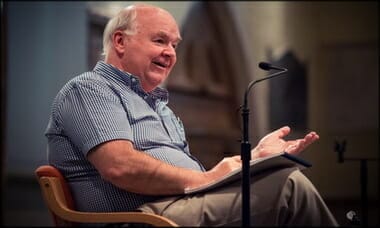
The larger, original file, can be found here and is well worth the watch if this subject intrigues you. I wanted to isolate how Denis Noble defines “what a gene is”? To wit, a great question starts out the above video — and as science advances, the neo-Darwinian model weakens immensely. See Dr. Noble’s lecture on this:
I do wish to add that biology… our physiology really, is also made via influences on the quantum level. ALL THIS is to say that the simplistic view of “gene to organism” is a lagging theory NOT based in current science… AND, it makes the irreducible complexity issue worse for the naturalist. For further reading on the newer field of “quantum biology,” see my post HERE. May I also note that my professor of apologetics WAAAY back in 2007 was noting this in his class. I bemoaned him then, but “bow down” to his foresight now.
One of the reasons I am a bibliophile and love to follow references given in one book with the purchase of the referenced book is many of the same quotes used by multiple authors on a subject do not give the full weight and gravity of the larger quote. I will give you an example. In J.P. Moreland’s work from 1987, “Scaling the Secular City: A Defense of Christianity,” he quotes Huw Parri Owen’s work, Christian Theism. In a more voluminous work, he and William Lane Craig use the same quote:
Determinism is self-stultifying. If my mental processes are totally determined, I am totally determined either to accept or to reject determinism. But if the sole reason for my believing or not believing X is that I am causally determined to believe it I have no ground for holding that my judgment is true or false.
J.P. Moreland and William Lane Craig, Philosophical Foundations for a Christian Worldview (Downers Grove, IL: IVP Academic, 2003) 241.
A great quote for sure.
I was finally able to get a good bound copy for a VERY reasonable price (previously when I looked for a copy, they were very expensive). While this book will enter my hopper to be read in full, I read the chapter the quote came from, and loved this larger quote from the section… and it deals with the self-stultifying aspect of Marx and Freud. I will add another quote by an excellent authot=r that does much the same, but first here is H.P. Owen’s larger reference:
If determinism were true how could the illusion of free will arise? If we are wholly determined why are we not conscious of being so? These questions gain additional force from the fact that we feel ourselves able to resist those very forces by which according to determinism our actions are invariably caused. The sense of free will cannot be plausibly attributed to “wish-fulfilment”. Admittedly it may seem desirable in so far as it raises us above physical nature. Yet is also imposes on us an existential burden together with a burden of guilt on those occasions when we have misused our freedom of choice.
Determinism is incompatible with a great deal of our moral language. In particular it is incompatible with the concepts of obligation and moral responsibility. I cannot be obliged to do X unless I am free to do it simply because it is my duty and not because I am determined by other factors. Of course obligation is itself a determining factor in so far as it is a form of constraint. However the constraint is a unique one; and a sign of its uniqueness is that it leaves a person free either to accept or to reject it. Equally I cannot be morally responsible for an action that I was compelled to perform even if the compulsion proceeds from my own nature and so is an act of self-determination. And if I am not responsible for an action I cannot be blamed for it.
Chiefly, however, determinism is self-stultifying. If my mental processes are totally determined, I am totally determined either to accept or to reject determinism. But if the sole reason for my believing or not believing X is that I am causally determined to believe it I have no ground for holding that my judgment is true or false. J. R. Lucas has put the point cogently with reference to Marxist and Freudian forms of determinism thus. ‘The Marxist who says that all ideologies have no independent validity and merely reflect the class interests of those who hold them can be told that in that case his Marxist views merely express the economic interests of his class, and have no more claim to be judged true or valid than any other view. So too the Freudian, if he makes out that everybody else’s philosophy is merely the consequence of childhood experiences, is, by parity of reasoning, revealing merely his delayed response to what happened to him when he was a child.’ Lucas then makes the same point with regard to a person who maintains, more generally, that our behaviour is totally determined by heredity and environment. “If what he says is true, he says it merely as the result of his heredity and environment, and of nothing else. He does not hold his determinist views because they are true, but because he has such-and-such a genetic make-up, and has received such-and-such stimuli; that is, not because the structure of the universe is such-and-such but only because the configuration of only one part of the universe, together with the structure of the determinist’s brain, is such as to produce that result.”
The exact force of this criticism is sometimes missed. Certainly on deterministic premisses determinism may be true. But we should not have any grounds for affirming that it is true or therefore for knowing that it is so. In order to obtain these grounds we must be free from all determining factors in order to assess the evidence according to its own worth. This principle applies to the assessment of all truth-claims (including those of Christianity). Freedom from determining factors is therefore required in the cognitive as much as in the moral sphere.
Huw Parri Owen, Christian Theism: A Study in its Basic Principles (Edinburgh, London: T & T Clark, 1984), 118-119.
Here is a smaller section from Dr. Roy Clouser critiquing Freudian determinism as well as throwing a stone in Taoism’s shoe:
…As an example of the strong sense of this incoherency, take the claim sometimes made by Taoists that “Nothing can be said of the Tao.” Taken without qualification (which is not the way it is intended), this is self-referentially incoherent since to say “Nothing can be said of the Tao” is to say something of the Tao. Thus, when taken in reference to itself, the statement cancels its own truth. As an example of the weak version of self-referential incoherency, take the claim once made by Freud that every belief is a product of the believer’s unconscious emotional needs. If this claim were true, it would have to be true of itself since it is a belief of Freud’s. It therefore requires itself to be nothing more than the product of Freud’s unconscious emotional needs. This would not necessarily make the claim false, but it would mean that even if it were true neither Freud nor anyone else could ever know that it is. The most it would allow anyone to say is that he or she couldn’t help but believe it. The next criterion says that a theory must not be incompatible with any belief we have to assume for the theory to be true. I will call a theory that violates this rule “self-assumptively incoherent.” As an example of this incoherence, consider the claim made by some philosophers that all things are exclusively physical [atheistic-naturalism]. This has been explained by its advocates to mean that nothing has any property or is governed by any law that is not a physical property or a physical law. But the very sentence expressing this claim, the sentence “All things are exclusively physical,” must be assumed to possess a linguistic meaning. This is not a physical property, but unless the sentence had it, it would not be a sentence; it would be nothing but physical sounds or marks that would not) linguistically signify any meaning whatever and thus could not express any claim — just as a group of pebbles, or clouds, or leaves, fails to signify any meaning or express any claim. Moreover, to assert this exclusivist materialism is the same as claiming it is true, which is another nonphysical property; and the claim that it is true further assumes that its denial would have to be false, which is a relation guaranteed by logical, not physical, laws. (Indeed, any theory which denies the existence of logical laws is instantly and irredeemably self-assumptively incoherent since that very denial is proposed as true in a way that logically excludes its being false.) What this shows is that the claim “All things are exclusively physical” must itself be assumed to have nonphysical properties and be governed by nonphysical laws or it could neither be understood nor be true. Thus, no matter how clever the supporting arguments for this claim may seem, the claim itself is incompatible with assumptions that are required for it to be true. It is therefore self-assumptively incoherent in the strong sense…
Roy A. Clouser, The Myth of Religious Neutrality: An Essay on the Hidden Role of Religious Belief in Theories (Notre Dame, IN: Notre Dame Press, 2005), 84-85.
Faith Goldy of TheRebel.media reports: After my investigation into reports that migrant children in Nova Scotia were bullying other students, TheRebel.media set up a tip line — tips@therebel.media (also http://www.therebel.media/tips) — for parents whose children were also being bullied.
Using that tip line, a New Brunswick parents says there are migrant “children” at her child’s school as old as 22. These adult males “with full beards” are “hitting on the 14-15 year old girls.”
TheRebel.media filed a freedom of information request to get to the bottom of this — and over 2000 documents came in, and more are on the way. Emails between teachers reveal what’s going on in their classrooms, and what they say will shock you.
On Thursday, I’ll present my full report, but throughout the week, more previews like this one will be posted. MORE: http://www.therebel.media/faithgoldy
The Argument from Silence… known as an “informal fallacy,” or, the argument from ignorance. Great video… I especially like the portion from 2:53 – to – 4:26:
Why do no other ancient sources mention things only in the Bible? Can we trust the Bible even though there is so much silence from the ancient world? This video addresses this issue.
THE BLAZE reports on this incident that could have turned into a mass shooting:
Police said Jody Ray Thompson pulled out a gun during an argument in front of the Playoffz nightclub in Lyman, South Carolina, early Sunday morning and fired at a gathered crowd, hitting three people.
Spartanburg County Sheriff’s deputies told WHNS-TV Thompson almost hit a fourth person — who just so happens to be a concealed carry permit holder.
Lt. Kevin Bobo said that the man pulled out his own gun in self defense and fired back at Thompson, hitting him in the leg.
The concealed carry permit holder, who hasn’t been named, cooperated with investigators and won’t be facing any charges stemming from the 3:30 a.m. incident, WHNS reported…
Other shooting that could have turned into a “mass shooting” but didn’t because of an armed citizen are these (there are many more, but this is good enough for the point):
Nigel Farage told fellow MEPs “you’re not laughing now” as he was barracked and booed at an emergency meeting of the European Parliament to discuss Brexit. The Ukip leader accused them of being “in denial” about the euro crisis, immigration and the imposition “by stealth, by deception, without ever telling the truth” of a political union.
Thank You NewsBusters! Christiane Amanpour looked so indignant throughout the “interview. Her “elitist” viewpoint was swelling up… the only problem was that Daniel Hanna had the facts, Amanpour was repeating leftist/activist talking points.
CNN’s Christiane Amanpour took her left-leaning, pro-European Union activism to a new level on Tuesday during an interview of pro-Brexit politician Daniel Hannan. Amanpour, who recently blasted the referendum as an example of “xenophobia“, tried to implicate the British member of the European Parliament as somehow partially responsible for supposed post-vote “hate crimes.” Hannan didn’t take her clear bias sitting down, however: “You guys have been shouting ‘racist’ so long, you’re not listening to what we were actually saying…if I was relying on CNN…I would think that this was nativist vote, a protectionist vote. It’s the opposite.” [video below]
The anchor began her unprofessional interrogation of the Brexit supporter by accusing the guest and his allies of not having a plan after the vote: “The question is being asked, what is the plan? And we’re not hearing it from the main Brexit leaders.” Hannan answered, in part, by noting that “48 percent of British people voted for no change….And so, we may have to temper what we’re doing, and go for a more gradual and more phased repatriation of power, while leaving some of the existing stuff in place.”…
This is an interesting excerpt about the history of music and why it flourished in the West and not elsewhere… similar to science. It is a bit incomplete as he spoke a little more on Kurt Cobain prior to where I start, and after he gets into Bach and other classical artists influenced by the Bible.
Vishal Mangalwadi, The Book that Made Your World: How the Bible Created the Soul of Western Civilization (Nashville, TN: Thomas Nelson Publishers, 2011), 9-15.
….Cobain’s music appealed to contemporary America because it was a full-throttled disharmony of rage, anguish, hatred, despair, meaninglessness, and obscenity. His song titles included “I Hate Myself, I Want to Die” and “Rape Me” (later changed to “Waite Me”). Most of what Cobain sang cannot be deciphered, and many of his lyrics that can be deciphered have no apparent meaning. Whether he knew it or not, his lyrics were Zen koans, counter-rational sayings such as “what is the sound of one hand clapping?” Such words do not make sense because (in the absence of revelation) reality itself makes no sense. Words are merely mantras—sounds without sense—to be chanted or shouted.
Cobain committed suicide because Nothingness as the ultimate reality does nothing positive. It cannot provide joy to the world, let alone meaning or hope for the mess in one’s life. Its only consequence is to inspire people to seek an exit from the world—Nirvana. A culture of music does not flourish in the soil of nihilism. Cobain’s gift as a musician blossomed because he had inherited a unique tradition of music.
Music seems a natural, perhaps even essential, part of life to the Western mind because it has been an integral part of traditional worship and education. For example, Oxford and Cambridge universities have played pivotal roles in shaping the second millennium. However, a person who has never visited these cities may not know that they are cities of churches and chapels. The chapel is the most important building in traditional colleges and a pipe organ is often the centerpiece of a chapel. That is not the case in every culture.
Turkmenistan is the latest country to put restrictions on music: on state holidays, in broadcasts by television channels, at cultural events organized by the state, in places of mass assembly, and at weddings and celebrations organized by the public. Nations such as Saudi Arabia have had restrictions on music for a long time. In Iran and Afghanistan, women cannot sing on the radio, let alone on television or in person before mixed audiences. In post-Saddam Iraq, radical Muslims have assassinated sellers of music CDs. Mosques do not have keyboards, organs, pianos, orchestras, or worship bands because according to traditional Islam, music is haraam or illegitimate.
These cultures see Western music as inextricably mixed with immoral debauchery. For them, musicians such as Kurt Cobain are undesirable role models. Indeed, on the cover of his album Nevermind, Buddhist monks in Asia developed sophisticated philosophies, psychology, rituals, and psycho-technologies to try to escape life and its sufferings. They perfected techniques such as Vipasana* to silence not just their tongues but also their thoughts. Buddhism originated in India and prior to its disappearance enjoyed powerful political patronage for centuries. It built such massive monasteries that Buddhist art is a cherished aspect of our national heritage. Yet, Buddhism left no discernible musical tradition or instrument in India. No Buddhist monk started a band such as Nirvana, because in Buddhism salvation is not a heaven filled with music. As a pessimistic philosophy of silence it could not produce music of hope and joy. Buddhism could not celebrate existence because it saw suffering as the essence of life. Some forms of modern Buddhism have embraced music, partially because of the efforts of Western converts, such as Kurt Cobain, who grafted the Western tradition of religious music into the Buddhist faith.
To say that music is a new phenomenon in Buddhist temples is not to suggest that pre-Buddhist Tibet or China had no music. Music is intrinsic to the universe and to human nature even if some worldviews, including Darwinism, do not understand, recognize, or promote it. China’s fertility cults and sexual rites involved choirs of boys and girls singing alternately and together to symbolize Yin and Yang dualism as early as 2000 BC. A thousand years prior to that, the worshippers in Sumero-Mesapotamia used music in their temple rituals.
The musical ragas of Hindu magical rituals have survived for thirty-five hundred years. Most of the Vedas are hymns and chants. The Vedic priests understood sound as well as anyone else in the world and developed a highly complex system of chanting, even if Hindu monks and priests did not develop music into the complex medium that Western music became. Thankfully this is changing now. Bollywood has played a great role in inspiring some Hindu ashrams to develop great music. It has also raised the standard of Qawwali, which began as a part of Sufi tradition: but is now loved by Hindus as well as by Muslims—including in Pakistan.
WRITING MUSIC INTO THE WEST’S DNA
St. Augustine, the author of the six-volume On Music, was a key figure in inserting music into Western education and worldview. His first five volumes are technical and could have been written by a Greek philosopher. But Augustine was most excited about his sixth book, which gives a biblical philosophy of music. Music is, of course, integral to the Bible, in which the longest book is Psalms. The last psalm, for example, asks creation to praise the Lord with the trumpet, lute, harp, tambourine, strings, pipe, and cymbals.
Why are these physical instruments able to make music? Augustine saw that the scientific basis or essence of music lies in mathematical “numbers” or scores at the core of creation. Since music is mathematical, Augustine argued, it must be rational, eternal, unchangeable, meaningful, and objective—it consists of mathematical harmony. We cannot make a musical sound from just any string. To get a precise note, a string has to have a specific length, thickness, and tension. This implies that the Creator has encoded music into the structure of the universe. This insight was not new. It had been noted by Pythagoras (570-490 BC), whose school Plato attended before starting his Academy.
Augustine promoted this “pagan” insight because the Bible presented a view of creation that explained why matter could make music.
Augustine taught that while this musical code is “bodily” (physical), it is made and enjoyed by the soul. For example, the book of Job deals with the problem of inexplicable suffering. In it God himself tells Job of the connection between music and creation: “Where were you when I laid the foundation of the earth? . . . when the morning stars sang together and all the sons of God shouted for joy?”
The Bible taught that a sovereign Creator (rather than a pantheon of deities with conflicting agendas) governs the universe for his glory. He is powerful enough to save men like Job from their troubles. This teaching helped develop the Western belief of a cosmos: an orderly universe where every tension and conflict will ultimately be resolved, just as after a period of inexplicable suffering Job was greatly blessed.
This belief in the Creator as a compassionate Savior became an underlying factor of the West’s classical music and its tradition of tension and resolution. Up until the end of the nineteenth century, Western musicians shared their civilization’s assumption that the universe was cosmos rather than chaos. They composed consonance and concord even when they experienced dissonance and discord. That is not to suggest that classical music did not express the full range of human emotions. It did. A bereaved composer would write a tragic piece; someone abandoned by his love would express his desolation. But such outpourings of a broken heart were understood as snapshots of real life. Given the cultural power of the biblical worldview, no one thought of them as Kurt Cobain did, as evidence of the breakdown of cosmic order or the nonexistence of order in the universe.
In the novel The Silmarillion, J. R. R. Tolkien gives us a beautiful, fictional exposition of the Augustinian perspective on the relationship of music, creation, the fall (evil), and redemption. Tolkien’s Middle-earth experienced much more suffering than the Buddha’s India. Tolkien’s “earth” was to be captured, corrupted, and virtually controlled by evil. Suffering was real, brutal, and awful. Yet the Bible taught Tolkien that the Almighty Creator, who was also a compassionate Redeemer, was loving enough and powerful enough to redeem the earth from the greatest possible mess, sin, and suffering. This helped Tolkien to celebrate creation, both in its origin as well as in its ultimate destiny:
There was Eru, the One, who in Arda is called Iluvatar; and he made first the Ainur, the Holy Ones, that were the offspring of his thought, and they were with him before aught else was made. And he spoke to them, propounding to them themes of music; and they sang before him, and he was glad. But for long while they sang only each alone, or but few together, while the rest hearkened; for each comprehended only part of the mind of Iluvatar from which he came, and in the understanding of their brethren they grew but slowly. Yet ever as they listened they came to deeper understanding, and increased in unison and harmony. . . .
Then Iluvatar said to them: “Of the theme that I have declared to you, I will now that ye make in harmony together a Great Music.”
Then the voices of the Ainur, like unto harps and lutes, and pipes and trumpets, and viols and organs, and like unto countless choirs singing with words, began to fashion the theme of a great music; and a sound arose of endless interchanging melodies woven in harmony that passed beyond hearing into the depths and into the heights, and the places of the dwelling of Iluvatar were filled to overflowing, and the music and the echo of the music went out into the Void, and it was not void.
Prior to becoming a follower of Christ, Augustine had been a professor of Greek philosophy. He knew that although music was encoded into the structure of the physical universe, being finite, it could never provide ultimate meaning to life.** Therefore, he reasoned that to be meaningful, music had to be integrated into the ultimate aim of human life, which was to love God and one’s neighbors. To love one’s neighbor is to “always mind” his welfare.
Over the centuries, the influence of Augustine’s biblical philosophy of music kept growing. Originally, church music was dominated by monophonic plainsong, a single line of melody as in the Gregorian chant. Roman Catholic churches began to develop polyphonic music. This style, which combines several differing voice parts simultaneously, began to flourish at Notre Dame (Paris) by the eleventh century. That development in Christian worship laid the foundation for the entire spectrum of Western classical music, religious and secular.***
In the tenth century AD, Augustine’s biblical philosophy of music inspired a group of Benedictine monks to build the world’s largest pipe organ in the cathedral of Winchester, England. The organ required seventy men and twenty-six bellows to supply wind to its four hundred pipes. Technologically, the pipe organ was the world’s most advanced machine until the invention of the mechanical clock. Europe’s organs stood as emblems of the West’s unique desire and ability to use the arts, science, and technology for the glory of God as well as for the relief of humanity’s suffering and toil.
Augustine’s biblical philosophy of music was an important tributary that contributed to the river of mechanical arts that began to flow out of Christian monasteries and churches. This tradition used technology to worship God and to love one’s neighbors.
* Yoga attempts to control breathing in its quest to realize self. Vipasana observes breathing as a means of silencing one’s mind to experience that there is no self or soul inside us but only Nothingness, Emptiness, Void, Shoonyta or Selflessness.
** Augustine’s intellectual mentor, Plato, believed that epistemologically no finite particular can make sense without an infinite reference point.
*** Augustine did not have much influence over the Eastern Church and that may be one reason why its music did not develop much beyond the chant.
C.S. Lewis: It must be understood that my conversion at that point was only to theism pure and simple. I knew nothing yet about the incarnation. The God to whom I surrendered was sheerly non-human.
C.S. Lewis: [Reading from Chesterton] A great man knows he is not God and the greater he is, the better he knows it. The gospels declare that this mysterious maker of the world has visited his world in person. The most that any religious prophet has said was that he was the true servant of such a being. But if the creator was present in the daily life of the Roman empire, that is something unlike anything else in nature. It is the one great startling statement that man has made since he spoke his first articulate word. It makes dust and nonsense of comparative religion.
C.S. Lewis: As I drew near to Christianity, I felt a resistance almost as strong as my previous resistance to theism. As strong but shorter lived for I understood it better. But each step, one had less chance to call one’s soul one’s own.
C.S. Lewis: What Tolkien showed me was this — that if I met the idea of sacrifice in a pagan story I didn’t mind it at all — I was mysteriously moved by it. The reason was that in pagan stories I was prepared to feel the myth as profound. Now the story of Christ is simply a true myth.
C.S. Lewis: I know very well when but hardly how the final step was taken. I went with my brother to have a picnic at Whipsnade Zoo. We started in fog, but by the end of our journey the sun was shining. When we set out I did not believe that Jesus Christ is the Son of God and when we reached the zoo I did. I had not exactly spent the journey in thought. Nor in great emotion. It was more like when a man, after a long sleep, becomes aware that he is now awake.