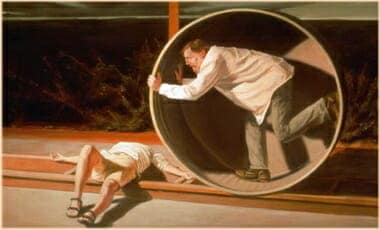
For He says to Moses, “I will have mercy on whomever I will have mercy, and I will have compassion on whomever I will have compassion.”
Dr. Leighton Flowers confronts Dr. James White’s faulty critique of Dr. William Lane Craig (and other non-Calvinists).
This is a condensed critique. To see the longer video going through each of Dr. White’s points go here: • What about those who never hear about Jesus?
Often we hear the objection that God is not obligated to have mercy on anyone. That’s true. However, the fact that God is not obligated to be merciful towards all people is what makes the display of His mercy to all people so amazingly gracious and abundantly glorious. That God does what He is not obligated to do for no other reason than He desires to be merciful to all is glorious.
Anyone suggesting this display of mercy isn’t genuine (or that’s it’s just an outward/external “prescriptive” will of God, but that His real secret desire is only to show mercy to a preselected few) is diminishing the abundance of His mercy and the glory of His grace extended to every person.
Also, I think sometimes there is an assumption that mercy is weakness. But that could not be further from the truth. Mercy can only be handed down by someone in a place of judgement over another. If it is not within my power to pass condemnation on someone, then it is also not within my power to have mercy on them. Mercy is an expression of power, not of weakness.
“The Lord is gracious and compassionate, slow to anger and rich in love. The Lord is good to all; he has compassion on all he has made.” -Ps 145:8-9
“For God has bound everyone over to disobedience so that he may have mercy on them all.” -Rom 11:32
V. WHY GOD IS JUST IN SHOWING MERCY TO UNFAITHFUL ISRAELITES TO ACCOMPLISH HIS PROMISE IN BRINGING THE WORD (14-16)
Does God’s choosing to bless one descendant over another descendant make God unrighteous? What shall we say then? Is there unrighteousness with God? Certainly not!
The descendants of Abraham in Paul’s day had two false perceptions:
Every descendant deserves the benefit of bringing God’s Word. However, the truth is that God has only selected a remnant through whom to bring His Word.
Every descendant deserves eternal life on the basis of their being of Israel. However, no one is saved based on nationality but only upon grace through faith. Those nations, and the individuals therein, who oppose God’s Word remain under the curse (hatred), as illustrated by Edom (direct descendants of Isaac himself).
There is no unrighteousness with God for choosing some descendants for a noble cause and not others, nor is it unjust to condemn a descendant of Abraham who stands in opposition to the Word of God.
For He says to Moses, “I will have mercy on whomever I will have mercy, and I will have compassion on whomever I will have compassion.”
Paul’s reference to Moses’ encounter with God in Exodus 32-33 gives a perfect historical example of when God was merciful to Israel when they deserved to be destroyed for their unfaithfulness (worshipping a golden calf).
This example also parallels Moses’ self-sacrificial Christ-like love for Israel as reflected by Paul in the opening verses of this chapter… “forgive their sin—and if not blot me out…” (Ex. 32:31-32).
Certainly God may choose to save whosoever He is pleased to save (scripture teaches He chooses to save those who humble themselves and repent in faith – 1 Pt. 5:5-6), but this passage is in reference to God showing mercy to unfaithful Israel so as to fulfill His original promise through them even though they deserve condemnation.
So then it is not of him who wills, nor of him who runs, but of God who shows mercy.
“It” refers to the fulfillment of God’s promise to bring His Word despite Israel’s unfaithfulness (Rom. 3:3-4).
The promise depends on our merciful God, not on the faithfulness (“willing and running”) of Abraham or his descendants.
Abraham “willed and ran” in the flesh to produce a son through Hagar (who Paul used symbolically to represent the covenant of law and works, Gal. 4:24).
God, by his mercy, provided Isaac through the free woman, Sarah (who Paul used symbolically to represent the covenant of grace by faith in the call of God, Gal. 4:21-26).
VI. WHY GOD IS JUST TO HARDEN UNFAITHFUL ISRAELITES TO ACCOMPLISH HIS PROMISE IN BRINGING THE WORD (17-18)
For the Scripture says to Pharaoh, “For this very purpose I have raised you up, that I may show My power in you, and that My name may be declared in all the earth.”
In the same way God hardened the already rebellious will of Pharaoh in order to accomplish the first Passover, so too God hardened the already rebellious wills of Israelites to accomplish the real Passover.
God’s power and goodness was displayed in mercy-ing unfaithful Israelites in the day of Moses and in hardening the unfaithful Israelites in the day of the Messiah.
Therefore He has mercy on whom He wills, and whom He wills He hardens.
Sometimes God will fulfill His promises by showing Israelites mercy, but His Word will never fail.
Sometimes God will fulfill His promises by hardening Israelites, but His Word will never fail.
Note: Those judicially hardened or cut off are not born in this condition, but have “grown hardened” over years of rebellion (Acts 28:27), they are cut off for unbelief (11:20) and the hope of the apostle is that they may be grafted back in and saved (11:11-32).
VII. IF THE ISRAELITES’ UNRIGHTEOUSNESS ACCOMPLISHES GOD’S PROMISE TO BRING HIS WORD, WHY ARE THEY TO BLAME? (19-21)
“You will say to me then, “Why does He still find fault? For who has resisted His will? But indeed, O man, who are you to reply against God?”
You (an Israelite hardened to accomplish God’s promise) will say to me (an Israelite shown mercy to accomplish God’s promise), why are we to blame if God’s will is being fulfilled?
As the apostle already indicated in 3:5, this is a man-made argument that reveals a heart that has become calloused in its rebellion, otherwise they might see, hear, understand and repent (Acts 17:30; 28:27).
“Will the thing formed say to him who formed it, “Why have you made me like this?” Does not the potter have power over the clay, from the same lump to make one vessel for honor and another for dishonor?”
The lump of hardened clay represents Israel who is had grown calloused in rebellion (Acts 28:27) and who are now being remolded into two kinds of vessels:
Those unfaithful Israelites remolded, by means of signs from the incarnate Messiah Himself, to bring the Word.
Those unfaithful Israelites remolded, by means of judicially hardening, to accomplish the ignoble purpose of bringing redemption on the cross and the grafting in of the Gentiles (yet they still may be saved, Rom. 11:11-32).
Romans 9 explained. This video is very relevant in today’s world as we see believers departing from the faith while only the chosen ones will be able to stand by God and God will also provide and have mercey on them. God is able to raise leaders and kings so His Name is exalted among the nations. just like He did with the Pharaoh.
Romans 9:21-23 says, “Has the potter no right over the clay, to make out of the same lump one vessel for honorable use and another for dishonorable use? What if God, desiring to show his wrath and to make known his power, has endured with much patience vessels of wrath prepared for destruction, in order to make known the riches of his glory for vessels of mercy, which he has prepared beforehand for glory…”
RC Sproul, a notable Calvinist, interprets this to mean that God creates some people for salvation and the rest for damnation, but is that what the Apostle Paul really had in mind? Let’s explore!
A definition from that fits Calvinism via the Stanford Encyclopedia of Philosophy and the current understanding of reformed theologies …. “Reformed” theologies:
I hate using “Reformed” because many Reformers (like Philip Melanchthon and Balthasar Hubmaier as some examples) thought differently than the “Pipers,” MacArthur’s,” and “Calvins” of their time and today. So Calvinism is a better term: John MacArthur was a “Calvinist Baptist,” not a “Reformed Baptist.” Understand the difference with a distinction? — RPT
Fatalism is the thesis that human acts occur by necessity and hence are unfree. Theological fatalism is the thesis that infallible foreknowledge of a human act makes the act necessary and hence unfree. If there is a being who knows the entire future infallibly, then no human act is free.
Fatalism seems to be entailed by infallible foreknowledge by the following informal line of reasoning:
For any future act you will perform, if some being infallibly believed in the past that the act would occur, there is nothing you can do now about the fact that he believed what he believed since nobody has any control over past events; nor can you make him mistaken in his belief, given that he is infallible. Therefore, there is nothing you can do now about the fact that he believed in a way that cannot be mistaken that you would do what you will do. But if so, you cannot do otherwise than what he believed you would do. And if you cannot do otherwise, you will not perform the act freely.
The same argument can be applied to any infallibly foreknown act of any human being. If there is a being who infallibly knows everything that will happen in the future, no human being has any control over the future.
This theological fatalist argument creates a dilemma for anyone who thinks it important to maintain both (1) there is a deity who infallibly knows the entire future, and (2) human beings have free will in the strong sense usually called libertarian. But it has also fascinated many who have not shared either of these commitments, because taking the argument’s full measure requires rethinking some of the most fundamental questions in philosophy, especially ones concerning time, truth, and modality. Those philosophers who think there is a way to consistently maintain both (1) and (2) are called compatibilists about infallible foreknowledge and human free will. Compatibilists must either identify a false premise in the argument for theological fatalism or show that the conclusion does not follow from the premises.
Another recent example that came across my desk (earbuds at work). Dr. Theodore Zachariades stating that God wills [causes, not just permits] a man to be unfaithful to his wife in his comment on becoming a Calvinist via Ephesians 1.
God works all things after the Council of His will. Even keeping those kings who want to commit adultery from committing so! And when He wants to, he orders those to commit adultery when he wants to! (Video)
Now that that is out of the way, on to the videos… I isolated the Piper quote from the video that follows it:
QUESTION: Has God predetermined every tiny detail in the universe, such as dust particles in the air? And then I should add here, including all our besetting sins.
PIPER RESPONDS: Yes, which means yes, every horrible thing and every sinful thing is ultimately governed by God and. That’s a problem, but the center of the solution to the problem is a choice. You have to make about the cross
(BTW, more on Piper can be found in this excellent journal article title (PDF), “I Believe In Divine Sovereignty,” by Thomas H. McCall)
Here are some of the comments on the original SOTERIOLOGY 101 video on their YouTube Channel [below]:
God determines every single thing even dust but you have to make the decision about the cross What????
So Calvinism teaches , “God commands you to obey, but has SECRETLY predestined you to DISOBEY, so He can burn you forever because you were a reprobate ‘before you were born, or had done anything either good or bad’.”
Piper who doesn’t believe in free will choice says “the solution to the problem is a CHOICE you have to make about a cross” 😂😂 how anyone can listen to this incoherent nonsense I’ll never know.
Piper: ” the center of the solution is a choice YOU have to make about the cross”? Does he mean I make a choice? Or God determines what choice I make??
If God is determining what man wants to do then also blinding and hardening doesn’t Jesus refute that reasoning when talking about how a kingdom divided against itself cannot stand? Matt. 12:25,26
Piper didn’t look like he wholeheartedly believed what he was saying.
Dr. Leighton Flowers, Director of Evangelism and Apologetics for Texas Baptists, confronts the Calvinist’s appeal to the Crucifixion as their proof that God predetermines all moral evil, specifically playing off John Piper’s use of Acts 4:27-28 as justification for his deterministic interpretation of the Bible.
…When we object to the concept of divine determinism (God’s sovereign work to bring about all things whatsoever that come to pass) and you appeal to the crucifixion as your proof that God brings about all moral evil, are you saying that God is sovereignly working so as to redeem the very sins He sovereignly worked to bring about? Is Calvary just about God cleaning up His own mess — redeeming His own determinations?
Appealing to God’s sovereign work to ensure the redemption of sin so as to prove that God sovereignly works to bring about all the sin that was redeemed is a self-defeating argument. It would be tantamount to arguing that because a police department set up a sting operation to catch a notorious drug dealer, that the police department is responsible for every single intention and action of all drug dealers at all times. Proof that the police department worked in secretive ways to hide their identities, use evil intentions, and work out the circumstances in such a way that the drug dealer would do what they wanted him to do (sell drugs) at that particular moment in time does not suggest that the police are in anyway responsible for all that drug dealer has done or ever will do. We celebrate and reward the actions of this police department because they are working to stop the drug activity, not because they are secretly causing all of it so as to stop some of it. Teaching that God brings about all sin based on how He brought about Calvary is like teaching that the police officer brings about every drug deal based on how he brought about one sting operation.
Yes, at times the scriptures do speak of God “hardening” men’s hearts (Ex. 7; Rm. 9), blinding them with a “spirit of stupor” (Rm. 11:8) and delaying their healing by use of parabolic language (Mk. 4:11-12, 34; Matt. 16:20), and He always does so for a redemptive good. But the reason such passages stand out so distinctly from the rest of scripture is because of their uniqueness. If God worked this way in every instance these texts would make no sense. After all, what is there for God to harden, provoke, or restrain if not the autonomous will of creatures?
If everything is under the meticulous control of God’s sovereign work what is left to permit and/or restrain except that which He is already controlling? Is God merely restraining something that He previously determined? Why blind eyes from seeing something the were “naturally” predetermined not to see? Why put a parabolic blind fold on a corpse-like dead sinner incapable of seeing spiritual truth? These are questions many Calvinists seem unwilling to entertain at any depth.
Dr. Leighton Flowers welcomes back Dr. Ken Wilson to defend his Oxford Thesis from over 15 hours of mostly fallacious and unfounded attacks by Dr. James White of Alpha and Omega Ministries.
The Common Misconceptions in this Debate So Far:
Wilson’s argument rests on Manicheanism and Augustinianism being the same worldview: This is untrue. It is not at all unreasonable to suggest that just one aspect of Manicheanism (i.e. its adherence to theistic determinism) might have influenced Augustine’s interpretation of the scripture.
Wilson is saying Augustinianism is untrue because of its similarities with Manicheanism: This is inaccurate. It is possible for false worldviews to adhere to some aspects of truth, therefore proving that Calvinism has some link to Manicheanism doesn’t prove Calvinism is false. Wilson is saying Augustinianism is not rooted or founded in the early church writings therefore it most likely originated from other gnostic, neoplatonic and Manichean roots, which brings into question its validity as the correct interpretive grid.
Wilson is arguing Augustinianism imports Manicheanism into Christianity because it uses similar words: This is also untrue. Just because Mani spoke of “the elect” and Calvinists also emphasize “the elect” does not mean they are necessarily linked, or even have the same definitions. Wilson is not attempting to argue that all aspects or jargon of the Manichean worldview are linked to the all aspects or jargon within the Calvinistic worldview. Wilson is only looking at the one common point of connection, namely deterministic philosophy, which was first introduced by Augustine, a former Manichean.
James White’s criticism has accurately portrayed Wilson’s arguments and showed Wilson’s bias: This is demonstrably untrue as will be shown in this video and in many of the articles posted at www.soteriology101.com.
If it can be proven that Wilson held to preconception of the ECFs and Augustine’s beliefs before doing his research, then his subsequent research is invalid: Again this is false. Even if it could be proven beyond all reasonable doubt that Wilson firmly believed the ECFs denied TULIP theology and that Augustine was the first to introduce it, this does not make his findings invalid. One would still need to demonstrate that Wilson’s bias lead to poor research.
Here are quotes from Reformed historians who validate the foundational claims of Wilson’s work:
Herman Bavinck:
In the early church, at a time when it had to contend with pagan fatalism and gnostic naturalism, its representatives focused exclusively on the moral nature, freedom, and responsibility of humans and could not do justice, therefore, to the teaching of Scripture concerning the counsel of God. Though humans had been more or less corrupted by sin, they remained free and were able to accept the proffered grace of God. The church’s teaching did not include a doctrine of absolute predestination and irresistible grace.
Loraine Boettner:
“It may occasion some surprise to discover that the doctrine of Predestination was not made a matter of special study until near the end of the fourth century….They of course taught that salvation was through Christ; yet they assumed that man had full power to accept or reject the gospel. Some of their writings contain passages in which the sovereignty of God is recognized; yet along side of those are others which teach the absolute freedom of the human will. Since they could not reconcile the two they would have denied the doctrine of Predestination… They taught a kind of synergism in which there was a co-operation between grace and free … this cardinal truth of Christianity was first clearly seen by Augustine…“
Robert Peterson and Michael Williams of Covenant Theological Seminary:
“The Semi-Pelagians were convinced that Augustine’s monergistic emphasis upon salvation by grace alone represented a significant departure from the traditional teaching of the church. And a survey of the thought of the apostolic father’s shows that the argument is valid… In comparison to Augustine’s monergistic doctrine of grace, the teachings of the apostolic fathers tended toward a synergistic view of redemption” (36).
Louis Berkhof [in The History of Christian Doctrines]:
“Their representations are naturally rather indefinite, imperfect, and incomplete, and sometimes even erroneous and self-contradictory. Says Kahnis: “It stands as an assured fact, a fact knowing no exceptions, and acknowledged by all well versed in the matter, that all of the pre-Augustinian Fathers taught that in the appropriation of salvation there is a co-working of freedom and grace.”
Berkhof goes on to admit that “they do not hold to an entire corruption of the human will, and consequently adhere to the synergistic theory of regeneration…” (130).
In other words, despite White’s assertions to the contrary, there were no “monergists” before Augustine.
An additional — fuller quote of Loraine Boettner from above:
“It may occasion some surprise to discover that the doctrine of Predestination was not made a matter of special study until near the end of the fourth century. The earlier church fathers placed chief emphasis on good works such as faith, repentance, almsgiving, prayers, submission to baptism, etc., as the basis of salvation. They of course taught that salvation was through Christ; yet they assumed that man had full power to accept or reject the Gospel. Some of their writings contain passages in which the sovereignty of God is recognized; yet along side of those are others which teach the absolute freedom of the human will. Since they could not reconcile the two they would have denied the doctrine of Predestination and perhaps also that of God’s absolute Foreknowledge. They taught a kind of synergism in which there was a co-operation between grace and free will. It was hard for man to give up the idea that he could work out his own salvation. But at last, as a result of a long, slow process, he came to the great truth that salvation is a sovereign gift which has been bestowed irrespective of merit; that it was fixed in eternity; and that God is the author in all of its stages. This cardinal truth of Christianity was first clearly seen by Augustine, the great Spirit-filled theologian of the West. In his doctrines of sin and grace, he went far beyond the earlier theologians, taught an unconditional election of grace, and restricted the purposes of redemption to the definite circle of the elect.” — from Loraine Boettner’s “Calvinism in History”
Early Christian authors unanimously taught relational divine eternal predetermination. God elected persons to salvation based upon foreknowledge of their faith (predestination). These Christians vigorously opposed the unilateral determinism of Stoic Providence, Gnosticism, and Manichaeism.[48] So early Christians taught predestination,[49] but refuted Divine Unilateral Predetermination of Individuals’ Eternal Destinies (unilateral determinism). This unilateral determinism can be identified in ancient Iranian religion, then chronologically in the Qumranites, Gnosticism, Neoplatonism, and Manichaeism. “Christian” heretics such as Basilides who taught God unilaterally bestowed the gift of faith to only some persons (and withheld that salvific gift to others) were condemned. Of the eighty-four pre-Augustinian authors studied from 95–430 CE, over fifty addressed this topic. All of these early Christian authors championed traditional free choice and relational predestination against pagan and heretical Divine Unilateral Predetermination of Individuals’ Eternal Destinies.[50]
This can only be understood and appreciated by reading comprehensively through the sizeable number of works by these authors. Some persons triumphantly cite ancient Christian authors claiming they believe Augustine’s deterministic interpretations of scripture, but without reading the entire context or without understanding the way in which words were being used.[51] I am not aware of any Patristics (early church fathers) scholar who would or could make a claim that even one Christian author prior to Augustine taught Divine Unilateral Predetermination of Individuals’ Eternal Destinies (DUPIED, i.e., non-relational determinism unrelated to foreknowledge of human choices).
I. Apostolic Fathers and Apologists 95–180 CE
Most of these works do not directly address God’s sovereignty or free will.[52]The Epistle of Barnabas (100–120 CE) admits the corruption of human nature (Barn.16.7) but only physical death (not spiritual) results from Adam’s fall. Personal sins cause a wicked heart (Barn.12.5). Divine foreknowledge of human choices allowed the Jews to make choices and remain within God’s plan, resulting in their own self-determination (Barn.3.6). God’s justice is connected with human responsibility (Barn.5.4). Therefore, God’s foreknowledge of human choices should affect God’s actions regarding salvation.
In The Epistle of Diognetus (120–170 CE) God does not compel anyone. Instead, God foreknows choices by which he correspondingly chooses his responses to humans. Meecham writes of Diogn.10.1–11.8, “Free-will is implied in his capacity to become ‘a new man’ (ii,I), and in God’s attitude of appeal rather than compulsion (vii, 4).”[53] Aristides (ca.125–170 CE) taught newborns enter the world without sin or guilt: only personal sin incurs punishment.[54]
II. Justin Martyr and Tatian
The first author to write more specifically on divine sovereignty and human free will is Justin Martyr (ca.155 CE). Erwin Goodenough explained:
Justin everywhere is positive in his assertion that the results of the struggle are fairly to be imputed to the blame of each individual. The Stoic determinism he indignantly rejects. Unless man is himself responsible for his ethical conduct, the entire ethical scheme of the universe collapses, and with it the very existence of God himself.[55]
Commenting on Dial.140.4 and 141.2, Barnard concurred, saying God “foreknows everything—not because events are necessary, nor because he has decreed that men shall act as they do or be what they are; but foreseeing all events he ordains reward or punishment accordingly.”[56] After considering 1 Apol.28 and 43, Chadwick also agreed. “Justin’s insistence on freedom and responsibility as God’s gift to man and his criticism of Stoic fatalism and of all moral relativism are so frequently repeated that it is safe to assume that here he saw a distinctively Christian emphasis requiring special stress.”[57] Similarly, Barnard wrote: “Justin, in spite of his failure to grasp the corporate nature of sin, was no Pelagian blindly believing in man’s innate power to elevate himself. All was due, he says, to the Incarnation of the Son of God.”[58]
Tatian (ca.165) taught that free choice for good was available to every person. “Since all men have free will, all men therefore have the potential to turn to God to achieve salvation.”[59] This remains true even though Adam’s fall enslaved humans to sin (Or.11.2). The fall is reversed through a personal choice to receive God’s gift in Christ (Or.15.4). Free choice was the basis of God’s rewards and punishments for both angels and humans (Or.7.1–2).
II. Theophilus, Athenagoras, and Melito
Theophilus (ca.180), all creation sinned in Adam and received the punishment of physical decay, not eternal death or total inability (Autol.2.17). Theophilus’ insistence upon a free choice response to God (Autol.2.27) occurs following his longer discussion of the primeval state in the Garden and subsequent fall of Adam. Christianity’s gracious God provides even fallen Adam with opportunity for repentance and confession (Autol.2.26). Theophilus exhorts Christians to overcome sin through their residual free choice (Autol.1.2, 1.7).
Athenagoras (ca.170 CE) believed infants were innocent and therefore could not be judged and used them as a proof for a bodily resurrection prior to judgment (De resurr.14). For God’s punishment to be just, free choice stands paramount. Why?—because God created both angels and persons with free choice for the purpose of assuming responsibility for their own actions (De resurr.24.4–5)[60] Humans and angels can live virtuously or viciously: “This, says Athenagoras, is a matter of free choice, a free will given the creature by the creator.”[61] Without free choice, the punishment or rewarding of both humans and angels would be unjust.
In Peri Pascha 326–388, Melito (ca.175 CE) possibly surpassed any extant Christian author in an extended description depicting the devastation of Adam’s fall.[62] The scholar Lynn Cohick explained: “The homilist leaves no doubt in the reader’s mind that humans have degenerated from a pristine state in the garden of Eden, where they were morally innocent, to a level of complete and utter perversion.”[63] Despite this profound depravity, all persons remain capable of believing in Christ through their own God-given free choice. No special grace is needed. A cause and effect relationship exists between human free choice and God’s response (P.P.739–744). “There is no suggestion that sinfulness is itself communicated to Adam’s progeny as in later Augustinian teaching.”[64]
B. Christian Authors 180–250 CE
I. Irenaeus of Lyons
Irenaeus of Lyons (ca.185) wrote primarily against Gnostic deterministic salvation in his famous work Adversus Haereses. “One position fundamental to Irenaeus is that man should come to moral good by the action of his own moral will, and not spontaneously and by nature.”[65] Physical death for the human race from Adam’s sin was not so much a punishment as God’s gracious gift to prevent humans from living eternally in a perpetual state of struggling with sin (Adv. haer.3.35.2).
Irenaeus championed humanity’s free will for four reasons: (1) to refute Gnostic Divine Unilateral Predetermination of Individuals’ Eternal Destinies, (2) because humanity’s persisting imago Dei (image of God within humans) demands a persisting free will, (3) scriptural commands demand free will for legitimacy, and (4) God’s justice becomes impugned without free will (genuine, not Stoic “non-free free will”). These were non-negotiable “apostolic doctrines.” Scholars Wingren and Donovan both identify Irenaeus’ conception of the imago Dei as freedom of choice itself. As Donovan relates: “This strong affirmation of human liberty is at the same time a clear rejection of the Gnostic notion of predetermined natures.”[66]
Andia clarified that God’s justice requires free choice since Irenaeus believed God’s providence created all persons equally.[67] In refuting Gnostic determinism (Divine Unilateral Predetermination of Individuals’ Eternal Destinies), Irenaeus argues that God determines persons’ eternal destinies through foreknowledge of the free choices of persons (Adv. haer.2.29.1; 4.37.2–5; 4.29.1–2; 3.12.2,5,11; 3.32.1; 4.14, 4.34.1, 4.61.2). Irenaeus attacked both Stoicism and Gnostic heresies because DUPIED made salvation by faith superfluous, and made Christ’s incarnation unnecessary.[68] Irenaeus taught God’s predestination. This was based on God’s foreknowledge of human choices without God constraining the human will as in Gnostic determinism.[69]
Irenaeus denied that any event could ever occur outside of God’s sovereignty (Adv. haer.2.5.4), but simultaneously emphasized residual human free choice to receive God’s gift, which only then results in regeneration. “The essential principle in the concept of freedom appears first in Christ’s status as the sovereign Lord, because for Irenaeus man’s freedom is, strangely enough, a direct expression of God’s omnipotence, so direct in fact, that a diminution of man’s freedom automatically involves a corresponding diminution of God’s omnipotence.”[70] Although he exalted God’s sovereignty, it was not (erroneously) defined as God receiving everything he desires.[71] The scholar Denis Minns correctly states, “Irenaeus would insist as vigorously as Augustine that nothing could be achieved without grace. But he would have been appalled at the thought that God would offer grace to some and withhold it from others.”[72]
II. Clement of Alexandria and Tertullian
Clement of Alexandria (ca.190) strongly defends a residual human free choice after Adam (Strom.1.1; cf. 4.24, 5.14). Divine foreknowledge determines divine election (Strom.1.18; 6.14). Clement understood that God calls all (lläv1ωv iοίvuv àvOρdrnωv)—every human, not a few of every kind of human —whereas, “the called” are those who respond. He believed that if God exercised Divine Unilateral Predetermination of Individuals’ Eternal Destinies (as the Marcionites and Gnostics believed), then he would not be the just and good Christian God but the heretical God of Marcion (Strom.5.1).
Clement refuted the followers of the Gnostic Marcion who believed initial faith was God’s gift. Why?—it robbed humans of free choice (Strom.2.3–4; cf. Strom.4.11, Quis dives Salvetur 10). Yet Clement does not believe free choice saves persons as a human work (cf. John 1:13). He teaches God must first draw and call every human to himself, since all have the greatest need for the power of divine grace (Strom.5.1). God does not initiate a mystical (i.e., Neoplatonic) inward draw to each of his elect. Instead, the Father previously revealed himself and drew every human through Old Testament scripture, but now reveals himself and draws all humanity equally to himself through Christ and the New Testament (cf. John 12:32; Strom.7.1–2).[73]
Tertullian (ca.205) wrote that despite a corrupted nature, humans possess a residual capacity to accept God’s gift based upon the good divine image (the “proper nature”) still resident within every human (De anima 22). Every person retains the capacity to believe. He refuted Gnosticism’s discriminatory deterministic salvation (Val.29). God remains sovereign while he permits good and evil, because he foreknows what will occur by human free choice (Cult. fem.2.10). Humans can and should respond to God by using their God-given innate imago Dei free choice. Therefore, Tertullian did not approve of an “innocent” infant being baptized before responding personally to God’s gift of grace through hearing and believing the gospel (De baptismo 18). He believed that children should await baptism until they are old enough to personally believe in Christ.
III. Origen of Alexandria
Origen (ca.185–254) advances scriptural arguments for free choice that fill the third book of De principiis (P. Arch.3.1.6). “This also is definite in the teaching of the Church, every rational soul is possessed of free-will and volition” that can choose the good (Princ., Pref.5). God does not coerce humans or directly influence individuals but instead only invites. Why?—because God desires willing lovers. Just as Paul asked Philemon to voluntarily (κατὰ Eκοuσιοv) act in goodness (Phlm. 1.14), so God desires uncoerced lovers (Hom. Jer.20.2). Origen explains how God hardens Pharaoh’s heart. God sends divine signs/events that Pharaoh rejects and hardens his own heart. God’s hardening is indirect. “Now these passages are sufficient of themselves to trouble the multitude, as if man were not possessed of free will, but as if it were God who saves and destroys whom he will” (Princ. 3.1.7). Origen distinguishes between God’s temporal blessings and eternal destinies in Romans 9–11, rejecting the Gnostic eternal salvation view from these chapters.
Initial faith is human faith, not a divine gift. “The apostles, once understanding that faith which is only human cannot be perfected unless that which comes from God should be added to it, they say to the Savior, ‘Increase our faith.'” (Com.Rom.4.5.3). God desires to give the inheritance of the promises not as something due from debt but through grace. Origen says that the inheritance from God is granted to those who believe, not as the debt of a wage but as a gift of [human] faith (Com.Rom.4.5.1).[74]
Election is based upon divine foreknowledge. “For the Creator makes vessels of honor and vessels of dishonor, not from the beginning according to His foreknowledge, since He does not pre-condemn or pre-justify according to it; but (He makes) those into vessels of honor who purged themselves, and those into vessels of dishonor who allowed themselves to remain unpurged” (P.Arch.3.1.21). Origen does not refute divine foreknowledge resulting in election but refutes the philosophical view of foreknowledge as necessarily causative, which Celsus taught:
Celsus imagines that an event, predicted through foreknowledge, comes to pass because it was predicted; but we do not grant this, maintaining that he who foretold it was not the cause of its happening, because he foretold it would happen; but the future event itself, which would have taken place though not predicted, afforded the occasion to him, who was endowed with foreknowledge, of foretelling its occurrence (C.Cels.2.20).
Origen explains the Christian interpretation of Rom 9:16.[75]The Gnostic and heretical deterministic interpretations render God’s words superfluous, and invalidate Paul’s chastisements and approbations to Christians. Nevertheless, the human desire/will is insufficient to accomplish salvation, so Christians must rely upon God’s grace (P. Arch.3.1.18). Origen does not minimize the innate human sin principle that incites persons to sin. Rather, he chastises immature Christians who blame their sins on the devil instead of their own passions (Princ.3.2.1–2; P. Arch.3.1.15).
IV. Cyprian and Novatian
Cyprian (d.254 CE) taught God stands sovereign (Treat.3.19; 5.56.8; 12.80). Yet, God rewards or punishes based upon his foreknowledge of human choices and responses (Treat.7.17, 19; Ep.59.2). Humans retain free choice despite Adam’s sin (Treat.7.17, 19).[76] “That the liberty of believing or of not believing is placed in freedom of choice” (Treat.12.52). Jesus utilized persuasion, not force (Treat.9.6). Obedience resulting in martyrdom should arise from free choice, not necessity (Treat. 7.18), especially since imitating Christ restores God’s likeness.
Novatian (ca.250 CE) teaches a personal responsibility for sin instead of guilt from Adam, because a person who is pre-determined due to (even fallen) nature cannot be held liable. Only a willful decision can incur guilt (De cib. Jud.3). Lactantius (ca.315 CE) taught Adam’s fall produced only physical death (not eternal death) through the loss of God’s perpetually gifted immortality (Inst.2.13), as Williams correctly identified.[77] Yet, mortality in a corrupted human body predisposed the human race to sin (Inst.6.13). God loves every person equally, offers immortality equally to each person, and every human is capable of responding to God’s offer—without divine intervention (Div.inst.5.15) “God, who is the guide of that way, denies immortality to no human being” but offers salvation equally to every person (Div.inst.6.3). Humanity must contend with its propensity to sin, but the corrupted nature provides no excuse since free choice persists (Inst.2.15; 4.24; 4.25; 5.1). He consistently teaches Christian free choice (Inst.5.10, 13, 14).
C. Christian Authors 250–400 CE
I. Hilary of Poitiers
Hilary (d.368 CE) referred to John 1:12–13 as God’s offer of salvation that is equally offered to everyone. “They who do receive Him by virtue of their faith advance to be sons of God, being born not of the embrace of the flesh nor of the conception of the blood nor of bodily desire, but of God […] the Divine gift is offered to all, it is no heredity inevitably imprinted but a prize awarded to willing choice” (Trin.1.10–11). Human nature has a propensity to evil (Trin.3.21; Hom. Psa.1.4) that is located in the physical body (Hom. Psa.1.13). Human free choice elicits the divine gift, yet the divine birth (through faith) belongs solely to God. A human ‘will’ cannot create the birth (Trin.12.56) yet that birth occurs through human faith.
II. The Cappadocians
Gregory of Nazianzus (ca.329–389 CE) writes frequently of the “fall of sin” from Adam (Or.1; 33.9; 40.7), including the evil consequence of that original sin (Or.45.12). “We were detained in bondage by the Evil One, sold under sin, and receiving pleasure in exchange for wickedness” (Or.45.22). Salvation (not faith) is God’s gift. “We call it the Gift, because it is given to us in return for nothing on our part” (Or.40.4). “This, indeed, was the will of Supreme Goodness, to make the good even our own, not only because it was sown in our nature, but because cultivated by our own choice, and by the motions of our free will to act in either direction.” (Or.2.17). “Our soul is self-determining and independent, choosing as it will with sovereignty over itself that which is pleasing to it” (Ref.Conf. Eun.139). Children are born blameless (Ep.206). God is sovereign, and Christ died for all humankind, including the ‘non-elect.’ (Or.45.26; cf. Or.38.14). Nevertheless, in matters of personal salvation, God limits himself, allowing humans free choice (Or.32.25, 45.8).
Basil of Caesarea (ca.330–379 CE) believed humans do not inherit sin or evil, but choose to sin resulting in death. We control our own actions, proved by God’s payment and punishment (Hom. Hex.2.4). He promotes God’s sovereignty over human temporal (not eternal) destinies, including our time of death by “God who ordains our lots” (Ep.269) yet he refutes micromanaging Stoic Providence (Ep.151). God empowers human faith for great works because mere human effort cannot accomplish divine good (Ep.260.9). Basil allowed no place for either Chaldean astrological fatalism (Hom. Hex.6.5; Ep.236), or Divine Unilateral Predetermination of Individuals’ Eternal Destinies. Righteous judgment resulting in reward and punishment demands Christian traditional free choice. In contrast, any concept of inevitable evil in humans necessarily destroys Christian hope (Hom. Hex.6.7) because all humans have an innate natural reason with the ability to do good and avoid evil (Hom. Hex.8.5; cf. Ep.260.7). Basil refuted a dozen heresies, but reserved his strongest denunciation for the one teaching determinism—”the detestable Manichaean heresy” (Hom. Hex.2.4).
Gregory of Nyssa (ca.335–395 CE) pervasively teaches a post-Adamic congenital weakness, inclined to evil and in slavery to sin but without guilt (C. Eun.1.1; 3.2–3; 3.8; De opificio hom.193; Cat. mag.6, 35; Ep.18; Ref. conf. Eun.; Dial. anim. et res., etc.). Each person’s alienation from God occurs through personal sin and vice, not Adam’s sin (C. Eun.3.10). Despite an inherited tendency to evil, the divine image within humans retains goodness, just as Tertullian and others had taught (Opif. hom.164; cf. Ep.3.17).[78] Humanity’s ruin and inability to achieve eternal life by self-effort demanded God initiate the rescue through Christ (Ref. conf. Eun.418–20). But Gregory refutes the idea of a human nature so corrupted that it would render an individual incapable of a genuine choice to receive God’s readily available gift of grace offered to everyone equally.
By appealing to the justice of God’s recompenses, Gregory refutes those [e.g., Manichaeans] who believe humans are born sinful and thus culpable (De anim.120). The choice for salvation belongs to humans, apart from God’s manipulation, coercion, or unilateral intervention (C. Eun.3.1.116–18; cf. Adv. Mac. spir. sancto 105–6; De virginitate 12.2–3). Gregory upholds Christian [not Stoic] divine sovereignty (Ref. conf. Eun. 169; cf. 126–27; Opif. hom.185).
III. Methodius, Theodore, and Ambrose
Methodius (d.312 CE) believed all humans retain genuine free will even after Adam’s fall since Christian free choice was necessary for God to be just in rewarding the good and punishing the wicked (Symp.8.16; P G 18:168d). He championed traditional Christian free choice in a major work against Gnostic determinism (Peri tou autexousiou, 73–77).[79] Cyril of Jerusalem (ca.348–386 CE) taught humans enter this world sinless (Cat.4.19) and God’s foreknowledge of human responses determines the divine choosing of them for service (Cat.1.3).
Theodore of Mopsuestia (ca.350–428 CE) defended traditional original sin against Manichaean damnable inherited guilt (Adv. def. orig. pecc.), so that, “Man’s freedom takes the first step, which is afterwards made effective by God … [with] the will of each man as being absolutely free and unbiased and able to choose either good or evil.”[80] Humans retain the ability to choose good and evil (Comm. Ioh.5.19).
Ambrose of Milan (d.397 CE) baptized Augustine in Milan on Easter in 387 CE. He taught traditional (not Augustinian) original sin (De fide 5.5, 8, 60; Exc. Satyri 2.6; cf. 1.4). Ambrose believed slavery to sin [the sin propensity] was inherited, but this was not literal sin that produced personal culpability and damnation (De Abrah.2.79). The scholar Paul Blowers noted, “Ambrosiaster (Rom.5:12ff) and Ambrose (Enar.in Ps.38.29) … both authors concluded that individuals were ultimately accountable only for their own sins.”[81]
Ambrose emphasized God predestined individuals based upon his foreknowledge of the future, concerning which God was omniscient (Ep.57; De fide 2.11, 97). God compels no one, but patiently waits for a human response in order that He may provide grace, preferring pity over punishment (Paen.1.5). He insisted upon residual free choice and views an increase in a person’s faith (not initial faith) as a divine gift given in response to faithfulness. (Paen.1.48; Ep.41.6).
D. Conclusion
Not even one early church father writing from 95–430 CE—despite abundant acknowledgement of inherited human depravity—considered Adam’s fall to have erased human free choice to independently respond to God’s gracious invitation.[82] God did not give initial faith as a gift. Humans could do nothing to save themselves—only God’s grace could save. Total inability to do God’s good works without God’s grace did not mean inability to believe in Christ and prepare for baptism. No Christian author embraced deterministic Divine Unilateral Predetermination of Individuals’ Eternal Destinies (DUPIED): all who considered it rejected DUPIED as an erroneous pagan Stoic or Neoplatonic philosophy, or a Gnostic or Manichaean heresy, unbefitting Christianity’s gracious relational God. God’s gift was salvation by divine grace through human faith (cf. Eph. 2:8), not a unilateral initial faith gift, as the Gnostics and Manichaean heretics were claiming. Early Christian literature could be distinguished from Gnostic and Manichaean literature by this essential element.
In a seemingly rare theological unanimity over hundreds of years and throughout the entire Mediterranean world, a Christian regula fidei (rule of faith) of free choice (advocated by Origen as the rule of faith) combated the Divine Unilateral Predetermination of Individuals’ Eternal Destinies espoused in Stoicism’s “non-free free will” and Gnosticism’s divine gift of infused initial faith into a “dead will.” The loving Christian God allowed humans to exercise their God-given free will.
Graph Click To Enlarge
Footnotes Abbreviations from Ken Wilsons Augustine Book (PDF)
[48]Sarah Stroumsa and Guy. G. Stroumsa, “Anti-Manichaean Polemics in Late Antiquity and under Early Islam,” HTR 81 (1988): 48.
[49]Wallace wrongly claims, “In spite of the numerous New Testament references to predestination, patristic writers, especially the Greek fathers, tended to ignore the theme before Augustine of Hippo. This was probably partly the result of the early church’s struggle with the fatalistic determinism of the Gnostics”; Dewey Wallace, Jr. “Free Will and Predestination: An Overview,” in Lindsay Jones, ed. The Encyclopedia of Religion. 2nd edn., vol.5. (Farmington Hills, MI: Macmillan Reference USA, 2005), 3203. He obviously had not read Irenaeus and other early authors. For a cogent refutation of this absurd claim, see in the same volume C.T. McIntire (2005), “Free Will and Predestination: Christian Concepts,” vol.5, 3207.
[50]Wilson, Augustine’s Conversion, Appendix III, 307–309.
[51] Wilson, Augustine’s Conversion, 41–94, and see other comments in the work revealing how this occurs.
[52]For The Shepherd of Hermas and other works not covered here see Wilson, Augustine’s Conversion, 41–50.
[53] Henry Meecham, The Epistle to Diognetus: The Greek Text (Manchester: Manchester University Press, 1949), 29–30.
[54] Harold Forshey, “The doctrine of the fall and original sin in the second century,” Restoration Quarterly 3 (1959): 1122, “But in this instance the doctrinal presupposition shows through clearly—a child comes into the world with a tabula rasa.“
[55] Erwin Goodenough, The Theology of Justin Martyr (Jena: Verlag Frommannsche Buchhandlung, 1923), 219.
[56]Leslie Barnard, Justin Martyr: His Life and Thought (Cambridge: Cambridge University Press, 1967), 78.
[57] Henry Chadwick, “Justin Martyr’s Defence of Christianity,” Bulletin of the John Rylands Library 47.2 (1965): 284; cf., 291–292.
[58] Barnard (1967), 156.
[59]Emily Hunt, Christianity in the Second Century: The Case of Tatian (New York, NY: Routledge, 2003), 49.
[60]Bernard Pouderon, Athénagore d’Athênes, philosophie chrétien (Paris: Beauchesne, 1989), 177– 178. Pouderon highlighted this requisite for God’s law and justice: “La liberté humaine se tire de la notion de responsabilité: ‘L’homme est responsable (lllóöικοc) en tant qu’ensemble, de toutes ses actions’ (D.R.XVIII, 4).” “Human freedom results from the concept of responsibility: ‘Man is generally responsible (lllóöικοc) for all his actions.'” (my translation)
[61] David Rankin, Athenagoras: Philosopher and Theologian. Surrey: Ashgate, 2009), 180.
[62]Stuart Hall, Melito of Sardis: On Pascha and Fragments in Henry Chadwick, ed. Oxford Early Christian Texts (Oxford: Oxford University Press, 1978), xvi, where The Petition To Antonius “is now universally regarded as inauthentic.”
[63] Lynn Cohick, The Peri Pascha Attributed to Melito of Sardis: Setting, Purpose, and Sources (Providence, RI: Brown Judaic Studies, 2000), 115.
[64]Hall (1978), xlii.
[65]John Lawson, The Biblical Theology of Saint Irenaeus (London: The Epworth Press, 1948), 203.
[66] Gustaf Wingren, Man and the Incarnation, trans. by Ross Mackenzie (Lund: C.W.K. Gleerup, 1947; repr., London: Oliver and Boyd, 1959), 36; Mary Ann Donovan, “Alive to the Glory of God: A Key Insight in St. Irenaeus,” TS 49 (1988): 291 citing Adv. haer.4.37.
[67]Ysabel de Andia, Homo vivens: incorruptibilité et divinisation de l’homme selon Irénée de Lyons (Paris: Études Augustiniennes, 1986), 131.
[68]E.P. Meijering, “Irenaeus’ relation to philosophy in the light of his concept of free will,” in E.P. Meijering, ed. God Being History: Studies in Patristic Philosophy (Amsterdam: North Holland Publishing, 1975), 23.
[69] James Beaven, An Account of the Life and Times of S. Irenaeus (London: Gilbert and Rivington, 1841), 165–166; F. Montgomery Hitchcock, Irenaeus of Lugdunum: A Study of His Teaching (Cambridge: Cambridge University Press, 1914), 260; Wingren (1947; repr., 1959), 35–36.
[70] Wingren (1947; repr., 1959), 35–36.
[71]Explained later when discussing Augustine’s later specific sovereignty view.
[72]Denis Minns, Irenaeus (Washington, DC: Georgetown University Press, 1994), 136.
[73] Modern commentaries on this gospel rarely connect God’s drawing as being through scripture and Christ (John 6:44–45; 5.38–47; 8.19, 31, 47; 12.32). Cf. 1 Pet. 2.2.
[74]This serves as an excellent example of a passage removed from its context by which some persons erroneously attempt to prove an early church father taught faith was God’s gift.
[75]Rom. 9:16, “So it depends not upon man’s will or exertion, but upon God’s mercy.”
[76]For a refutation of Cyprian as teaching Augustine’s inherited guilt unto damnation see Wilson, Augustine’s Conversion, 77–82.
[77]Norman Williams, The Ideas of the Fall and Original Sin from the Bampton Lectures, Oxford University, 1924 (London: Longmans, Green and Co., 1927), 297.
[78] C. Eunomium 24 (on the soul’s ability to see Christ) is probably post-baptismal.
[79] Patrologia orientalis 22:797–801. Cf. Roberta Franchi, Metodio di Olimpo: Il libero arbitrio (Milano: Paoline, 2015).
[80]Henry Wace, A Dictionary of Christian Biography and Literature to the End of the Sixth Century A.D., with an Account of the Principal Sects and Heresies (London: Murray, 1911), “Theodore, III.B.f.” This suggests Macarius was incorrect when he assumed that this work by Theodore was anti-Augustinian. It is defending traditional freedom of choice versus eternal damnation by inherited sin from being born physically, a Manichaean doctrine. The quotation is from Reginald Moxon, The Doctrine of Sin (London: George Allen and Unwin, 1922), 40.
[81]Paul Blowers, “Original Sin,” in Everett Ferguson, ed. Encyclopedia of Early Christianity. 2nd edn. (New York, NY: Routledge, 1999), 839–840.
In discussion with a friend who seemed like he did not watch the below video, I noted:
Calvinistic historian, Loraine Boettner, concedes that the concept of individual effectual election to salvation “was first clearly seen by Augustine” in the fifth century. John Calvin admits that his theology was first clearly seen in Augustine. Many reformers stood against many of these ideas… the scholar/Greek reader of the bunch, Phillipe Melanchthon, as well. Others were killed, like my homeboy Hubmaier.
We know currently – not standing in heaven after we pass, by Scripture – that God has allowed His prevenient grace to work thru Scripture [sharper than any two-edged sword] to change minds.
For the word of God is living and effective and sharper than any double-edged sword, penetrating as far as the separation of soul and spirit, joints and marrow. It is able to judge the thoughts and intentions of the heart.
In the 5-point system God chooses wholly who believes and who does not. In other words, I do not believe God chose before creation who would be saved and who would not. It would be like the evil guy in the Incredibles – Omnidroid – who made the evil robots to destroy them in order to look like the good guy. When people realize the 5-points do this to the God of the Bible [Augustinianism], they understand how shallow the God of those points are.
Dr. Leighton Flowers, Director of Evangelism and Apologetics for Texas Baptists, gives a history lesson on the soteriological influence of Augustine and the Reformers in contrast to the Earlier church leaders and apologists. For more on Dr Ken Wilson’s work: Did the Early Church Fathers teach “Calvinism?”
There has been an attempt to respond to this, however, as you will see some misquoting is going on
Dr. Leighton Flowers, Director of Evangelism and Apologetics for Texas Baptists, is joined by Dr. Ken Wilson to discuss the history of Determinism in the church.
Dr. Leighton Flowers, Director of Evangelism and Apologetics for Texas Baptists, answers a listener submitted question about whether Calvinism is a form of Gnosticism.
UPDATED:
David L. Allen & Steve W. Lemke (gen editors), Calvinism: A Biblical and Theological Critique (Nashville, TN: B&H Academic, 2022), 220-221, 225-226. From Kenneth Wilson’s chapter titled, “Calvinism is Augustinianism.”
Acronym below you need to know, DUPED: Divine Unilateral Predetermination of Eternal Destinies (unconditional election)
Gnostics and Manichaeans Abused Christian
Scriptures to Prove Determinism
Gnostics and Manichaeans usurped Christian Scriptures to argue for their deterministic theologies. They were able to interpret certain passages through their own deterministic lenses and discover their own doctrines (eisegesis). Irenaeus (ca. AD 180) warned Christians about these heretical misuses of Scripture by Gnostics in his major book Against All Heresies.
Gnostics/Manichaeans had cited Rom 9:18–31 to prove DUPED (Divine Unilateral Predetermination of Eternal Destinies | unconditional election) with humans having no choice (Augustine, De Genesi ad litteram, 11.10–12 and Origen, Peri Archon, 3.1.21). Gnostics taught that divine foreknowledge proved pagan absolute determinism (Origen, Contra Celsum, 2.20; Philocalia, 23.7). They used Phil 2:13 to teach God gifted the “good will” only to the unilaterally chosen elect, resulting in salvation (Peri Archon, 3.1.20). The Valentinian Gnostics taught divine determinism without human free choice by using Romans 11 in a Stoic interpretation of sovereignty (Clement, Excerpta ex Theodoto, 56.3–27).[20]
The Manichaeans appealed to John 6:44–45 and 14:6. “No one can come to me unless the Father who sent me draws him” (6:44) proved DUPED devoid of human choice/will (Contra litteras Petiliani, 2.185–186; Contra Fortunatum Manichaeum, 3; Ibid., 16–22). Manichaeans used Psalm 51:5 to prove all humans were damned at birth due to Adam’s sin (that Augustine refuted in Contra litteras Petiliani, 2.232). The 1 John 2:2 text had been used to argue Christ died only for the elect (Origen, Commentarii in evangelium Iohannis, 6.59; Commentarii Romanos, 3.8.13). Fortunatus the Manichaean cited Eph 2:3, 8–10 to support meticulous providence. Since spiritually dead persons cannot respond positively, God must unilaterally choose only the elect in rigid determinism by infusing faith (Contra Fortunatum Manichaeum, 14–21). Augustine, however, following the lead of all prior Christian authors, refuted the fatalistic determinism of Fortunatus and these Manichaean abuses of Scripture for twenty-five years. But, as we will now discover, he later reverted to his prior Manichaean deterministic interpretations [his later 18 years].
[….]
Thus, Augustine abandoned the unanimous consensus of the earlier Christian view and reverted to his Gnostic-Manichaean deterministic interpretations of Christian Scripture in AD 412. This can be best visualized by examining the following chart that compares the different interpretations of key Scripture passages by early Christians, Gnostic-Manichaeans, and Augustinian-Calvinists.
Gnostics and Manichaeans had used these same Christian Scriptures (listed above) for centuries to promote their unilateral determinism. Before Augustine, orthodox Christians had refuted heretical Gnostic and Manichaean DUPED and “interpreted proorizō [election] as depending upon proginoskō (foreknow)—those whom God foreknew would believe he decided upon beforehand to save. Their chief concern was to combat the concept of fatalism and affirm that humans are free to do what is righteous.”31
Augustine’s move toward DUPED was recognized by his peers, so he was accused of reverting to his prior Manichaean theology.32 But as a splendid rhetorician, Augustine defended himself brilliantly by creating a subtle distinction. He modified Gnostic/Manichaean “created human corrupt nature” (producing damnation) into a Christianized “fallen human corrupt nature” in Adam with inherited guilt (producing damnation; Nupt. et conc.2.16). Augustine’s novel nuanced “fallen” nature borrowed a key Gnostic/Manichaean and Neoplatonic doctrine: humans have total inability to respond to God until divinely awakened from spiritual death.
Furthermore, to avoid violating centuries of unanimous Christian teaching, Augustine had to redefine the Christian meaning of free will. He concluded God must micromanage and manipulate the circumstances that guarantee a person would “freely” respond to the invitation of God’s calling to eternal life.33 This should be compared to placing a mouse in a maze, then opening and closing doors so the mouse could “freely” reach the cheese. (In Christian theology that emphasized free will, all doors remained open for the maze traveler to choose his or her own path.) Augustine’s redefined free will was Stoic “non-free free will.” A millennium later, Calvinists would label this divine manipulation of the human free will by the term irresistible grace (God forcing a person to “love” him).
FOOTNOTES
[20]Jeffrey Bingham, “Irenaeus Reads Romans 8: Resurrection and Renovation,” in Early Patristic Readings of Romans, Romans Through History and Culture Series, ed. Kathy L. Gaca and L. L. Welborn (London: T&T Clark, 2005), 114–32.
[….]
[31] Carl Thomas McIntire, “Free Will and Predestination: Christian Concepts,” in The Encyclopedia of Religion, 15 vols., ed. Lindsay Jones, 2nd ed. (Farmington Hills, MI: Macmillan Reference USA, 2005), 5:3206–9.
[32]C. Jul. imp.1.52. His ordination as a bishop was blocked and almost prevented due to his prior Manichaeism. See Jason D. BeDuhn, “Augustine Accused: Megalius, Manichaeism, and the Inception of the Confessions,” Journal of Early Christian Studies 17, no. 1 (2009): 85–124; and Henry Chadwick, “Self-Justification in Augustine’s Confessions,” English Historical Review 178 (2003): 1168. As in the chart above, see Augustine’s Manichaean interpretations of Romans 9–11 (Pecc. merit.29–31, Spir. et litt.50, 60, 66; Nupt.2.31–32, C. du ep. Pelag.2.15, Enchir.98, C. Jul. 3.37,4.15, Corrept. 28); Eph 2:8–10 (Spir. et litt.56, C. du ep. Pelag., Enchir.31, Praed.12); John 14:6 and 6:44, 65 (C. du ep. Pelag.1.7, Grat.3–4,10); and Phil 2:13 (Spir. et litt.42, Grat. Chr.1.6, C. Jul.3.37, 4.15, Grat.32, 38).
[33] Patout Burns, “From Persuasion to Predestination: Augustine on Freedom in Rational Creatures,” in In Dominico Eloquio—In Lordly Eloquence: Essays on Patristic Exegesis in Honour of Robert Louis Wilken, ed. Paul M. Blowers, Angela R. Christman, David G. Hunter, and Robin D. Young (Grand Rapids: Eerdmans, 2002), 307.
These videos are almost a picture perfect response to Calvinism — responding to Allie Stuckey
Dr Leighton Flowers, Director of Evangelism and Apologetics for Texas Baptists, breaks down an interview between Ben Shapiro, an Orthodox Jew, and Allie Beth Stuckey, a Calvinist. The full video is here: Ben Shapiro Questions Calvinism as defined by Allie Stuckey (1 hour).
Ben Shapiro On Calvinism (12-minutes)
The 5 Points of Calvinism by Allie Stuckey: A Critique (Pt 1) 58-minutes
Dr. Leighton Flowers, Director of Evangelism and Apologetics for Texas Baptists, walks through Allie Beth Stuckey’s recent broadcast over the 5 points of Calvinistic soteriology (TULIP). This is part 1 of 2.
Allie Stuckey’s Calvinism: A Critique (part 2) 52-minutes
Dr. Leighton Flowers, Director of Evangelism and Apologetics for Texas Baptists, walks through Allie Beth Stuckey’s recent broadcast over the 5 points of Calvinistic soteriology (TULIP). This is part 2.
Balthasar Hubmaier (1480–1528) was an influential German Anabaptist leader and one of the most well-known and respected Anabaptist theologians of the Reformation.
Balthasar Hubmaier
It is important that we remember, not only those who were martyred for preaching the truth of salvation by faith in Christ alone, but also those within our Baptist heritage who were martyred for their convictions in Scripture as the final authority and believers’ baptism. Balthasar Hubmaier was one of these men. Learn more about his courageous stand for Christ in this short video.
While he was an early martyr by fellow Reformationists… the firsts were:
In the closing of his work entitled “Freedom of the Will” he laid out a very strong argument against theistic determinism and fatalism which are the undercurrent of Augustinian philosophy and Calvinist “Sovereignty”.
BAPTIST MARTYRS
This Baptist History is brought to you by Steve Brady at Fairhaven Baptist Church in Chesterton, Indiana. (Full playlist of 50 Baptists You Should Know here)
A little more history on Hubmaier…
Here, you can find more information about our online class program, and how you can earn your Associate in Bible degree online. Whether you are a pastor or a layman wanting to increase your Bible knowledge, a teacher desiring to refine your teaching methods, or someone who is curious about a certain course being offered, we encourage you to register today and begin working toward your degree, and more importantly, furthering your knowledge of the Bible. (Full playlist of Baptist History here)
One of Hubmaier’s best works was his “On The Sword,” sort of his “95-thesis” – so to speak. Here is some discussion of the history of his views on violence.
Shawn sits down with Drew from the Provisionist Perspective to discuss Balthasar Hubmaier’s two works on violence: On Heretics and Those Who Burn Them and On the Sword. This discussion covers how we should treat Christians who disagree with us (don’t burn them at the stake) and how we should relate to government (be a part of it if you can!).
Which brings me to an excerpt from a book I have a PDF form of… so the pages and the footnotes will not be properly marked.
As I am going thru this book (pictured), I am rejecting more of my compatibilism and drilling down on a more solid foundation.
Note also how Paul wheels the argument of Romans 1—11 to a climactic conclusion: “For God has bound all men over to disobedience so that he may have mercy on them all” (Rom 11:32, emphasis added). Here the scope of God’s intention to have mercy matches the scope of human sinfulness, as indicated by the repeated all. If Paul has already established in Romans 1—3 that all human beings without exception have been consigned to disobedience, then the symmetry of Paul’s expression in Romans 11:32 strongly implies that God intends to have mercy in a similar scope: on all human beings without exception. Even if we allow that Paul may here be referring to Jews and Gentiles as people groups, we must not imagine that God’s desire to show mercy fails to apply to every individual within each group. After all, Paul establishes that all humans are under sin by arguing that both Gentiles (Rom 1:18-32) and Jews (Rom 2:1—3:20) as people groups are under sin. If we accept Paul’s strategy of indicting every individual through indictment of the group, then consistency requires that we allow the same extension to hold with regard to God’s mercy, as Romans 11:32 seems to say.
The Pastoral Epistles abound with passages pointing toward God’s universal saving intentions: “God our Savior, who wants all men to be saved and to come to a knowledge of the truth” (1 Tim 2:3-4); “Christ Jesus, who gave himself as a ransom for all” (1 Tim 2:5-6); “We have put our hope in the living God, who is the Savior of all men, and especially of those who believe” (1 Tim 4:10); “For the grace of God that brings salvation has appeared to all” (Tit 2:11). Given the unqualified use of all in these passages to identify those whom God desires to save, the burden of proving otherwise is on those who hold that biblical writers assumed a limitation on those who would be saved.1
Of course Calvinists have offered their own accountings of these passages. Some argue, for example, that the “world” loved by God in John 3:16 must refer only to “the elect within the world.”2 Similarly, they read the unqualified all in restricted senses (e.g., “all types of people” or “all the elect”). Accordingly, the scriptural claim that Jesus died not only for our sins but also for the sins of the whole world means that Jesus died not only for the sins of (some) Jews but also for the sins of (some) Gentiles. But D. A. Carson, certainly no Arminian sympathizer, considers such moves to be clever but unconvincing exegetical ploys that feebly attempt to overcome “simply too many texts on the other side of the issue.”3 These restrictive interpretations of all require such textual gymnastics that they condemn themselves as invalid.
[….]
… compatibilism is a popular position among Calvinists, particularly among the philosophically informed, we want to stress that not all Calvinists embrace it. Some Reformed theologians have argued for another option. These writers do not agree with Feinberg that a Calvinist must either give up freedom altogether or accept compatibilism. To the contrary, they hold that we are required by Scripture to accept both God’s control of all things and human freedom, but they insist that it is not up to us to find a way to reconcile these truths. Popular evangelical author J. I. Packer is a proponent of this view. He endorses this position in his widely read book Evangelism and the Sovereignty of God.
As he notes, divine sovereignty and human responsibility are both clearly taught in Scripture. And he understands sovereignty in the Calvinistic sense that God unconditionally determines everything that happens. “Man is a responsible moral agent, though he is also divinely controlled; man is divinely controlled, though he is also a responsible moral agent.”4 Packer identifies this pair of claims as an “antinomy” because he believes we cannot dispense with either one of them, nor can we understand how they are compatible. From the standpoint of finite human reason, it may seem contradictory to affirm both of these claims and therefore impossible to do so. Here is Packer’s advice for dealing with such antinomies.
Accept it for what it is, and learn to live with it. Refuse to regard the apparent inconsistency as real; put down the semblance of contradiction to the deficiency of your own understanding; think of the two principles as, not rival alternatives, but, in some way that at present you do not grasp, complementary to each other.5
Apparently Packer means to affirm that both determinism and freedom in the libertarian sense are true. It is the affirmation of both of these that produces antinomy. By contrast, the affirmation of determinism and the compatibilist account of freedom produces no such intellectual tension. The resolution of antinomy will need the perspective of eternity, but it is easy to see here and now how freedom and determinism can be held together if one accepts a compatibilist account of freedom.
[….]
Second, we believe that there are large stretches of Scripture that are hard to make sense of if humans aren’t free in the libertarian sense of the word. In chapter two we examined some of these, but now let us consider another one, namely, Jeremiah 7:1-29. In this passage God calls his people to repentance. God enumerates the sins of his people and reminds them that while they were doing such things, he spoke to them again and again (Jer 7:13). But instead of repenting, they persist in idolatry and other self-destructive behavior. God promises to punish them for their sin, but he again reiterates that he repeatedly sent his prophets to them to urge them to obedience (Jer 7:20-26).
This passage is hardly unusual. The book of Jeremiah contains several other similar passages, as do most of the Prophets as well as some other biblical texts. Now the question we want to raise is, what view of freedom is implied in such texts? Of course, as we have already noted, Scripture does not expressly define the nature of our freedom or draw philosophical distinctions for us. But it is still worth asking what sort of freedom is implied by various texts of Scripture.
For a helpful treatment of such terms as all and every in the Pastoral Epistles, see I. Howard Marshall, “Universal Grace and Atonement in the Pastoral Epistles,” in The Grace of God and the Will of Man: A Case for Arminianism, ed. Clark H. Pinnock (Grand Rapids, Mich.: Zondervan, 1989), pp. 57-63.
See D. A. Carson’s characterization of this point of view in The Difficult Doctrine of the Love of God (Wheaton, Ill.: Crossway, 2000), p. 17.
Ibid., p. 75.
John S. Feinberg, “God, Freedom and Evil in Calvinist Thinking,” in The Grace of God, the Bondage of the Will, ed. Thomas R. Schreiner and Bruce A. Ware (Grand Rapids, Mich.: Baker, 1995), 2:465.
J. I. Packer, Evangelism and the Sovereignty of God (Downers Grove, Ill.: InterVarsity Press, 1961), p. 23. […] 21.
So there is wiggle room in orthodoxy – is my main point. Spurgeon is wrong:
And I have my own private opinion, that there is no such thing as preaching Christ and him crucified, unless you preach what now-a-days is called Calvinism. I have my own ideas, and those I always state boldly. It is a nickname to call it Calvinism. Calvinism is the gospel, and nothing else.
— Charles Spurgeon, Spurgeon’s Sermons, vol. I (Baker Books, reprinted 2007), 88-89.
And, I can disagree with Pink:
When we say that God is Sovereign in the exercise of His love, we mean that He loves whom He chooses. God does not love everybody. — A.W. Pink
(I wish to caveat/note… I am not a fan of the “Faith on Fire” guy in the 1st video, but I clip his video here to make the point that MacArthur was more of a traditional Baptist back in the day regarding his soteriology, and even today he struggles with his compatibilism regarding choosing and determined.)
Just came across this video[s], and thought it worthwhile to combine them to make the point that this seems a bit like MacArthur tricked an entire congregation. I believe MacArthur has contributed a greatly to the faith… but his books and teachings that incorporate TULIP are far from okay… IMO.
See a previous post highlighting this struggle session Pastor John has:
Is Dr. John MacArthur’s teaching on man’s responsibility in light of Divine Revelation consistent with the claims of Calvinism? Dr. Leighton Flowers explores this question by playing two sermon clips by Dr. MacArthur and contrasting them with the claims of Calvinistic doctrine.
The entire SOTERIOLOGY 101 Podcast can be heard HERE. Sot 101’s description:
Again we address the impractical implications of Calvinism. This time by unpacking Wayne Grudem’s teaching about the purpose and function of prayer. If God has determined all things then why pray? Does God really respond to us when we pray or is that just an illusion? Let’s dive in.
In discussion with a friend who seemed like he did not watch the below video, I noted:
Calvinistic historian, Loraine Boettner, concedes that the concept of individual effectual election to salvation “was first clearly seen by Augustine” in the fifth century. John Calvin admits that his theology was first clearly seen in Augustine. Many reformers stood against many of these ideas… the scholar/Greek reader of the bunch, Phillipe Melanchthon, as well. Others were killed, like my homeboy Hubmaier.
We know currently – not standing in heaven after we pass, by Scripture – that God has allowed His prevenient grace to work thru Scripture [sharper than any two-edged sword] to change minds.
For the word of God is living and effective and sharper than any double-edged sword, penetrating as far as the separation of soul and spirit, joints and marrow. It is able to judge the thoughts and intentions of the heart.
In the 5-point system God chooses wholly who believes and who does not. In other words, I do not believe God chose before creation who would be saved and who would not. It would be like the evil guy in the Incredibles – Omnidroid – who made the evil robots to destroy them in order to look like the good guy. When people realize the 5-points do this to the God of the Bible [Augustinianism], they understand how shallow the God of those points are.
Dr. Leighton Flowers, Director of Evangelism and Apologetics for Texas Baptists, gives a history lesson on the soteriological influence of Augustine and the Reformers in contrast to the Earlier church leaders and apologists. For more on Dr Ken Wilson’s work: Did the Early Church Fathers teach “Calvinism?”
There has been an attempt to respond to this, however, as you will see some misquoting is going on
Dr. Leighton Flowers, Director of Evangelism and Apologetics for Texas Baptists, is joined by Dr. Ken Wilson to discuss the history of Determinism in the church.
Here are quotes from Reformed historians who validate the foundational claims of Wilson’s work:
Herman Bavinck:
In the early church, at a time when it had to contend with pagan fatalism and gnostic naturalism, its representatives focused exclusively on the moral nature, freedom, and responsibility of humans and could not do justice, therefore, to the teaching of Scripture concerning the counsel of God. Though humans had been more or less corrupted by sin, they remained free and were able to accept the proffered grace of God. The church’s teaching did not include a doctrine of absolute predestination and irresistible grace.
Loraine Boettner:
“It may occasion some surprise to discover that the doctrine of Predestination was not made a matter of special study until near the end of the fourth century….They of course taught that salvation was through Christ; yet they assumed that man had full power to accept or reject the gospel. Some of their writings contain passages in which the sovereignty of God is recognized; yet along side of those are others which teach the absolute freedom of the human will. Since they could not reconcile the two they would have denied the doctrine of Predestination… They taught a kind of synergism in which there was a co-operation between grace and free … this cardinal truth of Christianity was first clearly seen by Augustine…“
Robert Peterson and Michael Williams of Covenant Theological Seminary:
“The Semi-Pelagians were convinced that Augustine’s monergistic emphasis upon salvation by grace alone represented a significant departure from the traditional teaching of the church. And a survey of the thought of the apostolic father’s shows that the argument is valid… In comparison to Augustine’s monergistic doctrine of grace, the teachings of the apostolic fathers tended toward a synergistic view of redemption” (36).
Louis Berkhof [in The History of Christian Doctrines]:
“Their representations are naturally rather indefinite, imperfect, and incomplete, and sometimes even erroneous and self-contradictory. Says Kahnis: “It stands as an assured fact, a fact knowing no exceptions, and acknowledged by all well versed in the matter, that all of the pre-Augustinian Fathers taught that in the appropriation of salvation there is a co-working of freedom and grace.”
Berkhof goes on to admit that “they do not hold to an entire corruption of the human will, and consequently adhere to the synergistic theory of regeneration…” (130).
In other words, despite Calvinists claims and assertions to the contrary, there were no “monergists” before Augustine.
Dr. Leighton Flowers, Director of Evangelism and Apologetics for Texas Baptists, answers a listener submitted question about whether Calvinism is a form of Gnosticism.
James White and Jeff Durbin exemplify just how 5-point Calvinism can destroy a good apologetic. It allows for an easy refutation of a Mormon apologist to show the God of Christianity is an evil god.
This defining sovereignty as some “determinism” creates a god more in line with a Muslim view of god than a Judeo-Christian view. 5-Pointers admit infants are created for destruction in Calvinism:
“We may rest assured that God would never have suffered any infants to be slain except those who were already damned and predestined for eternal death.” — John Calvin
In other words, the god of Calvinism is, as Lewis aptly notes, this thinking “may thus turn Christianity into a form of devil-worship.” Yup:
Any consideration of the goodness of God at once threatens us with the following dilemma.
On the one hand, if God is wiser than we His judgement must differ from ours on many things, and not least on good and evil. What seems to us good may therefore not be good in His eyes, and what seems to us evil may not be evil.
On the other hand, if God’s moral judgement differs from ours so that our ‘black’ may be His ‘white’, we can mean nothing by calling Him good; for to say ‘God is good’, while asserting that His goodness is wholly other than ours, is really only to say ‘God is we know not what’. And an utterly unknown quality in God cannot give us moral grounds for loving or obeying Him. If He is not (in our sense) ‘good’ we shall obey, if at all, only through fear—and should be equally ready to obey an omnipotent Fiend. The doctrine of Total Depravity— when the consequence is drawn that, since we are totally depraved, our idea of good is worth simply nothing— may thus turn Christianity into a form of devil-worship.
The escape from this dilemma depends on observing what happens, in human relations, when the man of inferior moral standards enters the society of those who are better and wiser than he and gradually learns to accept their standards—a process which, as it happens, I can describe fairly accurately, since I have undergone it. When I came first to the University I was as nearly without a moral conscience as a boy could be. Some faint distaste for cruelty and for meanness about money was my utmost reach—of chastity, truthfulness, and self-sacrifice I thought as a baboon thinks of classical music. By the mercy of God I fell among a set of young men (none of them, by the way, Christians) who were sufficiently close to me in intellect and imagination to secure immediate intimacy, but who knew, and tried to obey, the moral law. Thus their judgement of good and evil was very different from mine. Now what happens in such a case is not in the least like being asked to treat as ‘white’ what was hitherto called black. The new moral judgements never enter the mind as mere reversals (though they do reverse them) of previous judgements but ‘as lords that are certainly expected’. You can have no doubt in which direction you are moving: they are more like good than the little shreds of good you already had, but are, in a sense, continuous with them. But the great test is that the recognition of the new standards is accompanied with the sense of shame and guilt: one is conscious of having blundered into society that one is unfit for. It is in the light of such experiences that we must consider the goodness of God. Beyond all doubt, His idea of ‘goodness’ differs from ours; but you need have no fear that, as you approach it, you will be asked simply to reverse your moral standards. When the relevant difference between the Divine ethics and your own appears to you, you will not, in fact, be in any doubt that the change demanded of you is in the direction you already call ‘better’. The Divine ‘goodness’ differs from ours, but it is not sheerly different: it differs from ours not as white from black but as a perfect circle from a child’s first attempt to draw a wheel. But when the child has learned to draw, it will know that the circle it then makes is what it was trying to make from the very beginning.
(Left video) 5-minutes plus; (Right video) 15-minutes plus
(See more about who introduced such “determinism into the church in a previous post, HERE)
As I am studying this, I wonder if a few of the Reformers borrowed the fatalism of Allah. At any rate, you can watch James and Jeff (and other Calvinistic theologians/pastors, but not always stated as clearly) say that the god of the Bible authored sex trafficking and the Holocaust. Bravo to the Mormon in slapping these two down. Mormons are easy to discuss issues with… unless you posit a god thru the rose colored lenses of the Calvinistic systematic. [See my using lower case for “god” — the Calvinistic god is too small. Like the Mormon god… not the God of the Bible] BTW, these are all arguments a healthy view of a theistic God used against philosophical naturalism – atheism.
Observe How Calvinistic Determinism Undermines Christian Apologetics
Dr. Leighton Flowers interacts with a recent video where a young Mormon picks apart the Calvinistic determinism of James White and Jeff Durbin making their perspective seem completely irrational and untenable. Theistic determinism is an unnecessary burden that some Christians have adopted making it virtually impossible to rationally defend scriptural truths against the false teaching of groups like Mormons. Theology will drive your methodology and one’s apologetic suffers when they adopt a deterministic theology, as witnessed in this video. (Full Video Here)
If you do not already know what Calvinism is all about, I recommend that you study the teachings of Calvinists themselves and keep in mind that not all Calvinists are the same.[2] Learn from my mistake, you should always study the opposition’s viewpoint for yourself.
Back when I was a Calvinist, I had so saturated myself with Calvinistic preachers and authors that the only thing I knew of the opposing views was what they told me. Thus, I had been led to believe the only real alternative to Calvinism was this strange concept of God “looking through the corridors of time to elect those He foresees would choose Him.” Notable Calvinistic teachers almost always paint non-Calvinistic scholars as holding to this perspective. Once I realized I had been misled on this point, I was more open to consider other interpretations objectively. So, just as it is only fair to learn Calvinism from actual Calvinists, it is also only fair to learn Traditionalism from a Southern Baptist Traditionalist.[3]
With this in mind, here is a direct quote from John Calvin which most clearly reveals the Traditionalist’s major point of contention with our Calvinistic brethren:
“By predestination we mean the eternal decree of God, by which He determined with Himself whatever He wished to happen with regard to every man. All are not created on equal terms, but some are preordained to eternal life, others to eternal damnation; and, accordingly, as each has been created for one or other of those ends, we say that he has been predestined to life or death…[4] Some are predestined to salvation, others to damnation… Regarding the lost: it was His good pleasure to doom to destruction… Since the disposition of all things is in the hands of God and He can give life or death at His pleasure, He dispenses and ordains by His judgment that some, from their mother’s womb, are destined irrevocably to eternal death in order to glorify His name in their perdition… All are not created on equal terms, but some are predestined to eternal life, others to eternal damnation…”[5]
The very thought of a creator making human beings, with real conscious feelings and emotions, for the sole purpose of pouring out His everlasting wrath so as to manifest His glory leaves even Calvinists pondering.[6]
The “dreadfulness” of such a decree may accomplish some measure of terror filled “thankfulness” in the hearts of those who happen to be rescued from this unthinkable fate, but no one can objectively claim that they are not on some level troubled by such a doctrine.[7] If the Scripture clearly teaches us to adopt these doctrines and the emotional abhorrence that typically follows, then we certainly must submit ourselves to it. However, suppose that was not the intention of the biblical authors at all? Think of what damage such interpretations impose upon the church and the believer’s view of God if the “dreadfulness” of these doctrines are simply untrue.
[….]
John Calvin forthrightly reveals where his own systematic leads:
“A distinction has been invented between doing and permitting, because to many it seemed altogether inexplicable how Satan and all the wicked are so under the hand and authority of God, that He directs their malice to whatever end He pleases, and employs their iniquities to execute His judgments…
How foolish and frail is the support of divine justice afforded by the suggestion that evils come to be, not by His will but by His permission… It is a quite frivolous refuge to say that God otiosely permits them, when Scripture shows Him not only willing, but the author of them… Who does not tremble at these judgments with which God works in the hearts of even the wicked whatever He will, rewarding them nonetheless according to desert? Again it is quite clear from the evidence of Scripture that God works in the hearts of men to incline their wills just as He will, whether to good for His mercy’s sake, or to evil according to their merits.”[32]
Many modern day Calvinists would not go so far as to candidly admit what John Calvin does in the quote above. Yet, can the Calvinistic systematic avoid the necessity of this logical end? Their namesake does not think so.
FOOTNOTES:
[2]Examples of other points where Calvinists simply do not agree among themselves: (1) Atonement: Phil Johnson, President of Grace to You ministries, writes, “But second, don’t imagine that there is just one view for the Limited Atonement position and another view for the Unlimited Atonement position. As if there are two polar opposites here and they compete against each other. This is not really an either/or position even among Calvinists. And in fact, historically, the most intense debates about Limited Atonement have come over the past 400 years, they’ve all been intramural debates between Calvinists, among Calvinists… There are at least six possible Calvinists’ interpretations of it [Scripture]…” Phil Johnson, The Nature of the Atonement: Why and for Whom did Christ die? Quote taken from: http://www.bible-bb.com/files/MAC/SC03-1027.htm; [date accessed: 4/2/15] (2) God’s Love for All, see John MacArthur, Does God Love the World? (3) Lapsarian Controversy (4) God’s genuine desire for all to be saved (5) The “order salutis” (the temporal vs. logical order).
[3]Non-Calvinistic Southern Baptists have been using the term “Traditionalist” to describe the most commonly held Southern Baptist view of salvation taught by leaders over the last one hundred years or so. In 2012, a document was produced to better articulate the scholarly non-Calvinistic soteriology of Southern Baptists, whose primary author was Eric Hankins, and was entitled A Statement of the Traditional Southern Baptist Understanding of God’s Plan of Salvation. The word “traditional” was again used for the basic Baptist view of non-Calvinists. This term has never been meant to suggest that all Southern Baptists have been non-Calvinistic because it is clear there have been two clear streams of soteriology throughout Baptist history. […]
[4] John Calvin, Institutes of the Christian Religion, trans. Henry Beveridge (Grand Rapids: Christian Classics Ethereal Library, 2002), sec. 5, 1030–1031.
[5] Gilbert VanOrder, Jr. Calvinism’s Conflicts: An Examination of the Problems in Reformed Theology (Lulu Publishers, 2013), 99.
[6]John Calvin, pg. 124: “How it was ordained by the foreknowledge and decree of God what man’s future was without God being implicated as associate in the fault as the author or approver of transgression, is clearly a secret so much excelling the insight of the human mind, that I am not ashamed to confess ignorance…. I daily so meditate on these mysteries of his judgments that curiosity to know anything more does not attract me.”
[7] John Calvin himself admitted the dreadfulness of this teaching: “Again I ask: whence does it happen that Adam’s fall irremediably involved so many peoples, together with their infant offspring, in eternal death unless because it so pleased God? Here their tongues, otherwise so loquacious, must become mute. The decree is dreadful indeed, I confess. Yet no one can deny that God foreknew what end man was to have before he created him, and consequently foreknew because he so ordained by His decree.” Quote taken from: http://postbarthian.com/2014/05/31/john-calvin-confessed-double-prede-stination-horrible-dreadful-decree/; [date accessed: 3/25/15]
[….]
[32] John Calvin, The Eternal Predestination of God; 10:11, [emphasis added.]
I have argued against philosophical naturalism for decades because of deterministic values. How could the determinist know he is correct. Example:
“He thus acknowledged the need for any theory to allow that humans have genuine freedom to recognize the truth. He (again, correctly) saw that if all thought, belief, feeling, and choice are determined (i.e., forced on humans by outside conditions) then so is the determinists’ acceptance of the theory of determinism forced on them by those same conditions. In that case they could never claim to know their theory is true since the theory making that claim would be self-referentially incoherent. In other words, the theory requires that no belief is ever a free judgment made on the basis of experience or reason, but is always a compulsion over which the believer has no control.”
Roy A. Clouser, The Myth of Religious Neutrality: An Essay on the Hidden Role of Religious Belief in Theories (Notre Dame, IN: Notre Dame University Press, 2005), 174.
You could not argue that “evil” is really “evil.” Eastern philosophies run into the same problems as the atheist’s/evolutionist’s issue I just noted above. SEE:
The Calvinist runs into the same issue. And it is a distortion of Christianity (T.U.L.I.P.):
Ephesians 1:11 goes even further by declaring that God in Christ
“works all things according to the counsel of his will.” Here the Greek word for “works” is energeø, which indicates that God not merely carries all of the universe’s objects and events to their appointed ends but that he actually brings about all things in accordance with his will. In other words, it isn’t just that God manages to turn the evil aspects of our world to good for those who love him; it is rather that he himself brings about these evil aspects for his glory (see Ex. 9:13-16; John 9:3) and his people’s good (see Heb. 12:3-11; James 1:2-4). This includes—as incredible and as unacceptable as it may currently seem—God’s having even brought about the Nazis’ brutality at Birkenau and Auschwitz as well as the terrible killings of Dennis Rader and even the sexual abuse of a young child: “The LORD has made everything for its own purpose, even the wicked for the day of evil” (Prov. 16:4, NASB ).14 “When times are good, be happy; but when times are bad, consider: God has made the one as well as the other” (Eccl. 7:14, NIV).
John Piper and Justin Taylor, eds., Suffering and the Sovereignty of God (Wheaton, IL: Crossway Books, 2006), 42.
And God’s love is limited greatly.
When we say that God is Sovereign in the exercise of His love, we mean that He loves whom He chooses. God does not love everybody. — A.W. Pink
Dr. Flowers plays a recent teaching released by Dr. John Piper on Ephesians 1:11-14 in order to demonstrate the error of the Calvinistic interpretation.
Eph. 1:11 is one of the most used proof texts to support the Calvinistic doctrine of theistic determinism, the concept that God has sovereignly and unchangeably decreed whatsoever comes to pass, including every sinful inclination and action.
And I have my own private opinion, that there is no such thing as preaching Christ and him crucified, unless you preach what now-a-days is called Calvinism. I have my own ideas, and those I always state boldly. It is a nickname to call it Calvinism. Calvinism is the gospel, and nothing else.
— Charles Spurgeon, Spurgeon’s Sermons, vol. I (Baker Books, reprinted 2007), 88-89.
Calvinism IS NOT the Gospel. A theological paradigm is not that.
In my apologetic dealings with atheists, I note that even the language a person uses in life (moral categories, laws of thought, meaning of life, etc.) is in distinction to their started worldview. In other words, the Judeo-Christian God/worldview is the only paradigm where this language coherently works. Similarly, our being drawn to God is described best in the view of a sovereign God sovereignly giving his creatures agency. Here we see this at work with John MacArthur.
Free Will and Human Responsibility
Calvinism’s doctrine of Unconditional Election posits that God’s choice is independent of human action, implying humans lack agency in their salvation. However, the Bible repeatedly emphasizes human responsibility in responding to God’s grace.
John 3:16: “For God so loved the world that He gave His only begotten Son, that whoever believes in Him should not perish but have everlasting life.” This verse clearly conditions eternal life on individual belief.
Acts 16:31: “Believe on the Lord Jesus Christ, and you will be saved.” This directive underscores the necessity of human choice in salvation.
God’s Desire for All to Be Saved
Calvinism asserts that God decrees some to salvation and others to reprobation. This is problematic when measured against verses that show God’s universal salvific will:
1 Timothy 2:4: “[God] desires all men to be saved and to come to the knowledge of the truth.”
2 Peter 3:9: “[God is] not willing that any should perish but that all should come to repentance.”
Foreknowledge vs. Predestination
Calvinists often argue that God’s foreknowledge necessitates predestination, but the Bible presents foreknowledge as God’s knowing in advance who will choose Him, not causing them to believe:
Romans 8:29: “For whom He foreknew, He also predestined to be conformed to the image of His Son.” The sequence suggests that predestination follows foreknowledge.
1 Peter 1:2: “…elect according to the foreknowledge of God the Father.” Election is grounded in foreknowledge, not arbitrary decree.
Universal Offer of Salvation
The New Testament teaches that the gospel is offered to all, not only to a predetermined group of elect individuals:
Matthew 11:28: “Come to Me, all you who labor and are heavy laden, and I will give you rest.”
Revelation 22:17: “Whoever desires, let him take the water of life freely.”
God’s Justice and Impartiality
Calvinism’s concept of unconditional election raises questions about God’s justice and impartiality:
Acts 10:34-35: “God shows no partiality. But in every nation whoever fears Him and works righteousness is accepted by Him.”
Ezekiel 18:23: “Do I have any pleasure at all that the wicked should die? … and not that he should turn from his ways and live?”
The Role of Grace
While Calvinism emphasizes irresistible grace (that God’s grace cannot be resisted by the elect), Scripture illustrates that grace can be resisted:
Acts 7:51: “You stiff-necked and uncircumcised in heart and ears! You always resist the Holy Spirit.”
Matthew 23:37: “O Jerusalem, Jerusalem… How often I wanted to gather your children together… but you were not willing!”
The scriptural problems with Calvinism’s interpretation of salvation center on the denial of human agency and the misrepresentation of God’s character as impartial and loving. The biblical narrative consistently portrays salvation as a cooperative process: God initiates through grace, and humans respond through faith. This balance ensures that God’s sovereignty and human responsibility are harmonized, honoring the scriptural testimony that God foreknows who will choose Him, and based on this knowledge, He elects them for eternal life.
Dr. Flowers responds to another John Piper Podcast in which he answers the question of one who is struggling to keep his faith…

 Some more from SOTO 101: