Author: Papa Giorgio
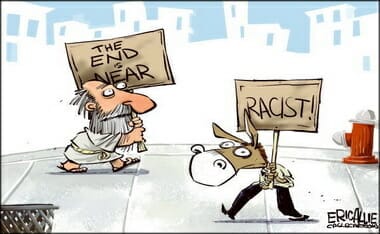

David Webb – The United States is Not Institutionally Racist

Joe R. Hicks – The United States is Not Institutionally Racist

Feminists Say the Darndest Things (Sargon of Akkad)
A collection of the most outlandish things I’ve ever heard from feminists.

Some Basic Differences Between Islam and Christianity
Among the major differences between Islam and Christianity is that of the character and nature of God as understood by the Bible and the Qur’an. For the Bible, Yahweh is a relational God, a God who appears to his people throughout the Old Testament, who took on flesh in the incarnation of Jesus Christ in the New Testament, and who will be present, the Bible claims, in heaven with us once again: “For now we see through a glass, darkly,” wrote the apostle Paul; “but then face to face.” [76] This is very different from Allah in the Qur’an, a God who is distant and remote, transcendent and lofty, who does not deign to step down into his creation, and is not present in Paradise. As Muslim theologian Isma’il al Faruqi writes:
Allah does not reveal Himself to anyone in any way. Allah reveals only his will… Allah does not reveal himself to anyone… that is the great difference between Christianity and Islam.[77]
Central, too, to the Christian understanding of God is that Yahweh is loving; indeed, the Bible goes as far as to boldly make the claim that God is love,[78] the one whose character and nature define what love actually is. You will commonly hear people opine that all religions teach that God is love, but this is simply not true – for instance, nowhere does the Qur’an claim that “Allah is love.”[79]
Finally, at the heart of Christianity stands the belief that, in Jesus, God has experienced suffering, paying the price of the cross in order to reconcile humanity to himself. Now atheists may choose to dismiss, laugh at, or even scoff at that claim, but it is a claim unique to Christianity.[80] It is certainly not an idea found in Islam, where the Qur’an goes as far as to deny that the historical event of Jesus’ crucifixion ever happened.
It has long fascinated me that when Christianity talks about the cross and the suffering of God, it is doing something quite startling, namely reversing the traffic pattern of every other religion, world view, and belief system. All other religions of which I am aware tend to work in one of three basic ways: they claim that if you know the right things, do the right things, or experience the right things, then you will achieve paradise, nirvana, wisdom, a higher state of consciousness, good teeth — whatever it is you are looking for. Islam adopts this model (“Keep the commandments”), as does, incidentally, the New Atheism, whose message is that if you think the right way — think good, secular, scientific thoughts — you’ll be one of the smart ones, one of the brights,[81] one of the elite, the elect.
[76] 1 Corinthians 13:12 (KJV).
[77] Isma’il al Faruqi, Christian Mission and Islamic Da’wah: Proceedings of the Chambésy Dialogue Consultation, Leicester: The Islamic Foundation, 1982, pp. 47-48.
[78] 1 John 4:16.
[79] And many Muslim theologians argue that Muslims should not use the word “love” when talking about Allah; see e.g. Murad Wilfried Hofmann, “Differences between the Muslim and the Christian Concept of Divine Love” in 14th General Conference of the Royal Aal al-Bayt Institute for Islamic Thought, Amman, Jordan, 2007. See also Gordon Nickel, “The Language of Love in Qur’an and Gospel” in Juan Pedro Monferrer-Sala and Angel Urban, (eds), Sacred Text: Explorations in Lexicography, Frankfurt: Peter Lang, 2009, pp. 223-248.
[80] If you wish to understand this idea (which, whatever you make of it, is the central claim at the heart of Christianity), a great place to start is John Stott, The Cross of Christ, Leicester: IVP, 2006.
[81] A nauseatingly self-congratulatory term coined by some of the New Atheists to mark themselves off from the rest of the world, whom they clearly perceive as dimwits. See Daniel Dennett, “The Bright Stuff“, The New York Times, 12 July 2003.
Andy Banister, The Atheist Who Didn’t Exist: Or, The Dreadful Consequences of Bad Arguments (Oxford, England: Monarch Books, 2015), 62-63.

Trey Gowdy Exposes Loretta Lynch’s Lack of Transparency
Trey Gowdy once again shows why during any congressional hearing he is the best.

Mark Levin Dogs Obama’s #BlacklivesMatter Radicalism
“The Great One,” Mark Levin, splains the radicalism Obama can’t help to exude. What the general public may think is a normal answer/position by Obama in regards to the recent Dallas shooting and the racist political cult known as Black Lives Matters, is anything but. A great segment on the ideology that drives our Prez.

Dallas Police Chief David Brown Eulogizes Fallen Officers

Larry Elder Sprinkles Some Kryptonite on Liberals
Here is LARRY ELDER layin’ down the SAGE LAW!
Where to start with actor Jesse Williams’ widely praised rant on police brutality and white racism delivered at this year’s Black Entertainment Television awards show?
To his enthusiastic audience, Williams reeled off lie after lie, all in the name of black “resistance” over the “oppressor” – meaning anyone he believes benefits from “this invention called whiteness.” Time magazine called his discourse “powerful.”
Where are fact-checkers when the fact-devoid desperately need fact-checking? After all, Williams practically begged to be fact-checked when he said, “What we’ve been doing is looking at the data, and we know that police somehow manage to de-escalate, disarm and not kill white people every day.”
The “police … manage to … not kill white people every day”?
Let’s start with 2014, the last year for which there are official records. According to the Centers for Disease Control, the police killed 261 whites and 131 blacks. The CDC also found that from 1999 to 2013, the police killed almost twice the number of whites compared to blacks, 3,160 and 1,724, respectively.
Activists promptly note that whites account for nearly 65 percent of the population and that, therefore, one would expect whites to comprise most of those killed by cops. And we are told that blacks, while 13 percent of the population, represent a much greater percentage of those killed by cops. Institutional, systemic, structural racism!
Here’s what those promoting the “police disproportionately kill black people” narrative consistently omit. Whites, despite being almost 65 percent of the population, disproportionately commit less of the nation’s violent crime – 10 percent. Blacks, at 13 percent of the population, disproportionately commit more violent crime. As to murders, black commit nearly half. Yet whites are 50 percent of cop killings.
Criminology professor Peter Moskos looked at the numbers of those killed by officers from May 2013 to April 2015 and found that 49 percent were white, while 30 percent were black. “Adjusted for the homicide rate,” says Moskos, “whites are 1.7 times more likely than blacks to die at the hands of police.” So if anything, whites have more to complain about than Mr. Williams….
Again we see a false narrative built by the media and then is comes collapsing down, via, THE AMERICAN SPECTATOR:
Here we go again.
Yet another hotly reported media narrative stamps itself on the national dialogue only to find — oops! — maybe there are actually more facts to be discovered before we know, as they say, “the truth, the whole truth and nothing but the truth.”
This time around the media narrative surrounds the Minnesota shooting by St. Anthony Village Police Department officer Jeronimo Yanez, the shooting victim one Philando Castile. Says a police audio tape of Yanez:
- “I’m going to check IDs. I have reason to pull it over. The two occupants just look like people that were involved in a robbery. The driver looks more like one of our suspects, just ’cause of the wide-set nose.”
Then we learn that there are pictures out there of the robber — one of two — committing the robbery, gun in hand. And indeed there is a similarity between one of the robbers and Castile.
Now. How did we learn any of this? From a narrative quite different from the mainstream media’s all-too-predictable “racist white cop kills black man” story — a different narrative that went viral over at CONSERVATIVE TREEHOUSE. The TreeHouse story drew instant wrath from liberal websites. Over at Mediaite John Ziegler PUT IT THIS WAY:
- Shocker! It Looks Like the Media May Have Bought a False Narrative in Philando Castile Shooting
Writes Ziegler in part:
If there is one thing I’ve learned about media firestorms in the modern age of one-hour news cycles and 15-second attention spans, it’s that whoever tells the first story which the news media likes is the “winner.” Once the narrative is set in stone (when the news media works in unison that takes about two days, tops), the truth will face a battle that is severely uphill, into the wind, on ice, and will almost never prevail.
There was no better example of this sad reality than the “Hands Up! Don’t Shoot!” myth which drove the entire Ferguson fiasco and was the origin of the entire “Black Lives Matter” movement. Every investigation into the matter (including by the Obama administration) later concluded, against self-interest, that this catchphrase was based on an obvious and despicable lie. However, even that did almost nothing to alter public perceptions of that event or the media’s eagerness to give instant credibility to similar claims from the same groups in the future.
Ziegler goes on at a later point to add:
Again, none of this remotely proves that Castile was indeed the armed robbery suspect. The point is that there is a potentially very compelling other side of this story which is being ignored or ridiculed by the media which is already very invested in the current narrative.
One of the best examples of this is the “fact check” website “Snopes,” which, in its typically arrogant and liberal fashion, has definitely declared these “rumors” about Castile to be “false,” while actually doing a pretty good job of establishing that they might actually be true (while also ignoring the significance of what we now know was in the police officer’s mindset). A close reading of their conclusions could best be summed up by saying: “We want this story to be false, so, because it hasn’t yet been proven 100% true by liberal media sources with no incentive to do so, it must be false.”
I have seen many times the power of what happens to media coverage once every new fact is seen through the prism of a false narrative and is impacted by a clear confirmation bias. Everything is then perceived completely differently than it should be, sometimes laughably so….
Exactly so….

Milo Yiannopoulos Drops a Truth Bomb on BLM!
[fbvideo link=”https://www.facebook.com/subjectpolitics/videos/vb.1633304150220472/1713873015496918/?type=2&theater” width=”685″ height=”400″ onlyvideo=”1″]
Beware, statistics we’re not allowed to talk about ahead. If you’re easily triggered by scientific studies, run away as fast as your little liberal legs can carry you. It’s about to get real.

22-Military Suicides a Day? ~ No (Military Mantras)
This post is not to diminish a horrible and tragic act of suicide, it is just bringing some sober thoughts to the all too commonly used 22-vets a day commit suicide. If you want the skinny now without the long post to follow, here it is:
A more recent study, which surveyed 1.3 million veterans who were discharged between 2001 and 2007, found that “Between 2001 and 2009, there were 1650 deployed veterans and 7703 non-deployed veteran deaths. Of those, 351 were suicides among deployed veterans and 1517 were suicides among non-deployed veterans. That means over nine years, there was not quite one veteran suicide a day,” according to the Washington Post.
This stat is spread to merely to promote politicians at the expense of truth… would be my guess.
The things to pull from the above 2011 video are:
- Its not deployment (PTSD);
- Its not financial reasons;
- It is the same age group in the general population that commit suicide.
This post is a combination of a newer report from FOX News (above) and an older post from my old blog in May of 2009. First however, I will deal with the 22-vets commit suicide every day number: The L.A. Times notes the following:
That number comes from a study published in early 2013 by researchers at the federal Department of Veterans Affairs. But the recent wars were not the study’s primary focus. In fact, they play a minor role in veteran suicides overall.
The VA researchers used death records from 21 states to come up with a 2010 national estimate for veterans of all ages. As a group, veterans are old. Military service being far rarer than it was in the days of the draft, more than 91% of the nation’s 22 million veterans are at least 35 years old, and the overwhelming majority did not serve in the post-9/11 era.
About 72% of veterans are at least 50. It is not surprising, then, that the VA found that people in this age group account for 69% of veteran suicides — or more than 15 of the 22 per day.
Many experts believe that the farther a veteran is from military service, the less likely it is that his or her suicide has anything to do with his or her time in uniform. In other words, many older veterans are killing themselves for the same reasons that other civilians in the same age group kill themselves: depression and other mental health problems coupled with difficult life circumstances.
The VA analysis does not attempt to determine rates of veteran suicide or how they compare with rates for people who never served.
[….]
One more step was required to make the comparisons relevant. California veterans under 35 are about 80% male, and nearly half are over 29. A straight comparison to the general population in that age group would be less than ideal, since suicide and accident rates vary significantly by gender and age.
The Times adjusted the non-veteran death rates so they reflected the age and gender mix of the veteran population.
As the story explained, suicide and accident rates were substantially higher for veterans. Over the six years examined by The Times, 329 California veterans under 35 took their own lives. That amounts to an average annual rate of 27 suicides per 100,000 veterans.
If that rate were to hold true across the country, about 530 young veterans are committing suicide each year — roughly 1.5 each day…
In a very recent conversation that has expanded my thinking a bit on this topic… is that… people hear 22-vets commit suicide and then rush to pass political bills that help with:
- PTSD,
- physical pain not managed by meds,
- survivors guilt,
- and difficult reintegration,
- etc.
But ~ this mainly deals with the suicides of young vets returning from the recent wars in Iraq and Afghanistan [which AGAIN, are not 22-a-day!].
Since the bulk of the suicides are in the 50-year old range, those “fix-its” are missing most of the veterans that need something else.
What was just pointed out to me as well that fighting cancer or other serious illnesses increase the probability of suicide. For instance:
- The researchers found that, in all countries combined, the number of suicides observed among the breast cancer patients was 37% higher than expected, on the basis of general population rates. That figure translates into four extra suicides per 100,000 person-years, according to the study’s lead author, Catherine Schairer, Ph.D., of NCI’s division of cancer epidemiology and genetics. In the United States, 245 breast cancer survivors committed suicide, making the risk 50% greater than would be normally expected, she said.
(Journal of the National Cancer Institute)
Just to be clear –veterans– who could be retired for decades, get cancer treatments [even if successful], and for whatever variable of reasons, commits suicide due to depression caused by this serious illness… this is wrapped up in the suicide statistics.
Here is WebMD:
…Although any illness can trigger depressed feelings, the risk of chronic illness and depression gets higher with the severity of the illness and the level of life disruption it causes. The risk of depression is generally 10-25% for women and 5-12% for men. However, people with a chronic illness face a much higher risk — between 25-33%. Risk is especially high in someone who has a history of depression.
Depression caused by chronic disease often makes the condition worse, especially if the illness causes pain and fatigue or it limits a person’s ability to interact with others. Depression can intensify pain, as well as fatigue and sluggishness. The combination of chronic illness and depression might lead you to isolate yourself, which is likely to make the depression even worse…
[….]
- Heart attack: 40%-65% experience depression
- Coronary artery disease (without heart attack): 18%-20% experience depression
- Parkinson’s disease: 40% experience depression
- Multiple sclerosis: 40% experience depression
- Stroke: 10%-27% experience depression
- Cancer: 25% experience depression
- Diabetes: 25% experience depression
- Chronic pain syndrome: 30%-54% experience depression
So the older members of the veteran community have these same maladies, and these statistics from serious illnesses SURELY play a roll VERSUS merely “being in the military.”
WHAT we can do or HOW we can help the vets is something I cannot answer.
But if all you have is the VA to help in your fight against cancer or heart disease, PTSD, or prompt medical responses to any number of things — getting a more private response versus “government care” is the answer that I think would help the most.
When all the factors of gender, race, age, etc. are plugged into the suicide rate in the military: if your son or daughter join the military their chances of commiting suicide lessen slightly. You combine this with other healthy activities such as marriage, regular church attendance, etc… and the rate drops even lower. There are many factors at play in this post, a person’s predisposition, religiousity, serious illness, etc. — it isn’t “cut’n’dry” in other words. ALL that being said, my main purpose of this post however is to deal with media myths and bad media headlines.
THE FOLLOWING COMES FROM MY OLD BLOG:
Spin Masters: Military * Stats + Bias = Liberal Agenda (MSNBC & NPR) [May 09, 2009]

I have recently come across this wonderful blogger/retired physician. Her name is Nancy Reyes, her catalogued articles can be found at the Blogger News Network, and her blog is not typically about political affairs at all: FinestKind Clinic and Fish Market. (She mainly writes on health issues or food.) How, you may ask did I come across this blogger/physician? Well, I overheard in a conversation someone mention the high suicide rates of our military are higher than the rest of the country. I remember hearing Michael Medved (if memory serves) going through the stats and correcting a caller on this subject. But very similar to other stats used by politicians in the past few elections (just as examples) these stats are easily shown to be misstated or misused. When I hear people make these claims – suicide rates of our military, unequal pay between genders, anthropogenic global warming, and the like — I often think how these people can make decisions and assumptions on statements made by media that has been proven to be biased time-and-time again.
There have been many studies done on where NPR for instance comes down on the side of the abortion controversy with how many stories and experts who give their input on the matter; the amount of “experts” brought in to support the Palestinian view of things versus how many people they bring in to support the Israeli view of the conflict; the amount of pro-2nd Amendment versus how many stories it lines up with “experts” who are for more gun regulation. The graph below is an example of NPR’s use of conservative versus liberal think tanks in the presentation of their stories (see graph below):
Heck, there are whole sites committed to following and exposing NPR’s biased reporting, one is NPR Sucks, for example. Another small article shows why this seems to be the case, a liberal slant to reporting that is, is one entitled, “Few Reporters Describe Themselves as Conservatives.” This isn’t a “big conspiracy,” rather, it is a culture born in the universities about 40 years ago. All this being said, I think the below articles are a must read. The reader should see my already mentioned link to ad to his or her understanding of how stats are misused. While keeping those examples in mind, the crux of the misuse of the below stats is this:
- By comparing a population that is 90 percent men to the general population, you are comparing apples and oranges.
Suicide attempts are more common in the female population, but the men who try it succeed at a higher rate. Taking this higher rate in men (which the military is primarily composed of) and then comparing this to the population as a whole (men and women in other words) is skewing the results.
Army desertion rate up 80%? More lying with statistics
Last week, it was CBS jiggling the numbers to bash the war in Iraq by stating Veterans had a suicide rate of 18, much higher than the civilian population’s rate of 11 (ignoring that it was only slightly higher than the suicide rate for men, which was 17, and a heck of a lot lower than the rate for doctors, which is 30/100 000 per year).
This week the headline is “Army Desertion rate up 80%”.
The problem? the number “80%” implies a huge increase. But in statistics, if you start with a small number, it doesn’t take a large number to get a huge increase.
So the actual numbers are an increase from 0.7 % to 0.9%. For those of you who are numerically challenged, both those numbers are less than one percent:
According to the Army, about nine in every 1,000 soldiers deserted in fiscal year 2007, which ended Sept. 30, compared to nearly seven per 1,000 a year earlier.
Many of the desertions are soldiers who don’t want to go back to a war, but many are about soldiers with family problems. Many wives and families are severely stressed by their husband or wife going overseas, and sometimes soldiers just disappear because their families need them more than the Army. Often they report in later, and get an administrative discharge. The article implies the majority are war protesters and says that Canada no longer welcomes them, but the article does not give hard data on this.
Many just don’t like the Army, and it has nothing to do with the war. This NYTimes article notes that the number who actually deserted the wars in Iraq or Afghanistan was 109 (out of the 1 million military who served in these areas since 2003). The real worry is that some of the deserters are not anti war as much as suffering from post traumatic stress syndrome and cannot face staying in the military. Others have family problems, such as spouses theatening child custody or divorce. The military is sensitive to these problems, and tries to work out helping the soldier rather than punishing him or her.
As a comparison, the article admits that during Viet Nam, the desertion rate was 5%, and many were for being against that war.
Finally, if you go down to the end of the article, you find the desertion rates for the Navy, Marines, and Air Force are either stable or have gone down.
Nope, can’t publish good news, folks, let’s just move along…
Yup….just ignore the headline.
The war in Iraq is going well, so we have to find bad news to report…..
But just wait a week. Christmas is coming and the MSM will start their annual deluge of articles explaining why Christ was just a myth and Christians are delusional.
[….]
The Military and Suicides, Part One: Spinning statistics
The US Army is very worried about suicide and injuries in returning veterans. Stress in soldiers, and in returning veterans, is nothing new:
During World War II, PTSD was an even more serious problem. In the European Theater, 25 percent of all casualties were serious PTSD cases, compared to about 20 percent today. In the Pacific Theater, the rate varied widely, depending on the campaign. In some of the most intense fighting, like Okinawa in 1945, PTSD accounted for over a third of all wounded. In Iraq, less than ten percent of the wounded are PTSD, but the more troops serve in a combat zone, in combat jobs, the more likely they are to develop PTSD. This has been known for over a century.
One of the results of this is, alas, suicide.
The annual suicide statistics of the military/VA have been released.
The good news? The suicide rate remains low.
The bad news? The press is spinning the numbers to fit into the “Evil Iraq war is killing soldiers” and “the Military doesn’t care about the soldiers” meme (to fit the ultimate meme: Evil Bush’s war and evil Republicans don’t care).
Well, never mind the politics. I’m a doctor. Suicide is a major public health problem in the US (and in many countries). But there are a lot of myths out there.
So let’s look at myth number one:
CNN article: Headline: Army Suicide rates could top nation’s this year.
The story is not half bad, but you have to dig into the actual statistics to find the details.
As of August, 62 Army soldiers have committed suicide, and 31 cases of possible suicide remain under investigation, according to Army statistics. Last year, the Army recorded 115 suicides among its ranks, which was also higher than the previous year.
Well, one would expect a higher rate of returning veterans, who suffer from Post Traumatic Stress syndrome.
Problem: By not placing it into the context of total number of those who served in the Army, we cannot do a comparison.
But the third paragraph is the real problem:
Army officials said that if the trend continues this year, it will pass the nation’s suicide rate of 19.5 people per 100,000, a 2005 figure considered the most recent by the government.
That, my friends, is spin.
You see, suicide rates vary by age and by sex.
Although women have a higher rate of attempted suicide, men die of suicide at a much higher rate than the general population.
The rate of suicide of the general population is 19.5

The rate of suicide in men from the ages of 20 to 35 in 1980 was 24.
The rate of suicide in women from the ages of 20 to 35 was 5.
By comparing a population that is 90 percent men to the general population, you are comparing apples and oranges.
Certain groups: older men, alcoholics, minorities, and those with mental health problems, have a higher rate also.
So CNN assures us:
According to the VA, about 46 of 100,000 males between the ages of 18 and 29 utilizing VA services committed suicide in 2006, compared with about 27 the year before.
A very high rate. Except this is not the general population: this is the rate of those using the VA services, including those with mental health problems. By eliminating the healthy from the statistics, it makes the rate look higher than if the numbers included the entire population of military personnel.
The rest of the article goes on to say the VA is going to improve care for those with PTSS and depression.
So it’s not like nothing is being done: they are just trying to improve the care of the veterans.
For example, unmentioned in the article is that a pre 2001 program in the AirForce was credited with lowering it’s suicide rate from 16.4 yo 9.4 per 100 000 in two years.
Ironically, the article citing the Air Force is not about military suicides, but about suicides in physicians.
Eva Schernhammer and Graham Colditz examined the results of 25 studies of physician suicides and concluded that male doctors killed themselves at a rate 41 percent higher than that of other men and women. The more startling finding was that female doctors take their lives at a rate more than twice (2.27 times) that of the general public.

WOW! An E-2C Hawkeye Snaps Cable ~ USS Eisenhower
An E-2C Hawkeye almost crashing into the sea after arresting cable snaps aboard USS Eisenhower.