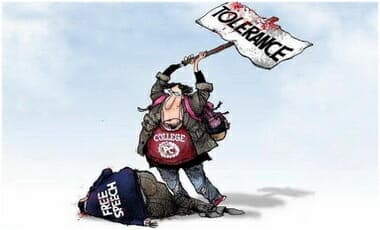
Dr. Everett Piper Talks Day-Cares with Dennis Prager

Dennis Prager had Dr. Everett Piper, president of Oklahoma Wesleyan University, on his show to discuss his new book, “Not a Day Care: The Devastating Consequences of Abandoning Truth.” As an aside, if Dr. Piper writes as well as he speaks, his books are a must read. A great interview, too short… he is “hour long worthy.”

You can follow Dr. Piper on his TWITTER.

Sorry Dems – America Not Even Close To Being Racist

Jay Fayza uses facts and statistics to show that whites and western nations are the least racist and bigoted people on earth contrary to lies told by liberal media and academia.

Here is some of the text of the above video:

…It shows the English speaking world, USA, Canada, Australia, New Zealand, and the Nordic countries and Iberian peninsula are the least racist and bigoted people, yet, if you turn on the television, if you crack open a college sociology textbook, they’ll tell you the exact opposite.

They’ll brainwash you into thinking that whites are racist to demonize and race-bait when facts point the other way.

In 1990, Congress passed the Hate Crime Statistics Act, which required the attorney general to collect data “about crimes which manifest evidence of prejudice based on race, religion, sexual orientation, or ethnicity.” Ever since the act, the FBI and Criminal Justice Departments have had reliable records on the number of hate crimes and who the offenders are. Reports like THIS show, blacks, on average, disproportionately commit hate crimes.

The liberal media and academia tell us whites are racist— only whites can commit hate crimes. But when you look at the data, it’s clear that only one group of people have a tendency to commit hate crimes. One group of people are disproportionately, factually, more racist and bigoted in America. Blacks.

I’m not doing this to defend white people. I’m doing this to defend objective reality.

I’m looking at stats, crunching the numbers, and forming an opinion based on the evidence which is clear: Whites and white countries are the least racist and bigoted.

Whites commit less hate crimes, on average. Whites are far more tolerant and accepting than other races, besides maybe Latin Americans.

Therefore, the liberal media and academia should report the facts, honestly, instead of lying to the world by saying whites are somehow more racist than others. They’re not. They are in fact, less racist…

An oldie but goodie – as President Barack Obama said — “part of our DNA”? Author and talk-show host Larry Elder examines America’s legacy of racism, whether it’s one we can ever escape, and in the process offers a different way of looking at things like Ferguson, crime, police and racial profiling.

A Rasmussen poll supports Larry Elder’s earlier chapters from his first book, here is the main point:

Rasmussen found in its national telephone survey that 37 percent of U.S. adults believe blacks are racist, compared to 15 percent and 18 percent regarding whites and Hispanics, respectively, as racist. The report stipulated that the respondents were asked about ethnic groups in America, not around the world.

[….]

Rasmussen said: “Among black Americans, 31 percent think most blacks are racist, while 24 percent consider most whites racist and 15 percent view most Hispanics that way. Among white adults, 10 percent think most white Americans are racist, 38 percent believe most blacks are racist and 17 percent say most Hispanics are racist.”

(WASHINGTON TIMES)

THOMAS SOWELL notes the following about the same poll:

  • The difference between these percentages is not great, but it is remarkable nevertheless. After all, generations of blacks fought the white racism from which they suffered for so long. If many blacks themselves now think that most other blacks are racist, that is startling.

And a recent complaint, filed by a coalition of 64 organizations, says “the university has set quotas to keep the numbers of Asian-American students significantly lower than the quality of their applications merits.” Continuing the WASHINGTON FREE BEACON notes the grading by ethnicity:

It cites third-party academic research on the SAT exam showing that Asian-Americans have to score on average about 140 points higher than white students, 270 points higher than Hispanic students and 450 points higher than African-American students to equal their chances of gaining admission to Harvard. The exam is scored on a 2400-point scale. The complaint was filed with the U.S. Education Department’s Office for Civil Rights.

Be sure to go through PRAGER UNIVERSITIES “Race Relations” playlist.

Neumark/Wascher Bitch Slap Card/Krueger

I was listening to Larry Elder interview Lee Ohanian, who is professor of economics, University of California, Los Angeles. During the conversation Larry asked the professor about the Card Krueger study, and he mentioned the book that I excerpt below.

  • David Neumark and William L. Wascher, Minimum Wages (Cambridge, MA: MIT Press, 2008), 71-77.

(See more in my MINIMUM WAGE section of my Economic’s “mantra page“)

[p.>71] 3.4.5 Reactions to the State Case Studies

The case studies that constitute the other strand of the new minimum wage literature soon generated considerable controversy. Some labor economists embraced the studies as praiseworthy examples of the use­fulness of the natural experiment approach to studying the economic effects of policy changes (e.g., Freeman 1995). Others, however, were more critical of these studies. For example, referring to the descriptions of these studies in Myth and Measurement, Welch writes: “I am con­vinced that the book’s long-run impact will instead be to spur, by neg­ative example, a much-needed consideration of standards we should institute for the collection, analysis, and release of primary data” (1995, 842). Likewise, Hamermesh concludes that “even on its own grounds, CK’s [Card and Krueger’s] strongest evidence is fatally flawed” (1995, 838).

The criticisms of the case study approach focus on three main is­sues. The first concerns the adequacy of the control groups used in the studies. On its face, for example, it seems reasonable to question the use of Georgia, Florida, and Dallas/Ft. Worth as appropriate control groups in Card’s (1992b) study of the California minimum wage increase, given that these places are far from California and likely influenced by very different demand conditions. But even for states in close geo­graphic proximity, using one state as a control for analyzing a policy change in another state can sometimes be problematic. For example, Deere, Murphy, and Welch (1995) point out that teenage employment [p.>72] rates in New Jersey diverged significantly from those in Pennsylvania beginning in 1988, casting doubt on Card and Krueger’s claim that res­taurants in Pennsylvania provided a sensible control group with which to compare restaurants in New Jersey. More broadly, Hamermesh notes that the variance in employment seems to be dominated by de­mand shocks, which suggests that “any changes in the relative demand shocks” affecting two geographic areas will easily “swamp the effect of a higher minimum wage” (1995, 837). In our view, this issue highlights a potential advantage of a larger panel with many minimum wage increases, over which these demand shocks would be much more likely to be, on average, uncorrelated with minimum wage changes.

A second criticism concerns the timing of the surveys used in the case study analyses. In each of the fast-food case studies, the post­treatment observation comes less than a year after the relevant mini­mum wage increase. As we noted earlier, however, there is substantial empirical evidence that the disemployment effects of an increase in the minimum wage may occur with a lag of one year or more. For the same reason, both Brown (1995) and Freeman (1995) suggest that these studies are more appropriate for examining the short-run effects of minimum wage changes than for estimating their long-run effects.

A third concern involves questions about the reliability of the data used in these case studies. In each study, the researchers conducted their own telephone surveys of fast-food restaurants, which were not subject to the same rigorous standards as those employed in develop­ing the surveys used in government statistical programs. Welch (1995) expresses significant doubts about the quality of the data, noting in particular some puzzling features of the sample collected for the analy­sis in Card and Krueger (1994). In Neumark and Wascher (2000), we document what seems to us to be an unusually high degree of volatil­ity in the employment changes measured with Card and Krueger’s survey data.

In light of these concerns, a number of researchers subsequently reexamined the results reported in the initial round of state-specific case studies. For example, Kim and Taylor (1995) revisit Card’s study of the effects of California’s 1988 minimum wage increase on employ­ment in the low-wage retail sector. Using data for the retail trade sector as a whole, Kim and Taylor first replicate Card’s finding that employ­ment growth in California around the time of the minimum wage in­crease was not statistically different from retail employment growth for the United States as a whole. However, they also point out that the [p.>73] volume of retail sales in California rose much more rapidly during that period than in the United States, which raises questions about the va­lidity of this experiment. Kim and Taylor then turn to more-detailed in­dustry data within the retail sector and examine whether differences across industries in wage growth in California relative to the United States as a whole were negatively correlated with differences across industries in California versus U.S. employment growth in various years. The results show a negative and statistically significant correla­tion for the changes from March 1988 to March 1989, the period that included the minimum wage increase, but not for the changes in earlier years; they interpret this result as consistent with a negative employ­ment effect of the minimum wage. A similar result emerges from their analysis of county-level employment growth and wage growth. The implied minimum wage elasticities that they calculate from their esti­mates range from —0.15 to —0.2.31

In Neumark and Wascher 2000, we revisit Card and Krueger’s anal­ysis of New Jersey’s minimum wage increase, paying particular atten­tion to data quality issues. In particular, we collected administrative payroll records on hours worked from 235 fast-food establishments that were in the universe from which Card and Krueger drew their sample, and compare the two data sources. The Card-Krueger data were elicited from a survey that asked managers or assistant managers “How many full-time and part-time workers are employed in your res­taurant, excluding managers and assistant managers?” This question is highly ambiguous, as it could refer to the current shift, the day, or per­haps the payroll period, and the respondents’ interpretation of it could differ in the observations covering the periods before and after the minimum wage increase. In contrast, the payroll data referred unam­biguously to the payroll period used by the restaurant. Reflecting this difference, the data collected by Card and Krueger had much greater variability across the two observations than did the payroll data, with changes that were sometimes implausible.32

We then replicate Card and Krueger’s difference-in-differences test after replacing their survey-based data with observations taken from the payroll records. In contrast to Card and Krueger’s results, the re­sults from our replication indicate that the minimum wage increase in New Jersey led to a decline in employment (FTEs) in the New Jersey sample of restaurants relative to the Pennsylvania sample. The elastic­ities from our direct replication analysis were a little larger than —0.2, while additional sensitivity analyses suggested a range of elasticities [p.>74] from —0.1 to —0.25, with many (but not all) of the estimates statisti­cally significant at conventional levels.

In their reply, Card and Krueger (2000) present several additional analyses of the effects of New Jersey’s minimum wage increase using both their original data and our payroll records. In addition, they re­port results from a separate longitudinal sample of fast-food restau­rants obtained from BLS records. In contrast both to their original study and to our replication, their reanalysis generally finds small and statistically insignificant effects of the increase in New Jersey’s mini­mum wage on employment, and they conclude that “the increase in New Jersey’s minimum wage probably had no effect on total employ­ment in New Jersey’s fast-food industry, and possibly had a small pos­itive effect” (1419). Of course, had this been the conclusion from Card and Krueger’s original analysis, there would have been much less scope for casting doubt on the standard competitive model of labor markets.

A more recent case study is contained in a paper by Powers, Baiman, and Persky (2007), who revisit the question of the effects of the mini­mum wage on employment and hours in the fast-food industry based on an increase in the minimum wage in Illinois. Their research design parallels very closely the original design of the Card and Krueger 1994 study, using survey data to examine employment changes in counties along the Illinois-Indiana border between the fall of 2003 and the fall of 2005, when the Indiana minimum wage was unchanged and the Illi­nois minimum wage rose from $5.15 (the federal minimum) to $6.50 in two steps.

As in Card and Krueger, Powers, Baiman, and Persky (2007) use two estimators: (1) a simple difference-in-differences comparison of em­ployment changes in Illinois to those in Indiana, and (2) a regression of employment changes on the wage gap between the average starting wage before the minimum wage increase and the new minimum wage. As dependent variables, they look at the change in FTE employees (weighting part-time workers at 0.5), changes in the numbers of full-time and part-time employees separately, and the change in weekly hours. In all cases, they examine both absolute and percentage changes.

One significant improvement in this study is the use of a more pre­cise employment question that asks “How many people … were on your restaurant’s payroll during the last pay period?” The responses to this question should correspond much more closely to the type of in‑[p.>75]-formation we collected from payroll records. Unfortunately, however, Powers, Baiman, and Persky do not provide any information on the distribution of employment changes to confirm that they obtained far fewer of the implausibly large employment changes that we docu­mented in Card and Krueger’s data (Neumark and Wascher, 2000).

For the entire 2003-2005 period, the state difference-in-differences specifications for FTE employment yield an estimate of zero for the ab­solute changes, and a negative but insignificant (and imprecise) esti­mate for the relative changes, with an implied elasticity in the latter case of -0.14. For the gap specification, they also obtain negative but insignificant estimates. When they estimate specifications for part-time and full-time employees separately, the evidence for part-time em­ployment points to negative effects, while the evidence for full-time employment points to positive (and generally much smaller) effects. However, the only significant estimate is a negative effect for the absolute change in part-time employment in the state difference-in­differences specification. When they break the sample into 2003-2004 and 2004-2005 changes, they find significant negative effects on FTE employment from the second minimum wage change using both the difference-in-differences and gap specifications, but little evidence of any effect from the first minimum wage change. For the 2004-2005 pe­riod, the estimated elasticity for the difference-in-differences specifica­tion is -0.75, which is very large. The stronger evidence of negative effects for the latter change could reflect the fact that the minimum wage only rose by 35 cents in January 2004, while it rose by $1.00 in January 2005, as well as the possibility that the 2004-2005 change includes some lagged effects from the first increase.33

Powers, Baiman, and Persky conclude from this research: “While we can reasonably conclude that the Illinois-Indiana comparison shows no positive response to minimum wages (the most striking claim of the original Card-Krueger study), we cannot yet confidently assert that the overall response is negative (the conventional hypothesis)” (2007, 26). This statement closely parallels our conclusion based on our reevalua­tion of the Card and Krueger study.34

Regardless of what the case studies of the fast-food industry show, we think that their importance is overstated. For one thing, there is no reason to expect the predicted negative employment effect to show up in studies of a particular state minimum wage increase—especially in light of Hamermesh’s point about the importance of relative demand shocks in generating fluctuations in employment. In addition, as we [p.>76] discussed in section 3.2, the interpretation of evidence from case studies of a specific industry is unclear, given that the neoclassical model does not predict that employment in a particular sub-sector of the economy will decline in response to a general increase in the mini­mum wage. For example, it is possible that fast-food restaurant chains are less intensive in low-wage labor than are their competitors, in which case the effect of the higher wage floor on prices at the low-wage-intensive establishments could induce greater consumer demand for fast-food output and an increase in fast-food employment. As a consequence, the absence of an employment decline for a narrow industry should not be viewed as a contradiction of that model.

Finally, two recent studies attempt, in one way or another, to explore some of the explanations of the differences in results between the industry-specific case studies and the panel data analysis of broader af­fected groups. Dube, Lester, and Reich attempt to broaden the analysis by studying the restaurant industry as a whole, rather than the fast-food sector in isolation, and by computing difference-in-differences estimates for a large number of minimum wage increases over many geographic areas. Their preferred specifications yield estimated mini­mum wage effects that are near zero. The authors suggest that because they look at the entire restaurant industry, for which substitution in consumption between the output of subsectors of the industry is not problematic, their study can help to reconcile the findings of the fast-food studies and the state-level panel data studies of groups of low-skill workers (2007, 3 and 39).

In general, it seems preferable to estimate minimum wage effects from a large set of increases over many regions, in order to avoid the undue influence of idiosyncratic shocks that may plague a case study of a single minimum wage increase in an isolated region; and certainly, in that sense, their study is more like the state-level panel analyses. However, their focus on the restaurant industry is complicated by two factors. First, tip credits—which are important for non-fast-food restaurants—vary across states, making measurement of the effective minimum wage complicated.35 Second, as discussed earlier with refer­ence to the paper by Wessels (1997), monopsony-like effects can arise in an industry with tipped workers, raising questions about whether these results can be generalized to other industries (aside from other industry differences). As a result, the implications of these results for more aggregate state-level panel data studies are unclear.36

Hoffman and Trace (2007) attempt to bridge the gap between the state-level panel data analyses and the fast-food case studies in a differ‑[p.>77]-ent way. They focus on teenagers and other low-skill groups, as in the state-level panel data analyses, but they restrict their attention to New Jersey and Pennsylvania in the 1991-1993 period surrounding the minimum wage increase in New Jersey that Card and Krueger (1994) studied. In addition, they examine a “reverse” experiment for these two states for the 1995-1998 period, when Pennsylvania’s minimum wage went up faster than New Jersey’s in 1996 and 1997 because of the federal minimum wage increases in those years (coupled with New Jersey’s higher minimum wage prior to the federal increases).

Their results are mixed. For the 1991-1993 period, they find a nega­tive but insignificant effect on the employment of teenagers, but a posi­tive and significant effect for non-teenage dropouts. In contrast, in the 1995-1998 period, they find that employment of sixteen- to nineteen-year-olds and sixteen- to twenty-four-year-olds and of non-teenage high-school dropouts declined in Pennsylvania relative to New Jersey, with the results especially strong in a triple difference estimate that compares employment changes for these groups with changes in the employment of thirty- to forty-nine-year-olds. They also examine changes in the shares of teenagers in the restaurant industry in each state and find weak evidence suggesting that minimum wages reduced this share in the 1995-1998 period, but evidence of a positive effect in the 1991-1993 period. Thus, this study also does not successfully rec­oncile the fast-food case studies and state-level panel data analyses, al­though it does help to emphasize the fragility of results from studies that estimate minimum wage effects from the impact of an isolated minimum wage increase in a single pair of nearby regions.


FOOTNOTES


31. A potential shortcoming of Kim and Taylor’s analysis is the absence of a direct wage measure in the County Business Pattern data they used (Card and Krueger 1995a; Kennan 1995). In particular, they computed wage rates by dividing total payrolls for the first quarter of each year by total employment for a single pay period in March, which may induce measurement errors associated with differences in the timing of the numera­tor and denominator and with variation in the average number of hours included in the pay period. Kim and Taylor were well aware of this data problem and noted that there is no indication of a negative correlation in years in which the minimum wage was con­stant; they also showed that IV estimates that use lagged wages and average firm size in the industry as instruments produce similar results. Card and Krueger address the first point by showing that there is a negative correlation in the 1989-1990 change (although this could reflect a lagged effect from the 1988 increase in the minimum wage). In addi­tion, they point out that the significant negative coefficient in the IV estimates relies on the inclusion of average firm size as an instrument, which they argue is inappropriate.

32. The same problem likely exists in the Katz and Krueger (1992) study. Although the paper is not very specific about the nature of the questions used to elicit the employment data for the Texas study, the survey instrument appears to be included in an appendix to a related paper (Katz and Krueger 1991), with wording similar to that used in Card and Krueger’s New Jersey study. Figure 2 in the 1992 study similarly indicates some very large changes in employment.

33. The estimates for total hours are somewhat stronger. All four estimates (for the two specifications, and with hours changes measured in absolute and percentage terms) are negative, with the state difference-in-differences estimates statistically significant at the 5 percent level. However, the estimated effects are very large, with the implied elasticities ranging from —0.85 to —0.92. The authors indicate that they are less confident about the hours results, however, because of measurement problems.

34. We concluded, “The payroll data raise serious doubts about the conclusions CK drew from their data, and provide a reasonable basis for concluding that New Jersey’s minimum-wage increase reduced fast-food employment … in New Jersey rela­tive to the Pennsylvania control group. Combined with the new evidence from the ES-202 data that CK present … we think we can be more decisive in concluding that New Jersey’s minimum-wage increase did not raise fast-food employment in that state” (2000, 1391).

35. Tip credits specify a dollar or percentage amount of the minimum wage that can be made up by tips. For example, a 50 percent credit coupled with a $5.00 minimum wage would imply that as long as hourly tips exceed $2.50, the employer has to pay only a base hourly wage of $2.50. The paper makes no reference to taking account of tip credits in defining state minimum wages, and tip credits vary across states; see http://www.dol .gov/esa/programs/whd/state/tipped.htm (viewed November 6, 2007).

36. Indeed, earlier work by Partridge and Partridge (1999) noted the potential for the tip credit to render results for the restaurant industry inapplicable to other industries. In their study, they present some evidence of disemployment effects for the retail sector as a whole and for the retail sector excluding eating and drinking establishments. However, the estimated effects for eating and drinking establishments, although negative, are mostly insignificant. That said, we also have doubts about their analysis, as they find sig­nificant negative effects of the minimum wage on overall nonfarm employment growth as well, which seems implausible.


REFERENCES


Brown, Charles. 1995. “Myth and Measurement: The New Economics of the Minimum Wage: Comment.” Industrial and Labor Relations Review 48, no. 4 (July): 828-830.

Deere, Donald, Kevin M. Murphy, and Finis Welch. 1995. “Employment and the 1990­1991 Minimum-Wage Hike.” American Economic Review Papers and Proceedings 85, no. 2 (May): 232-237.

Freeman, Richard B. 1995. “Myth and Measurement: The New Economics of the Mini­mum Wage: Comment.” Industrial and Labor Relations Review 48, no. 4 (July): 830-834.

Hamermesh, Daniel S. 1995. “Myth and Measurement: The New Economics of the Mini­mum Wage: Comment.” Industrial and Labor Relations Review 48, no. 4 (July): 835-838.

Kim, Taeil, and Lowell J. Taylor. 1995. “The Employment Effect in Retail Trade of Califor­nia’s 1988 Minimum Wage Increase.” Journal of Business and Economic Statistics 13, no. 2 (April): 175-182.

Neumark, David, and William Wascher. 2000. “Minimum Wages and Employment: A. Case Study of the Fast-Food Industry in New Jersey and Pennsylvania: Comment.” Amer­ican Economic Review 90, no. 5 (December): 1362-1396.

Rest In Presence Nabeel Qureshi

While I was in Michigan visiting family, a stalwart apologist for the Christian faith passed due to stomach cancer. As David Wood noted, Nabeel had only 12-years in the faith and led many Muslims to Christ. He had quite a few masters degrees (degrees in medicine – Eastern Virginia Medical School, Christian apologetics – Biola University, and religion – Duke University. And had a doctorate as well).

He will be missed, and I was looking forward to his continued addition to the Christian faith giving us insights into the Muslim faith, apologetics, science, and the like.

Here are his books:
__________________
No God but One: Allah or Jesus?: A Former Muslim Investigates the Evidence for Islam and Christianity
Seeking Allah, Finding Jesus: A Devout Muslim Encounters Christianity
Answering Jihad: A Better Way Forward

Manafort May Be Jail-Bound?

THE HILL notes this about Paul Manfort’s possible involvement…

…Investigators were reportedly concerned that the intelligence included communications that Manafort may have encouraged the Russians to help influence the 2016 election, though two unnamed sources familiar with the matter cautioned that the evidence is not conclusive.

Manafort has emerged as a key figure in special counsel Robert Mueller’s investigation into Russia’s role in the 2016 election and possible collusion between the Trump campaign and Moscow.

Mueller’s team has taken a series of aggressive actions against Manafort in recent months. In July, for example, the FBI conducted an early-morning raid of Manafort’s Alexandria, Va., home. Mueller has also subpoenaed the former campaign chairman’s personal spokesman and former attorney…

Manafort is tied to Clinton comrades (APRIL 13th!!!)…. and CLINTON CASH makes it clear the connections of Russia and Hillary are damning. Manafort may be in trouble! Mark Levin said he may go to jail as well. If you are friends with Clinton friends… trouble soon follows.

Born Gay? Immutable vs. Mutable

I wanted to isolate sections of a larger post for both ease of referencing as well as updating and adding a point-or-two. This post deals with the 14th Amendment and peoples use of it to say gay men and women are considered a minority under its clause. I show that far from being “immutable,” there are many factors that play into being gay, and this “self-designation” is fluid. And often times people cease being gay. In contradistinction to someone ceasing being black.

Here is the text of Section I of the 14th Amendment:

  • Section 1. All persons born or naturalized in the United States, and subject to the jurisdiction thereof, are citizens of the United States and of the State wherein they reside. No State shall make or enforce any law which shall abridge the privileges or immunities of citizens of the United States; nor shall any State deprive any person of life, liberty, or property, without due process of law; nor deny to any person within its jurisdiction the equal protection of the laws.

As we will see, this section used in application to the gay community is misused.


Homosexuality is often times due to trauma early in the person’s life. So, for instance, a woman I knew had met quite a few lesbians throughout her life as an ex hippie/druggy, who now loves Jesus. In her mobile-home park living experience she has become friends, acquaintances with and met quite a few lesbians over the years. She told me that most had been abused by some older man (often a family member) when they were young.

ENVIRONMENT

Similarly, the men I have known well-enough to intimate to me their early lives also have corroborated such encounters (one was a family member, the other not). Which brings me to a quote by a lesbian author I love:

“Here come the elephant again: Almost without exception, the gay men I know (and that’s too many to count) have a story of some kind of sexual trauma or abuse in their childhood — molestation by a parent or an authority figure, or seduction as an adolescent at the hands of an adult. The gay community must face the truth and see sexual molestation of an adolescent for the abuse it is,* instead of the ‘coming-of-age’ experience many [gays] regard it as being. Until then, the Gay Elite will continue to promote a culture of alcohol and drug abuse, sexual promiscuity, and suicide by AIDS”

Tammy Bruce, The Death of Right and Wrong: Exposing the Left’s Assault on Our Culture and Values (Roseville: Prima, 2003), 99.

* By the age of 18 or 19 years, three quarters of American youth, regardless of their sexual orientation, have had sexual relations with another person. Gay males are more likely than heterosexual males to become sexually active at a younger age (12.7 vs. 15.7 years) and to have had multiple sexual partners. The ages at the time of the first sexual experience with another person are closer for lesbians and heterosexual females (15.4 vs. 16.2 years).

(New England Journal of Medicine)

Alan Shlemon makes the following point as well:

  • “It’s sad—though not surprising—that many celebrity lesbians like Ellen DeGeneres, Rosie O’Donnell, Melissa Etheridge, and others have publicly stated they were sexually abused as children.”

You see, much like this man who had a sex operation, lived as a woman for 8-years, and then was forced to deal with his early life after taking some courses to get a degree in counseling via U.C. Irvine, his gender problems came because of trauma at a young age (http://tinyurl.com/b5c9elj). To put a stamp of approval via society on a “choice” that is caused by anothers “choice” in making these relationships equal, is doing more harm to the individual that good (as Walt Heyer also points out in his book, mentioned in the link). Many have changed their sexual orientation from gay to hetero, as shown above. But if this is the case, then it is very UNLIKE ethnic origins (an ex-gay tells his story: http://tinyurl.com/anrvm64; a man raised by lesbians and who’s own early sexuality was in flux tells his story: http://youtu.be/MeNrPJ42Xoo).

…One study followed approximately 10,800 adolescents between the ages of 16 and 22 years old. Of the 16 year-old males who had exclusively SSA, 61% had opposite-sex attraction at age 17. For same-sex attracted females, 81% changed to opposite attraction in just one year.

The study also compared sexual attraction at ages 17 and 22, with similar results. For example, 75% of adolescent males with SSA at age 17 had opposite-sex attraction at age 22.

Dr. Neil Whitehead, a research scientist who worked for the New Zealand government for 24 years and the United Nations for another four years, analyzed this study. He notes that although a small percentage of heterosexual adolescents developed homosexuality, the vast majority transitioned in the opposite direction. Based on the data, 16 year-olds with SSA are “25 times more likely to change towards heterosexuality at the age of 17 than those with a heterosexual orientation are likely to change towards bi-sexuality or homosexuality.” That means that heterosexuality is 25 times more stable than homosexuality. It also seems to suggest that heterosexuality is more of a “default” orientation…

Dr. Michael Brown notes as well two well known gay “civil” rights leaders own stories in his book, Outlasting the Gay Revolution:

That’s why almost no one in the gay community bats an eyelash when they hear about Harvey Milk’s sexual history (yes, I’m talking about the slain political leader who has taken on iconic status in our culture). To be specific, according to acclaimed gay journalist Randy Shilts, at age eleven, Milk began attending performances of the New York Metropolitan Opera, where he met with “wandering hands” and soon was engaged in “brief trysts [with grown men] after the perfor­mances.” While still in junior high, he “dove headfirst into the newly discovered subculture,” and by fourteen, Milk was “leading an active homosexual life.” As he grew older, the pattern reversed itself to the point that, at age thirty-three, Milk hooked up with a sixteen-year-old named Jack McKinley, one of a number of younger men with whom he was intimate.

Has this tarnished his legacy? Not at all. Why? Because it is not that unusual. 

Dr. Brown continues:

As gay journalist and radio host Michelangelo Signorile explained:

[W]e’ve been so focused in recent years on how we’re all the same [meaning as heterosexuals]—we want many of the same things in life, including a job, a home, a relationship—that we’ve obscured some real differences in how we’ve constructed our community and our relationships. Historically, gay men have engaged in inter-generational sexual encounters, brief romances and long-term relation­ships—among consenting adults—probably much more than straight people have.

And those “consenting adults” were often men in their teens. (The situation that Signorile was defending involved Hollywood screenwriter Dustin Lance Black, age thirty-nine, and British diving champion Tom Daley, age nineteen. Other gay leaders were critical of the relationship.) That’s why it was not surprising to hear that Terry Bean, one of the founders of the influential HRC—and a major player in Democratic politics and gay activism—was arrested on November 19, 2014, “on charges of sex abuse in a case involving a 15-year-old boy. [Bean was 66 at the time.]… The arrest comes after a five-month investigation that began with allegations Bean secretly made video recordings of men having sex in his bedroom.”

As argued by conservative journalist and law professor Matt Barber, “The cases of Bean and [Larry] follow a long-established pattern as old as the ancient Greek bathhouse. It’s not just homosexual priestly predators on the prowl in the Catholic Church. From pedophile “LGBT” hero Harvey Milk, to high-profile “gay activists” like Duke University’s Frank Lombard and USC’s Walter Lee Williams, the homosexual lust for young flesh seems insatiable”

In support of this statement, which some would find extreme and unfair, Barber cited Harry Hay, the iconic pioneer of the gay rights movement, who (in)famously said,

“It seems to me that in the gay com­munity the people who should be running interference for NAMBLA [the North American Man/Boy Love Association] are the parents and friends of gays. Because if the parents and friends of gays are truly friends of gays, they would know from their gay kids that the relationship with an older man is precisely what 13-, 14-, and 15-year-old kids need more than anything else in the world.”

Michael L. Brown, Outlasting the Gay Revolution: Where Homosexual Activism Is Really Going and How to Turn the Tide (Washington, DC: WND Books, 2015), 151-152.

The harm of the recent movement to fully endorse gay-lifestyles harms children in a way never before in history. For example, in California if a young child starts to act out in a way that seems to the school counselor as signs of sexual abuse, the counselor now can be fired for asking questions of a young pre-teen boy about home life. In other words acting “gay” at such a young age more often than not means there is some sexual abuse happening to the child.

Another point made by myself in the past and reiterated by Dr. Brown is that often times the female daughters of lesbians end up being gay at a much higher rate that the general populace. One activist he mentions has three daughters, and they are all gay.

THE LOVING thing to do is to allow society to not make the private actions of individual illegal, but not to normalize these actions when there is another root cause, or a combination of root causes, other than genetics.

A liberal society might, then, find it prudent to ignore homosexuality. It might well deem it unwise to peer into private bedrooms. However, this is not the issue before us. Today the demand is that homosexuality be endorsed and promoted with the full power of the law. This would require us to abandon the standard of nature, the one standard that can teach us the difference between freedom and slavery, between right and wrong. (Source)

100-YEARS OF STUDIES

This was an amazing piece from Alan Shlemon, from his book, The Ambassador’s Guide to Understanding Homosexuality: I highly recommend reading this whole pamphlet/book:

CAN HOMOSEXUALS CHANGE?

For many this is a settled question. The “experts” have spoken. Change is not possible and ex-gays don’t exist. This is a bold assertion, though, since finding just one person who changed would falsify it.

First, note that a two-thousand-year-old report claimed this change actually happened. In 1 COR. 6:9-11, Paul says some of the Christians in Corinth had been homosexual (“Such were some of you…”), suggesting they no longer were.

Some might dismiss this account because they don’t believe the Bible is the Word of God. This is irrelevant to my point, though. Paul’s epistle to Corinth, at the very least, is an ancient letter to a community of people in a city still existing in modern Greece. It testifies to the fact that some people left homosexuality behind.

Recent studies indicate the same thing. An article published in Psychological Reports in 2000 investigated 882 dissatisfied homosexuals. After pursuing some form of therapy, 34% of the participants reported shifting their orientation to an exclusively or almost exclusively heterosexual orientation. They experienced statistically significant reductions in “homosexual thoughts and fantasies” and improvements in their “psychological, interpersonal, and spiritual well-being.”26

One long-term study completed in 2007 by Drs. Jones and Yarhouse was recently published in the Journal of Sex & Marital Therapy.27 It’s been hailed as one of the most methodologically rigorous studies ever designed to investigate the possibility of change. The researchers followed 98 individuals with unwanted same-sex attractions for six to seven years. They found 15% of the participants reported “substantial reductions in homosexual attraction and subsequent conversion to heterosexual attractions and functioning.” The most surprising result, though, was that subjects classified as “truly gay”—the ones with the highest levels of homosexual attraction, fantasy, and behavior—reported the greatest amount of change.

Clinicians and other scientists have reported successes for over a century. Jean-Martin Charcot, the “father of modern neurology,” described how “the homosexual became heterosexual” through his treatments back in 1882. Sigmund Freud reported change in sexual orientation using psychoanalysis in the 1920s. Researchers continued to report simi­lar findings throughout the 20th century: Wilhelm Stekel in the 1930s, Frank Caprio and Albert Ellis in the 1950s, Russell Monroe and Edward Glover in the 1960s, Irving Bieber in the 1970s, Karolynn Siegel in the 1980s, and Houston Macintosh in the 1990s, to name just a few.

Given such convincing evidence, it’s not surpris­ing a recent psychiatry textbook, Essential Psychopa­thology & Its Treatment, concluded that homosexual orientation can change and that therapy isn’t neces­sarily harmful:

While many mental health care providers and professional associations have expressed considerable skepticism that sexual orientation could be changed with psychotherapy and also assumed that therapeutic attempts at reorientation would produce harm, recent empirical evidence demonstrates that homosexual orientation can indeed be therapeutically changed in motivated clients, and that reorientation therapies do not produce emotional harm when attempted (e.g., Byrd & Nicolosi, 2002; Byrd et al., 2008; Shaeffer et al., 1999; Spitzer, 2003).28

Given this clinical data, thousands must have personally experienced this change. Each year, more people publicly declare they are no longer homosexual.

Dr. Nicholas Cummings, past President of the American Psychological Association (APA), was Chief of Mental Health at Kaiser Permanente in San Francisco for 20 years. He personally worked with over 2,000 patients with same-sex attraction. His staff (six of whom were gay) saw an additional 16,000 homosexuals. Cummings estimates that hundreds of people under his care changed their sexual orientation. He also notes that approximately 7% of those 16,000 patients experienced some measurable change, many going on to marry and live heterosexual lives. 29

Cummings’s data can’t be dismissed. He’s been a lifelong champion of gay and lesbian rights and was the first leader, while President of the APA, to ap­point the Task Force on Lesbian and Gay Issues.

Given this evidence, how can some still claim that sexual orientation change isn’t possible? They’d have to believe multiple and independent lines of evidence were all mistaken or fraudulent. They’d have to believe that over the last 100 years, hundreds of scientists, psychologists, psychiatrists, and physicians who’ve treated homosexuals were mistaken or lied about their findings. Therapists who treat homosexuality today would also have to be fabricating their success stories. Religious and secular organizations providing counseling to ho­mosexuals would have to be misrepresenting their results. Thousands of heterosexuals around the world who once lived as homosexuals must be fak­ing. And every friend I know and person I’ve met over the years who has claimed to have changed has been lying to me and everyone around them. As Tiffany Barnhouse, a professor of psychiatry, has said, “The frequent claim by ‘gay’ activists that it is impossible for homosexuals to change their orientation…accuses scores of conscientious, respon­sible psychiatrists and psychologists of falsifying their data.”30

Does this mean change is easy? No. Is everyone successful? Not at all. Does success always entail total transformation? Rarely. Should we try to change people who don’t want to change? Of course not. But is it possible for some homosexuals to expe­rience substantial and enduring change? Absolutely….

A page later he responds to critique of the idea that if a person even has feelings for the same sex… therapy has failed:

… Clinical psychologist Mark Yarhouse criti­cizes researchers who insist ex-gay men who still struggle with occasional temptations are not, in fact, changed. “Continued struggles with same-sex arousal may be expected residual effects from years of homosexual fantasy and behavior. Psychologists certainly refrain from decrying chemical-dependen­cy programs because someone experiences cravings following treatment.”31

Allegedly, the Alcoholics Anonymous success rate is only 25%. Yet few would deny AA works for some people. My point: low success rates or relaps­es are not proof that therapy never works.

DECADES OF TWIN STUDIES

This next bit of info comes by way NARTH, in an audio posted the “genetic” aspect of this debate has been prevalent… so this is a rejoinder to it:

Identical Twin Studies Demonstrate Homosexuality is Not Genetic

Eight major studies of identical twins in Australia, the U.S., and Scandinavia during the last two decades all arrive at the same conclusion: gays were not born that way. “At best genetics is a minor factor,” says Dr. Neil Whitehead, PhD. Whitehead worked for the New Zealand government as a scientific researcher for 24 years, then spent four years working for the United Nations and International Atomic Energy Agency. Most recently, he serves as a consultant to Japanese universities about the effects of radiation exposure. His PhD is in biochemistry and statistics.

Identical twins have the same genes or DNA. They are nurtured in equal prenatal conditions. If homosexuality is caused by genetics or prenatal conditions and one twin is gay, the co-twin should also be gay. “Because they have identical DNA, it ought to be 100%,” Dr. Whitehead notes. But the studies reveal something else. “If an identical twin has same-sex attraction the chances the co-twin has it are only about 11% for men and 14% for women.”

Because identical twins are always genetically identical, homosexuality cannot be genetically dictated. “No-one is born gay,” he notes. “The predominant things that create homosexuality in one identical twin and not in the other have to be post-birth factors.”

Dr. Whitehead believes same-sex attraction (SSA) is caused by “non-shared factors,” things happening to one twin but not the other, or a personal response to an event by one of the twins and not the other. For example, one twin might have exposure to pornography or sexual abuse, but not the other. One twin may interpret and respond to their family or classroom environment differently than the other. “These individual and idiosyncratic responses to random events and to common environmental factors predominate,” he says.

The first very large, reliable study of identical twins was conducted in Australia in 1991, followed by a large U.S. study about 1997. Then Australia and the U.S. conducted more twin studies in 2000, followed by several studies in Scandinavia, according to Dr. Whitehead. “Twin registers are the foundation of modern twin studies. They are now very large, and exist in many countries. A gigantic European twin register with a projected 600,000 members is being organized, but one of the largest in use is in Australia, with more than 25,000 twins on the books.”

A significant twin study among adolescents shows an even weaker genetic correlation. In 2002 Bearman and Brueckner studied tens of thousands of adolescent students in the U.S. The same-sex attraction concordance between identical twins was only 7.7% for males and 5.3% for females—lower than the 11% and 14% in the Australian study by Bailey et al conducted in 2000.

In the identical twin studies, Dr. Whitehead has been struck by how fluid and changeable sexual identity can be. “Neutral academic surveys show there is substantial change. About half of the homosexual/bisexual population (in a non-therapeutic environment) moves towards heterosexuality over a lifetime. About 3% of the present heterosexual population once firmly believed themselves to be homosexual or bisexual. Sexual orientation is not set in concrete.”

…read it all…

And just to be absolutely clear, discrimination for the gay segment of society is nothing like other segments have experienced. In fact, the false impression the public has is amazing.

PERSECUTION?

Dr. Brown quotes Notre Dame professor Gerald Bradley as saying:

Gay Americans are afforded all their rights. They can vote, can have almost any job they are qualified for, live where ever they want to, travel unburdened, just like everyone else. Demographics show they are among the wealthiest and best educated people in the United States. No one wants to take anything away from them. But the question becomes, can a tiny sliver of our population change the definition of marriage not only for the 243,000,000 adult Americans alive today, but for all those who will come after us?

Michael L. Brown, Outlasting the Gay Revolution: Where Homosexual Activism Is Really Going and How to Turn the Tide (Washington, DC: WND Books, 2015), 144.

Many years ago the Wall Street Journal noted the same:

Average Household Income:

  • Homosexuals – $55,430
  • African Americans – $12,166

Percentage of College Graduates:

  • Homosexuals – 60%
  • African Americans – 5%

Holding Professional Positions:

  • Homosexuals – 49%
  • African Americans – 1%

Taken Overseas Vacations:

  • Homosexuals – 66%
  • African Americans – 1%

Ever Denied the Right to Vote:

  • Homosexuals – No
  • African Americans – Yes

Ever Faced Legal Segregation:

  • Homosexuals – No
  • African Americans – Yes

Ever Denied Access to Public Restrooms:

  • Homosexuals – No
  • African Americans – Yes

Ever Denied Access to Businesses and Restaurants:

  • Homosexuals – No
  • African Americans – Yes

Wall Street Journal, 7/18/91, B1

Not only is being gay not immutable, being “gay” isn’t harmful to one’s lifestyle… monetarily speaking. It seems to enhance it in fact.

Of Spaghetti Monsters and Teapots

The Stanford Encyclopedia of Philosophy notes that “category mistakes” were a key cause to metaphysical mistakes:

Finally, the fallacy that Aristotle calls form of expression exploits the kind of ambiguity made possible by what we have come to call category mistakes, in this case, fitting words to the wrong categories. Aristotle’s example is the word ‘flourishing’ which may appear to be a verb because of its ‘ing’ ending (as in ‘cutting’ or ‘running’) and so belongs to the category of actions, whereas it really belongs in the category of quality. Category confusion was, for Aristotle, the key cause of metaphysical mistakes. (ARISTOTLE 2.1.4)

THE POACHED EGG includes CARM well reasoned explanation of the issue:

Matt Slick over at CARM writes, “A category mistake is an error in logic in which one category of a thing is presented as belonging to another category.  For example, to say “the rock is alive” assigns the category of life to an inanimate object.  Another example would be to judge the beauty of a painting based on how much it weighs.  This is a category error, since the category of beauty is not determined by the category of weight. So, for the atheist to work from inside his materialistic, non-transcendent worldview and require evidence for the non-material, transcendent God (which necessarily exists outside his perceived worldview) is a category mistake because it is asking for the material evidence of the non-material, the non-transcendent evidence of the transcendent.  It is like asking to have a thought placed on a scale.  It doesn’t work because they are different categories.”

Here are two challenges by an atheist troll which I take up (click to enlarge):

This is with a h/t to Detective Wallace, and comes via THE POACHED EGG as well as the original author, ANSWERS FOR HOPE:

There is a fundamental distinction between the way that Christian apologists approach proving a negative, and the way that atheists approach proving a negative. The distinction is that Christian apologists give good reasons to accept that something doesn’t exist or isn’t true, whereas atheist apologists will commit a fallacy known as an argument from ignorance. The atheist will say “If you can’t prove to my satisfaction that God exists, then I am justified in not believing.” It is an argument from ignorance to say that “X” does not exist because it hasn’t been proven to my satisfaction. However, Christian apologists will say, “We have good reasons to not accept your claim.” and then will proceed to give those reasons.

The Conflict of Worldviews

Since science alone can not test the validity of worldviews, we must use other methods to test claims in which science itself cannot test. You might ask, how can we tell how a worldview is valid or invalid? The mark of something that is not true is inconsistency. What we must do is take all of the presuppositions of a worldview into account, and follow those presuppositions to their logical conclusions. If any of these presuppositions are shown to be internally inconsistent while following them to their ultimate conclusion, then that worldview is false.

In this case, since the atheist is arguing for The Flying Spaghetti Monster, we must take the properties of the Flying Spaghetti Monster into consideration when arguing against it.

The Problem for the Atheist

It should be recognized that when the atheist is arguing for a deity in order to refute any type of theism, including Christianity, that the atheist is forsaking their own worldview for in favor of another. The presuppositions of Pastafarianism are inconsistent with the presuppositions of atheism. Since the arguments and objections that atheism brings to the table in regards to Christianity are not sufficient, it is necessary for atheists to posit something as absurd as a Flying Spaghetti Monster. Since the presuppositions of Pastafarianism are inconsistent with atheism, when they adopt this worldview to try to challenge the Special Revelation of Christianity, they are actually forsaking their own belief that no gods exist. If the arguments that atheists used against Christianity were so consistent, there would be no need for them to mention the Flying Spaghetti Monster. It seems that the atheists have not realized that if could successfully prove the existence of a Flying Spaghetti Monster, then atheism would be false. The Flying Spaghetti Monster undermines the entire atheist worldview.

The Flying Spaghetti Monster

The Flying Spaghetti Monster concept was revealed to the public when an atheist named Bobby Henderson wrote a letter to the Kansas State Board of Education in regards to a decision to permit teaching intelligent design as an alternative to evolution in public school science classes.(1) Intelligent Design proponents responded by saying that his letter unwittingly proved the ID movement’s point, because ID does not say or try to conclude who the designer is. Nevertheless, The Flying Spaghetti Monster became a popular objection to Christianity and all other forms of theism, even though that doesn’t appear to be what Bobby Henderson’s original intention was.

[….]

1. Pastafarianism only entertains relative moral values at best.

2. Pastafarians live as if objective moral values exist.

3. If a Pastafarian lives as if objective morals exist while claiming that morals are relative, then the pastafarian worldview is self-contradictory.

4. A self-contradictory worldview cannot be true.

Conclusion: Therefore, Pastafarianism is false. (A cosmological argument against flying spaghetti monster.)

(read it all)

Prior to the “FLYING SPAGHETTI MONSTER” hypothesis there was the CELESTIAL TEAPOT ARGUMENT:

So the Flying Spaghetti Monster is just a rip off of earlier thinking. But, here is the refutation of it:

Brian Garvey, a lecturer in the philosophy of mind and psychology at Lancaster University, has written an article (referenced here) exploring Russell’s famous celestial teapot. The article, Absence of Evidence, Evidence of Absence, and the Atheist’s Teapot (PDF), appears in in the latest volume of Ars Disputandi, a philosophy of religion journal hosted by Utrecht University in the Netherlands. Here’s the abstract:

Atheists often admit that there is no positive evidence for atheism. Many argue that there is nonetheless a prima facie argument, which I will refer to as the ‘teapot argument’. They liken agnosticism to remaining neutral on the existence of a teapot in outer space. The present paper argues that this analogy fails, for the person who denies such a teapot can agree with the person who affirms it regarding every other feature of the world, which is not the case with the atheist vis-a-vis the theist. The atheist is committed to there being an alternative explanation of why the universe exists and is the way it is. Moreover, the analogy relies on assumptions about the prior plausibility of atheism. Hence, the teapot argument fails.

And a quote:

“There is, I want to argue, a significant difference between denying the existence of a teapot orbiting the sun, and denying the existence of God. When two people disagree over whether or not there is a teapot orbiting the sun, they are disagreeing over whether the world includes that particular item or not. For all that that particular disagreement implies, the two people agree about every other feature of the world: the tea-ist believes in a world that is exactly the same as the one the a-tea-ist believes in, with the single difference that it contains one item that the a-tea-ist’s world doesn’t contain. Since, as I have argued in the previous section, the only thing that could count as evidence for the teapot orbiting the sun is that someone has seen it, it is in one way analogous to a situation where one person says: ‘there’s a postbox at the end of the high street’ and the other person says ‘no there isn’t, go and have a look’, and the first person goes and looks and doesn’t see one. If that person is reasonable, that will be the end of the argument. The two situations are not quite analogous, however, in that no-one has gone and looked to see whether there is a teapot in outer space. But the situations are disanalogous in a second way too, and a way which helps to illuminate why, in the absence of evidence, it is reasonable to conclude that there is no such teapot. That is, that there is nothing manifestly far-fetched in the idea of there being a postbox at the end of the high street. In the absence of seeing one (leaving aside the possibility of more indirect evidence, such as seeing a map of where all the postboxes are at the GPO) one is hardly being unreasonable if one doesn’t come down on one side or the other. And this difference between the postbox and the teapot tells us something about why it is unreasonable to suspend judgement regarding the teapot, even though we have not only failed to see one, but failed to carry out anything remotely approaching an exhaustive search. Because of its manifest far-fetchedness, or what amounts to the same thing, because it’s reasonable in the absence of prior evidence on the specific hypothesis to estimate that it’s highly unlikely, we can say that, when it comes to teapots orbiting the sun, absence of evidence is evidence of absence. The atheist’s argument attempts to gain persuasiveness by ignoring this issue of prior plausibility. It is true that we cannot (at present) conclusively prove that there’s no teapot in outer space in the way that we could conclusively prove that there’s no postbox on the end of the street by going there and looking. But part of the reason why, despite not being able to do this, it is still reasonable to conclude that there isn’t, is that prior to any investigation the hypothesis is manifestly far-fetched. In the postbox case it is not, and thus we can see that absence of evidence, as far as rendering it reasonable to deny something’s existence goes, has different force depending on the case in hand. Unless the existence of God is taken to be also manifestly far-fetched, the argument to the effect that if we don’t suspend judgement regarding the teapot then we shouldn’t suspend it regarding God, doesn’t get off the ground.”Boiled for Sins Flying Spaghetti Monster

(Via Thinking Matters)

The Stanford Encyclopedia of Philosophy defines Atheism as: the negation of theism, the denial of the existence of God —

  • The “a-” in “atheism” must be understood as negation instead of absence, as “not” instead of “without”. Therefore, in philosophy at least, atheism should be construed as the proposition that God does not exist (or, more broadly, the proposition that there are no gods).

There is a subtle, but important difference between not believing in something and believing that something is not (does not exist). Atheism adopts the latter position in holding that God does not exist. Atheism is more than mere lack of belief, it is the denial of the existence of God. Mere lack of belief makes the atheist no different from a newborn baby or my Chevy. (Added to a bit — but from APOLOGETICS 315)


a couple more videos i liked


Is the Southern Poverty Law Center Itself a “Hate Group”?

Originally posted in April, 2012

POWERLINE has recently posted on this in two parts (Part 1 | Part 2). Here is a portion of their PART ONE:

I didn’t realize that I was following in the footsteps of former Vanderbilt political science professor Carol Swain, who called the SPLC’s number in a post she wrote about it for the Huffington Post in September 2009. Professor Swain concluded the post: “Rather than monitoring hate groups, the Southern Poverty Law Center has become one.”

This could not stand. In today’s Wall Street Journal Professor Swain tells the rest of the story:

The SPLC’s retaliation was vicious and effective. On Oct. 17, 2009, my photo appeared on the front page of my local newspaper, the Tennessean, with the headline “ Carol Swain is an apologist for white supremacists.” That was a quote from Mark Potok, at the time the SPLC’s national spokesman. The context for Mr. Potok’s attack was a review I gave for a film titled “A Conversation About Race.” I endorsed it for classroom use because it offered a perspective on race rarely encountered on university campuses. Mr. Potok argued that the filmmaker was a bigot. I felt then and now that the perspective needed to be heard.

This negative article was featured on the front pages of several newspapers and it went viral, especially in black media outlets. The attacks did not subside until this newspaper’s website published a lengthy article titled “In Defense of Carol Swain.”

Being targeted by the SPLC has had a lasting impact on my life and career. Offers from other universities ended and speaking opportunities declined. Once you’ve been smeared in this way, mainstream news outlets are less likely to cite you as an expert of any kind.

Professor Swain knows she is in good company:

[T]oday I wear the SPLC’s mud as a badge of honor because I know I am in the company of many good men and women who have been similarly vilified for standing for righteousness and truth. Other SPLC targets have included Ben Carson (who eventually received an apology and retraction), Somali refugee Ayaan Hirsi Ali, terrorism expert Steve Emerson, political scientist Guenter Lewy (who successfully sued the SPLC), attorney Robert Muise, Frank Gaffney of the Center for Security Policy, and Princeton professor Robert P. George. The SPLC has tagged Mr. George, a devout Catholic intellectual, as “anti-LGBT.”…..

(read it all)

And the video at the top of this update is from PART TWO. But the Wall Street Journal article is a “pay-to-play” article. I have found a decent excerpt at FOX NEWS. PART THREE is more of a biography and statement of amazement regarding Professor Swain:

….According to her Wikipedia entry, Swain grew up in a shack without running water. She and her eleven siblings shared two beds. She did not have shoes and thus missed school whenever it snowed. She did not attend high school, dropping out in ninth grade.

When her mother and abusive stepfather moved the family to Roanoke, Swain appealed to a judge to be transferred to a foster home. When her appeal was denied, she lived with her grandmother in a trailer park.

Intimately familiar with the south and with poverty, Swain also knows about the law, having earned a master’s degree from Yale Law School. This was the culmination of an education that begin with a GED, and was followed by an associate degree from Virginia Western Community College; a B.A. in criminal justice from Roanoke College; a master’s degree in political science from Virginia Tech; and a Ph.D. in political science from the University of North Carolina at Chapel Hill.

Swain went on to become a professor at leading universities and the author of several books. One was cited by Supreme Court Justices Anthony Kennedy and Sandra Day O’Connor. Two dealt with the topic of white nationalism.

There is an obvious disconnect when an African-American from the south rises from extreme poverty to glittering scholarly success, only to be branded an “apologist for white supremacists” by the Southern Poverty Law Center….

So what is the hub-bub about with the SPLC? One blogger calls it as they see it:

The Montgomery, Alabama-based Southern Poverty Law Center (SPLC), has quite a racket going on. Now, they don’t practice poverty law as their name suggests, but they do spread hate, and lots of it too. In the name of the almighty dollar, the SPLC will slander and defame anyone it chooses. Especially those with the temerity to oppose their extreme, leftwing ideological views.

[….]

The SPLC is a racket. Contrary to it’s name, the Southern Poverty Law Center does not practice poverty law, but instead serves a 2-fold purpose: 1) lining the pockets of Morris Dees, the SPLC’s staff, its directors, and various cronies; and 2) serve as attack dogs for the government and radical left (did I repeat myself?).

(Classic Liberal)

The Southern Poverty Law Center bills itself as a watchdog of hate groups. But is this just a cover for its true aims? Journalist and author Karl Zinsmeister explains.

Take note as well that many Black groups and individuals stand against the SPLC, as Godfather Politics points out:

A coalition of African-American pastors and pro-family Christian and Jewish leaders held a press conference outside the headquarters of the Southern Poverty Law Center in Montgomery, Alabama, to protest the SPLC’s smearing of pro-family groups that oppose homosexual activism as “hate groups.”

The SPLC has been co-opted by a Leftist, pro-homosexual, anti-Christian agenda. If you don’t agree with the SPLC leftist litmus test, then you are a de facto “hate group.” With its new definition of what constitutes a hate group, the SPLC has become a fund-raising machine. It’s no wonder that the organization is flush with cash. At the end of fiscal year 2010 SPLC’s endowment stood at $216.2 million. Ultimately, the tactic is to strike fear in middle-America so the checks keep rolling in. Most communities don’t see skinheads or even KKKers, so the SPLC needs a tangible enemy.

In other words, a money maker from its left leaning donors. Conservapedia points out the obvious, that by labeling Michele Bachmann, Glenn Beck, Ron Paul, and Judge Napolitano, as well as conservative Christian oragnizations that stand against same-sex marriage in with other hate groups, that this “proves that the SPLC is a left-wing political organization rather than one focused on racism and civil rights.” (I wish to point out that Conservapedia includes as normative some groups I would not have, like the John Birch Society, VDARE, and others.)

While I can understand and maybe support their position on the John Birch Society and Alex Jones… the main point still stands: This … further proves that the SPLC is a left-wing political organization rather than one focused on racism and civil rights.

The following half-hour / in-depth review of the SPLC is by the John Birch Society, which… for the record — I do not endorse nor recommend their [John birch Society’s] resources. However, this presentation is a decent excoriation of the “craziness” over at this liberal propaganda machine:

The problem with this whole venture by the left is that it destroys the institutions it touches. The SPLC at one point may have had honorable goals, but when leftism infects things, it destroys them. So the power behind the original ideas and goals of the SPLC are negated — rendered ineffective/powerless — by their newer political goals. As Dennis Prager points out in regards to whatever the Left touches: