Just when you thought it doesn’t get more retarded — it does.
Donald Trump


Michael Walsh, Author Of “The Devil’s Pleasure Palace”
Dennis Prager interviews Michael Walsh who writes for the NEW YORK POST as well as PJ MEDIA. Michael is on for his book being released in paperback, “The Devil’s Pleasure Palace: The Cult of Critical Theory and the Subversion of the West.” The conversation was interesting, I even enjoyed the “conductor talk,” but alas, I am keeping this upload directed at the political. A great conversation and a humbling of myself who stayed anti-Trump till the last month-and-a-half before the election. The article mentioned by these two, “The Flight 93 Election,” can be found at CLAREMONT INSTITUTE … near the end they discussed the previous hour about cultural appropriation, that segment can be found HERE.
I am a new fan of Michael’s and look forward to reading his work. Follow him on TWITTER.
Rep. Steve Scalise Discusses Trump’s Budget (Plus: Maddow Challenge)
- “President Trump has passed more legislation in his first 100 days than any president since Harry Truman.” — Tom McClintock on Friday, April 28th, 2017 in a radio interview
Michael Medved interviews House of Representatives Majority Whip and representative for Louisiana’s 1st congressional district, Steve Scalise. Steve responds first to a statement by Rachel Maddow that the House Republicans haven’t done anything since they took office. Then the discussion focused on this administrations work to help the middle-class and lower class get work, leave the dependent lifestyle, and the like.
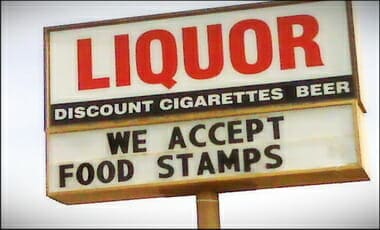
Food Stamp Mantra[s] from Democrats Rebutted
Michael Medved responds to the food stamp issue that Democrats and the Left are bringing up. I take a clip from yesterday’s show and insert it into the middle of today’s show to give the listener some ammunition when these banal arguments come up. At the 5:17 mark, the caller mentions taxes for the millionaires as part of his argument. Medved Responds well to this challenge at the… and at the 6:24 mark you hear the caller respond with a bumper sticker jingle. In other words, talking about facts matters little to these people, but at least you will be able to influence those around you eavesdropping in on the conversation.
- For some good food stamp news items, see FOX NEWS.
- For my own “comparison,” see my post, COMPARE AND CONTRAST.
I posted this video on LIVELEAK, and a comment got me “clicking around” the internet to test what the person said. Here is the comment:
For every $1 spent on food stamps there’s a $1.80 stimulative effect to the economy. The poor person spends the funds at the grocery store, which allows the store to employ more people, the store spends the funds to buy more food which helps farmers and food producers. On the other hand, tax cuts for the wealthy have a negative effect on the economy, it just doesn’t trickle down enough so it drains economic growth. Plus it helps feed poor people that can’t afford to eat. — Warren H.
First, it should be noted that this idea was championed mainly by Moody’s chief economist Mark Zandi, a hard-core Keynesian. However, it should be noted that unfortunately “for Zandi, there has never been any empirical evidence of the Keynesian multiplier. Government doesn’t take one dollar and turn it into more by spending it. God doesn’t live in the White House, no matter how much Paul Krugman prays.” (AMERICAN THINKER)
HERITAGE FOUNDATION puts it like this:
…The Keynesian argument also assumes that consumption spending adds to immediate economic growth while savings do not. By this reasoning, unemployment benefits, food stamps, and low-income tax rebates are among the most effective stimulus policies because of their likelihood to be consumed rather than saved.
Taking this analysis to its logical extreme, Mark Zandi of Economy.com has boiled down the government’s influence on America’s broad and diverse $14 trillion economy into a simple menu of stimulus policy options, whereby Congress can decide how much economic growth it wants and then pull the appropriate levers. Zandi asserts that for each dollar of new government spending: temporary food stamps adds $1.73 to the economy, extended unemployment benefits adds $1.63, increased infrastructure spending adds $1.59, and aid to state and local governments adds $1.38. Jointly, these figures imply that, in a recession, a typical dollar in new deficit spending expands the economy by roughly $1.50. Over the past 40 years, this idea of government spending as stimulus has fallen out of favor among many economists. As this paper shows, it is contradicted both by empirical data and economic logic…
They then respond to the above:
The Evidence is In
Economic data contradict Keynesian stimulus theory. If deficits represented “new dollars” in the economy, the record $1.2 trillion in FY 2009 deficit spending that began in October 2008–well before the stimulus added $200 billion more–would have already overheated the economy. Yet despite the historic 7 percent increase in GDP deficit spending over the previous year, the economy shrank by 2.3 percent in FY 2009. To argue that deficits represent new money injected into the economy is to argue that the economy would have contracted by 9.3 percent without this “infusion” of added deficit spending (or even more, given the Keynesian multiplier effect that was supposed to further boost the impact). That is simply not plausible, and few if any economists have claimed otherwise.
And if the original $1.2 trillion in deficit spending failed to slow the economy’s slide, there was no reason to believe that adding $200 billion more in 2009 deficit spending from the stimulus bill would suddenly do the trick. Proponents of yet another stimulus should answer the following questions: (1) If nearly $1.4 trillion budget deficits are not enough stimulus, how much is enough? (2) If Keynesian stimulus repeatedly fails, why still rely on the theory?
This is no longer a theoretical exercise. The idea that increased deficit spending can cure recessions has been tested repeatedly, and it has failed repeatedly. The economic models that assert that every $1 of deficit spending grows the economy by $1.50 cannot explain why $1.4 trillion in deficit spending did not create a $2.1 trillion explosion of new economic activity.
CATO likewise notes that the numbers were fudged to provide exaggerated outcomes:
Food stamps are effective economic stimulus. Led by Mark Zandi and other Keynesian economists, food-stamp advocates have made wildly exaggerated claims about the program’s role in stimulating the economy. Zandi, for instance, claims that “extending food stamps is the most effective way to prime the economy’s pump.”
But aside from the fact that those economic models just as well predict an alien invasion would be a boon to the economy, there is little evidence to support the theory. Even the Agriculture Department’s own inspector general concluded that it was unable to determine whether the additional dollars in the stimulus’s food-stamp expansion were in any way effective in meeting the 2009 Recovery Act’s goals. Three of the four performance measures the program was supposed to use, the office found, “reflected outputs, such as the dollar amount of benefits issued and administrative costs expended” and did not provide any insight into outcomes.
On the other hand, we do know that a failure to get government spending under control will have long-term economic consequences. Food stamps are hardly the major cause of deficits and debt — that distinction lies with middle-class entitlements such as Social Security and Medicare — but every little bit helps.
Valerie Jarrett and Nancy Pelosi said similar things:
- JARRETT: Let’s face it: Even though we had a terrible economic crisis three years ago, throughout our country many people were suffering before the last three years, particularly in the black community. And so we need to make sure that we continue to support that important safety net. It not only is good for the family, but it’s good for the economy. People who receive that unemployment check go out and spend it and help stimulate the economy, so that’s healthy as well.
- PELOSI: Economists agree that unemployment benefits remain one of the best ways to grow the economy in a very immediate way. It immediately injects demand into our markets and increases employment. For every dollar spent on unemployment benefits, the economy grows by, according to one estimate, $1.52; by others, $2. So somewhere in that range, but much more than is spent on it…. We have a responsibility to the American people. These are people who have played by the rules, have lost their job through no fault of their own, and need these benefits in order to survive. So we must extend this insurance before the end of the year and we must extend it for at least a year. And I’d like to see that as we go forward before this year ends. Hopefully it could be part of a budget, but it doesn’t have to be part of a budget. It could be in its own vehicle as it goes forward, but it’s something we must consider.
Again, similar responses happened then as well:
Economists at the Heritage Foundation have written about this claim, explaining:
The theory behind extending UI [Unemployment Insurance] benefits as a stimulus assumes that unemployed workers will immediately spend any additional UI payments, instantly increasing consumption, boosting aggregate demand, and stimulating the economy.
This is not a new idea. Economists in the 1960s thought that unemployment insurance could function as an important automatic economic stabilizer. Empirical research in the 1970s demonstrated that this was not the case, and studies since then have concluded that unemployment insurance plays at best a small role in stabilizing the economy. Empirical research at the state level also finds that UI plays a negligible role in stimulating the economy.
Studies that have found that UI stimulates the economy effectively — such as studies by the Congressional Budget Office and economist Mark Zandi — rely on two faulty assumptions, thereby drawing a false conclusion:
They assume that unemployed workers spend every dollar of additional UI benefits almost immediately and that extending unemployment insurance does not affect workers’ behavior. In that case, every dollar spent on unemployment insurance adds a dollar to consumption without any direct effects on the labor market. Both assumptions are false.
Unemployment Insurance Prolongs Unemployment. One of the most thoroughly established results in labor economics is the effect of unemployment benefits on unemployed workers’ behavior. labor economists agree that extended unemployment benefits cause workers to remain unemployed longer than they otherwise would.
This occurs for obvious reasons: Workers respond to incentives. Unemployment benefits reduce the incentive and the pressure to find a new job by making it less costly to remain without work…..
Michael Medved Discusses Trump’s Budget Proposal
I like Medved’s take because he (unlike many other commentators) takes calls which are negative to his view. A good short article on Trump’s budget is over at POWERLINE talking about the projected GDP. The WASHINGTON TIMES notes that this budget is shocking!
President Trump’s 2018 budget proposal is shocking on two fronts, and both will have denizens of the Washington swamp tearing their hair out.
Backgrounding supporters on a Monday conference call, Office of Management and Budget Director Mick Mulvaney referred to the budget proposal as a “Taxpayer First Budget,” and said, “I imagined myself standing in front of a taxpayer asking him for his money.” Could Mulvaney justify asking any taxpayer to hand over money to pay for health services for disabled veterans, he asked? Yes, of course. Could he justify asking that taxpayer for money to pay for a program that takes college graduates and helps them get graduate degrees, a program that’s been documented to have a 6 percent success rate? No, he could not. Consequently, programs for disabled veterans get funding, and programs with a 6 percent success rate do not.
Shocking, eh?
[….]
But putting taxpayers first isn’t the only shocking thing about the proposed Trump budget.
OMB Director Mulvaney went on to explain a second shocking aspect: The proposed budget attacks waste in government by employing a simple test – if Congress has not authorized a program, it should not be funded. That is, if Congress itself doesn’t deem the program worthy enough of funding to take the time to authorize it, the program isn’t worth the money Congress is spending on it.
[….]
Putting taxpayers first and refusing to illegally spend money on unauthorized programs are shocks to the system. They’re also proof of the political axiom that elections have consequences – and even more proof, for anyone who needed it, that President Trump aims to end business as usual in Washington, and live up to his promise to drain the swamp.
For a more negative review of the budget, see NATIONAL REVIEW’S article by Kevin D. Williamson.
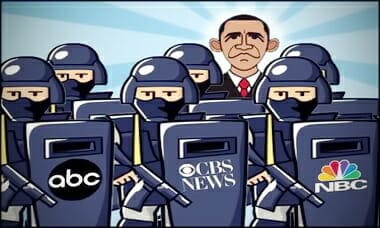
Media Bias Exemplified… AGAIN! (Plus: More CNN #fakenews)
FOX NEWS ends up being the most “Fair and Balanced,” as usual. Now, some of it may be explained away by this analogy: “The Lions [NFL] get bad press because they do poorely.” Okay, I cannot argue against nor defend Trump’s insane Tweets and foot-n-mouth disease. But many of the major networks and papers show their bias towards the issues thus:
- …immigration coverage received 96 percent of negative coverage. (NEWSBUSTERS)

In a previous NEWSBUSTERS study, they pointed out the same biased media coverage (see graphic to the right).
I WILL INCLUDE some similar graphics I have collected over the years, at the end of this post.
Here is the
How negative was press coverage of President Trump’s first 100 days in office? Far more than that of Barack Obama, George W. Bush, or Bill Clinton, according to a new report from the Harvard Kennedy School’s Shorenstein Center on Media, Politics and Public Policy.
The Harvard scholars analyzed the New York Times, Wall Street Journal, Washington Post and the main newscasts (not talk shows) of CBS, CNN, Fox and NBC during Trump’s initial time in office. They found, to no one’s surprise, that Trump absolutely dominated news coverage in the first 100 days. And then they found that news coverage was solidly negative — 80 percent negative among those outlets studied, versus 20 percent positive.

The numbers for previous presidents: Barack Obama, 41 percent negative, 59 percent positive; George W. Bush, 57 percent negative, 43 percent positive; and Bill Clinton, 60 percent negative, 40 percent positive.
Accusations of bias aside, it’s simply a fact that a number of negative things happened in Trump’s opening 100 days. The Russia investigation, for example, was a source of endless criticism from Democrats and other Trump opponents. The travel ban executive order led to intense argument and losses for the administration in the courts. The healthcare debacle created more negative coverage because it was a major screwup and a setback for both Trump and House Republicans.
That said, the coverage of some news organizations was so negative, according to the Harvard study, that it seems hard to argue that the coverage was anywhere near a neutral presentation of facts. Assessing the tone of news coverage, the Harvard researchers found that CNN’s Trump coverage was 93 percent negative, and seven percent positive. The researchers found the same numbers for NBC.
Others were slightly less negative. The Harvard team found that CBS coverage was 91 percent negative and 9 percent positive. New York Times coverage was 87 percent negative and 13 percent positive. Washington Post coverage was 83 percent negative and 17 percent positive. Wall Street Journal coverage was 70 percent negative and 30 percent positive. And Fox News coverage also leaned to the negative, but only slightly: 52 percent negative to 48 percent positive.

Ninety-three percent negative — that’s a lot by anybody’s standards. “CNN and NBC’s coverage was the most unrelenting — negative stories about Trump outpaced positive ones by 13-to-1 on the two networks,” the study noted. “Trump’s coverage during his first 100 days set a new standard for negativity.”……
What is funny is CNN produced some #fakenews from the study — of course they did!
A Couple Older “Bias” Graphics


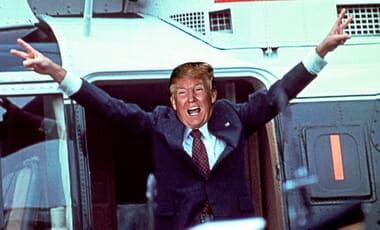
Articles of Impeachment (Nixon v. Trump)
Larry Elder covers the articles of impeachment for Nixon. Many pundits are saying that what Trump did is Nixon-like or worse, “the Sage” notes what Nixon would have been impeached for — he stepped down before that. Jonathan Turley, Leftist legal scholar and professor, notes that so far Trump’s actions don’t even come close. Enjoy!
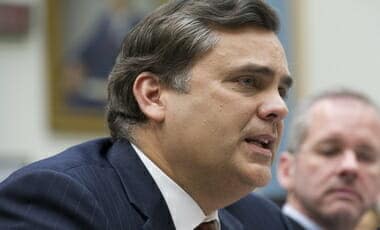
Professor Jonathan Turley On Trump/Comey/Special Prosecutor

Saudi Arabia – More Pro-American Than California?

…let’s not forget that we are dealing with a corrupt, degenerate, autocratic state where there is no free speech, where universities are run by fanatics who indoctrinate students with radical ideology; where street thugs aligned with the ruling party freely commit acts of violence against opposing views, and whose ruling elite routinely violates the basic rights of Christians and other minorities. Also, Saudi Arabia is pretty bad too.
(GAY PATRIOT “That Awkward Moment When Saudi Arabia Is More Pro-American Than California“)
WaPo – Did Trump Spills the Beans to the Russians? No
Of course the talk this morning is about the Washington Post story, highlighted at HOTAIR, where Trump was suppose to have given classified information to the Russians during a meeting. A friend asked me about this and I responded in part:
Okay, my thoughts are the same as I relayed to a friend (before the above McMaster audio was watched): ” the bottom line is in a discussion between two powers fighting a common enemy, what the President decides to declassify is his prerogative, not WaPo’s. The main issue is when are these leakers going to be prosecuted?”
To which my compatriot wisely noted: “…agreed, how many secrets were shared between FDR and Stalin?”
General McMaster also said something similar later in the day:
McMaster: “Our national security has been put at risk by those violating confidentiality and those releasing information to the press.” pic.twitter.com/JOi6wRZLfC
— ABC News (@ABC) May 16, 2017
As well as Trump laying down Presidential authority via Twitter (not so Presidential medium):

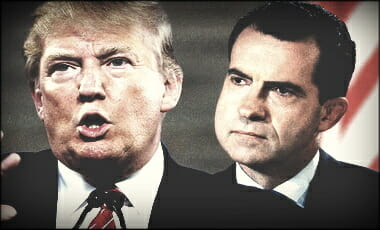
Larry Elder Ruminates On Trump, Comey, and Watergate
Here is the WASHINGTON POST article by Bill Clinton’s former Attorney General:
….It is true, as I pointed out in a Post op-ed in October, that Attorney General Loretta E. Lynch, after her tarmac meeting with Bill Clinton, had left a vacuum by neither formally recusing herself nor exercising supervision over the case. But the remedy for that was for Comey to present his factual findings to the deputy attorney general, not to exercise the prosecutorial power himself on a matter of such grave importance.
Until Comey’s testimony last week, I had assumed that Lynch had authorized Comey to act unilaterally. It is now clear that the department’s leadership was sandbagged. I know of no former senior Justice Department official — Democrat or Republican — who does not view Comey’s conduct in July to have been a grave usurpation of authority.
Comey’s basic misjudgment boxed him in, compelling him to take increasingly controversial actions giving the impression that the FBI was enmeshed in politics. Once Comey staked out a position in July, he had no choice on the near-eve of the election but to reopen the investigation when new evidence materialized. Regrettably, however, this performance made Comey himself the issue, placing him on center stage in public political discourse and causing him to lose credibility on both sides of the aisle. It was widely recognized that Comey’s job was in jeopardy regardless of who won the election.
It is not surprising that Trump would be inclined to make a fresh start at the bureau and would consult with the leadership of the Justice Department about whether Comey should remain. Those deliberations could not begin in earnest until the new deputy attorney general, Rod J. Rosenstein, to whom Comey would report, was confirmed and in a position to assess Comey and his performance. No matter how far along the president was in his own thinking, Rosenstein’s assessment is cogent and vindicates the president’s decision.
Rosenstein made clear in his memorandum that he was concerned not so much with Comey’s past arrogation of power, as astonishing as it was, but rather with his ongoing refusal to acknowledge his errors. I do not dispute that Comey sincerely believes he acted properly in the best interests of the country. But at the same time, I think it is quite understandable that the administration would not want an FBI director who did not recognize established limits on his powers.
It is telling that none of the president’s critics are challenging the decision on the merits. None argue that Comey’s performance warranted keeping him on as director. Instead, they are attacking the president’s motives, claiming the president acted to neuter the investigation into Russia’s role in the election.
The notion that the integrity of this investigation depends on Comey’s presence just does not hold water. Contrary to the critics’ talking points, Comey was not “in charge” of the investigation….

Rand Paul Discusses James Comey’s Firing
Michael Medved had Senator Rand Paul in to discuss James Comey’s firing and what the delay was in firing him earlier. A good 6-minute interview.