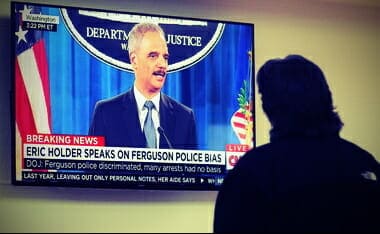
Here is some of Krauthammer’s article Prager read from:
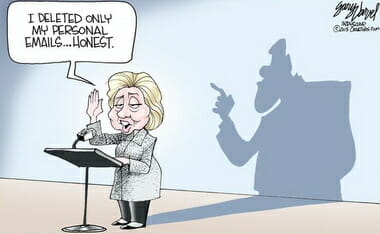
…“I didn’t see any reason to keep them.” After all, they were private and personal, she assured everyone.
How do we know that? She says so. Were, say, Clinton Foundation contributions considered personal? No one asked. It’s unlikely we’ll ever know. We have to trust her.
That’s not easy. Not just because of her history — William Safire wrote in 1996 that “Americans of all political persuasions are coming to the sad realization that our first lady . . . is a congenital liar” — but because of what she said in her emergency news conference on Tuesday. Among the things she listed as private were “personal communications from my husband and me.” Except that, as the Wall Street Journal reported the very same day, Bill Clinton’s spokesman said the former president has sent exactly two e-mails in his life, one to John Glenn, the other to U.S. troops in the Adriatic.
Mrs. Clinton’s other major declaration was that the server containing the e-mails — owned, controlled and housed by her — “will remain private.” Meaning: No one will get near them.
This she learned not from Watergate but from Whitewater. Her husband acquiesced to the appointment of a Whitewater special prosecutor. Hillary objected strenuously. Her fear was that once someone is empowered to search, the searcher can roam freely. In the Clintons’ case, it led to impeachment because when the Lewinsky scandal broke, the special prosecutor added that to his portfolio.
Hillary was determined never to permit another open-ended investigation. Which is why she decided even before being confirmed as secretary of state that only she would control her e-mail.
Her pretense for keeping just a single private e-mail account was “convenience.” She doesn’t like to carry around two devices.
But two weeks ago she said she now carries two phones and a total of four devices. Moreover, it takes about a minute to create two accounts on one device. Ray LaHood, while transportation secretary, did exactly that.
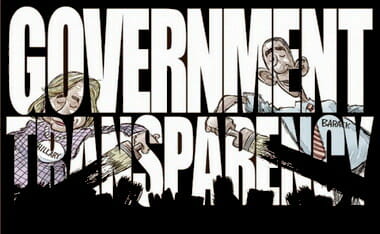
Her answers are farcical. Everyone knows she kept the e-mail private for purposes of concealment and, above all, control. For other State Department employees, their e-mails belong to the government. The records officers decide to return to you what’s personal. For Hillary Clinton, she decides….
Throughout ones life we need to reorient ourselves to a focal point. Going from the technical to the personal is something I have to remind myself of, again and again. This is a great presentation to refocus us on the interpersonal relationships between people… allowing God to move through these opportunities to impact the heart and mind.
a wise man will listen and increase his learning… for understanding a proverb or a parable… and their riddles.
So there seems to be a way to learn techniques that help us inculcate well, Scripture, and to represent it well to others. In theology, there is a technique called Hermeneutics, and while used quite often in Christian theology, these techniques “pre-date” Christ and should be looked at as truths imbued into nature by its Creator, like reason and logic. So let’s define these ideas a bit before continuing:
Hermeneutics – From the Greek hermeneutikos, “interpretation.” Hermeneutics is the science of the study and interpretation of Scripture, the branch of theology that prescribes rules by which the Bible should be interpreted. Biblical hermeneutics strives to formulate guidelines for studying Scripture that help recover the meaning a Biblical text had for its original hearers. (The Compact Dictionary of Doctrinal Words, 1988).
Underneath the “hermeneutic umbrella” is the idea of using the document in question to interpret the entire document.
Exegesis – (Gk. explanation) Critical exposition or explanation of the meaning of a scriptural passage in the context of the whole Bible. The reader of Scripture studies the word meanings and grammar of the text to discern what… was communicated, drawing the meaning out of the text rather than reading what he wants into the text (eisegesis).
Eisegesis – is the process of interpreting a text or portion of text in such a way that it introduces one’s own presuppositions, agendas, and/or biases into and onto the text.
Why do people insert their biases or anachronistic thinking into the Biblical text? We know why the unregenerate person does:
…the mind set on the flesh is hostile toward God; for it does not subject itself to the law of God, for it is not even able to do so (Romans 8:7)
But even Christian thinkers will undutifully insert ideas into the text that the text itself does not call for. A neat story to further my point comes from a story retold from John Warwick Montgomery in Classical Apologetics
STORY OF A DEAD GUY
Once upon a time — note the mystical cast — there was a man who thought he was dead. His concerned wife and friends sent him to the friendly neighborhood psychiatrist determined to cure him by convincing him of one fact that contradicted his beliefs that he was dead. The fact that the psychiatrist decided to use was the simple truth that dead men do not bleed. He put his patient to work reading medical texts, observing autopsies, etc. After weeks of effort the patient finally said, “All right, all right! You’ve convinced me. Dead men do not bleed.” Whereupon the psychiatrist stuck him in the arm with a needle, and the blood flowed. The man looked down with a contorted, ashen face and cried, “Good Lord! Dead men bleed after all!”
Emotional prejudice IS NOT LIMITEDto:
1) the dull-witted, 2) the illiterate, 3) and poorly educated.
…are not exempt from the vested interests and psychological prejudice that distort logical thinking. One of my favorite examples of this adding to the text that many do to this day can be found in Genesis. James Barr — one of the most trusted scholars on ancient Hebrew — long time Oriel professor at Oxford — and himself a neo-orthodox believer, rightly applied to Scripture a point of view he personally rejects:
…probably, so far as I know, there is no professor of Hebrew or Old Testament at any world-class university who does not believe that the writer(s) of Genesis [chapters] 1–11 intended to convey to their readers the ideas that:
1. creation took place in a series of six days which were the same as the days of 24 hours we now experience; 2. the figures contained in the Genesis genealogies provided by simple addition a chronology from the beginning of the world up to later stages in the biblical story; 3. Noah’s flood was understood to be world-wide and extinguished all human and animal life except for those in the ark.
You see, professor Barr asked some of the following questions that are simple questions one should ask coming to any text, especially ancient texts:
Who was the writer?
To whom were they writing?
Is the choice of words, wording, or word order significant in this particular passage?
What is the cultural, historical context?
What was the author’s original intended meaning?
How did the author’s contemporaries understand him?
Why did he say it that way?
Bully for Barr! Who was no friend to this interpretation of Scripture by He was also an outspoken critic of conservative Evangelicalism (WIKI).
Why do we insist on putting our own thoughts and ideas into/onto the Bible, or why we allow the skeptic to think he has mastered God’s Holy word by placing onto Scripture anachronistic thinking and creating straw-man arguments which they then immediately tear down? With the skeptic, the belief in God is VERY personal… e-v-e-n if they don’t admit it. The question of the existence of God evokes deep emotional and psychological prejudice. People understand that the question of the existence of God is not one that is of neutral consequence. We understand intuitively, if not in terms of its full rational implication, that the existence of an eternal Creator before whom we are ultimately accountable and responsible is a matter that touches the very core of life.
How do we try and keep our, yes our, biases out so we “correctly teaching the word of truth”? And not abrogate control of the conversation to the skeptical friend or family member? One way is the old-fashioned way, the eight rules of interpretation. These 8-Rules pre-date Christ, that being said, they matured greatly under Christianity and are used across many disciplines to this day.
Greeks (Aristotle and Cicero) are the genesis of, Irenaeus used them when he wrote Against Heresies, which dealt with Gnosticism and other untruths. Every law court religiously follows them and honest theologians dare not violate them. Much false teaching is the result of violating one or more of these universal rules of interpretation. They were used by the master expositors of the Middle Ages all the way to Luther and the Reformation theologians who disproved Roman fallacies with them. These rules were involved in the great doctrinal debates of the theologians from the Council of Nice (324 A.D.) to the Council of Trent (1545-1563).
WHAT ARE THESE RULES?
1) Rule of Definition: Define the term or words being considered and then adhere to the defined meanings.
Any study of Scripture . . . must begin with a study of words. (Protestant Biblical Interpretation, Ramm, Bernard, p. 129. W. A. Wilde Co.. Boston. 1956. )
Define your terms and then keep to the terms defined. (The Structural Principles of the Bible, Marsh, F. E., p. 1. Kregel Publications.)
In the last analysis, our theology finds its solid foundation only in the grammatical sense of Scripture. The interpreter should . . . conscientiously abide by the plain meaning of the words. (Principles of Biblical Interpretation, Berkhof, pp. 74?75, Baker Book House, 1960.)
The Bible writers could not coin new words since they would not be understood, and were therefore forced to use those already in use. The content of meaning in these words is not to be determined by each individual expositor . . . to do so would be a method of interpretation [that is] a most vicious thing. (Studies in the Vocabulary of the Greek New Testament, bluest, Kenneth. pp. 30-37, Eerdmans Pub. Co., 1945.)
[The author] confines the definitions strictly to their literal or idiomatic force; which, after all. will be found to form the best. and indeed the only safe and solid basis for theological deductions of any kind. (Young’s Analytical Concordance, Prefatory Note.)
2) Rule of Usage: Don’t add meaning to established words and terms. Ask what was the common usage in the culture at that time period.
The whole Bible may be regarded as written for “the Jew first.” and its words and idioms ought to be rendered according to Hebrew usage. (Synonyms of the Old Testament, Girdlestone. R. B., p. 14.)
Christ then accepted the usage He found existing. He did not alter it. (Pulpit Commentary, Matthew, V. 1, xxv. old edition.)
Jesus of Nazareth was a Jew, spoke to and moved among Jews in Palestine …. He spoke first and directly to the Jews, and His words must have been intelligible to them… It was absolutely necessary to view that Life and Teaching in all its surroundings of place. society. popular life…. This would form not only the frame in which to set the picture of the Christ, but the very background of the picture itself. (The Life and Times of Jesus the Messiah, Edersheim, Alfred. V, 1, xii, Eerdmans Pub. Co., 1953.)
In interpreting very many phrases and histories of the New Testament, it is not so much worth what we think of them from notions of our own . . . as in what sense these things were understood by the hearers and lookers on. according to the usual custom and vulgar dialect of the nation. (Bishop Lightfoot, quoted in The Vocabulary of the Greek New Testament, xii. Moulton & Mulligan, Eerdmans Pub. Co., 1959.)
3) Rule of Context: Avoid using words out of context. Context must define terms and how words are used.
Many a passage of Scripture will not be understood at all without the help afforded by the context; for many a sentence derives all its point and force from the connection in which it stands. (Biblical Hermeneutics, Terry. M. S.. p. 117. 1896.)
[Bible words] must be understood according to the requirements of the context. (Thayer’s Greek English Lexicon of the New Testament, p. 97.)
Every word you read must be understood in the light of the words that come before and after it. (How to Make Sense, Flesch, Rudolph, p. 51, Harper & Brothers. 1959.)
[Bible words] when used out of context . . . can prove almost anything. [Some interpreters] twist them . . . from a natural to a non?natural sense. (Irenaeus, second century church father, quoted in Inspiration and Interpretation, p. 50, Eerdmans Pub. Co., 1957.)
The meaning must be gathered from the context. (Encyclopedia Britannica, Interpretation of Documents. V. 8, p. 912. 1959.)
4) Rule of Historical background: Don’t separate interpretation from historical investigation.
Even the general reader must be aware that some knowledge of Jewish life and society at the time is requisite for the understanding of the Gospel history. (The Life and Times of Jesus the Messiah, Edersheim. Alfred. V. 1, xiii, Eerdmans Pub. Co., 1953.)
The moment the student has in his mind what was in the mind of the author or authors of the Biblical books when these were written. he has interpreted the thought of Scripture …. If he adds anything of his own. it is not exegesis. (International Standard Bible Encyclopedia. V. 3. p. 1489. 1952.)
Theological interpretation and historical investigation can never be separated from each other. . . . The strictest historical . . . scrutiny is an indispensable discipline to all Biblical theology. (A Theological Word Book of the Bible, 30 scholars. Preface, Macmillan Co., 1958.)
I have said enough to show the part which the study of history necessarily plays in the intelligent study of the law as it is today …. Our only interest in the past is for the light it throws upon the present. (U.S. Supreme Court Justice Oliver Wendell Holmes, Jr., [sat on the bench from 1902 to 1932] quoted in The World of Law, V. 2. p. 630. Simon & Schuster. 1960.)
5) Rule of Logic: Be certain that words as interpreted agree with the overall premise.
Interpretation is merely logical reasoning. (Encyclopedia Americana. V. 15. p. 261. 1953.)
The use of reason in the interpretation of Scripture is everywhere to be assumed. The Bible comes to us in the forms of human language, and appeals to our reason . . . it invites investigation. and it is to be interpreted as we interpret any other volume by a rigid application of the same laws of language, and the same grammatical analysis. (Biblical Hermeneutics, Terry, M. S., p. 25. 1895.)
What is the control we use to weed out false theological speculation? Certainly the control is logic and evidence . . . interpreters who have not had the sharpening experience of logic . . . may have improper notions of implication and evidence. Too frequently such a person uses a basis of appeal that is a notorious violation of the laws of logic and evidence. (Protestant Biblical Interpretation, Ramm, Bernard. pp. 151153, W. A. Wilde Co., 1956.)
It is one of the most firmly established principles of law in England and in America that “a law means exactly what it says, and is to be interpreted and enforced exactly as it reads.” This is just as good a principle for interpreting the Bible as for interpreting law. (The Importance and Value of Proper Bible Study, Torrey. R. A., pp. 67-70, Moody Press, 1921.)
Charles G. Finney, lawyer and theologian, is widely considered the greatest theologian and most successful revivalist since apostolic times. He was often in sharp conflict with the theologians of his day because they violated these rules of interpretation. Finney said he interpreted a Bible passage as he “would have understood the same or like passage in a law book” (Autobiography, pp. 42-43 ).
Finney stressed the need for definition and logic in theology and said the Bible must be understood on “fair principles of interpretation such as would be admitted in a court of justice” (Systematic Theology. Preface, ix).
6) Rule of Precedent: Use the known and commonly accepted meanings of words, not obscure meanings for which there is no precedent.
We must not violate the known usage of a word and invent another for which there is no precedent. (The Greek New Testament for English Readers, Alford, Dean, p. 1098, Moody Press.)
The professional ability of lawyers in arguing a question of law, and the judges in deciding it, is thus chiefly occupied with a critical study of previous cases. in order to determine whether the previous cases really support some alleged doctrine. (Introduction to the Study of Law, p. 40, Woodruff, E. H., 1898.)
The first thing he [the judge] does is to compare the case before him with precedents …. Back of precedents are the basic judicial conceptions which are postulates of judicial reasoning, and farther back are the habits of life, the institutions of society, in which those conceptions had their origin …. Precedents have so covered the ground that they fix the point of departure from which the labor of the judge begins. Almost invariably, his first step is to examine and compare them. It is a process of search, comparison. and little more. (U.S. Supreme Court Justice Benjamin Cardozo, [sat on the bench from 1902 to 1932], The Nature of the Judicial Process, quoted in The World of Law, V. 2. p. 671. Simon & Schuster, 1960.)
7) Rule of Unity: Even though many documents may be used there must be a general unity among them.
[It is] fundamental to a true interpretation of the Scripture. viz.. that the parts of a document. law, or instrument are to be construed with reference to the significance of the whole. (Dean Abbot. Commentary on Matthew, Interpretation, p. 31. )
Where a transaction is carried out by mean of several documents so that together they form part of a single whole, these documents are read together as one …. [They are to be so read], that, THATconstruction is to be preferred which will render them consistent. (Interpretation of Documents, Sir Roland Burrows. p. 49. Lutterworth & Co., London. 1946.)
8) Rule of Inference: Base conclusions on what is already known and proven or can be reasonably implied from all known facts.
In the law of evidence. an inference is a fact reasonably implied from another fact. It is a logical consequence. It is a process of reasoning. It derives a conclusion from a given fact or premise. It is the deduction of one proposition from another proposition. It is a conclusion drawn from evidence. An inferential fact or proposition. although not expressly stated. is sufficient to bind. This principle of interpretation is upheld by law courts. (Jesus proved the resurrection of the dead to the unbelieving Sadducees by this rule [Matt. 22:31. 32]. See Encyclopedia Britannia, V. 6. p. 615 [1952] and Black’s Law Dictionary, p. 436, Fourth Edition. West Pub. Co.. 1951. )
A proposition of fact is proved when its truth is established by competent and satisfactory evidence. By competent evidence is meant such evidence as the nature of the thing to be proved admits. By satisfactory evidence is meant that amount of proof which ordinarily satisfies an unprejudiced mind beyond reasonable doubt. Scripture facts are therefore proved when they are established by that. kind and degree of evidence which would in the affairs of ordinary life satisfy the mind and conscience of a common man. When we have this kind and degree of evidence it is unreasonable to require more. (Systematic Theology, Strong. Augustus H.. p. 142. Judson Press. 1899.)
Is there an ancient example exemplifying a bit of what we are talking about? We find in Aristotle’s Poetics(25) the following:
They [the critics] start with some improbable presumption; and having so decreed it themselves, proceed to draw inferences, and censure the poet as though he had actually said whatever they happen to believe, if, his statement conflicts with their notion of things….
Whenever a word seems to imply some contradiction, it is necessary to reflect how many ways there may be of understanding it in the passage in question…. So it is probably the mistake of the critics that has given rise to the Problem….
So let us deal with four major missteps people make in coming to the Bible which also translate to the believer as a deeper study of God’s Word:
LANGUAGE GAP
…Consider how confused a foreigner must be when he reads in a daily newspaper:
“The prospectors made a strike yesterday up in the mountains.”
“The union went on strike this morning.”
“The batter made his third strike and was called out by the umpire.”
“Strike up with the Star Spangled Banner.”
“The fisherman got a good strike in the middle of the lake.”
Or consider what Dr. Edgar Andrews wrote about in his book, Who Made God:
When I first began visiting the USA regularly on business, I was struck by the huge versatility of one little word — check. Not only could you write a check to pay a bill and check that your airline hadn’t gone bankrupt overnight, but you could request your check at the end of a restaurant meal, check the boxes on your laundry list (or any other form for that matter), check your luggage at the airline desk, check in or check out of a hotel, check out a new product, check your hasty words when you got mad with some officious bureaucrat, and so on. Then, of course, the word lends itself beautifully to portmanteau usage, as in checklist, raincheck and checkup (I never did encounter checkdown but I’m still optimistic). Why, with a few more words like ‘check’ we could halve the weight of our dictionaries!
Another step that will enlighten our study time is
THE CULTURE GAP
If we don’t understand the various cultures of the time in which the Bible was written, we’ll never comprehend its meaning. For example, if we did not know anything about the Jewish culture at the time of Christ, the Gospel of Matthew would be very difficult to grasp. Concepts such as the Sabbath, Jewish rituals, the temple ceremonies, and other customs of the Jews must be understood within cultural context in order to gain the true meaning of the author’s ideas.
THE GEOGRAPHY GAP
A failure to be familiar with geography will hinder learning. For instance, in 1 Thessalonians 1:8 we read, “The Lord’s message rang out from you not only in Macedonia and Achaia—your faith in God has become known everywhere.” What is so remarkable about this text is that the message traveled so quickly. In order to understand how, it is necessary to know the geography.
Paul had just been there, and when he wrote the letter, very little time had passed. Paul had been with them for a couple of weeks, but their testimony had already spread far. How could that happen so fast? If you study the geography of the area you’ll find that the Ignatian Highway runs right through the middle of Thessalonica. It was the main concourse between the East and the West, and whatever happened there was passed all the way down the line.
THE HISTORY GAP
Knowing the history behind a passage will enhance our comprehension of what was written. In the Gospel of John, the whole key to understanding the interplay between Pilate and Jesus is based on the knowledge of history. John MacArthur in “How to Study the Bible” says about Pilate:
When Pilate came into the land with his emperor worship, it literally infuriated the Jews and their priests. So he was off to a bad start from the very beginning. Then he tried to pull something on the Jews, and when they caught him, they reported him to Rome, and he almost lost his job. Pilate was afraid of the Jews, and that’s why he let Christ be crucified. Why was he afraid? Because he already had a rotten track record, and his job was on the line.
Let’s apply, then, what we learned from these literary skills from Aristotle and others, and see where they lead us with supposed difficulties in the Bible. Aristotle’s dictum ~ the benefit of the doubt is afforded to the author of the document, not allowing it to be arrogated by the critic, is standard practice in court rooms to this day. That is, the benefit of the doubt to the document unless there is clear evidence that it is not what it claims to be. First we will start with a hypothetical, then go to the historical.
Let’s say you have a friend—let’s call him Ken—who lives in the Midwest. Ken had three very good friends—let’s call them Jim, John, and Mark—who live on the East Coast. One day Ken received a note from John saying that Jim was involved in a terrible car accident and died instantly. The following day, Ken received a letter from Mark saying that Jim was in an car accident and survived but died some time later.
At first glance, these two accounts seem to contradict each other. Either Jim died instantly in the accident or he did not.
Now, Ken knew that John and Mark were reliable sources, and he trusted them to give him an accurate account of the events surrounding their mutual friend’s death. As it turned out, John and Mark were both right, but there was missing information.
Jim was actually involved in two automobile accidents on the same day. In the first accident, Jim was badly injured but survived. A “Good Samaritan” stopped to help him, taking him to the nearest emergency room. However, on the way to the hospital, the driver of that vehicle was involved in a very serious accident, and as a result Jim was instantly killed. Hence, both accounts were correct. John was not aware of the first accident; he only knew about the second one that instantly killed Jim. Mark was only aware of the details of the first accident in which Jim survived, and not the second; he only knew that Jim died later that day. The apparent contradiction was solved when the rest of the truth was discovered.
STORY OF JUDAS
In theGospel according to Matthew, he records the death Judas as suicide by hanging (Matthew 27:5). However, in Acts 1:18 Luke records the death of Judas as having occurred when he fell down and his body “burst open.” Some scholars have determined that these two divergent accounts are, irreconcilable; they assume that one or even both of these accounts are incorrect. If Matthew and Luke are trustworthy in giving an accurate accounts of the events, it certainly seems as if at least one of them is in error: Judas either fell down or he hung himself. Or is it another option?
If the branch from which Judas hung himself was dead and dry–and there are many trees that match this description even to this day on the brink of the canyon that tradition identifies the place where Judas died–it would take only one strong gust of wind to yank the heavy corpse and split the branch to which it was attached and plunge both with great force into the bottom of the chasm below. There is indication that a strong wind arose at the hour Christ died and ripped the great curtain inside the temple from top to bottom (Matthew 27:50C.)
These accounts are not contradictory, but mutually complementary. Judas hung himself exactly as Matthew affirms that he did. The account in Acts simply adds that Judas fell, and his body opened up at the middle and his intestines gushed out. This is the very thing one would expect of someone who hanged himself from a tree over a cliff and fell on sharp rocks below.
So this application and understanding that seemingly divergent tales may in fact be mutually complementary… if giving the benefit of the doubt to this ancient book. And you can see how teaching sound doctrine just is placed in us miraculously, is situ.
“But you must say the things that are consistent with sound teaching” (Titus 2:1).
THERE IS ALSO GENRE (IN THE OLD TESTAMENT)
Lawis “God’s law,” they are the expressions of His sovereign will and character. The writings of Moses contain a lot of Law. God provided the Jews with many laws (619 or so). These laws defined the proper relationship with God to each others and the world (the alien)….
History. Almost every OT book contains history. Some books of the Bible are grouped together and commonly referred to as the “History” (Joshua, Kings & Chronicles). These books tell us the history of the Jewish people from the time of the Judges through the Persian Empire…. In the NT, Acts contains some of the history of the early church, and the Gospels also have History as Jesus’ life is told as History….
Wisdom Literature is focus on questions about the meaning of life (Job, Ecclesiastes), practical living, and common sense (Proverbs and some Psalms )….
Poetryis found mostly in the Old Testament and is similar to modern poetry. Since it is a different language, “Hebrew,” the Bible’s poetry can be very different, because it does not translate into English very well….
Prophecy is the type of literature that is often associated with predicting the future; however, it is also God’s words of “get with it” or else. Thus Prophecy also exposes sin and calls for repentance and obedience. It shows how God’s law can be applied to specific problems and situations, such as the repeated warnings to the Jews before their captivity….
Apocalyptic Writing is a more specific form of prophecy. Apocalyptic writing is a type of literature that warns us of future events which, full meaning, is hidden to us for the time being….
Just the other day an atheist got on my YouTube account and posted this on Prager critiquing seculrism:
Secularism makes more sense that some imaginary friend in the sky. They mention unicorns and dragons in the bible. Yes, I will take that seriously… NOT!
So lets apply some of what we learned (#’s 2 and 4 should suffice). Through the study of the word in question, “unicorn,” we come to find is only in the King James Bible, which is known for it’s “Queens language,” having been written in the early 1600’s. So what did the word “unicorn” mean in the 1600’s? We have a clue in Websters first edition (1828) of his dictionary.
(Take note that “bicorn” is defined in the 1828 edition as an animal with two horns) What does the Webstersdictionary say today?
…a mythical animal generally depicted with the body and head of a horse, the hind legs of a stag, the tail of a lion, and a single horn in the middle of the forehead.
They even are so kind as to furnish their readers with a picture (to the right). Let us apply another of the eight rules of interpretation (#’s 7 and 8 should do). Elsewhere in the KJV we read the following:
mentions them traveling like bullocks, and bleeding when they die.
Horses have been tamed for agricultural work, so the above descriptions fit something else. Let’s use the term as was used in the day of its writing to define the meaning.
HERE IS A UNICORN:
HERE IS A BICORN:
Definitely not a creature typically see doing agricultural work. You see, what the skeptic has done is taken a word as defined today and ripped it from it’s historical context, placed it onto another culture/time period (built a straw-man), and then attack it. The argument really shouldn’t involve us at all. It is all going on in the head of the skeptic… he is arguing with himself! All you have to call for is lithium for this bi-polar person. Since, however, I am a young earth creationist (YEC), I would even posit that Job was viewing the Elasmotherium (Greek for “plated beast”; pronounced ell-azz-moe-THEE-ree-um):
But whether you posit the ELASMOTHERIUM (pictured above), or a simple rhino… this is using a lane-line guide to look at — not only the Bible (but especially the Bible ~ *smile*), but any ancient text.
He went up from there to Bethel, and while he was going up on the way, some small boys came out of the city and jeered at him, saying, “Go up, you baldhead! Go up, you baldhead!” And he turned around, and when he saw them, he cursed them in the name of the LORD. And two she-bears came out of the woods and tore forty-two of the boys. From there he went on to Mount Carmel, and from there he returned to Samaria.
Here the skeptic posits God’s wrath on 42 children, presumably innocent in that their greatest offense was calling someone a “bald-head.” It would be similar to a guy being called “four-eyes” by a bunch of kids and then whipping out an AK-47 and mowing them down… and then expecting you to view him as a moral agent. In accessing the following books,
The New Manners & Customs of Bible Times;
Manners and Customs in the Bible: An Illustrated Guide to Daily Life in Bible Times;
An Introduction to the Old Testament;
The IVP Bible Background Commentary: Old Testament;
Old Testament Survey: The Message, Form, and Background of the Old Testament;
A Popular Survey of the Old Testament;
New International Encyclopedia of Bible Difficulties;
Hard Sayings of the Bible;
When Critics Ask: A Popular Handbook on Bible Difficulties.
I noticed something was missing. That is, a bit more of what is not said in the text, but we can assume using and accessing what any historical literary critic would with the principles that predate Christ — mentioned in the above “latte” link. Mind you, many of the responses in my home library that I came across were great, and, in fact they made me dig a bit further. (I do not want the reader to think that I place myself on a higher academic level that these fine theologians and professors.) Three big points stuck out from texts I reviewed:
“LITTLE KIDS”
“Little children” is an unfortunate translation. The Hebrew expression neurim qetannim is best rendered “young lads” or “young men.” From numerous examples where ages are specified in the Old Testament, we know that these were boys from twelve to thirty years old. One of these words described Isaac at his sacrifice in Genesis 22:12, when he was easily in his early twenties. It described Joseph in Genesis 37:2 when he was seventeen years old. In fact, the same word described army men in 1 Kings 20:14-15…these are young men ages between twelve and thirty.” (Hard Sayings of the Bible)
HARMLESS TEASING/PUBLIC SAFETY
A careful study of this incident in context shows that it was far more serious than a “mild personal offense.” It was a situation of serious public danger, quite as grave as the large youth gangs that roam the ghetto sections of our modern American cities. If these young hoodlums were ranging about in packs of fifty or more, derisive toward respectable adults and ready to mock even a well-known man of God, there is no telling what violence they might have inflicted on the citizenry of the religious center of the kingdom of Israel (as Bethel was), had they been allowed to continue their riotous course. (Encyclopedia of Bible Difficulties)
The harmless “teasing” was hardly that–they were direct confrontation between the forces of Baal and the prophet of YHWH that had just healed the water supply (casting doubt on the power and beneficence of Baal!). This was a mass demonstration (if 42 were mauled, how many people were in the crowd to begin with? 50? 100? 400?):
“As Elisha was traveling from Jericho to Bethel several dozen youths (young men, not children) confronted him. Perhaps they were young false prophets of Baal. Their jeering, recorded in the slang of their day, implied that if Elisha were a great prophet of the Lord, as Elijah was, he should go on up into heaven as Elijah reportedly had done. The epithet baldhead may allude to lepers who had to shave their heads and were considered detestable outcasts. Or it may simply have been a form of scorn, for baldness was undesirable (cf. Isa. 3:17, 24). Since it was customary for men to cover their heads, the young men probably could not tell if Elisha was bald or not. They regarded God’s prophet with contempt….Elisha then called down a curse on the villains. This cursing stemmed not from Elisha pride but from their disrespect for the Lord as reflected in their treatment of His spokesman (cf. 1:9-14). Again God used wild animals to execute His judgment (cf., e.g., 1 Kings 13:24). That 42 men were mauled by the two bears suggests that a mass demonstration had been organized against God and Elisha.” [Bible Knowledge Commentary]
ELISHA’S MISSION-HELPING NEEDY
The chapter closes with two miracles of Elisha. These immediately established the character of his ministry–his would be a helping ministry to those in need, but one that would brook no disrespect for God and his earthly representatives. In the case of Jericho, though the city had been rebuilt (with difficulty) in the days of Ahab (1 Kings 16:34, q.v.), it had remained unproductive. Apparently the water still lay under Joshua’s curse (cf. Josh 6:26), so that both citizenry and land suffered greatly (v. 19). Elisha’s miracle fully removed the age-old judgment, thus allowing a new era to dawn on this area (vv. 20-22). Interestingly Elisha wrought the cure through means supplied by the people of Jericho so that their faith might be strengthened through submission and active participation in God’s cleansing work. (Encyclopedia of Bible Difficulties)
All good stuff, but something is missing. During the course of the debate I pieced together some truths, using culture and history as keys to a “crime scene.” Again, I want to stress what some of the habits were in this small town where this group of people came from:
Molech was a Canaanite underworld deity represented as an upright, bull-headed idol with human body in whose belly a fire was stoked and in whose arms a child was placed that would be burnt to death. It was not just unwanted children who were sacrificed. Plutarch reports that during the Phoenician (Canaanite) sacrifices, “the whole area before the statue was filled with a loud noise of flutes and drums so that the cries and wailing should not reach the ears of the people.”
This crowd of persons was older than what is typically posited by skeptics. Secondly, this group was a very bad lot. But didn’t explain why bald-head was egregious enough for God to call 42 scurvy bastards to judgement. To be fair, I sympathize with the skeptic here. That being said, there is more to the story. I want us to view some artistic drawings of historical figures from Israels history: priests, prophets, spiritual leaders, and even Flavius Josephus.
What did you notice above in the cover to an A&E documentary? Yup, a turban or covering of some sort as well as a cloak which covers the heads of the priests and prophets. Take note of the below as well.
I posted so many images to drive a point home in our mind. The prophet Elisha would have had a couple of things that changes this story from simple name calling to an assault. Firstly, he wouldn’t have been alone, he would have had some people attached to him that would lay down their lives to protect him. And secondly, he would have had a head covering on, especially since he was returning from a “priestly” intervention.
One last point before we bullet point the complete idea behind the Holy and Rightful judgement from the Judge of all mankind. There were 42 persons killed by two bears. Obviously this would require many more than 42 people. Why? What happens when you have a group of ten people and a bear comes crashing out of the bushes in preparation to attack? Every one will immediately scatter! In the debate I pointed out that freezing 42 people and allowing the bears time to go down the line to kill each one would be even more of a miracle than this skeptic would want to allow. So the common sense position would require a large crowd and some sort of terrain to cut off escape. So the crowd would probably have been at least a few hundred.
Also, this holy man of God was coming back from a “mission,” he would have had an entourage with him, as well as having some sort of head-covering on as pictured above. So, what do these cultural and historical points cause us to rightly assume? That the crowd could not see that the prophet was bald. Which means they would have had to of gotten physical — forcefully removing the head covering. Which means also that the men with the prophet Elisha would have also been overpowered. So lets bullet point the points that undermine the skeptics viewpoint.
✔ The crowd was in their late teens to early twenties; ✔ they were antisemitic (this is known from most of the previous passages and books); ✔ they were from a violently cultic city; ✔ the crowd was large;
And unique to me having shown that there is no way for the crowd to know Elisha was bald unless they had already attacked him and his entourage, is this point:
✔ the crowd had already turned violent.
These points caused God in his foreknowledge to protect the prophet and send in nature to disperse the crowd. Nature is not kind, and the death of these men were done by a just Judge. This explains the actions of a just God better than many of the references I read.
SO IN CONCLUSION,
a knowledge of history, culture, language, the words being used and their history, and the like… all contribute to the “sound doctrine” we are called to express.
Because otherwise, we will be the time-keepers in the story below, wronger and wronger all the time:
THE BELL TOWER
Have you ever heard the story of a man who used to go to work at a factory and every day would stop outside a clockmaker’s store to synchronize his watch with the clock outside? At the end of several days the clockmaker stopped him and said, “Excuse me, sir, I do have a question for you. I see that every day you stop and adjust your watch with my clock. What kind of work do you do?” The man said, “I’m embarrassed to tell you this; I keep the time at the factory nearby, and I have to ring the bell at four o clock every afternoon when it is time for the people to go home. My watch doesn’t work very well, so I synchronize it with your clock.” The clockmaker says, “I’ve got bad news for you. My clock doesn’t work very well either, so I synchronize it with the bell that I hear from the factory at 4:00 every afternoon.” If you’ll pardon the grammar, what happens when two wrong watches correct themselves by each other? They will get wronger and wronger all the time. Even a clock that doesn’t work may show you the right time twice a day…but it’s not because it’s keeping time!
Ravi Zacharias, “Address to the United Nations’ Prayer Breakfast.”
(Short description) There is a band called Five Finger Death Punch… in this short hand-out I explain how to get the most out of Bible reading. This was [again] a handout for a Sunday school class I filled in for at Grace Baptist. This class I taught was on Hermeneutics and dissecting Scripture through exegesis.
UNITED NATIONS (AP) — Hillary Rodham Clinton says she used a private email account when she served as secretary of state as a way to avoid carrying more than one electronic device.
But she recently said she now uses multiple electronic devices. During an interview at a women’s conference in California’s Silicon Valley last month, Clinton was asked by tech publisher Kara Swisher whether she preferred Apple’s iPhone or Google’s Android.
Clinton said she liked the iPhone but she also used a BlackBerry. She joked to Swisher that she was “two steps short of a hoarder” and has four electronic devices: an iPad, a mini-iPad, an iPhone and a BlackBerry.
In a discussion about Hillary’s emails, a 2nd Amendment loving ex-conservative (read here, committed [not in an asylum] lefty) said this:
[icon name=”thumb-tack” class=””] Its another “Bengazi-styled”, mountain out of a mole hill, Fox news promoted, waste of time, partisan, Hillary witch hunt.
This really is not the case. In other words, Fox is joined by a chorus of media this time. Remember, when this was found out, Democrats were pissed: “5 House Democrats call for release of first batch of Hillary Clinton emails.” Hillary herselfin 2007 was against secret emails before she was for them.
“We know our Constitution is being shredded. We know about the secret wiretaps, the secret military tribunals, the secret White House email accounts.” ~ 2007 (RPT)
The AP (not Fox News) is suing Hillary. And NPR points out 3-reasons Dems are worried (what the Washington Post says are leading Democrats):
1. Democrats feel like they’ve just stepped into the wayback machine and not in a good way. 2. It won’t go away any time soon. 3. There’s no Plan B.
Bubba even said he never emailed her, then, “surprise, surprise,” the emails are already showing this to be a lie.
She also printed out 50,000 pages of emails… as to make me ask on my Twitter how many indigenous people had to die and trees be destroyed for this eco-terror to happen :lol:
She has said she deleted many. S h e – h a s – s a i d… not Fox News.
So this scandal is soo bad that Fox is not the leader in real news for once. Nor are Republicans taking legal action against the Clinton’s~ the Democrats are as well as the AP.
The Associated Press on Wednesday sued the State Department to force the release of email correspondence and government documents from Hillary Rodham Clinton’s tenure as secretary of state.
The legal action follows repeated requests filed under the U.S. Freedom of Information Act that have gone unfulfilled. They include one request the AP made five years ago and others pending since the summer of 2013.
The suit in U.S. District Court comes a day after Clinton broke her silence about her use of a private email account while she was America’s top diplomat.
The FOIA requests and the suit seek materials related to her public and private calendars; correspondence involving aides likely to play important roles in her expected campaign for president; and Clinton-related emails about the Osama bin Laden raid and National Security Agency surveillance practices.
“After careful deliberation and exhausting our other options, The Associated Press is taking the necessary legal steps to gain access to these important documents, which will shed light on actions by the State Department and former Secretary Clinton, a presumptive 2016 presidential candidate, during some of the most significant issues of our time,” said Karen Kaiser, AP’s general counsel.
Said AP Executive Editor Kathleen Carroll: “The Freedom of Information Act exists to give citizens a clear view of what government officials are doing on their behalf. When that view is denied, the next resort is the courts.”…
THE FACTS: Although email practices varied among her predecessors, Clinton is the only secretary of state known to have conducted all official unclassified government business on a private email address. Years earlier, when emailing was not the ubiquitous practice it is now among high officials, Colin Powell used both a government and a private account. It’s a striking departure from the norm for top officials to rely exclusively on private email for official business.
CLINTON: “I fully complied with every rule I was governed by.”
THE FACTS: At the very least, Clinton appears to have violated what the White House has called “very specific guidance” that officials should use government email to conduct business.
Clinton provided no details about whether she had initially consulted with the department or other government officials before using the private email system. She did not answer several questions about whether she sought any clearances before she began relying exclusively on private emails for government business.
Federal officials are allowed to communicate on private email and are generally allowed to conduct government business in those exchanges, but that ability is constrained, both by federal regulations and by their supervisors.
Federal law during Clinton’s tenure called for the archiving of such private email records when used for government work, but did not set out clear rules or punishments for violations until rules were tightened in November. In 2011, when Clinton was secretary, a cable from her office sent to all employees advised them to avoid conducting any official business on their private email accounts because of targeting by unspecified “online adversaries.”
CLINTON: “I did not email any classified material to anyone on my email. There is no classified material.”
THE FACTS: The assertion fits with the facts as known but skirts the issue of exchanging information in a private account that, while falling below the level of classified, is still sensitive.
The State Department and other national security agencies have specified rules for the handling of such sensitive material, which could affect national security, diplomatic and privacy concerns, and may include material such as personnel, medical and law enforcement data. In reviewing the 30,000 emails she turned over to the State Department, officials are looking for any security lapses concerning sensitive but unclassified material that may have been disclosed.
CLINTON: “It had numerous safeguards. It was on property guarded by the Secret Service. And there were no security breaches.”
THE FACTS: While Clinton’s server was physically guarded by the Secret Service, she provided no evidence it hadn’t been compromised by hackers or foreign adversaries. She also didn’t detail who administered the email system, if it received appropriate software security updates, or if it was monitored routinely for unauthorized access.
Clinton also didn’t answer whether the homebrew computer system on her property had the same level of safeguards provided at professional data facilities, such as regulated temperatures, offsite backups, generators in case of power outages and fire-suppression systems. It was unclear what, if any, encryption software Clinton’s server may have used to communicate with U.S. government email accounts.
Recent high-profile breaches, including at Sony Pictures Entertainment, have raised scrutiny on how well corporations and private individuals protect their computer networks from attack.
CLINTON: “When I got to work as secretary of state, I opted for convenience to use my personal email account, which was allowed by the State Department, because I thought it would be easier to carry just one device for my work and for my personal emails instead of two. Looking back, it would’ve been better if I’d simply used a second email account and carried a second phone, but at the time, this didn’t seem like an issue.”
THE FACTS: If multiple devices were an inconvenience in the past, they may be something of an obsession now. Clinton told an event in California’s Silicon Valley last month that she has an iPad, a mini-iPad, an iPhone and a BlackBerry. “I’m like two steps short of a hoarder,” she said. She suggested she started out in Washington with a BlackBerry but her devices grew in number.
Smartphones were capable of multiple emails when she became secretary; it’s not clear whether the particular phone she used then was permitted to do so under State Department rules.
Yet another unfounded swipe at the Iraq War. John Van Huizum lives in a bubble where if he has come to a conclusion years ago… that’s it! History forever stays right where John wants it to stay. Here is an excerpt of John’s (click to enlarge it) article shows a complete lack of history.
I doubt he think any differently about Vietnam based on his 1970’s conclusions. It wouldn’t matter that after 1990 — the fall of the Wall — 100,000 of thousands of Soviet era documents were now being translated and reviewed by military historians and good books based on MORE historical documents. Because these new documents support the traditional (and not the Left’s reasoning) for entering and fighting this proxy war of WWIII (the Cold War), this new information is rejected from the matrix of the left’s consciousness. But that is neither here-nor-there.
So, let’s deal with some of the contentions in John’s excerpted article. Firstly he notes that there were insufficient reasons for going to war.
May I remind him there were many U.N. Resolutions against Iraq that were almost all not met:
UNSCR 678 – November 29, 1990
UNSCR 686 – March 2, 1991
UNSCR 687 – April 3, 1991
UNSCR 688 – April 5, 1991
UNSCR 707 – August 15, 1991
UNSCR 715 – October 11, 1991
UNSCR 949 – October 15, 1994
UNSCR 1051 – March 27, 1996
UNSCR 1060 – June 12, 1996
UNSCR 1115 – June 21, 1997
UNSCR 1134 – October 23, 1997
UNSCR 1137 – November 12, 1997
UNSCR 1154 – March 2, 1998
UNSCR 1194 – September 9, 1998 (“Condemns the decision by Iraq of 5 August 1998 to suspend cooperation with” UN and IAEA inspectors, which constitutes “a totally unacceptable contravention” of its obligations under UNSCR 687, 707, 715, 1060, 1115, and 1154.)
Official U.N. resolutions aside, Bush went to Congress and made his case with these and many other points. One point being that Iraq was firing almost everyday on our fighter pilots in the no-fly zone. In the cease fire of the First Gulf War, this was enough — under international law — to RESUME aggression.
But I also argue very forcefully that WMDs (and AMDs) were found in Iraq. And I made a case for it via a debate with a professor of history from the University of Michigan. The ever growing case for it can be found here on my WMD PAGE. Another site that is more in-depth than my own is this one. On it we find an even more in-depth quoting of Democrats — in other words, not Cheney — making Bush’s case:
“One way or the other, we are determined to deny Iraq the capacity to develop weapons of mass destruction and the missiles to deliver them. That is our bottom line.”
~ President Clinton, Feb. 4, 1998.
“Together we must also confront the new hazards of chemical and biological weapons, and the outlaw states, terrorists and organized criminals seeking to acquire them. Saddam Hussein has spent the better part of this decade, and much of his nation’s wealth, not on providing for the Iraqi people, but on developing nuclear, chemical and biological weapons and the missiles to deliver them.”
~ President Clinton, Jan. 27, 1998.
“Fateful decisions will be made in the days and weeks ahead. At issue is nothing less than the fundamental question of whether or not we can keep the most lethal weapons known to mankind out of the hands of an unreconstructed tyrant and aggressor who is in the same league as the most brutal dictators of this century.”
~ Sen. Joe Biden (D, DE), Feb. 12, 1998
“It is essential that a dictator like Saddam not be allowed to evade international strictures and wield frightening weapons of mass destruction. As long as UNSCOM is prevented from carrying out its mission, the effort to monitor Iraqi compliance with Resolution 687 becomes a dangerous shell game. Neither the United States nor the global community can afford to allow Saddam Hussein to continue on this path.”
~ Sen. Tom Daschle (D, SD), Feb. 12, 1998
“Iraq is a long way from [here], but what happens there matters a great deal here. For the risks that the leaders of a rogue state will use nuclear, chemical or biological weapons against us or our allies is the greatest security threat we face.”
~ Madeleine Albright, Feb. 18, 1998.
“He will use those weapons of mass destruction again, as he has ten times since 1983.”
~ Sandy Berger, Clinton National Security Adviser, Feb. 18, 1998.
“We urge you, after consulting with Congress, and consistent with the U.S. Constitution and laws, to take necessary actions (including, if appropriate, air and missile strikes on suspect Iraqi sites) to respond effectively to the threat posed by Iraq’s refusal to end its weapons of mass destruction programs.”
~ Letter to President Clinton, signed by Sens. Carl Levin, Tom Daschle, John Kerry, and others Oct. 9, 1998.
“As a member of the House Intelligence Committee, I am keenly aware that the proliferation of chemical and biological weapons is an issue of grave importance to all nations. Saddam Hussein has been engaged in the development of weapons of mass destruction technology which is a threat to countries in the region and he has made a mockery of the weapons inspection process.”
~ Rep. Nancy Pelosi (D, CA), Dec. 16, 1998.
“Hussein has … chosen to spend his money on building weapons of mass destruction and palaces for his cronies.”
~ Madeleine Albright, Clinton Secretary of State, Nov. 10, 1999.
“This December will mark three years since United Nations inspectors last visited Iraq. There is no doubt that since that time, Saddam Hussein has reinvigorated his weapons programs. Reports indicate that biological, chemical and nuclear programs continue apace and may be back to pre-Gulf War status. In addition, Saddam continues to refine delivery systems and is doubtless using the cover of a licit missile program to develop longer-range missiles that will threaten the United States and our allies.”
~ Letter to President Bush, Signed by Sen. Bob Graham (D, FL) and others, Dec, 5, 2001.
“We begin with the common belief that Saddam Hussein is a tyrant and a threat to the peace and stability of the region. He has ignored the mandate of the United Nations and is building weapons of mass destruction and the means of delivering them.”
~ Sen. Carl Levin (D, MI), Sept. 19, 2002.
“We know that he has stored away secret supplies of biological and chemical weapons throughout his country.”
~ Al Gore, Sept. 23, 2002.
“Iraq’s search for weapons of mass destruction has proven impossible to deter and we should assume that it will continue for as long as Saddam is in power.”
~ Al Gore, Sept. 23, 2002.
“We have known for many years that Saddam Hussein is seeking and developing weapons of mass destruction.”
~ Sen. Ted Kennedy (D, MA), Sept. 27, 2002.
“The last UN weapons inspectors left Iraq in October 1998. We are confident that Saddam Hussein retains some stockpiles of chemical and biological weapons, and that he has since embarked on a crash course to build up his chemical and biological warfare capabilities. Intelligence reports indicate that he is seeking nuclear weapons…”
~ Sen. Robert Byrd (D, WV), Oct. 3, 2002.
“My position is very clear: The time has come for decisive action to eliminate the threat posed by Saddam Hussein’s weapons of mass destruction. I’m a co-sponsor of the bipartisan resolution that’s presently under consideration in the Senate. Saddam Hussein’s regime is a grave threat to America and our allies…”
~ John Edwards (D, NC), Oct. 7, 2002
“I will be voting to give the President of the United States the authority to use force — if necessary — to disarm Saddam Hussein because I believe that a deadly arsenal of weapons of mass destruction in his hands is a real and grave threat to our security.”
~ Sen. John F. Kerry (D, MA), Oct. 9, 2002.
“There is unmistakable evidence that Saddam Hussein is working aggressively to develop nuclear weapons and will likely have nuclear weapons within the next five years …. We also should remember we have always underestimated the progress Saddam has made in development of weapons of mass destruction.”
~ Sen. Jay Rockefeller (D, WV), Oct 10, 2002.
“He has systematically violated, over the course of the past 11 years, every significant UN resolution that has demanded that he disarm and destroy his chemical and biological weapons, and any nuclear capacity. This he has refused to do.”
~ Rep. Henry Waxman (D, CA), Oct. 10, 2002.
“In the four years since the inspectors left, intelligence reports show that Saddam Hussein has worked to rebuild his chemical and biological weapons stock, his missile delivery capability, and his nuclear program. He has also given aid, comfort, and sanctuary to terrorists, including al Qaeda members…. It is clear, however, that if left unchecked, Saddam Hussein will continue to increase his capacity to wage biological and chemical warfare, and will keep trying to develop nuclear weapons.”
~ Sen. Hillary Clinton (D, NY), Oct. 10, 2002.
“We are in possession of what I think to be compelling evidence that Saddam Hussein has, and has had for a number of years, a developing capacity for the production and storage of weapons of mass destruction.
~ Sen. Bob Graham (D, FL), Dec. 8, 2002.
“Without question, we need to disarm Saddam Hussein. He is a brutal, murderous dictator, leading an oppressive regime …. He presents a particularly grievous threat because he is so consistently prone to miscalculation … And now he is miscalculating America’s response to his continued deceit and his consistent grasp for weapons of mass destruction …. So the threat of Saddam Hussein with weapons of mass destruction is real ….”
~ Sen. John F. Kerry (D, MA), Jan. 23. 2003.
Nope, no one named Dick Cheney there.
Now, on to my second grievance with John’s ignorance of history. And it has to do with God’s existence and war. While I will grant him that Islam has inherent to it properties that make them go to war… constantly, their whole history.
John Quincy Adams is worth reading at greater length on the topic, as he provides some insight into what has been going on in Iraq now that Obama has prematurely removed our troops:
▼ In the seventh century of the Christian era, a wandering Arab of the lineage of Hagar [i.e., Muhammad], the Egyptian, […..] Adopting from the new Revelation of Jesus, the faith and hope of immortal life, and of future retribution, he humbled it to the dust by adapting all the rewards and sanctions of his religion to the gratification of the sexual passion. He poisoned the sources of human felicity at the fountain, by degrading the condition of the female sex, and the allowance of polygamy; and he declared undistinguishing and exterminating war, as a part of his religion, against all the rest of mankind. THE ESSENCE OF HIS DOCTRINE WAS VIOLENCE AND LUST. – TO EXALT THE BRUTAL OVER THE SPIRITUAL PART OF HUMAN NATURE…. Between these two religions, thus contrasted in their characters, a war of twelve hundred years has already raged. The war is yet flagrant … While the merciless and dissolute dogmas of the false prophet shall furnish motives to human action, there can never be peace upon earth, and good will towards men.
Winston Churchill deserves a longer hearing too:
▼ “How dreadful are the curses which Mohammedanism lays on its votaries! Besides the fanatical frenzy, which is as dangerous in a man as hydrophobia in a dog, there is this fearful fatalistic apathy. The effects are apparent in many countries, improvident habits, slovenly systems of agriculture, sluggish methods of commerce and insecurity of property exist wherever the followers of the Prophet rule or live. A degraded sensualism deprives this life of its grace and refinement, the next of its dignity and sanctity. The fact that in Mohammedan law every woman must belong to some man as his absolute property, either as a child, a wife, or a concubine, must delay the final extinction of slavery until the faith of Islam has ceased to be a great power among men. Individual Moslems may show splendid qualities, but the influence of the religion paralyzes the social development of those who follow it. No stronger retrograde force exists in the world.
Islam has not changed over the centuries. All that has changed is that never before have we been ruled by people who take Islam’s side against us.
(Click to enlarge)
Other religions do not. But the Left typically will think religion is the main catalyst for war throughout history. This is not the case. Let me repeat that, this is NOT the case.
A recent comprehensive compilation of the history of human warfare, Encyclopedia of Wars by Charles Phillips and Alan Axelrod documents 1763 wars, of which 123 have been classified to involve a religious conflict. So, what atheists have considered to be ‘most’ really amounts to less than 7% of all wars. It is interesting to note that 66 of these wars (more than 50%) involved Islam, which did not even exist as a religion for the first 3,000 years of recorded human warfare. Even the Seven Years’ War, widely recognized to be “religious” in motivation, noting that the warring factions were not necessarily split along confessional lines as much as along secular interests.
Alan Axelrod & Charles Phillips, Encyclopedia of Wars, Facts on File, November 2004
John Entick, The General History of the Later War, Volume 3, 1763, p. 110.
So I would argue the further you get from the Judeo-Christian ethic/God, the more violent a culture gets. As we become more secularized, we (Judeo-Christian adherents) meet snorts and ridicule:
“No culture is perfect – far from it. But all healthy cultures reward virtue and punish vice, encourage what is noble and beautiful and discourage what is base and tawdry, promote liberty, and restrain license. [Every young man] must now dwell in a perverse anti-culture in which his attempt to practice the demanding virtue of purity meets less than approval. It meets snorts of disdain and ridicule.”
Anthony Esolen, Defending Marriage: Twelve Arguments for Sanity (Charlotte, NC: Saint Benedict Press, 2014), 54.
We know that our Constitution was founded for a particular people, which is what the left want a “living/breathing” constitution which is based in a different worldview than those who wrote it: “Living political constitutions must be Darwinian in structure and practice” ~ Woodrow Wilson.
“…we have no government, armed with power, capable of contending with human passions, unbridled by morality and religion. Avarice, ambition, revenge and licentiousness would break the strongest cords of our Constitution, as a whale goes through a net. Our Constitution was made only for a moral and religious people. It is wholly inadequate to the government of any other.”
John Adams, first (1789–1797) Vice President of the United States, and the second (1797–1801) President of the United States. Letter to the Officers of the First Brigade of the Third Division of the Militia of Massachusetts, 11 October 1798, in Revolutionary Services and Civil Life of General William Hull (New York, 1848), pp 265-6.
All this is lost on John however… it is like teaching a new trick to a very old dog. But people are entitled to their opinions… just not their own facts.
Question: Which American institution—one that prides itself on being open, democratic, and diverse—punishes its members severely for offering unpopular opinions, while it offers them a very narrow, limited worldview? Answer: Universities. Once the vanguard of open debate and free speech, colleges have become a place where alternative thinking goes to die. Students who speak out on behalf of traditional American ideals, unfortunately, are often silenced by college administrators. Learn how the college campus, a place that should be an intellectual melting pot, has turned into anything but, violating the rights of those who have alternate opinions.
Lecturer: Greg Lukianoff, President at The Foundation for Individual Rights in Education. His book, “Unlearning Liberty,” is available on Amazon
Video Description:
Should offensive speech be banned? Where should we, as a society, draw the line where permitted speech is on one side, and forbidden speech is on the other? Should we even have that line? And should free speech be limited by things like trigger warnings and punishments for microaggressions? Greg Lukianoff, president of the Foundation for Individual Rights in Education, answers these questions and more.
One of my favorite clips from IndoctrinateU, is this one by a liberal professor that echoes the above video by pointing out the intellectual laziness created by “labeling” people who “offend” them:
Video Description:
A liberal professor interviewed in Indoctrinate U explains that protecting and teaching from one ideological viewpoint insulates students who are liberal to properly defend and coherently explain their views in the real world — outside the classroom. This excerpt is taken from two parts, Part One is here, and Part Two is here. (Posted by: Religio-Political Talk)
This segways into an introduction to F.I.R.E.’s co-founder, Harvey Silverglate, and exemplifies the importance of keeping free speech alive and well… especially on university campuses. Harvey touches on his Alma mater, Harvard (the ENTIRE video can be found HERE):
Here is one of my favorite examples of what F.I.R.E. does:
A magic 50-minutes with Larry Elder. He weaves the reality that the Left can only weave — and that is this:
▼ the bankruptcy of and the consequences of the “state” [statist ideology] that came to fruition in Ferguson in the micro via the MACRO application of failed leftist policies! (e.g., the welfare state, subsidizing fatherless-ness, and the funding of programs and pensions via unions and it’s city/state employes.
Larry elder is not on 790 any-longer. To get his shows one MUST currently go here: http://www.larryelder.com/ One can sign up as an Elderado and get his podcasts on iTunes.
➳ (A tip for Elderodoes): My Larry Elder podcasts stopped downloading recently in iTunes. So the first thing I did was I copied my past episodes into a seperate file (the copying and relocating took a while). Then I went into iTunes and deleted the Larry Elder podcast[s]. I then went to larryelder.com, got into my account, and refreshed the whole show podcasts for iTunes. I am now getting the new episodes.
A young man called into the show that same day. Larry Elder kept him on for a long time, but I truncated the call to reflect the main [muddled] thinking of the caller’s reasoning:
“We know our Constitution is being shredded. We know about the secret wiretaps, the secret military tribunals, the secret White House email accounts.” ~ 2007
Megyn Kelly noted the hypocrisy in the Hillary “mailgate” issue:
…“That’s not how it’s supposed to work,” she continued. “The federal agencies are supposed to have all these documents. They’ll screen them. They’ll take out the personal ones. Someone could be held accountable. Right now it’s just Hillary’s people whose word upon which we apparently must rely.”
She added, “It’s not just the — you can have private email, it’s what you do with the email thereafter is what’s the problem. Federal law makes it a crime punishable by up to three years in prison if someone has records and “willfully and unlawfully conceals or destroys such records.” Did she conceal those records for years when those seven committees were demanding to see her personal correspondence?”
After running a clip of Hillary Clinton criticizing the Bush Administration over secret emails, Kelly continued, “What a hypocrite. It’s obvious.”
Kelly ended the segment, which featured Fox News White House correspondent Ed Henry, Judge Andrew Napolitano and “The Five” co-host Dana Perino, by speaking directly to a State Department spokeswoman Marie Harf….
When I noted all the new Benghazi emails being uncovered that were previously requested, I got this link to a story about Issa “glossing over” Bush emails (Crooks & Liars: “Issa Blamed IBM Software For Loss Of 22 Million Bush Emails“). I wish to note the difference here.
1) The new law that ex-CIA director David Petraeus is pleading guilty to and all incoming Cabinet members were filled in on, and Hillary helped pass the rules for when in the Senate ~ was made law in 2009. I will repeat, 2009. The separation of Bush emails was in trying to comply with the Hatch Amendments. Hillary has broken the law on this newer regulation which she was aware of… and as she emailed many people in the administration, they knew she was violating as well. Even Mother Jones gets it:
Since 2009, NARA’s regulations have stated that “Agencies that allow employees to send and receive official electronic mail messages using a system not operated by the agency must ensure that Federal records sent or received on such systems are preserved in the appropriate agency recordkeeping system.”
This rule is clear: If Clinton used personal email to conduct official business—which apparently did not violate any federal rules at the time—all of those emails had to be collected and preserved within the State Department’s recordkeeping system. That makes sense: The whole point of preserving official records of government business is to have this material controlled by the government, not by the individual official or employee.
So Issa had no legal course of action to say the same thing.
2) All those “lost emails” of Bush were found. The charge was that these lost emails showed collusion by the Bush administration against Valerie Plame. They have had all these emails since early 2009… don’t you think we would have been inundated with story-after-story about these emails showing this left-wing conspiracy narrative to be true?
3) Bush did not use his own server in his home.
Ben Shapiro notes the history of Hillary thwarting documents being handed over:
Hillary’s “Thwarted Record Requests.” On Wednesday, the Times reported that Clinton used her private email address to avoid turning over documents to Congressional committees investigating the Benghazi, Libya terror attack of September 11, 2012. According to the Times, “It was one of several instances in which records requests sent to the State Department, which had no access to Mrs. Clinton’s emails, came up empty.” The State Department did the same routine with regard to a Freedom of Information Act request asking for correspondence between Hillary and former political hit man Sidney Blumenthal; in 2010, the AP said its FOIA requests had gone unanswered by the State Department on the same grounds; the same holds true with regard to FOIA requests from conservative group Citizens United.
Hillary’s First Emailgate. According to Tom Fitton of Judicial Watch, Hillary’s top woman, Cheryl Mills – you remember her from Benghazi – “helped orchestrate the cover-up of a major scandal, often referred to as ‘Email-gate.’” Over the course of years, the Clinton Administration allegedly withheld some 1.8 million email communications from Judicial Watch’s attorneys, as well as federal investigators and Congress. Judicial Watchsays that when a White House computer contractor attempted to reveal the emails, White House officials “instructed her to keep her mouth shut about the hidden e-mail or face dismissal and jail time.”
Hillary’s Missing Whitewater Documents. In 1996, a special Senate Whitewater committee released a report from the FBI demonstrating that documents sought in the Whitewater investigation had been found in the personal Clinton quarters of the White House. The First Lady’s fingerprints were on them. The documents had gone mysteriously missing for two years. Mark Fabiani, special White House counsel, immediately stated that there was no problem, according to the Times: “He added that she had testified under oath that she had nothing to do with the documents during the two years they were missing and did not know how they ended up in the family quarters.” Hillary remains the only First Lady in American history to be fingerprinted by the FBI. Those weren’t the only missing Whitewater documents later found in the Clinton White House. Rose Law billing records were found years after being sought “in the storage area in the third-floor private residence at the White House where unsolicited gifts to the President and First Lady are stored before being sorted and catalogued.”
Hillary’s Missing Travelgate Documents. In 1996, just before the Whitewater documents emerged – literally the day before – a two-year-old memo emerged, according to The New York Times, showing that Hillary “had played a far greater role in the dismissal of employees of the White House travel office than the Administration has acknowledged.” Oops.
Hillary’s “Unethical Practices” During Watergate.According to Democrat Jerry Zeifman, Hillary “engaged in a variety of self-serving unethical practices in violation of House rules” designed to keep Nixon in office long enough to guarantee a Democratic presidential victory in 1976. Zeifman said that Clinton – then Hillary Rodham — had worked with Teddy Kennedy’s political strategist. More specifically, Zeifman accused Rodham of writing a fraudulent legal brief and grabbing public documents. Zeifman fired her, and later claimed that he wished he had reported her to the Bar.
Hillary has a long history of this behavior. But that won’t stop her from moving forward. The media are less interested in governmental transparency than in picking the next president – and making sure the next president represents the hard, corrupt left….