John Calvin’s Own Words — And the Implications
The following are sequential quotations from John Calvin, as documented in Phil Bair’s Calvin’s Desperation: How John Calvin’s Unbiblical Divine Determinism Destroys the Credibility of the Christian Faith.
The analysis following each quotation draws from Bair’s book and his discussions with Dr. Leighton Flowers, Warren McGrew, Tim Stratton, Jamie Russell, Drew Mack, and other contributors. These conversations raise related but distinct challenges to exhaustive divine determinism. Some focus on moral responsibility and the character of God; others examine causation, human freedom, biblical interpretation, and the possibility of knowledge itself.
The central issue is exhaustive divine determinism (EDD): the claim that God’s will is the ultimate determining cause of everything that occurs—including human thoughts, desires, beliefs, intentions, and actions.
The question is not whether God is sovereign, providential, or capable of determining particular events. The question is whether His sovereignty requires Him to determine every detail of everything that happens.
Foreknowledge and Decree
“But since he foresees future events only by reason of the fact that he decreed that they take place, they vainly raise a quarrel over foreknowledge, when it is clear that all things take place rather by his determination and bidding.”
— John Calvin, Institutes of the Christian Religion, III.23.6.
Calvin connects God’s foreknowledge to His decree: God foreknows future events because He has decreed that they take place. This raises an important distinction:
knowing that something will happen and determining that it happen are not the same thing.
In the discussion with Dr. Leighton Flowers, Bair challenges the move from God’s knowledge of an event to the claim that God causally determines the event. Flowers reinforces the distinction by pointing out that God’s knowledge of something does not make that knowledge the cause of it. To treat foreknowledge as causation is to confuse two different concepts.
Bair and Flowers also discuss Acts 4:27–28, where the actions surrounding the crucifixion occur according to God’s predetermined purpose. Their point is that the passage identifies what God determined to happen, but it does not necessarily say that God determined every choice and sinful intention of the people involved.
That distinction matters. God can determine the outcome of an event without determining every human decision that contributes to it.
Drew Mack’s discussion with Bair develops a similar distinction:
an event is not identical to the individual acts, decisions, and intentions that bring it about.
Even if God determines that an event will occur, it does not automatically follow that He determined every choice involved in producing that event.
This is especially important when considering the crucifixion. God intended and accomplished redemption through the actions of people who acted with their own intentions. The fact that God determined the redemptive outcome does not, by itself, establish that He determined the evil motives of Judas, the religious leaders, or the Roman authorities.
The larger question raised by Calvin’s statement is whether God’s foreknowledge depends upon His exhaustive determination of human choices—or whether God can know what free creatures will do without causing them to do it.
Foreknowledge is not causation. Providence is not necessarily determinism. And God’s ability to guarantee an outcome does not establish that He must determine every choice along the way.
The Dreadful Decree
“The decree is dreadful indeed, I confess. Yet no one can deny that God foreknew what end man was to have before He created him, and consequently foreknew because He so ordained by His decree. … And it ought not to seem absurd for me to say that God not only foresaw the fall of the first man, and in him the ruin of his descendants, but also meted it out in accordance with His own decision.”
— John Calvin, Institutes of the Christian Religion, III.23.7.
Calvin does not merely say that God foresaw Adam’s fall. He says that God ordained it and meted it out according to His own decision.
This brings the discussion directly to the question of moral responsibility.
In his conversation with Jamie Russell, Bair explains why he believes libertarian freedom is necessary. He rejects the accusation that defending human freedom means wanting autonomy from God, independence from divine authority, or the ability to save oneself.
Bair gives two reasons for maintaining genuine human freedom:
- Human beings must be responsible for their own sins.
- God’s righteousness must be protected from the charge that He determines the very sins He condemns.
Russell recognizes the importance of this distinction. The objection is not that human beings want to be independent of God. It is that the doctrine of exhaustive determination appears to make God the ultimate source of the very sins for which human beings are held accountable.
Bair argues that if human sin is determined by antecedent conditions ultimately grounded in God’s will, then responsibility cannot simply be assigned to humanity while God’s determining role is excluded from the discussion.
Drew Mack presses this issue from another angle. He proposes granting, for the sake of argument, that determinism and human responsibility can coexist. Even granting that premise, he asks how theological determinism avoids making God responsible for the evil actions He determines.
That is an important challenge because it does not depend entirely on first proving that compatibilism is logically impossible. It asks whether the combination of divine determination and human culpability leaves God morally responsible for the sins He determines.
Leighton Flowers also addresses the problem of evil and responsibility. In his discussion with Bair, he describes the Calvinist appeal to mystery: God decrees even moral evil, yet somehow only the human being is culpable. Flowers helps expose the central question that this explanation must answer rather than merely repeat: if God determines the choices and the conditions producing those choices, what ultimately distinguishes God’s responsibility from the creature’s?
The issue extends beyond Adam’s initial transgression. If the same determining principle governs every human action, then the question applies to every sin throughout human history.
If God determines the sinful choices for which humanity is condemned, how can humanity alone bear responsibility?
God’s Will as the Supreme Cause
“…[Augustine] proves that the will of God is the supreme and primary cause of all things, because nothing happens without his order or permission. He certainly does not figure God sitting idly in a watch-tower, when he chooses to permit anything. The will which he represents as interposing is, if I may so express it, active (actualis), and but for this could not be regarded as a cause.”
— John Calvin, Institutes of the Christian Religion, I.16.8.
This passage is especially important because Calvin describes God’s will as active, not merely passive or permissive.
In his conversation with Warren McGrew, Bair emphasizes that Calvin’s understanding of divine permission does not leave an event occurring independently of God’s determining will. Bair’s interpretation is that Calvin’s language makes God’s will the ultimate determining cause, even when the terminology of permission is used.
The discussion raises a fundamental question:
What does it mean for God to permit something if the event is nevertheless immutably determined by His will?
Jamie Russell and Bair also distinguish two concepts that should not be confused: sustaining something and causing something.
Bair explains that God sustains our existence, but that does not mean He causes every action we perform. God can sustain the existence of a creature without being the author of that creature’s evil choices.
This is an important distinction because the fact that God sustains creation does not automatically establish that He determines every event within creation.
Russell offers an analogy concerning secondary causes: under exhaustive determinism, adding more links to a causal chain does not necessarily change who is ultimately responsible for the action. If God determines every link and every outcome, then the intermediate causes may simply become additional links in a chain whose determining source is still God.
Bair develops the argument more formally:
- If a secondary cause can genuinely resist or alter the outcome determined by the primary cause, then the outcome was not exhaustively determined.
- If the secondary cause cannot affect the outcome in any way, then its supposed causal contribution becomes difficult to distinguish from a mere instrument in the determining chain.
McGrew’s discussions of secondary causation help sharpen this problem. Merely identifying an intermediate cause does not explain how it exercises meaningful causal influence if every detail has already been immutably settled by the primary cause.
The objection is not that God is uninvolved in creation. It is that God’s sustaining power, sovereignty, and providential authority do not automatically establish exhaustive causation.
Nothing Left to Fortune
“In short, Augustine everywhere teaches, that if anything is left to fortune, the world moves at random. And although he elsewhere declares (Quæstionum, lib. 83), that all things are carried on, partly by the free will of man, and partly by the Providence of God, he shortly after shows clearly enough that his meaning was, that men also are ruled by Providence, when he assumes it as a principle, that there cannot be a greater absurdity than to hold that anything is done without the ordination of God; because it would happen at random. For which reason, he also excludes the contingency which depends on human will, maintaining a little further on, in clearer terms, that no cause must be sought for but the will of God.”
— John Calvin, Institutes of the Christian Religion, I.16.8.
Calvin’s concern is that if anything happens outside God’s ordination, it would be left to fortune or occur at random. He uses Augustine to support the conclusion that no cause should be sought apart from God’s will.
Bair argues that this is a false dilemma: the alternatives are not exhaustive divine determination or a world governed by randomness.
A world in which human beings make meaningful choices is not a world in which God has lost control. God’s providence can encompass human decisions without requiring Him to cause every decision.
In the discussion with Leighton Flowers, Bair repeatedly emphasizes that God can determine an outcome while allowing the human choices leading to it to remain free. Flowers reinforces this distinction through the discussion of Acts 4 and the crucifixion.
Bair’s discussion with Drew Mack adds another important clarification. Mack examines the claim that God’s decree is comprehensive. Bair agrees that God’s decree can be comprehensive, that His purposes are certain, and that His providence extends throughout time. But he challenges the assumption that a comprehensive decree necessarily means that God exhaustively determines every event.
The word comprehensive can mean that God has taken every contingency into account and that His ultimate purposes will be accomplished. It does not automatically mean that He causally determines every contingency.
Bair also points out that God’s knowledge of even the smallest events does not prove that He causes them. God’s awareness of an event and God’s determination of an event are different claims.
The biblical examples of Nineveh, Jonah, and Jeremiah 18 are relevant to this discussion. God’s warnings and announced judgments are presented in relation to human repentance and disobedience. These passages depict meaningful human responses within God’s providential dealings with people.
The discussion of 2 Peter 3:9 with Jamie Russell develops the same concern. The passage describes God as patient, not wishing that any should perish, but that all should come to repentance.
Bair focuses on the language of God’s patience and His desire that people come to repentance. He argues that patience toward people makes sense if their responses are not simply predetermined by God.
The central point is not that God cannot determine anything. It is that God’s ability to accomplish His purposes does not require Him to determine every human choice.
The Reprobate
“The sum of the whole is this,—since the will of God is said to be the cause of all things, all the counsels and actions of men must be held to be governed by his providence; so that he not only exerts his power in the elect, who are guided by the Holy Spirit, but also forces the reprobate to do him service.”
— John Calvin, Institutes of the Christian Religion, I.18.2.
Calvin extends God’s providential government beyond the elect to the counsels and actions of all people, including the reprobate.
Notice that Calvin’s statement includes not only outward actions but also the counsels of men. The question therefore concerns more than what people do. It concerns the thoughts, desires, intentions, and decisions behind their actions.
This is where the discussion with Leighton Flowers turns directly to compatibilism.
Flowers explains the familiar Calvinist response: people remain responsible because they act according to their own desires, even though God determines whatsoever comes to pass.
That is the compatibilist claim: a person is free and responsible when acting according to his desires, even if those desires and actions are determined.
Bair presses the obvious follow-up question: Who determined those desires?
If God determines all things about humanity, then He determines not only the choices people make but also the desires that lead them to make those choices.
The appeal to acting according to one’s desires does not, by itself, answer the question of who ultimately determined those desires.
Drew Mack contributes another useful distinction. In his discussion of human freedom, he distinguishes hard determinism, compatibilism, and libertarian freedom. He argues that Christians cannot simply dismiss the question of freedom by equating libertarian freedom with randomness. The relevant issue is whether a person’s choices genuinely originate from that person or whether they are exhaustively determined by antecedent causes.
Mack also asks Calvinists to explain how God is not morally responsible for an evil action if He determines that action while the human agent is also held responsible.
Flowers helps clarify a further distinction: God can determine an event without determining every evil intention involved in that event. God’s use of wicked people to accomplish His purposes does not automatically establish that He determines every wicked choice they make.
That distinction is crucial. The question is not whether God can use the actions of the wicked. The question is whether He determines the wickedness for which He subsequently condemns them.
God as Author
“I have already shown clearly enough that God is the author of all those things which, according to these objectors, happen only by his inactive permission.”
— John Calvin, Institutes of the Christian Religion, I.18.3.
This statement brings the question of divine causation directly into the discussion of evil.
Calvin rejects the idea that the events under discussion happen only through God’s inactive permission. Bair argues that this is consistent with the larger principle he identifies throughout Calvin’s writings:
God’s will is the singular determining cause of all things.
During the discussion with Leighton Flowers, the question becomes whether God’s will is the sufficient cause of everything that occurs, including human sin.
Flowers helps clarify the distinction between God determining an event and God determining the evil intentions of the people participating in it.
The crucifixion is again an important example. God sovereignly accomplished redemption through the actions of sinful people. But does that mean God had to determine the evil intentions of those people?
Bair’s argument is that God can accomplish His purposes without being the determining author of their sinful intentions.
Drew Mack presses the moral question directly. Even if one grants that human beings can be held responsible under determinism, how does that remove responsibility from the God who determined their actions? Mack argues that a theological system making such claims about God needs compelling biblical support because the implications for God’s moral character are so serious.
Jamie Russell adds the distinction between sustaining and causing. God can sustain the existence of a person without causing that person’s evil choices. The fact that God is the Creator and sustainer of all things does not automatically make Him the determining cause of every sinful action.
The issue is not whether God sustains creation or exercises providential authority. The issue is whether He determines the evil thoughts, desires, and intentions for which human beings are held accountable.
Using an evil action to accomplish a righteous purpose is not the same thing as determining the evil intention behind that action.
Eternal Predestination
“That the eternal predestination of God, by which He decreed, before the Fall of Adam, what should take place in the whole human race and in every individual thereof, was unalterably fixed and determined.”
— John Calvin, A Treatise on the Eternal Predestination of God.
Bair argues that Calvin’s doctrine of predestination cannot be separated from his larger understanding of divine determinism.
The language encompasses the whole human race and every individual. Bair’s concern is that the decree is not merely about the final destination of particular people. It extends to what takes place in human history and in the lives of individuals.
The discussion with Jamie Russell about 2 Peter 3:9 is particularly relevant here. The passage describes God as patient, not wishing that any should perish, but that all should come to repentance.
Bair asks what it means for God to be patient with someone. His illustration is teaching his daughter to drive a manual transmission. He could not simply determine her to learn instantly; he had to wait while she practiced and learned.
Bair applies that idea to God’s patience with humanity. If God determines who repents and when each person repents, then the language of patience becomes difficult to explain. God would effectively be waiting for something He had already determined Himself.
Russell’s discussion reinforces the importance of taking human response seriously rather than treating it as an appearance of freedom within an already determined sequence.
Drew Mack’s distinction between God’s comprehensive decree and exhaustive determination also matters here. God’s eternal plan can guarantee the fulfillment of His purposes without requiring that every human decision be individually determined.
The distinction is between God’s certainty in accomplishing His plan and the claim that every thought, desire, and choice is caused by His decree.
Predestination and providence should not automatically be equated with the causation of every human decision.
Calvin on Human Free Will
“But those who, while they profess to be the disciples of Christ, still seek for free-will in man, notwithstanding of his being lost and drowned in spiritual destruction, labour under manifold delusion, making a heterogeneous mixture of inspired doctrine and philosophical opinions, and so erring as to both.”
— John Calvin, Institutes of the Christian Religion, I.15.8.
Calvin characterizes those who seek human free will as deluded and as confusing inspired doctrine with philosophical opinions.
Bair challenges both the characterization and the assumption behind it.
In his conversation with Jamie Russell, Bair explains that he agrees every aspect of human nature has been affected by the Fall. He does not reject the reality of human depravity. His objection is to extending the effects of the Fall into an inability to make any meaningful response to God’s gracious invitation.
Bair makes an important qualification: if total depravity means that every aspect of human nature has been affected by sin, he agrees with that description. His disagreement is with the specifically Calvinist definition that includes the absence of libertarian freedom and the claim that God determines human sin.
Russell recognizes how easily the terminology can blur the disagreement. Someone may affirm that humanity is thoroughly affected by sin without affirming that humanity is incapable of responding to God’s grace.
The conversation also addresses the accusation of autonomy. Bair rejects the idea that defending libertarian freedom means that human beings are independent of God, do not need grace, or can save themselves.
The distinction is between being unable to save oneself and being unable to respond to God’s call.
Drew Mack’s discussion of freedom adds another important point: libertarian freedom should not be confused with random or meaningless behavior. The question is whether a person can genuinely make a choice that originates from that person, rather than being exhaustively determined by antecedent causes.
Tim Stratton’s work also challenges the assumption that rationality and freedom are irrelevant to this discussion. If our reasoning and judgments are determined in every detail, then questions arise about whether we are genuinely evaluating arguments or merely arriving at conclusions that were already causally fixed.
The issue is not whether humanity is fallen. The issue is whether the Fall means that human beings have been rendered incapable of responding to God’s gracious invitation.
And the fact that an argument involves philosophical reasoning does not automatically make it unbiblical. Questions about causation, moral responsibility, and human freedom require careful examination rather than dismissal by label.
God’s Direction of Satan and the Reprobate
“From other passages, in which God is said to draw or bend Satan himself, and all the reprobate, to his will, a more difficult question arises. For the carnal mind can scarcely comprehend how, when acting by their means, he contracts no taint from their impurity, nay, how, in a common operation, he is exempt from all guilt, and can justly condemn his own ministers. Hence a distinction has been invented between doing and permitting, because to many it seemed altogether inexplicable how Satan and all the wicked are so under the hand and authority of God, that he directs their malice to whatever end he pleases, and employs their iniquities to execute his judgments.”
— John Calvin, Institutes of the Christian Religion, I.18.1.
This passage brings the problem of divine causation directly into the discussion of evil.
Calvin recognizes the difficulty: if God directs Satan and the wicked according to His will, how does God remain free from the guilt associated with their wickedness? How can He employ their iniquities to accomplish His judgments and yet justly condemn them?
In his discussion with Warren McGrew, Bair challenges the appeal to secondary causes under exhaustive divine determinism.
Bair’s argument is that if a secondary cause can genuinely alter an outcome, then that outcome was not exhaustively determined in every detail. But if the secondary cause cannot affect the outcome in any way, then it has no meaningful causal role.
McGrew helps bring out the problem: merely naming a secondary cause does not explain how it can exercise genuine causal influence if every detail has already been immutably determined.
Russell offers a memorable analogy: adding more links to a chain does not change who is ultimately swinging it if the entire chain and its outcome are already determined by the same source.
Bair also distinguishes between God using the actions of wicked people to accomplish His purposes and God determining the wicked intentions behind those actions.
This is where the biblical examples of God’s use of human and spiritual agents become important. God can use an event, a person, or even the actions of wicked agents to accomplish His purposes without the conclusion automatically following that He determines every intention involved.
Drew Mack’s discussion of Acts 4 and the crucifixion reinforces the distinction between an event and the acts or choices that produce it. A predetermined event does not necessarily establish that every sinful choice involved was also predetermined.
The problem is not whether God can direct events or use the wicked to accomplish His purposes. The problem is whether God determines the wickedness for which He subsequently condemns them.
An Additional Problem: Knowledge, Reason, and the Deity of Deception
The conversations with Warren McGrew, Tim Stratton, and Leighton Flowers also develop an objection that reaches beyond moral responsibility: the problem of knowing whether our beliefs are true.
This is one of the most important areas where the contributors bring different but related arguments to the table.
Tim Stratton — The Problem of Rational Responsibility
Stratton emphasizes the reliability of human reasoning. If exhaustive divine determinism is true, then God determines the thoughts and beliefs through which people evaluate arguments and arrive at theological conclusions.
Stratton’s concern is that determinism undermines rational responsibility. If our reasoning processes are exhaustively determined, then what grounds our confidence that we have actually evaluated the evidence and followed the truth rather than simply arrived at a predetermined conclusion?
In his discussion with Bair, Stratton also develops an argument concerning false theological beliefs. If mature Christians hold false theological beliefs, and God determines all things about humanity, then God determines those false theological beliefs as well.
The problem is not limited to people who disagree with Calvinism. It applies to Calvinists themselves.
Warren McGrew — The Problem of Trusting Our Beliefs
McGrew develops the epistemological concern by asking whether people can trust their beliefs if God determines every belief, including false ones.
He challenges the response that God determines the means as well as the ends. If the means themselves can produce false beliefs, then appealing to those means does not establish that the beliefs reached through them are true.
The problem applies to the Calvinist’s own belief in determinism. If God determines all beliefs, then the belief that exhaustive divine determinism is true could itself be a false belief determined by God.
Phil Bair — The Broader Epistemological Problem
Bair distinguishes his emphasis from Stratton’s. Stratton focuses more directly on reasoning and rationality; Bair emphasizes the broader question of epistemology: whether human beings can possess knowledge at all under exhaustive divine determinism.
Bair argues that if God determines every human thought, belief, and judgment, then those beliefs are present because God determined them—not because the person arrived at them through a reliable process of evaluating truth.
He asks:
If all our beliefs are determined, and some of those beliefs are false, how can we know that our own beliefs are true?
Bair further argues that the problem cannot be escaped simply by saying that God is good and therefore would not cause false beliefs. We know that human beings do hold false beliefs. Under exhaustive determination, those false beliefs would also have been determined.
Leighton Flowers — The Deity-of-Deception Problem
Flowers connects this concern to the expression “deity of deception.” If God is the ultimate cause of people’s false beliefs, then the ultimate source of those deceptions is not the creature but the divine determining will.
Flowers also makes an important point about the motivation behind defending libertarian freedom. The concern is not that human beings want to take credit for salvation or become independent of God. The concern is to protect God’s holiness while maintaining genuine human responsibility.
The argument can be summarized this way:
- Under exhaustive divine determinism, God determines all human thoughts, beliefs, and judgments.
- Human beings hold false beliefs, including false theological beliefs.
- Therefore, under exhaustive divine determinism, God determines those false beliefs.
- If God determines people to hold false beliefs, then the source of those deceptions ultimately rests in the divine determining will.
Bair and Stratton take the argument further. If God determines false theological beliefs, then how can people know which of their theological beliefs are true? How can Calvinists know that their interpretation of Scripture is correct rather than one of the false beliefs God determined them to hold?
Bair also argues that this problem reaches the trustworthiness of Scripture itself. If the same determining source is responsible for false beliefs, then the Calvinist must explain how confidence in the truth of Scripture and its interpretation can be maintained.
This is not merely an argument that human beings make mistakes. Everyone recognizes that people can be mistaken. The question is whether exhaustive divine determinism undermines the reliability of the very faculties and beliefs through which we claim to know anything.
The question becomes self-referential: If exhaustive divine determinism is true, how can someone know that his belief in exhaustive divine determinism is true rather than a false belief that God determined him to hold?
Bair’s Summary: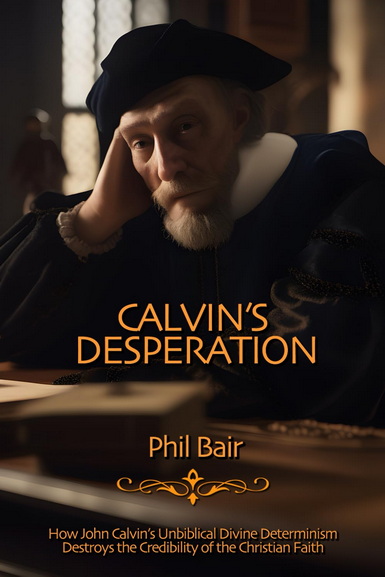
Calvinism (deterministic TULIP):
- God is the author of evil, and therefore is evil.
- Man, having no libertarian freedom, is not guilty of sin.
Word of God:
- God is good.
- Man is guilty of sin.
— Phil Bair, Calvin’s Desperation, p. 28.
The Central Question
The discussions among Bair, Flowers, McGrew, Stratton, Russell, and Mack bring the central issue into focus. Their arguments approach the problem from different directions, but several common questions emerge:
The Question of Causation
Does God’s foreknowledge mean that He causes what He knows? Does determining an event require determining every human choice and intention involved in that event?
The Question of Responsibility
If God determines every sinful desire and action, what ultimately distinguishes the responsibility of the creature from the responsibility of the Creator?
The Question of Secondary Causes
If secondary causes cannot alter or influence an outcome determined by God, in what meaningful sense are they causes?
The Question of Human Freedom
Does the fact that humanity is fallen mean that people cannot make a meaningful response to God’s gracious invitation? Is libertarian freedom necessarily autonomy or randomness?
The Question of Knowledge
If God determines every thought, belief, and judgment—including false beliefs—what grounds our confidence that our own theological conclusions are true?
The Question of God’s Character
If God determines the very sins for which humanity is condemned, how does the system preserve the distinction between a perfectly righteous Creator and sinful creatures?
These are not merely different ways of asking whether God is sovereign. They are challenges to a particular understanding of sovereignty: the claim that God’s will is the singular determining cause of absolutely everything.
Bair’s argument is that God’s sovereignty does not require Him to be the determining cause of every human choice. Flowers emphasizes the distinction between God’s intended outcome and the sinful intentions of the agents involved. McGrew challenges the appeal to secondary causes and the epistemological consequences of determinism. Stratton presses the problem of rational responsibility and justified belief. Russell emphasizes human responsibility, God’s righteousness, and the difference between sustaining and causing. Mack challenges the attempt to reconcile theological determinism with God’s innocence in the face of evil.
Together, these discussions raise a serious question for deterministic Calvinism:
If God determines every thought, desire, belief, intention, and action, what meaningful role remains for human agency—and how does that understanding preserve God’s moral perfection?
The issue is not whether God is sovereign. The issue is what we mean when we say that He is sovereign.
Resources and Further Reading
John Calvin — Primary Quotations
- Institutes of the Christian Religion, I.15.8.
- Institutes of the Christian Religion, I.16.8.
- Institutes of the Christian Religion, I.18.1–3.
- Institutes of the Christian Religion, III.23.6–7.
- A Treatise on the Eternal Predestination of God.
Interview and Video Discussions
The following interviews and discussions provide additional context for Phil Bair’s arguments in Calvin’s Desperation. They address divine determinism, human freedom, moral responsibility, the problem of evil, and the implications of exhaustive divine determinism.
Interviews and Conversations
- Phil Bair with Dr. Leighton Flowers — “Calvin’s Desperation w/ Phil Bair” — Soteriology 101. Discussion of foreknowledge, decree, Acts 4, compatibilism, human responsibility, the problem of sin, and the deity-of-deception argument.
- Phil Bair with Warren McGrew — “How Calvinism Destroys the Christian Faith” — The Idol Killer. Discussion of Calvin’s understanding of God’s will as the singular cause of all things, active versus permissive causation, secondary causes, and the implications of exhaustive divine determinism for human knowledge.
- Phil Bair with Jamie Russell — “Phil Bair joins Jamie Russell: Determinism in Bible? Debate Prep” Discussion of libertarian freedom, moral responsibility, the Fall, total depravity, God’s righteousness, autonomy, sustaining versus causing, secondary causes, and God’s patience in 2 Peter 3:9.
- Phil Bair with Tim Stratton — “Calvin’s Desperation” — FreeThinking Ministries. Discussion of Calvin’s theology, exhaustive divine determinism, human freedom, and the philosophical and theological problems raised by determinism.
- Phil Bair with Drew Mack — “MERCILESS Debate Review | CALVINISM Debunked” Discussion of determinism, divine decrees, human choices, compatibilism, the author-of-evil problem, and the distinction between determining an event and determining the intentions of those involved.
Additional Video Discussions
- “Decretalism vs. Determinism: What’s the Difference?” — Phil Bair. A discussion distinguishing decretalism from determinism.
- “Debate Review: Does the Bible Teach Determinism?” — Phil Bair. A review of the debate over whether Scripture teaches determinism.
- “What Does It Mean to Be Chosen?” — Phil Bair. A discussion addressing the biblical meaning of being chosen.
- “Calvin’s Desperation with Special Guest Phil Bair” — The Caffeinated Christian. A conversation with Phil Bair about his book and its critique of John Calvin’s doctrine of divine determinism.
Editorial note: The Calvin quotations are presented as quotations attributed to Calvin in the source material. The discussion is a synthesis of Bair’s book and the interview conversations. The contributors’ arguments are paraphrased rather than presented as verbatim quotations. The page-28 comparison is retained as supplied, including “My Descriptors.”
One last note, this post was going to be much shorter and push people to a particular author and his larger work. But fate has decided to support a larger swath, losing the main character in the waves of determinism. That’s a joke son.