Yes, this is from the church I attend. A wonderful place to attend, but definitely Calvinistic. This is a newer pastor, and I must say, even though I vehemently disagree, at least he is preaching honestly. Another pastor months before preached a sermon where he quoted Joshua 24:15 and said:
“Make a choice. Choose this day. In fact, you can choose one of the… He’s not saying that he’s happy if you choose the pagan gods, but he says, in fact, pick one of the pagan gods. Do you know that something that God is extremely kind and gracious to us and that he gave us free will? Did you know that? He didn’t force a relationship on us. He gave us free will. Do you remember what he gave Adam and Eve? Free will. You can make a choice. I’m not gonna force it. Hey, you choose, yeah, you, make the choice.”
When I asked an elder if this pastor really believed this statement he made regarding free will from the pulpit, I got an honest answer of “No.”
So I love the almost Provisionist preaching and call to come to God in faith — but this is not what is REALLYbelieved as these pastors overlay TULIP on to their understanding of Biblical text. I struggle with the good that can come from the “alter call” type preaching of the “Armininian style” while they sleep as a Calvinist. That being said, it is a duplicitous preaching like they make God out to be by overlaying a 16th century philosophy onto God. A Jaundiced view at best. AND, I can truly appreciate the rawness of the logical outcomes being honestly preached from the pulpit. Although even this pastor does not follow his own thinking to their ends without hemming and hawing with a myriad of qualifiers and nuances.
Here is my FACEBOOK comments on this sermon:
So, in the past I have praised good sermons from my church… if I do that, should I at times not critique [as publicly] a bad one? I will be clipping the main idea of it from the video for my site [like I have uploaded some clips from the good ones], but that is in the future tense. I am thankful, however, that this pastor was so forthright, and didn’t hide behind the “preaching as an Arminian, sleep as a Calvinist” idea.
Honest preaching is laudable. This was essentially the sermon:
(a)God decrees and ordains all evil for His glory (b) God saves us from the evil He decreed and ordained…. for His glory.
In other words, while this pastor didn’t follow his sermon to its logical conclusion, it is essentially God saving us from Himself. So, all the pain and suffering mentioned in stories and text… are all God caused. Remember, this pastor chose AW Pink’s book for the last Monday men’s service series. [It could have been more in the pastorate choosing Pink’s book, as far as I know — because I do not actually know how these books are approved.] Pink is a hyper Calvinist, like this Pastor publicly is.
All I was thinking was,
“well, people who don’t get the raw [5-point, Calvinist] truth from other pastors are hearing it now.”
On the flip side of that “positive”, the new people on the “faith fence” — which only makes sense to those of the non-Calvinist soteriological bent — may have wrote off Crossroads as their home. Or worse yet, wrote off God.
Which in this pastor’s view, was also ordained.
The same pastor here eisegetes into Scripture a 16th century doctrine not understood as being the Bible before Calvin popularized it via his doctrinal hero:
The reason I added the SNL skit was to note that right when the sermon was starting to state some good position or truth, it was dashed shortly after by the “doctrines of grace.”
Due to the overwhelming popularity of this passage when it comes to the defense of Calvinistic soteriology, I feel it is necessary to provide a verse by verse exegetical commentary from a traditional non-Calvinistic perspective.
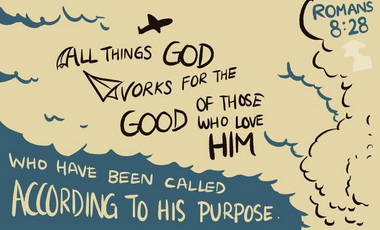
Romans 8:28
And we know that in all things God works for the good of those who love Him, who have been called according to His purpose.
The Greek verb oida (“we know”) is a perfect active indicative form of the verb, which may simply refer to knowledge gained by observance or remembrance of the past. This is paralleled earlier in verse 22 (using the same Greek verb tense of oida) when speaking about their observation of creation “groaning as in the pains of child birth right up to the present time.”
Paul seems to be saying “we have observed” and “therefore we know.” The context and grammar appear to indicate a reference not to an intuitive knowledge of Paul’s readers, but to that which comes from observation of the past, or a remembrance.[73]
Paul means that believers know, from observation of God’s past dealings with those who love Him, that he has a mysterious way of working things out for the greatest good. By observing the stories of the saints of old —those called to accomplish His redemptive purposes—believers can rest in knowledge of this truth. God can take whatever evil may come our way and redeem it for good. Believers can know this because God has been doing it for generations.
Paul does not say that his readers should intuitively know how God works things out for those who love Him in the present. He is saying believers know what is true of God by observing what He has done in the past for those who have loved Him. The New Testament saints have a great cloud of witnesses that have gone before them (Heb. 12:1), giving evidence of God’s trustworthiness toward all who enter into a covenant with Him.
A simple survey of the verses leading up to this point reveals that Paul is reflecting on the problem of the evil and suffering in our world since the beginning:
Rom. 8:20-22: “For the creation was subjected to futility, not willingly, but because of Him who subjected it, in hope that the creation itself also will be set free from its slavery to corruption into the freedom of the glory of the children of God. For we know that the whole creation groans and suffers the pains of childbirth together until now.”
N.T. Wright comments on Rom. 8:28–30, saying in part:
“[This passage] is a sharp, close-up, compressed telling of the story of Israel, as the chosen people, whose identity and destiny is then brought into sharp focus on Jesus. Jesus, in a sense, is the one ‘chosen One.’ But, then that identity is shared with all of those who are ‘in Christ.’ And he [Paul] is not talking primarily there about salvation. He is talking primarily about the way God is healing the whole creation. There is a danger here. What has happened in so many theological circles over the years is that people have come to the text assuming that it is really saying how we are to get to heaven, and what is the mechanism and how does that work. And if you do that, interestingly, many exegetes will more or less skip over Romans 8:18–27, which is about the renewing of creation.”[74]
In verses 28 and 29 the focus shifts to providing comfort for those in suffering by reminding them to observe God’s dealings with others who loved God throughout history. Notice that this truth is not applicable to everyone. The passage is specifically an observation of those who “love God,” or as Wright notes, “those who are in Christ.”
The point is not that God causes everything for a good purpose, but that God redeems occurrences of evil for a good purpose in the lives of those who love Him. Therefore, it would be inaccurate to use this passage to support the concept of divine meticulous determinism of all things.[75] Again, God does not cause occurrences of evil for His purposes; instead, He redeems moral evil for a good purpose. Traditionalists would typically agree with what John MacArthur, a Calvinistic pastor, wrote on this point:
“But God’s role with regard to evil is never as its author. He simply permits evil agents to work, then overrules evil for His own wise and holy ends. Ultimately He is able to make all things—including all the fruits of all the evil of all time—work together for a greater good.”[76]
The focus of the apostle’s observation is on the saints of old, those from the elect nation of Israel who were called to fulfill God’s plan to redeem His creation from its groans and sufferings. This passage does not mean that the truth being revealed is not applicable to those of other nations. Rather, it means that what is proven to be true of God by observing His dealings with those called out from Israel throughout history must also be true of anyone who comes to follow and love the God of Israel.
Consider this analogy: Suppose a new pastor is called to a church. The staff members are nervous about his leadership style and how they might be treated, but a letter of reference which reflects on his past relationships might ease their fears. The pastor’s reference might say something like, I have observed this pastor’s dealings with the staff members he knew before, and he has always worked to lovingly support anyone who gets behind the vision and direction of the church. By reflecting on the pastor’s history, the new staff can know what to expect in their future dealings with him. So too, Paul gives a divine reference by reflecting on the trustworthiness of God in His dealings with the saints of old so as to ensure his readers of what they may expect of Him.
Romans 8:29
For those God foreknew He also predestined to be conformed to the image of His Son, that He might be the firstborn among many brothers and sisters.
Here the apostle reveals his focus on the saints of old, “those God foreknew.” Paul seeks to provide evidence of his claim in verse 28 by reflecting on God’s faithfulness to His chosen nation, those beloved who were known before. Paul provides a reference of sorts to ease the fears of those who are now coming to faith. This point continues to be the apostle’s focus for the next three chapters.
Much debate centers on the meaning of the word proginōskō (“to know beforehand”).[77]Many popular authors fail to recognize all the available options for consideration. For example, John Piper lists only two options for interpreting this verse:
Option #1: God foresaw our self-determined faith. We remain the decisive cause of our salvation. God responds to our decision to believe.
Option #2: God chose us—not on the basis of foreseen faith, but on the basis of nothing in us. He called us, and the call itself creates the faith for which it calls.[78]
Piper overlooks the most basic meaning of this word, which is “to know beforehand” or to have known in the past. The same Greek word is used by Peter and Paul in the following passages,
2 Pet. 3:17: “Therefore, dear friends, since you have been forewarned, be on your guard so that you may not be carried away by the error of the lawless and fall from your secure position.”
Acts 26:4–5: “The Jewish people all know the way I have lived ever since I was a child, from the beginning of my life in my own country, and also in Jerusalem. They have known me for a long time and can testify, if they are willing, that I conformed to the strictest sect of our religion, living as a Pharisee.”
Clearly, this word can be understood simply as knowing someone or something in the past, as in those known previously (i.e. the saints of old). Non-Calvinistic scholars, Roger Forster and Paul Marston, convincingly argue,
“God ‘foreknew them’ or ‘knew them of old’ thus it does not mean that God entered in some former time into a relationship with the Israelites of today, it means that he entered a (two-way) relationship with the Israel that existed in early Old Testament times, and he regards the present Israelites as integral with it.”[79]
If Paul intended to use the word proginōskō in this sense, then he meant simply that because we have seen how God worked all things to the good for those whom He knew before, we know that He will do the same for those who love and are called by Him now.
Some Calvinists contend that the word foreknew is equivalent to fore-loved. That use of the word generally fits this interpretation since the Israelites of the past who loved God certainly would have been loved by God before (i.e. fore-loved). Of course, the Calvinistic interpretation differs because they insist this passage is about God unconditionally setting His “effectual” salvific love upon certain individuals before the foundation of the world. Calvinists go to great lengths to show that God did not merely foresee the behavior and choices of the elect by looking down the corridors of time. Rather, God knew them intimately and set His effectual love on them before the foundation of the world.[80]
This argument might address the classical Arminian approach (Piper’s first option),[81] but it fails to rebut the approach being advocated here. Fore-loved is a viable and even likely meaning of the term proginōskō, yet it does not clarify who might be the intended target of that divine love.
Was Paul intending to introduce for the first time in this epistle a particular group of people out of the mass of humanity who were unconditionally elected to be effectually saved before the world began? Or, was he simply referencing those from the past whom God had known and faithfully cared for throughout the generations?
Romans 8:29b states “He (God) also predestined to become conformed to the image of His Son.” Who was “predestined” and to what ends were they predestined, according to this passage? Remember the point of the apostle leading up to this verse. He began speaking about the futility and suffering that has come into this world due to the fall of humanity into sin (vv. 20–22). In verse 28-29a, Paul provides comfort to lovers of God in his audience by reminding them of God’s trustworthiness for those who have loved Him throughout the generations.
Paul reminds his readers that God will redeem the suffering and evil for a good purpose in their lives just as he has done in the lives of those known before and loved throughout the previous generations. It is these whom God previously knew (Israelites whom loved God in the past) who were predestined to be conformed into the image of Christ so as to make the way for His coming.
God planned to accomplish salvation for those who were previously known and loved (i.e. Abraham, Moses, David, etc) by conforming them into the image of the One who would come to purchase their redemption. This is the ultimate example of God causing “all things to work for the good” of those saints of old who loved God. Paul is saying that God brings about the redemption of their souls and He will do the same for whoever loves Him. N. T. Wright states,
“Here is the note of hope which has been sounded by implication so often since it was introduced in 5:2: hope for the renewal of all creation, in a great act of liberation for which the exodus from Egypt was simply an early type. As a result, all that Israel hoped for, all that it based its hope on, is true of those who are in Christ.”[82]
Romans 8:29c states “that He (the Son) might be the firstborn among many brothers and sisters.” Consider the fact that he is speaking about what Christ might be, which strongly implies that Paul still has the saints of old in focus here. Why would Paul speak of future generations being conformed to the image of Christ so that He “might be the firstborn among many brothers and sisters” if He were already the firstborn prior to this discourse?
The term prōtotokos (“firstborn”) can simply refer to the one who is first to be born in a family, which carries much significance in the Jewish culture (Luke 2:7). Typically, the birthright given to the firstborn son signified a place of preeminence, by which he would receive the father’s inheritance and blessing. For instance, Psalm 89:20, 27 states, “I have found David my servant; with my sacred oil I have anointed him. . . And I will appoint him to be my firstborn, the most exalted of the kings of the earth.” David, who was the last one born in his family, was called by God the firstborn. David was given a place of preeminence.[83]
The term firstborn also speaks of Christ’s preexistence as the eternal Creator.[84] God created the world through Christ and redeemed the world through Christ (John 1:3, 10; Heb. 1:2–4). The former speaks of His eternal nature and the latter of His temporal role as the redeemer of the world.
Yet, even when speaking of our preexistent Lord, the biblical authors addressed Him as “becoming” or “fulfilling” His role as our Messiah within the temporal world. For example, the Psalmist writes, “And I will appoint Him to be my firstborn, the most exalted of the kings of the earth” (Ps. 89:27). For the Old Testament saints, the firstborn Savior was the expected One that was yet to come. From their view, the long-awaited Messiah was the future hope, not a past and completed reality.
In contrast to the Old Testament saints, a modern-day preacher would not teach that we are being conformed to Christ’s image so that Jesus might be the firstborn among many brethren, because we know Him to already be the firstborn of many brethren. Our being conformed into Christ’s image today has nothing to do with the future coming of Christ’s birth, whereas the saints of old were part of His very lineage. It is through the life of men like Abraham, Isaac, Jacob, David, and many other saints of old that Christ is brought into this world “that He might be the firstborn among many brothers and sisters (Rom. 8:29c).”
Paul is reflecting on God’s redemptive purpose being accomplished through those who loved God in former generations. That redemptive purpose included bringing the Messiah into this world through Israel (Rom. 9:4-5), or those Israelites set apart for that noble purpose (Rom. 9:21). This was God’s predestined plan of redemption, which was brought to pass through those who loved God and were called according to His purpose. Tim Warner describes this purpose,
“Paul was not referring to some prior knowledge in the mind of God before creation. Nor was He speaking about predetermining their fate. He was referring to those whom God knew personally and intimately, men like Abraham and David.
The term ‘foreknew’ does not mean to have knowledge of someone before they were conceived. The verb προεγνω is the word for ‘know’ (in an intimate sense) with the preposition προ (before) prefixed to it. It refers to having an intimate relationship with someone in the past… Literally, we could render Rom. 8:29 as follows: ‘For those God formerly knew intimately, He previously determined them to be conformed to the image of His Son.’
The individual saints of old, with whom God had a personal relationship, were predestined by Him to be conformed to the image of Christ. That is, God predetermined to bring their salvation to completion by the sacrifice of Christ on their behalf.” [85]
Likewise, William R. Newell, a colleague of D.L. Moody and a notable teacher at the Bible Moody College, explained that God “had acquaintanceship” with the Israelites of the past. So, it was not “mere Divine pre-knowledge” of certain individuals, but a real intimate “pre-acquaintanceship.”[86]
Romans 8:30
And those He predestined, He also called; those He called, He also justified; those He justified, He also glorified.
Notice the apostle’s use of the past tense in this verse. If Paul intended to speak about the future salvation of every elect individual, then why would he use these past tense verbs? When writing these words, Paul and his readers had not yet been glorified, so there is no explicit reason to use the past tense. Thus, there is no reason to assume Paul has in mind the future glorification of all believers.
The past tense suggests that Paul is referring to former generations of those who have loved God and were called to fulfill His redemptive purpose. They were known in the past generations and predestined by God to be made in the very image of the One to come, “the firstborn among many brothers and sisters,” which is something already completed in the past through the working of God in former generations. These are the individuals whom God called, justified, and who now, even as Paul was writing these words, are already glorified in the presence of God.
If indeed Paul was referencing the saints formerly known and loved by God, he would have communicated the certainty of their being justified, sanctified and finally glorified in a way that some might describe as a “golden chain of redemption.”[87] To presume, however, that Paul’s unbroken chain of past tense verbs is not in reference to people of the past is a linguistic stretch. [88]
Calvinists must explain away the use of the past tense verbs in order to maintain their interpretation of Paul’s intent. For instance, The Bible Knowledge Commentary, a Calvinistic source, provides this explanation, “Glorified is in the past tense because this final step is so certain that in God’s eyes it is as good as done.”[89]
Calvinists must interpret Paul’s use of the past tense (aorist indicative) as meaning “it is as good as done” because it was predestined. But this is a very rare usage in the original language and the immediate context does not clearly support a Calvinistic rendering.
We must take into account Paul’s usage of the same term earlier in the chapter as a future hope for believers. Romans 8:17:
“Now if we are children, then we are heirs—heirs of God and co-heirs with Christ, if indeed we share in His sufferings in order that we may also share in His glory” (emphasis added).
Paul does not speak of glorification as a past and completed action in reference to the believers in his day. Rather, he seems to qualify their being glorified upon the condition that they persevere through the suffering that is to come. If it is “as good as done” due to God’s predetermination, then why would Paul make such a qualification and use the future tense of the same verb? Further, Paul speaks of the eager expectation of the glorification that is to come in verses 22–25:
“We know that the whole creation has been groaning as in the pains of childbirth right up to the present time. Not only so, but we ourselves, who have the firstfruits of the Spirit, groan inwardly as we wait eagerly for our adoption to sonship, the redemption of our bodies. For in this hope we were saved. But hope that is seen is no hope at all. Who hopes for what they already have? But if we hope for what we do not yet have, we wait for it patiently” (emphasis added).
Is the reader to believe that Paul shifts from speaking of glorification as a future hope for those who persevere, to speaking of it as a past and already-completed act for those who have not yet been glorified? Or, could it simply be that Paul has the Old Testament saints in view as he makes his case for the trustworthiness of God throughout all generations? The latter seems to be the most basic understanding of the apostle’s words in their context.
This interpretation may seem foreign to some Western readers because of the philosophical and theological baggage that has been attached to the concept of divine foreknowledge over the years, but to the first century reader the simple concept of proginōskō, understood as “previously known,” would have been far more likely. In fact, if one can objectively back away from their presuppositions and approach this passage with fresh eyes, I believe they will discover the utter simplicity and clarity of this perspective.
Instead of introducing a complex concept of divine prescience, unconditional election, and effectual salvation never once clearly expounded upon in the Scriptures, could it be that Paul may intend simply to communicate that those who were previously loved and known by God were also predestined to be conformed to the image of the One to come? Paul seems to be giving a brief history lesson of what God had done in former generations as a reference for God’s trustworthiness for all who come to Him in faith. Wright explains it this way:
“The creation is not god, but it is designed to be flooded with God: The Spirit will liberate the whole creation. Underneath all this, of course, remains Christology: the purpose was that the Messiah ‘might be the firstborn among many siblings’ (8.29). Paul is careful not to say, or imply, that the privileges of Israel are simply ‘transferred to the church,’ even though, for him, the church means Jews-and-gentiles-together in Christ. Rather, the destiny of Israel has devolved, entirely appropriately within the Jewish scheme, upon the Messiah. All that the new family inherit, they inherit in Him.”[90]
Those who object to the suggestion that Paul’s use of the term proginōskō is limited to the beloved of Israel’s past should consider the apostle’s use of the same word just three chapters later, Rom. 10:21-11:2a:
“But concerning Israel he says, ‘All day long I have held out my hands to a disobedient and obstinate people.’ I ask then: Did God reject His people? By no means! I am an Israelite myself, a descendant of Abraham, from the tribe of Benjamin. God did not reject His people, whom he foreknew” (emphasis added).
Notice that Paul uses the term proginōskō in reference to God’s intimate relationship with the faithful Israelites of old. Paul continues to make his case, Rom. 11:2b-4:
“Don’t you know what Scripture says in the passage about Elijah—how he appealed to God against Israel: ‘Lord, they have killed your prophets and torn down your altars; I am the only one left, and they are trying to kill me?’ And what was God’s answer to him? ‘I have reserved for myself seven thousand who have not bowed the knee to Baal.’”
Elijah and those who refused to bow a knee were among the ones who were previously known (foreknown/fore-loved) by God. To foreknow refers to God’s intimate relationship with people who loved Him in the past (like Abraham in Rom. 4:22–5:5). Nothing in this or any other text supports the concept of God in eternity past preselecting certain individuals out of the mass of humanity for effectual salvation. It would be difficult to substantiate this meaning of the term foreknow in reference to the Israelites who were in covenant with God. It is best interpreted in reference to those known by God in former times. William Lane Craig explains,
“In certain cases, proginōskō and prooraō mean simply that one has known or seen (someone or something) previously. For example, in Acts 26:5 Paul states that the Jews had previously known for a long time the strictness of his life a Pharisee, and in Acts 21:29 Luke mentions that the Jews had previously seen (prooraō) Trophimus in Paul’s company. This sense is probably operative in Romans 11:2 as well, where Paul states of apostate Israel that ‘God has not rejected His people whom He foreknew [proginōskō],’ that is, whom He had previously known in an intimate way.”[91]
Romans 8:31–39
Returning to the analogy above, the pastor had former staff members whom he intimately knew and loved. The new staff would be comforted to know of the pastor’s prior relationships. Likewise, those being grafted into covenant with the God of Israel for the first time (i.e. the Gentiles) would be thrilled to learn of God’s faithfulness to those He formerly knew and loved (i.e. men like Abraham and David, etc.). What can the readers say in response to these teachings of Paul about God’s faithfulness toward the saints of old?
That is the very question the apostle poses in Rom. 8:31a as he transitions to the application of His message,
“What, then, shall we say in response to these things?”
This interpretation is consistent with the view that present-day saints who love God and are called according to His purposes (vs. 28) have nothing to fear, for…
“If God is for us, who can be against us?” (vs. 31b).
God, who gave up His Son, justifies, intercedes, and places His undying love upon all who love Him and are called according to His purposes (vv. 32–39).
The objector in Paul’s mind asks: Paul, you have made a good case regarding God’s faithfulness to the Israelites in the past, but what about the Israelites today? Have God’s promises for Israel failed? Why are the Israelites today refusing to accept their own Messiah? The apostle attempts to answer these questions in Romans 9 and following.
NOTES:
[73] Johannes P. Louw and Eugene A. Nida, Lexicon of the New Testament: Based on Semantic Domains, Second Edition (New York: United Bible Societies, 1989), 29.6.
[74]N.T. Wright in a question and answer session at Oklahoma Christian University on April 1, 2014. Samuel Selvin, “Dr. N. T. Wright on predestination,”
[75]This is also true of Eph. 1:11, which is often misapplied to support the idea of meticulous determinism.
[76]John MacArthur, “Is God Responsible for Evil?” Grace To You Ministries web page. Quote taken from: http://www.gty.org/ resources /articles/A189/is-god-responsible-for-evil; [date accessed: 5/19/15]
[76] The definition of progin-osk-o is from The Lexham Analytical Lexicon to the Greek New Testament (Bellingham, WA: Logos Bible Software, 2011), 30.100.
[78] Roger T. Forster and V. Paul Marston, God’s Strategy in Human History (Wheaton: Tyndale, 1973), 179–90.
[79]John Murray, The Epistle to the Romans, Volume I (Grand Rapids, MI: Eerdmans Publishing, 1959), 316-318.
[80]Frederic Godet’s commentary on Romans 8:29, inquires: “In what respect did God thus foreknow them?” and answers that they were “foreknown as sure to fulfill the conditions of salvation, viz. faith; so: foreknown as His by faith.” The word “foreknew” is thus understood by Godet, a classical Arminian, to mean that God knew beforehand which sinners would believe, and on the basis of this knowledge He predestined them unto salvation. Frederic Godet, Commentary on the Epistle to the Romans (New York: Messrs Clark, 1880), 325.
[81]N.T. Wright, Pauline Theology, Volume III, ed. David M. Hay & E. Elizabeth Johnson (Minneapolis: Fortress, 1995), 30–67.
[82]James D. G. Dunn, Romans 1-8, Word Biblical Commentary, David A. Hubbard and Glenn W. Barker, vol. 38a (Dallas: Word, 1988), 1: 484.
[83] Theologian Bernard Ramm noted that “It has been standard teaching in historic Christology that the Logos, the Son, existed before the incarnation. That the Son so existed before the incarnation has been called the pre-existence of Christ.” Bernard Ramm, An Evangelical Christology: Ecumenic and Historic (Vancouver, BC: Regent College Publishing, 1993) 47.
[86]Some Calvinistic scholars describe this as the unbreakable “golden chain of redemption” meant to communicate the unchangeable plan of God to irrevocably justify, sanctify and glorify those He elected before the world began.
[87] Greek scholars teach that while the aorist indicative can be used to describe an event that is not yet past as though it were already completed, this usage is “not at all common.” Daniel B. Wallace, Greek Grammar Beyond the Basics (Grand Rapids, MI: Zondervan Publishing, 1997) 564.
[88] John F. Walvoord and Roy B. Zuck, eds. The Bible Knowledge Commentary (Dallas: Victor Books, 1983), 474.
[89] “And all this is viewed as past; because, starting from the past decree of ‘predestination to be conformed to the image of God’s Son’ of which the other steps are but the successive unfoldings—all is beheld as one entire, eternally completed salvation.” Jamieson-Fausset-Brown Bible Commentary, “Romans 8.”
[90] Wright, Pauline Theology, 20.
[91] William Lane Craig, The Only Wise God: The Compatibility of Divine Foreknowledge and Human Freedom (Grand Rapids: Baker, 1987), 31–32.
God is the Creator – there would not be a universe or human beings without him. God is the sovereign upholder of the universe – none of its history is outside his control. Christ is the Saviour and Redeemer – apart from him there would be no salvation.
Furthermore, we have seen that God’s initiative is expressed in Scripture in terms like election, foreknowledge, predestination, and calling, all of which occur together at the climax of one of the major sections of the letter to the Romans in chapter 8. By this stage Paul has already argued universal human guilt and the consequent need of salvation. He has explained that salvation is by faith in Christ and not of works. He has developed the theme of human responsibility to live a holy life in the power of God’s Holy Spirit. He has described the inner battle against our human nature (the flesh) that we all experience as we seek to walk after the Spirit.
The inner battle is not the only battle, however. Paul himself was no stranger to suffering – he had lived with persecution for many years. And so in Romans 8 Paul addresses suffering directly. He describes the provision that God has made for him and his fellow believers to remain firm in their faith when the winds of adversity blow. Here is the wonderful passage in full:
I consider that our present sufferings are not worth comparing with the glory that will be revealed in us. The creation waits in eager expectation for the sons of God to be revealed. For the creation was subjected to frustration, not by its own choice, but by the will of the one who subjected it, in hope that the creation itself will be liberated from its bondage to decay and brought into the glorious freedom of the children of God.
We know that the whole creation has been groaning as in the pains of childbirth right up to the present time. Not only so, but we ourselves, who have the firstfruits of the Spirit, groan inwardly as we wait eagerly for our adoption as sons, the redemption of our bodies. For in this hope we were saved. But hope that is seen is no hope at all. Who hopes for what he already has? But if we hope for what we do not yet have, we wait for it patiently.
In the same way, the Spirit helps us in our weakness. We do not know what we ought to pray for, but the Spirit himself intercedes for us with groans that words cannot express. And he who searches our hearts knows the mind of the Spirit, because the Spirit intercedes for the saints in accordance with God’s will.
And we know that in all things God works for the good of those who love him, who have been called according to his purpose. For those God foreknew he also predestined to be conformed to the likeness of his Son, that he might be the firstborn among many brothers. And those he predestined, he also called; those he called, he also justified; those he justified, he also glorified.
What, then, shall we say in response to this? If God is for us, who can be against us? He who did not spare his own Son, but gave him up for us all – how will he not also, along with him, graciously give us all things? Who will bring any charge against those whom God has chosen? It is God who justifies. Who is he that condemns? Christ Jesus, who died – more than that, who was raised to life – is at the right hand of God and is also interceding for us. Who shall separate us from the love of Christ? Shall trouble or hardship or persecution or famine or nakedness or danger or sword? As it is written:
“For your sake we face death all day long;
we are considered as sheep to be slaughtered.”
No, in all these things we are more than conquerors through him who loved us. For I am convinced that neither death nor life, neither angels nor demons, neither the present nor the future, nor any powers, neither height nor depth, nor anything else in all creation, will be able to separate us from the love of God that is in Christ Jesus our Lord.
(Romans 8:18–39.)
In all of Scripture this is one of the most magnificent statements of the love of God in taking the initiative to provide salvation in all of its aspects, so that nothing whatsoever can separate us from his love for us in Christ Jesus – not even death itself. I have emphasised the passage that is relevant to our discussion. In the context of suffering, weakness, and uncertainty, we are to know that God is working in all things for the good of those who love him. Paul describes them as those who have been called according to his purpose. What that grand purpose is, he is about to explain. But not before he gives another description of believers as those whom God foreknew, which (as we have seen) does not imply that God caused or forced them to do anything in advance. It is a great encouragement to believers under pressure to know that they have experienced the call of God; God has known them, and knows all about them – and he has a purpose for them. What is that purpose? He has predestined them to be conformed to the image of his Son.
Under the pressure of an assumed paradigm it is all too easy to read into this that Paul is saying that God has predestined them to be believers, and then using this statement to buttress theistic determinism. However, Paul is saying something completely different: that God has predestined those who are believers to be conformed to the image of his Son. That is, he plans to confer unimaginable dignity upon believers. As creatures of God they were made in the image of God. But now that they have put their faith in Christ and received his salvation, a destiny of almost indescribable glory awaits them. In his love for them God has determined that they should be like his Son. The sheer wonder of this purpose now defines the illimitable nature of God’s grace and glory. In one sense, God could have predestined us to anything glorious that he willed, but he has chosen this ultimate accolade. The objective is that the Lord Jesus should be the firstborn (first to be glorified and also first in rank) among many brothers.
This is God’s staggeringly gracious goal. Achieving it involves all of God’s provision in the gospel that Paul has been expounding up to this point – calling, justification by faith, and glorification. It is the sheer glory of the achievement that calls forth Paul’s triumphant and confident conclusion – If God is for us, who can be against us?
Arising directly from these glorious thoughts, however, there comes a question that deeply disturbs and concerns the apostle. In light of such a magnificent and gracious message, how is it that his fellow Israelites, Paul’s own kith and kin, mainly reject such a wonderfully gracious message and deny that Jesus is the Messiah, the Son of God? Paul’s pain is palpable as he explains:
I speak the truth in Christ – I am not lying, my conscience confirms it in the Holy Spirit – I have great sorrow and unceasing anguish in my heart. For I could wish that I myself were cursed and cut off from Christ for the sake of my brothers, those of my own race, the people of Israel. Theirs is the adoption as sons; theirs the divine glory, the covenants, the receiving of the law, the temple worship and the promises. Theirs are the patriarchs, and from them is traced the human ancestry of Christ, who is God over all, for ever praised! Amen.
(Romans 9:1–5.)
Paul faces an apparent contradiction. His nation of Israel by and large rejected Christ, who was also their own flesh and blood, even though as a nation they were uniquely privileged. God had adopted them as his people – as his sons, even, those who inherit the family assets; he had visited them in his glory at Sinai, and in the tabernacle, given them the covenants, the law, and the worship programme of the temple; he had lavished his promises on them. Not only that, it was God who had given them the patriarchs, from whom the ancestry of the Messiah would be traced – the Messiah who is none less than God himself. And they don’t believe in him!
This was no new issue for Paul. He faced it many times as he sought to persuade men and women of the truth of the Christian message. For instance, he held lectures in the synagogue at Thessalonica on three sabbath days:
As his custom was, Paul went in to the synagogue, and on three Sabbath days he reasoned with them from the Scriptures, explaining and proving that the Christ had to suffer and rise from the dead. “This Jesus I am proclaiming to you is the Christ,” he said.
(Acts 17:2–3.)
One can easily imagine some intelligent Jew saying, “That was a very interesting talk, Paul, and I find it impressive that a rabbi with your undoubtedly high qualifications, having studied under Gamaliel, is prepared to argue in this way. However, what bothers me is that you seem to be on your own in this. Or am I mistaken? Can you tell me of any other senior rabbis who believe that your interpretations are correct?”
And Paul might reply, “Well there’s Nicodemus, and Joseph of Arimathea, both on the Sanhedrin Council in Jerusalem.”
“Is that all? If what you say is true – and I admit I was moved by it – surely one might expect the majority of the Jewish thinkers to accept it? After all, on the basis of our Scriptures you are claiming that Jesus is the Messiah expected by our nation, yet the experts in the interpretation of those Scriptures don’t agree with you. Surely you can see why I am puzzled!”
Paul could see it, and it affected him deeply. He got the same question from Gentiles as well. “If something is really authentically Jewish, the Jews should be the first to accept it. And yet most of them reject it. How can that be?”
Paul was heartbroken about the situation and desperately wanted to do something about it. It threatened to become a serious stumbling block in the way of people taking the gospel seriously. As he writes in chapter 8, how can he believe that nothing shall separate us from the love of God, when it appears to many that something has separated Israel from God? How can Israel have lost her way so dramatically?
So Paul writes Romans 9–11 in order to show that, far from being an objection to the Christian message, what has happened historically with Israel, in their rejection of the Lord Jesus, in fact confirms the truth of it.
At this point some interpreters of Scripture argue that the ultimate answer to this question is given by Paul in his letter to the Galatians. There he abolishes all distinctions between Jews and non-Jews in his famous statement, that in Christ there is neither Jew nor Greek… (Galatians 3:28). Surely this means (it is argued) that all the promises given to Israel in the Old Testament are now to be understood as fulfilled in the church. Hence God has not cast off his people, since “his people” now equates to “the church” which is alive and thriving.
However, Paul’s statement in Galatians is not relevant to his problem in Romans. In Galatians 3:21–29 Paul is discussing the basis of salvation, and he stresses that it is the same for everyone, whatever their ethnicity, social status, or gender – Jew, Greek, slave, free, man, woman. That common basis is faith in Christ alone. Paul is not talking there about the question of roles in history or in the world, which for obvious reasons might well be different for each of these groups. To deduce from these verses that, now that Christ has come, there is absolutely no difference between the roles of Jews and Gentiles, would be as absurd as saying that, since Christ has come, there is absolutely no difference between the roles of slave and free or between the roles of male and female. Their roles can remain the same without prejudice to their status in Christ.
By contrast Paul’s concern in Romans 9–11 is not the basis of the gospel but why it is that the very nation that was privileged by God to be the vehicle of his revelation to the world now mainly rejects the gospel of the Messiah. That is the problem he has to address, and it is so complex that he takes three chapters to do it.
The first main argument is based on the fact that not all ethnic Israelites are the genuine people of God. His discussion involves considering the sovereignty of God in history regarding the role of different individuals and the nations descended from them.
The second main argument is that Israel’s unbelief is culpable. God has made every provision for them. Paul goes through every excuse that might be raised to let Israel off the hook and concludes in each case that they are responsible for their unbelief.
The third main argument concentrates on the fact that there are some Israelites, like Paul, who do believe in Jesus. Indeed, all through history there has been a “remnant” of true believers within Israel, whose number has at times been underestimated. Paul then discusses the historical roles that Israel and then the Gentiles have had in witnessing for God in the world, and concludes with the glorious hope for his nation that one day “all Israel will be saved”. Paul is in no doubt that there remains a role for his nation in the future, but not until they come to faith in Jesus as Messiah.
UPDATED WITH WRETCHED… originally posted August 2014
This evangelism encounter is POWERFUL. Watch an intelligent college student PRESS street-preacher Todd Friel on the requirements to enter Heaven, then receive a biblical explanation.
This post is a response to a question posed to me via my email by an atheist.
I see that you do some apologetics. Here are a few sincere questions that I’ve tried to get answered from Christians like Greg Koukl, but I never seem to get a response. I’m not baiting you by sending you these questions. If you have any thoughts on these issues, I’d appreciate getting to read your opinion.
1. The New Testament makes it clear that its only through faith in Jesus and his sacrifice that humans can enter heaven. Anyone who lived before Jesus started his ministry had no way of having faith in Jesus. Maybe the people of ancient Israel could piece together what they needed to believe to achieve salvation, but for the gentiles or even humans who lived in North America before the birth of Jesus, they would have no knowledge of the nation of Israel. And most certainly they would have no knowledge of a coming messiah or a future person named Jesus and his sacrifice. What I can conclude is that God allowed humans to be born that would have absolutely no chance of avoiding eternal torment in the fires of hell. I’ve been told that human morality proves that God must be a moral being. However, we have an enormous contradiction here. The God in this scenario is not worthy of respect or love because he is not moral. Hitler and Stalin would have to be quite envious of the amount of torment this God would have allowed.
I brought up the idea of Native-Americas (N-A) not hearing the Gospel with my dad. It seemed, to me, unfair that they should not be afforded at least some clarity in an opportunity to be judged before their maker. My dad shared his thoughts on the matter, and it started with a reading from Romans:
18 For God’s wrath is revealed from heaven against all godlessness and unrighteousness of people who by their unrighteousness suppress the truth, 19 since what can be known about God is evident among them, because God has shown it to them. 20 For His invisible attributes, that is, His eternal power and divine nature, have been clearly seen since the creation of the world, being understood through what He has made. As a result, people are without excuse. (The Holy Bible: Holman Christian Standard Version. [Nashville: Holman Bible Publishers, 2009], Ro 1:18–20.)
But God’s angry displeasure erupts as acts of human mistrust and wrongdoing and lying accumulate, as people try to put a shroud over truth. But the basic reality of God is plain enough. Open your eyes and there it is! By taking a long and thoughtful look at what God has created, people have always been able to see what their eyes as such can’t see: eternal power, for instance, and the mystery of his divine being. So nobody has a good excuse. (Eugene H. Peterson, The Message: The Bible in Contemporary Language [Colorado Springs, CO: NavPress, 2005], Ro 1:18–20.)
He explained that the tribes that were very “war-like,” like the Comanches, acted in rejection of what they knew to be God’s creation and how they should treat their fellow man and nature via the attributes they could clearly interpret via nature. The Sioux were at other times feared as well.
Peaceful tribes – not perfect mind you, but they had a deep understanding of their Creator and how to care for their own and other Native-American tribes they encountered — would interpret nature’s revelatory aspect of Whom they were to worship, and how. The Hopi tribe is one example.
To be clear, when theologians say that God is ultimately sovereign in his decisions over his creation, I am down with this. God — in classical understanding — IS the “Good” and would have a larger view of the panoply of history (since God would be outside of it and viewing it as a whole… the Eternal Now type stuff). So His judgement would necessarily be a Just one. I am not questioning this. I am saying that there are views within orthodoxy that struggle with the boundaries of those who have lived by law seeing that redemption of nature and themselves was somehow woven into nature and never hearing the Gospel (Hebrews 11:9-11). …continuing….
So using the Romans understanding of “The Book of Nature,” and the basis for “unsaved” people seeing – yes, even God’s attributes – something metaphysical and not just material, and looked forward to this hope. Also, these stories of creation and serving a God were handed down from the beginning of mankind. Some people across the earth held close these ancient stories although changed with time.
Combine this with the story of Abraham’s Bosom (Luke 16:19-31) and what Peter tells us about Jesus preaching to these lost souls (I Peter 3:18-20). I would posit — staying within the lane-lines of orthodoxy — that those in the world [pre and post Calvary] who have not been afforded a good explanation of the Gospel message may be afforded an opportunity to respond. This is not me arguing for universalism, but for justice being metered out in some form that was communicated to the Hebraic peoples that is hinted to in the New Testament.
Some Commentary On 1 Peter 3:18-19
This verse raises the two most difficult questions in the letter. When did Jesus preach to the spirits in prison, and who were they? Some take the verse to refer to the chronological sequel to Jesus’ death, when his spirit passed into the realms of the departed. Then, with Acts 2:31 and Eph. 4:9, this verse establishes the clause in the Creeds about Jesus’ descent to the dead. In that case he must have preached to all the dead in one of three ways: to offer them a second chance of salvation; to proclaim his victory over death and triumph over the power of evil and so confirm the sentence on unbelievers and announce deliverance for believers; to proclaim release from purgatory to those who had repented just before they perished in the flood (a popular interpretation among Roman Catholic writers).
Neither the first nor the last of these can be supported from Scripture, but the second has been held by many commentators as fitting in with the NT evidence above. E.G. Selwyn (The First Epistle of Peter [Macmillan, 1949]), and others see the spirits in prison as the fallen angels of Gn. 6:1–8 referred to in 2 Pet. 2:4–10 and Jude 6 as well as in the apocryphal 1 Enoch. Peter’s aim in this context is to demonstrate that God’s purpose is being worked out even in times of suffering. So it would seem best to understand the preaching as a declaration of Christ’s triumph, in order to assert (22) that all angels, authorities and powers [are] in submission to him. Grudem (TNTC) in an appendix summarizes the views and claims that the spirits were Noah’s contemporaries who rejected the preaching of the Spirit of Christ through Noah (see 2 Pet. 2:5) and are now in the prison of the abode of the dead. The interpretation of made alive by the Spirit (18) as a reference to the resurrection, and the spirits in prison as a reference to the fallen angels is cogently argued by R. T. France in New Testament Interpretation, ed. I. H. Marshall (Paternoster Press, 1979), pp. 264–281. He claims that NT and contemporary usage favour this understanding of the word spirits when used by itself, rather than applying it to men and women who had died before Jesus came to bring the gospel.
No view is free of problems, but the use of a verb implying steady and purposeful progression (went [19] and has gone [22] are both the same Gk. word poreutheis) suggests that Peter is recounting what Jesus accomplished between his death and exaltation.
D. A. Carson et al., eds., New Bible Commentary: 21st Century Edition, 4th ed. (Leicester, England; Downers Grove, IL: Inter-Varsity Press, 1994), 1380–1381.
I marry this understanding to a view via William Lane Craig, a name you may be familiar with is on the opposing side of Christian apologetics. He has a view on Molinism I enjoy a bit. [“Enjoy a bit” – I believe is still in the pale of orthodoxy] Here is what he says, and I will emphasize the important aspect I wish to highlight:
The doctrine of Molinism seeks to reconcile God’s sovereign predestination with man’s free will. Through His divine middle knowledge, God can know all possible outcomes of any world that is feasible for Him to create, including all the circumstances required for an individual to come to a saving knowledge of Him. But what if the saving of one individual means the loss of another? Does Molinism provide answers to such a dilemma? In this article, Dr. Craig answers questions on the how God would act if his choices were bound by damning either person A or person B arbitrarily.
I see the solution to your query in your first question in the above. [And the few videos immediately below.]
And it is the same question[s] I struggled with and struggle with. This does away with the contradiction you see. I do wish to note however, that you are taking a moral position in your premise, Saby. And without God, this cannot be the case. Jesus would HAVE to be intimately involved in all of the above scenarios… intimately. None of the above take away from this fact.
I do not know your worldview you operate from, but I can assume atheistic in its presuppositions. But truth (absolute ethical statements are included in this understanding of truth) is something of a fiction to the atheistic evolutionist. Here are some quotes and audio/videos to make my point:
Let’s consider a basic question: Why does the natural world make any sense to begin with? Albert Einstein once remarked that the most incomprehensible thing about the universe is that it is comprehensible. Why should we be able to grasp the beauty, elegance, and complexity of our universe?
Einstein understood a basic truth about science, namely, that it relies upon certain philosophical assumptions about the natural world. These assumptions include the existence of an external world that is orderly and rational, and the trustworthiness of our minds to grasp that world. Science cannot proceed apart from these assumptions, even though they cannot be independently proven. Oxford professor John C. Lennox asks a penetrating question, “At the heart of all science lies the conviction that the universe is orderly. Without this deep conviction science would not be possible. So we are entitled to ask: Where does the conviction come from?”” Why is the world orderly? And why do our minds comprehend this order?
Toward the end of The God Delusion, Dawkins admits that since we are the product of natural selection, our senses cannot be fully trusted. After all, according to Darwinian evolution, our senses have been formed to aid survival, not necessarily to deliver true belief. Since a human being has been cobbled together through the blind process of natural selection acting on random mutation, says Dawkins, it’s unlikely that our views of the world are completely true. Outspoken philosopher of neuro-science Patricia Churchland agrees:
The principle chore of brains is to get the body parts where they should be in order that the organism may survive. Improvements in sensorimotor control confer an evolutionary advantage: a fancier style of representing [the world] is advantageous so long as it… enhances the organism’s chances for survival. Truth, whatever that is, takes the hindmost.
Dawkins is on the right track to suggest that naturalism should lead people to be skeptical about trusting their senses. Dawkins just doesn’t take his skepticism far enough. In Miracles, C. S. Lewis points out that knowledge depends upon the reliability of our mental faculties. If human reasoning is not trustworthy, then no scientific conclusions can be considered true or false. In fact, we couldn’t have any knowledge about the world, period. Our senses must be reliable to acquire knowledge of the world, and our reasoning faculties must be reliable to process the acquired knowledge. But this raises a particularly thorny dilemma for atheism. If the mind has developed through the blind, irrational, and material process of Darwinian evolution, then why should we trust it at all? Why should we believe that the human brain—the outcome of an accidental process—actually puts us in touch with reality? Science cannot be used as an answer to this question, because science itself relies upon these very assumptions.
Even Charles Darwin was aware of this problem: “The horrid doubt always arises whether the convictions of man’s mind, which has developed from the mind of the lower animals, are of any value or at all trustworthy. Would anyone trust the conviction of a monkey’s mind, if there are any convictions in such a mind?” If Darwinian evolution is true, we should distrust the cognitive faculties that make science possible.
Sean McDowell and Jonathan Morrow, Is God Just a Human Invention? And Seventeen Other Questions Raised by the New Atheists (Grand Rapids, MI: Kregel Publications, 2010), 37-38.
….Darwin thought that, had the circumstances for reproductive fitness been different, then the deliverances of conscience might have been radically different. “If . . . men were reared under precisely the same conditions as hive-bees, there can hardly be a doubt that our unmarried females would, like the worker-bees, think it a sacred duty to kill their brothers, and mothers would strive to kill their fertile daughters, and no one would think of interfering” (Darwin, Descent, 82). As it happens, we weren’t “reared” after the manner of hive bees, and so we have widespread and strong beliefs about the sanctity of human life and its implications for how we should treat our siblings and our offspring.
But this strongly suggests that we would have had whatever beliefs were ultimately fitness producing given the circumstances of survival. Given the background belief of naturalism, there appears to be no plausible Darwinian reason for thinking that the fitness-producing predispositions that set the parameters for moral reflection have anything whatsoever to do with the truth of the resulting moral beliefs. One might be able to make a case for thinking that having true beliefs about, say, the predatory behaviors of tigers would, when combined with the understandable desire not to be eaten, be fitness producing. But the account would be far from straightforward in the case of moral beliefs.” And so the Darwinian explanation undercuts whatever reason the naturalist might have had for thinking that any of our moral beliefs is true. The result is moral skepticism.
If our pretheoretical moral convictions are largely the product of natural selection, as Darwin’s theory implies, then the moral theories we find plausible are an indirect result of that same evolutionary process. How, after all, do we come to settle upon a proposed moral theory and its principles as being true? What methodology is available to us?
Paul Copan and William Lane Craig [Mark D. Linville], eds., Contending With Christianity’s Critics: Answering the New Atheists & Other Objections (Nashville, TN: B&H Publishing, 2009), 70.
What about human actions? They are of no more value or significance than the actions of any other material thing. Consider rocks rolling down a hill and coming to rest at the bottom. We don’t say that some particular arrangement of the rocks is right and another is wrong. Rocks don’t have a duty to roll in a particular way and land in a particular place. Their movement is just the product of the laws of physics. We don’t say that rocks “ought” to land in a certain pattern and that if they don’t then something needs to be done about it. We don’t strive for a better arrangement or motion of the rocks. In just the same way, there is no standard by which human actions can be judged. We are just another form of matter in motion, like the rocks rolling down the hill.
We tend to think that somewhere “out there” there are standards of behaviour that men ought to follow. But according to Dawkins there is only the “natural, physical world”. Nothing but particles and forces. These things cannot give rise to standards that men have a duty to follow. In fact they cannot even account for the concept of “ought”. There exist only particles of matter obeying the laws of physics. There is no sense in which anything ought to be like this or ought to be like that. There just is whatever there is, and there just happens whatever happens in accordance with the laws of physics.
Men’s actions are therefore merely the result of the laws of physics that govern the behaviour of the particles that make up the chemicals in the cells and fluids of their bodies and thus control how they behave. It is meaningless to say that the result of those physical reactions ought to be this or ought to be that. It is whatever it is. It is meaningless to say that people ought to act in a certain way. It is meaningless to say (to take a contemporary example) that the United States and its allies ought not to have invaded Iraq. The decision to invade was just the outworking of the laws of physics in the bodies of the people who governed those nations. And there is no sense in which the results of that invasion can be judged as good or bad because there are no standards to judge anything by. There are only particles reacting together; no standards, no morals, nothing but matter in motion.
Dawkins finds it very hard to be consistent to this system of belief. He thinks and acts as if there were somewhere, somehow standards that people ought to follow. For example in The God Delusion, referring particularly to the Christian doctrine of atonement, he says that there are “teachings in the New Testament that no good person should support”. And he claims that religion favours an in-group/out-group approach to morality that makes it “a significant force for evil in the world”.
According to Dawkins, then, there are such things as good and evil. We all know what good and evil mean. We know that if no good person should support the doctrine of atonement then we ought not to support that doctrine. We know that if religion is a force for evil then we are better off without religion and that, indeed, we ought to oppose religion. The concepts of good and evil are innate in us. The problem for Dawkins is that good and evil make no sense in his worldview. “There is nothing beyond the natural, physical world.” There are no standards out there that we ought to follow. There is only matter in motion reacting according to the laws of physics. Man is not of a different character to any other material thing. Men’s actions are not of a different type or level to that of rocks rolling down a hill. Rocks are not subject to laws that require them to do good and not evil; nor are men. Every time you hear Dawkins talking about good and evil as if the words actually meant something, it should strike you loud and clear as if he had announced to the world, “I am contradicting myself”.
Please note that I am not saying that Richard Dawkins doesn’t believe in good and evil. On the contrary, my point is that he does believe in them but that his worldview renders such standards meaningless.
Even Darwin had some misgivings about the reliability of human beliefs. He wrote, “With me the horrid doubt always arises whether the convictions of man’s mind, which has been developed from the mind of lower animals, are of any value or at all trustworthy. Would any one trust in the convictions of a monkey’s mind, if there are any convictions in such a mind?”
Given unguided evolution, “Darwin’s Doubt” is a reasonable one. Even given unguided or blind evolution, it’s difficult to say how probable it is that creatures—even creatures like us—would ever develop true beliefs. In other words, given the blindness of evolution, and that its ultimate “goal” is merely the survival of the organism (or simply the propagation of its genetic code), a good case can be made that atheists find themselves in a situation very similar to Hume’s.
The Nobel Laureate and physicist Eugene Wigner echoed this sentiment: “Certainly it is hard to believe that our reasoning power was brought, by Darwin’s process of natural selection, to the perfection which it seems to possess.” That is, atheists have a reason to doubt whether evolution would result in cognitive faculties that produce mostly true beliefs. And if so, then they have reason to withhold judgment on the reliability of their cognitive faculties. Like before, as in the case of Humean agnostics, this ignorance would, if atheists are consistent, spread to all of their other beliefs, including atheism and evolution. That is, because there’s no telling whether unguided evolution would fashion our cognitive faculties to produce mostly true beliefs, atheists who believe the standard evolutionary story must reserve judgment about whether any of their beliefs produced by these faculties are true. This includes the belief in the evolutionary story. Believing in unguided evolution comes built in with its very own reason not to believe it.
This will be an unwelcome surprise for atheists. To make things worse, this news comes after the heady intellectual satisfaction that Dawkins claims evolution provided for thoughtful unbelievers. The very story that promised to save atheists from Hume’s agnostic predicament has the same depressing ending.
It’s obviously difficult for us to imagine what the world would be like in such a case where we have the beliefs that we do and yet very few of them are true. This is, in part, because we strongly believe that our beliefs are true (presumably not all of them are, since to err is human—if we knew which of our beliefs were false, they would no longer be our beliefs).
Suppose you’re not convinced that we could survive without reliable belief-forming capabilities, without mostly true beliefs. Then, according to Plantinga, you have all the fixins for a nice argument in favor of God’s existence For perhaps you also think that—given evolution plus atheism—the probability is pretty low that we’d have faculties that produced mostly true beliefs. In other words, your view isn’t “who knows?” On the contrary, you think it’s unlikely that blind evolution has the skill set for manufacturing reliable cognitive mechanisms. And perhaps, like most of us, you think that we actually have reliable cognitive faculties and so actually have mostly true beliefs. If so, then you would be reasonable to conclude that atheism is pretty unlikely. Your argument, then, would go something like this: if atheism is true, then it’s unlikely that most of our beliefs are true; but most of our beliefs are true, therefore atheism is probably false.
Notice something else. The atheist naturally thinks that our belief in God is false. That’s just what atheists do. Nevertheless, most human beings have believed in a god of some sort, or at least in a supernatural realm. But suppose, for argument’s sake, that this widespread belief really is false, and that it merely provides survival benefits for humans, a coping mechanism of sorts. If so, then we would have additional evidence—on the atheist’s own terms—that evolution is more interested in useful beliefs than in true ones. Or, alternatively, if evolution really is concerned with true beliefs, then maybe the widespread belief in God would be a kind of “evolutionary” evidence for his existence.
You’ve got to wonder.
Mitch Stokes, A Shot of Faith: To the Head (Nashville, TN: Thomas Nelson, 2012), 44-45.
I wish to start out with an excerpt from a chapter in my book where I use two scholarly works that use Darwinian naturalism as a guide to their ethic:
Dale Peterson and Richard Wrangham, Demonic Males: Apes and the Origins of Human Violence (New York, NY: Houghton Mifflin Harcourt Publishing, 1997).
Randy Thornhill and Craig T. Palmer, A Natural History of Rape: Biological Bases of Sexual Coercion (Cambridge: MIT Press, 2000).
My incorporation of these works into my book (quote):
“Lest one think this line of thinking is insane, that is: sexual acts are something from our evolutionary past and advantageous; rape is said to not be a pathology but an evolutionary adaptation – a strategy for maximizing reproductive success….. The first concept that one must understand is that these authors do not view nature alone as imposing a moral “oughtness” into the situation of survival of the fittest. They view rape, for instance, in its historical evolutionary context as neither right nor wrong ethically. Rape, is neither moral nor immoral vis-à-vis evolutionary lines of thought, even if ingrained in us from our evolutionary paths of survival. Did you catch that? Even if a rape occurs today, it is neither moral nor immoral, it is merely currently taboo. The biological, amoral, justification of rape is made often times as a survival mechanism bringing up the net “survival status” of a species, usually fraught with examples of homosexual worms, lesbian seagulls, and the like.”
Now, hear from other atheist and evolutionary apologists themselves in regard to the matter:
Richard Dawkins
(h/t: TrueFreeThinker) – A Statement Made by an atheist at the Atheist and Agnostic Society:
Some atheists do believe in ethical absolutes, some don’t. My answer is a bit more complicated — I don’t believe that there are any axiological claims which are absolutely true, except within the context of one person’s opinion.
That is, beauty is in the eye of the beholder, and so are ethics. So, why is Adolf Hitler wrong? Because he murdered millions, and his only justification, even if it were valid, was based on things which he should have known were factually wrong. Why is it wrong to do that? Because I said so. Unless you actually disagree with me — unless you want to say that Adolf Hitler was right — I’m not sure I have more to say.
[side note] You may also be aware that Richard Dawkins stated,
…I asked an obvious question: “As we speak of this shifting zeitgeist, how are we to determine who’s right? If we do not acknowledge some sort of external [standard], what is to prevent us from saying that the Muslim [extremists] aren’t right?”
“Yes, absolutely fascinating.” His response was immediate. “What’s to prevent us from saying Hitler wasn’t right? I mean, that is a genuinely difficult question. But whatever [defines morality], it’s not the Bible. If it was, we’d be stoning people for breaking the Sabbath.”
I was stupefied. He had readily conceded that his own philosophical position did not offer a rational basis for moral judgments. His intellectual honesty was refreshing, if somewhat disturbing on this point….
Stated during an interview with Larry Taunton, “Richard Dawkins: The Atheist Evangelist,” by Faith Magazine, Issue Number 18, December 2007 (copyright; 2007-2008)
Lewis Wolpert
From the video description:
Atheists Trying to Have Their Cake and Eat It Too on Morality. This video shows that when an atheist denies objective morality they also affirm moral good and evil without the thought of any contradiction or inconsistency on their part.
Dan Barker
This is from the video Description for the Dan Barker video below:
The atheist’s animal-level view of “morality” is completely skewed by dint of its lack of objectivity. In fact, the atheist makes up his own personal version of “morals” as he goes along, and this video provides an eye-opening example of this bizarre phenomenon of the atheist’s crippled psyche:
During this debate, the atheist stated that he believed rape was morally acceptable, then he actually stated that he would rape a little girl and then kill himself — you have just got to hear his psychotic words with your own ears to believe it!
He then stammered and stumbled through a series of ridiculously lame excuses for his shameful lack of any type of moral compass.
To the utter amazement of his opponent and all present in the audience, the gruesomely amoral atheist even goes so far as to actually crack a sick little joke on the subject of SERIAL CHILD-RAPE!
:::shudders:::
Meanwhile, the Christian in the video gracefully and heroically realizes the clearly objective moral values that unquestionably come to humanity by God’s grace, and yet are far beyond the lower animal’s and the atheist’s tenuous mental grasp. Be sure to keep watching until the very end so that you can hear the Christian’s final word — it’s a real knuckle-duster!
Atheist dogma™ not only fails to provide a stable platform for objective human morality for its adherent — it precludes him even the possibility. It’s this very intellectual inability to apprehend any objective moral values that leads such believers in atheist dogma™ as Hitler, Stalin, Mao, and Dahmer to commit their horrific atheistic atrocities.
Any believer in atheist dogma™, given sufficient power, would take the exact same course of action that Hitler did, without a moment’s hesitation.
Note as well that evolutionary naturalism has very dogmatic implication, IF — that is — the honest atheist/evolutionist follow the matter to their logical conclusions, via the ineffable Dr. Provine:
William Provine
Atheist and staunch evolutionist Dr. William Provine (who is often quoted by Richard Dawkins) admits what life has in stored if Darwinism is true. The quote comes from his debate here with Dr. Phillip E. Johnson at Stanford University, April 30, 1994.
Sam Harris denies completely free will: “In fact, the concept of free will is a non-starter, both philosophically and scientifically.” This is important — as Stephen Hawking points out in his lecture entitled Determinism: Is Man a Slave or the Master of His Fate — who admitted that if “we are the random products of chance, and hence, not free, or whether God had designed these laws within which we are free.”[1] In other words, do we have the ability to make choices, or do we simply follow a chemical reaction induced by millions of mutational collisions of free atoms? Michael Polyni mentions that this “reduction of the world to its atomic elements acting blindly in terms of equilibrations of forces,” a belief that has prevailed “since the birth of modern science, has made any sort of teleological view of the cosmos seem unscientific…. [to] the contemporary mind.”[2]
Which is why in Hawkings most recent book he says “This book is rooted in the concept of scientific determinism, which implies that the answer to [the question of miracles] is that there are no miracles, or exceptions to the laws of nature.”[3] And hence the spiral from scientism, to determinism, to reductionism: “…so it seems that we are no more than biological machines and that free will is just an illusion.”[4]
[1]Ravi Zacharias, The Real Face of Atheism (Grand Rapids, MI: Baker Books, 2004), 118, 119.
[2]Michael Polanti and Harry Prosch, Meaning (Chicago, IL: Chicago university Press, 1977), 162.
[3]Stephen Hawking and Leonard Mlodinow, The Grand Design (London, England: Bantam Press, 2010), 34.
[4] Ibid., 32.
Ethics and propositions that include ethical choice is one that rejects naturalistic origins. Some more quotes to make the point:
What merit would attach to moral virtue if the acts that form such habitual tendencies and dispositions were not acts of free choice on the part of the individual who was in the process of acquiring moral virtue? Persons of vicious moral character would have their characters formed in a manner no different from the way in which the character of a morally virtuous person was formed—by acts entirely determined, and that could not have been otherwise by freedom of choice.
Mortimer J. Adler, Ten Philosophical Mistakes (New York, NY: Touchstone, 1985), 154.
If what he says is true, he says it merely as the result of his heredity and environment, and nothing else. He does not hold his determinist views because they are true, but because he has such-and-such stimuli; that is, not because the structure of the structure of the universe is such-and-such but only because the configuration of only part of the universe, together with the structure of the determinist’s brain, is such as to produce that result…. They [determinists – I would posit any philosophical naturalist] want to be considered as rational agents arguing with other rational agents; they want their beliefs to be construed as beliefs, and subjected to rational assessment; and they want to secure the rational assent of those they argue with, not a brainwashed repetition of acquiescent pattern. Consistent determinists should regard it as all one whether they induce conformity to their doctrines by auditory stimuli or a suitable injection of hallucinogens: but in practice they show a welcome reluctance to get out their syringes, which does equal credit to their humanity and discredit to their views. Determinism, therefore, cannot be true, because if it was, we should not take the determinists’ arguments as being really arguments, but as being only conditioned reflexes. Their statements should not be regarded as really claiming to be true, but only as seeking to cause us to respond in some way desired by them.
J. R. Lucas, The Freedom of the Will (New York: NY: Oxford University Press, 1970), 114, 115.
He thus acknowledged the need for any theory to allow that humans have genuine freedom to recognize the truth. He (again, correctly) saw that if all thought, belief, feeling, and choice are determined (i.e., forced on humans by outside conditions) then so is the determinists’ acceptance of the theory of determinism forced on them by those same conditions. In that case they could never claim to know their theory is true since the theory making that claim would be self-referentially incoherent. In other words, the theory requires that no belief is ever a free judgment made on the basis of experience or reason, but is always a compulsion over which the believer has no control.
Roy A. Clouser, The Myth of Religious Neutrality: An Essay on the Hidden Role of Religious Belief in Theories (Notre Dame, IN: Notre Dame University Press, 2005), 174.
Determinism is self-stultifying. If my mental processes are totally determined, I am totally determined either to accept or to reject determinism. But if the sole reason for my believing or not believing X is that I am causally determined to believe it I have no ground for holding that my judgment is true or false.
J. P. Moreland & William Lane Craig, Philosophical Foundations for a Christian Worldview (Downers Grove, IL: IVP Academic, 2003), 241; Quoting: H.P. Owen, Christian Theism (Edinburgh: T&T Clark, 1984), 118.
Frank Zindler (Editor of American Atheist Magazine and Director of American Atheists Press), denies the existence of free will. In an article he wrote for the American Atheist magazine, he writes this:
Although I risk inciting to disaffection many of the people who have expressed admiration for some of my previous articles, I must now focus my ‘Probing Mind’ upon the question, “Can will be free?” Let me answer the question straightaway with a firm “no,” and then attempt to support my conclusion.
The Center for Naturalism is strongly advocating for widespread rejection of free will:
We should doubt the little god of free will on the very same grounds that atheists doubt the big god of traditional religions: there’s no evidence for it.
I hope this helped and challenged you to know the variability within faith (while remaining orthodox) as well as bringing you face-to-face with your own premises in your worldview. Remember, if you disagree with the above ethics portion, you are not arguing against me but arguing against fellow atheists (if you are an atheist… I would hope you are a soft-agnostic). I also hope you asked your questions in a manner that is in line with you truly seeking a solution to these sticky issues. I will respond to your other challenges (honest questions) at a later date,
Finally, it is objected that the ultimate loss of a single soul means the defeat of omnipotence. And so it does. In creating beings with free will, omnipotence from the outset submits to the possibility of such defeat. What you call defeat, I call miracle: for to make things which are not Itself, and thus to become, in a sense, capable of being resisted by its own handiwork, is the most astonishing and unimaginable of all the feats we attribute to the Deity. I willingly believe that the damned are, in one sense, successful, rebels to the end; that the doors of hell are locked on the inside. I do not mean that the ghosts may not wish to come out of hell, in the vague fashion wherein an envious man “wishes” to be happy: but they certainly do not will even the first preliminary stages of that self-abandonment through which alone the soul can reach any good. They enjoy forever the horrible freedom they have demanded, and are therefore self-enslaved just as the blessed, forever submitting to obedience, become through all eternity more and more free.
C.S. Lewis, The Problem of Pain (New York, NY: Simon & Shuster, 1996), 113-114.
The Israel antiquities authority is supervising the dig, which also has yielded a blue agate stone seal known as a bulla.
It carried the inscription belonging to Ikkar son of Matanyahu, officials said.
“This is not just another discovery,” said Professor Yuval Gadot, 51, the head of archaeology at Tel Aviv University, in an interview with Aish.
He is leading the dig.
“We are talking about the cradle of civilization and a highly significant item which bears the name of a specific individual,” he said.
The report said the seal was the first archaeological evidence of the biblical name Nathan-Melech….
Also this archaeological dig discovered, for the first time, the remains of a Second Temple period Jewish settlement IN the city of Beersheva, a connection to both Abraham and Jesus (via CBN-NEWS):
…The excavations were part of a plan to facilitate a new neighborhood in the city. However, Israeli researchers inadvertently uncovered the remains of an ancient neighborhood that was once bustling with ancient Jewish life.
The site is dated from the 1st century AD until the Bar-Kokhba Revolt against the Roman Empire in 135 AD. It is located along the southern border of the ancient kingdom of Judah.
A dig 40 feet under a former parking lot in Jerusalem unearthed a tiny clay seal bearing the name of an aide to the biblical King Josiah.
[….]
“Remains of the settlement cover an area of c. 2 dunams and include several structures and installations, such as the foundations of a large watchtower, baking facilities, ancient trash pits and an underground system that was probably used as a Jewish ritual bath (mikveh),” explained Dr. Peter Fabian of the Ben-Gurion University in the Negev and Dr. Daniel Varga of the Israel Antiquities Authority.
“Signs of a conflagration discovered in some of the structures evince a crisis that the settlement experienced, probably that of the First Jewish Revolt,” they added. That revolt took place in 70 AD.
Researchers are especially excited about the ancient menorah found on the oil lamp shard.
“This is probably one of the earliest artistic depictions of a nine-branched menorah yet discovered,” Dr. Vargas said.
Archaeologists also found dozens of bronze coins that were minted by the Roman Empire.
In Genesis 21, the city was founded by Abraham and Abimelech after the two settled their differences over a well of water and formed a covenant together. The name Beersheva means “Well of Seven” or “Well of the Oath.”
The Bible says Isaac built an altar in Beersheba and Jacob had a dream about a stairway to heaven after leaving the city.
Later, the prophet Elijah took refuge in Beersheva after Jezebel ordered his execution.
Beersheva is mentioned in the Bible several times in connection with the Hebrew Patriarchs Abraham and Isaac.
During a teaching, professor Jay Wegter gleans from Romans that we are doomed — have bo choice, are determined to worship the creature/creation without some other — outside force. E.g., Jesus’ Sacrificial input. We are ONLY set free via Calvary.