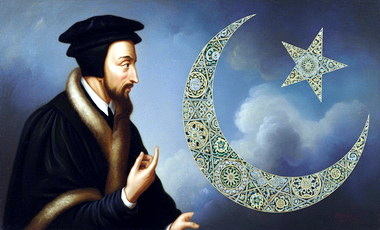
The “Connective Tissue” Between Islam and Calvinism

In my [I guess now, 4-month study of the Augustinian influenced [Gnostic] Calvinism, I kept coming back to the connections with Islam’s “god” as a close comparison to Calvin’s “god”.

So I have found a couple videos I liked on the matter that expanded this connection that came to my mind. Enjoy

(Video Description) Is God the author and the cause of sin? Does God ordain and decree evil and wickedness? Is infant damnation real? We will look at several of these claims from Calvinists and show their similarities to statements made from Mohammed and Islam. John Edwards, Augustus Toplady, James White, John Piper, Justin Peters, RC Sproul, Theodore Zachariades, Gordon Clark, Edwin Palmer, G3, Scott Aniol, Ephesians 1:11, Proverbs 16:4, God’s sovereignty, Satan’s influence, biblical responsibility, Westminster confessions, Council of Dort.

There are other videos out there as well, many make some good points — but I wouldn’t recommend them as a whole. Consistent Calvinist has a decent video however. But I liked this video as it sent me searching for PDFs and text type sources… which will follow. (BTW, I assume the voices in this video are A.I. voices):

(Video Description) John Calvin’s theology exhibits a significant alignment with Islamic doctrine. The analysis focuses on shared tenets such as the denial of free will, the doctrine of double predestination, and the assertion that God ordains sin. By comparing Calvin’s Institutes of the Christian Religion with the Quran and the writings of Islamic scholars, both theological systems emphasise God’s absolute sovereignty to the extent that it overrides human agency and traditional notions of divine justice. This Islamic basis undermines core biblical teachings regarding God’s nature and human responsibility.

A recommended read is what follows:

Islam and Calvinism: An Uncomfortable Comparison

Determinism

The sovereignty of Allah in Islam and God in Calvinism is absolutely deterministic. They are the author of every action, word, and thought, including sin and evil. Moreover, they predetermined before time everything that shall occur in time including who will be given the gift of faith and eternal life, and who will not and be condemned to eternal death.

Calvinist church historian Phillip Schaff writes:

Calvinismstarts with a double decree of predestination, which antedates and is the divine program of human history. This program includes the successive stages of the creation of man, a universal fall and condemnation of the human race, a partial redemption and salvation: all for the glory of God and the display of His attributes of mercy and justice. History is only the execution of the original design(History of the Christian Church 8.4.114).

Note that Schaff does not shy away from affirming that God Himself decreed the fall of man, and is therefore the author of sin!

The same view was affirmed by Calvin:

By predestination we mean the eternal decree of God, by which he determined with himself whatever he wished to happen with regard to every man. All are not created on equal terms, but some are preordained to eternal life, others to eternal damnation; and, accordingly, as each has been created for one or other of those ends, we say that he has been predestined to life or death (Institutes, 3.21.5).

Islam teaches the same doctrine as Calvinism. According to Islam, Allah is absolutely deterministic. As Caner and Caner write:

One of the foundational doctrines of Islam is the absolute sovereignty, to the point of determinism, of Allah. Allah knows everything, determines everything, decrees everything, and orders everything. Allah is even the cause of evil (Unveiling Islam, p. 109).

It follows that Allah predestines all who will be saved and all who will be eternally damned. Of those who cannot be saved, Surah 2:6-7 states:

It is the same to them whether you warn them or do not warn them; they will not believe. Allah has set a seal on their hearts and on their hearing. And on their eyes is a veil; Great is the chastisement they [incur].

Fatalism

It follows that Calvinism and Islam are both inherently fatalistic. In Calvinism, the sovereign God elects those who will be saved and rejects all others, as seen repeatedly in Calvin’s writings:

some are preordained to eternal life, others to eternal damnation; and, accordingly, as each has been created for one or other of those ends, we say that he has been predestined to life or death (Institutes, 3.21.5).

[God] arranges all things by his sovereign counsel, in such a way that individuals are born, who are doomed from the womb to certain death(Institutes, 3.23.6).

In the same way, Allah leads astray whom he wills, and saves whom he wills (Surah 14:4):

Allah is exalted and pleased as he sends people to hell: this is the fatalistic claim of Islam. Fatalism is a belief that events are fixed in advance for all time in such a manner that human beings are powerless to change them. In this case, Allah will send to heaven whomever he pleases, and send to hell whomever he pleases (Unveiling Islampp. 31-32).

An old joke tells of a Calvinist who fell down the stairs, got up, and said, “Thank God that’s over!” Interestingly, Caner and Caner recount from their Islamic childhood:

Our father used to say, “If you fall and break your leg, say, ‘Allah wills it,’ because he caused it to happen” (Unveiling Islam, p. 109).

The Love of God

Perhaps the most fundamental of all aspects of God’s character is love. “He who does not love does not know God, for God is love” (1 John 4:8). “For God so loved the world” (John 3:16) “God demonstrates His own love toward us” (Rom 5:8). These are just a few of the numerous Biblical texts which affirm the universal, sacrificial, eternal, personal, and unconditional love of God for all mankind. No character of God is more central to the message of the gospel. The incarnation and substitutionary atonement shout it. Everything in God’s saving action toward mankind declares it. But what do we see in Islam and Calvinism?

Love De-Emphasized

In Islam, Allah is virtually devoid of love. Caner and Caner list 99 names of Allah, and only one includes a reference to love (and this only to those who are “his own”). They write:

When Allah is discussed within the Islamic community, the absence of intimacy, atonement, and omnibenevolence becomes apparent. In all the terms and titles of Allah, one does not encounter terms of intimacy. . . Even the most faithful and devout Muslim refers to Allah only as servant to master; Allah is a distant sovereign (Unveiling Islam, p. 117).

But what do we find in Calvinism? God’s sovereignty—His power and holiness—are emphasized at the expense of His love. Dave Hunt observes:

But where is God’s love? Not once in the nearly thirteen hundred pages of his Institutes does Calvin extol God’s love for mankind. This one-sided emphasis reveals Calvinism’s primary defect: the unbiblical limitations it places upon God’s most glorious attribute. . . Something is radically amiss at the very foundation of this unbiblical doctrine (Debating Calvinism, p. 47).

Limited Love

As we look closer, we find reasons for this muting of God’s love in Islam and Calvinism. For example, Calvin’s God and Islam’s Allah are both bereft of unconditional love for everyone.

Allah’s heart is set against the infidel (kafir). He has no love for the unbeliever, nor is it the task of the Muslim to “evangelize” the unbelieving world (Unveiling Islam, p. 118).

Caner and Caner note, “This is why so many Muslims quickly disown children who have converted to another religion, especially Christianity. Why love them when almighty Allah will never love them?” (Unveiling Islam, p. 33).

But is this any different than Calvinism? Dave Hunt puts it bluntly:

Never forget that the ultimate aim of Calvinism…is to prove that God does not love everyone, is not merciful to all, and is pleased to damn billions. If that is the God of the Bible, Calvinism is true. If that is not the God of the Bible, who “is love” (1 John 4:8), Calvinism is false. The central issue is God’s love and character in relation to mankind, as presented in Scripture (Debating Calvinism, p. 21).

Conditional Love

While Calvinists (but not Muslims) would object to the idea their God has a conditional love, that is the effect of their doctrine.

This doctrine is openly announced in Islam: “Allah loves not transgressors” (Qur’an 2:190). “For [Allah] loves not any ungrateful sinner” (Qur’an 2:276). “For Allah loves not those who do wrong” (Qur’an 3:57). “For Allah loves not the arrogant, the vainglorious” (Qur’an 4:36).

Within Calvinism, God’s love is declared to be unconditional because He has given it “unconditionally”—i.e., not in response to anything we do. But whether or not one is actually loved in this “salvific” way is ultimately determined by what we do. This fact is enshrined by the last of the Five Points of Calvinism, i.e., the Perseverance of the Saints. Since all who are saved will inevitably persevere in living a faithful life, God’s saving love, in the end, is determined by our works.

Notably, as is always the result with synergism (i.e., salvation by faith and works), no amount of good works can give you assurance of salvation.

Insecure Love

It is impossible in Calvinism and Islam to know that you are loved by God. While Calvinists proclaim their belief in eternal security, what they mean is if you are really saved (which you cannot know with absolute certainty until you die), then you will never lose your salvation. But how can you know that? Based on your works. However, the threat of falling into some sin, and thus finding out that you were never really saved in the first place, is a possibility hanging over the head of every Calvinist.

Similarly, and blatantly, Islam teaches this same doctrine:

The Qur’an hints that the believer in Allah can be confident of his or her eternal destiny, but there is no guarantee, even for the most righteous. . . In Islam, the answer to the question, “What must I do to go to heaven?” is “mysterious and complex. . . Islamic tradition argues that the guarantee ofheaven is as impossible to find as a chaste virgin and pure speech. Consequently, the devoutMuslim makes every effort to please Allah and thereby obtain heaven. But fate (kismet) in the hands of the all-powerful Allah will decide the outcome (Unveiling Islam, p. 144).

Clearly, the love of God is at best compromised in both Islam and Calvinism.

READ IT ALL


This next piece is a clip from a Facebook Post… Here is the title of this post

“Calvinism Is Just Islam Repackaged”

Comparing the Calvinist God and the God of Islam

At first glance, Calvinism and Islam may seem vastly different due to their theological and cultural contexts. However, when examining the portrayal of God in Calvinist theology and Islamic theology, striking similarities emerge. Both traditions emphasize God’s absolute sovereignty, but in ways that challenge concepts of divine love, justice, and human freedom as revealed in the Bible. Here is a comparison of the Calvinist God and the God of Islam:

  1. Absolute Sovereignty and Determinism

Calvinist God:

  • Calvinism teaches that God’s sovereignty means He unconditionally decrees all events, including human actions, sin, and salvation. This leads to the doctrine of double predestination, where some are chosen for salvation and others are predestined for damnation, entirely apart from human free will.

Islamic God (Allah):

  • In Islam, Allah’s sovereignty is also absolute and deterministic. The Quran states that Allah guides whom He wills and leads astray whom He wills (Surah 14:4, Surah 16:93). Human actions, both good and evil, are believed to occur because Allah has willed them.

Comparison:

Both the Calvinist God and Allah are depicted as sovereign in ways that minimize or negate genuine human free will. This deterministic framework portrays God as the ultimate cause of sin and unbelief, raising serious questions about divine justice and human accountability.

  1. Justice and Predestination

Calvinist God:

  • According to Calvinism, God’s justice allows Him to predestine some to eternal damnation without any consideration of their actions or choices. This is often defended as a “mystery” of God’s will, though it conflicts with the notion of a just and impartial God.

Islamic God (Allah):

  • In Islam, Allah is described as just but is not bound by human notions of justice. Allah may forgive or punish as He pleases, and there is no guarantee of salvation even for the most devout believer. Salvation depends entirely on Allah’s arbitrary will.

Comparison:

In both systems, God’s justice is portrayed as inscrutable or arbitrary, leading to a sense of fear and uncertainty. The Calvinist doctrine of reprobation and the Islamic belief in Allah’s arbitrary judgment both suggest a God whose actions are beyond moral comprehension.

  1. Love and Mercy

Calvinist God:

  • Calvinism teaches that God’s love is limited to the elect. Christ’s atonement is “limited” and applies only to those predestined for salvation. The reprobate, by contrast, are excluded from God’s saving love and are created solely to demonstrate His wrath.

Islamic God (Allah):

  • In Islam, Allah is described as merciful (Ar-Rahman, Ar-Rahim), but His mercy is conditional. Allah does not love sinners or unbelievers (Surah 3:31-32). His mercy is reserved for those who obey Him and follow His commands.

Comparison:

Both the Calvinist God and Allah show love and mercy only to a select group—either the elect in Calvinism or the obedient in Islam. This stands in stark contrast to the biblical God, who loves all people and desires the salvation of everyone (1 Timothy 2:4, John 3:16).

  1. Human Freedom and Responsibility

Calvinist God:

  • Human free will is effectively denied in Calvinism. People are bound by their sinful nature and cannot choose God unless they are regenerated first. Even their “choices” are ultimately determined by God’s eternal decree.

Islamic God (Allah):

  • In Islam, humans have limited free will, but their actions are ultimately determined by Allah’s will. The Quran repeatedly emphasizes that Allah guides or leads astray whomever He wills (Surah 6:125).

Comparison:

In both systems, human freedom is subordinated to divine sovereignty, resulting in a deterministic worldview. This undermines the biblical teaching that humans are created in the image of God with the capacity to freely love and respond to Him (Genesis 1:27, Deuteronomy 30:19).

[….]

Conclusion: The Biblical God Is Distinct

While the Calvinist God and the God of Islam share similarities in their emphasis on sovereignty and determinism, they both fall short of the biblical portrayal of God. The God of the Bible is sovereign, but His sovereignty is expressed through love, justice, and respect for human freedom. He desires the salvation of all, offers grace universally, and seeks a personal relationship with every human being.

The biblical God is not arbitrary or partial but perfectly just, merciful, and relational. His love is unconditional, and His gospel is genuinely good news for all people. This is the God revealed in Jesus Christ, who came to save the world, not just a select few (John 3:17).

Just an additional thought on Calvinism by this wonderful sermon that includes an excellent analogous story showing how absurd Calvinistic Reformed thinking is.

The Absurdity of Reformed Theology

Nov. 6, 2022, Adult Sunday School at Truth Baptist Church. 2 Peter 3:9 “The Lord is not slack concerning his promise, as some men count slackness; but is longsuffering to us-ward, not willing that any should perish, but that all should come to repentance.”

Women Pastors? Scripture Says “No Way José”

While this post is about mainly Beth Moore, it will be a natural critique of other women preacher like Joyce Meyer, Priscilla Shirer, and others. But Revelation…

… expands even further that when persons prophecy non-Biblical ideas or additions to the clear enumeration of God’s Word, they are anathema. We use this warning when dealing with various cults and movements, like: J-Dubs, Mormons, New Agers, Word Faith/name it and claim it, and the like.

I can speak to this somewhat as the Word Faith theology was the root of havoc my parent adhered to. In the case of my father, to his death. And I came to a conclusion years ago, this understanding is very legalistic:

An additional point. This type of thinking is VERY legalistic. You will often hear about some Baptists practicing strict legalism over behavior. However, in the “Health and Wealth Gospel,” often time you HAVE to show the evidence of tongues in order to to show that you have the indwelling of the Holy Spirit. If you do not speak in tongues, you do not have the Spirit in you. This is legalism that changes even Jesus’ promise to us (John 14:15-31).

In this set of verses He [the Holy Spirit] is called Truth v. 16-17):

  • And I will ask the Father, and he will give you another advocate to help you and be with you forever—the Spirit of truth. The world cannot accept him, because it neither sees him nor knows him. But you know him, for he lives with you and will be in you.”

This is important because for all the evidences we give for the faith, we KNOW it to be true because of the inner witness of the Spirit. And “knowing” truth [Truth] is important when confronting a culture with God’s attributes that not only include love, but equally: justice, hatred of sin, and even judgement. Without truth [Truth], a Christian does not KNOW God, cannot express the Truth in love or in standing against evil. True evil.

It interferes with what Scripture is meant for as well:

  • All Scripture is inspired by God and is profitable for teaching, for rebuking, for correcting, for training in righteousness, so that the man of God may be complete, equipped for every good work. (2 Timothy 3:16-17)

What a daunting rejection of God’s grace and plan for His church/people. Pride comes before a fall, and this is hubris on steroids!

What does the Bible say about women pastors?
John F. MacArthur and Paul Washer

And not only are these women pastors adding to Scripture and it’s meaning, as will be elucidated below, others do as well. Here is a snippet from my eulogy to my father:

The charismatic and Pentecostal tradition has a lot to answer for in the proverbial “By-and-By.” Mind you, while I truly believe some of these people at my dad’s church are saved and are going to heaven, they are destroying lives of people around them. They just don’t see it.

Here I am adding a caveat.

If people follow the Word-Faith theology to its logical conclusion, then the person may not in fact be saved at all. My father rejected much of the following… I know because we argued this stuff for years. Some dangerous views that could lead some to eternal separation from their Creator are:

Listen to more actual audio of these cultists preaching a twisted faith, HERE, stuff like:

  • God the Father has a body;
  • Trinity not important;
  • Adam flew to the moon;
  • men become gods;
  • men are gods

I could go on but the point is made.

Just like the early movement in the Corinthian church that had a similar emotional outburst and rejected a healthy-well-balanced theology that Paul spoke to in 1 Corinthian 14:23. Thus, Paul would have rebuked gracefully and doctrinally my dad’s church.

BTW, the above was added to this post just this morning after the sermon from my church. This post, again is mainly focused on Beth Moore to add additional context to my previous posts, found here:

There will be some meaty videos below that will tend to be longer at times. I will also quote from some more theologically minded books on the topic that elucidate Scripture.

This is meant to embolden one with some Scripture and understanding as well as some resources for the serious layman. Also, it is updating my understanding of who Beth Moore has become since I last looked into her many years ago. She falsely follows the narrative of Christian nationalism), she has accepted the ideas of Critical Race Theory (CRT), and is self involved (a narcissist) as one of her past fans writes in an excellent thread. Not only have I in the past rejected her positions, after going thru her more recent issues and positions since that earlier time, I can more boldly say she is a false teacher and heretic. Many good links to critiques of her can be found HERE.

See my previous posts here and here; also Front Page’s articles here and here for more; PJ-Media’s post / post will help

See more video interviews HERE & HERE of Eric Metaxes

First up is Justin Peters, someone I have come to respect as a teacher due to my closeness to just how detrimental bad theology (Word of Faith) can be in one’s life.

Beth Moore has finally eschewed biblical complementarianism and come out of the egalitarian closet. In this program, I interview Susan Heck (who has every book in the New Testament memorized and several in the Old) about her concerns with Beth Moore. I also ask Susan about the egalitarian arguments of Priscilla, the women at the tomb, and Deborah.

The following is from Chapter two of a wonderful book authored by John Piper and Wayne Grudem: Recovering Biblical Manhood and Womanhood: A Response to Evangelical Feminism (I PDF’ed Chapter 2 HERE):

(2) What do you mean (in question 1) by “unbiblical female leadership in the church”?

We are persuaded that the Bible teaches that only men should be pastors and elders. That is, men should bear primary responsibility for Christlike leader­ship and teaching in the church. So it is unbiblical, we believe, and therefore detrimental, for women to assume this role. (See question 13.)

(3) Where in the Bible do you get the idea that only men should be the pastors and elders of the church?

The most explicit texts relating directly to the leadership of men in the church are 1 Timothy 2:11-15; 1 Corinthians 14:34-36; 11:2-16. The chapters in this book on these texts will give the detailed exegetical support for why we believe these texts give abiding sanction to an eldership of spiritual men. Moreover, the biblical connection between family and church strongly suggests that the headship of the husband at home leads naturally to the primary leadership of spiritual men in the church. (See chapter 13.)

[….]

(16) Aren’t the arguments made to defend the exclusion of women from the pas­torate today parallel to the arguments Christians made to defend slavery in the nineteenth century?

See the beginning of our answer to this problem in question 15. The preserva­tion of marriage is not parallel with the preservation of slavery. The existence of slavery is not rooted in any creation ordinance, but the existence of marriage is. Paul’s regulations for how slaves and masters related to each other do not assume the goodness of the institution of slavery. Rather, seeds for slavery’s dissolution were sown in Philemon 16 (“no longer as a slave, but better than a slave, as a dear brother”), Ephesians 6:9 (“Masters . . . do not threaten [your slaves]”), Colossians 4:1 (“Masters, provide your slaves what is right and fair”), and 1 Timothy 6:1-2 (masters are “brothers”). Where these seeds of equality came to full flower, the very institution of slavery would no longer be slavery.

But Paul’s regulations for how husbands and wives relate to each other in marriage do assume the goodness of the institution of marriage-and not only its goodness but also its foundation in the will of the Creator from the beginning of time (Ephesians 5:31-32). Moreover, in locating the foundation of marriage in the will of God at creation, Paul does so in a way that shows that his regu­lations for marriage also flow from this order of creation. He quotes Genesis 2:24, “they will become one flesh,” and says, “I am talking about Christ and the church.” From this “mystery” he draws out the pattern of the relationship between the husband as head (on the analogy of Christ) and the wife as his body or flesh (on the analogy of the church) and derives the appropriateness of the husband’s leadership and the wife’s submission. Thus Paul’s regulations concerning marriage are just as rooted in the created order as is the institution itself. This is not true of slavery. Therefore, while it is true that some slave owners in the nineteenth century argued in ways parallel with our defense of distinct roles in marriage, the parallel was superficial and misguided.

Mary Stewart Van Leeuwen points out, from 1 Timothy 6:1-6, that, accord­ing to the nineteenth-century Christian supporters of slavery, “even though the institution of slavery did not go back to creation . . . the fact that Paul based its maintenance on a revelation from Jesus himself meant that anyone wishing to abolish slavery (or even improve the slaves’ working conditions) was defying timeless biblical norms for society.”3 The problem with this argument is that Paul does not use the teachings of Jesus to “maintain” the institution of slavery, but to regulate the behavior of Christian slaves and masters in an institution that already existed in part because of sin. What Jesus endorses is the kind of inner freedom and love that is willing to go the extra mile in service, even when the demand is unjust (Matthew 5:41). Therefore, it is wrong to say that the words of Jesus give a foundation for slavery in the same way that creation gives a foundation for marriage. Jesus does not give any foundation for slavery, but creation gives an unshakeable foundation for marriage and its complementary roles for husband and wife.

Finally, if those who ask this question are concerned to avoid the mistakes of Christians who defended slavery, we must remember the real possibility that it is not we but evangelical feminists today who resemble nineteenth century defenders of slavery in the most significant way: using arguments from the Bible to justify conformity to some very strong pressures in contemporary society (in favor of slavery then, and feminism now).

And this next part is from Norman Geisler’s Systematic Theology

The Gender of an Elder

All elders were males, for they needed to be “the husband” of one wife (1 Tim. 3:2). Elder was a position of authority, and women were not “to usurp authority over the man” (1 Tim. 2:12). The reasons given, which clarify that this is not merely cultural, are based here on the order of creation and elsewhere (1 Cor. 11:3) on the nature of the Godhead. However, women are not inferior in nature, redemptive status, or spiritual gifting; they differ only in function.

Women Are Equal to Men in Nature

If women were naturally unequal to men because of their God-appointed role as submissive to their head, then Christ would be naturally inferior to God, since He is submissive to the Father (1 Cor. 11:3; 15:28). For instance, Jesus said, “I can of my own self do nothing: as I hear, I judge: and my judgment is just; because I seek not mine own will, but the will of the Father which hath sent me” (John 5:30; cf. 8:28). Both women and men were created in God’s image (cf. Gen. 1:27).

Women Are Equal to Men in Redemptive Status

Neither are women inferior as to redemptive status; soteriologically (salvifically), “there is neither Jew nor Greek, slave nor free, male nor female, for you are all one in Christ Jesus” (Gal. 3:28 niv).

Women Are Equal to Men in Spiritual Gifting

Nor are women inferior to men in the area of spiritual gifts, there being no sex indicators on the gifts. There were prophetesses in the New Testament (Acts 21:29); the woman Priscilla taught the man Apollos (Acts 18:26); and women prophesied in the church service, since Paul told them how to do it (1 Cor. 11:13).

Women Are Different in Function From Men

That women are different in function in no way makes them inferior; if anything, they have an unparalleled function—childbearing—which Paul singles out in 1 Timothy 2:15. Functions (or lack thereof) do not make one naturally inferior or superior to members of the opposite sex; they merely make one different. Everyone, male or female, functions best in his/her God-given role. For example, men are neither inferior because they cannot bear children nor superior

Apple doesn’t fall far from the tree:

Some more zeroed in issues… under the covering of a pastor, via Dr. Wayne Grudem:

DOES A PASTOR’S AUTHORITY
TRUMP SCRIPTURE?

Some evangelical feminists
say that women can teach if
they are “under the authority”
of the pastors or elders

Another liberal tendency among evangelical egalitarians is the claim that a woman may teach Scripture to men if she does so “under the authority of the pastor or elders.” I say this is indicative of a liberal ten­dency because on no other area of conduct would we be willing to say that someone can do what the Bible says not to do as long as the pastor and elders give their approval.

This position is found fairly often in evangelical churches. What makes this position different from others we have treated up to this point in the book is that many who take this view say they genuinely want to uphold male leadership in the church, and they say they are upholding male leadership when a woman teaches “under the authority of the elders” who are men (or of the pastor, who is a man).

On the other hand, this is not a commonly held view among the main egalitarian authors or those who support Christians for Biblical Equality, for example.[1] These writers do not think only men should be elders, so they surely don’t think that women need any approval from male elders to teach the Bible!

But this view comes up fairly often in phone calls or e-mails to the Council on Biblical Manhood and Womanhood (CBMW) office, and I often hear it in personal conversations and discussions of church policies.

Is it really true that a woman is obeying the Bible if she preaches a sermon “under the authority of the pastor and elders”?

The question here is, what does the Bible say? It does not merely say, “Preserve some kind of male authority in the congregation.” It does not say, “A woman may not teach men unless she is under the author­ity of the elders.” Rather, it says, “I do not permit a woman to teach or to exercise authority over a man” (1 Tim. 2:12).

Can a pastor or the elders of a church give a woman permission to disobey this statement of Scripture? Certainly not! Can a woman do what the Bible says not to do and excuse it by saying, “I’m under the authority of the elders”? Would we say that the elders of a church could tell people “under their authority” that they have permission to disobey other passages of Scripture?

What would we think of someone who said, “I’m going to rob a bank today because I need money and my pastor has given me permission, and I’m under his authority”? Or of a person who said, “I’m committing adul­tery because I’m unhappy in my marriage and my elders have given me permission, so I’m still under the authority of my elders”? Or of someone who said, “I’m committing perjury because I don’t want to go to jail and my pastor has given me permission, and I’m under his authority”? We would dismiss those statements as ridiculous, but they highlight the gen­eral principle that no pastor or church elder or bishop or any other church officer has the authority to give people permission to disobey God’s Word.

Someone may answer, “But we are respecting the Bible’s general prin­ciple of male headship in the church.” But Paul did not say, “Respect the general principle of male headship in your church.” He said, “I do not permit a woman to teach or to exercise authority over a man” (1 Tim. 2:12). We do not have the right to change what the Bible says and then obey some new “general principle of the Bible” that we have made up.

Nor do we have the right to take a specific teaching of Scripture and abstract some general principle from it (such as a principle of “male headship”) and then say that principle gives us the right to disobey the specific commands of Scripture that fall under that principle. We are not free to abstract general principles from the Bible however we wish, and then invent opinions about how those principles will apply in our situ­ations. Such a procedure would allow people to evade any command of Scripture they were uncomfortable with. We would become a law unto ourselves, no longer subject to the authority of God’s Word.

We could try this same procedure with some other passages. Would we think it right to say that the Bible teaches that men should pray “with­out anger or quarreling, unless they quarrel under the authority of the elders” (see 1 Tim. 2:8)? Or that women should adorn themselves “with modesty and self-control, unless the elders give them permission to dress immodestly” (see 1 Tim. 2:9)? Or would we say that those who are “rich in this present age” should “be generous and ready to share, unless the elders give them permission to be stingy and miserly” (see 1 Tim. 6:17­19)? But if we would not add “unless the elders give permission to do otherwise under their authority” to any of the other commands in Scripture, neither should we add that evasion to 1 Timothy 2:12.

If a woman says, “I will teach the Bible to men only when I am under the authority of the elders,” she has become no different from men who teach the Bible. No man in any church should teach the Bible pub­licly unless he also is under the authority of the elders (or pastor, or other church officers) in that church. The general principle is that anyone who does Bible teaching in a church should be subject to the established gov­erning authority in that church, whether it is a board of elders, a board of deacons, a church governing council, or the church board. Both men and women alike are subject to that requirement. Therefore, upon reflec­tion, it turns out that this “under the authority of the elders” position essentially says there is no difference between what men can do and what women can do in teaching the Bible to men.

Do we really think that is what Paul meant? Do we really think that Paul did not mean to say anything that applied only to women when he said, “I do not permit a woman to teach or to exercise authority over a man” (1 Tim. 2:12)?

Allowing a woman to disobey 1 Timothy 2:12 by saying she is doing so “under the authority of the elders” is setting a dangerous precedent by saying, in effect, that church leaders can give people permission to disobey Scripture. It is thus another step on the path toward liberalism.


[1] In fact, egalitarian author J. Lee Grady rejects this idea. He writes, in the context of talking about women who have public preaching ministries: “And in many cases, leaders have inno­cently twisted various Bible verses to suggest that a woman’s public ministry can be valid only if she is properly ‘covered’ by a male who is present” (J. Lee Grady, Ten Lies the Church Tells Women [Lake Mary, Fla.: Creation House, 2000], 89).

Beth Moore’s Wild Unbiblical Teachings: Michelle Lesley Interview

See Michelle Leslie’s articles on Beth HERE

10 Questions are asked in the RENEW.ORG article worth considering:

  1. Why are Women’s Bible Studies filled with False Teachers?
  2. Why did God create from scratch—not based on culture—male leadership roles in the Old Testament, in the ministry of Jesus, and in the New Testament church?
  3. Why make giftedness and not the created order the starting point?
  4. Why reject the priest/rabbi/synagogue role as a historical background for key texts in 1 Corinthians 11:3-5, 1 Corinthians 14:29-34, and 1 Timothy 2:11-13?
  5. How do Jesus and the Church mutually submit to each other?
  6. Does it bother you that you must redefine the understanding of so many passages and key words?
  7. What can you teach from Scripture on what makes a man distinct from a woman?
  8. How will you use Scripture as a basis for appointing female elders?
  9. Why do churches not grounded in secular Western egalitarianism tend to read these passages so differently?
  10. How will you stop the drift to gay, lesbian, and transgender affirmation and other forms of progressivism in your church?

A great read BTW!

Why are Women’s Bible Studies filled with False Teachers?

Why do so many women’s Bible studies have false word of faith teachings, and me-centered emotionalism from Beth Moore, Joyce Meyer, Priscilla Shirer, and similar false teachers? Noted women’s Bible study author, Susan Heck, discusses why women need sound theological teaching and the importance of memorizing Scripture. Susan describes how she memorized the entire New Testament, and she’s now in the process of memorizing the Old Testament.

GOT QUESTIONS ends with these two paragraphs to a wonderful read.

Many women excel in gifts of hospitality, mercy, teaching, evangelism, and helping/serving. Much of the ministry of the local church depends on women. Women in the church are not restricted from public praying or prophesying (1 Corinthians 11:5), only from having spiritual teaching authority over men. The Bible nowhere restricts women from exercising the gifts of the Holy Spirit (1 Corinthians 12). Women, just as much as men, are called to minister to others, to demonstrate the fruit of the Spirit (Galatians 5:22–23), and to proclaim the gospel to the lost (Matthew 28:18–20Acts 1:81 Peter 3:15).

God has ordained that only men are to serve in positions of spiritual teaching authority in the church. This does not imply men are better teachers or that women are inferior or less intelligent. It is simply the way God designed the church to function. Men are to set the example in spiritual leadership—in their lives and through their words. Women are also to set an example in their lives, but in a different way (1 Peter 3:1-6). Women are encouraged to teach other women (Titus 2:3–5). The Bible also does not restrict women from teaching children. The only activity women are restricted from is teaching or having spiritual authority over men. This bars women from serving as pastors to men. This does not make women less important, by any means; rather, it gives them a ministry focus more in agreement with God’s design.

I will end with CHRISTIAN PIRATE MEDIA dealing with some prophecy by Beth Moore that is essentially adding to Scripture.

Beth Moore’s “Outpouring ‘Prophecy'” | Pirate Christian Radio Flashback

Justin Peters Talks Specifically on Joseph Prince’s Wrong Teaching

Here are a few resources on Joseph Prince:

  1. Word Faith Prosperity Preacher Joseph Prince (Apprising Ministries)
  2. Destined to Reign…. BUT WHERE? (For the Love of HIS Truth)
  3. Joseph Prince and his message of radical grace – PLUS his word faith teachings (Let Us Reason, part 1)
  4. Grace, and the lack of personal accountability for sin (Let Us Reason, part 2)
  5. A Matter of Righteousness (Let Us Reason, part 3)
  6. Prince’s WORD FAITH TEACHING imbedded in grace (Let Us Reason, part 4)
  7. Is Joseph Prince preaching the Whole Counsel of God? (Christian Faith)
  8. Exposing A Heretic: Joseph Prince (Facebook)