Calvinism: A Biblical and Theological Critique, by David L. Allen (Editor), Steve W Lemke (Editor),
CHAPTER 6 by Ken Wilson — pages 230-237.
The Fatal Error of Calvinists
A Critique of Augustine’s Reversion to Pagan Concepts
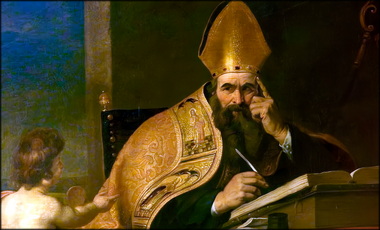
When he redefined Christian terms and concepts, Augustine misrepresented earlier Christian authors. Lewis Ayres politely noted, “Augustine was an attentive reader of his forebears, but one whose interpretations of them were frequently very much his own.”44 As a result, Luther and Calvin mistakenly believed that Augustine was merely teaching what all of the earlier church fathers had taught.45 But in fact, Augustine himself admitted that he had tried but failed to continue in the Christian doctrine of free will of the first four centuries. He consistently utilized the same Christian terms but inserted new meanings into those terms.46 Roger Haight wrote, “Grace for Augustine was delight in the good, a new form of liberty that required an internal modification of the human will. No one [Christian] prior to Augustine had really asserted anything like this need for an inner working of God within human freedom.”47 Augustine redefined free will, utilizing Stoic concepts, deformed original sin with Manichaean dualism, and mutilated faith into a divine gift to match Gnostic and Manichaean unilateral election.48 Augustinian scholar Eugene TeSelle noted:
Augustine always reacted vigorously to the suggestion that he taught what amounted to a doctrine of fate. Now it is undeniable that he did hold to something like what is usually meant by fate. . . . To him fate meant something precise: the doctrine that external occurrences, bodily actions, even thoughts and decisions are determined by the position of the heavenly bodies [C. dua ep Pel., II,6,12] or more broadly, universal material determinism [C. dua ep Pel. II, 6,12; De Civ. Dei. IV.33, V.1,8].49
Augustine said if anyone “calls the will of God or the power of God itself by the name of fate, let him keep his opinion but correct his language” (C. dua ep. Pel.1.2.4). Over a thousand years later, Augustine’s novel and syncretistic reinterpretations of Christian Scripture (TULIP) would be faithfully replicated by Calvin and his followers.
Similarly, modern Calvinists (such as the contributing authors of Whomever He Wills) vehemently defend their theology using Scripture. But they refuse to admit their own interpretations are based on the pagan philosophies and Manichaean religion deeply imbedded into their current syncretistic scriptural interpretations by Augustine.50 God as micromanager of the universe (Stoic sovereignty) stands foremost and paramount: total depravity (Manichaean) follows logically from it (using the same pagan arguments).51 For Calvinists like Andrew Davis, “Romans 9:11–13 is the mortal wound for conditional election.”52 This replicates the “biblical” arguments by Gnostics and Manichaeans for unconditional election (determinism); but all pre-Augustinian Christian writings opposed this pagan doctrine. Thomas Schreiner claimed all Christians will inevitably persevere. This assumes the perfect divine gift of faith unilaterally infused by (the Gnostic/Manichaean) God cannot fail, because ultimate salvation requires perseverance—faith plus works (i.e., not our own but fruit God produces, per Augustine). This includes Schreiner’s appeal to Phil 1:6, repeating Augustine’s tortured interpretation.53 Bruce Ware’s chapter on the compatibility of determinism and freedom could have been argued by a Stoic or Manichaean who was familiar with Scripture. His argument for compatibility was unnecessary in pre-Augustinian Christian theology.54 Likewise, Stephen Wellum repeated Augustine’s appeal to “mystery” that was not required until his Stoic god unilaterally desired, predetermined, and ordained all things, including monstrous evils (such as genocide, rape, torture, and child sacrifice).55 Matthew Barrett’s “The Scriptural Affirmation of Monergism” would have shocked all pre-Augustinian Christians, while making the ancient monergistic Manichaeans proud.56
For Calvinists, the only reasonable theological choice must be Calvinism, since in Arminianism, “God is robbed of his glory at the expense of demanding libertarian freedom.”57 This false disjunction (limited to two poor choices of Calvinism and Arminianism) ignores the centuries of unanimous pre-Augustinian Christian theology on human free will and God’s general sovereignty. Calvinism’s God is puny. Calvinism limits God’s sovereignty.
Calvinists must either ignore these facts or attempt to marginalize them. The vast majority of Christianity—Catholics, Orthodox, Protestants, and other Christian groups—have been unsuccessful in using these facts to convince Calvinists of their errors. We cannot seem to break through the resilient barrier of indoctrinated self-deception to reach adherents of modern Calvinism. In Calvinism, tradition has triumphed over truth.
Conclusion
Augustine of Hippo subverted Christian theology in AD 412 by incorporating his prior Stoic view of meticulous providence and his prior Manichaean doctrine of Divine Unilateral Predetermination of Eternal Destinies (DUPED). All prior Christians had fought against Stoic meticulous providence and Gnostic/Manichaean DUPED. They taught the Christian God is relational and exercises general (not specific) sovereignty for the purpose of allowing human freedom. The Christian God chooses persons for salvation based upon his foreknowledge of their free choices. Augustine reverted to his Manichaean deterministic interpretations of Scripture when attempting to explain infant baptism against the Pelagians. For twenty-five years he had refuted those interpretations as heresy.
After AD 411, Augustine’s final eighteen years of theology was DUPED as the Manicheans had claimed—monergistic, to the glory of Augustine’s new inscrutable sovereign God who creates then damns innocent babies to hell.58 He confessed, “I cannot find a satisfactory and worthy explanation— because I can’t find one, not because there isn’t one” (Serm.294.7). After 1,600 years, no philosopher or theologian has found a “satisfactory and worthy explanation” to salvage Augustine’s syncretism of pagan ideas into Christianity that damns innocent babies to hell. It will forever remain a “mystery.”
Cicero (ca. 50 BC), one of Augustine’s favorite authors, had argued for the in-compatibility between divine omniscience and human free will. Augustine’s final answer was to claim that divine foreknowledge of the future occurs only through God’s unilateral predetermination and ordaining of every event, both good and evil (Civ.5). By this move he departed from all prior Christian teaching and syncretized a concept common in Stoicism: “God foreordains human wills.”59 The Stoic scholar John Rist concluded that Augustine’s novel Christian determinism produced “a theology which fails to do justice to his own theory of God’s love.”60 In contrast, Jerome succeeded in refuting the Pelagians without adopting the extremes of Augustinianism (Against the Pelagians 3) and retained the traditional Christian beliefs in God’s general sovereignty, grace, and free will.61
Harry Wolfson, historian and philosopher at Harvard University’s Judaic Studies Center, concluded, “Augustine’s doctrine of grace is only a Christianization of the Stoic doctrine of fate.”62 Because of Augustine’s AD 412 reversion to pagan ideas, the exalted justice of the relational Christian God (used to combat pagan philosophies and heresies) was instantly transformed into inscrutable theology—deformed theology. Augustine overtly wrote of God’s predestination of the ones he purposefully created for damnation in eternal torment (“double predestination”; Nat. orig.1.14, Civ.14.26, 15.1; Serm.229S, Serm.260D.1; An.et or.4.16).63 Augustine borrowed his prior Neoplatonic inscrutable mystery as his defense for this horrendous divine injustice (Serm.D.29.10 and Serm.294.7). Neoplatonism (ca. AD 250) had invented this crucial theodicy by appealing to the inscrutable secret counsels of God, who is fair by definition, regardless of whatever apparent evils he desires and ordains. Prior Christians had never required this implausible and disingenuous attempt at a defense for their God.
Modern Calvinists teach Augustine’s theology. Calvinists appeal to the same deterministic interpretations of the same Scripture passages taught by Manichaeans. Calvinism’s historical foundation is dangerously unstable. Its foundation relies on the Manichaean interpretations of Scripture by a single man in the ancient church who rejected three hundred years of unanimous church teaching of free will, a teaching that had refuted Stoic and Gnostic/Manichaean determinism. This man was indoctrinated for decades in extremely deterministic pagan philosophies and heretical Manichaeism. Augustine admitted he changed his theology regarding free will: he abandoned the Christian rule of faith regarding free choice. “In the solution of this question I struggled in behalf of free choice of the will, but the grace of God won out” (Retr.2.1).
But the grace that “won out” was not Christian grace: it was Manichaean grace. According to Augustine (Conf.7.5), he only escaped the philosophical prison of Manichaean DUPED by accepting Christian free choice. This freed him from viewing God as punishing unjustly. But ironically, after finally escaping, Augustine’s later “inscrutable justice” of Christianized pagan DUPED reimprisoned both himself and his followers.
In contrast, the prior nearly unanimous Christian teaching (that God offers his grace to every human equally) persisted throughout the Patristic period into the eighth century with John of Damascus (d. ca. AD 760): “We ought to understand that while God knows all things beforehand, yet He does not predetermine all things. . . . So that predetermination is the work of the divine command based on foreknowledge” (Exp. fid.44). Eleonore Stump astutely concluded, “Unless Augustine is willing to accept that God’s giving of grace is responsive to something in human beings, even if that something is not good or worthy of merit, I don’t see how he can be saved from the imputation of theological determinism with all its infelicitous consequences.”64
A willingness to return to the universal Christian theology that God gives grace as a response to human choice would never come for Augustine. The famous rhetorician never looked back in his resolve to win his debate against the Pelagians at all costs. William Frend explained, “Augustine could not concede a single point to his adversaries and this was his undoing.”65 Augustine died eighteen years after reverting to his pagan monergistic determinism, still trusting in his self-crafted syncretistic theology.
As we observed in the introduction, Calvinists address the blatant absence of their theology in the pre-Augustinian centuries in one of two possible ways. The less scholarly Calvinists invent proto-Calvinists among early Christian authors. Scholarly Calvinists claim Augustine was the first theologian since the apostle Paul to interpret Scripture correctly. Benjamin Warfield opined Augustine’s “doctrine was not new” but was lost for four centuries between the time the apostle Paul wrote it and Augustine “ recovered” it for the church (the Calvinist Gap Theory).66 These scholars appear oblivious to the enormous chasm separating Paul from Augustine. This formidable chasm is Augustine’s Stoicism, Neoplatonism, and Manichaeism. It separates Paul from Augustine by hundreds of years and thousands of miles. Calvinists attempt to bridge this insurmountable gap by using the “hermeneutical” lens of Augustine’s Manichaeism to reinterpret Pauline (and other) Scriptures within their own paradigm.
Calvinism’s alleged “biblical foundation” rests on Augustine’s deterministic interpretations of Scripture from his decade of Gnostic/Manichaean training (John 6:44–66; 14:6; Rom 9–11; Eph 2:1–3, 8–9; Phil 2:13; etc.). Such a dangerous foundation requires a precarious “faith” in Augustine’s “Sovereign God,” caricatured through syncretism with Stoic and Neoplatonic philosophy and the heretical Manichaean religion.67 He baptized his prior pagan philosophies and religion into Christianity, resulting in an unrecognizable doctrinal conglomeration. Calvinism is Augustinianism. Augustinianism is Christian theology scrambled with Gnostic/Manichaean theology and Stoic/Neoplatonic philosophy. As John Rist concluded, Augustinianism is “Ancient [pagan] Thought Baptized.”68
Nevertheless, these serious syncretistic errors did not make Augustine a heretic or a non-Christian. Augustine still embraced the essential doctrines of the Christian faith. Modern Calvinists also embrace the major tenets of Christianity regarding Jesus Christ as God in the flesh and Savior from sin. Despite their divergent views (sovereignty, total depravity/inability, and DUPED determinism) imported from Augustine’s paganism, Calvinists remain Christian brothers and sisters worthy of respect, love, and fellowship —contrary to the opinion of one extreme evangelical sect.69 In this anti-Christian period of history, Christians of all persuasions must be unified, despite our internal disagreements.
NOTES
44 Lewis Ayres, Augustine and the Trinity (Cambridge: Cambridge University Press, 2010), 86.
45 See Martin Luther, “To George Spalatin—Wittenberg, October 19, 1516,” in Luther’s Works, 48:23 (see chap. 5, n. 13); Luther, “Lectures on Romans: Glosses and Scholia,” in Luther’s Works, vol. 25; Calvin, Institutes, trans. Battles, 1:158–59 (I.xiii.29) (see chap. 4, n. 85); Harry Wolfson, Religious Philosophy: A Group of Essays (Cambridge, MA: Belknap Press of Harvard University Press, 1961), 158– 76, in which he explained the centuries-old traditional Judeo-Christian understanding of free will (despite the sinful inclination) that persisted until the “later Augustine” introduced Stoic ideas into Judeo-Christian theology, and especially Augustine’s misunderstanding of concupiscentia in his Latin translation of Wisdom of Solomon 8:21.
46 This included the terms original sin, grace, predestination, free will, and so forth. “For example, in the early patristic writers we find references to the origin of sin, to a fall, and to the inheritance of sin, but what is meant is often different from the meaning given to those terms in the later classical tradition influenced by Augustine.” Tatha Wiley, Original Sin: Origins, Developments, Contemporary Meanings (New York: Paulist Press, 2002), 53; italics in the original; Ralph Mathiesen, “For Specialists Only: The Reception of Augustine and His Teachings in the Fifth Century Gaul” in Collectanea Augustina: Presbyter Factus Sum, ed. Joseph Lienhard, Earl Muller, and Roland Teske (New York: Peter Lang, 1993), 30–31; Rebecca Weaver, s.v. “Predestination,” in Encyclopedia of Early Christianity, 2nd ed., ed. Everett Ferguson (New York: Garland, 1998): “The now centuries-old characterization of the human being as capable of free choice and thus accountable at the last judgment had been retained, but the meaning of its elements had been considerably altered”; Peter J. Leithart, “Review of Adam, Eve, and the Serpent” by Elaine Pagels, Westminster Theological Seminary Journal 51, no. 1 (Spring 1989): 186. “Augustine’s concept of free will certainly differs from that of earlier theologians.”
47 Roger Haight, The Experience of Language of Grace (New York: Paulist, 1979), 36.
48 In Stoicism, fate controls every minute occurrence in the universe (Cicero, Div.1, 125–26), and although a person has no possibility of actuating an opportunity, “free will” remains solely by definition (Cicero, Fat.12–15). See Margaret Reesor, “Fate and Possibility in Early Stoic Philosophy,” Phoenix 19, no. 4 (1965): 285–97, esp. 201; Stoics, “took elaborate precautions to protect their system from rigid determinism.” Neoplatonists did the same.
49 TeSelle, Augustine the Theologian, 313; emphasis in the original.
50 Barrett and Nettles, Whomever He Wills (see intro., n. 22).
51 Steven Lawson, “Our Sovereign Savior,” 3–15; and Mark DeVine, “Total Depravity,” 16–36, in Whomever He Wills.
52 Andrew Davis, “Unconditional Election: A Biblical and God-Glorifying Doctrine,” in Whomever He Wills, 51.
53 Thomas Schreiner, “Promises of Preservation and Exhortations to Persevere,” in Whomever He Wills, 188–211, esp. 192. His “biblical” arguments all rest on those pagan assumptions inherited from Augustine. Distinguishing works as necessary fruit for final salvation but not the basis of it mimics Roman Catholicism’s theology. Calvinists merely replace (Faith + Works ➡ Salvation) with (Faith ➡ Works ➡ Salvation). Neither Roman Catholics nor Calvinists believe in faith alone for salvation—both require good works.
54 Bruce Ware, “The Compatibility of Determinism and Human Freedom,” in Whomever He Wills, 212–30. There was no Christian tension between general sovereignty and free will for centuries before Augustine; Fergusson, s.v. “Predestination,” Oxford Companion.
55 Stephen Wellum, “God’s Sovereignty over Evil,” in Barrett and Nettles, Whomever He Wills, 256.
56 Barrett, “Monergism,” 120–87 (see intro., n. 22).
57 Barrett and Nettles, introduction to Whomever He Wills, xxvi.
58 See Augustine, Serm.294.7: “Here too I like to exclaim with Paul, Oh the depths of the riches! (Rom 11:33). Unbaptized infants go to damnation; they are like the apostles’ words, after all: From one to condemnation (Rom 5:16). I cannot find a satisfactory and worthy explanation . . . [he cited all of Rom 11:33–36].” See The Works of Saint Augustine, III/8, 196n8, with Hill’s comments: “Babies who die unbaptized therefore go to hell. . . . It is precisely this assumption that renders his whole argument weak, and his conclusion highly questionable.”
59 Christopher Kirwan, Augustine, The Arguments of the Philosophers (New York: Routledge, 1989), 98–103.
60 John Rist, Augustine: Ancient Thought Baptized (Cambridge: Cambridge University Press, 1994), 307.
61 See Vít Hušek, “Human Freedom According to the Earliest Latin Commentaries on Paul’s Letters,” Studia Patristica 44 (2010): 385–90.
62 Harry Wolfson, Religious Philosophy: A Group of Essays (Cambridge, MA: Belknap Press of Harvard University Press, 1961), 176. See also Michael Frede and Halszka Osmolska, A Free Will: Origins of the Notion in Ancient Thought (Berkley, CA: University of California Press, 2011), especially 153–174, “Chapter Nine—Augustine: A Radically New Notion of a Free Will?”
63 Gerard O’Daly, “Predestination and Freedom in Augustine’s Ethics,” in The Philosophy in Christianity, ed. Godfrey Vesey (Cambridge: Cambridge University Press, 1989), 90.
64 Eleonore Stump, “Augustine on Free Will,” in The Cambridge Companion to Augustine, ed. Eleonore Stump and Norman Kretzmann (Cambridge: Cambridge University Press, 2001), 124–147 at 142.
65 William H. C. Frend, “Doctrine of Man in the Early Church: An Historical Approach,” Modern Churchman 45, no. 3 (1955): 227.
66 Warfield, Tertullian and Augustine, 129.
67 Wilson, Foundation of Augustinian-Calvinism, 97–103. Translated into Spanish—Fundación del Calvinismo Agustiniano; into German—War Augustin der erste Calvinist?; and into Portuguese —Fundamento do Calvinismo-Agostiniano.
68 See note 60. Rist’s focus was pagan Stoicism.
69 Some Christian groups can press anti-Calvinism too far, so much that they themselves violate the limits of historical orthodoxy. See, e.g., Kenneth Wilson, Heresy of the Grace Evangelical Society: Become a Christian without Faith in Jesus as God and Savior (Montgomery, TX: Regula Fidei Press, 2020). Bob Wilkin and his Grace Evangelical Society teach “assurance is of the essence of saving faith.” Calvinists cannot have assurance of their own eternal security because Calvinists teach perseverance in faith and works until physical death is required for final salvation. Therefore, Calvinists are not Christians. This GES heresy requires absolute assurance in Jesus’s promise of personal eternal security to become a Christian, yet does not require faith in Jesus as God and Savior.
(Video Description) The provided text, excerpts from “AntiCALVIN The Gnostic Origins of Calvinism” by Ken Johnson, Th.D., establishes a detailed argument tracing the theological origins of Calvinism, particularly the doctrines codified in TULIP (Total Depravity, Unconditional Election, Limited Atonement, Irresistible Grace, and Perseverance of the Saints), back to ancient Gnostic and Manichaean heresies rather than scriptural orthodoxy. The author contends that concepts such as predestination and the denial of free will were first espoused by groups like the Valentinian Gnostics and were later incorporated by thinkers like Augustine of Hippo during debates against Pelagianism. A significant portion of the material contrasts the Calvinist definitions of these core theological points with the Arminian and “biblical” positions, often appealing to the writings and testimonies of the Ancient Church Fathers to support the idea that early Christianity affirmed free will and resisted doctrines leading to double predestination. Ultimately, the work aims to dismantle Calvinist theology by exposing its claimed “Gnostic origins” and demonstrating its contradiction with the beliefs of the immediate successors to the apostles.
A simplistic understanding of church history claims:
“Augustine introduced a dozen novel Doctrines in the course of his writing one short letter; then, he developed amnesia on his new doctrines for the next fifteen years.”
However, we know from his going back in time and changing [rewriting portions of] his views (for instance in Ad Simplicianum [2.5-22] and Lib. arb.3.47-54) that his reverting back to his neo platonic/Gnostic roots is clearly earmarked at the AD 412 mark.
His changes included not acceptance of,
Total Inability
Double Predestination
No choice in choosing spiritual goodness
God is just despite creating people intended for an eternal torture in hell with no ability to choose the good even when offered it.
Calvin (and to a lesser degree, Luther) plumed these later changes and incorporated them specifically into their reformational undercutting of the early Baptists and the SOLAs.
ADDITION: to be clear, we possess no writings from any prior Christian author who held such pagan views – which were plentiful in Platonism, Stoicism, and Gnosticism before AD 412.
I wish every person interested could at least read chapter 6 of “Calvinism: A Biblical and Theological Critique” WOWZA.
Why Did Augustine Revert to Pagan Salvific Determinism in AD 412?
The major influence on Augustine’s AD 412 reversion to his prior deterministic Manichaean interpretations of Scripture was the arrival of Pelagius and Caelestius near his North African home in late AD 411. Augustine previously admitted (AD 405) he did not know why infant baptism was practiced (Quant.80). But the conflict with Caelestius and Pelagius forced him to rethink the church’s infant baptismal tradition and precipitated his reversion to his pagan DUPED.26 Caelestius had argued that infants did not receive baptism for salvation from sin but only for inheritance of the kingdom. Augustine’s polemical response to Caelestius in AD 412 was logical: (1) Infants are baptized by church tradition; (2) water baptism is for forgiveness of sin and reception of the Holy Spirit; (3) some dying infants are rushed by their Christian parents to the bishop for baptism but die before baptism occurs, while other infants born of prostitutes are found abandoned on the streets by a church virgin who rushes them to the baptismal font where the bishop baptizes them; (4) these infants have no “will” and no control over whether or not they are baptized to receive the Holy Spirit to become Christians. Therefore, God must unilaterally and unconditionally predetermine which infants are saved by baptism and which are eternally damned without baptism (unconditional election).27 God’s election must be unconditional since infants have no personal sin, no merit, no good works, no functioning free will (incognizant due to the inability to understand at their age), and therefore, no choice.
In his next work that same year, Augustine concluded if this is true for infants, then unbaptized adults also have no choice or free will (Sp. et litt.54– 56). The Holy Spirit was received in water baptism, transforming the person into a Christian with a free will. Since humans have no free will before baptism, God must unilaterally choose who will be saved and infuse faith into those persons. Augustine taught even when “ministers prepared for giving baptism to the infants, it still is not given, because God does not choose [those infants for salvation]” (persev.31). Infant baptism became the impetus for Augustine’s novel theology when he reinterpreted that church tradition and reached a logical conclusion. By doing this he abandoned over three hundred years of church teaching on free will. According to the famous scholar Jaroslav Pelikan, Augustine departed from traditional Christian theology by incorporating his prior pagan teachings and thereby developed inconsistencies in his new anthropology and theology of grace, especially his “idiosyncratic theory of predestination.”28
Augustine Reverted to His Prior Pagan Philosophies in AD 412
The controversy over infant baptismal regeneration propelled Augustine to revert to his pagan training. Augustine’s reading of the Neoplatonism of Plotinus (Enneads) and Porphyry provided vital concepts he would incorporate from philosophy into his new theology.29 Evil produced an incapacitating fall with a total loss of the image of God in humans (Enn.1.1.12; 1.8.5; 4.3.12). In Neoplatonism, all humans were created as pure spirits (no physical body). Their voluntary choice to become physical resulted in the loss of free will.
By this choice humanity lost the “good will” and became inextricably chained in universal wickedness from an “evil will” (Enn.3.2.10; cf. Stoicism). This required the Spirit to implant the desired love and restore the “good will” by divine infusion (Enn.3.5.4; 1.7.9; 3.2.9.1; 2.3.1.1; 3.3.19–21; 4.8.5.1– 4). Although human souls do not possess genuine free will, (somehow) neither do they act by compulsion (Enn.4.3.13).30 The Neoplatonic “Reason-Principle” (god) purposefully created only a few individuals to whom he would gift a “good will” but created many more evil individuals who would remain devoid of personal choice. These evil persons were created as predestined to damnation. Nevertheless, those created for damnation remain inexcusably culpable and guilty, because the universe is just and good when each person accepts his or her god-imposed role, including those eternally tortured screaming in pain (Enn.3.2.17). Because “The One” (god) can only do good, he is exonerated by doctrinal definition from committing any injustice. These pagan philosophical teachings were the warp and woof of Augustine’s earlier studies, and these buttressed his theological answers to the Pelagian challenge.
Augustine utilized all these Neoplatonic doctrines after AD 411: (1)humanity’s fall resulted in total inability to respond with loss of free will (leaving only an evil will); (2) individuals were created for the purpose of damnation unto God’s glory; (3)individuals were culpable despite the lack of any choice to do good or respond positively; and (4) God was just, despite deliberately creating persons for eternal torture. After AD 412 Augustine regurgitated these pagan doctrines. “This absolutely obvious truth by which we see that so many are not saved because God does not will this, though human beings do” (Ep.217.19). God purposefully created persons to damn them eternally (Nupt. et conc.2.31–32). We possess no writings from any prior Christian author who held such pagan views.
Similarly, in AD 412, Manichaean Divine Unilateral Predetermination of Eternal Destinies (DUPED) invaded Christianity through Augustine. Foreknowledge now resulted from God unilaterally predetermining the elect (in other words, divine foreordination preceded divine foreknowledge). This was a Gnostic requirement. “Present a command to us to see Thee, so that we may be saved. Knowledge of Thee, it is the salvation of us all! Present a command! When Thou dost command, we have been saved” (The Three Steles of Seth, 125). Augustine wrote a similar line: “Give what you command, and command what you will” (Conf.10.40).
Thus, Augustine abandoned the unanimous consensus of the earlier Christian view and reverted to his Gnostic-Manichaean deterministic interpretations of Christian Scripture in AD 412. This can be best visualized by examining the following chart that compares the different interpretations of key Scripture passages by early Christians, Gnostic-Manichaeans, and Augustinian-Calvinists.
*Greek eudokias; the five other texts (Ps 5:13, 68:14, 144:16; Sir 15:15; Luke 2:14) containing eudokia refer to favor, acceptance, or good pleasure; “good willer” is my pejorative term for the pagan concept of a formal faculty that can “will good” (Stoic/ Neoplatonic/ Manichaean). It must be gifted by god/ the One to overcome the “evil will” in spiritually dead persons incapable of a positive response to god/ the One’s offer of salvation. The same passages the Gnostics and Manichaeans had interpreted as deterministic are now used by modern Calvinists to prove total depravity and unconditional election (the essential elements of Divine Unilateral Predetermination of Eternal Destinies, DUPED).
Gnostics and Manichaeans had used these same Christian Scriptures (listed above) for centuries to promote their unilateral determinism. Before Augustine, orthodox Christians had refuted heretical Gnostic and Manichaean DUPED and “interpreted proorizō [election] as depending upon proginoskō (foreknow)—those whom God foreknew would believe he decided upon beforehand to save. Their chief concern was to combat the concept of fatalism and affirm that humans are free to do what is righteous.”31
Augustine’s move toward DUPED was recognized by his peers, so he was accused of reverting to his prior Manichaean theology.32 But as a splendid rhetorician, Augustine defended himself brilliantly by creating a subtle distinction. He modified Gnostic/Manichaean “created human corrupt nature” (producing damnation) into a Christianized “fallen human corrupt nature” in Adam with inherited guilt (producing damnation; Nupt. et conc.2.16). Augustine’s novel nuanced “fallen” nature borrowed a key Gnostic/Manichaean and Neoplatonic doctrine: humans have total inability to respond to God until divinely awakened from spiritual death.
Furthermore, to avoid violating centuries of unanimous Christian teaching, Augustine had to redefine the Christian meaning of free will. He concluded God must micromanage and manipulate the circumstances that guarantee a person would “freely” respond to the invitation of God’s calling to eternal life.33 This should be compared to placing a mouse in a maze, then opening and closing doors so the mouse could “freely” reach the cheese. (In Christian theology that emphasized free will, all doors remained open for the maze traveler to choose his or her own path.) Augustine’s redefined free will was Stoic “non-free free will.” A millennium later, Calvinists would label this divine manipulation of the human free will by the term irresistible grace (God forcing a person to “love” him).
NOTES
26Wilson, 285. See also Chadwick, Early Christian Thought, 110–11.
27Augustine, Pecc.mer.1.29–30. In contrast, ca. AD 200, Tertullian had rejected infant baptism, stating one should wait until personal faith was possible (De bapt.18).
28Jaroslav Pelikan, The Christian Tradition: A History of the Development of Doctrine, vol. 1, The Emergence of the Catholic Tradition (100–600) (Chicago: University of Chicago Press, 1975), 278–327, quotation at 325.
29O’Daly, Platonism Pagan and Christian, 719.
30This equivocation was also practiced by the ardently deterministic Stoics, since a total absence of free will was untenable to many among the ancient populace.
31Carl Thomas McIntire, “Free Will and Predestination: Christian Concepts,” in The Encyclopedia of Religion, 15 vols., ed. Lindsay Jones, 2nd ed. (Farmington Hills, MI: Macmillan Reference USA, 2005), 5:3206–9.
32C. Jul. imp.1.52. His ordination as a bishop was blocked and almost prevented due to his prior Manichaeism. See Jason D. BeDuhn, “Augustine Accused: Megalius, Manichaeism, and the Inception of the Confessions,” Journal of Early Christian Studies 17, no. 1 (2009): 85–124; and Henry Chadwick, “Self-Justification in Augustine’s Confessions,” English Historical Review 178 (2003): 1168. As in the chart above, see Augustine’s Manichaean interpretations of Romans 9–11 (Pecc. merit.29–31, Spir. et litt.50, 60, 66; Nupt.2.31–32, C. du ep. Pelag.2.15, Enchir.98, C. Jul. 3.37,4.15, Corrept. 28); Eph 2:8–10 (Spir. et litt.56, C. du ep. Pelag., Enchir.31, Praed.12); John 14:6 and 6:44, 65 (C. du ep. Pelag.1.7, Grat.3–4,10); and Phil 2:13 (Spir. et litt.42, Grat. Chr.1.6, C. Jul.3.37, 4.15, Grat.32, 38).
33Burns, “From Persuasion to Predestination,” 307.
David L. Allen (Editor), Steve W Lemke (Editor), Calvinism: A Biblical and Theological Critique (Nashville, TN: B & H Academic, 2022), 222-226.
“The Ninth Wave” (1850 painting by Ivan Aivazovsky)
The above painting is mentioned in the below excerpt of “Calvinism: A Biblical and Theological Critique” by David L. Allen (Editor), Steve W Lemke (Editor), pages 175-182
All images added by RPT
The Alternative of Prevenient or Assisting Grace. What alternative is there to affirming irresistible grace? The most common alternative to irresistible grace is usually called prevenient or assisting grace.107In assisting or enabling grace, God through the Holy Spirit convicts, convinces, and impels the unsaved toward repentance and faith. God can exert powerful influences through the Holy Spirit to incline unbelievers toward faith and obedience without literally forcing them to do so or changing their wills (John 15:26–27; 16:7–15; 1 Thess 1:5).
Humans cannot save themselves. This situation was depicted powerfully in an 1850 painting by Ivan Aivazovsky, “The Ninth Wave,” which hangs in the Russian Museum in St. Petersburg. The painting on an enormous canvas depicts the aftermath of a sunken sailing ship. Only the mast of the ship remains afloat. The survivors of the sunken ship cling to the mast of the ship, buffeted by high waves. Like much of earlier Russian art, the painting communicates a powerful spiritual message. Like most sailing ship masts, this mast is in the shape of a cross. Only those who cling to the cross will be saved. No one can save themselves. It is only by the grace of God that the mast can save them, though they must take hold of it.
While driving home from preaching one Sunday night years ago, I experienced a terrible wreck. The car rolled off the road out of my control, making me feel as if I was being tossed round and round like clothes in a dryer. The airbag crushed my glasses, so I could not find the brake as the vehicle rolled. Since I knew I had been going at interstate highway speed and never touched the brake, I simply waited for the last crash that I thought would end my life. However, when the vehicle stopped rolling, I was alive but in pain. I crawled out of the car into the ditch. I was hurting and alone on this cold night in a remote area. But drivers who saw the wreck called 911, and an ambulance came to get me. I couldn’t even get up myself because of the pain. They put me on a stretcher and took me to the hospital. There the doctors ministered to me, diagnosed the problem, and put me on a path toward healing. But before the medical staff helped me, they first asked me to sign a consent form. I had to consent before I could receive care. I was delighted to receive from them what I could not do for myself!108
Eternal salvation has some similarities to my physical rescue. We cannot save ourselves. We can do no good “works” to rescue ourselves (Eph 2:8–9). The only thing humans can do is assent to be rescued, or at least not resist being rescued. Giving one’s assent to be saved is not a “good work.” Unfortunately, in the world of salvation, all too many refuse to accept Jesus’s gracious offer of salvation. Most do not even recognize they are drowning and reject all efforts to warn them. Some foolishly think they can save themselves, but they cannot. In the end, because of their rejection of the persistent witness of the Holy Spirit and the salvation proffered through Christ, God reluctantly allows them to drown eternally in their own sins (Matt 12:32; Mark 3:29; Luke 12:10; Rom 1:21–32; 5:6–21).
Billy Graham put it so well:
There is also volitional resolution. The will is necessarily involved in conversion. People can pass through mental conflicts and emotional crises without being converted. Not until they exercise the prerogative of a free moral agent and will to be converted are they actually converted. This act of will is an act of acceptance and commitment. They willingly accept God’s mercy and receive God’s Son and then commit themselves to do God’s will. In every true conversion the will of man comes into line with the will of God. Almost the last word of the Bible is this invitation: “And whosoever will, let him take of the water of life freely” (Rev 22:17). It is up to you. You must will to be saved. It is God’s will, but it must become your will, too.109
We have it from God’s own Word—God chooses how he wants to exercise his sovereignty. We should understand sovereignty from God’s perspective, not from a sinful human perspective. If we truly believe in the sovereignty of God, we must be obedient to the criteria he has laid down. We should let God be God and rule the world and bring about salvation as he has sovereignly established in his Word.
Irresistible Grace Gives God More Glory
Non-Calvinists are happy to affirm the strong emphasis that glorifying God should be our primary vocation, as John Piper has articulated so well.110However, while agreeing that God’s people should give him the praise he rightfully deserves, we should be mindful that (a) God does not need our praise, and (b) our praise does not make God more glorious. God is glorious! His shekinah glory radiates from him every moment of eternity. There is nothing you or I could do to make him more glorious. We can and should simply join in the heavenly chorus giving him the praise and glory he rightfully deserves. Praising God is one of our responsibilities and privileges as believers, but he is already perfectly glorious. The key question is, what gives God maximal glory?
Moral Problems with Monergism. Many Calvinists believe that only monergistic salvation gives God the maximal glory. According to Matthew Barrett, “Monergism preserves God’s glory”:111
If God’s work in calling and regenerating the sinner is conditioned upon man’s will, then God cannot receive all the glory in salvation. But if God works alone, effectually to call and regenerate dead sinners, then He does receive all of the glory in our salvation. . . . [O]nly monergism can do justice to the glory of God in salvation.112
Let there be no doubt what monergism entails. It entails God’s culpability for reprobation because he predestines a few to heaven and most to hell. Hear the words of John Calvin himself:
God not only foresaw the fall of the first man, and in him the ruin of his posterity, but also at His own pleasure arranged it.113
We say, then, that Scripture clearly proves this much, that God by his eternal and immutable counsel determined once for all those whom it was his pleasure one day to admit to salvation, and those whom, on the other hand, it was his pleasure to doom to destruction.114
First, how do Calvin’s words align with God’s Word? Calvin’s words stand in sharp contrast to the words of God recorded in Ezek 33:11: “Tell them, ‘As I live—this is the declaration of the Lord GOD—I take no pleasure in the death of the wicked, but rather that the wicked person should turn from his way and live. Repent, repent of your evil ways! Why will you die, house of Israel?’” as well as the repeated assertions in the New Testament that God desires that all persons be saved (Matt 18:14; 1 Tim 2:4; 2 Pet 3:9; 1 John 2:2).
Second, is God’s refusal to save the majority of persons praiseworthy for God? I think not! Imagine a fireman who goes into a burning orphanage to save some young children because they are unable to escape by themselves and can be saved only if he rescues them. Only the fireman can save them because he has an asbestos suit. He comes back in a few minutes, bringing out three of the thirty children; but rather than going back in to save more children, the fireman goes over to the news media and brags about how praiseworthy he is for saving the three children. He believes he should be glorified for saving a few. Indeed, saving the three children was a good, heroic deed. But the pressing question on everyone’s mind is, What about the other twenty-seven children? Since he has the means to rescue the children and, indeed, is the only one who can save the children since they cannot save themselves, do we view the fireman as morally praiseworthy? We would not. In fact, probably he would be charged with depraved indifference homicide. He had the means to help them, but he would not. If we do not find that praiseworthy in a human, why would we find it praiseworthy in God? If God deliberately decided not to save (i.e., give irresistible grace to) anyone in your family (your parents, siblings, spouse, or children), indeed, if he took a pernicious pleasure in dooming them to destruction, would that make him more glorious for you? For most of us, it would make him less glorious.
[….]
[….]
Questions about Conflict within God’s Will. Second, the notion of irresistible grace also creates questions about the character of God that present him as less glorious. The two callings (the outward and inward, effectual and ineffectual, serious and not serious callings) correspond to two apparently contradictory wills within God (the revealed and secret wills of God). The revealed will of God issues the Great Commission that the gospel should be preached to all nations, but the secret will is that only a small group of elect will be saved through irresistible grace. The revealed will commands the general, outward call to be proclaimed, but the secret will knows that only a few will receive the effectual, serious calling from the Holy Spirit. The God of hard Calvinism is either disingenuous, cynically making a pseudo-offer of salvation to persons whom he has not given the means to accept, or there is a deep inner conflict within the will of God. If he has extended a general call to all persons to be saved, but has given the effectual call irresistibly to just a few, the general call seems rather misleading. This conflict between the wills of God portrays him as having a divided mind. In response to this challenge, Calvinists appeal to mystery. Is that a successful move? No, because God’s revealed will is not a mystery; it is revealed in his Word.
The Remonstrants, against whom the Synod of Dort was directed, raised the concern that the hard Calvinist perspective advocated by the Synod of Dort portrayed God as riddled by inner conflict. The Remonstrants later affirmed in a response written after the Synod of Dort:
All those whom God calls to salvation, those he calls seriously, that is, with an upright and altogether unfeigned purpose and will to save. And we do not agree with those who hold that God externally calls some whom He does not will to call internally, that is, does not will that they be actually converted, even before they have rejected the grace of the calling.
There is not in God such a hidden will which stands over against His will which is revealed in the Word, that He according to that will (that is, the hidden will) does not will the conversion and the salvation of the greater part of those whom He through the Word of the gospel, and according to the revealed will, is seriously calling and inviting unto faith and salvation; neither do we here acknowledge, as some speak, a holy dissimulation, or a double person in God.115
Some Calvinists attempt to downplay this criticism by advocating the “well-meant offer” or “free offer” of the gospel to the lost. As the Synod of Dort affirmed in Doctrine 2, article 5:
Moreover, the promise of the gospel is, that whosoever believes in Christ crucified shall not perish, but have everlasting life. This promise, together with the command to repent and believe, ought to be declared and published to all nations, and to all persons promiscuously and without distinction, to whom God out of His good pleasure sends the gospel.116
However, such a claim appears to be not only logically contradictory but also mean-spirited to proclaim a false offer of salvation to persons who have no possible chance to receive it because they were not one of the lucky ones to get irresistible grace. Obviously, portraying God as having a divided mind and will is not the way we want to go. It seems disingenuous for God to offer a definitive, serious calling to some but not at all offer a serious calling to others. This does not make God appear more glorious!
Irresistible Grace Is Impersonal. The biblical image of God is based on God as love (1 John 4:7–8) and God as holy (1 Pet 1:16). A God who says he loves all people and desires to save all people but intentionally saves just a few is not the God of the New Testament. The God of the Bible deals with persons as persons, as F. Leroy Forlines articulated; for us to be in a relationship with God, we must be dealt with as persons rather than as machines:
In the relationship of the physical to the physical, or the relationship of the parts of a machine to one another, we are dealing with cause and effect relationships. . . . When a hammer hits a nail, the hammer is active and the nail is passive. The hammer causes the nail to be driven into the wood. The nail had no choice. A force outside the nail caused the nail to be driven into the wood. Interpersonal relationships do not submit to such a simple analysis. Influence and response provide more appropriate terms. . . . [T]he inability of one person to cause another person to do something grows out of the nature of what it means to be a person. . . . There is no such thing as a person doing or not doing something without having made a decision. . . . [I]t has been a mistake over the centuries to focus the conflict between Calvinists and Arminians on whether fallen or redeemed man has a free will. The real question is: Is fallen man a personal being, or is he sub-personal? Human beings are personal beings, by God’s design, and were made for a personal relationship with a personal God. God will not violate His own plan.117
The same concern pertains to the distinction that Calvinists make between the “universal” (ineffective) call and the “particular” (effective) call. Suppose we had a “will changer” machine or pill that turned its victim into a mindless robot who always did what he or she was instructed. The 1975 cult movie The Stepford Wives told this story, often repeated with variations in various science fiction story lines. The Stepford, Connecticut Men’s Association had the technology to turn their wives into subservient, robotic women who existed only to please their husbands. If taken to court, the Men’s Association members would definitely not be held up for praise. They would be accused and tried for crimes such as kidnapping, enslavement, and brainwashing. We would not consider the men to be glorious. We would consider them to be depraved. Is this not how Calvinists are portraying God? He is changing people’s will so they will glorify him? Why would the omnipotent Lord of the universe even care about that? To even suggest such a thing is to view the Bible from a radically anthropocentric point of view in which God desperately needs people to give their approval to him, even if he has to force them to do so. Love is only meaningful when it is chosen. Therefore, if we are concerned about God’s greater glory, it would be in a world of free persons, not persons whose will was mechanically overridden.
What understanding of sovereignty gives God greater glory? Does this notion of sovereignty as total control bring the greatest glory to God? No. Suppose a couple desires to have a baby. They have at least two options. Option one is that they can go down to Walmart and purchase a doll. That plastic doll, for every time they pull its string, will say, “Daddy, I love you!” Now that is total control. They can have that doll say, “I love you” anytime they want. They just pull its string; the doll has no decision but to react the way it has been programmed to react. Option two, however, is to have a real baby. Now, they know from the beginning that the baby is going to be more trouble. Babies do not come home from the hospital housebroken. They cry all night. They break their toes, and they break your hearts. But when that child of his or her own volition says, “Daddy, I love you,” it really means something. The parents are more glorified with a real child than with a doll that could not have praised them had they not pulled its string. So, then, which gives God the greater glory—a view that the only persons who can praise God are those whose wills he changes without their permission, or the view that persons respond to the gracious invitation of God and the conviction of the Holy Spirit to praise God truly of their own volition?
NOTES
[107]Although “prevenient grace” is the term most often used in the non-Calvinist tradition, I prefer to use the term “assisting grace,” “enabling grace,” or to simply use the biblical language as in John 16:7–15. For further exploration of the concept of prevenient grace see W. Brian Shelton, Prevenient Grace: God’s Provision for Humanity (Wilmore, KY: Francis Asbury Press, 2014).
[108]For another version of this “ambulatory” model, see Cross, “Resistibility of Grace,” 199–210; and Keathley, Salvation and Sovereignty, 103–5. Cross and Keathley use this example to argue that one can affirm both that salvation is monergistically brought about by God and that God’s grace is resistible. My position adds to their view that a positive response is necessary, which, regarding salvation, requires responding in faith to Jesus Christ.
[109] Billy Graham, The World Aflame (Minneapolis: Billy Graham Evangelistic Association, 1967), 134.
[110] John Piper, God’s Passion for His Glory: Living the Vision of Jonathan Edwards (Wheaton, IL: Crossway, 1998).
[113]Calvin, Institutes, trans. H. Beveridge, 232 (3.23.7); emphasis added.
[114] Calvin, 210 (3.21.7); emphasis added.
[115] “The Opinions of the Remonstrants,” Responses to article 3 of the Synod of Dort, comments 8– 9, in Vance, The Other Side of Calvinism, rev. ed. (Pensacola, FL: Vance Publications, 1999), appendix 3, 604; also available online at “C. The Opinion of the Remonstrants regarding the third and fourth articles, concerning the grace of God and the conversion of man,” The Arminian Opinions (Heretical), A Puritans Mind.
Dr. Leighton Flowers responds to a book recently published by Matthew Cserhati titled, “A Critique of Provisionism: A Response to Leighton Flowers’s ‘The Potter’s Promise.'” Join us LIVE as we demonstrate how Matthew’s arguments never get off the ground by surviving even the most basic level of unbiased scrutiny. To get your copy of Dr. Flowers book, Drawn By Jesus.
To assist in this video above, I will also excerpt a large portion of a must read book pictured below… it is a long read but well worth the time. Under that book quote I will put a very recent interview with Ken Wilson [Jump To] regarding Augustine… also worth your while IMHO.
Chapter IV titled: “Is God’s Grace Irresistible? A Critique of Irresistible Grace
[….]
The Bible and Irresistible Grace
What does the Bible say about irresistible grace? The easy answer is the Bible does not specifically address it. The phrase “irresistible grace” does not appear anywhere in Scripture. Neither can one find such important Calvinist words as “monergism,” “compatibilism,” or ordo salutis. This absence alone does not mean irresistible grace might not be a reality. Other doctrines such as the Trinity are described in Scripture but not with the theological name that we now give them. So let us examine Old Testament texts, New Testament texts, and the ministry and teachings of Jesus to see if they support irresistible grace. We will also see how the repeated all-inclusive invitations to salvation throughout Scripture and the descriptions of how to be saved argue against irresistible grace.
Key Texts Affirming Resistible Grace
Old Testament Texts—Some Scripture texts appear to deny irresistible grace and to affirm resistible grace explicitly. For example, in Proverbs 1, the wisdom of God personified speaks to those whom “I called” (Prov 1:24 NASB), to whom “I will pour out my spirit on you” (v. 23b), and to whom wisdom has made “my words known to you” (v. 23c). Nevertheless, no one regarded God’s truth, for the hearers refused God’s message and disdained wisdom’s counsel (vv. 22–26). Some might claim this message merely exemplifies the resistible outward call. The problem becomes complicated because these are God’s elect people, the Jews, with whom God had entered into covenant: “I called and you refused” (v. 24a). God makes them the offer: “I will pour out my spirit on you” (v. 23b), but they would not turn and instead refused to accept the message (v. 24). The grace that was so graciously offered was ungraciously refused. The proffered grace was conditional on their response. Acceptance of God’s Word would have brought blessing, but their rejection of it brought calamity upon themselves.
In the Prophets and the Psalms, God responds to the Israelites’ refusal to repent and their rejection of his Word:
“When Israel was a child, I loved him, and out of Egypt I called My son. As they called them, so they went from them; they sacrificed to the Baals, and burned incense to carved images. I taught Ephraim to walk, taking them by their arms; but they did not know that I healed them. I drew them with gentle cords, with bands of love, and I was to them as those who take the yoke from their neck. I stooped and fed them. He shall not return to the land of Egypt; but the Assyrian shall be his king, because they refused to repent. And the sword shall slash in his cities, devour his districts, and consume them, because of their own counsels. My people are bent on backsliding from Me. Though they call to the Most High, none at all exalt Him. How can I give you up, Ephraim? How can I hand you over, Israel? How can I make you like Admah? How can I set you like Zeboiim? My heart churns within Me; My sympathy is stirred. I will not execute the fierceness of My anger; I will not again destroy Ephraim. For I am God, and not man, the Holy One in your midst; and I will not come with terror.” (Hos 11:1–9 NKJV)
They did not keep the covenant of God; they refused to walk in His law. (Ps 78:10 NKJV)
“But My people would not heed My voice, and Israel would have none of Me. So I gave them over to their own stubborn heart, to walk in their own counsels. Oh, that My people would listen to Me, that Israel would walk in My ways!” (Ps 81:11–13 NKJV)
They have turned their backs to Me and not their faces. Though I taught them time and time again, they do not listen and receive discipline. (Jer 32:33 HCSB)
New Testament Texts—One of the most direct references to the resistibility of grace in the New Testament is in Stephen’s sermon in Acts 7:2–53, just before his martyrdom in vv. 54–60. In confronting the Jews who had rejected Jesus as Messiah, Stephen said, “You men who are stiff-necked and uncircumcised in heart and ears are always resisting the Holy Spirit; you are doing just as your fathers did” (v. 51 NASB). The Remonstrants referenced this specific Scripture, as do most scholars who reject the notion of irresistible grace. Stephen is not speaking to believers but to Jews who have rejected Christ. He not only accuses them of “resisting the Holy Spirit” but observes that many of their Jewish ancestors resisted God as well. The word translated as “resist” (antipiptō) means not “to fall down and worship,” but to “oppose, ” “strive against,” or “resist.”21 Clearly this Scripture teaches that the influence of the Holy Spirit is resistible. A similar account in Luke describes the Pharisees’ response to the preaching of John the Baptist: “But the Pharisees and lawyers rejected the counsel of God against themselves, being not baptized of him” (Luke 7:30 KJV).
Another example of resistance occurs in Paul’s salvation experience in Acts 26. As Saul was on the road to Damascus to persecute Christians, a blinding light hit him, and a voice out of heaven said, “Saul, Saul, why are you persecuting Me? It is hard for you to kick against the goads” (Acts 26:14 HCSB). Saul had resisted the conviction of the Holy Spirit in events such as the stoning of Stephen, but after his dramatic experience with the risen Christ, Saul did believe. Even so, some time lapsed before Ananias arrived and Paul received the Holy Spirit (Acts 9:17). However, in both the Old and New Testaments, other people saw miracles yet continued to resist God’s grace.22
What do Calvinists say about these texts? First, Calvinists do not deny that people can resist the Holy Spirit in some situations. Unbelievers can resist the “ outward call” of the gospel, but the elect cannot resist the “effectual call.” John Piper has said, “What is irresistible is when the Spirit is issuing the effectual call.”23 However, Calvinistic explanations do not appear to help in this instance. The Jews, after all, were God’s chosen people, and the entirety of the Jewish people were covered under the covenant, not just individual Jews. Calvinist covenantal theology sees the entire nation of Israel as being God’s chosen people. The elect, after all, are supposed to receive the effectual call. Calvinists often quote, “Jacob I have loved, but Esau I have hated” (Rom 9:13 NKJV) as strong evidence for election.24 But these divinely elected people have not only rejected Jesus as Messiah but resisted the Holy Spirit through many generations in history. Therefore, it would seem God’s grace is resistible, even among the elect who are eligible to receive the effectual call.
Resistible Grace in the Ministry and Teachings of Jesus
Throughout his teaching ministry, Jesus taught and ministered in ways that seem to be inconsistent with the notion of irresistible grace. In each of these occasions, he appears to advocate the idea that God’s grace is resistible. For example, hear again Jesus’s lament over Jerusalem: “Jerusalem, Jerusalem! [The city] who kills the prophets and stones those who are sent to her. How often I wanted to gather your children together, as a hen gathers her chicks under her wings, yet you were not willing!” (Matt 23:37 HCSB, emphasis added; cf. Luke 13:34). What was Jesus lamenting? He was lamenting that despite God’s gracious love for “Jerusalem” (by metonymy including all Jews, not merely the leaders) and his desire to gather them to eternal security under his protection, and the many prophets and messengers he sent them with his message, they rejected the message that was sent them and “were not willing” to respond to God. In fact, the Greek sets the contrast off even more sharply than the English does because forms of the same Greek verb thelō (to will) are used twice in this verse: “I willed . . . but you were not willing.”25 Gottlob Schrenk described this statement as expressing “the frustration of His gracious purpose to save by the refusal of men.”26 Note also that his lament concerned the entire city of Jerusalem, not just a small number of the elect within Jerusalem. Indeed, Jesus’s “how often” signified even his preincarnate salvific concern about not only the persons living in Jerusalem at that time but for many previous generations of Jerusalemites.
Again, one might suggest that the prophets were merely the vehicles for proclaiming the general call, and thus these Jerusalemites never received the efficacious call. However, this argument will not do. First, the Jerusalemites were God’s chosen people. As the elect, they should have received the efficacious call, but in fact, they were still unwilling to respond. Some Calvinists might make this argument: the election of Israel included individuals within Israel, not all of Israel as a people. Only a remnant of physical Israel, not all of it, will be saved. But the proposal that God sent the efficacious call to just a portion of Israel nevertheless does not match up well with this text or numerous other texts.
Even so, the greater issue is that if Jesus believed in irresistible grace, with both the outward and inward calls, his apparent lament over Jerusalem would have been just a disingenuous act, a cynical show because he knew that God had not and would not give these lost persons the necessary conditions for their salvation. His lament would have been over God’s hardness of heart, but that is not what the Scripture says. Scripture attributes the people’s not coming to God to their own unwillingness, that is, the hardness of their own hearts.
What is generalized in Jesus’s lament over Jerusalem is personalized in the incident with the rich young ruler (Luke 18:18–23). The ruler asked, “What must I do to inherit eternal life?” (v. 18 HCSB). If Jesus were a Calvinist, one might have expected him to answer, “Nothing!” and admonish the young ruler for the impertinence of his question, particularly the idea that he could do anything to inherit eternal life, as if to steal glory from God’s monergistic salvation. Instead, Jesus told him what he could do: he could go and sell all his possessions and give them to the poor. This instruction was not just about the young ruler’s money; it was about his heart. He loved his money and the privileges it gave him, and he just could not live without it. In other words, Jesus would not grant him eternal life unless he was willing to make a total commitment of his life to God, but the young ruler was unwilling to do so. Jesus let him walk away and face the solemn consequences of his decision.
Noting the rich young ruler’s unwillingness, Jesus then commented about how hard it is for a rich person to enter heaven—indeed, as hard as a camel going through the eye of a needle (Luke 13:24–28). Of course, if Jesus were a Calvinist, he never would have suggested that it was harder for rich people to be saved by God’s irresistible grace than for poor people. Their wills would be changed immediately and invincibly upon hearing God’s effectual call. It would be no harder for a rich person to be saved by God’s monergistic and irresistible calling than it would be for any other sinner. But the real Jesus was suggesting that their salvation was tied in some measure to their response and commitment to his calling.
The same idea of resistible grace arises frequently in the parables of Jesus’s teaching ministry. In the parable of the two sons (Matt 21:28–32), Jesus described their differing responses. One son initially refused to do the work he was told to do, saying “I don’t want to!” but later “changed his mind” and did it (v. 29 HCSB). Meanwhile, the other son said he would do the work, but later he did not do the work. What was the main point of this parable? The point was that tax collectors and prostitutes were going to enter the kingdom of heaven before the chief priests and elders who resisted Jesus’s teaching (vv. 31–32). The distinction between the two was not that one was a son and one was not, for they both were sons from whom the father desired obedience. The distinction between them is the response of each son— resistance from one, repentance and obedience from the other. Evidently Jesus thought that a personal response to the Father’s will is important!
A similar teaching follows in the parable of the vineyard (Matt 21:33–44). Using the familiar Old Testament symbol of a vineyard to represent Israel, Jesus told of the owner of the vineyard going away and leaving it in the hands of the tenants. He sent back a series of messengers and finally sent his own son to instruct the tenants about running the vineyard, but they rejected each messenger and killed his son in the hope of seizing the vineyard for themselves. The owner then returned and exacted a solemn punishment on the rebellious tenants. Jesus then spoke of the cornerstone, the rock that was rejected by the builders but became the chief cornerstone, obviously speaking of himself (vv. 42–44). Jesus then told the Pharisees that the kingdom of God would be taken from them and “given to a nation producing its fruit” (v. 43 HCSB). Again, the key differential was whether persons were willing to be responsive to the Word of God.
The parable of the sower (or of the soils) in Matt 13:1–23; Mark 4:1–20; and Luke 8:1–15 highlights the issue of personal responsiveness to the Word of God. The invariable element is the seed, which represents the Word. The variable factor is the receptiveness of the soil on which the sower sowed the seed. The seed on the path, on the rocky ground, and among the thorns never became rooted enough in the soil to flourish. The seed on the path was snatched away by the evil one. The rocky ground represents the person who “hears the word” and “receives it with joy” (Matt 13:20 HCSB) but does not flourish because “he has no root in himself” (v. 21). The seed that fell among thorns represents the person who also hears the Word of God, but the message becomes garbled by worldly interests. Only the seed that fell on good, receptive ground flourished. Again, the variable is not the proclamation of the Word but the response of the individual.
Resistible Grace in the All-Inclusive Invitations in Scripture
One of the most off-repeated themes throughout many genres of Scripture is the broad invitation of God to “all” people. This invitation parallels in many ways David L. Allen’s discussion on the issue of a limited atonement in this volume and in other works.27 However, the question relating to irresistible grace is why, when receiving irresistible grace is the only way persons can be saved, would God choose only a small number of people to be saved? In essence, Calvinists blame God for those who do not come. These lost souls cannot come because God did not give them irresistible grace, the only way they can be saved. Roger Olson compared the roles of Satan and God in Calvinism: “Satan wants all people damned to hell and God wants only a certain number damned to hell.”28 While Calvinists would insist that the sinners who reject the message of salvation merely receive their just deserts, there is really more to it than that. Calvinists affirm that God elected some for his own reasons from before the world began, and he gave them irresistible grace through his Spirit so they inevitably would be saved. Obviously, those whom he did not choose to give the irresistible effectual call but merely the resistible outer ineffectual call can never be saved. These are no more or less sinners than others, but God for no obvious reason does not love this group (Calvinists call this “preterition,” or intentionally overlooking some persons), while he loves the other group through election. God chose not to give them the means of salvation, and thus they have zero chance of being saved. The alternative perspective that I affirm is that God does extend the general call to all persons and unleashes the Holy Spirit to persuade and convict them of their need for repentance and faith. The Holy Spirit, however, does not impose his will irresistibly. At the end of the day, response to the grace of God determines whether the call is effectual.
The key issue, then, is whether salvation is genuinely open to all people or just to a few who receive irresistible grace. What does the Scripture say concerning this issue? First, Scripture clearly teaches that God desires the salvation of all people. The Bible teaches that:
He Himself is the propitiation for our sins, and not only for ours, but also for those of the whole world. (1 John 2:2 HCSB)
“It is not the will of your Father who is in heaven for one of these little ones to perish.” (Matt 18:14 NASB)
“The Lord is . . . not willing that any should perish, but that all should come to repentance.” (2 Pet 3:9 KJV)
“[God] wants everyone to be saved and to come to the knowledge of the truth.” (1 Tim 2:4 HCSB)
The Greek word pas (πᾶς) and its similar cognate synonym words (pantes, panta, and hos an), meaning “all” or “everyone,” such as in 1 Tim 2:4 and 2 Pet 3:9, in all the standard Greek dictionaries means “all” without exception!29
Those who would like to translate the word pas as something other than a synonym for “all” should ponder the theological cost of such a move merely because it disagrees with their theological system. For example, Paul used the same term in 2 Tim 3:16, when he declared that “all Scripture is given by inspiration of God”(2 Tim 3:16 KJV, emphasis added). He did not mean that God inspires merely some selected portions of Scripture but that God inspires all Scripture. Likewise, the Greek word pas (“all”), used in the prologue to John, makes the enormous claim about creation that “all things were made by him; and without him was not any thing made that was made” (John 1:3 KJV, emphasis added). Jesus was not involved in merely creating a few trees and hills here and there, but all things were created by him. We see the word again in Ephesians when Paul looked toward the eschaton and claimed that in the fullness of time will be gathered “all things in Christ, both which are in heaven, and which are on earth” (Eph 1:10 KJV, emphasis added). Thus, an accurate doctrine of the creation of the world, the inspiration of Scripture, and the consummation of the world hinges on an accurate rendering of the Greek word pas as “all.” So does the doctrine of salvation—that God desires the salvation of all people and has made an atonement through Christ that is sufficient for all people.
This same all-inclusive Greek word pas (translated as “everyone,” “all,” or “whosoever”) is used repeatedly in the New Testament to offer an invitation to all people who will respond to God’s gracious initiative with faith and obedience (italics in the following Scripture passages are mine):
“Therefore whoever [pas hostis] hears these sayings of Mine, and does them, I will liken him to a wise man who built his house on the rock.” (Matt 7:24 NKJV; see Luke 6:47–48)
“Whosoever [pas hostis] therefore shall confess me before men, him will I confess also before my Father which is in heaven. But whosoever [hostis an] shall deny me before men, him will I also deny before my Father which is in heaven.” (Matt 10:32–33 KJV; see Luke 12:8)
“Come to Me, all [pantes] who are weary and heavy-laden, and I will give you rest.” (Matt 11:28 NASB1995)
John the Baptist “came as a witness, / to testify about the light, / so that all [pantes] might believe through him.” (John 1:7 HCSB)
Jesus is “the true light, who gives light to everyone” [panta]. (John 1:9 HCSB)
Whoever [pas] believes in Him should not perish but have eternal life. For God so loved the world that He gave His only begotten Son, that whoever [pas] believes in Him should not perish but have everlasting life. (John 3:15–16 NKJV)
“Everyone [pas] who drinks of this water will thirst again; but whoever [hos an] drinks of the water that I will give him shall never thirst; but the water that I will give him will become in him a well of water springing up to eternal life.” (John 4:13–14 NASB1995)
“For this is the will of My Father, that everyone [pas] who beholds the Son and believes in Him will have eternal life, and I Myself will raise him up on the last day.” (John 6:40 NASB1995)
“Everyone [pas] who lives and believes in Me will never die. Do you believe this?” (John 11:26 NASB)
“I have come as Light into the world, so that everyone [pas] who believes in Me will not remain in darkness.” (John 12:46 NASB1995)
And it shall be that everyone [pas, hos an] who calls on the name of the Lord will be saved. (Acts 2:21 NASB)30
“Of Him [Jesus] all [pantes] the prophets bear witness that through His name everyone [panta] who believes in Him receives forgiveness of sins.” (Acts 10:43 NASB1995)
As it is written: “Behold, I lay in Zion a stumbling stone and rock of offense, and whoever [pas] believes on Him will not be put to shame.” (Rom 9:33 NKJV)
For the Scripture says, “Whoever [pas] believes in Him will not be disappointed.” (Rom 10:11 NASB1995)
Whoever [pas] denies the Son does not have the Father; the one who confesses the Son has the Father also. (1 John 2:23 NASB)
Whoever [pas] believes that Jesus is the Christ is born of God, and whoever loves the Father loves the child born of Him. (1 John 5:1 NASB1995)
Many more of these broad invitations are found throughout Scripture than space permits to list here. In addition, the New Testament often uses a form of hostis, which when combined with an or ean is an indefinite relative pronoun best translated as “anyone,” “whosoever,” or “everyone” and refers to the group as a whole, with a focus on each individual member of the group.31
An All-Inclusive Invitation in the Prophets
In the famous prophecy of Joel, the prophet commented on whom God delivers:
And it shall come to pass, that whosoever shall call on the name of the LORD shall be delivered: for in mount Zion and in Jerusalem shall be deliverance, as the LORD hath said, and in the remnant whom the LORD shall call. (Joel 2:32 KJV)
Note that the “whosoever” (translated “everyone” in NASB and HCSB) refers to “the remnant whom the Lord shall call.” These are not two distinct groups but are one and the same.
All-Inclusive Invitations Offered by Jesus
Jesus offered an all-inclusive invitation in the Sermon on the Mount and throughout his teaching ministry. Note that Jesus did not say “whoso-elect” in these invitations; the invitation is always addressed to “whosoever.”32
“And blessed is he, whosoever [hos ean] shall not be offended in me.” (Matt 11:6 KJV; see Luke 7:23)
“For whosoever [hostis an] shall do the will of my Father which is in heaven, the same is my brother, and sister, and mother.” (Matt 12:50 KJV; cf. Mark 3:35)
“If any man [tis] will come after me, let him deny himself, and take up his cross, and follow me. For whosoever [hos an] will save his life shall lose it: and whosoever will lose his life for my sake shall find it.” (Matt 16:24– 25 KJV; cf. Mark 8:34–35; Luke 9:23–24)
“I am the living bread that came down out of heaven; if anyone [ean tis] eats of this bread, he will live forever; and the bread also which I will give for the life of the world is My flesh.” (John 6:51 NASB1995)
“If anyone [ean tis] is willing to do His will, he will know of the teaching, whether it is of God or whether I speak from Myself.” (John 7:17 NASB1995)
Now on the last day, the great day of the feast, Jesus stood and cried out, saying, “If anyone [ean tis] is thirsty, let him come to Me and drink.” (John 7:37 NASB)
“Truly, truly, I say to you, if anyone [ean tis] keeps My word he will never see death.” (John 8:51 NASB1995)
All-Inclusive Invitations in the Proclamation and Epistles of the Early Church
“And it shall be that everyone [pas, hos an] who calls on the name of the Lord will be saved.” (Acts 2:21 NASB)
“Of Him [Jesus] all [pantes] the prophets bear witness that through His name everyone [panta] who believes in Him receives forgiveness of sins.” (Acts 10:43 NASB1995)
For everyone [pas, hos an] who calls on the name of the Lord will be saved. (Rom 10:13 HCSB)
Whoever [hos an] confesses that Jesus is the Son of God, God abides in him, and he in God. (1 John 4:15 NASB1995)
All-Inclusive Invitations in John’s Revelation
“Behold, I stand at the door and knock; if anyone [ean tis] hears My voice and opens the door, I will come in to him and will dine with him, and he with Me.” (Rev 3:20 NASB)
And the Spirit and the bride say, Come. And let him that heareth say, Come. And let him that is athirst come. And whosoever will, let him take the water of life freely. (Rev 22:17 KJV)
To be sure, Calvinists attribute all these verses to the “general call” or “universal call” that God gives to all people although he has no intention of actually saving many of them. But in so doing they impose their own theological beliefs on the text. These verses mention no difference between a “ general call” and “specific call,” or between “common grace” and “enabling irresistible grace.” Therefore, when we see the same all-inclusive invitation over and over again in the various genres of Scripture, the question must be asked if the Calvinist theological system is doing justice to the biblical text. Calvinists should take seriously Paul’s admonition in Rom 9:20 (NIV): “But who are you, a human being, to talk back to God?” In Romans 9 Paul was addressing believers from a Jewish background who believed they were among the elect people, the “frozen chosen.” But much to their surprise, God in his sovereignty extended salvation to others—the Gentiles whom they hated. If God has chosen to save those who come to him by faith in Christ, as Romans 9–11 repeatedly assert, who are we to disagree with his sovereign choice? Just so, if God says he desires the salvation of all people, I believe he means it, not just in his revealed (for Calvinists, evidently deceptive) will, but also in his secret (real) will. The call is indeed universal or general for everyone to be saved. But the elect are not limited to a select group that God has chosen because he especially and savingly loves them and rejects by preterition all others, but are coterminous with those who have trusted Christ as Savior and Lord.
Resistible Grace in Descriptions of How to Be Saved
Another line of evidence in Scripture that supports the idea that grace is resistible is in biblical descriptions of how to be saved. Whenever anyone in the New Testament asks a direct question about how to be saved, the answer never refers to election. The answer always calls for an action on the part of the person to receive the salvation that God has provided and offers to each person. In Scripture, eternal life is proffered to all those who hear the gospel, not just to a few select persons who receive effectual grace irresistibly. What do the New Testament salvific formulas say is required to be saved?
The Teachings of Jesus
Jesus directly tied salvation to faith in him realized through human response to the proclamation of the gospel:
“And as Moses lifted up the serpent in the wilderness, even so must the Son of Man be lifted up, that whoever believes in Him should not perish but have eternal life. For God so loved the world that He gave His only begotten Son, that whoever believes in Him should not perish but have everlasting life. For God did not send His Son into the world to condemn the world, but that the world through Him might be saved.
“He who believes in Him is not condemned; but he who does not believe is condemned already, because he has not believed in the name of the only begotten Son of God.” (John 3:14–18 NKJV).
The Need for Persuasion
At the end of the sermon at Pentecost, some of the hearers “were pierced to the heart and said to Peter and the rest of the apostles, ‘Brethren, what shall we do?’” (Acts 2:37 NASB1995). Peter’s answer was not, “Are you elect or not?” His answer was, “Repent, and each of you be baptized in the name of Jesus Christ for the forgiveness of your sins; and you will receive the gift of the Holy Spirit” (v. 38). Even after this, “with many other words he [Peter] solemnly testified and kept on exhorting them, saying, ‘Be saved from this perverse generation!’” (v. 40, emphasis added). The word translated “exhorting” in the NASB1995 is variously translated in other Bible versions as “strongly urged” (HCSB), “entreated” (Weymouth), “pleaded” (NIV), or “begged” (NCV). The word that is translated “exhort” is parekalei, meaning to invite or summon someone to a decision, to beseech or implore someone, or to plead with or call someone to a decision.33 The same meaning applies to all six other usages of parekalei in the New Testament. Of course, had Peter known that grace was irresistible, he wouldn’t have wasted his time with such a solemn exhortation, knowing that God had already regenerated them by irresistible grace. What persuasion is necessary for one who is already convinced?
Likewise, Paul wrote that his preaching was an effort intended to “ persuade” people (2 Cor 5:11 NIV). The word Paul used here is peithō, meaning to persuade or convince someone, to try to win someone over to your point of view.34 Why would there be a need to persuade someone who had already been regenerated by irresistible enabling grace?
The Appeal to the Philippian Jailer.When the Philippian jailer saw the miraculous intervention of God in releasing Paul and Silas from his jail, he fell at their feet and asked the salvation question in the most direct way possible: “Sirs, what must I do to be saved?” (Acts 16:30 NASB). Peter did not respond by talking about election. Instead, he answered, “Believe in the Lord Jesus, and you will be saved, you and your household” (v. 31; emphasis added). Being saved was conditional on his belief.
The Appeal to the Ethiopian Eunuch.After Philip had witnessed to the Ethiopian eunuch from the Old Testament prophecies, the eunuch exclaimed, “‘Look! Water! What prevents me from being baptized?’ And Philip said, ‘If you believe with all your heart, you may.’ And he answered and said, ‘I believe that Jesus Christ is the Son of God’” (Acts 8:36–37 NASB1995). And so he was baptized. Note that his being baptized was conditional upon his trust in Christ.
The Teaching of Paul. “If you confess with your mouth, ‘Jesus is Lord,’ and believe in your heart that God raised Him from the dead, you will be saved. One believes with the heart, resulting in righteousness, and one confesses with the mouth, resulting in salvation” (Rom 10:9–10 HCSB). Again, salvation is conditional on trusting in Christ.
To summarize, the Scriptures contain significant evidence against irresistible grace. The Bible specifically teaches that the Holy Spirit can be resisted. It repeatedly calls upon all people to respond to God’s gracious invitation. The descriptions of how to be saved focus on the requirement for a positive human response to God’s initiative. The texts do not seem to support irresistible grace, but they call upon persons to respond to the grace of God in specific ways. The plain reading of these texts tends to support the belief that God’s grace, by his own intent and design, is resistible, and choosing Christ is voluntary (guided by the conviction and convincing of the Holy Spirit).
Assessing Calvinist Arguments and Proof Texts for Irresistible Grace
In the previous version of this article in Whosoever Will, I explored seven theological concerns about irresistible grace.35 While I still affirm those concerns, in this article I have chosen to address some arguments and proof texts proffered by Calvinists to defend the notion of irresistible grace. Specifically, we will examine Calvinist proof texts in John 6 and 12; Rom 8:29–30; and Eph 2:1 in the light of the best hermeneutics.36 Then we will examine two theological arguments made by Calvinists—that irresistible grace is required for God to be sovereign, and it is necessary for God to receive glory.
Calvinist Argument #1: John 6:37–44, 65 and 12:32
Probably the Scripture most frequently cited by Calvinists regarding
irresistible grace is John 6:44, along with related verses in John 6 and 12:
“All that the Father gives Me will come to Me, and the one who comes to Me I will certainly not cast out. For I have come down from heaven, not to do My own will, but the will of Him who sent Me. This is the will of Him who sent Me, that of all that He has given Me I lose nothing, but raise it up on the last day. For this is the will of My Father, that everyone who beholds the Son and believes in Him will have eternal life, and I Myself will raise him up on the last day. . . . No one can come to Me unless the Father who sent Me draws him; and I will raise him up on the last day. ” . . . And He was saying, “For this reason I have said to you, that no one can come to Me unless it has been granted him from the Father.” (John 6:37–40, 44, 65 NASB1995)
“And I, if I am lifted up from the earth, will draw all men to Myself” (John 12:32 NASB1995).
John Frame,37 R. C. Sproul,38 Matthew Barrett,39 Loraine Boettner,40 William Hendrikson and Simon J. Kistemaker,41 and Robert Yarbrough42 (among others) list these verses as among the primary proof texts for irresistible grace. To make their case, several of them referred specifically to a citation in Kittel’s ten-volume Theological Dictionary of the New Testament.43 As Sproul noted, one translation for the word “draws” (helkuō) is “to compel by irresistible superiority.”44 Barrett waxed eloquent to infer from that one definition that John 6:44 teaches God’s drawing is “indefectible, invincible, unconquerable, indomitable, insuperable, and unassailable summons,”45 words which appear neither in this text or any other biblical text regarding God’s grace, but appear only when Calvinistic presuppositions color the reading of Scripture. Calvinists like to appeal to other New Testament references in which the word “draw” is used literally, such as Acts 16:19 and Jas 2:6, in which prisoners are being physically dragged against their wills by authorities.
The Calvinist use of helkuō in Jas 2:6, Acts 16:19, and other places as justification for understanding helkuō in John 6:44 as meaning “to compel by irresistible superiority,” or a “forceful [irresistible] attraction,” commits a word-study fallacy known as “word loading” or “illegitimate totality transfer.”46 Word loading occurs when an interpreter takes a meaning of a word in one context (physical) and then seeks to apply that same meaning into a different context (spiritual). A simple example of this fallacy is to overlook the fact that the same word “spirit” (pneuma) that refers to the human spirit can also refer to the divine Holy Spirit. It is the same Greek word with two very different meanings, depending on the context. “The immediate context always determines the meaning for any word—no matter how many times a word carries such a meaning in another context.”47
Perhaps more embarrassingly for the Calvinists’ exegesis of John 6:44, the article on elkō in the abridged one-volume TDNT, which focuses more on biblical interpretation than general usage, was authored by the same Albrecht Oepke who authored the article in the ten-volume edition. Oepke noted that helkein in the Old Testament “denotes a powerful impulse . . . [that] expresses the force of love.” Oepke’s specific interpretation of John 6:44 deals a stunning blow to the Calvinist interpretation of that would-be proof text:
This is the point in the two important passages in Jn. 6:44; 12:32. There is no thought here of force or magic. The term figuratively expresses the supernatural power of the love of God or Christ which goes out to all (12:32) but without which no one can come (6:44). The apparent contradiction shows that both the election and the universality of grace must be taken seriously; the compulsion is not automatic.48
By no means is the abridged version of Kittel the only lexigraphical reference favoring a non-Calvinist reading of John 6:44. Note how the following well-respected lexicons address “draw” in John 6:44 to be interpreted metaphorically or figuratively rather than literally:
A Greek-English Lexicon of the New Testament and Other Early Christian Literature, 3rd ed., by Bauer and Danker: “to draw a pers. in the direction of values for inner life, draw, attract, an extended fg. [figurative] mng. [meaning] . . . J[ohn] 6:44 . . . J[ohn] 12:32.”49
The Analytical Lexicon to the Greek New Testament by Mounce: “met. [metaphorically] to draw mentally and morally, John 6:44; 12:32.”50
Greek-English Lexicon to the New Testament by Hickie: “met., to draw, i.e. to attract, Joh. 12:32. Cf. Joh. 6:44.”51
Analytical Lexicon of the Greek New Testament by Friberg, Friberg, and Miller: “figuratively, of a strong pull in the mental or moral life draw, attract (JN 6.44).”52
Greek and English Lexicon to the New Testament by Robinson: “to draw, by a moral influence, John 6:44. 12:32.”53
The New Analytical Greek Lexicon by Perschbacher: “met. to draw mentally and morally, John 6:44; 12:32.”54
Note that these respected lexicons all take “draw” in John 6:44 to be a figurative or metaphorical usage when applied to spiritual issues within persons. In short, these standard lexicons provide no support for the Calvinist reading of John 6:44.55
Other exegetical points can be raised to show the error of the Calvinist interpretation of John 6:44,56 but one more must be mentioned here. Who is it that the Father draws? Is it some arbitrary choice he makes in his “secret will”? Schreiner and Ware asserted that the “drawing” in John 6:44 is only for the elect:
Is [this an] unlimited or common grace, given to all? Or is it a particular grace, an efficacious grace given only to some? The second half of verse 44 answers our question, for there we find that . . . the one who is given grace (who is drawn by the Father) is actually saved (raised up). The drawing of the Father, then, is not general, but particular, for it accomplishes the final salvation of those who are drawn. God’s grace, without which no one can be saved, is therefore an efficacious [irresistible] grace, resulting in the sure salvation of those to whom it is given.57
Who are “all that” the Father will draw (John 6:37 NASB1995)? Woven throughout John 6 (and prior chapters) are repeated references to the necessity of believing in Jesus as Savior and Lord to receive eternal life (John 3:16, 18, 36; 6:27–29, 40, 54). Schreiner and Ware also acknowledged that those who are “coming” to Christ (John 6:35, 37, 44, 45) are essentially synonymous with those “believing” in Christ. John 6:39–40 are verses woven together with the preposition “for,” and these verses mirror the structure of each other in an ABCCBA pattern (“A” being the repeated phrase “raise them up,” for example).58 What this makes clear is that the identity of those whom the Father gives to Jesus are precisely identical with those who believe. Calvinist F. F. Bruce supported this reading of John 6:37–40: “In the first part of verse 37 the pronoun ‘all’ is neuter singular (Gk. pan), denoting the sum-total of believers. In the second part (‘the one who comes’) each individual of the sum-total is in view. This oscillation between the [believing] community and its individual members reappears in verses 39 and 40.”59
Likewise, Lenski noted that those who are given by the Father to the Son sum up “the whole mass of believers of all ages and speaks of them as a unit.”60 Vincent described it as “all believers regarded as one complete whole.”61 Jesus stated God’s will clearly and unequivocally: “For this is the will of My Father, that everyone who sees the Son and believes in Him will have eternal life, and I Myself will raise him up on the last day” (John 6:40 NASB). To be sure, because of human depravity, it is essential that the Father must draw humans unto himself through the convicting and convincing of the Holy Spirit. God’s grace is a necessary condition of our salvation, but God’s saving grace does not become operational in our own lives until we place our faith in Jesus Christ.
Ben Witherington pointed out the necessity of both God’s grace and human response by faith in addressing this passage:
Both God’s sovereign grace and human response play a role in human salvation, but even one’s human response is enabled by God’s grace. God’s role in the relationship is incomparably greater than the human one, but the fact remains that God does not and will not save a person without the positive human response, called faith, to the divine leading and drawing.62
Richard Lenski affirmed that both God’s grace and human response are voiced in John 6:37 and 6:44:
But in these expressions, “all that the Father gives,” and, “all that he has given,” Jesus speaks of all believers of all ages as already being present to the eyes of God, he also thus is giving them to Jesus. . . . God’s grace is universal. He would give all men to Jesus. The only reason he does not do so is because so many men obdurately refuse to be part of that gift. . . . “Him that comes to me” makes the matter individual, personal, and a voluntary act. The Father’s drawing (v. 44) is one of grace alone, thus it is efficacious, wholly sufficient, able to change the unwilling into the willing, but not by coercion, not irresistibly. Man can obdurately refuse to come. . . .63
Here [in John 6:44] Jesus explains the Father’s “giving” mentioned in v. 37 and 39: he gives men to Jesus by drawing them to him. This drawing [helkuō] is accomplished by a specific power, one especially designed for the purpose, one that takes hold of the sinner’s soul and moves it away from darkness, sin, and death, to Jesus, light, and life. No man can possibly thus draw himself to Jesus. The Father, God himself, must come with his divine power and must do this drawing; else it will never be effected. . . . The drawing is here predicated of the Father; in 12:32 it is predicated of Jesus, “And I will draw all men unto myself.” . . . The power by which these Jews are at this very moment being drawn is the power of divine grace, operative in and through the Word these Jews now hear from the lips of Jesus. While it is power (Rom. 1:16), efficacious to save, it is never irresistible (Matt. 23:37, “and ye would not”). Nor is this power extended only to a select few, for in 12:32 Jesus says, “I will draw all men.” The power of the gospel is for the world, and no sinner has fallen so low but what this power is able to reach him effectually.64
Therefore, we need not speculate about what God’s “secret will” might be, because Jesus clearly revealed what his will actually is: “For this is the will of My Father, that everyone who sees the Son and believes in Him will have eternal life, and I Myself will raise him up on the last day.” (John 6:40 NASB; emphasis added). The Father draws those whom he has foreseen will believe in his Son as Savior and Lord! God’s grace is necessary for salvation, but God’s grace does not become operational in our own lives until we respond by placing our faith in Jesus Christ.
Calvinist Argument #2: Romans 8:29–30
Another proof text cited by many Calvinists is Rom 8:29–30, sometimes called the “Golden Chain of Redemption”:
For those He foreknew He also predestined to be conformed to the image of His Son, so that He would be the firstborn among many brothers. And those He predestined, He also called; and those He called, He also justified; and those He justified, He also glorified. (Rom 8:29– 30 HCSB)
For example, Matthew Barrett argued that Rom 8:29–30 is an ideal example of the “effectual calling.”65 He cited Doug Moo in arguing that the links in the chain are all connected by the demonstrative pronoun “these” (toutous): “This leaves little room for the suggestion that the links in this chain are not firmly attached to one another, as if some who were ‘foreknown’ and ‘predestined’ would not be ‘called,’ ‘justified,’ and ‘glorified.’”66
The Priority of Divine Foreknowledge
I absolutely agree with Moo’s assertion. But it is ironic to me that Calvinists consider Rom 8:29–30 to favor their position. I cite it as a text favoring a non-Calvinist interpretation, so it obviously depends on the proper interpretation of the text. Note that the first link in that chain of redemption is not predestination, but foreknowledge. God does not first predestine the elect and then foreknow them. Rather, God’s foreknowledge of human responses comes first, with God’s election, calling, and justification flowing from his foreknowledge. The entire discussion of election in Romans 9–11 is framed by references to foreknowledge, both as a prologue to the discussion in Rom 8:29–30 and near its conclusion in Rom 11:1–2: “I say then, God has not rejected His people, has He? May it never be! For I too am an Israelite, a descendant of Abraham, of the tribe of Benjamin. God has not rejected His people whom He foreknew” (Rom 11:1–2 NASB1995; emphasis added).
Who are these people whom God foreknew? The apostle Paul made it very clear in Romans 9–11 that God will save whosoever will come to Him by faith:
What shall we say then? That Gentiles, who did not pursue righteousness, attained righteousness, even the righteousness which is by faith; but Israel, pursuing a law of righteousness, did not arrive at that law. Why? Because they did not pursue it by faith, but as though it were by works. They stumbled over the stumbling stone, just as it is written, “Behold, I lay in Zion a stone of stumbling and a rock of offense, and he who believes in Him will not be disappointed.” (Rom 9:30–33 NASB1995; emphasis added)
But what does it say? “The word is near you, in your mouth and in your heart”—that is, the word of faith which we are preaching, that if you confess with your mouth Jesus as Lord, and believe in your heart that God raised Him from the dead, you will be saved; for with the heart a person believes, resulting in righteousness, and with the mouth he confesses, resulting in salvation. For the Scripture says, “Whoever believes in Him will not be disappointed.” For there is no distinction between Jew and Greek; for the same Lord is Lord of all, abounding in riches for all who call on Him; for “Whoever will call on the name of the Lord will be saved.” (Rom 10:8–13 NASB1995; emphasis added)
Exegetical Evidence
God’s foreknowledge is consistently affirmed in the Bible (Ps 139:1–10; Acts 2:23; Rom 8:29; 11:2; 16:27; 1 Pet 1:2). The Greek word translated “foreknew” is the verb proginoskō. In any standard lexicon, the root Greek word for “foreknew” (proginoskō) simply means knowing something before it happens.67 In his classic commentary on the letter to the Romans, Frederic Godet noted that “knowledge” is the “first and fundamental meaning” of prognosis.68 In his commentary on Romans, R. C. H. Lenski likewise affirmed that “both linguistically and doctrinally the knowing cannot be eliminated and an act of willing, a decree, be substituted. . . . ‘Foreknew’ ever remains eternal advance knowledge, a divine knowledge that includes all that God’s grace would succeed in working in us.”69 Ben Witherington also distinguished God’s foreknowledge from predestination:
Paul distinguishes between what God knows and what God wills or destines in advance. Knowing and willing are not one and the same. The proof of this is of course that God knows very well about human sin but does not will it or destine it to happen.70
The belief that divine election is based upon his foreknowledge of a believer’s faith is not a new idea. This understanding of Scripture goes back to the earliest days of Christianity. Lenski noted of the earlier church fathers, “The older dogmaticians interpreted: quos credituros praevidit, ‘whom he foresaw as believers.’”71 Gerald Bray and Ben Witherington also have documented that the belief in divine foreknowledge is seen in both Judaism and in the early church fathers, including Diodore of Tarsus, Theodoret of Cyrrhus, Ambrosiaster, Cyril of Alexandria, and John Chrysostom.72 Election based on divine foreknowledge is also affirmed by Molinism, in which God’s foreknowledge is described as “middle knowledge.”
The Requirements for Salvation
What requirements has God sovereignly established for salvation? The Bible makes it abundantly clear that God requires repentance and faith for salvation. As noted earlier, every formulaic statement of what is required for salvation makes the necessity of repentance and faith crystal clear (Matt 10:32–33; Mark 16:15–16; John 3:14–17; 6:40; 11:26; 12:46; Acts 2:21, 27–30; 10:43; 16:30–31; Rom 9:33; 10:9–11; 1 John 5:1). The question is not what God could or might have done, but what he has done. God does foreknow, elect, and predestine a particular type of person from before the foundation of the world—and that is believers! Based on his foreknowledge of those who will (under the conviction of the Holy Spirit) repent of their sins and trust Christ as their personal Lord and Savior, God elects, predestines, justifies, and glorifies (Rom 8:29–30).
Since the traditional interpretation of Rom 8:29–30 as God electing based on his foreknowledge of the future faith of believers does not square with Calvinist theology, they reinterpret Rom 8:29–30 in various ways. Calvinist scholars have raised at least three challenges to the traditional interpretation of Rom 8:29–30: that “foreknew” really means “foreloved,” that God’s foreknowledge is not chronologically and logically before God’s predestination, and that genuine human freedom would violate God’s foreknowledge and sovereignty. What is wrong with each of these alternative explanations?
Does foreknew mean foreloved? No. As noted earlier, standard lexicons make it clear that the primary meaning of “foreknew” is “foreknew,” not “foreloved.” Witherington pointed out that the next reference to foreknowledge in Romans, Rom 11:2, makes this distinction between God foreknowing believers and election even clearer:
Love for God can be commanded, but it cannot be coerced, compelled, or engineered in advance, or else it loses its character as love. The proof that this line of thinking, and not that of Augustine, Luther, or Calvin, is on the right track is seen clearly in 11:2, where Paul says plainly that God foreknew his Jewish people, and yet not all of them responded positively to his call. Indeed, only a minority have as he writes this letter. God’s foreknowledge, and even God’s plan of destiny for Israel, did not in the end predetermine which particular individual Israelite would respond positively to the gospel call and which would not. In 10:8–15 Paul will make clear that the basis of that response is faith and confession.73
Does God’s predestination precede his foreknowledge? Some Calvinists suggest that foreknowledge is an overarching summary, so that the first link in the “Golden Chain of Redemption” is really predestination. However, although this view squares with Calvinist theology, it does not square with Rom 8:29–30. As noted earlier, the “Golden Chain of Redemption” is intended as a series of events, one following after the other, linked in each case by the Greek word hous, translated, “whom.” God foreknowing believers is clearly the first link in that chain.74 Witherington commented, “Hous, ‘whom,’ at the beginning of v. 29 must refer back to ‘those who love God,’ that is, Christians, in v. 28. The discussion that follows is about the future of believers.”75 Witherington lamented that what some commentators “seem to have clearly missed is that we continue to have reference to the same hous: once in v. 29, and three times in v. 30. . . .” One implication of this series of connected statements is that
since vv. 29–30 must be linked to v. 28, the “those who” in question are those about whom Paul has already said that they “love God”—i.e., Paul makes perfectly clear that he is talking about Christians here. The statement about them loving God precedes and determines how we should read both hous in these verses and the chain of verbs. God knew something in advance about these persons, namely that they would respond to the call of God in love. For such people, God goes all out to make sure that in the end they are fully conformed to the image of Christ.76
Does human freedom obviate God’s sovereignty? Calvinists question how God could foreknow all things before the foundation of the world and yet allow us genuine libertarian free will. If he knows for sure what we are going to choose to do before we do it, do we really have a choice? How could God foreknow that we are going to change our minds? Once God knows what we are going to do, does it not become fixed and determined so that we have no real free choice—we can choose nothing else?
The fundamental problem with these objections is that they put nonlogical limitations on God’s omniscience and foreknowledge. Human choices reflect our God-given creaturely freedom, and God foreknows the future free choices of individuals. As an omniscient being, God timelessly knows all future human choices (not only the actual choices, but also the possible choices in any conceivable circumstance). To deny the complete foreknowledge of God is to deny the omniscience of God.
Second, from a logical perspective, the claim that God’s foreknowledge takes away any real human choices fundamentally confuses the difference between knowledge and causation. Two plus two is not four because I know it; it is true because it is true in reality. In fact, two plus two equals four whether or not I believe it. Knowing something does not cause it to happen, even for God. Knowledge, no matter who holds it, is causally indeterminative. Therefore, it is a misconception to think that God’s foreknowledge of future human choices causes a person’s acceptance or rejection of faith in Christ.
Third, the claim that God’s foreknowledge takes away any real human choices fundamentally confuses the important distinction between necessity (what must happen) and certainty (what will happen). Since God’s omniscient knowledge does not cause future events, his (fore)knowledge does not make these events necessary. God knows future events with certainty, but that does not mean that those events had to happen by logical necessity. Future events are contingent on the future decisions of his free creatures.77 As explained earlier, God simply knows before we make those choices what our choices are going to be.
Ponder this analogy, although human analogies about God are inherently limited because he is not bound to our limitations of time and imperfect knowledge. Jim and Rusty were fans of a basketball team playing a game that would determine the league championship, but their schedules did not permit them to watch the game. So they taped it to watch later. Jim got out of the meeting early and witnessed the team making a remarkable comeback to win in the last seconds of the game. When Rusty came in, he did not know the outcome of the game (or that Jim had seen it). As their team trailed the opponent for most of the game, Rusty kept lamenting that their team was going to lose, but Jim told Rusty that he is confident that they could come back and win. Jim encouraged Rusty to have faith in their team. Sure enough, as Jim foreknew, the team came back in the last seconds of the game and won a dramatic victory. Rusty was amazed that Jim seemed so sure that their team would rally and win the game. In truth, of course, Jim did not really have “faith”—he had knowledge of what would actually happen that was inaccessible to Rusty.
The point is this: Jim’s certain knowledge of what would happen at the end of the game had exactly nothing to do with his team winning the game. His knowledge did not predetermine the fouls, the plays, or the last-second shot that won the game. Jim knew the result with certainty, but not of logical necessity. He simply knew ahead of time what would actually happen without causing what happened. Likewise, God knows our future choices with certainty without making them logically necessary. So the compatibility of divine foreknowledge and human freedom is coherent, and more importantly, it aligns with the description of God’s foreknowledge of human choices in the pages of Scripture.
[….]
FOOTNOTES
21 William E. Vine, An Expository Dictionary of New Testament Words (Old Tappan, NJ: Revell, 1966), 286; Joseph H. Thayer, A Greek-English Lexicon of the New Testament (Nashville: Broadman, 1977), 51; BDAG, 90.
22 John Chrysostom said in a sermon on 1 Cor 1:4–5, “But some man will say, ‘He ought to bring men in, even against their will.’ Away with this. He doth not use violence, nor compel; for who that bids to honours, and crowns, and banquets, and festivals, drags people unwilling and bound? No one. For this is the part of one inflicting an insult. Unto hell He sends men against their will, but unto the kingdom He calls willing minds.” John Chrysostom, The Homilies of St. John Chrysostom on the First Epistle of St. Paul the Apostle to the Corinthians, homily 2, point 9 (Oxford: John Henry Parker, 1854), 17.
23 Piper and staff, “Five Points of Calvinism.”
24 Israel’s election to service as a chosen people and individual election to salvation for Christians are interwoven in Romans 9–11. Calvinists often do not give adequate attention to the former. See the article by William Klein in this volume.
25 Gottlob Schrenk, s.v. “theō, theleōma, theleōsis,” in TDNT, 3:48–49.
26 TDNT, 3:48–49.
27 Allen, The Atonement (see intro., n. 20); Allen, Extent of the Atonement (see intro., n. 10); David L. Allen, “Commentary on Article 3: The Atonement of Christ,” in Allen, Hankins, and Harwood, Anyone Can Be Saved, 55–64 (see intro., n. 20).
28 Roger Olson, Against Calvinism (Grand Rapids: Zondervan, 2011), 159.
29 Bo Reicke, s.v. “pas,” TDNT, 5:886–96; Thayer, “pas,” Greek-English Lexicon, 491–93; BDAG, 782–84. Danker noted that pas pertains “to totality” with a “focus on its individual components.” BDAG, 782. Johannes P. Louw and Eugene A. Nida similarly observe that pas denotes “the totality of any object, mass, collective, or extension” (L&N 1:597).
30 Note the commentary on Acts 2:21 by John Calvin himself: “He [God] says, all things are in turmoil and possessed by the fear of death, only call upon Me and you shall be saved. So however much a man may be overwhelmed in the gulf of misery there is yet set before him a way of escape. We must also observe the universal word, ‘whosoever’. For God himself admits all men to Himself without exception and by this means invites them to salvation, even as Paul deduces in Rom. 10, and as the prophet had earlier recorded. ‘Thou Lord who hearest prayer, unto Thee shall all flesh come’ (Ps. 65.2). Therefore since no man is excluded from calling upon God the gate of salvation is set open to all. There is nothing else to hinder us from entering, but our own unbelief.” Calvin, “The Acts of the Apostles 1–13,” in Calvin’s New Testament Commentaries, 12 vols., trans. J. W. Fraser and W. J. G. McDonald, ed. David W. Torrance and Thomas F. Torrance (Grand Rapids: Eerdmans, 1995), 6:61–62, emphasis added. Evidently Calvin does not always agree with Calvinists.
31 Thayer, “hostis,” Greek-English Lexicon, 33–34, 454–57; BDAG, “hostis,” 56–57, 725–27, 729–30. Danker noted that hostis means “whoever, everyone, who, in a generalizing sense,” and when combined with an “the indefiniteness of the expression is heightened.” BDAG, 729.
32 See also Mark 8:38/Luke 9:26; Mark 9:37/Luke 9:48; Mark 10:15; and Luke 14:27.
33 Otto Schmitz, s.v. “parakaleō,” TDNT, 5:773–79, 793–94.
34 Rudolf Bultmann, s.v. “peithō,” TDNT, 6:8–9.
35 Lemke, “Critique of Irresistible Grace,” in Whosoever Will, 109–62.
36 For more on sound hermeneutics, see Steve Lemke, Grant Lovejoy, and Bruce Corley, eds., Biblical Hermeneutics: A Comprehensive Introduction to Interpreting Scripture, 2nd ed. (Nashville: B&H Academic, 2002).
37 John Frame, Salvation Belongs to the Lord (Phillipsburg, PA: P&R, 2006), 184.
38 Sproul, Chosen by God, 69; Grace Unknown: The Heart of Reformed Theology (Grand Rapids: Baker, 1997), 153–54.
39 Barrett, “Monergism,” 141.
40 Loraine Boettner, The Reformed Faith (Philadelphia: P&R, 1984), 11.
41 William Hendriksen and Simon J. Kistemaker, Exposition of the Gospel according to John, 2 vols., New Testament Commentary (Grand Rapids: Baker, 2002), 1:238.
42 Robert Yarbrough, “Divine Election in the Gospel of John,” in Still Sovereign: Perspectives on Election, Foreknowledge, and Grace, ed. Thomas R. Schreiner and Bruce A. Ware (Grand Rapids: Baker, 2000), 50n10.
43 Albrecht Oepke, s.v. “Elkō,” TDNT, 2:503.
44 Sproul, Chosen by God, 69; Grace Unknown, 153.
45 Barrett, “Monergism,” 141.
46 See Carson, Exegetical Fallacies, 53 (see chap. 3, n. 21); and Moisés Silva, Biblical Words and Their Meaning (Grand Rapids: Zondervan, 1995), 25–27.
47 Steve Witzki, “Free Grace or Forced Grace?” The Arminian 19, no.1 (Spring 2001): 2.
48 Albrecht Oepke, s.v. “elkō,” TDNTa, 227; emphasis added.
49 BDAG, 251.
50 William Mounce, The Analytical Lexicon to the Greek New Testament, Zondervan Greek Reference Series (Grand Rapids: Zondervan Academic, 1993), 180.
51 William J. Hickie, Greek-English Lexicon to the New Testament (New York: Cosimo, 2007), 13.
52 Timothy Friberg, Barbara Friberg, and Neva Miller, Analytical Lexicon of the Greek New Testament (Bloomington, IN: Trafford, 2006), 144.
53 Edward Robinson, A Greek and English Lexicon to the New Testament (Charleston, SC: Bibliolife, 2009), 240.
54 Wesley J. Perchbacher, ed., The New Analytical Greek Lexicon (Peabody, MA: Hendrickson, 2009), 135.
55 Furthermore, if “draws” meant irresistible drawing, John 12:32 would affirm universal salvation.
57 Thomas Schreiner and Bruce Ware, introduction to Still Sovereign, 15. Schreiner and Ware thus interpret John 6:44 to mean, “No one can come to me unless the Father who sent me draws him, and I will raise the one whom the Father draws up on the last day.” However, John 6:44 must be read in light of a preceding verse with a parallel construction, John 6:40: “For this is the will of My Father, that everyone who sees the Son and believes in Him will have eternal life, and I Myself will raise him up on the last day” (NASB). Therefore, the proper interpretation of John 6:44 should be, “No one can come to me unless the Father who sent me draws him, and I will raise up on the last day the one who comes to me (through faith).” As noted above, the lexical definition of “draw” does not mean the irresistible drawing that Calvinists try to make it mean to suit their theology. This promise of the resurrection is given to believers who respond to the gracious invitation of God.
58 Witzki, “Calvinism and John 6, Part One,” 4–5.
59 F. F. Bruce, The Gospel of John (Grand Rapids: Eerdmans, 1983), 154.
60 Richard C. H. Lenski, The Interpretation of St. John’s Gospel (Minneapolis: Augsburg, 1961), 463.
61 Marvin Vincent, Vincent’s Word Studies in the New Testament, 4 vols. (Peabody, MA: Hendrickson, 1886), 2:150.
62 Ben Witherington III, John’s Wisdom: A Commentary on the Fourth Gospel (Louisville: Westminster John Knox, 1995), 158, emphasis added.
63 Lenski, Interpretation of St. John’s Gospel, 464–65; emphasis added.
64 Lenski, 475–76; emphasis added.
65 Barrett, “Monergism,” 128–30.
66 Douglas J. Moo, The Epistle to the Romans, NICNT (Grand Rapids: Eerdmans, 1996), 535; cited in Barrett, “Monergism,” 129.
67 Rudolf Bultmann, s.v. “proginoskō, prognosis,” TDNT, 1:715–16.
68 Frederic L. Godet, Commentary on Romans (Grand Rapids: Kregel, 1977), 325. Godet notes that “the act of knowing, exactly like that of seeing, supposes an object perceived by the person who knows or sees. It is not the act of seeing or knowing which produces this object; it is the object, on the contrary, which determines this act of knowing or seeing. And the same is the case with divine provision of foreknowledge; for in the case of God who lives above time, foreseeing is seeing; knowing what shall be is knowing what to Him already is. And therefore it is the believer’s faith which, as a future fact, but in His sight already existing, which determines His foreknowledge” (emphasis added).
69 Richard C. H. Lenski, The Interpretation of St. Paul’s Epistle to the Romans (Columbus, OH: Lutheran Book Concern, 1936), 558–59.
70 Ben Witherington III, with Darlene Hyatt, Paul’s Letter to the Romans: A Socio-Rhetorical Commentary (Grand Rapids: Eerdmans, 2004), 230.
71 Lenski, Romans, 559.
72 Gerald Bray and Thomas Bray, eds., New Testament VI: Romans (Revised), Ancient Christian Commentary on Scripture (Downers Grove, IL: InterVarsity, 1998), 233–44; Witherington, Romans, 227–28. Additional early church fathers who endorsed this perspective on human freedom and foreknowledge include Origen, Irenaeus, Tertullian, and Jerome.
73 Witherington, Romans, 229–30.
74 F. F. Bruce noted that these phrases are also connected in what is called a sorites construction, in which the predicate of one clause becomes the subject of the next clause. Bruce, The Epistle of Paul to the Romans, Tyndale New Testament Commentary (Grand Rapids: Tyndale, 1963), 176.
75 Witherington, Romans, 227.
76 Witherington, 229, n. 28.
77 For more on the confusion of contingency and necessity, see Kenneth D. Keathley, Salvation and Sovereignty: A Molinist Approach (Nashville: B&H Academic, 2010), 8–9, 31–38; and Robert E. Picirilli, Grace, Faith, Free Will—Contrasting Views of Salvation: Calvinism and Arminianism (Nashville: Randall House, 2002), 36–63.
Whether you are familiar with Augustine or not, chances are you have encountered Calvinism and its core doctrines—especially the idea of unconditional election. Perhaps you have Reformed friends who hold to the belief that God has sovereignly chosen some individuals for salvation and others for damnation, entirely apart from their free will. This deterministic view of salvation has become deeply embedded in much of Western Christianity. But what if we could trace this theological development to a specific moment in church history? What if we could say, with confidence, when and how this view was introduced—and argue that it was not part of the original Christian faith?
On today’s show, we take a critical look at one of the most influential figures in Christian history: Augustine of Hippo. We’re joined by Dr. Ken Wilson, Oxford-trained scholar and author of The Foundations of Augustinian Calvinism. In his historical research, Dr. Wilson demonstrates how Augustine’s later theology—particularly his embrace of determinism and unilateral grace—marked a significant departure from the teachings of earlier Church Fathers and laid the foundation for what would become Calvinistic theology.
The Foundation of Augustinian-Calvinism with Dr. Ken Wilson