Exegetical Study of Romans 8:28-39 (Dr. Flowers & Dr. Lennox)

See also : “Pastor Gary Hamrick Preaches Through Romans 9-11“

Study of Romans 8:28 Thru 8:39

Pages 81-98. The Potter’s Promise: A Biblical Defense of Traditional Soteriology 

Due to the overwhelming popularity of this passage when it comes to the defense of Calvinistic soteriology, I feel it is necessary to provide a verse by verse exegetical commentary from a traditional non-Calvinistic perspective.

Romans 8:28

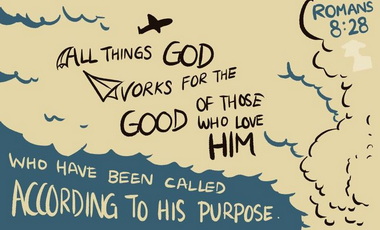
And we know that in all things God works for the good of those who love Him, who have been called according to His purpose.

The Greek verb oida (“we know”) is a perfect active indicative form of the verb, which may simply refer to knowledge gained by observance or remembrance of the past. This is paralleled earlier in verse 22 (using the same Greek verb tense of oida) when speaking about their observation of creation “groaning as in the pains of child birth right up to the present time.”

Paul seems to be saying “we have observed” and “therefore we know.” The context and grammar appear to indicate a reference not to an intuitive knowledge of Paul’s readers, but to that which comes from observation of the past, or a remembrance.[73]

Paul means that believers know, from observation of God’s past dealings with those who love Him, that he has a mysterious way of working things out for the greatest good. By observing the stories of the saints of old —those called to accomplish His redemptive purposes—believers can rest in knowledge of this truth. God can take whatever evil may come our way and redeem it for good. Believers can know this because God has been doing it for generations.

Paul does not say that his readers should intuitively know how God works things out for those who love Him in the present. He is saying believers know what is true of God by observing what He has done in the past for those who have loved Him. The New Testament saints have a great cloud of witnesses that have gone before them (Heb. 12:1), giving evidence of God’s trustworthiness toward all who enter into a covenant with Him.

A simple survey of the verses leading up to this point reveals that Paul is reflecting on the problem of the evil and suffering in our world since the beginning:

Rom. 8:20-22: “For the creation was subjected to futility, not willingly, but because of Him who subjected it, in hope that the creation itself also will be set free from its slavery to corruption into the freedom of the glory of the children of God. For we know that the whole creation groans and suffers the pains of childbirth together until now.”

N.T. Wright comments on Rom. 8:28–30, saying in part:

  • “[This passage] is a sharp, close-up, compressed telling of the story of Israel, as the chosen people, whose identity and destiny is then brought into sharp focus on Jesus. Jesus, in a sense, is the one ‘chosen One.’ But, then that identity is shared with all of those who are ‘in Christ.’ And he [Paul] is not talking primarily there about salvation. He is talking primarily about the way God is healing the whole creation. There is a danger here. What has happened in so many theological circles over the years is that people have come to the text assuming that it is really saying how we are to get to heaven, and what is the mechanism and how does that work. And if you do that, interestingly, many exegetes will more or less skip over Romans 8:18–27, which is about the renewing of creation.”[74]

In verses 28 and 29 the focus shifts to providing comfort for those in suffering by reminding them to observe God’s dealings with others who loved God throughout history. Notice that this truth is not applicable to everyone. The passage is specifically an observation of those who “love God,” or as Wright notes, “those who are in Christ.”

The point is not that God causes everything for a good purpose, but that God redeems occurrences of evil for a good purpose in the lives of those who love Him. Therefore, it would be inaccurate to use this passage to support the concept of divine meticulous determinism of all things.[75] Again, God does not cause occurrences of evil for His purposes; instead, He redeems moral evil for a good purpose. Traditionalists would typically agree with what John MacArthur, a Calvinistic pastor, wrote on this point:

  • “But God’s role with regard to evil is never as its author. He simply permits evil agents to work, then overrules evil for His own wise and holy ends. Ultimately He is able to make all things—including all the fruits of all the evil of all time—work together for a greater good.”[76]

The focus of the apostle’s observation is on the saints of old, those from the elect nation of Israel who were called to fulfill God’s plan to redeem His creation from its groans and sufferings. This passage does not mean that the truth being revealed is not applicable to those of other nations. Rather, it means that what is proven to be true of God by observing His dealings with those called out from Israel throughout history must also be true of anyone who comes to follow and love the God of Israel.

Consider this analogy: Suppose a new pastor is called to a church. The staff members are nervous about his leadership style and how they might be treated, but a letter of reference which reflects on his past relationships might ease their fears. The pastor’s reference might say something like, I have observed this pastor’s dealings with the staff members he knew before, and he has always worked to lovingly support anyone who gets behind the vision and direction of the church. By reflecting on the pastor’s history, the new staff can know what to expect in their future dealings with him. So too, Paul gives a divine reference by reflecting on the trustworthiness of God in His dealings with the saints of old so as to ensure his readers of what they may expect of Him.

Romans 8:29

For those God foreknew He also predestined to be conformed to the image of His Son, that He might be the firstborn among many brothers and sisters.

Here the apostle reveals his focus on the saints of old, “those God foreknew.” Paul seeks to provide evidence of his claim in verse 28 by reflecting on God’s faithfulness to His chosen nation, those beloved who were known before. Paul provides a reference of sorts to ease the fears of those who are now coming to faith. This point continues to be the apostle’s focus for the next three chapters.

Much debate centers on the meaning of the word proginōskō (“to know beforehand”).[77] Many popular authors fail to recognize all the available options for consideration. For example, John Piper lists only two options for interpreting this verse:

Option #1: God foresaw our self-determined faith. We remain the decisive cause of our salvation. God responds to our decision to believe.

Option #2: God chose us—not on the basis of foreseen faith, but on the basis of nothing in us. He called us, and the call itself creates the faith for which it calls.[78]

Piper overlooks the most basic meaning of this word, which is “to know beforehand” or to have known in the past. The same Greek word is used by Peter and Paul in the following passages,

2 Pet. 3:17: “Therefore, dear friends, since you have been forewarned, be on your guard so that you may not be carried away by the error of the lawless and fall from your secure position.”

Acts 26:4–5: “The Jewish people all know the way I have lived ever since I was a child, from the beginning of my life in my own country, and also in Jerusalem. They have known me for a long time and can testify, if they are willing, that I conformed to the strictest sect of our religion, living as a Pharisee.”

Clearly, this word can be understood simply as knowing someone or something in the past, as in those known previously (i.e. the saints of old). Non-Calvinistic scholars, Roger Forster and Paul Marston, convincingly argue,

  • “God ‘foreknew them’ or ‘knew them of old’ thus it does not mean that God entered in some former time into a relationship with the Israelites of today, it means that he entered a (two-way) relationship with the Israel that existed in early Old Testament times, and he regards the present Israelites as integral with it.”[79]

If Paul intended to use the word proginōskō in this sense, then he meant simply that because we have seen how God worked all things to the good for those whom He knew before, we know that He will do the same for those who love and are called by Him now.

Some Calvinists contend that the word foreknew is equivalent to fore-loved. That use of the word generally fits this interpretation since the Israelites of the past who loved God certainly would have been loved by God before (i.e. fore-loved). Of course, the Calvinistic interpretation differs because they insist this passage is about God unconditionally setting His “effectual” salvific love upon certain individuals before the foundation of the world. Calvinists go to great lengths to show that God did not merely foresee the behavior and choices of the elect by looking down the corridors of time. Rather, God knew them intimately and set His effectual love on them before the foundation of the world.[80]

This argument might address the classical Arminian approach (Piper’s first option),[81] but it fails to rebut the approach being advocated here. Fore-loved is a viable and even likely meaning of the term proginōskō, yet it does not clarify who might be the intended target of that divine love.

Was Paul intending to introduce for the first time in this epistle a particular group of people out of the mass of humanity who were unconditionally elected to be effectually saved before the world began? Or, was he simply referencing those from the past whom God had known and faithfully cared for throughout the generations?

Romans 8:29b states “He (God) also predestined to become conformed to the image of His Son.” Who was “predestined” and to what ends were they predestined, according to this passage? Remember the point of the apostle leading up to this verse. He began speaking about the futility and suffering that has come into this world due to the fall of humanity into sin (vv. 20–22). In verse 28-29a, Paul provides comfort to lovers of God in his audience by reminding them of God’s trustworthiness for those who have loved Him throughout the generations.

Paul reminds his readers that God will redeem the suffering and evil for a good purpose in their lives just as he has done in the lives of those known before and loved throughout the previous generations. It is these whom God previously knew (Israelites whom loved God in the past) who were predestined to be conformed into the image of Christ so as to make the way for His coming.

God planned to accomplish salvation for those who were previously known and loved (i.e. Abraham, Moses, David, etc) by conforming them into the image of the One who would come to purchase their redemption. This is the ultimate example of God causing “all things to work for the good” of those saints of old who loved God. Paul is saying that God brings about the redemption of their souls and He will do the same for whoever loves Him. N. T. Wright states,

  • “Here is the note of hope which has been sounded by implication so often since it was introduced in 5:2: hope for the renewal of all creation, in a great act of liberation for which the exodus from Egypt was simply an early type. As a result, all that Israel hoped for, all that it based its hope on, is true of those who are in Christ.”[82]

Romans 8:29c states “that He (the Son) might be the firstborn among many brothers and sisters.” Consider the fact that he is speaking about what Christ might be, which strongly implies that Paul still has the saints of old in focus here. Why would Paul speak of future generations being conformed to the image of Christ so that He “might be the firstborn among many brothers and sisters” if He were already the firstborn prior to this discourse?

  • The term prōtotokos (“firstborn”) can simply refer to the one who is first to be born in a family, which carries much significance in the Jewish culture (Luke 2:7). Typically, the birthright given to the firstborn son signified a place of preeminence, by which he would receive the father’s inheritance and blessing. For instance, Psalm 89:20, 27 states, “I have found David my servant; with my sacred oil I have anointed him. . . And I will appoint him to be my firstborn, the most exalted of the kings of the earth.” David, who was the last one born in his family, was called by God the firstborn. David was given a place of preeminence.[83]

The term firstborn also speaks of Christ’s preexistence as the eternal Creator.[84] God created the world through Christ and redeemed the world through Christ (John 1:3, 10; Heb. 1:2–4). The former speaks of His eternal nature and the latter of His temporal role as the redeemer of the world.

Yet, even when speaking of our preexistent Lord, the biblical authors addressed Him as “becoming” or “fulfilling” His role as our Messiah within the temporal world. For example, the Psalmist writes, “And I will appoint Him to be my firstborn, the most exalted of the kings of the earth” (Ps. 89:27). For the Old Testament saints, the firstborn Savior was the expected One that was yet to come. From their view, the long-awaited Messiah was the future hope, not a past and completed reality.

In contrast to the Old Testament saints, a modern-day preacher would not teach that we are being conformed to Christ’s image so that Jesus might be the firstborn among many brethren, because we know Him to already be the firstborn of many brethren. Our being conformed into Christ’s image today has nothing to do with the future coming of Christ’s birth, whereas the saints of old were part of His very lineage. It is through the life of men like Abraham, Isaac, Jacob, David, and many other saints of old that Christ is brought into this world “that He might be the firstborn among many brothers and sisters (Rom. 8:29c).”

Paul is reflecting on God’s redemptive purpose being accomplished through those who loved God in former generations. That redemptive purpose included bringing the Messiah into this world through Israel (Rom. 9:4-5), or those Israelites set apart for that noble purpose (Rom. 9:21). This was God’s predestined plan of redemption, which was brought to pass through those who loved God and were called according to His purpose. Tim Warner describes this purpose,

“Paul was not referring to some prior knowledge in the mind of God before creation. Nor was He speaking about predetermining their fate. He was referring to those whom God knew personally and intimately, men like Abraham and David.

The term ‘foreknew’ does not mean to have knowledge of someone before they were conceived. The verb προεγνω is the word for ‘know’ (in an intimate sense) with the preposition προ (before) prefixed to it. It refers to having an intimate relationship with someone in the past… Literally, we could render Rom. 8:29 as follows: ‘For those God formerly knew intimately, He previously determined them to be conformed to the image of His Son.’

The individual saints of old, with whom God had a personal relationship, were predestined by Him to be conformed to the image of Christ. That is, God predetermined to bring their salvation to completion by the sacrifice of Christ on their behalf.” [85]

Likewise, William R. Newell, a colleague of D.L. Moody and a notable teacher at the Bible Moody College, explained that God “had acquaintanceship” with the Israelites of the past. So, it was not “mere Divine pre-knowledge” of certain individuals, but a real intimate “pre-acquaintanceship.”[86]

Romans 8:30

And those He predestined, He also called; those He called, He also justified; those He justified, He also glorified.

Notice the apostle’s use of the past tense in this verse. If Paul intended to speak about the future salvation of every elect individual, then why would he use these past tense verbs? When writing these words, Paul and his readers had not yet been glorified, so there is no explicit reason to use the past tense. Thus, there is no reason to assume Paul has in mind the future glorification of all believers.

The past tense suggests that Paul is referring to former generations of those who have loved God and were called to fulfill His redemptive purpose. They were known in the past generations and predestined by God to be made in the very image of the One to come, “the firstborn among many brothers and sisters,” which is something already completed in the past through the working of God in former generations. These are the individuals whom God called, justified, and who now, even as Paul was writing these words, are already glorified in the presence of God.

If indeed Paul was referencing the saints formerly known and loved by God, he would have communicated the certainty of their being justified, sanctified and finally glorified in a way that some might describe as a “golden chain of redemption.”[87] To presume, however, that Paul’s unbroken chain of past tense verbs is not in reference to people of the past is a linguistic stretch. [88]

Calvinists must explain away the use of the past tense verbs in order to maintain their interpretation of Paul’s intent. For instance, The Bible Knowledge Commentary, a Calvinistic source, provides this explanation, “Glorified is in the past tense because this final step is so certain that in God’s eyes it is as good as done.”[89] 

Calvinists must interpret Paul’s use of the past tense (aorist indicative) as meaning “it is as good as done” because it was predestined. But this is a very rare usage in the original language and the immediate context does not clearly support a Calvinistic rendering.

We must take into account Paul’s usage of the same term earlier in the chapter as a future hope for believers. Romans 8:17:

“Now if we are children, then we are heirs—heirs of God and co-heirs with Christ, if indeed we share in His sufferings in order that we may also share in His glory” (emphasis added).

Paul does not speak of glorification as a past and completed action in reference to the believers in his day. Rather, he seems to qualify their being glorified upon the condition that they persevere through the suffering that is to come. If it is “as good as done” due to God’s predetermination, then why would Paul make such a qualification and use the future tense of the same verb? Further, Paul speaks of the eager expectation of the glorification that is to come in verses 22–25:

“We know that the whole creation has been groaning as in the pains of childbirth right up to the present time. Not only so, but we ourselves, who have the firstfruits of the Spirit, groan inwardly as we wait eagerly for our adoption to sonship, the redemption of our bodies. For in this hope we were saved. But hope that is seen is no hope at all. Who hopes for what they already have? But if we hope for what we do not yet have, we wait for it patiently” (emphasis added).

Is the reader to believe that Paul shifts from speaking of glorification as a future hope for those who persevere, to speaking of it as a past and already-completed act for those who have not yet been glorified? Or, could it simply be that Paul has the Old Testament saints in view as he makes his case for the trustworthiness of God throughout all generations? The latter seems to be the most basic understanding of the apostle’s words in their context.

This interpretation may seem foreign to some Western readers because of the philosophical and theological baggage that has been attached to the concept of divine foreknowledge over the years, but to the first century reader the simple concept of proginōskō, understood as “previously known,” would have been far more likely. In fact, if one can objectively back away from their presuppositions and approach this passage with fresh eyes, I believe they will discover the utter simplicity and clarity of this perspective.

Instead of introducing a complex concept of divine prescience, unconditional election, and effectual salvation never once clearly expounded upon in the Scriptures, could it be that Paul may intend simply to communicate that those who were previously loved and known by God were also predestined to be conformed to the image of the One to come? Paul seems to be giving a brief history lesson of what God had done in former generations as a reference for God’s trustworthiness for all who come to Him in faith. Wright explains it this way:

  • “The creation is not god, but it is designed to be flooded with God: The Spirit will liberate the whole creation. Underneath all this, of course, remains Christology: the purpose was that the Messiah ‘might be the firstborn among many siblings’ (8.29). Paul is careful not to say, or imply, that the privileges of Israel are simply ‘transferred to the church,’ even though, for him, the church means Jews-and-gentiles-together in Christ. Rather, the destiny of Israel has devolved, entirely appropriately within the Jewish scheme, upon the Messiah. All that the new family inherit, they inherit in Him.”[90]  

Those who object to the suggestion that Paul’s use of the term proginōskō is limited to the beloved of Israel’s past should consider the apostle’s use of the same word just three chapters later, Rom. 10:21-11:2a:

“But concerning Israel he says, ‘All day long I have held out my hands to a disobedient and obstinate people.’ I ask then: Did God reject His people? By no means! I am an Israelite myself, a descendant of Abraham, from the tribe of Benjamin. God did not reject His people, whom he foreknew” (emphasis added).

Notice that Paul uses the term proginōskō in reference to God’s intimate relationship with the faithful Israelites of old. Paul continues to make his case, Rom. 11:2b-4:

“Don’t you know what Scripture says in the passage about Elijah—how he appealed to God against Israel: ‘Lord, they have killed your prophets and torn down your altars; I am the only one left, and they are trying to kill me?’ And what was God’s answer to him? ‘I have reserved for myself seven thousand who have not bowed the knee to Baal.’”

Elijah and those who refused to bow a knee were among the ones who were previously known (foreknown/fore-loved) by God. To foreknow refers to God’s intimate relationship with people who loved Him in the past (like Abraham in Rom. 4:22–5:5). Nothing in this or any other text supports the concept of God in eternity past preselecting certain individuals out of the mass of humanity for effectual salvation. It would be difficult to substantiate this meaning of the term foreknow in reference to the Israelites who were in covenant with God. It is best interpreted in reference to those known by God in former times. William Lane Craig explains,

  • “In certain cases, proginōskō and prooraō mean simply that one has known or seen (someone or something) previously. For example, in Acts 26:5 Paul states that the Jews had previously known for a long time the strictness of his life a Pharisee, and in Acts 21:29 Luke mentions that the Jews had previously seen (prooraō) Trophimus in Paul’s company. This sense is probably operative in Romans 11:2 as well, where Paul states of apostate Israel that ‘God has not rejected His people whom He foreknew [proginōskō],’ that is, whom He had previously known in an intimate way.”[91]  

Romans 8:31–39

Returning to the analogy above, the pastor had former staff members whom he intimately knew and loved. The new staff would be comforted to know of the pastor’s prior relationships. Likewise, those being grafted into covenant with the God of Israel for the first time (i.e. the Gentiles) would be thrilled to learn of God’s faithfulness to those He formerly knew and loved (i.e. men like Abraham and David, etc.). What can the readers say in response to these teachings of Paul about God’s faithfulness toward the saints of old?

That is the very question the apostle poses in Rom. 8:31a as he transitions to the application of His message,

“What, then, shall we say in response to these things?”

This interpretation is consistent with the view that present-day saints who love God and are called according to His purposes (vs. 28) have nothing to fear, for…

“If God is for us, who can be against us?” (vs. 31b).

God, who gave up His Son, justifies, intercedes, and places His undying love upon all who love Him and are called according to His purposes (vv. 32–39).

The objector in Paul’s mind asks: Paul, you have made a good case regarding God’s faithfulness to the Israelites in the past, but what about the Israelites today? Have God’s promises for Israel failed? Why are the Israelites today refusing to accept their own Messiah? The apostle attempts to answer these questions in Romans 9 and following.

NOTES:

[73] Johannes P. Louw and Eugene A. Nida, Lexicon of the New Testament: Based on Semantic Domains, Second Edition (New York: United Bible Societies, 1989), 29.6.

[74] N.T. Wright in a question and answer session at Oklahoma Christian University on April 1, 2014. Samuel Selvin, “Dr. N. T. Wright on predestination,”

[75] This is also true of Eph. 1:11, which is often misapplied to support the idea of meticulous determinism.

[76] John MacArthur, “Is God Responsible for Evil?” Grace To You Ministries web page. Quote taken from: http://www.gty.org/ resources /articles/A189/is-god-responsible-for-evil; [date accessed: 5/19/15]

[76] The definition of progin-osk-o is from The Lexham Analytical Lexicon to the Greek New Testament (Bellingham, WA: Logos Bible Software, 2011), 30.100.

[77] John Piper, Sermon: “Foreknown by God,”

[78] Roger T. Forster and V. Paul Marston, God’s Strategy in Human History (Wheaton: Tyndale, 1973), 179–90.

[79] John Murray, The Epistle to the Romans, Volume I (Grand Rapids, MI: Eerdmans Publishing, 1959), 316-318.

[80] Frederic Godet’s commentary on Romans 8:29, inquires: “In what respect did God thus foreknow them?” and answers that they were “foreknown as sure to fulfill the conditions of salvation, viz. faith; so: foreknown as His by faith.” The word “foreknew” is thus understood by Godet, a classical Arminian, to mean that God knew beforehand which sinners would believe, and on the basis of this knowledge He predestined them unto salvation. Frederic Godet, Commentary on the Epistle to the Romans (New York: Messrs Clark, 1880), 325.

[81] N.T. Wright, Pauline Theology, Volume III, ed. David M. Hay & E. Elizabeth Johnson (Minneapolis: Fortress, 1995), 30–67.

[82] James D. G. Dunn, Romans 1-8, Word Biblical Commentary, David A. Hubbard and Glenn W. Barker, vol. 38a (Dallas: Word, 1988), 1: 484.

[83] Theologian Bernard Ramm noted that “It has been standard teaching in historic Christology that the Logos, the Son, existed before the incarnation. That the Son so existed before the incarnation has been called the pre-existence of Christ.” Bernard Ramm, An Evangelical Christology: Ecumenic and Historic (Vancouver, BC: Regent College Publishing, 1993) 47.

[84] Tim Warner, PFRS Commentary on Romans, Pristine Faith Restoration Society. 

[85] William R. Newell, “Romans Verse-by-Verse,” Christian Classics Ethereal Library,” 1938.

[86] Some Calvinistic scholars describe this as the unbreakable “golden chain of redemption” meant to communicate the unchangeable plan of God to irrevocably justify, sanctify and glorify those He elected before the world began.

[87] Greek scholars teach that while the aorist indicative can be used to describe an event that is not yet past as though it were already completed, this usage is “not at all common.” Daniel B. Wallace, Greek Grammar Beyond the Basics (Grand Rapids, MI: Zondervan Publishing, 1997) 564.

[88] John F. Walvoord and Roy B. Zuck, eds. The Bible Knowledge Commentary (Dallas: Victor Books, 1983), 474.

[89] “And all this is viewed as past; because, starting from the past decree of ‘predestination to be conformed to the image of God’s Son’ of which the other steps are but the successive unfoldings—all is beheld as one entire, eternally completed salvation.” Jamieson-Fausset-Brown Bible Commentary, “Romans 8.”

[90] Wright, Pauline Theology, 20.

[91] William Lane Craig, The Only Wise God: The Compatibility of Divine Foreknowledge and Human Freedom (Grand Rapids: Baker, 1987), 31–32.

Leighton Flowers, The Potter’s Promise: A Biblical Defense of Traditional Soteriology (Trinity Academic Press, 2017), 81-98.
Here are some thoughts via John Lennox’s wonderful book,  “Determined to Believe? The Sovereignty of God, Freedom, Faith, and Human Responsibility,”

God is the Creator – there would not be a universe or human beings without him. God is the sovereign upholder of the universe – none of its history is outside his control. Christ is the Saviour and Redeemer – apart from him there would be no salvation.

Furthermore, we have seen that God’s initiative is expressed in Scripture in terms like election, foreknowledge, predestination, and calling, all of which occur together at the climax of one of the major sections of the letter to the Romans in chapter 8. By this stage Paul has already argued universal human guilt and the consequent need of salvation. He has explained that salvation is by faith in Christ and not of works. He has developed the theme of human responsibility to live a holy life in the power of God’s Holy Spirit. He has described the inner battle against our human nature (the flesh) that we all experience as we seek to walk after the Spirit.

The inner battle is not the only battle, however. Paul himself was no stranger to suffering – he had lived with persecution for many years. And so in Romans 8 Paul addresses suffering directly. He describes the provision that God has made for him and his fellow believers to remain firm in their faith when the winds of adversity blow. Here is the wonderful passage in full:

I consider that our present sufferings are not worth comparing with the glory that will be revealed in us. The creation waits in eager expectation for the sons of God to be revealed. For the creation was subjected to frustration, not by its own choice, but by the will of the one who subjected it, in hope that the creation itself will be liberated from its bondage to decay and brought into the glorious freedom of the children of God.

We know that the whole creation has been groaning as in the pains of childbirth right up to the present time. Not only so, but we ourselves, who have the firstfruits of the Spirit, groan inwardly as we wait eagerly for our adoption as sons, the redemption of our bodies. For in this hope we were saved. But hope that is seen is no hope at all. Who hopes for what he already has? But if we hope for what we do not yet have, we wait for it patiently.

In the same way, the Spirit helps us in our weakness. We do not know what we ought to pray for, but the Spirit himself intercedes for us with groans that words cannot express. And he who searches our hearts knows the mind of the Spirit, because the Spirit intercedes for the saints in accordance with God’s will.

And we know that in all things God works for the good of those who love him, who have been called according to his purpose. For those God foreknew he also predestined to be conformed to the likeness of his Son, that he might be the firstborn among many brothers. And those he predestined, he also called; those he called, he also justified; those he justified, he also glorified.

What, then, shall we say in response to this? If God is for us, who can be against us? He who did not spare his own Son, but gave him up for us all – how will he not also, along with him, graciously give us all things? Who will bring any charge against those whom God has chosen? It is God who justifies. Who is he that condemns? Christ Jesus, who died – more than that, who was raised to life – is at the right hand of God and is also interceding for us. Who shall separate us from the love of Christ? Shall trouble or hardship or persecution or famine or nakedness or danger or sword? As it is written:

“For your sake we face death all day long;
we are considered as sheep to be slaughtered.”

No, in all these things we are more than conquerors through him who loved us. For I am convinced that neither death nor life, neither angels nor demons, neither the present nor the future, nor any powers, neither height nor depth, nor anything else in all creation, will be able to separate us from the love of God that is in Christ Jesus our Lord.

(Romans 8:18–39.)

In all of Scripture this is one of the most magnificent statements of the love of God in taking the initiative to provide salvation in all of its aspects, so that nothing whatsoever can separate us from his love for us in Christ Jesus – not even death itself. I have emphasised the passage that is relevant to our discussion. In the context of suffering, weakness, and uncertainty, we are to know that God is working in all things for the good of those who love him. Paul describes them as those who have been called according to his purpose. What that grand purpose is, he is about to explain. But not before he gives another description of believers as those whom God foreknew, which (as we have seen) does not imply that God caused or forced them to do anything in advance. It is a great encouragement to believers under pressure to know that they have experienced the call of God; God has known them, and knows all about them – and he has a purpose for them. What is that purpose? He has predestined them to be conformed to the image of his Son.

Under the pressure of an assumed paradigm it is all too easy to read into this that Paul is saying that God has predestined them to be believers, and then using this statement to buttress theistic determinism. However, Paul is saying something completely different: that God has predestined those who are believers to be conformed to the image of his Son. That is, he plans to confer unimaginable dignity upon believers. As creatures of God they were made in the image of God. But now that they have put their faith in Christ and received his salvation, a destiny of almost indescribable glory awaits them. In his love for them God has determined that they should be like his Son. The sheer wonder of this purpose now defines the illimitable nature of God’s grace and glory. In one sense, God could have predestined us to anything glorious that he willed, but he has chosen this ultimate accolade. The objective is that the Lord Jesus should be the firstborn (first to be glorified and also first in rank) among many brothers.

This is God’s staggeringly gracious goal. Achieving it involves all of God’s provision in the gospel that Paul has been expounding up to this point – calling, justification by faith, and glorification. It is the sheer glory of the achievement that calls forth Paul’s triumphant and confident conclusion – If God is for us, who can be against us?

Arising directly from these glorious thoughts, however, there comes a question that deeply disturbs and concerns the apostle. In light of such a magnificent and gracious message, how is it that his fellow Israelites, Paul’s own kith and kin, mainly reject such a wonderfully gracious message and deny that Jesus is the Messiah, the Son of God? Paul’s pain is palpable as he explains:

I speak the truth in Christ – I am not lying, my conscience confirms it in the Holy Spirit – I have great sorrow and unceasing anguish in my heart. For I could wish that I myself were cursed and cut off from Christ for the sake of my brothers, those of my own race, the people of Israel. Theirs is the adoption as sons; theirs the divine glory, the covenants, the receiving of the law, the temple worship and the promises. Theirs are the patriarchs, and from them is traced the human ancestry of Christ, who is God over all, for ever praised! Amen.

(Romans 9:1–5.)

Paul faces an apparent contradiction. His nation of Israel by and large rejected Christ, who was also their own flesh and blood, even though as a nation they were uniquely privileged. God had adopted them as his people – as his sons, even, those who inherit the family assets; he had visited them in his glory at Sinai, and in the tabernacle, given them the covenants, the law, and the worship programme of the temple; he had lavished his promises on them. Not only that, it was God who had given them the patriarchs, from whom the ancestry of the Messiah would be traced – the Messiah who is none less than God himself. And they don’t believe in him!

This was no new issue for Paul. He faced it many times as he sought to persuade men and women of the truth of the Christian message. For instance, he held lectures in the synagogue at Thessalonica on three sabbath days:

As his custom was, Paul went in to the synagogue, and on three Sabbath days he reasoned with them from the Scriptures, explaining and proving that the Christ had to suffer and rise from the dead. “This Jesus I am proclaiming to you is the Christ,” he said.

(Acts 17:2–3.)

One can easily imagine some intelligent Jew saying, “That was a very interesting talk, Paul, and I find it impressive that a rabbi with your undoubtedly high qualifications, having studied under Gamaliel, is prepared to argue in this way. However, what bothers me is that you seem to be on your own in this. Or am I mistaken? Can you tell me of any other senior rabbis who believe that your interpretations are correct?”

And Paul might reply, “Well there’s Nicodemus, and Joseph of Arimathea, both on the Sanhedrin Council in Jerusalem.”

“Is that all? If what you say is true – and I admit I was moved by it – surely one might expect the majority of the Jewish thinkers to accept it? After all, on the basis of our Scriptures you are claiming that Jesus is the Messiah expected by our nation, yet the experts in the interpretation of those Scriptures don’t agree with you. Surely you can see why I am puzzled!”

Paul could see it, and it affected him deeply. He got the same question from Gentiles as well. “If something is really authentically Jewish, the Jews should be the first to accept it. And yet most of them reject it. How can that be?”

Paul was heartbroken about the situation and desperately wanted to do something about it. It threatened to become a serious stumbling block in the way of people taking the gospel seriously. As he writes in chapter 8, how can he believe that nothing shall separate us from the love of God, when it appears to many that something has separated Israel from God? How can Israel have lost her way so dramatically?

So Paul writes Romans 9–11 in order to show that, far from being an objection to the Christian message, what has happened historically with Israel, in their rejection of the Lord Jesus, in fact confirms the truth of it.

At this point some interpreters of Scripture argue that the ultimate answer to this question is given by Paul in his letter to the Galatians. There he abolishes all distinctions between Jews and non-Jews in his famous statement, that in Christ there is neither Jew nor Greek… (Galatians 3:28). Surely this means (it is argued) that all the promises given to Israel in the Old Testament are now to be understood as fulfilled in the church. Hence God has not cast off his people, since “his people” now equates to “the church” which is alive and thriving.

However, Paul’s statement in Galatians is not relevant to his problem in Romans. In Galatians 3:21–29 Paul is discussing the basis of salvation, and he stresses that it is the same for everyone, whatever their ethnicity, social status, or gender – Jew, Greek, slave, free, man, woman. That common basis is faith in Christ alone. Paul is not talking there about the question of roles in history or in the world, which for obvious reasons might well be different for each of these groups. To deduce from these verses that, now that Christ has come, there is absolutely no difference between the roles of Jews and Gentiles, would be as absurd as saying that, since Christ has come, there is absolutely no difference between the roles of slave and free or between the roles of male and female. Their roles can remain the same without prejudice to their status in Christ.

By contrast Paul’s concern in Romans 9–11 is not the basis of the gospel but why it is that the very nation that was privileged by God to be the vehicle of his revelation to the world now mainly rejects the gospel of the Messiah. That is the problem he has to address, and it is so complex that he takes three chapters to do it.

The first main argument is based on the fact that not all ethnic Israelites are the genuine people of God. His discussion involves considering the sovereignty of God in history regarding the role of different individuals and the nations descended from them.

The second main argument is that Israel’s unbelief is culpable. God has made every provision for them. Paul goes through every excuse that might be raised to let Israel off the hook and concludes in each case that they are responsible for their unbelief.

The third main argument concentrates on the fact that there are some Israelites, like Paul, who do believe in Jesus. Indeed, all through history there has been a “remnant” of true believers within Israel, whose number has at times been underestimated. Paul then discusses the historical roles that Israel and then the Gentiles have had in witnessing for God in the world, and concludes with the glorious hope for his nation that one day “all Israel will be saved”. Paul is in no doubt that there remains a role for his nation in the future, but not until they come to faith in Jesus as Messiah.


“For He says to Moses” | Biblical Mercy

For He says to Moses, “I will have mercy on whomever I will have mercy, and I will have compassion on whomever I will have compassion.”

Dr. Leighton Flowers confronts Dr. James White’s faulty critique of Dr. William Lane Craig (and other non-Calvinists).

This is a condensed critique. To see the longer video going through each of Dr. White’s points go here: • What about those who never hear about Jesus?

Often we hear the objection that God is not obligated to have mercy on anyone. That’s true. However, the fact that God is not obligated to be merciful towards all people is what makes the display of His mercy to all people so amazingly gracious and abundantly glorious. That God does what He is not obligated to do for no other reason than He desires to be merciful to all is glorious.

Anyone suggesting this display of mercy isn’t genuine (or that’s it’s just an outward/external “prescriptive” will of God, but that His real secret desire is only to show mercy to a preselected few) is diminishing the abundance of His mercy and the glory of His grace extended to every person.

Also, I think sometimes there is an assumption that mercy is weakness. But that could not be further from the truth. Mercy can only be handed down by someone in a place of judgement over another. If it is not within my power to pass condemnation on someone, then it is also not within my power to have mercy on them. Mercy is an expression of power, not of weakness.

“The Lord is gracious and compassionate, slow to anger and rich in love. The Lord is good to all; he has compassion on all he has made.” -Ps 145:8-9

“For God has bound everyone over to disobedience so that he may have mercy on them all.” -Rom 11:32

Some more from SOTO 101:

V.  WHY GOD IS JUST IN SHOWING MERCY TO UNFAITHFUL ISRAELITES TO ACCOMPLISH HIS PROMISE IN BRINGING THE WORD (14-16)

  • Does God’s choosing to bless one descendant over another descendant make God unrighteous? What shall we say then? Is there unrighteousness with God? Certainly not!

The descendants of Abraham in Paul’s day had two false perceptions:

Every descendant deserves the benefit of bringing God’s Word. However, the truth is that God has only selected a remnant through whom to bring His Word.

Every descendant deserves eternal life on the basis of their being of Israel. However, no one is saved based on nationality but only upon grace through faith. Those nations, and the individuals therein, who oppose God’s Word remain under the curse (hatred), as illustrated by Edom (direct descendants of Isaac himself).

There is no unrighteousness with God for choosing some descendants for a noble cause and not others, nor is it unjust to condemn a descendant of Abraham who stands in opposition to the Word of God.

  • For He says to Moses, “I will have mercy on whomever I will have mercy, and I will have compassion on whomever I will have compassion.”

Paul’s reference to Moses’ encounter with God in Exodus 32-33 gives a perfect historical example of when God was merciful to Israel when they deserved to be destroyed for their unfaithfulness (worshipping a golden calf).

This example also parallels Moses’ self-sacrificial Christ-like love for Israel as reflected by Paul in the opening verses of this chapter… “forgive their sin—and if not blot me out…” (Ex. 32:31-32).

Certainly God may choose to save whosoever He is pleased to save (scripture teaches He chooses to save those who humble themselves and repent in faith – 1 Pt. 5:5-6), but this passage is in reference to God showing mercy to unfaithful Israel so as to fulfill His original promise through them even though they deserve condemnation.

  • So then it is not of him who wills, nor of him who runs, but of God who shows mercy.

“It” refers to the fulfillment of God’s promise to bring His Word despite Israel’s unfaithfulness (Rom. 3:3-4).

The promise depends on our merciful God, not on the faithfulness (“willing and running”) of Abraham or his descendants.

Abraham “willed and ran” in the flesh to produce a son through Hagar (who Paul used symbolically to represent the covenant of law and works, Gal. 4:24).

God, by his mercy, provided Isaac through the free woman, Sarah (who Paul used symbolically to represent the covenant of grace by faith in the call of God, Gal. 4:21-26).

VI.  WHY GOD IS JUST TO HARDEN UNFAITHFUL ISRAELITES TO ACCOMPLISH HIS PROMISE IN BRINGING THE WORD (17-18)

  • For the Scripture says to Pharaoh, “For this very purpose I have raised you up, that I may show My power in you, and that My name may be declared in all the earth.”

In the same way God hardened the already rebellious will of Pharaoh in order to accomplish the first Passover, so too God hardened the already rebellious wills of Israelites to accomplish the real Passover.

God’s power and goodness was displayed in mercy-ing unfaithful Israelites in the day of Moses and in hardening the unfaithful Israelites in the day of the Messiah.
  • Therefore He has mercy on whom He wills, and whom He wills He hardens.

Sometimes God will fulfill His promises by showing Israelites mercy, but His Word will never fail.

Sometimes God will fulfill His promises by hardening Israelites, but His Word will never fail.

Note: Those judicially hardened or cut off are not born in this condition, but have “grown hardened” over years of rebellion (Acts 28:27), they are cut off for unbelief (11:20) and the hope of the apostle is that they may be grafted back in and saved (11:11-32).

VII.  IF THE ISRAELITES’ UNRIGHTEOUSNESS ACCOMPLISHES GOD’S PROMISE TO BRING HIS WORD, WHY ARE THEY TO BLAME? (19-21)

  • “You will say to me then, “Why does He still find fault? For who has resisted His will? But indeed, O man, who are you to reply against God?”

You (an Israelite hardened to accomplish God’s promise) will say to me (an Israelite shown mercy to accomplish God’s promise), why are we to blame if God’s will is being fulfilled?

As the apostle already indicated in 3:5, this is a man-made argument that reveals a heart that has become calloused in its rebellion, otherwise they might see, hear, understand and repent (Acts 17:30; 28:27).

  • “Will the thing formed say to him who formed it, “Why have you made me like this?” Does not the potter have power over the clay, from the same lump to make one vessel for honor and another for dishonor?”

The lump of hardened clay represents Israel who is had grown calloused in rebellion (Acts 28:27) and who are now being remolded into two kinds of vessels:

Those unfaithful Israelites remolded, by means of signs from the incarnate Messiah Himself, to bring the Word.

Those unfaithful Israelites remolded, by means of judicially hardening, to accomplish the ignoble purpose of bringing redemption on the cross and the grafting in of the Gentiles (yet they still may be saved, Rom. 11:11-32).

Romans 9 explained. This video is very relevant in today’s world as we see believers departing from the faith while only the chosen ones will be able to stand by God and God will also provide and have mercey on them. God is able to raise leaders and kings so His Name is exalted among the nations. just like He did with the Pharaoh.
Romans 9:21-23 says, “Has the potter no right over the clay, to make out of the same lump one vessel for honorable use and another for dishonorable use? What if God, desiring to show his wrath and to make known his power, has endured with much patience vessels of wrath prepared for destruction, in order to make known the riches of his glory for vessels of mercy, which he has prepared beforehand for glory…”

RC Sproul, a notable Calvinist, interprets this to mean that God creates some people for salvation and the rest for damnation, but is that what the Apostle Paul really had in mind? Let’s explore!

~ R.C. SPROUL PLAYLIST ~
 

Trump/Epstein: MSM vs. RigoStaRR

I love this guy: Twi-X | Facebook. Hands down — great work on the simplifying of tough “media narratives” exploded with truth. Here’s a couple of his videos:

ONE


TWO

Calvinism’s Tyrannical Bent | Dave Hunt (PLUS: Closet Calvinists?)

This post is going to be a bit long, as if that is abnormal. (I am including an entire chapter from WHAT LOVE IS THIS? as you proceed… like I said, long.) For the record, I am not an Arminian, their view of prevenient grace is too Calvinistic for me. I added a few graphics to drive these excellent points home that Jerry Walls made in his larger presentation.

“Perhaps Christ died for you.”

“Maybe God so loved you.”

“Christ shed His blood for you, perhaps.”

“Salvation has been provided for you, maybe.”

“Possibly God commendeth His love toward you.”

“Hopefully He’s the propitiation for your sins.”

“There is a possibility that Christ died as your Substitute.”

“I bring you good news, maybe.”

“It’s possible that Christ died for you. If you get saved then we know that He did die for you, but if you continue to reject Him then He did not die for you.”

“Christ died for you only if you believe that Christ died for you (thus proving you are elect), but if you do not believe this and if you continue in your unbelief until the day you die, then Christ did not die for you.”

Here is Dave Hunt discussing the issue in a larger lecture: Why Baptist’s would import Calvinism into the pulpit and put up with it is the theme of the topic.

Here is chapter 5 from Hunt’s book

5

Irresistibly Imposed “Christianity”

Arguably, one of Satan’s cleverest and most effective strategies was to delude the Emperor Constantine with a false conversion. Accounts differ, but whether this came about through a vision or a dream as recounted by Eusebius and Lactantius,1 Constantine saw a “cross” in the sky and heard a “voice” proclaiming (by some accounts the words were inscribed on the cross), “In this sign thou shalt conquer.” In the prior year the god Apollo had also promised him victory.

Constantine’s edicts of toleration gave every man “a right to choose his religion according to the dictates of his own conscience and honest conviction, without compulsion and interference from the government.” 2 Schaff views Constantine’s conversion as a wonderful advance for Christianity: “The church ascends the throne of the Caesars under the banner of the cross, and gives new vigor and lustre to the hoary empire of Rome. 3 In fact, that “conversion” began the corruption of the church and its marriage to the world. 4

How could a true follower of the Christ whose kingdom is not of this world and whose servants do not wage war proceed to wage war in His name, and under the banner of His cross to conquer with the sword? Of course, the Crusaders did the same, slaughtering both Muslims and Jews to retake the “holy land” under Pope Urban II’s pledge (matching Muhammad’s and the Qur’an’s promise to Muslims) of full forgiveness of sins for those who died in this holy war (Muslim jihad). But it was all very Augustinian. The City of God had to be defended!

From Constantine To Augustine

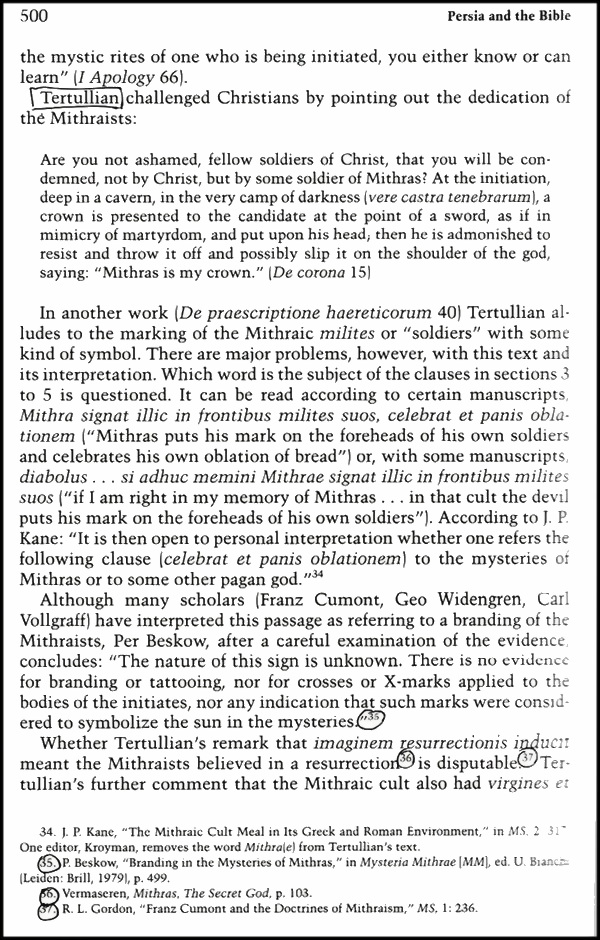
As Durant and other historians have pointed out, Constantine never renounced his loyalty to the pagan gods. He abolished neither the Altar of Victory in the Senate nor the Vestal Virgins who tended the sacred fire of the goddess Vesta. The Sun-god, not Christ, continued to be honored on the imperial coins. In spite of the “cross” (actually the cross of the god Mithras) on his shields and military banners, Constantine had a medallion created honoring the Sun for the “liberation” of Rome; and when he prescribed a day of rest it was again in the name of the Sun-god (“the day celebrated by the veneration of the Sun” 5 ) and not the Son of God. 6 Durant reminds us that throughout his “Christian” life Constantine used pagan as well as Christian rites and continued to rely upon “pagan magic formulas to protect crops and heal disease.”7

That Constantine murdered those who might have had a claim to his throne, including his son Crispus, a nephew and brother-in-law, is further evidence that his “conversion” was, as many historians agree, a clever political maneuver to unite the empire. Historian Philip Hughes, himself a Catholic priest, reminds us, “in his manners he [Constantine] remained, to the end, very much the Pagan of his early life. His furious tempers, the cruelty which, once aroused, spared not the lives even of his wife and son, are … an unpleasing witness to the imperfection of his conversion.” 8

It was not long after the new tolerance that Constantine found himself faced with a problem he had never anticipated: division within the Christian church to which he had given freedom. As we noted in the last chapter, it came to a head in North Africa with the Donatists, who, concerned for purity of the faith, separated from the Catholic churches, rejected their ordinances and insisted upon rebaptizing clergy who had repented after having denied the faith during the persecutions which arose when the Emperor Diocletian demanded that he be worshiped as a god. 9 After years of futile efforts to reestablish unity through discussion, pleadings, councils and decrees, Constantine finally resorted to force. Frend puts it well:

In the spring of 317 he [Constantine] followed up his decision by publishing a “most severe” edict against the Donatists, confiscating their property and exiling their leaders. Within four years, the universal freedom of conscience proclaimed at Milan had been abrogated, and the state had become a persecutor once more, only this time in favor of Christian orthodoxy ….

[The Donatists] neither understood nor cared about Constantine’s conversion. For them it was a case of the Devil insisting that “Christ was a lover of unity” …. In their view, the fundamental hostility of the state toward the church had not been altered. 10

In his own day and way, Augustine followed Constantine’s lead in his treatment of the Donatists, who were still a thorn in the side of the Roman Church. “While Augustine and the Catholics emphasized the unity of the Church, the Donatists insisted upon the purity of the Church and rebaptized all those who came to them from the Catholics – considering the Catholics corrupt.”11 Constantine had been “relentless [as would Augustine and his disciple Calvin be] in his pursuit of `heretics’ [forbidding] those outside of the Catholic church to assemble … and confiscated their property … the very things Christians had endured themselves were now being practiced in the name of Christianity.” 12

As a good Catholic enjoying the blessing of the Emperor and believing in the state church Constantine had established, Augustine persecuted and even sanctioned the killing of the Donatists and other schismatics, as we have already seen. Gibbon tells us that the severe measures against the Donatists “obtained the warmest approbation of St. Augustine [and thereby] great numbers of the Donatists were reconciled to [forced back into] the Catholic Church.” 13 Of Augustine it has been well said that “the very greatness of his name has been the means of perpetuating the grossest errors which he himself propagated. More than anyone else, Augustine has encouraged the pernicious doctrine of salvation through the sacraments of an organized earthly Church, which brought with it priestcraft with all the evil and miseries that has entailed down through the centuries.” 14

From Augustine To Calvin

There is no question that John Calvin had a great zeal for God and His Word. As we have already seen, however, there was a serious defect in his understanding of true Christianity. In many ways which colored his perspective until his death, he still viewed the church of Christ through Roman Catholic eyes. One of those ways was his acceptance of the church as Constantine had molded it and Augustine had cemented it: a partner of the state, with the state enforcing orthodoxy (as the state church defined it) upon all its citizens. Based upon this misunderstanding, Calvin applied his legal training and natural brilliance to the development of a system of Christianity based upon an extreme view of God’s sovereignty which by the sheer force of its logic would compel kings and all mankind to conform all affairs to righteousness. Indeed, in partnership with the church, kings and other civil rulers would enforce Calvinistic Christianity.

Calvin has impossibly been called both an amillennialist and postmillenialist. Of those who believed in a thousand-year reign of Christ upon earth, Calvin said their “fiction is too puerile to need or to deserve refutation.” 15 As far as Calvin was concerned, Christ’s kingdom began with His advent upon earth and had been in process ever since. Rejecting the literal future reign of Christ upon the earth through His Second Coming to establish his earthly kingdom upon David’s throne in Jerusalem, Calvin felt obliged to establish the kingdom by his own efforts in Christ’s absence.

The Bible makes it clear that one must be “born again” even to “see the kingdom of God” (John 3:3) and that “flesh and blood cannot inherit the kingdom of God” (1 Corinthians 15:50). Ignoring this biblical truth and following Augustine’s error, Calvin determined (along with Guillaume Farel) to establish a beachhead for the kingdom of God on earth in Geneva, Switzerland. His first attempt there ended with his expulsion from that city. Boettner acknowledges, “Due to an attempt of Calvin and Farel to enforce a too severe system of discipline in Geneva, it became necessary for them to leave the city temporarily.” 16

Three years later, however, facing Catholic opposition from within and the threat of armed intervention by Roman Catholics from without, Geneva’s city council decided that they needed Calvin’s strong measures and invited him back. This time he succeeded in imposing his religion upon Geneva’s citizens with an iron hand. His first act was to hand the city council his Ecclesiastical Ordinances, which were adopted November 20, 1561. Stefan Zweig tells us:

One of the most momentous experiments of all time began when this lean and harsh man entered the Cornavian Gate [of Geneva]. A State [the walled citystate of Geneva] was to be converted into a rigid mechanism; innumerable souls, people with countless feelings and thoughts, were to be compacted into an all-embracing and unique system. This was the first attempt made in Europe to impose … a uniform subordination upon an entire populace.

With systematic thoroughness, Calvin set to work for the realization of his plan to convert Geneva into the first Kingdom of God on earth. It was to be a community without corruption, disorder, vice or sin; it was to be the New Jerusalem, a centre from which the salvation of the world would radiate … the whole of his life was devoted to the service of this one idea. 17

Tyranny in Geneva

Perhaps Calvin thought he was God’s instrument to force Irresistible Grace (a key doctrine in Calvinism) upon the citizens of Geneva, Switzerland, even upon those who proved their unworthiness by resisting to the death. He unquestionably did his best to be irresistible in imposing “righteousness,” but what he imposed and the manner in which he imposed it was far from grace and the teachings and example of Christ.

Many of those who profess a “Reformed” faith today, especially those known as Reconstructionists such as the late Rousas J. Rushdoony, Gary North, Jay Grimstead and others (including organizations such as the Coalition on Revival), take Calvin’s Geneva as their model and thus hope to Christianize the United States and then the world. Many Christian activists of looser attachment to Calvin hope in their own way, through protest marches and the organizing of large enough voting blocks, to force an ungodly American citizenry into godly living. No one ever worked so hard at attempting to do this and for so long a time as Calvin. Durant reports:

To regulate lay conduct a system of domiciliary visits was established … and questioned the occupants on all phases of their lives …. The allowable color and quantity of clothing, and the number of dishes permissible at a meal, were specified by law. Jewelry and lace were frowned upon. A woman was jailed for arranging her hair to an immoral height ….

Censorship of the press was taken over from Catholic and secular precedents and enlarged: books … of immoral tendency were banned …. To speak disrespectfully of Calvin or the clergy was a crime. A first violation of these ordinances was punished with a reprimand, further violation with fines, persistent violation with imprisonment or banishment. Fornication was to be punished with exile or drowning; adultery, blasphemy, or idolatry, with death . . . a child was beheaded for striking its parents. In the years 1558-59 there were 414 prosecutions for moral offenses; between 1542 and 1564 there were seventy-six banishments and fifty-eight executions; the total population of Geneva was then about 20,000.18

Certainly, much of Calvin’s unusual zeal could not have come from the Holy Spirit’s guidance but rather from his powerful personality and extreme view of God’s sovereignty that denied all power of choice to man. Thus “grace” had to be irresistibly imposed. This was evident in the unbiblical manner in which he attempted to inflict his understanding of godliness upon the citizens of Geneva. In contrast to the humility, mercy, love, compassion and longsuffering of Christ, whom he loved and tried to serve, Calvin exerted authority much like the papacy which he now despised. Ironically, in spite of opposing the tyranny of the papacy, Calvin wielded the same unbiblical authoritarianism in attempting to enforce godliness upon ungodly people. Moreover, he criticized other Protestant leaders for not doing the same:

Seeing that the defenders of the Papacy are so bitter and bold in behalf of their superstitions, that in their atrocious fury they shed the blood of the innocent, it should shame Christian magistrates that in the protection of certain truth, they are entirely destitute of spirit. 19

Calvin’s defenders turn a blind eye to the facts when they attempt to exonerate him by blaming events in Geneva on the civil authorities. In the face of so much evidence to the contrary, Boettner even insists that “Calvin was the first of the Reformers to demand complete separation between Church and State.” 20 In fact, Calvin not only established ecclesiastical law but he codified the civil legislation. 21 He held the civil authorities responsible to “foster and maintain the external worship of God, to defend sound doctrine and the condition of the church” 22 and to see that “no idolatry, no blasphemy against God’s name, no calumnies against his truth, nor other offenses to religion break out and be disseminated among the people … [but] to prevent the true religion … from being with impunity openly violated and polluted by public blasphemy.” 23

Calvin used the civil arm to impose his peculiar doctrines upon the citizens of Geneva and to enforce them. Zweig, who pored over the official records of the City Council for Calvin’s day, tells us, “There is hardly a day, in the records of the settings of the Town Council, in which we do not find the remark: `Better consult Master Calvin about this.’ 24 Za Pike reminds us that Calvin was given a “consultant’s chair” in every meeting of the city authorities and “when he was sick the authorities would come to his house for their sessions.” 25 Rather than diminishing with time, Calvin’s power only grew. John McNeil, a Calvinist, admits that “in Calvin’s latter years, and under his influence, the laws of Geneva became more detailed and more stringent.” 26

Don’t Cross Dr. Calvin!

With dictatorial control over the populace (“he ruled as few sovereigns have done” 27), Calvin imposed his brand of Christianity upon the citizenry with floggings, imprisonments, banishments and burnings at the stake. Calvin has been called “the Protestant Pope” and “the Genevese dictator” who “would tolerate in Geneva the opinions of only one person, his own.” 28 Concerning the adoption in Geneva of a confession of faith that was made mandatory for all citizens, the historian Philip Schaff comments:

It was a glaring inconsistency that those who had just shaken off the yoke of popery as an intolerable burden, should subject their conscience and intellect to a human creed; in other words, substitute for the old Roman popery a modern Protestant popery.” 29

Durant says that “Calvin held power as the head of this consistory; from 1541 till his death in 1564, his voice was the most influential in Geneva.” 30 Vance reminds us that

Calvin was involved in every conceivable aspect of city life: safety regulations to protect children, laws against recruiting mercenaries, new inventions, the introduction of cloth manufacturing, and even dentistry. He was consulted not only on all important state affairs, but on the supervision of the markets and assistance for the poor. 31

Most of these were laudable efforts, but matters of faith were legislated as well. A confession of faith drawn up by Calvin was made mandatory for all citizens. It was a crime for anyone to disagree with this Protestant pope. Durant comments:

All the claims of the popes for the supremacy of the church over the state were renewed by Calvin for his church …. [Calvin] was as thorough as any pope in rejecting individualism of belief; this greatest legislator of Protestantism completely repudiated that principle of private judgment with which the new religion had begun …. In Geneva … those … who could not accept it would have to seek other habitats. Persistent absence from Protestant [Calvinist] services, or continued refusal to take the Eucharist was a punishable offense.

Heresy again became [under Calvin as under Augustine] … treason to the state, and was to be punished with death … in one year, on the advice of the Consistory, fourteen alleged witches were sent to the stake on the charge that they had persuaded Satan to afflict Geneva with plague. 32

Calvin was again following in the footsteps of Augustine, who had enforced “unity … through common participation in the Sacraments . . . .” 33 A medical doctor named Jerome Bolsec dared to disagree with Calvin’s doctrine of predestination. He was arrested for saying that “those who posit an eternal decree in God by which he has ordained some to life and the rest to death make of Him a tyrant, and in fact an idol, as the pagans made of Jupiter.” 34 Bolsec was arrested and banished from Geneva with the warning that if he ever returned he would be flogged. 35 John Trolliet, a city notary, criticized Calvin’s view of predestination for “making God the author of sin.” 36 In fact, the charge was true, as Calvin’s own writings clearly state. The court decreed that “thenceforward no one should dare to speak against this book [Institutes] and its doctrine.” 37 So much for the freedom of conscience which had been promised would replace the popes’ intolerable oppression!

Calvin’s power was so great that it was tantamount to treason against the state to oppose him. A citizen named Jacques Gruet was arrested on suspicion of having placed a placard on Calvin’s pulpit which read in part, “Gross hypocrite … ! After people have suffered long, they avenge themselves …. Take care that you are not served like M. Verle [who had been killed] . . . .” 38

Gruet was tortured twice daily in a manner similar to which Rome, rightly condemned by the Reformers for doing so, tortured the victims of her inquisitions who were accused of daring to disagree with her dogmas. The use of torture for extracting “confessions” was approved by Calvin. 39 After thirty days of severe suffering, Gruet finally confessed-whether truthfully, or in desperation to end the torture, no one knows. On July 16, 1547, “half dead, he was tied to a stake, his feet were nailed to it. and his head was cut off.” 40

Good Intentions Gone Astray

No one has ever been as successful as John Calvin at totalitarian imposition of “godliness” upon a whole society. And therefore no one has proved as clearly as he that coercion cannot succeed because it can never change the hearts of men. Calvin’s theology as laid out in his Institutes denied that unregenerate man could choose to believe and obey God. Apparently he was ignorant of the commonsense fact that genuine choice is essential if man is to love and obey God or show love and real compassion to his fellows. By his determined efforts to make Geneva’s citizens obey, Calvin disproved his own theories of Unconditional Election and Irresistible Grace. What he did prove, seemingly, by years of totalitarian and surely ungodly force, was the first of Calvinism’s Five Points, Total Depravity. Try as he might, there were many whom he simply could not persuade to live as he decreed, no matter how severe the penalty for failing to do so. He did succeed in creating many hypocrites who outwardly conformed to the law so long as the authorities were looking, but in their hearts longed for and practiced, when possible, the same old sins of the past.

Yes, there were reports from visitors that “cursing and swearing, unchastity, sacrilege, adultery, and impure living” such as were found elsewhere were absent from Geneva. 41 John Knox, of course, was enthusiastic. He called Geneva “the most perfect school of Christ that ever was in the earth since the days of the Apostles.” 42 A visiting Lutheran minister, who thought Calvin’s coercion was commendable, wrote in 1610, “When I was in Geneva I observed something great which I shall remember and desire as long as I live.” He praised the “weekly investigations into the conduct, and even the smallest transgressions, of the citizens” and concluded, “If it were not for the difference of religion, I would have been chained to Geneva forever.” 43 Difference of religion? Yes, Calvinism was not Lutheranism, although both persecuted the Anabaptists. Protestantism involved several rival factions to say nothing of millions of true Christians who had never given allegiance to Rome and thus had not come out of her as “Protestants.” These believers had been martyred by Roman Catholics at the instigations of various popes for a thousand years before Luther and Calvin were born. Thus today’s representation of Calvinism as “Reformation theology” that supposedly revived true Christianity is grossly inaccurate. Calvinists have, in fact, hijacked the Reformation.

Admirers of John Calvin cite favorable stories as proof of the godly influence he and his theories exerted in changing a godless society into one that honored God. His methods, however, far from Christlike, could not be justified by any results. Nor could Calvin’s means, as we have already noted, be justified by the fact that torture, imprisonment and execution had been employed by Luther and the popes and other Roman Catholic clergy to force their religious views upon those under their power. A true follower of Christ is not to be conformed to this world but in his behavior is to follow Christ’s example.

Calvin’s followers boast that he was the greatest of exegetes and followed Scripture meticulously both in formulating his theology and in guiding his life. Supposedly, Calvin “was willing to break sharply with tradition where it was contrary to the Word of God.” 44 At the same time, he is defended with the excuse that he was only conforming to the traditions long established by Rome which began with Constantine. Scott says, “In the early years of the Reformation, censorship of manners and morals remained a settled, accepted part of existing, ancient police regulations not only in Geneva, but in all Europe.” 45 This is true. Such curbs discouraged rebellious attempts to leave one’s “class,” etc. But that was not Christianity as taught and exemplified by Christ and His apostles.

There is no way to defend Calvin’s conduct from Scripture. Yes, he was loving and caring toward those who agreed with him. Yes, he expended himself and shortened his life through visiting the sick, caring for the flock and preaching continually. But in his treatment of those who disagreed with him he was anything but a Christian.

The Hopelessness Of Imposed “Godliness”

Sadly, upon looking a bit more closely we find that in spite of threats and torture, Calvin’s Geneva was not as righteous a city as the selected optimistic stories seem to indicate. The surviving records of the Council of Geneva unveil a city more similar to the rest of the world than Calvin’s admirers would like to admit. These documents reveal “a high percentage of illegitimate children, abandoned infants, forced marriages, and sentences of death.” 46 The stepdaughter and son-in-law of Calvin were among the many condemned for adultery. 47 Calvin had done his best, but at his death he felt that he had failed. Certainly he had not been able to produce among sinners, by the irresistible grace he sought to impose upon them, the ideal society – Augustine’s City of God – which he had envisioned when he wrote Institutes.

Some critics have falsely accused Calvinists of teaching that totally depraved man is incapable of responding to God. That is not exactly their position. They believe that the unsaved can and do respond to God but only in unbelief, rebellion and opposition. White explains: “Unregenerate men who are enemies of God most assuredly respond to God: in a universally negative fashion.” 48 That being the case, by his own theory, Calvin’s efforts at Geneva were doomed before they began! Speaking for all Calvinists, R.C. Sproul explains that according to the “Reformed view of predestination … before a person can choose Christ … he must be born again” 49 by a sovereign act of God. How could Calvin be sure that God had done this work in the hearts of all in Geneva? If God had not predestined every citizen of Geneva to salvation, then Calvin was wrong in trying to force them into a Christian mold. Yet coercion even by force was an integral part of the system as practiced by Calvin himself and his immediate successors.

Do Calvinists today approve of such conduct? It’s doubtful. Then is it not probable that the Calvinism which produced such tyranny was also wrong in other respects?

How many of the “elect” were there in Geneva? As Jay Adams points out, no one, not even Calvin, could know. Calvinism has no explanation for how the elect could have been identified with certainty among the hypocrites who acted as though they were among the elect by behaving themselves, but did so only out of fear of the consequences. No matter how hard Calvin tried, if God had not elected every citizen in Geneva to salvation (and He apparently had not), then evil would still persist – though not as blatantly as in other cities of that day.

One wonders why Calvin, while insisting upon the doctrine of Total Depravity, didn’t realize the hopelessness of trying to impose godliness upon the totally depraved citizens of Geneva. One wonders also, considering Calvin’s abysmal record of failure, why today’s Reconstructionists who hold to the same dogma nevertheless believe they will be able to impose righteous living upon entire nations – or why evangelicals continue to praise Calvin, the oppressor of Geneva.

Servetus: The Arch Heretic

Born Miguel Serveto in Villanova in 1511, the man known to the world as Michael Servetus “discovered the pulmonary circulation of the blood – the passage of the blood from the right chamber of the heart along the pulmonary artery to and through the lungs, its purification there by aeration, and its return via the pulmonary vein to the left chamber of the heart.” He was in some ways “a bit more insane than the average of his time,” announcing the end of the world in which “the Archangel Michael would lead a holy war against both the papal and Genevese Antichrists.” 50

There is no question that he was a rank heretic whose ravings about Christ reflected a combination of Islam and Judaism, both of which intrigued him. He was, however, right about some things: that God does not predestine souls to hell and that God is love. His otherwise outrageous ideas might have passed unnoticed had he not published them and attempted to force them upon Calvin and his fellow ministers in Geneva with aggressive, contemptuous and blasphemous railings. That Servetus titled one of his published works The Restitution of Christianity could only be taken as an intentional personal affront by the author of the Institutes of the Christian Religion.

Servetus’s persistence is seen in the fact that he wrote at least thirty letters to Calvin, an attention which must have irritated the recipient greatly. On February 13, 1546, Calvin wrote to Farel, “Servetus has just sent me a long volume of his ravings. If I consent he will come here, but I will not give my word, for should he come, if my authority is of any avail, I will not suffer him to get out alive.” 51 Servetus made the mistake of passing through Geneva seven years later on his way to Naples and was recognized when he attended church (possibly out of fear of arrest for nonattendance) by someone who saw through his disguise and notified Calvin, who in turn ordered his arrest.

The Torture And Burning Of Servetus

Early in the trial, which lasted two months, Calvin wrote to Farel, “I hope that sentence of death will be passed upon him.” 52 To understand Calvin, we need to consider that if the God one believes in predestines billions of the “totally depraved” to a burning hell (all of whom He could rescue), then to burn at the stake an obviously totally depraved heretic would seem quite mild and easily justifiable. That logic, however, seems somehow to escape many of today’s evangelical Christians who admire the man and call themselves Calvinists.

The indictment, drawn up by Calvin the lawyer, contained thirty-eight charges (including rejection both of the Trinity and infant baptism) supported by quotations from Servetus’s writings. Calvin personally appeared in court as the accuser and as “chief witness for the prosecution.” 53 Calvin’s reports of the trial matched Servetus’s railings with such un-Christian epithets as “the dirty dog wiped his snout … the perfidious scamp soils each page with impious ravings,” etc. 54 The Council consulted the other churches of Protestant Switzerland, and six weeks later their reply was received: Servetus should be condemned but not executed. Nevertheless, under Calvin’s leadership, He was sentenced to death on two counts of heresy: Unitarianism and rejection of infant baptism. Durant writes:

He asked to be beheaded rather than burned; Calvin was inclined to support this plea, but the aged Farel … reproved him for such tolerance; and the Council voted that Servetus should be burned alive.

The sentence was carried out the next morning, October 17, 1553…. On the way [to the burning] Farel importuned Servetus to earn divine mercy by confessing the crime of heresy; according to Farel the condemned man replied, “I am not guilty, I have not merited death”; and he besought God to pardon his accusers. He was fastened to a stake by iron chains, and his last book was bound to his side. When the flames reached his face he shrieked with agony. After half an hour of burning he died. 55

The Failure Of Attempted Exonerations

Many attempts have been made by his modern followers to exonerate Calvin for the unconscionably cruel death of Michael Servetus. It is said that Calvin visited him in prison and pleaded with him to recant. Calvin’s willingness for Servetus to be beheaded rather than burned at the stake was not necessarily motivated by kindness, however, but was an attempt to transfer the responsibility from himself to the civil authority. Beheading was the penalty for civil crimes; burning at the stake was for heresy. The charges, however, were clearly theological rather than civil and brought by Calvin himself.

There is no question that the civil authority only acted at the behest of the church. According to the laws of Geneva, Servetus, as a traveler passing through, not a citizen and not being guilty of any crime within the city, should have been expelled from the city, not executed. It was only his heresy which doomed him – and only because Calvin pressed the charges. Calvin did exactly what his view of God required in keeping with what he had written to Farel seven years before. Here again, over Calvin’s shoulder, we see the long shadow of Augustine. To justify his actions, Calvin borrowed the same perverted interpretation of Luke 14:23 which Augustine had used. Frend said, “Seldom have gospel words been given so unexpected a meaning.” 56 Farrar writes:

To him [AugustineI are due … above all the bitter spirit of theological hatred and persecution. His writings became the Bible of the Inquisition. His name was adduced – and could there be a more terrible Nemesis on his errors? – to justify the murder of Servetus. 57

There was wide acclaim from Catholics and Protestants alike for the burning of Servetus. The Inquisition in Vienne burned him in effigy. Melanchthon wrote Calvin a letter in which he called the burning “a pious and memorable example to all posterity” and gave “thanks to the Son of God” for the just “punishment of this blasphemous man.” Others, however, disagreed; and Calvin became the target of criticism.

Calvin’s Self-Justifications

Some critics argued that burning Servetus would only encourage the Roman Catholics of France to do the same to the Huguenots (70,000 would be slaughtered in one night in 1572). Stung by such opposition, in February 1554, Calvin published a broadside aimed at his critics: Defensio orthodoxae fidei de sacra Trinitate contra prodigiosos errores Michaelis Serveti. He argued that all who oppose God’s truth are worse than murderers because murder merely kills the body whereas heresy damns the soul for eternity (was that worse than predestination by God to eternal damnation?) and that God had explicitly instructed Christians to kill heretics and even to smite with the sword any city that abandoned the true faith:

Whoever shall maintain that wrong is done to heretics and blasphemers in punishing them [with death] makes himself an accomplice in their crime … it is God who speaks, and it is clear what law He would have kept in the Church even to the end of the world … so that we spare not kin nor blood of any, and forget all humanity when the matter is to combat for His glory. 58

Historian R. Tudor Jones declares that this tract, which Calvin wrote in defense of the burning of Michael Servetus, “is Calvin at his most chilling … as frightening in its way as Luther’s tract against the rebellious peasants.” 59 Eight years later Calvin was still defending himself against criticism and still advocating the burning of heretics. In a 1561 letter to the Marquis de Poet, high chamberlain to the King of Navarre, Calvin advises sternly:

… do not fail to rid the country of those zealous scoundrels who stir up the people to revolt against us. Such monsters should be exterminated, as I have exterminated Michael Servetus the Spaniard. 60

A year later (just two years before his own death), Calvin again justifies Servetus’s death, while at the same time acknowledging that he was responsible: “And what crime was it of mine if our Council at my exhortation . . . took vengeance upon his execrable blasphemies?” (Emphasis added.) 61 Much further documentation could be presented to expose the partisan bias of Calvinists who persist in offering one excuse after another for their hero. No wonder that even such a staunch Calvinist as William Cunningham writes:

There can be no doubt that Calvin beforehand, at the time, and after the event, explicitly approved and defended the putting him [Servetus] to death, and assumed the responsibility of the transaction. 62

Does The Christian Life Conform To Culture?

Today Calvin’s supporters complain, “No Christian leader has ever been so often condemned by so many. And the usual grounds for condemnation are the execution of Servetus and the doctrine of predestination.” 63 In fact, Servetus was only one of many such victims of Calvinism put into practice. Calvin is defended with the plea that such dealings were common practice and that he should be judged by the standard of his time. Do Calvin’s defenders really mean that “new creatures in Christ Jesus” are to rise no higher than the conventions of their culture and moment in history?

God’s sovereignty in controlling and causing everything that occurs is the very heart of Calvinism as conceived and taught by Calvin himself. Staunch Calvinist C. Gregg Singer declares that “the secret grandeur of Calvin’s theology lies in his grasp of the biblical teaching of the sovereignty of God.” 64 Could Calvin truly have believed that he was God’s instrument chosen from past eternity to coerce, torture and kill in forcing Geneva’s citizens into behavior that God had predestined for them? How else could he have justified his actions?

Calvin has been acclaimed as a godly example, one who based his theology and actions upon Scripture alone. We have seen that his actions were in fact unbiblical in the extreme but were consistent with his theology. Is not that fact sufficient reason to question Calvinism itself and to examine it carefully from Scripture? That the Pope and Luther joined in unholy alliances with civil rulers to imprison, flog, torture, and kill dissenters in the name of Christ is no excuse for Calvin having done so also. Do his modern defenders really believe that Calvin’s conduct conformed to Scripture? Is it not possible that some of his theology was just as unscriptural as the principles which drove his conduct? William Jones declares:

And with respect to Calvin, it is manifest, that the leading, and to me at least, the most hateful feature in all the multiform character of popery adhered to him through life – I mean the spirit of persecution. 65

Is not Christ alone the standard for His followers? And is He not always the same, unchanged by time or culture? How can the popes be condemned (and rightly so) for the evil they did under the banner of the Cross while excusing Calvin for doing much the same, though on a smaller scale? Calvin’s conduct day after day and year after year was the very antithesis of what it would have been had he truly been led of the Spirit of God. We cannot escape drawing that conclusion from God’s Word. The following are just two passages among many that condemn Calvin:

But the wisdom that is from above is first pure, then peaceable, gentle, and easy to be intreated, full of mercy and good fruits, without partiality, and without hypocrisy. (James 3:17)

He that saith he abideth in him [Christ] ought himself also so to walk, even as he [Christ] walked. (I John 2:6)

One wonders why so many of today’s Christian leaders who call themselves Calvinists are so quick to laud a man who was so far removed from the biblical exemplar reflected above.

FOOTNOTES:

1 W.H.C. Frend, The Rise of Christianity (Fortress Press, 1984), 482.

2 Philip Schaff, History of the Christian Church (Charles Scribner’s Sons, 1910; Wm. B. Eerdmans Publishing Company, reprint 1959),11:72-73.

3 Ibid.

4 FE Bruce, Lightin the West, Bk. III of The Spreading Flame (Wm. B. Eerdmans Publishing Co., 1956), 11-13.

5 Codex Theodosianus, (July 3, AX. 321), XVI:8.1.

6 Frend, op. cit., 484.

7 Will Durant, “Caesar and Christ,” Pt. III of The Story of Civilization (Simon and Schuster, 1950), 656.

8 Philip Hughes, A History of the Church (London, 1934), 1:198.

9 E.H. Broadbent, The Pilgrim Church (Gospel Folio Press, reprint 1999), 38-39.

10 Frend, op. cit., 492.

11 John Laurence Mosheim, An Ecclesiastical History, Ancient and Modern, trans. Archibald MacLaine (Applegate and Co., 1854), 101; and many other historians.

12 Laurence M. Vance, The Other Side of Calvinism (Vance Publications, Pensacola FL, rev. ed. 1999), 45.

13 Edward Gibbon, The Decline and Fall of the Roman Empire (Modern Library, n.d.), 2:233.

14 John W. Kennedy, The Torch of the Testimony (Christian Books Publishing House, 1963), 68.

15 John Calvin, Institutes of the Christian Religion, trans. Henry Beveridge (Wm. B. Eerdmans Publishing Company, 1998 ed.), III: xxv, 5

16 Loraine Boettner, The Reformed Doctrine of Predestination (Presbyterian and Reformed Publishing Co., 1932), 408.

17 Stefan Zweig, Eden Paul and Cedar Paul, trans.,Erasmus: The Right to Heresy (Cassell and Company, 1936), 207-208; cited in Henry R. Pike, The Other Side of John Calvin (Head to Heart, n.d.), 21-22.

18 Durant, op. cit., 474.

19 George Park Fisher, The Reformation (Scribner, Armstrong and Co., 1873), 224.

20 Boettner, op. cit., 410.

21 Ronald S. Wallace, Calvin, Geneva, and the Reformation (Baker Book House, 1990), 29.

22 Calvin, op. cit., IV:xx,2.

23 Op. cit., IV:xx,3.

24 Zweig, op. cit., 217.

25 Pike, op. cit., 26.

26 John T. McNeil, The History and Character of Calvinism (Oxford University Press, 1966), 189.

27 Williston Walker, John Calvin: The Organizer of Reformed Protestantism (Schocken Books, 1969), 259.

28 Op. cit., 107.

29 Schaff, op. cit., 8:357.

30 Durant, op. cit., VI:473.

31 Vance, op. cit., 85.

32  Durant, op. cit., 465.

33 Frend, op. cit., 669.

34 The Register of the Company of Pastors of Geneva in the Time of Calvin, trans. and ed. Philip E. Hughes (Wm. B. Eerdmans Publishing Co., 1966), 137-38; cited in Vance, op. cit., 84.

35 Schaff, op. cit., 8:618.

36 G.R. Potter and M. Greengrass, John Calvin (St. Martin’s Press, 1983), 92-93.

37 Register of Geneva, op. cit., cited in Vance, op. cit., 201.

38 Schaff, op. cit., 502.

39 Fisher, op. cit., 222.

40 J.M. Robertson, Short History of Freethought (London, 1914),1:443-44.

41 Schaff, op. cit., 644.

42 Bard Thompson, Humanists and Reformers: A History of the Renaissance and Reformation (Wm. B. Eerdmans Publishing Co., 1996), 501.

43 Schaff, op. cit., 519.

44 C. Gregg Singer, John Calvin: His Roots and Fruits (A Press, 1989), 19.

45 Otto Scott, The Great Christian Revolution (The Reformer Library, 1994), 46.

46 Charles Beard, The Reformation of the Sixteenth Century in Relation to Modern Thought and Knowledge (London, 1885), 353; also see Edwin Muir, John Knox (London, 1920), 108.

47 Preserved Smith, The Age of the Reformation (New York, 1920), 174.

48 James R. White, The Potter’s Freedom (Calvary Press Publishing, 2000), 98.

49 R.C. Sproul, Chosen by God (Tyndale House Publishers, Inc., 1986), 72.

50 Durant, op. cit., VIA81.

51 Roland P Bainton, Hunted Heretic: The Life of Michael Servetus (Boston: The Beacon Press, 1953), 144; cited in Durant, op. cit., VI:481. See also John Calvin, The Letters of John Calvin (The Banner of Truth Trust, 1980), 159.

52 John Calvin, dated August 20, 1553; quoted in Letters, op. cit.

53 Wallace, op. cit., 77.

54 Durant, op. cit., VIA83.

55 Op. cit., 484.

56 Frend, op. cit., 672.

57 Frederic W. Farrar, History of Interpretation (E.P Dutton and Co., 1886), 235-38.

58 J.W. Allen, History of Political Thought in the Sixteenth Century (London, 1951), 87.

59 R. Tudor Jones, The Great Reformation (Inter-Varsity Press, n.d.), 140.

60 John Calvin to the Marquis de Poet, in The Works of Voltaire (E.R. Dumont, 1901), 4:89; quoted in Vance, op. cit., 95, who gives two other sources for this quote.

61 Schaff, op. cit., 8:690-91.

62 William Cunningham, The Reformers and the Theology of the Reformation (The Banner of Truth Trust, 1967), 316-17.

63 Scott, op. cit., 100.

64 Singer, op. cit., 32.

65 William Jones, The History of the Christian Church (Church History Research and Archives, 5th ed. 1983), 2:238.

Pastor Gary Hamrick Preaches Through Romans 9-11

This is the churches “hello page,” and they are part of Calvary Chapel. This section of a longer sermon series is the best I have heard romans preached.

PART 1 | Are the Jewish people God’s “chosen people”? And if so, why have most Jews not accepted Jesus as Messiah? Has the Church “replaced” Israel in terms of promises God made to her that now belong to the Church? Pastor Gary answers these and other questions in today’s study from Romans 9-11. In these three chapters, Paul addresses the subject of Israel and the Jewish people and how they fit into God’s redemptive plan.

PART 2 | Does God predetermine some people to go to Heaven and others to go to Hell? Did Jesus die only for the Elect (those whom God decided to save)? Does man have a free will to choose Jesus, or is that God’s choice? Pastor Gary answers these questions and more in today’s teaching on predestination and election.

The Baptist Faith and Message (2000)

Here is the “Baptist Faith and Message 2000” Statement that I can really adhere to as how I have thought about these issues — I just never put them into well ordered thought like this. The first picture will bring you to the website where they have linked sections or a downloadable PDF of it. I will include two journal article as well of some deeper thinkers on each of the sections. These will all be linked of course:

Augustinian Determinism VS. The Early Church (Updated)

I updated this post with some more early church father “stuff.” Feel free to jump to the excerpt/graph and additional info. Jump to my other posts so far on the topic of Calvinism:

To go to all my posts on Calvinism and related issues, click the graphic to the right.

Enjoy the rest

Ken Wilson Rebuts James White

Description from the above video on SOTERIOLOGY 101’s YouTube:

Dr. Leighton Flowers welcomes back Dr. Ken Wilson to defend his Oxford Thesis from over 15 hours of mostly fallacious and unfounded attacks by Dr. James White of Alpha and Omega Ministries.

The Common Misconceptions in this Debate So Far:

  1. Wilson’s argument rests on Manicheanism and Augustinianism being the same worldview: This is untrue. It is not at all unreasonable to suggest that just one aspect of Manicheanism (i.e. its adherence to theistic determinism) might have influenced Augustine’s interpretation of the scripture.
  2. Wilson is saying Augustinianism is untrue because of its similarities with Manicheanism: This is inaccurate. It is possible for false worldviews to adhere to some aspects of truth, therefore proving that Calvinism has some link to Manicheanism doesn’t prove Calvinism is false. Wilson is saying Augustinianism is not rooted or founded in the early church writings therefore it most likely originated from other gnostic, neoplatonic and Manichean roots, which brings into question its validity as the correct interpretive grid.
  3. Wilson is arguing Augustinianism imports Manicheanism into Christianity because it uses similar words: This is also untrue. Just because Mani spoke of “the elect” and Calvinists also emphasize “the elect” does not mean they are necessarily linked, or even have the same definitions. Wilson is not attempting to argue that all aspects or jargon of the Manichean worldview are linked to the all aspects or jargon within the Calvinistic worldview. Wilson is only looking at the one common point of connection, namely deterministic philosophy, which was first introduced by Augustine, a former Manichean.
  4. James White’s criticism has accurately portrayed Wilson’s arguments and showed Wilson’s bias: This is demonstrably untrue as will be shown in this video and in many of the articles posted at www.soteriology101.com.
  5. If it can be proven that Wilson held to preconception of the ECFs and Augustine’s beliefs before doing his research, then his subsequent research is invalid: Again this is false. Even if it could be proven beyond all reasonable doubt that Wilson firmly believed the ECFs denied TULIP theology and that Augustine was the first to introduce it, this does not make his findings invalid. One would still need to demonstrate that Wilson’s bias lead to poor research.

Here are quotes from Reformed historians who validate the foundational claims of Wilson’s work:

Herman Bavinck:

  • In the early church, at a time when it had to contend with pagan fatalism and gnostic naturalism, its representatives focused exclusively on the moral nature, freedom, and responsibility of humans and could not do justice, therefore, to the teaching of Scripture concerning the counsel of God. Though humans had been more or less corrupted by sin, they remained free and were able to accept the proffered grace of God. The church’s teaching did not include a doctrine of absolute predestination and irresistible grace.

Loraine Boettner:

  • “It may occasion some surprise to discover that the doctrine of Predestination was not made a matter of special study until near the end of the fourth century….They of course taught that salvation was through Christ; yet they assumed that man had full power to accept or reject the gospel. Some of their writings contain passages in which the sovereignty of God is recognized; yet along side of those are others which teach the absolute freedom of the human will. Since they could not reconcile the two they would have denied the doctrine of Predestination… They taught a kind of synergism in which there was a co-operation between grace and free … this cardinal truth of Christianity was first clearly seen by Augustine…“

Robert Peterson and Michael Williams of Covenant Theological Seminary:

  • “The Semi-Pelagians were convinced that Augustine’s monergistic emphasis upon salvation by grace alone represented a significant departure from the traditional teaching of the church. And a survey of the thought of the apostolic father’s shows that the argument is valid… In comparison to Augustine’s monergistic doctrine of grace, the teachings of the apostolic fathers tended toward a synergistic view of redemption” (36).

Louis Berkhof [in The History of Christian Doctrines]:

  • “Their representations are naturally rather indefinite, imperfect, and incomplete, and sometimes even erroneous and self-contradictory. Says Kahnis: “It stands as an assured fact, a fact knowing no exceptions, and acknowledged by all well versed in the matter, that all of the pre-Augustinian Fathers taught that in the appropriation of salvation there is a co-working of freedom and grace.”

Berkhof goes on to admit that “they do not hold to an entire corruption of the human will, and consequently adhere to the synergistic theory of regeneration…” (130).

In other words, despite White’s assertions to the contrary, there were no “monergists” before Augustine.

An additional — fuller quote of Loraine Boettner from above:

  • “It may occasion some surprise to discover that the doctrine of Predestination was not made a matter of special study until near the end of the fourth century. The earlier church fathers placed chief emphasis on good works such as faith, repentance, almsgiving, prayers, submission to baptism, etc., as the basis of salvation. They of course taught that salvation was through Christ; yet they assumed that man had full power to accept or reject the Gospel. Some of their writings contain passages in which the sovereignty of God is recognized; yet along side of those are others which teach the absolute freedom of the human will. Since they could not reconcile the two they would have denied the doctrine of Predestination and perhaps also that of God’s absolute Foreknowledge. They taught a kind of synergism in which there was a co-operation between grace and free will. It was hard for man to give up the idea that he could work out his own salvation. But at last, as a result of a long, slow process, he came to the great truth that salvation is a sovereign gift which has been bestowed irrespective of merit; that it was fixed in eternity; and that God is the author in all of its stages. This cardinal truth of Christianity was first clearly seen by Augustine, the great Spirit-filled theologian of the West. In his doctrines of sin and grace, he went far beyond the earlier theologians, taught an unconditional election of grace, and restricted the purposes of redemption to the definite circle of the elect.” — from Loraine Boettner’s “Calvinism in History”

Here is chapter two from Ken Wilson’s book, “The Foundation of Augustinian-Calvinism” (PDF as well)

Here is a good review of the book via the South African Theological Seminary.

See also my first post commenting on this issue.


Chapter 2

Early Christian Authors 95–400 CE


Early Christian authors unanimously taught relational divine eternal predetermination. God elected persons to salvation based upon foreknowledge of their faith (predestination). These Christians vigorously opposed the unilateral determinism of Stoic Providence, Gnosticism, and Manichaeism.[48] So early Christians taught predestination,[49] but refuted Divine Unilateral Predetermination of Individuals’ Eternal Destinies (unilateral determinism). This unilateral determinism can be identified in ancient Iranian religion, then chronologically in the Qumranites, Gnosticism, Neoplatonism, and Manichaeism. “Christian” heretics such as Basilides who taught God unilaterally bestowed the gift of faith to only some persons (and withheld that salvific gift to others) were condemned. Of the eighty-four pre-Augustinian authors studied from 95–430 CE, over fifty addressed this topic. All of these early Christian authors championed traditional free choice and relational predestination against pagan and heretical Divine Unilateral Predetermination of Individuals’ Eternal Destinies.[50]

This can only be understood and appreciated by reading comprehensively through the sizeable number of works by these authors. Some persons triumphantly cite ancient Christian authors claiming they believe Augustine’s deterministic interpretations of scripture, but without reading the entire context or without understanding the way in which words were being used.[51] I am not aware of any Patristics (early church fathers) scholar who would or could make a claim that even one Christian author prior to Augustine taught Divine Unilateral Predetermination of Individuals’ Eternal Destinies (DUPIED, i.e., non-relational determinism unrelated to foreknowledge of human choices).

I. Apostolic Fathers and Apologists 95–180 CE

Most of these works do not directly address God’s sovereignty or free will.[52] The Epistle of Barnabas (100–120 CE) admits the corruption of human nature (Barn.16.7) but only physical death (not spiritual) results from Adam’s fall. Personal sins cause a wicked heart (Barn.12.5). Divine foreknowledge of human choices allowed the Jews to make choices and remain within God’s plan, resulting in their own self-determination (Barn.3.6). God’s justice is connected with human responsibility (Barn.5.4). Therefore, God’s foreknowledge of human choices should affect God’s actions regarding salvation.

In The Epistle of Diognetus (120–170 CE) God does not compel anyone. Instead, God foreknows choices by which he correspondingly chooses his responses to humans. Meecham writes of Diogn.10.1–11.8, “Free-will is implied in his capacity to become ‘a new man’ (ii,I), and in God’s attitude of appeal rather than compulsion (vii, 4).”[53] Aristides (ca.125–170 CE) taught newborns enter the world without sin or guilt: only personal sin incurs punishment.[54]

II. Justin Martyr and Tatian

The first author to write more specifically on divine sovereignty and human free will is Justin Martyr (ca.155 CE). Erwin Goodenough explained:

Justin everywhere is positive in his assertion that the results of the struggle are fairly to be imputed to the blame of each individual. The Stoic determinism he indignantly rejects. Unless man is himself responsible for his ethical conduct, the entire ethical scheme of the universe collapses, and with it the very existence of God himself.[55]

Commenting on Dial.140.4 and 141.2, Barnard concurred, saying God “foreknows everything—not because events are necessary, nor because he has decreed that men shall act as they do or be what they are; but foreseeing all events he ordains reward or punishment accordingly.”[56] After considering 1 Apol.28 and 43, Chadwick also agreed. “Justin’s insistence on freedom and responsibility as God’s gift to man and his criticism of Stoic fatalism and of all moral relativism are so frequently repeated that it is safe to assume that here he saw a distinctively Christian emphasis requiring special stress.”[57] Similarly, Barnard wrote: “Justin, in spite of his failure to grasp the corporate nature of sin, was no Pelagian blindly believing in man’s innate power to elevate himself. All was due, he says, to the Incarnation of the Son of God.”[58]

Tatian (ca.165) taught that free choice for good was available to every person. “Since all men have free will, all men therefore have the potential to turn to God to achieve salvation.”[59] This remains true even though Adam’s fall enslaved humans to sin (Or.11.2). The fall is reversed through a personal choice to receive God’s gift in Christ (Or.15.4). Free choice was the basis of God’s rewards and punishments for both angels and humans (Or.7.1–2).

II. Theophilus, Athenagoras, and Melito

Theophilus (ca.180), all creation sinned in Adam and received the punishment of physical decay, not eternal death or total inability (Autol.2.17). Theophilus’ insistence upon a free choice response to God (Autol.2.27) occurs following his longer discussion of the primeval state in the Garden and subsequent fall of Adam. Christianity’s gracious God provides even fallen Adam with opportunity for repentance and confession (Autol.2.26). Theophilus exhorts Christians to overcome sin through their residual free choice (Autol.1.2, 1.7).

Athenagoras (ca.170 CE) believed infants were innocent and therefore could not be judged and used them as a proof for a bodily resurrection prior to judgment (De resurr.14). For God’s punishment to be just, free choice stands paramount. Why?—because God created both angels and persons with free choice for the purpose of assuming responsibility for their own actions (De resurr.24.4–5)[60] Humans and angels can live virtuously or viciously: “This, says Athenagoras, is a matter of free choice, a free will given the creature by the creator.”[61] Without free choice, the punishment or rewarding of both humans and angels would be unjust.

In Peri Pascha 326–388, Melito (ca.175 CE) possibly surpassed any extant Christian author in an extended description depicting the devastation of Adam’s fall.[62] The scholar Lynn Cohick explained: “The homilist leaves no doubt in the reader’s mind that humans have degenerated from a pristine state in the garden of Eden, where they were morally innocent, to a level of complete and utter perversion.”[63] Despite this profound depravity, all persons remain capable of believing in Christ through their own God-given free choice. No special grace is needed. A cause and effect relationship exists between human free choice and God’s response (P.P.739–744). “There is no suggestion that sinfulness is itself communicated to Adam’s progeny as in later Augustinian teaching.”[64]

B. Christian Authors 180–250 CE

I. Irenaeus of Lyons

Irenaeus of Lyons (ca.185) wrote primarily against Gnostic deterministic salvation in his famous work Adversus Haereses. “One position fundamental to Irenaeus is that man should come to moral good by the action of his own moral will, and not spontaneously and by nature.”[65] Physical death for the human race from Adam’s sin was not so much a punishment as God’s gracious gift to prevent humans from living eternally in a perpetual state of struggling with sin (Adv. haer.3.35.2).

Irenaeus championed humanity’s free will for four reasons: (1) to refute Gnostic Divine Unilateral Predetermination of Individuals’ Eternal Destinies, (2) because humanity’s persisting imago Dei (image of God within humans) demands a persisting free will, (3) scriptural commands demand free will for legitimacy, and (4) God’s justice becomes impugned without free will (genuine, not Stoic “non-free free will”). These were non-negotiable “apostolic doctrines.” Scholars Wingren and Donovan both identify Irenaeus’ conception of the imago Dei as freedom of choice itself. As Donovan relates: “This strong affirmation of human liberty is at the same time a clear rejection of the Gnostic notion of predetermined natures.”[66]

Andia clarified that God’s justice requires free choice since Irenaeus believed God’s providence created all persons equally.[67] In refuting Gnostic determinism (Divine Unilateral Predetermination of Individuals’ Eternal Destinies), Irenaeus argues that God determines persons’ eternal destinies through foreknowledge of the free choices of persons (Adv. haer.2.29.1; 4.37.2–5; 4.29.1–2; 3.12.2,5,11; 3.32.1; 4.14, 4.34.1, 4.61.2). Irenaeus attacked both Stoicism and Gnostic heresies because DUPIED made salvation by faith superfluous, and made Christ’s incarnation unnecessary.[68] Irenaeus taught God’s predestination. This was based on God’s foreknowledge of human choices without God constraining the human will as in Gnostic determinism.[69]

Irenaeus denied that any event could ever occur outside of God’s sovereignty (Adv. haer.2.5.4), but simultaneously emphasized residual human free choice to receive God’s gift, which only then results in regeneration. “The essential principle in the concept of freedom appears first in Christ’s status as the sovereign Lord, because for Irenaeus man’s freedom is, strangely enough, a direct expression of God’s omnipotence, so direct in fact, that a diminution of man’s freedom automatically involves a corresponding diminution of God’s omnipotence.”[70] Although he exalted God’s sovereignty, it was not (erroneously) defined as God receiving everything he desires.[71] The scholar Denis Minns correctly states, “Irenaeus would insist as vigorously as Augustine that nothing could be achieved without grace. But he would have been appalled at the thought that God would offer grace to some and withhold it from others.”[72]

II. Clement of Alexandria and Tertullian

Clement of Alexandria (ca.190) strongly defends a residual human free choice after Adam (Strom.1.1; cf. 4.24, 5.14). Divine foreknowledge determines divine election (Strom.1.18; 6.14). Clement understood that God calls all (lläv1ωv iοίvuv àvOρdrnωv)—every human, not a few of every kind of human —whereas, “the called” are those who respond. He believed that if God exercised Divine Unilateral Predetermination of Individuals’ Eternal Destinies (as the Marcionites and Gnostics believed), then he would not be the just and good Christian God but the heretical God of Marcion (Strom.5.1).

Clement refuted the followers of the Gnostic Marcion who believed initial faith was God’s gift. Why?—it robbed humans of free choice (Strom.2.3–4; cf. Strom.4.11, Quis dives Salvetur 10). Yet Clement does not believe free choice saves persons as a human work (cf. John 1:13). He teaches God must first draw and call every human to himself, since all have the greatest need for the power of divine grace (Strom.5.1). God does not initiate a mystical (i.e., Neoplatonic) inward draw to each of his elect. Instead, the Father previously revealed himself and drew every human through Old Testament scripture, but now reveals himself and draws all humanity equally to himself through Christ and the New Testament (cf. John 12:32; Strom.7.1–2).[73]

Tertullian (ca.205) wrote that despite a corrupted nature, humans possess a residual capacity to accept God’s gift based upon the good divine image (the “proper nature”) still resident within every human (De anima 22). Every person retains the capacity to believe. He refuted Gnosticism’s discriminatory deterministic salvation (Val.29). God remains sovereign while he permits good and evil, because he foreknows what will occur by human free choice (Cult. fem.2.10). Humans can and should respond to God by using their God-given innate imago Dei free choice. Therefore, Tertullian did not approve of an “innocent” infant being baptized before responding personally to God’s gift of grace through hearing and believing the gospel (De baptismo 18). He believed that children should await baptism until they are old enough to personally believe in Christ.

III. Origen of Alexandria

Origen (ca.185–254) advances scriptural arguments for free choice that fill the third book of De principiis (P. Arch.3.1.6). “This also is definite in the teaching of the Church, every rational soul is possessed of free-will and volition” that can choose the good (Princ., Pref.5). God does not coerce humans or directly influence individuals but instead only invites. Why?—because God desires willing lovers. Just as Paul asked Philemon to voluntarily (κατὰ Eκοuσιοv) act in goodness (Phlm. 1.14), so God desires uncoerced lovers (Hom. Jer.20.2). Origen explains how God hardens Pharaoh’s heart. God sends divine signs/events that Pharaoh rejects and hardens his own heart. God’s hardening is indirect. “Now these passages are sufficient of themselves to trouble the multitude, as if man were not possessed of free will, but as if it were God who saves and destroys whom he will” (Princ. 3.1.7). Origen distinguishes between God’s temporal blessings and eternal destinies in Romans 9–11, rejecting the Gnostic eternal salvation view from these chapters.

Initial faith is human faith, not a divine gift. “The apostles, once understanding that faith which is only human cannot be perfected unless that which comes from God should be added to it, they say to the Savior, ‘Increase our faith.'” (Com.Rom.4.5.3). God desires to give the inheritance of the promises not as something due from debt but through grace. Origen says that the inheritance from God is granted to those who believe, not as the debt of a wage but as a gift of [human] faith (Com.Rom.4.5.1).[74]

Election is based upon divine foreknowledge. “For the Creator makes vessels of honor and vessels of dishonor, not from the beginning according to His foreknowledge, since He does not pre-condemn or pre-justify according to it; but (He makes) those into vessels of honor who purged themselves, and those into vessels of dishonor who allowed themselves to remain unpurged” (P.Arch.3.1.21). Origen does not refute divine foreknowledge resulting in election but refutes the philosophical view of foreknowledge as necessarily causative, which Celsus taught:

Celsus imagines that an event, predicted through foreknowledge, comes to pass because it was predicted; but we do not grant this, maintaining that he who foretold it was not the cause of its happening, because he foretold it would happen; but the future event itself, which would have taken place though not predicted, afforded the occasion to him, who was endowed with foreknowledge, of foretelling its occurrence (C.Cels.2.20).

Origen explains the Christian interpretation of Rom 9:16.[75] The Gnostic and heretical deterministic interpretations render God’s words superfluous, and invalidate Paul’s chastisements and approbations to Christians. Nevertheless, the human desire/will is insufficient to accomplish salvation, so Christians must rely upon God’s grace (P. Arch.3.1.18). Origen does not minimize the innate human sin principle that incites persons to sin. Rather, he chastises immature Christians who blame their sins on the devil instead of their own passions (Princ.3.2.1–2; P. Arch.3.1.15).

IV. Cyprian and Novatian

Cyprian (d.254 CE) taught God stands sovereign (Treat.3.19; 5.56.8; 12.80). Yet, God rewards or punishes based upon his foreknowledge of human choices and responses (Treat.7.17, 19; Ep.59.2). Humans retain free choice despite Adam’s sin (Treat.7.17, 19).[76] “That the liberty of believing or of not believing is placed in freedom of choice” (Treat.12.52). Jesus utilized persuasion, not force (Treat.9.6). Obedience resulting in martyrdom should arise from free choice, not necessity (Treat. 7.18), especially since imitating Christ restores God’s likeness.

Novatian (ca.250 CE) teaches a personal responsibility for sin instead of guilt from Adam, because a person who is pre-determined due to (even fallen) nature cannot be held liable. Only a willful decision can incur guilt (De cib. Jud.3). Lactantius (ca.315 CE) taught Adam’s fall produced only physical death (not eternal death) through the loss of God’s perpetually gifted immortality (Inst.2.13), as Williams correctly identified.[77] Yet, mortality in a corrupted human body predisposed the human race to sin (Inst.6.13). God loves every person equally, offers immortality equally to each person, and every human is capable of responding to God’s offer—without divine intervention (Div.inst.5.15) “God, who is the guide of that way, denies immortality to no human being” but offers salvation equally to every person (Div.inst.6.3). Humanity must contend with its propensity to sin, but the corrupted nature provides no excuse since free choice persists (Inst.2.15; 4.24; 4.25; 5.1). He consistently teaches Christian free choice (Inst.5.10, 13, 14).

C. Christian Authors 250–400 CE

I. Hilary of Poitiers

Hilary (d.368 CE) referred to John 1:12–13 as God’s offer of salvation that is equally offered to everyone. “They who do receive Him by virtue of their faith advance to be sons of God, being born not of the embrace of the flesh nor of the conception of the blood nor of bodily desire, but of God […] the Divine gift is offered to all, it is no heredity inevitably imprinted but a prize awarded to willing choice” (Trin.1.10–11). Human nature has a propensity to evil (Trin.3.21; Hom. Psa.1.4) that is located in the physical body (Hom. Psa.1.13). Human free choice elicits the divine gift, yet the divine birth (through faith) belongs solely to God. A human ‘will’ cannot create the birth (Trin.12.56) yet that birth occurs through human faith.

II. The Cappadocians

Gregory of Nazianzus (ca.329–389 CE) writes frequently of the “fall of sin” from Adam (Or.1; 33.9; 40.7), including the evil consequence of that original sin (Or.45.12). “We were detained in bondage by the Evil One, sold under sin, and receiving pleasure in exchange for wickedness” (Or.45.22). Salvation (not faith) is God’s gift. “We call it the Gift, because it is given to us in return for nothing on our part” (Or.40.4). “This, indeed, was the will of Supreme Goodness, to make the good even our own, not only because it was sown in our nature, but because cultivated by our own choice, and by the motions of our free will to act in either direction.” (Or.2.17). “Our soul is self-determining and independent, choosing as it will with sovereignty over itself that which is pleasing to it” (Ref.Conf. Eun.139). Children are born blameless (Ep.206). God is sovereign, and Christ died for all humankind, including the ‘non-elect.’ (Or.45.26; cf. Or.38.14). Nevertheless, in matters of personal salvation, God limits himself, allowing humans free choice (Or.32.25, 45.8).

Basil of Caesarea (ca.330–379 CE) believed humans do not inherit sin or evil, but choose to sin resulting in death. We control our own actions, proved by God’s payment and punishment (Hom. Hex.2.4). He promotes God’s sovereignty over human temporal (not eternal) destinies, including our time of death by “God who ordains our lots” (Ep.269) yet he refutes micromanaging Stoic Providence (Ep.151). God empowers human faith for great works because mere human effort cannot accomplish divine good (Ep.260.9). Basil allowed no place for either Chaldean astrological fatalism (Hom. Hex.6.5; Ep.236), or Divine Unilateral Predetermination of Individuals’ Eternal Destinies. Righteous judgment resulting in reward and punishment demands Christian traditional free choice. In contrast, any concept of inevitable evil in humans necessarily destroys Christian hope (Hom. Hex.6.7) because all humans have an innate natural reason with the ability to do good and avoid evil (Hom. Hex.8.5; cf. Ep.260.7). Basil refuted a dozen heresies, but reserved his strongest denunciation for the one teaching determinism—”the detestable Manichaean heresy” (Hom. Hex.2.4).

Gregory of Nyssa (ca.335–395 CE) pervasively teaches a post-Adamic congenital weakness, inclined to evil and in slavery to sin but without guilt (C. Eun.1.1; 3.2–3; 3.8; De opificio hom.193; Cat. mag.6, 35; Ep.18; Ref. conf. Eun.; Dial. anim. et res., etc.). Each person’s alienation from God occurs through personal sin and vice, not Adam’s sin (C. Eun.3.10). Despite an inherited tendency to evil, the divine image within humans retains goodness, just as Tertullian and others had taught (Opif. hom.164; cf. Ep.3.17).[78] Humanity’s ruin and inability to achieve eternal life by self-effort demanded God initiate the rescue through Christ (Ref. conf. Eun.418–20). But Gregory refutes the idea of a human nature so corrupted that it would render an individual incapable of a genuine choice to receive God’s readily available gift of grace offered to everyone equally.

By appealing to the justice of God’s recompenses, Gregory refutes those [e.g., Manichaeans] who believe humans are born sinful and thus culpable (De anim.120). The choice for salvation belongs to humans, apart from God’s manipulation, coercion, or unilateral intervention (C. Eun.3.1.116–18; cf. Adv. Mac. spir. sancto 105–6; De virginitate 12.2–3). Gregory upholds Christian [not Stoic] divine sovereignty (Ref. conf. Eun. 169; cf. 126–27; Opif. hom.185).

III. Methodius, Theodore, and Ambrose

Methodius (d.312 CE) believed all humans retain genuine free will even after Adam’s fall since Christian free choice was necessary for God to be just in rewarding the good and punishing the wicked (Symp.8.16; P G 18:168d). He championed traditional Christian free choice in a major work against Gnostic determinism (Peri tou autexousiou, 73–77).[79] Cyril of Jerusalem (ca.348–386 CE) taught humans enter this world sinless (Cat.4.19) and God’s foreknowledge of human responses determines the divine choosing of them for service (Cat.1.3).

Theodore of Mopsuestia (ca.350–428 CE) defended traditional original sin against Manichaean damnable inherited guilt (Adv. def. orig. pecc.), so that, “Man’s freedom takes the first step, which is afterwards made effective by God … [with] the will of each man as being absolutely free and unbiased and able to choose either good or evil.”[80] Humans retain the ability to choose good and evil (Comm. Ioh.5.19).

Ambrose of Milan (d.397 CE) baptized Augustine in Milan on Easter in 387 CE. He taught traditional (not Augustinian) original sin (De fide 5.5, 8, 60; Exc. Satyri 2.6; cf. 1.4). Ambrose believed slavery to sin [the sin propensity] was inherited, but this was not literal sin that produced personal culpability and damnation (De Abrah.2.79). The scholar Paul Blowers noted, “Ambrosiaster (Rom.5:12ff) and Ambrose (Enar.in Ps.38.29) … both authors concluded that individuals were ultimately accountable only for their own sins.”[81]

Ambrose emphasized God predestined individuals based upon his foreknowledge of the future, concerning which God was omniscient (Ep.57; De fide 2.11, 97). God compels no one, but patiently waits for a human response in order that He may provide grace, preferring pity over punishment (Paen.1.5). He insisted upon residual free choice and views an increase in a person’s faith (not initial faith) as a divine gift given in response to faithfulness. (Paen.1.48; Ep.41.6).

D. Conclusion

Not even one early church father writing from 95–430 CE—despite abundant acknowledgement of inherited human depravity—considered Adam’s fall to have erased human free choice to independently respond to God’s gracious invitation.[82] God did not give initial faith as a gift. Humans could do nothing to save themselves—only God’s grace could save. Total inability to do God’s good works without God’s grace did not mean inability to believe in Christ and prepare for baptism. No Christian author embraced deterministic Divine Unilateral Predetermination of Individuals’ Eternal Destinies (DUPIED): all who considered it rejected DUPIED as an erroneous pagan Stoic or Neoplatonic philosophy, or a Gnostic or Manichaean heresy, unbefitting Christianity’s gracious relational God. God’s gift was salvation by divine grace through human faith (cf. Eph. 2:8), not a unilateral initial faith gift, as the Gnostics and Manichaean heretics were claiming. Early Christian literature could be distinguished from Gnostic and Manichaean literature by this essential element.

In a seemingly rare theological unanimity over hundreds of years and throughout the entire Mediterranean world, a Christian regula fidei (rule of faith) of free choice (advocated by Origen as the rule of faith) combated the Divine Unilateral Predetermination of Individuals’ Eternal Destinies espoused in Stoicism’s “non-free free will” and Gnosticism’s divine gift of infused initial faith into a “dead will.” The loving Christian God allowed humans to exercise their God-given free will.

Graph
Click To Enlarge

Footnotes
Abbreviations from Ken Wilsons Augustine Book (PDF)

[48] Sarah Stroumsa and Guy. G. Stroumsa, “Anti-Manichaean Polemics in Late Antiquity and under Early Islam,” HTR 81 (1988): 48.

[49] Wallace wrongly claims, “In spite of the numerous New Testament references to predestination, patristic writers, especially the Greek fathers, tended to ignore the theme before Augustine of Hippo. This was probably partly the result of the early church’s struggle with the fatalistic determinism of the Gnostics”; Dewey Wallace, Jr. “Free Will and Predestination: An Overview,” in Lindsay Jones, ed. The Encyclopedia of Religion. 2nd edn., vol.5. (Farmington Hills, MI: Macmillan Reference USA, 2005), 3203. He obviously had not read Irenaeus and other early authors. For a cogent refutation of this absurd claim, see in the same volume C.T. McIntire (2005), “Free Will and Predestination: Christian Concepts,” vol.5, 3207.

[50] Wilson, Augustine’s Conversion, Appendix III, 307–309.

[51] Wilson, Augustine’s Conversion, 41–94, and see other comments in the work revealing how this occurs.

[52] For The Shepherd of Hermas and other works not covered here see Wilson, Augustine’s Conversion, 41–50.

[53] Henry Meecham, The Epistle to Diognetus: The Greek Text (Manchester: Manchester University Press, 1949), 29–30.

[54] Harold Forshey, “The doctrine of the fall and original sin in the second century,” Restoration Quarterly 3 (1959): 1122, “But in this instance the doctrinal presupposition shows through clearly—a child comes into the world with a tabula rasa.“

[55] Erwin Goodenough, The Theology of Justin Martyr (Jena: Verlag Frommannsche Buchhandlung, 1923), 219.

[56] Leslie Barnard, Justin Martyr: His Life and Thought (Cambridge: Cambridge University Press, 1967), 78.

[57] Henry Chadwick, “Justin Martyr’s Defence of Christianity,” Bulletin of the John Rylands Library 47.2 (1965): 284; cf., 291–292.

[58] Barnard (1967), 156.

[59] Emily Hunt, Christianity in the Second Century: The Case of Tatian (New York, NY: Routledge, 2003), 49.

[60] Bernard Pouderon, Athénagore d’Athênes, philosophie chrétien (Paris: Beauchesne, 1989), 177– 178. Pouderon highlighted this requisite for God’s law and justice: “La liberté humaine se tire de la notion de responsabilité: ‘L’homme est responsable (lllóöικοc) en tant qu’ensemble, de toutes ses actions’ (D.R.XVIII, 4).” “Human freedom results from the concept of responsibility: ‘Man is generally responsible (lllóöικοc) for all his actions.'” (my translation)

[61] David Rankin, Athenagoras: Philosopher and Theologian. Surrey: Ashgate, 2009), 180.

[62] Stuart Hall, Melito of Sardis: On Pascha and Fragments in Henry Chadwick, ed. Oxford Early Christian Texts (Oxford: Oxford University Press, 1978), xvi, where The Petition To Antonius “is now universally regarded as inauthentic.”

[63] Lynn Cohick, The Peri Pascha Attributed to Melito of Sardis: Setting, Purpose, and Sources (Providence, RI: Brown Judaic Studies, 2000), 115.

[64] Hall (1978), xlii.

[65] John Lawson, The Biblical Theology of Saint Irenaeus (London: The Epworth Press, 1948), 203.

[66] Gustaf Wingren, Man and the Incarnation, trans. by Ross Mackenzie (Lund: C.W.K. Gleerup, 1947; repr., London: Oliver and Boyd, 1959), 36; Mary Ann Donovan, “Alive to the Glory of God: A Key Insight in St. Irenaeus,” TS 49 (1988): 291 citing Adv. haer.4.37.

[67] Ysabel de Andia, Homo vivens: incorruptibilité et divinisation de l’homme selon Irénée de Lyons (Paris: Études Augustiniennes, 1986), 131.

[68] E.P. Meijering, “Irenaeus’ relation to philosophy in the light of his concept of free will,” in E.P. Meijering, ed. God Being History: Studies in Patristic Philosophy (Amsterdam: North Holland Publishing, 1975), 23.

[69] James Beaven, An Account of the Life and Times of S. Irenaeus (London: Gilbert and Rivington, 1841), 165–166; F. Montgomery Hitchcock, Irenaeus of Lugdunum: A Study of His Teaching (Cambridge: Cambridge University Press, 1914), 260; Wingren (1947; repr., 1959), 35–36.

[70] Wingren (1947; repr., 1959), 35–36.

[71] Explained later when discussing Augustine’s later specific sovereignty view.

[72] Denis Minns, Irenaeus (Washington, DC: Georgetown University Press, 1994), 136.

[73] Modern commentaries on this gospel rarely connect God’s drawing as being through scripture and Christ (John 6:44–45; 5.38–47; 8.19, 31, 47; 12.32). Cf. 1 Pet. 2.2.

[74] This serves as an excellent example of a passage removed from its context by which some persons erroneously attempt to prove an early church father taught faith was God’s gift.

[75] Rom. 9:16, “So it depends not upon man’s will or exertion, but upon God’s mercy.”

[76] For a refutation of Cyprian as teaching Augustine’s inherited guilt unto damnation see Wilson, Augustine’s Conversion, 77–82.

[77] Norman Williams, The Ideas of the Fall and Original Sin from the Bampton Lectures, Oxford University, 1924 (London: Longmans, Green and Co., 1927), 297.

[78] C. Eunomium 24 (on the soul’s ability to see Christ) is probably post-baptismal.

[79] Patrologia orientalis 22:797–801. Cf. Roberta Franchi, Metodio di Olimpo: Il libero arbitrio (Milano: Paoline, 2015).

[80] Henry Wace, A Dictionary of Christian Biography and Literature to the End of the Sixth Century A.D., with an Account of the Principal Sects and Heresies (London: Murray, 1911), “Theodore, III.B.f.” This suggests Macarius was incorrect when he assumed that this work by Theodore was anti-Augustinian. It is defending traditional freedom of choice versus eternal damnation by inherited sin from being born physically, a Manichaean doctrine. The quotation is from Reginald Moxon, The Doctrine of Sin (London: George Allen and Unwin, 1922), 40.

[81] Paul Blowers, “Original Sin,” in Everett Ferguson, ed. Encyclopedia of Early Christianity. 2nd edn. (New York, NY: Routledge, 1999), 839–840.

In discussion with a friend who seemed like he did not watch the below video, I noted:

Calvinistic historian, Loraine Boettner, concedes that the concept of individual effectual election to salvation “was first clearly seen by Augustine” in the fifth century. John Calvin admits that his theology was first clearly seen in Augustine. Many reformers stood against many of these ideas… the scholar/Greek reader of the bunch, Phillipe Melanchthon, as well. Others were killed, like my homeboy Hubmaier.  

We know currently – not standing in heaven after we pass, by Scripture  –  that God has allowed His prevenient grace to work thru Scripture [sharper than any two-edged sword] to change minds.

For the word of God is living and effective and sharper than any double-edged sword, penetrating as far as the separation of soul and spirit, joints and marrow. It is able to judge the thoughts and intentions of the heart.

In the 5-point system God chooses wholly who believes and who does not. In other words, I do not believe God chose before creation who would be saved and who would not. It would be like the evil guy in the Incredibles – Omnidroid – who made the evil robots to destroy them in order to look like the good guy. When people realize the 5-points do this to the God of the Bible [Augustinianism], they understand how shallow the God of those points are.

Dr. Leighton Flowers, Director of Evangelism and Apologetics for Texas Baptists, gives a history lesson on the soteriological influence of Augustine and the Reformers in contrast to the Earlier church leaders and apologists. For more on Dr Ken Wilson’s work: Did the Early Church Fathers teach “Calvinism?”

There has been an attempt to respond to this, however, as you will see some misquoting is going on

Dr. Leighton Flowers, Director of Evangelism and Apologetics for Texas Baptists, is joined by Dr. Ken Wilson to discuss the history of Determinism in the church.

Dr. Leighton Flowers, Director of Evangelism and Apologetics for Texas Baptists, answers a listener submitted question about whether Calvinism is a form of Gnosticism.

UPDATED:

David L. Allen & Steve W. Lemke (gen editors), Calvinism: A Biblical and Theological Critique (Nashville, TN: B&H Academic, 2022), 220-221, 225-226. From Kenneth Wilson’s chapter titled, “Calvinism is Augustinianism.”

  • Acronym below you need to know, DUPED: Divine Unilateral Predetermination of Eternal Destinies (unconditional election)

Gnostics and Manichaeans Abused Christian
Scriptures to Prove Determinism

Gnostics and Manichaeans usurped Christian Scriptures to argue for their deterministic theologies. They were able to interpret certain passages through their own deterministic lenses and discover their own doctrines (eisegesis). Irenaeus (ca. AD 180) warned Christians about these heretical misuses of Scripture by Gnostics in his major book Against All Heresies.

Gnostics/Manichaeans had cited Rom 9:18–31 to prove DUPED (Divine Unilateral Predetermination of Eternal Destinies | unconditional election) with humans having no choice (Augustine, De Genesi ad litteram, 11.10–12 and Origen, Peri Archon, 3.1.21). Gnostics taught that divine foreknowledge proved pagan absolute determinism (Origen, Contra Celsum, 2.20; Philocalia, 23.7). They used Phil 2:13 to teach God gifted the “good will” only to the unilaterally chosen elect, resulting in salvation (Peri Archon, 3.1.20). The Valentinian Gnostics taught divine determinism without human free choice by using Romans 11 in a Stoic interpretation of sovereignty (Clement, Excerpta ex Theodoto, 56.3–27).[20]

The Manichaeans appealed to John 6:44–45 and 14:6. “No one can come to me unless the Father who sent me draws him” (6:44) proved DUPED devoid of human choice/will (Contra litteras Petiliani, 2.185–186; Contra Fortunatum Manichaeum, 3; Ibid., 16–22). Manichaeans used Psalm 51:5 to prove all humans were damned at birth due to Adam’s sin (that Augustine refuted in Contra litteras Petiliani, 2.232). The 1 John 2:2 text had been used to argue Christ died only for the elect (Origen, Commentarii in evangelium Iohannis, 6.59; Commentarii Romanos, 3.8.13). Fortunatus the Manichaean cited Eph 2:3, 8–10 to support meticulous providence. Since spiritually dead persons cannot respond positively, God must unilaterally choose only the elect in rigid determinism by infusing faith (Contra Fortunatum Manichaeum, 14–21). Augustine, however, following the lead of all prior Christian authors, refuted the fatalistic determinism of Fortunatus and these Manichaean abuses of Scripture for twenty-five years. But, as we will now discover, he later reverted to his prior Manichaean deterministic interpretations [his later 18 years].

[….]

Thus, Augustine abandoned the unanimous consensus of the earlier Christian view and reverted to his Gnostic-Manichaean deterministic interpretations of Christian Scripture in AD 412. This can be best visualized by examining the following chart that compares the different interpretations of key Scripture passages by early Christians, Gnostic-Manichaeans, and Augustinian-Calvinists.

Gnostics and Manichaeans had used these same Christian Scriptures (listed above) for centuries to promote their unilateral determinism. Before Augustine, orthodox Christians had refuted heretical Gnostic and Manichaean DUPED and “interpreted proorizō [election] as depending upon proginoskō (foreknow)—those whom God foreknew would believe he decided upon beforehand to save. Their chief concern was to combat the concept of fatalism and affirm that humans are free to do what is righteous.”31

Augustine’s move toward DUPED was recognized by his peers, so he was accused of reverting to his prior Manichaean theology.32 But as a splendid rhetorician, Augustine defended himself brilliantly by creating a subtle distinction. He modified Gnostic/Manichaean “created human corrupt nature” (producing damnation) into a Christianized “fallen human corrupt nature” in Adam with inherited guilt (producing damnation; Nupt. et conc.2.16). Augustine’s novel nuanced “fallen” nature borrowed a key Gnostic/Manichaean and Neoplatonic doctrine: humans have total inability to respond to God until divinely awakened from spiritual death.

Furthermore, to avoid violating centuries of unanimous Christian teaching, Augustine had to redefine the Christian meaning of free will. He concluded God must micromanage and manipulate the circumstances that guarantee a person would “freely” respond to the invitation of God’s calling to eternal life.33 This should be compared to placing a mouse in a maze, then opening and closing doors so the mouse could “freely” reach the cheese. (In Christian theology that emphasized free will, all doors remained open for the maze traveler to choose his or her own path.) Augustine’s redefined free will was Stoic “non-free free will.” A millennium later, Calvinists would label this divine manipulation of the human free will by the term irresistible grace (God forcing a person to “love” him).

FOOTNOTES

[20] Jeffrey Bingham, “Irenaeus Reads Romans 8: Resurrection and Renovation,” in Early Patristic Readings of Romans, Romans Through History and Culture Series, ed. Kathy L. Gaca and L. L. Welborn (London: T&T Clark, 2005), 114–32.

[….]

[31] Carl Thomas McIntire, “Free Will and Predestination: Christian Concepts,” in The Encyclopedia of Religion, 15 vols., ed. Lindsay Jones, 2nd ed. (Farmington Hills, MI: Macmillan Reference USA, 2005), 5:3206–9.

[32] C. Jul. imp.1.52. His ordination as a bishop was blocked and almost prevented due to his prior Manichaeism. See Jason D. BeDuhn, “Augustine Accused: Megalius, Manichaeism, and the Inception of the Confessions,” Journal of Early Christian Studies 17, no. 1 (2009): 85–124; and Henry Chadwick, “Self-Justification in Augustine’s Confessions,” English Historical Review 178 (2003): 1168. As in the chart above, see Augustine’s Manichaean interpretations of Romans 9–11 (Pecc. merit.29–31, Spir. et litt.50, 60, 66; Nupt.2.31–32, C. du ep. Pelag.2.15, Enchir.98, C. Jul. 3.37,4.15, Corrept. 28); Eph 2:8–10 (Spir. et litt.56, C. du ep. Pelag., Enchir.31, Praed.12); John 14:6 and 6:44, 65 (C. du ep. Pelag.1.7, Grat.3–4,10); and Phil 2:13 (Spir. et litt.42, Grat. Chr.1.6, C. Jul.3.37, 4.15, Grat.32, 38).

[33] Patout Burns, “From Persuasion to Predestination: Augustine on Freedom in Rational Creatures,” in In Dominico Eloquio—In Lordly Eloquence: Essays on Patristic Exegesis in Honour of Robert Louis Wilken, ed. Paul M. Blowers, Angela R. Christman, David G. Hunter, and Robin D. Young (Grand Rapids: Eerdmans, 2002), 307.

Allie Beth Stuckey’s High Calvinism | Leighton Flowers

These videos are almost a picture perfect response to Calvinism — responding to Allie Stuckey

Dr Leighton Flowers, Director of Evangelism and Apologetics for Texas Baptists, breaks down an interview between Ben Shapiro, an Orthodox Jew, and Allie Beth Stuckey, a Calvinist. The full video is here: Ben Shapiro Questions Calvinism as defined by Allie Stuckey (1 hour).

Ben Shapiro On Calvinism (12-minutes)

The 5 Points of Calvinism by Allie Stuckey: A Critique (Pt 1) 58-minutes

Dr. Leighton Flowers, Director of Evangelism and Apologetics for Texas Baptists, walks through Allie Beth Stuckey’s recent broadcast over the 5 points of Calvinistic soteriology (TULIP). This is part 1 of 2.

Allie Stuckey’s Calvinism: A Critique (part 2) 52-minutes

Dr. Leighton Flowers, Director of Evangelism and Apologetics for Texas Baptists, walks through Allie Beth Stuckey’s recent broadcast over the 5 points of Calvinistic soteriology (TULIP). This is part 2.

Bill Maher Goes 4-Rounds with Truth and Loses (Horus Edition)

This is the longest refutation of the others I am doing from Bill Maher’s “Religulous.” The Horus myth is a favorite of the se “Jesus Mythers,” and this collection of four refutations are clear in their rebuttal of this narrative. Quite literally a lie.

  • The first refutation came via Inspiring Philosophy’s video, “Jesus vs. Horus” (YOUTUBE)
  • The second refutation is by a long video that refutes the entire “Zeitgeist the Movie” “” It is titled, “Zeitgeist Refuted- Final Cut Full Movie” (YOUTUBE). Unfortunately, like the refutations of Loose Change, these videos are old and a very low resolution being that these were made in the infancy of YouTube and minimal editing tools available at the time.
  • The third video excerpt was taken from something I just grabbed and tweaked for my RUMBLE: “Refuting Zeitgeist, the Movie | Dr. Mark Foreman”
  • The fourth video is via Dr. Craigs YouTube Channel, “Jesus and the Story of Osiris and Horus (William Lane Craig)” (YOUTUBE)


Bill Maher Gets “Religulouse” About Mithra (Oops A Daisy)

The opening is from Bill Maher’s “documentary,” Religulous. This response to the charge of Christianity borrowing from Mithraism is a combination of two video sources:

FIRST: The first refutation comes via Inspiring Philosophy’s video, “Jesus vs. Mithra” (YOUTUBE)
SECOND: Zeitgeist Refuted- Final Cut Full Movie (YOUTUBE)

PURCHASE THE BOOK, it is a must for a Christian scholars library: Amazon | LOGOS

Zeitgeist Refuted by Dr. Mark Foreman (RIP to the Z)

In putting this post together to “house” the above video, I found out the sad news that Mark Foreman passed a couple years back (Liberty University). So, if any of his family or friends come across this video description, know that his work has lasted and affected the apologetic discourse and response for years to come. I look forward to meeting him in the “great-by-n-by.” This is from the book, “Come Let Us Reason: New Essays in Christian Apologetics” (AMAZON)

See my, “Is Jesus a Copycat Savior?“, for more.


Chapter 11

CHALLENGING THE ZEITGEIST MOVIE

Parallelomania on Steroids

Mark W. Foreman


A few semesters back, a student approached me after class and wanted to know whether he could meet with me. He was having some doubts about his faith because of a movie he had seen on the Internet called Zeitgeist (pronounced “tzaiyt-gaiyst“). He shared with me how this movie had made claims that Christianity was a total fiction—that it was completely made up from a combination of other religious claims—and that all world religions were just different expressions of sun worship. He blurted out, “They really backed up their claims with all sorts of evidence, Dr. Foreman. I don’t know what to believe anymore. Is it true? Is all this stuff I was taught in church just a big hoax?” I had not seen the film at the time, but I had heard there was something out there on the web and decided to investigate it. What I found was a very polished film that might come across to the uninformed at first glance as well argued but actually was full of fallacious arguments and false claims. In fact, they weren’t even new bad arguments. Some of them go back to the late nineteenth century.

In this essay, I want to briefly examine some of the arguments and claims of Zeitgeist. My purpose will be to show that these arguments are replete with poor reasoning and that the argument that Christianity is just a rehash of old pagan myths does not hold up under close scrutiny.

The Zeitgeist Movie

Zeitgeist (a German word meaning “spirit of the age”) was produced and written by Peter Joseph and was released online in June of 2007. The film is a two-hour documentary conspiracy theory that attempts to show a connection among three supposed frauds: Christianity, the terrorist attacks of 9/11, and the domination of world events by international bankers. The film is made up of three parts, each part dedicated to one of these three supposed frauds. For purposes of this essay, we will only discuss the claims from part 1 about Christianity.

This first portion of the film is divided into two main arguments: (1) Christianity is a myth based on teachings from earlier pagan myths; (2) all these myths, including Christianity, are in essence astrologically based—a view called “astrotheology.” Because of space constraints, I shall examine only the first argument. The basic thesis of this argument is well stated in The Companion Guide to Zeitgeist: Part 1. The book was written by Acharya S, the periodic pen name of Dorothy M. Murdock, who was a primary consultant for the film and whose book, The Christ Conspiracy: The Greatest Story Ever Sold, was one of the main sources for many of the claims in the film. She writes:

Indeed, it is my contention and that of others deemed “Jesus mythicists” that the creators of the gospel tale picked various themes and motifs from the pre-Christian religions and myths, including and especially the Egyptian, and wove them together, using also the Jewish scriptures, to produce a unique version of the “mythos and ritual.” In other words, the creators of the Christ myth did not simply take an already formed story, scratch out the name Osiris or Horus and replace it with Jesus. They chose their motifs carefully, out of the most popular religious symbols, myths and rituals, making sure they fit to some degree with the Jewish “messianic scriptures” as they are termed, and created a new story that hundreds of millions since have been led to believe really and truly took place in history. . . . In other words, we are convinced that “Jesus Christ” is a fictional character created out of older myths, rituals and symbols.1

The idea that the early church of the first century borrowed its beliefs from other pagan religions is often referred to as the copycat theory. The main tactic employed in supporting this claim is to cite parallels between the pagan religions and Christianity. Here is an example from the film:

Broadly speaking, the story of Horus is as follows: Horus was born on December 25th of the virgin Isis-Meri. His birth was accompanied by  a star in the east, which in turn, three kings followed to locate and adorn the new-born savior. At the age of 12, he was a prodigal child teacher, and at the age of 30 he was baptized by a figure known as Anup and thus began his ministry. Horus had 12 disciples he traveled about with, performing miracles such as healing the sick and walking on water. Horus was known by many gestural names such as The Truth, The Light, God’s Anointed Son, The Good Shepherd, The Lamb of God, and many others. After being betrayed by Typhon, Horus was crucified, buried for 3 days, and thus, resurrected.

These attributes of Horus, whether original or not, seem to permeate in many cultures of the world, for many other gods are found to have the same general mythological structure.

Attis, of Phrygia, born of the virgin Nana on December 25th, crucified, placed in a tomb and after 3 days, was resurrected.

Krishna, of India, born of the virgin Devaki with a star in the east signaling his coming, performed miracles with his disciples, and upon his death was resurrected.

Dionysus of Greece, born of a virgin on December 25th, was a traveling teacher who performed miracles such as turning water into wine, he was referred to as the “King of Kings,” “God’s Only Begotten Son,” “The Alpha and Omega,” and many others, and upon his death, he was resurrected.

Mithra, of Persia, born of a virgin on December 25th, he had 12 disciples and performed miracles, and upon his death was buried for 3 days and thus resurrected, he was also referred to as “The Truth,” “The Light,” and many others. Interestingly, the sacred day of worship of Mithra was Sunday.2

This tactic of citing parallels is not new. In fact, in a 1962 article in the Journal of Biblical Literature, Samuel Sandmel referred to such sloppy scholarship as “parallelomania,” which he defined as “that extravagance among scholars which first overdoes the supposed similarity in passages and then proceeds to describe source and derivation as if implying literary connection flowing in an inevitable or predetermined direction.”3 Zeitgeist is parallelomania on steroids.

In addressing the copycat charge, I do not intend to examine every parallel being claimed, though I will comment on some of them.4 Instead, my approach is to look at the overall method used in making the arguments in the film and by other supporters of the copycat theory. I will argue that these arguments are baseless, and poorly argued, and most of them are rejected by all but a tiny percentage of scholars in the field.

Assessing the Copycat Theory

Before examining the specific fallacies involved in the copycat theory, I need to make some general comments. First, while the ideas portrayed in Zeitgeist may be new to many viewers, the basic charge is an old one. The copycat theory emerged in the mid-nineteenth century and was popularized mostly through James Frazer’s The Golden Bough (1890). It continued until the early twentieth century, when its methods and conclusions were rejected by critical scholars.5 In fact, the vast majority of sources cited in the online Zeitgeist transcript to support its claims come either from these late-nineteenth- and early-twentieth-century authors or from more recent writings that depend heavily on these sources.6 While the copycat theory is largely ignored by critical scholars, the movement has gained some new momentum more recently, in part owing to films such as this.7 While the view is regaining popularity, however, no new evidence has been presented in its support. The same old sources are just being dusted off and repackaged as slickly produced films like Zeitgeist. Arguments don’t stop being bad simply because of their upgraded, flashy attire.

Another point to note is that certain similarities between pagan religions and Christianity are inevitable. The simple fact that we categorize them under the same term—”religion”—means that they will have some things in common. Many religions believe in and worship a godlike figure, have rites and ceremonies that express this belief, and deal with the universal struggles of the human condition. These are often conveyed in a shared language and analogous symbols.8 Ronald Nash comments, “After all, religious rituals can assume only a limited number of forms, and they naturally relate to important or common aspects of human life. Alleged similarities might reflect only common features of a time or culture, rather than genetic dependence.”9 Similarity, we see, does not imply dependence. In order to better understand this, we need to make “a clear distinction between dependence in the genetic sense and the dependence of ‘adaptation.'”10 A “genetic” dependence is one where we can trace an idea or belief back to an original earlier source. A dependence of “adaptation” occurs when one borrows words, symbols, or concepts to convey an idea or belief, the substance of which does not originate in another religion. For example, the apostle Paul adapts the Athenians’ belief in an unknown God in the speech on Mars Hill to talk about the Christian God. The church father Clement of Rome (d. AD 110) does the same thing when he says, “Come, I shall show you the Logos, and the mysteries of the Logos, and I shall explain them to you in images that are known to you.”11 The adaptation sense of dependence is still used today by Christian missionaries to communicate the gospel message in foreign cultures.

Is there any evidence of genetic dependence of Christian beliefs on pagan religions? Yes and no. There is strong evidence that the pagan religions did have some influence over certain beliefs and practices of the Christian church. However, as biblical scholar Bruce Metzger comments, “A distinction must be made between the faith and practice of the earliest Christians and that of the Church during subsequent centuries. One cannot deny that post-Constantinian Christianity [fourth and fifth centuries AD], both Eastern and Western, adopted not a few pagan rites and practices.”12 For example, mystery religions may well have influenced the selection of December 25 as the celebration of the birth of Christ, but this date was not widely observed until the fourth century.13 We do not deny such late influences. What is missing, though, is evidence to suggest that any pagan religion influenced basic Christian teaching or the Gospel accounts of Jesus written in the first century. There are two reasons for this. First, there is no evidence of pagan mystery religions existing in Palestine in the first century.14 Second, Judaism was an extremely exclusive monotheistic religion and would not have tolerated the syncretism of the mystery religions. Christianity was even more exclusivistic and has often been referred to as the “anti-mystery” religion.15

A third point has to do with the overall fallacy behind these arguments: post hoc, ergo propter hoc—a form of the fallacy of the false cause. It is committed when a causal connection is drawn between two events or ideas without adequate evidence of such a connection. While Zeitgeist is full of individual examples of post hoc fallacies,16 my point is that the entire argument based on parallels is one flagrant post hoc fallacy. For even if it is true that these parallels between pagan religions and Christianity exist, that fact alone does not constitute evidence that Christianity was influenced or based on these pagan mystery religions. While one might speculate and assert a causal connection, speculation and assertion are not evidence of a causal connection between the two.17 Correlation does not entail causation.

Finally, Zeitgeist makes clear that its producers believe the entire story of Jesus is fictional: “Once the evidence is weighed, there are very high odds that the figure known as Jesus, did not even exist. . . . The reality is, Jesus was the Solar Deity of the Gnostic Christian sect, and like all other Pagan gods, he was a mythical figure.”18 The nonexistence of Jesus is essential to the theory behind the Zeitgeist movie, for it wants to argue that every major aspect in the life of Jesus—his birth, teachings, baptism, followers, miracles, crucifixion, and resurrection—is based not on real historical events but on previous pagan religious myths that were around long before the time of Jesus. Before one can reasonably make that case, however, one must address something more basic: There are a massive number of New Testament critical historical scholars, holding a wide range of theological perspectives, still confidently affirming the historicity of Jesus. The film simply ignores this scholarship. It is outside the scope of this article to present such evidence, but it can be categorically stated that, while there are certainly widely divergent views concerning certain specific events in the life of Jesus, the vast majority of critical scholars acknowledge the existence of the historical Jesus and most of the major aspects of His life in some form.19 The historical evidence for Jesus is a major argument against the whole theory behind Zeitgeist.20

Zeitgeist Fallacies

Space constraints preclude a discussion of all but a few of the many specific fallacies Zeitgeist commits. One of the most blatant is the terminology fallacy. That is, events in the lives of the mythical gods, for example, are expressed using Christian terminology in order subtly to manipulate viewers into accepting that the same events in the life of Jesus also happened in the lives of mythical gods. We are told, for instance, that Horus, Krishna, Dionysius, and others were “baptized,” “born of a virgin,” “crucified,” and “resurrected”—just to mention a few. Examples of such locutions, however, involve assertions with no evidence, are ripped out of their Christian context, or are obtained from post-first-century sources. Nash observes: “One frequently encounters scholars who first use Christian terminology to describe pagan beliefs and practices and then marvel at the awesome parallels that they think they have discovered.”21 A few examples will suffice.

It is claimed that Horus was “born of the virgin Isis-Meri.”22 In the most common version of the Osiris-Isis-Horus myth, Osiris has been murdered by Set and cut into 14 pieces. Isis, his wife (so we can assume she is not a virgin), retrieves all but one of the pieces and reconstructs Osiris. She cannot find the fourteenth piece (his sexual organ); so she fashions one out of wood and then has sexual relations with him. She later gives birth to Horus. Here are other alleged “virgin births.” Attis is conceived when Zeus spilled his seed on the side of a mountain which eventually became a pomegranate tree. Nana, mother of Attis, is sitting under the tree when a pomegranate falls in her lap and she becomes pregnant with the child of Zeus. Devaki, the mother of Krishna, had seven children before Krishna.23 Dionysius’s mother, Semele, was impregnated by Zeus. In fact, none of the mythical gods experienced a “virginal” conception even close to the manner that Scripture claims of Jesus.24

What of the claim that these figures were “crucified”? Krishna was shot in the foot with an arrow and died from his wounds. Attis castrated himself in a jealous rage, fled into the wilderness, and died. Depending on which version of the myth one reads, Horus either (1) did not die, (2) was merely stung by a scorpion, or (3) his death is conflated with the death of Osiris.25 Adonis was gored by a wild boar. Yet, Acharya S justifies the use of the term “crucify” to describe the death of Horus as follows:

When it is asserted that Horus (or Osiris) was “crucified” it should be kept in mind that it was not part of the Horus/Osiris myth that the murdered god was held down and nailed on a cross, as we perceive the meaning of “crucified” to be, based on the drama we believe allegedly took place during Christ’s purported passion. Rather in one myth Osiris is torn to pieces before being raised from the dead, while Horus is stung by a scorpion prior to his resurrection. However, Egyptian deities, including Horus, were depicted in cruciform with arms extended or outstretched, as in various images that are comparable to crucifixes.26

So, according to Murdock, anytime deities are depicted with arms outstretched, we are justified in claiming they were crucified.

A final example is the claim that all of these gods were “resurrected” from the dead. While the idea that the resurrection of Jesus was borrowed from the “dying and rising gods” of the pagan mystery religions was very popular at one time, almost all scholars have abandoned this view today. Jonathan Z. Smith writes:

All of the deities that have been identified as belonging to the class of dying and rising deities can be subsumed under the two larger classes of disappearing deities or dying deities. In the first case, the deities return but have not died; in the second case, the gods die but do not return. There is no unambiguous instance in the history of religions of a dying and rising deity.27

The best known example of a resurrection claim is the Horus/Osiris myth, but Osiris did not rise from the dead and return to this world as did Jesus.

Instead, he was made king of the underworld.28 After his death, Attis eventually turns into a pine tree. Many sources claiming resurrections were written long after the first-century sources for Christianity and therefore could not have influenced the Gospel accounts or Paul’s teaching in letters such as 1 Corinthians. A second-century source tells us of the resurrection of Adonis. Claims of Krishna’s resurrection do not emerge until the sixth or seventh century.29 Older tradition holds he simply entered the spirit world where he is always present. This is not a resurrection in the manner in which the Gospels claim Jesus rose from the dead.

A second fallacy is the nonbiblical fallacy. This is where a parallel is claimed about some aspect of Jesus that is not even reported in the Gospel accounts. One example is where Zeitgeist claims a parallel between the three stars in the belt of Orion called the “three kings” and the three kings who visited the baby Jesus. The problem is that the Gospels never call them kings and never state how many there are.30 Another example, mentioned above, is the oft-claimed parallel of the birth date of all these deities, December 25, with the birth date of Christ.

A third fallacy is the chronological fallacy. In order for the copycat charge of borrowing to succeed, one needs to provide evidence that the parallel preceded the writing of the Gospel accounts and the letters of Paul— all written in the first century. However, this simply is not the case. First, as mentioned above, there is no evidence that there was any pagan mystery influence in first-century Palestine.31 Second, the mystery religions evolved over time, and as they did, their beliefs and narratives changed. This results in several versions of the various pagan myths. Most of the evidence we have of their narratives comes from sources dated in the second and third centuries, a time when they were experiencing the peak of their influence in the Mediterranean world. We have little evidence of the beliefs of these religions from the first century. Nash comments:

Far too many writers on the subject use the available sources to form the plausible reconstructions of the third-century mystery experience and then uncritically reason back to what they think must have been the earlier nature of the cults. We have plenty of information about the mystery religions of the third century. But important differences exist between these religions and earlier expressions of the mystery experience (for which adequate information is extremely slim).32

A fourth fallacy closely connected with this last one is the source fallacy. One of the comments often made in praise of Zeitgeist is how well the claims are documented. It is true that, in the transcript of the movie, many of the claims are documented; some by multiple sources. The brief section quoted above has 44 citations from 11 different sources to support its claims. At first glance this may seem impressive. As scholars will insist, however, it is not the number of sources that matter but their quality—and the quality of these sources is highly questionable. Not one of them is a primary source of the religion under discussion. They are all secondary, and most of them are the older, discredited sources that have been abandoned by most critical scholars. These sources often make undocumented assertions, speculate on causal relationships, and offer selective interpretations of some texts (of which there is much unrevealed disagreement). Often the authors are not experts in the field of religion, or they are experts in a related field (such as Egyptology), neither of which is a qualification over which to drape a cloak of scholarship. What inevitably results is rabid and unprincipled speculation on the origin of Christianity.

One reason why primary sources are not relevant is that they are not as conclusive as copycat theorists would lead one to believe. Because these ancient religions evolved over time, often no one authoritative story exists to which one may appeal. For example, the story of Horus in Zeitgeist is pieced together from a number of sources, some of which conflict. It is like playing “connect the dots,” but interpreting how to connect those dots is a slippery, unscholarly enterprise. These writers seem to use the life of Jesus as a guide for how to connect the dots for the life of Horus and then proclaim that the story of Jesus is based on Horus—when actually it is the other way around! Other religions don’t fare much better. For example, there is no text for Mithraism; everything we know about the religion comes either from interpreting reliefs and statues or from brief comments by other ancient writers, almost all of whom are post-first century. Metzger comments, “It goes without saying that alleged parallels which are discovered by pursuing such methodology evaporate when they are confronted with the original texts. In a word, one must beware of what have been called ‘parallels made plausible by selective description.'”33

The final fallacy to mention is the difference fallacy, which is committed by an overemphasis on (supposed) similarities between two things while ignoring the vast and relevant differences between them. Again, Metzger observes, “In arriving at a just estimate of the relation of the Mysteries to Christianity as reflected in the New Testament, attention must be given to their differences as well as resemblances.”34 The differences between Christianity and the pagan religions are enormous, and yet Zeitgeist ignores them.

Here are a few examples. First, whereas all of the mystery religions are tied into the vegetative cycle of birth-death-rebirth and continue to follow this cycle year after year ad infinitum, Christianity is linear, viewing all of history as headed on a trajectory culminating in God’s transforming this world into a renewed creation—the new heaven and new earth. Second, mystery religions are secretive. One has to go through secret initiation rites to become a member. They are full of secret knowledge, available only to some, which is one reason we don’t know a lot about them. By contrast, Christianity is open to all to scrutinize and to embrace. It is a “mystery of revelation.”35 Third, doctrine and beliefs are totally unimportant in pagan mystery religions. In fact, a characteristic hallmark is their syncretism: you can hold almost any belief and still become a member of their religion. They emphasize feeling and experience over doctrine and belief.36 In diametric contrast, doctrine and beliefs are the heart and soul of Christianity, which is highly exclusivistic. That is one of the major reasons Christians were so persecuted in the Roman Empire. They held that there was only one way to God. Fourth, the pagan mystery religions are almost completely void of almost any ethical element. Rahner comments:

At no stage [of their development] do the mysteries bear comparison with the ethical commandments of the new Testaments and their realization in early Christianity. The two terms are truly incommensurable—and this is not the foregone conclusion of apologists but results from an unbiased examination of the sources by scholars who cannot be accused of denominational commitment.37

Fifth, even if one accepts the “dying and rising gods” concept, the meaning of the death of Christ is completely different. Christ died for the sins of mankind; none of the pagan gods died for someone else. Pagan gods died under compulsion, but Jesus died willingly. Jesus died and was raised once; the pagan gods die cyclically. Jesus’ death was not tragic or a defeat; it was a victory. Pagans mourn and lament the death of their gods.38 Finally, and most importantly, the view of the church from the very beginning is that Jesus was a real person who lived in history. His death and resurrection were actual events of history. Metzger states, “Unlike the deities of the Mysteries, who were nebulous figures of an imaginary past, the Divine being whom the Christian worshipped as Lord was known as a real Person on earth only a short time before the earliest documents of the New Testament were written.”39 It is the historicity of Jesus’ life, death, and resurrection that makes Christianity the true anti-mystery.

Conclusion

Imagine we are 2,000 years in the future. Through some sort of cataclysmic event only a handful of documents of the history of the United States are available, and these are just fragments. After sifting through these fragments, a small group of historical enthusiasts come to a radical conclusion: The myth of President John F. Kennedy is based on the earlier myth of Abraham Lincoln. Their reason for such a conclusion: “Just look at all the parallels!”

  • Lincoln was elected to Congress in 1846; Kennedy was elected to Congress in 1946.
  • Lincoln was elected president in 1860; Kennedy was elected President in 1960.
  • “Lincoln” and “Kennedy” each have seven letters in their names.
  • Lincoln had a secretary named Kennedy; Kennedy had a secretary named Lincoln.40
  • Both married, in their thirties, a 24-year-old socially prominent girl who could speak fluent French.
  • Both presidents dealt with civil rights movements for African Americans.
  • Both presidents were assassinated on a Friday, in the back of the head, before a major holiday, while sitting next to their wives.
  • Both their assassins were known by three names consisting of 15 letters (John Wilkes Booth, Lee Harvey Oswald).
  • Oswald shot Kennedy from a warehouse and was captured in a theater; Booth shot Lincoln in a theater and was captured in a warehouse.41
  • Both assassins were shot and killed with a Colt revolver days after they assassinated the president and before they could be brought to trial.
  • Both presidents were succeeded by vice presidents named Johnson, from the South, born in 1808 and 1908 respectively.42

This example shows that insignificant, spurious, false, and misleading parallels can be used to argue just about anything.

When one considers the fallacies that permeate the “parallelomania” of Zeitgeist, one is left agreeing with Rahner: “It is and remains a riddle how in the period of unrestricted ‘comparative religion’ scholars should even have ventured a comparison, not to speak of trying to derive the basic doctrines of Christ from the mystery religions.”43 But it is Adolf von Harnack, writing in 1911, who deserves the last word here:

We must reject the comparative mythology which finds a causal connection between everything and everything else, which tears down solid barriers, bridges chasms as though it were child’s play, and spins combinations from superficial similarities. . . . By such methods one can turn Christ into a sun god in the twinkling of an eye, or transform the Apostles into the twelve months; in connection with Christ’s nativity one can bring up the legends attending the birth of every conceivable god or one can catch all sorts of mythological doves to keep company with the baptismal dove; and find any number of celebrated asses to follow the ass on which Jesus rode into Jerusalem; and thus with the magic wand of “comparative religion,” triumphantly eliminate every spontaneous trait in any religion.44

FOOTNOTES

1 Acharya S, The Companion to Zeitgeist: Part 1 (Seattle, WA: Stellar House Publishing, 2009), 8 (emphasis hers).

2 Peter Joseph, Zeitgeist : The Movie. Online Transcript (2007). Accessed Sept. 23, 2011, http://en.wikiversity.org/wiki/Zeitgeist_the_movie/Transcript.

3 Samuel Sandmel, “Parallelomania,” Journal of Biblical Literature 81 (1962): 1. Sandmel admits that he did not originate the term “parallelomania” but does not remember where he first came across it.

4 Unfortunately, space does not allow me to do more than offer a short overview of the main problems of the copycat theory. I encourage the reader to seek out the sources cited in this article (especially Rahner, Metzger, Nash, and Komoszewski et al.) for a more thorough treatment.

5 The Religionsgeschichtliche Schule, or history of religions school, coming out of Germany, was one of the instigators of this line of thinking, but was abandoned by the early 1930s because of its radical methodology and approach. See Kurt Rudolph, “Religionsgeschichtliche Schule,” The Encyclopedia of Religion, ed. Mircea Eliade (New York: Macmillan, 1987), 12:293–96.

6 Forty percent of the citations offered come from only three sources: Gerald Massey, a nineteenth-century amateur Egyptologist, author of The Historical Jesus and the Mythical Christ (1886); Thomas Doane, Bible Myths and Their Parallels in Other Religions (1882); and James Frazer, The Golden Bough (1890). My argument is not that age makes a work necessarily inferior. It is simply to point out that this is an old theory that has been abandoned by all but a tiny handful of scholars, a fact of which viewers of the film are likely to be unaware.

7 One writer suggests that much of the resurgence is because of a “ready access to unfiltered information via the internet and the influential power of this medium. The result is junk food for the mind—a pseudointellectual meal that is as easy to swallow as it is devoid of substance.” J. Ed Komoszewski, M. James Sawyer, and Daniel B. Wallace, Reinventing Jesus: How Contemporary Skeptics Miss the Real Jesus and Mislead Popular Culture (Grand Rapids: Kregel, 2006), 221–22.

8 Hugo Rahner writes, “A vast number of ideas, words, rites, which formerly were designated offhand as ‘borrowings’ of Christianity from the mysteries, grew to life in the early church from a root that has indeed no bearing on a historical-genetic dependence, but that did spring from the universal depths of man, from the psychological nature common to heathen and Christian alike—’from below,’ as we have said. Every religion forms sensory images of spiritual truths: we call them symbols.” Hugo Rahner, “The Christian Mystery and the Pagan Mysteries,” in Pagan and Christian Mysteries: Papers from the Eranos Yearbooks, ed. Joseph Campbell (New York: Harper Torchbooks, 1955), 171–72.

9 Ronald H. Nash, The Gospel and the Greeks: Did the New Testament Borrow from Pagan Thought? (Phillipsburg, NJ: P&R Publishing, 2003), 140.

10 Rahner, “Christian Mystery,” 152; Nash, Gospel, 8–9; and Komoszewski, et al., Reinventing Jesus, 227–28, refer to this distinction as strong (genetic) and weak (adaptation) dependence.

11 Clement, Protrepticus 12.119.1, cited in Rahner, “Christian Mystery,”146. Much has been made about Justin Martyr’s defense of the virgin birth of Jesus by referencing the belief in the virgin birth of Perseus. However, the “adaptation” concept of dependence accounts for what Justin is doing here. He is not affirming Perseus’s virgin birth but just using this widespread belief to communicate his message.

12 Bruce M. Metzger, “Methodology in the Study of the Mystery Religions and Early Christianity,” Historical and Literary Studies: Pagan, Jewish, and Christian (Grand Rapids: Eerdmans, 1968), 4. Every student interested in this topic should read Metzger’s and Rahner’s essays.

13 Zeitgeist makes the point of claiming that all of the pagan gods were born on December 25. Of course, this is moot when it comes to Jesus, as the New Testament makes no mention of the date of his birth. Acharya S is aware of this response and states:

“Nevertheless it has been argued that this comparison is erroneous because Jesus Christ was not born on December 25th, an assertion in itself that would come as a surprise to many, since up until just a few years ago only a miniscule percentage of people knew such a fact. In any event, this argument constitutes a logical fallacy, because over the centuries since the holiday was implemented by Christian authorities, hundreds of millions of people have celebrated Jesus’ birthday on December 25th, or Christmas, so named after Christ. Moreover, hundreds of millions continue to celebrate the 25th of December as the birth of Jesus Christ, completely oblivious to the notion that this date does not represent the ‘real’ birthday of the Jewish son of God” (Acharya S, Companion, 24, emphasis hers).

I am not sure how this strengthens the parallel or where the “logical fallacy” is. Just because Christians have celebrated the birth of Jesus on December 25 has nothing to do with the origin of the belief and, hence, the parallel.

14 According to Metzger, “Unlike other countries bordering the Mediterranean Sea, Palestine has been extremely barren in yielding archaeological remains of the paraphernalia and places of worship connected with Mysteries” (Metzger, “Methodology,” 8). He cites one second-century source that contains a detailed list of places where Isis was worshipped: 67 in Egypt and 55 outside Egypt, only one of which is in Palestine—namely, Strato’s Tower in Caesarea, which was built by the wicked king Herod.

15 “In the matter of intolerance Christianity differed from all pagan religions, and surpassed Judaism; in that respect it stood in direct opposition to the spirit of that age. . . . It frowned upon the hospitality of the competing cults. The rites of pagans were in her eyes performed to devils; pagan worship was founded by demons and maintained in the interest of demons.” Samuel Angus, The Mystery Religions: A Study in the Early Religious Background of Early Christianity (New York: Dover Publications, 1975 [1928]), 279.

16 To offer just one example: “The Virgin Mary is the constellation Virgo, also known as Virgo the Virgin. Virgo in Latin means virgin. The ancient glyph for Virgo is the altered ‘m.’ This is why Mary along with other virgin mothers, such as Adonis’s mother Myrrha or Buddha’s mother Maya, begin [sic] with an M” (Zeitgeist transcript).

The film is suggesting a causal connection between the astrological symbol for the constellation Virgo and the names of the mothers of pagan gods as if the symbol is the cause of the names. However, there is no evidence for such a connection.

17 In the Companion to Zeitgeist: Part 1, Acharya S offers this as an explanation for the parallels:

“In essence, when studying this situation, the scenario that reveals itself is that the creators of the gospel story in large part appear to have been scouring the vast Library of Alexandria in Egypt and elsewhere, such as Antioch and Rome, and picking out various attributes of the pre-Christian religion to be used in their creation of a cohesive Christian mythical tale that was later fallaciously set into history and presented to the gullible masses as a ‘true story'” (Companion, 16).

No evidence is offered for this charge of calculated and intentional deception on the part of the early church, and the inherent implausibility of the stipulated scenario strains the credulity of the most gullible indeed.

18 Zeitgeist transcript.

19 John Dominic Crossan, certainly no conservative scholar, comments on the crucifixion of Jesus: “That he was crucified is sure as anything historical can ever be.” John Dominic Crossan, Jesus: A Revolutionary Biography (San Francisco: HarperCollins), 145.

20 Among the plethora of scholars affirming the historicity of Jesus are N. T. Wright, Jesus and the Victory of God (Minneapolis: Augsburg/Fortress Press, 1997); E. P. Sanders, The Historical Person of Jesus (New York: Penguin, 1996); John P. Meier, A Marginal Jew: Rethinking the Historical Jesus, 4 vols., Anchor Bible Reference Library (New York: Doubleday, 1991–2009); Craig Keener, The Historical Jesus of the Gospels (Grand Rapids: Eerdmans, 2009). This list barely scratches the surface.

21 Nash, Gospel, 116.

22 The term “Isis-Meri” is specifically used to associate Isis with Mary the mother of Jesus. Actually the term “meri” is used of almost all of the gods of Egypt, as Acharya S herself admits: “In reality, the epithet meri/mery [meaning ‘beloved’] was so commonly used in regards to numerous figures in ancient Egypt, such as gods, kings, priests, government officials and others that we could not list here all the instances in which it appears.” So the term has no substantive connection with Isis.

23 I read one online post that claimed: “In the Krishna tale we are not talking about real people but about myths. In the world of mythology, gods and goddesses can have a number of children and still be considered ‘chaste’ and ‘virginal.'” If one can use language so equivocally, I suppose one can claim just about anything.

24 New Testament scholar Raymond Brown comments, “These ‘parallels’ consistently involve a type of hieros gamos where a divine male, in human or other form, impregnates a woman, either through normal sexual intercourse or through some substitute form of penetration. They are not really similar to the non-sexual virginal conception that is at the core of the infancy narratives, a conception where there is no male deity or element to impregnate.” Raymond E. Brown, The Virginal Conception and Bodily Resurrection of Jesus (New York: Paulist Press, 2003), 64.

25 It is common in the development of Egyptian myth to conflate the gods. This is a major way copycats draw many of the parallels with Horus/Osiris.

26 D. M. Murdock, Christ in Egypt: The Jesus-Horus Connection (Seattle: Stellar House, 2009), 335. It is interesting to note that even Murdock states that there are other reasons gods are depicted with arms outstretched: “The god Ptah is the very ancient Father-Creator who in ‘suspending the sky’ resembles other Egyptian deities such as Isis and Horus with arms outstretched in the vault of heaven, as well as the Greek god Atlas supporting the world on his shoulders” (Companion, 32).

27 Jonathan Z. Smith, “Dying and Rising Gods,” in Encyclopedia of Religion, ed. Eliade, 1:522 (emphasis mine). Until recently this view was close to unanimous by critical scholars. In 2001, T. N. D. Mettinger published a monograph titled The Riddle of the Resurrection: Dying and Rising Gods in the Ancient Near East (Stockholm: Almquist & Wiksell International, 2001); in it he argued that there is some evidence of at least three cases of pre-Christian belief in dying and rising gods (none of whom are those highlighted in Zeitgeist). Copycat supporters have made much of Mettinger’s book, but (1) his evidence is largely circumstantial; (2) he is the only scholar who supports the view (a point he concedes); and (3) he does not believe such ancient belief led to the early church’s proclamation of Jesus’ resurrection. He writes, “There is, as far as I am aware, no prima facie evidence that the death and resurrection of Jesus is a mythological construct, drawing on the myths and rites of the dying and rising gods of the surrounding world. While studied with profit against the background of Jewish resurrection belief, the faith in the death and resurrection of Jesus retains its unique character in the history of religions” (Mettinger, Riddle, 221).

28 “Whether this can be rightly called a resurrection is questionable, especially since, according to Plutarch, it was the pious desire of devotees to be buried in the same ground where, according to local tradition, the body of Osiris was still lying” (Metzger, “Methodology,” 21).

29 A number of scholars point to evidence that these late sources may actually have borrowed from Christianity rather than the other way around. Rahner comments, “As modern scholars have become more objective in this field, they have turned with increasing interest to another aspect, namely the possible influence of Christianity on the Greek mysteries” (Rahner, “Christian Mystery,” 176). See also Metzger, “Methodology,” 11; Nash, Gospel, 187; and Komoszewski, et al., Reinventing Jesus, 232–33.

30 In fact, the film states that the three stars have been called the “three kings” from ancient times but offers no ancient text naming them so. It could very well be that they received this nickname from the Christian nonbiblical tradition of the three kings and not the other way around.

31 “There is no evidence whatever, that I know of, that the mystery religions had any influence in Palestine in the early decades of the first century”; Norman Anderson, Christianity and World Religions (Downers Grove, IL: InterVarsity, 1984), 53–54.

32 Nash, Gospel, 116.

33 Metzger, “Methodology,” 9.

34 Ibid., 12.

35 Rahner, “Christian Mystery,” 167.

36 “They are a religion of feeling. They do not address themselves to the perplexed intellect of man, they are no ‘doctrine’ or ‘dogma,’ and the cult legend with its thousands of variations has no bearing upon religious action.” Ibid., 159.

37 Ibid., 169.

38 See Nash, Gospel, 160–61, for a further development of the contrasts.

39 Metzger, “Methodology,” 13. He then quotes Plutarch, “Whenever you hear the traditional tales which the Egyptians tell about the gods, their wanderings, dismemberments, and many experiences of this sort, . . . you must not think any of these tales actually happened in the manner in which they are related” (Plutarch, De Isede at Osiride, trans. Frank Cole Babbitt, Loeb Classical Library [Cambridge, MA: Harvard University Press, 1936], 11).

40 While this is often asserted, there is absolutely no evidence that Lincoln had a secretary named “Kennedy.”

41 Well, not really. Booth was actually captured in a barn. “But it’s kind of a warehouse.”

42 These parallels are available from a number of sources and have become part of our American folklore even though they prove absolutely nothing.

43 Rahner, “Christian Mystery,” 168.

44 Translated by and cited in Rahner, “Christian Mystery,” 153. From Adolf von Harnack, Wissenschaft und Leben (Giessen, Germany: Töplemann, 1911) 2:191.