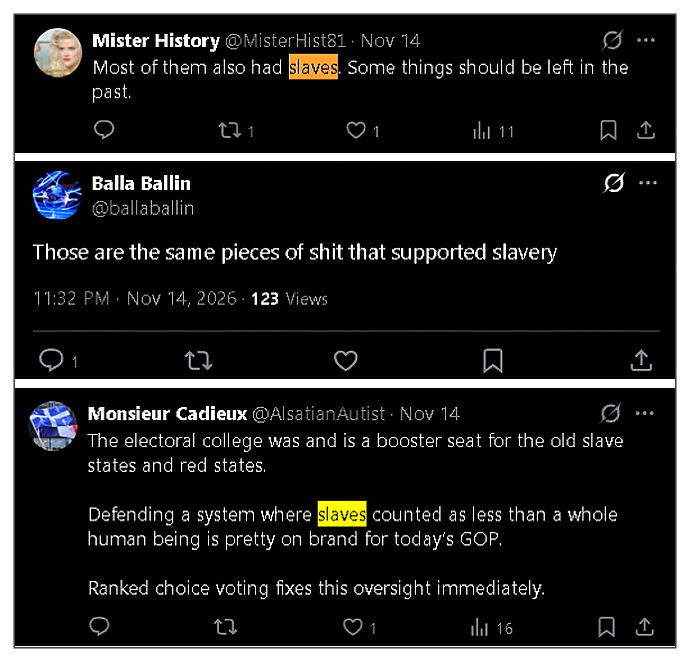
So a recent Twi-X by Ron DeSantis and the dumb-ass responses [like the examples below] inspired this post. Also, here are all my “Electoral College Posts.” Enjoy:
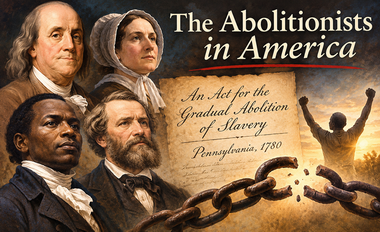
The Historical Roots of the Abolition Movement
THE OFTEN-OVERLOOKED HISTORY OF THOSE WHO CHALLENGED SLAVERY DURING AMERICA’S FOUNDING GENERATION
One of the more persistent historical narratives about American slavery suggests that opposition to the institution was largely a later development, associated primarily with nineteenth-century abolitionists and the political movements that eventually led to the Civil War.
That narrative overlooks a significant part of American history.
Opposition to slavery was already developing during the colonial period, became increasingly organized during the American Revolution, and produced substantial political and legislative victories during the nation’s founding generation. Long before Abraham Lincoln, the Republican Party, or the Civil War, Americans were debating the morality of slavery, establishing abolition societies, petitioning legislatures, emancipating enslaved people, and passing laws designed to dismantle the institution.
The Founders were not of one mind on slavery. Some owned slaves and defended the institution. Others expressed moral opposition while continuing to participate in it. Still others worked actively toward emancipation.
Understanding these distinctions is essential to an honest examination of the founding era.
The contradiction between American liberty and slavery
The American Revolution was built around arguments concerning natural rights, individual liberty, and resistance to arbitrary power. Those principles raised an unavoidable question: How could a nation proclaim that all men were created equal while permitting one person to own another?
This contradiction was recognized by many Americans during the founding era itself.
The early antislavery movement drew upon both Enlightenment principles of natural rights and religious convictions concerning the dignity of human beings. Quaker activists, in particular, had been challenging slavery for decades before the Declaration of Independence.
Historian Sean Wilentz, in No Property in Man: Slavery and Antislavery at the Nation’s Founding, documents how organized antislavery activism was already underway before the Revolution had been won.
In 1775, ten Philadelphians, seven of them Quakers, established the Society for the Relief of Free Negroes Unlawfully Held in Bondage. It became the foundation of what would eventually develop into the Pennsylvania Abolition Society.
This was not simply a matter of political rhetoric. These activists worked to challenge illegal enslavement, defend the liberty of free Black Americans, petition government officials, and promote emancipation.
Founders who opposed slavery or worked toward abolition
Several prominent Americans of the founding generation took meaningful steps against slavery, although their individual records and degrees of commitment differed.
John Adams never owned slaves and personally opposed the institution. He was among the very few early American presidents who had never participated in slaveholding. His opposition was not merely a political position but a consistent feature of his personal convictions.
Benjamin Franklin owned slaves earlier in his life but eventually freed those he held. In his later years, he became president of the Pennsylvania Society for Promoting the Abolition of Slavery. His transformation from slaveholder to abolition advocate represents an important development in the history of the founding generation.
Benjamin Rush, a physician, Declaration signer, and prominent reformer, was an important advocate of abolition. He challenged slavery on moral and religious grounds, supported Black education, and participated in organized efforts to improve the condition of formerly enslaved people.
John Jay helped establish and lead the New-York Manumission Society, which advocated gradual emancipation and worked to protect the rights of free Black Americans. As governor of New York, he signed the state’s 1799 gradual emancipation law. Jay himself had owned slaves, an important qualification when evaluating his record.
Alexander Hamilton was associated with the New-York Manumission Society and served in its leadership and legal activities. However, his antislavery record is more complicated than popular accounts sometimes suggest. His association with the organization is documented, but historians have raised questions about his willingness to advance its more ambitious objectives.
George Washington owned enslaved people for much of his life but increasingly expressed reservations about the institution. In his will, he provided for the emancipation of the enslaved people he personally owned, following the death of his wife. This did not include enslaved people belonging to the Custis estate, which he did not own. Nevertheless, his decision was a significant departure from the practices of many wealthy Virginia slaveholders.
These examples demonstrate that the founding generation was not uniformly committed to preserving slavery. There were genuine disagreements, evolving convictions, and meaningful efforts to bring about emancipation.
The historical record becomes considerably more complicated when examining prominent Southern leaders.
Thomas Jefferson drafted the Declaration of Independence’s condemnation of the slave trade, describing it as an “execrable commerce” and a “cruel war against human nature.” That language was removed from the final document.
Jefferson also contemplated gradual emancipation and supported ending the international slave trade. As president, he recommended legislation to prohibit American participation in that trade, which took effect in 1808.
However, Jefferson remained a slaveholder throughout his life. He held deeply racist views, opposed immediate emancipation, and favored colonization rather than full integration of emancipated Black Americans. His words and actions reveal a profound contradiction between his stated principles and his personal conduct.
James Madison opposed aspects of the African slave trade and participated in the founding-era debates over its eventual termination. Yet he remained a slaveholder and did not consistently support measures that would have brought about emancipation. His record illustrates the difference between opposing certain aspects of slavery and actively working to abolish the institution.
George Mason opposed the continuation of the African slave trade and criticized the constitutional provisions that permitted its continuation until 1808. Nevertheless, he owned many enslaved people and never emancipated them.
These men should neither be portrayed as committed abolitionists nor stripped of every recorded objection they made to slavery. Their records demonstrate the competing interests, compromises, and contradictions that characterized the founding generation.
The abolition movement was already producing results
Perhaps the most overlooked part of this history is that the early antislavery movement was not confined to speeches, private letters, or philosophical discussions. It produced organized societies, legislative campaigns, and actual emancipation laws.
Two organizations were especially influential.
The Pennsylvania Abolition Society developed from an organization founded in 1775 to assist free Black people unlawfully held in bondage. It was reorganized after the Revolutionary War and expanded its activities to include abolition advocacy, legal assistance, education, and the protection of Black liberty. Benjamin Franklin eventually served as its president.
The New-York Manumission Society, established in 1785, advocated gradual emancipation and worked to protect free Black Americans from kidnapping and illegal enslavement. It also established the African Free School in 1787, providing educational opportunities for Black children.
These organizations were not merely collections of wealthy white politicians. Quakers, religious reformers, Black community leaders, and ordinary citizens played essential roles in their activities.
Black Americans themselves participated in the struggle for liberty, organized petitions, challenged discriminatory laws, and helped defend the freedom they had secured.
Thomas Sowell and the larger history of abolition
The American founding generation’s efforts to challenge slavery were part of a much larger historical development. In Black Rednecks and White Liberals, economist and author Thomas Sowell examines the worldwide history of slavery and its eventual abolition in a chapter titled “The Real History of Slavery.”
Sowell challenges the familiar assumption that slavery simply faded away as societies became more enlightened. He examines how the consolidation of nation-states made slave raiding increasingly difficult, while also tracing the development of a moral opposition to slavery within Western civilization.
One of his central arguments concerns the often-overlooked religious origins of organized abolition. Sowell points out that the movement’s principal impetus came from conservative religious activists, particularly those whose Christian convictions led them to challenge an institution that had been accepted across civilizations for thousands of years.
As he writes:
“The principal impetus for the abolition of slavery came first from very conservative religious activists—people who would today be called ‘the religious right.'”
Thomas Sowell, Black Rednecks and White Liberals (San Francisco: Encounter Books, 2005), 115–16, chap. “The Real History of Slavery.” Google Books, page 116.
This broader perspective is particularly relevant to America’s founding generation. Quakers and other Christian reformers were among the earliest organized opponents of slavery in colonial America, and their religious convictions helped shape the abolition movement long before it became a major political cause in the nineteenth century.
The following audiobook chapter, “The Real History of Slavery,” presents Sowell’s fuller examination of this history, including the political, military, moral, and religious forces involved in slavery’s eventual abolition.
Here is Thomas Sowell’s full chapter on slavery:
Northern states began dismantling slavery
The founding generation also witnessed the beginning of slavery’s legal dismantling across much of the North.
Consider the following developments:
- Vermont, 1777: Its constitution prohibited slavery.
- Pennsylvania, 1780: Passed the first gradual emancipation law.
- Massachusetts, 1783: Court decisions interpreting the state constitution effectively ended slavery.
- Connecticut, 1784: Adopted gradual emancipation legislation.
- Rhode Island, 1784: Adopted gradual emancipation legislation.
- New York, 1799: Passed a gradual emancipation law under Governor John Jay.
- New Jersey, 1804: Adopted gradual emancipation legislation.
These laws did not immediately free everyone. Many applied primarily to children born after the laws took effect, while those already enslaved remained in bondage for years or decades. The process was frequently compromised, and enforcement was imperfect.
Nevertheless, these were significant developments. Slavery, which had existed throughout the original thirteen colonies, was being legally dismantled in a growing number of states.
The Pennsylvania emancipation law even connected its action directly to the principles of the Revolution, declaring:
“We conceive that it is our duty … to extend a portion of that freedom to others, which hath been extended to us.”
Thomas G. West, Vindicating the Founders: Race, Sex, Class, and Justice in the Origins of America (Lanham, MD: Rowman & Littlefield, 1997), section “Actions against Slavery.”
That is an especially revealing statement. The connection between American independence and the moral obligation to address slavery was being articulated by Americans living during the founding era itself.
The Founding Generation was not a uniform pro-slavery movement
It is important not to rewrite history in either direction.
The Founders did not collectively abolish slavery. The Constitution accommodated slaveholding interests, including provisions protecting the continuation of the African slave trade until 1808 and requiring the return of fugitive enslaved people.
Many prominent Founders continued to own enslaved people. Some expressed opposition to slavery in principle but were unwilling to sacrifice their economic interests or political alliances to bring about its abolition.
Others, however, took meaningful steps toward emancipation.
The early abolition movement was not invented in the nineteenth century. Its roots extended into colonial religious reform, the Revolutionary era, and the nation’s earliest political institutions. It was shaped by Quaker convictions, Christian morality, natural-rights philosophy, and the very principles of liberty invoked in America’s founding documents.
The struggle to reconcile American independence with human bondage began during the founding generation itself.
The historical record is more complicated than the familiar political narratives suggest. America was founded with a profound contradiction, but it was also founded during a period when Americans were already challenging that contradiction and beginning the long process of dismantling slavery.
That history deserves to be remembered in its entirety.
A Revolutionary Promise: Extending the Blessings of Liberty
On March 1, 1780, Pennsylvania passed An Act for the Gradual Abolition of Slavery, becoming the first state to enact a gradual emancipation law through its legislature.
The law’s preamble contained a remarkable statement connecting the principles of the American Revolution with the responsibility to address slavery:
“We conceive that it is our duty . . . to extend a portion of that freedom to others, which hath been extended to us, and release them from that thralldom, to which we ourselves were tyrannically doomed.”
These words are significant. The legislators were not simply discussing an abstract political principle. They were acknowledging that the freedom Americans had fought to secure carried a moral obligation toward those who remained enslaved.
The law was gradual and deeply imperfect. It did not immediately emancipate everyone already held in bondage. Children born to enslaved mothers after the law took effect were legally designated as indentured servants until age twenty-eight. Nevertheless, it represented a major legislative step toward dismantling slavery in America.
This was not an idea invented by nineteenth-century abolitionists. It was being debated, defended, and put into law during the founding generation itself.
David Barton’s Setting the Record Straight: American History in Black & White examines many of the lesser-known figures and events in this history, including Founding-era opponents of slavery, Black American patriots, and early efforts to secure freedom and equal rights. The documentary below, based on his book, provides a broader look at these often-overlooked chapters of American history.
Here is the documentary based on Barton’s book:
The historical record deserves to include both the contradiction of slavery at America’s founding and the efforts of those who challenged it.
Selected Bibliography
- David Barton, Setting the Record Straight: American History in Black & White (Aledo, TX: WallBuilder Press, 2004).
- Finkelman, Paul. Slavery and the Founders: Race and Liberty in the Age of Jefferson. 2nd ed. Armonk, NY: M. E. Sharpe, 2001.
- Polgar, Paul J. Standard-Bearers of Equality: America’s First Abolition Movement. Chapel Hill: University of North Carolina Press, 2019.
- Sowell, Thomas. Black Rednecks and White Liberals. San Francisco: Encounter Books, 2005.
- West, Thomas G. Vindicating the Founders: Race, Sex, Class, and Justice in the Origins of America. Lanham, MD: Rowman & Littlefield, 1997.
- Wilentz, Sean. No Property in Man: Slavery and Antislavery at the Nation’s Founding. Cambridge, MA: Harvard University Press, 2018.
- Wood, Nicholas P. Let the Oppressed Go Free: Abolitionism in Colonial and Revolutionary America. Cambridge: Cambridge University Press, 2025.
Find more “stuff” at my: U.S. RACIAL HISTORY PAGE
3/5ths BONUS
(Originally posted in November of 2010)
Description under video:
Let me explain.
- I have heard many people over the years quote St. Augustine to support their understanding of a Church Father supporting old-earth creationism (OEC). But in fact, as Augustine matured in his faith and thought about the competing worldviews (remember, he was a Pagan before being Born Again) he became a solid young earth creationist (YEC). So the quote people choose pre-dates his ending up as a YEC’er. In other words, as he moved further away from his Pagan roots he came closer to God’s clear work. (See my post entitled “Taking Physicist Stephen Barr to Task Over St. Augustine“)
The same applies here, Douglas was newly freed, he fell into being tutored by someone who viewed the Constitution as a “slave document, but after spreading his wings further, reading the Constitution (and the Civil War) — he matured to believe the Constitution was an anti-slavery document. The book pictured and I highly recommend is this: “Setting the Record Straight: American History in Black & White“.
See as well my page on my site with many resource recommendations on various topics: “U.S. RACIAL HISTORY“
Also see my post, “What Was the Civil War Over?“
Is racism enshrined in the United States Constitution? How could the same Founding Fathers who endorsed the idea that all men are created equal also endorse the idea that some men are not? The answer provided in this video by, Carol Swain, former professor of political science and law at Vanderbilt University, may surprise you.
More of David Barton talking about the Constitution and Frederick Douglass:
LINCOLN BONUS
Because we have Lincoln’s notes he kept, these were ready to go if Abraham Lincoln needed them in one of his many debates with Douglas:
You say A is a white, and B is black. It is –color–, then; the lighter, having the right to enslave the darker? Take care. By this rule, you are to be the slave to the first man you meet, with a fairer skin than your own.
You do not mean color exactly? — You mean the whites are –intellectually– the superiors of the blacks, and therefore, have the right to enslave them? Take care again. By this rule, you are to be slave to the first man you meet, with an intellect superior to your own.
But, say you, it is a question of –interest; and, if you can make it your –interest–, you have the right to enslave another. Very well. And if he can make it his interest, he has the right to enslave you.”
You say A. is white, and B. is black. It is color, then; the lighter, having the right to enslave the darker? Take care. By this rule, you are to be slave to the first man you meet, with a fairer skin than your own.
You do not mean color exactly? You mean the whites are intellectually the superiors of the blacks, and, therefore have the right to enslave them? Take care again. By this rule, you are to be slave to the first man you meet, with an intellect superior to your own.
But, say you, it is a question of interest; and, if you can make it your interest, you have the right to enslave another. Very well. And if he can make it his interest, he has the right to enslave you.
The importance of Lincoln’s logic should not be overlooked. Lincoln understood that if you attempt to establish human rights or personhood by appealing to a set of arbitrary, degreed properties such as color and intellect, properties which carry no moral weight or significance and which none of us share equally, then you end up undermining human rights for everyone….