The audio at the start from Jeff Durbin is bad… so one has to put up with it a little when the initial audio is played. But the same arguments against atheistic determinism can be used against Augustinian/Calvinistic [theistic] determinism:
Dr. Braxton Hunter, President of Trinity Seminary and host of Trinity Radio, joins Dr. Flowers to talk about how the main arguments against naturalistic determinism can apply against theistic determinism, as held by Compatibilistic Calvinists. They demonstrate this by engaging a clip from Apologia Studios with Jeff Durbin which references a quote from Calvinistic apologist, Greg Bahnsen.
Justin Brierley drives this point home in his article:
… Atheist Determinism
Calvinistic Christians have more in common with many atheists than they may realize. Determinism has also become a very popular philosophy among their godless counterparts. For some time, prominent voices in atheist circles have also been announcing that the notion of free will is past its sellby date.
Popular atheist author Sam Harris wrote a book titled Free will (Free Press) which, drawing on research in neuroscience, argued that our innate sense of freedom is merely an illusion foisted on us by nature. None of us is actually in control of what we do. So far so Calvinist. But rather than believing God has predestined us, atheists like Harris say the universe is responsible.
Atheist determinism springs from a ‘materialist’ worldview. All that exists is the ‘material’ stuff of the universe. Everything about us and the world we live in can ultimately be explained by the physics of atoms, electrons, quarks and neutrons, interacting according to the predictable regularity of natural laws.
Think of it like this: the skill of the snooker player is in predicting as accurately as possible how the balls will ricochet off each other in order to find the pockets on the table. But, theoretically, if a snooker player lined up their very first shot with perfect precision and perfect force, they could clear the table in one shot. The universe is like that, but on a much bigger scale.
Every single physical event, from the movements of electrons to the orbits of the planets, follows predictable laws of cause and effect. Therefore, the way the universe is now is a direct result of the way it was when it first began. If you rewound the clock by 13 billion years to the exact same physical state of affairs, things would roll out in exactly the same way they already have.
But, in such a universe, the idea that we have any measure of free will evaporates. Every aspect of our existence was predestined by a cosmos blindly following the laws of cause and effect. …
READ IT ALL: “Why Both Atheists and Christians Need to Believe in Free Will“
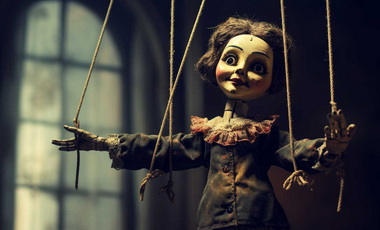
You cannot have LOVE with people made into dolls with a pull string that say, “I love you.” This is evidence that Calvinists/”Reformed” make Calvary useless.
Here is a favored adapted combination of mine:
One of the most intriguing aspects mentioned by Ravi Zacharias of a lecture he attended entitled “Determinism – Is Man a Slave or the Master of His Fate,” given by Stephen Hawking, who is the Lucasian Professor of Mathematics at Cambridge, Isaac Newton’s chair, was this admission by Dr. Hawking’s, was Hawking’s admission that if “we are the random products of chance, and hence, not free, or whether God had designed these laws within which we are free.”[1] In other words, do we have the ability to make choices, or do we simply follow a chemical reaction induced by millions of mutational collisions of free atoms? Michael Polyni mentions that this “reduction of the world to its atomic elements acting blindly in terms of equilibrations of forces,” a belief that has prevailed “since the birth of modern science, has made any sort of teleological view of the cosmos seem unscientific…. [to] the contemporary mind.”[2]
[1] Ravi Zacharias, The Real Face of Atheism (Grand Rapids, MI: Baker Books, 2004), 118, 119.
[2] Michael Polanyi and Harry Prosch, Meaning (Chicago, IL: Chicago university Press, 1977), 162.
This is one of the biggest reasons I [about half-a-year-ago] have rejected the 5-Points of Calvinism. Which is, determinism. I have written, posted, and debated this with atheists for years on the WWW., and when I saw that people like Al Mohler refute the atheist versions of this but does not apply the same thinking to his position — my apologetic bug was brought alive. Here is the video that started this rabbit trail:
Here is the full Al Mohler article: “So . . . Why Did I Write This? The Delusion of Determinism”
The subversion of moral responsibility is one of the most significant developments of recent decades. Though this subversion was originally philosophical, more recent efforts have been based in biology and psychology. Various theorists have argued that our decisions and actions are determined by genetics, environmental factors, or other forces. Now, Scientific American is out with a report on a study linking determinism and moral responsibility.
The diverse theories of determinism propose that our choices and decisions are not an exercise of the will, but simply the inevitable outcome of factors outside our control. As Scientific American explains, determinists argue that “everything that happens is determined by what happened before — our actions are inevitable consequences of the events leading up to the action.”
In other words, free will doesn’t exist. Used in this sense, free will means the exercise of authentic moral choice and agency. We choose to take one action rather than the other, and must then take responsibility for that choice.
This link between moral choice and moral responsibility is virtually instinctive to humans. As a matter of fact, it is basic to our understanding of what it means to be human. We hold each other responsible for actions and choices. But if all of our choices are illusory — and everything is merely the “inevitable consequence” of something beyond our control, moral responsibility is an exercise in delusion.
Scientific American reports on a study performed by psychologists Kathleen Vohs and Jonathan Schooler. The psychologists found that individuals who were told that their moral choices were determined, rather than free, were also more likely to cheat on an experimental examination.
As Shaun Nichols reports:
The Western conception idea of free will seems bound up with our sense of moral responsibility, guilt for misdeads and pride in accomplishment. We hold ourselves responsible precisely when we think that our actions come from free will. In this light, it’s not surprising that people behave less morally as they become skeptical of free will. Further, the Vohs and Schooler result fits with the idea that people will behave less responsibly if they regard their actions as beyond their control. If I think that there’s no point in trying to be good, then I’m less likely to try.
Even if giving up on free will does have these deleterious effects, one might wonder how far they go. One question is whether the effects extend across the moral domain. Cheating in a psychology experiment doesn’t seem too terrible. Presumably the experiment didn’t also lead to a rash of criminal activity among those who read the anti-free will passage. Our moral revulsion at killing and hurting others is likely too strong to be dismantled by reflections about determinism. It might well turn out that other kinds of immoral behavior, like cheating in school, would be affected by the rejection of free will, however.
There are limitations to this kind of research, of course, but the report is both revealing and unsurprising. If we are not responsible for our actions, they why would people do the right thing? The most immediate result of such thinking is the subversion of moral accountability.
Of course, this pattern of thought also renders human existence irrational. How can we understand ourselves, our children, our spouses, our friends, or our neighbors if moral responsibility is undermined by determinism. Our legal system would completely collapse, as would the entire experience of relating to other human beings.
Shaun Nichols explains that “the Western conception of free will seems bound up with our sense of moral responsibility.” That “Western conception” is a product of the Christian inheritance and the biblical worldview. The Bible clearly presents human beings as morally responsible. Christians of virtually all theological traditions — including Reformed theology, Arminianism, and Catholicism — affirm moral and spiritual responsibility and the authenticity of the experience of choice.
As a matter of fact, this capacity and accountability is rooted in the biblical concept of the imago Dei — the image of God. Our Creator made us as moral creatures and planted within us the capacity of conscience. All this refutes the concept of moral determinism.
In its most modern forms, determinism is a product of naturalism — the belief that everything must be explained in purely natural terms. Naturalism explains the human mind (including the experience of moral choice) as a matter of chemical reactions in the brain, and nothing more.
Determinism is implied by naturalism and relieves human beings of moral responsibility. There is no moral revolt against the Creator, no Fall, and no need for the Gospel. This subversion of moral responsibility is both a delusion and a trap. And, as the Scientific American report indicates, even those who say they believe in moral determinism are unable to live consistently with this assumption. We know we are responsible.
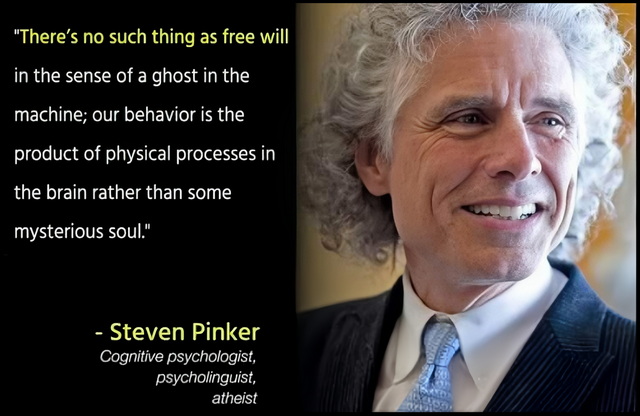
SOME QUOTES CONNECTING THIS IDEA MORE
ATHEISTS:




THEISTS:


If Mohler applies that to his own theological determinism, he would have to reject it.
THERE IS NO GOSPEL IN TULIP
In other words, a person accepts Christ’s death and Resurrection as secondary to being ELECTED.
Here is more on this via this excerpt of an article and short video:
Calvinist: “That is why Christ said that you must be born again in order to even see the kingdom of God. The new nature must come before faith. God making us willing is not mind control in the sense that you describe it but giving us a new nature and a new mind. Of course the analogy isn’t perfect but it does illustrate the fact that we can be made to love without it being against our will.”
Me: “No it doesn’t. If we were God haters that wanted nothing to do with Christ prior to His irresistible act of “giving us a new heart” that “makes us willing”, then it was certainly “against our will” because our will was to hate and reject God prior to His irresistible working in us. It would be like a man meeting a girl at a bar and the girl doesn’t like him and wants nothing to do with him. In fact, she finds him repulsive. So the man slips a pill in her drink that removes her inhibitions and causes her to begin to find him attractive, even to the point of “making her willing” to sleep with him. Now if this incident was brought before the court, would the court say that the man is not liable for violating the woman against her will, since the pill he put in her drink “made her willing”? Of course not. Nobody would say that she freely chose to be with the man under such circumstances, and no one would say that her will was not violated.”
“As distasteful as this illustration might be, it illustrates the exact same principle behind your claims that while God “makes us willing” this making us willing by “giving us a new heart” is not a violation of the person’s will. Instead of dropping a pill into our drink, God drops a “new heart” into our God hating chest. The only difference would be that in your view of how God works, the “effects” of the “drug” would never wear off. But that doesn’t change the fact that a person’s will has been obviously violated in the process.”
“It really is pretty simple. If God’s working faith into us is not resistible, but irresistible, then it certainly violates freedom and the will. That is so obvious, it shouldn’t even need to be pointed out. If you want to say that God irresistibly brings sinners to faith and love and devotion to Him (by irresistibly removing their “hate God heart” and putting in a “love God heart”) because you think the Bible teaches that, then fine. But trying to then claim that God does this in such a way that we freely come to him in such a way that our wills are not violated is clearly incoherent. You can’t have it both ways. Sorry.”
Dr. Leighton Flowers talk about martyrs who stood against the Calvinists of their day and what happened to them.