
A series of 5-myths via Daniel Flynn’s excellent book — Machiavelli said, “One who deceives will always find those who allow themselves to be deceived.”
- Daniel J. Flynn, Why the Left Hates America: Exposing the Lies That Have Obscured Our Nation’s Greatness (Roseville, CA: Prima Publishing, 2002), 132-138.
MYTH #4: THE UNITED STATES IS AN IMPERIAL POWER
ON APRIL 20, 2002, nearly 50,000 people converged on the Mall in Washington, D.C., to protest. The diverse targets of the activists included Israeli occupation of the West Bank, the School of the Americas, the World Bank, and the War on Terrorism. The inhabitants of the government buildings surrounding the protestors received the blame for many of the international ills that the activists sought to cure.
The protestors’ chants, signs, and rhetoric targeted the United States. Kenneth Stewart, a Vietnam veteran from Maine, bluntly opined, “We are a terrorist nation.” A North Carolina college student remarked, “I think the United States of America is a culturally and emotionally diseased country.” “Who’s the real Axis of Evil?” State University of New York—Brockport student Chris Powers rhetorically asked. “If any country’s really an Axis of Evil, it’s us.”
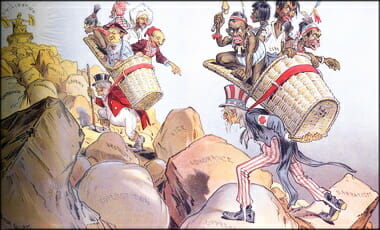
Their nation, the activists uniformly contended, seeks to conquer the world through empire. Imperialism is the most threatening manifestation of the evil that they see inherent in America. As sign-carrying New Yorker Charles Freed expressed, “The United States, being the one lone superpower, thinks its manifest destiny is to rule the world.”
If the United States is an imperial power, where is our empire? What are the names of the colonies we possess? What wars of conquest did we fight to gain this territory?
The British Empire ruled Ireland, India, Arabia, Rhodesia, and numerous other locales. The French Empire cast its dominion over Vietnam, Algeria, and Lebanon, among other places. The Roman Empire claimed Britain, Judea, Gaul, Macedonia, and points beyond. The American “empire” rules no one.
American imperialism, the Left maintains, is not necessarily characterized by stealth fighters, M-16s, or navy destroyers. It is more nuanced than that. The corporate logos of Starbucks, Coca-Cola, and The Gap are the images evoked by American empire. These seemingly benign symbols suggest just how threatening American “imperialism” really is to the rest of humanity. Something is obviously amiss when the same word used to describe a McDonald’s opening up in a Third World country is also used to describe the horrors that occurred in the Belgian Congo.
In the lexicon of the Left, the term “empire” possesses an amazing elasticity. “An empire does not only necessarily consist of actual colonial countries that one owns,” Charles Freed insisted. “The real empire is owning all these countries in terms of dollars.” Beverley Anderson, who traveled to the Washington rally from California, maintained that America’s foreign policy is “imperialism disguised as human rights, and building economies, and wiping out poverty.” Student Rachel Garskof-Leiberman sees American imperialism as “much more dangerous because if you see someone taking over with a gun . . . and you see traditional imperialism it has negative connotations that are obvious. But an economic imperialization is so much worse because you look at Starbucks and Starbucks isn’t threatening. [Third World people] don’t think of imperialism. They think of comfort.”
Where did these activists get their ideas? “No country is exempt from [the brutal force of the U.S. military], no matter how unimportant,” famed Massachusetts Institute of Technology linguist Noam Chomsky writes in the popular pamphlet What Uncle Sam Really Wants. A possible socialist success story, Chomsky alleges, threatens the economic order and sparks the capitalist states to crush even tiny rebellions against free enterprise. “If you want a global system that’s subordinated to the needs of U.S. investors, you can’t let little pieces of it wander off.” Howard Zinn labels the recent relationship between U.S. corporations and the Third World “a classical imperial situation, where the places with natural wealth became victims of more powerful nations whose power came from that seized wealth.” Gore Vidal tags his homeland “a seedy imperial state.” The aging literary crank advances the theory that the military retaliation against Afghanistan for the 9-11 attacks had nothing to do with stopping terrorism but was in fact “a great coup on the part of the United States to grab all of the oil and natural gas of central Asia.”
By now, the reader is perhaps familiar with the Left’s response to military action around the globe. Radicals inevitably hypothesize that the United States is pulling the strings behind the scenes, usually through the Central Intelligence Agency, even in the cases where no evidence links the United States to the conflict. The non-Americans engaged in the actual fighting, they suggest, serve as our proxies. Far from casting doubt on their analysis, the absence of proof linking the United States to, say, a coup in the Third World merely confirms the Left’s view of the CIA’s cunning and conspiratorial acumen. Similarly predictable is the Mandan analysis attributing financial motives to all military actions by free-market democracies. The financial motivation usually takes the form of oil, even when the enemy in question—such as the Taliban’s Afghanistan—boasts no great oil reserves. If one gets feelings of déjà vu after speaking with leftists about America’s role in global affairs, it is because activists lower on the information food chain devour the party line of Zinn, Chomsky, and others.
A problem for the “American Empire” school of thought is that the masses in developing countries enthusiastically welcome what the Left describes as imperialism. When a clothing line sets up a factory in Central America, no one forces anyone at gunpoint to work the jobs. In fact, the opposite scenario occurs. The people flock to work there. Coca-Cola’s omnipresence around the world similarly stems from voluntary choice, not force. For better or worse, Third World people embrace both the production and the consumption components of corporatism. How do leftists explain the enthusiasm of the masses for what they describe as imperialism? “The masses,” explained one young man, “are uneducated.”
The Left’s contention that the United States holds a disproportionate share of military power certainly is valid. It does not follow, however, that great military power necessarily translates into imperial designs. If the United States sought to impose its will on other nations, it certainly could have a great deal of success. It chooses, however, not to do so. This is a conspicuous deviation from the historical pattern. Nations holding power vis-a-vis other nations have traditionally used that power to claim dominion over others. America refrains from this course of action. In fact, the major wars involving the United States since it became the world’s preeminent military power have been fought to prevent empires—Nazi imperialism, Japanese imperialism, Communist imperialism, and Iraq’s attempt at an oil empire. After all these wars, America’s territory remained essentially the same.
The rise of American hegemony notably coincided with the decline of colonialism. The American Century witnessed the fall of, among others, the British, French, and Soviet Empires. Normally, the ascendant power fills the vacuum left by the falling powers. We defeated the Soviet Union, but we do not rule over it. We helped liberate Eastern Europe from its Soviet overlords, but, unlike with the Soviets’ rule replacing the vanquished Nazis’ rule, we declined to exert our will in governing the affairs of these nations. America’s example is a historical anomaly.
The fallacy that one nation’s fortune causes another’s misfortune inspires much of the hatred of U.S. foreign policy. America’s wealth did not come at the expense of other nations. On the contrary, the economies of other nations benefit from Western wealth. The theory behind the false notion of American imperialism posits that U.S. policy aims to transfer the wealth of the rest of the world to the elites of this country. This has not happened. The United States has certainly grown wealthier during the past century. The rest of the world has, too, and at a more dramatic pace. In relative terms, the wealth shift has been away from the West and toward the rest of humanity. Samuel Huntington guesses in The Clash of Civilizations that the West’s portion of the economic pie reached a high of around 70% after World War I and will decline to the 30% mark by 2020. More important, this time period witnessed remarkable economic progress for non-Western countries in absolute terms as well.
The idea that the United States obtained its wealth by bleeding the rest of humanity dry is a gross inversion of reality for another reason. From the close of World War II until today, the United States has given more than $500 billion in aid to the rest of the world. This figure is roughly $500 billion more than the aid the rest of the world has given the United States. If adjusted for inflation, the $500 billion figure would be quite larger. A survey by the Congressional Research Service estimates that the actual cost to the taxpayer for foreign aid (as a result of interest payments on the borrowing that finances it) stands at over $2 trillion during this period. Again, this massive amount of money is in non-inflation-adjusted dollars. The foreign appropriations budget for fiscal year 2002 lays out more than $15 billion for foreign countries and international programs. The $15 billion, which represents about two-thirds of government spending on foreign governments and international programs, includes money for more than 130 countries. One might logically argue that the federal government milks its own citizens for the benefit of foreigners. Holding that the federal government milks foreigners for its own citizens’ benefit belies the objective numbers.
The Left’s ideology presumes that the drive for profits from capitalist countries results in attempts at political, economic, and military domination. The facts resist this theory. Preferring ideology to reality, the Left persists in claiming that the dictates of their theories are reality—even when everything around them says otherwise.