Thanks to Debunking Atheists for the Link!
William Lane Craig
One-Minute Apologetics~Euthyphro Dilemma
On the Run ~ Richard Dawkins, Polly Toynbee, and AC Grayling ~ William Lane Craig’s 2011 UK Tour (October 17-26)
Dr. William Lane Craig Fields a Question About God`s Omniscience
This was originally found on YouTube (youtu.be/69dbNQ7QVJw), but the audio was atrocious. So I fixed it and uploaded it here for others to use. Enjoy, it is Dr. Craig at his best — Q&A. I have posted on this before, belowis a paper and a Power Point Presentation:
(Serious Saturday) Skeptics Having Their Cake and Eating It Too
William Lane Craig debates AC Grayling-A Serious Saturday Debate About God and Evil
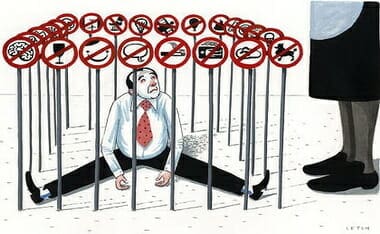
Whats Okay with Big Gov and Not Okay With It (Nanny State Comparisons)
Libertarian Republican notes the latest nanny state move by the banning of cartoon characters for sugary cereals.
The Federal Government, pushed along by liberal pressure groups, is taking the first steps towards banning the sale of sugary cereals and salt-abundant foods to kids.
CBS News reports: “GOP decries “nanny state” push on junk food ads”:
To critics, it’s the latest example of “nanny state” overreach by the federal government that could cost money and jobs.
The issue? A proposed set of voluntary guidelines backed by the Obama administration designed to limit the marketing of junk food to children through mascots like “Tony the Tiger,” the smiling animated figure used for decades to sell Kellogg’s “Frosted Flakes” breakfast cereal. Under the guidelines, companies would only be able to advertize and promote healthy foods low in fat, sugar…
Professor Walter Williams described these “Do Gooders” as lifestyle Nazis. CS Lewis aptly talked about his fear of such people:
Of all tyrannies, a tyranny exercised for the good of its victims may be the most oppressive. It may be better to live under robber barons than under omnipotent moral busybodies. The robber baron’s cruelty may sometimes sleep, his cupidity may at some point be satiated; but those who torment us for our own good will torment us without end for they do so with the approval of their own conscience. They may be more likely to go to Heaven yet at the same time likelier to make a Hell of earth. Their very kindness stings with intolerable insult. To be ‘cured’ against one’s will and cured of states which we may not regard as disease is to be put on a level of those who have not yet reached the age of reason or those who never will; to be classed with infants, imbeciles, and domestic animals.
C. S. Lewis, God in the Dock, p. 292.
The government will demand the following to be placed on cigarette packs (forcing private business to place gruesome photos on their product:

That, however, is not my main focus. What I do wish to zero in on is what causes the secular left does go to the mat/floor for. That is, the above at the Federal level is kosher… the below at the local level is not! That is, to ban simple labels inserted into biology textbooks simply warning the school children about the monolithic view taught in their science classes [in regards to origin science, not working science] in a small label inserted into their biology textbooks:
- This textbook contains material on evolution. Evolution is a theory, not a fact, regarding the origin of living things. This material should be approached with an open mind, studied carefully, and critically considered. (Selman v. Cobb County School District)
- Intelligent Design is an explanation of the origin of life that differs from Darwin’s view. The reference book Of Pandas and People is available for students to see if they would like to explore this view in an effort to gain an understanding of what Intelligent Design actually involves. As is true with any theory, students are encouraged to keep an open mind. (Tammy Kitzmiller v. Dover Area School District)
How is this argument misconstrued with straw-men and non-sequiturs? Here is a great example that comes from an evolutionary website, first the person posts this graphic equating ID to the following:

Did you notice the lumping in of Neo-Darwinian THEORY with laws of science and effects that are repeatable, observable? The author contunues down the non-sequitur road creating a straw-man and then defeating it, not the real argument:
How long does this fight need to go on? Do we need to teach the “strengths and weaknesses” of the theory of gravity? That’s right. That’s all it is. A theory. But I don’t see any creationists defiantly jumping off cliffs.
One commentator also hops in and says something that is truly amazing and shows you the depths of non-thinking in regards to this topic:
The world is flat, the moon landing was a hoax, global warming is not real, and intelligent design is true. Amazing what some people will resort to, just to avoid facing the truth and questioning their beliefs or their lifestyles.
All I have to say is “WOW!” Which brings me to the god centered vacuum that man tries to fill with himself. And this is the bottom line, do you want to give ultimate credence to The Designer, or the creature:
Romans 1:21-23 (ESV):
For although they knew God, they did not honor him as God or give thanks to him, but they became futile in their thinking, and their foolish hearts were darkened. Claiming to be wise, they became fools, and exchanged the glory of the immortal God for images resembling mortal man and birds and animals and creeping things.
I would hope, to rightly understand what Intelligent Design theorists ARE saying, one would take the time to read the small portion entitled “The Golden Arm,” posted after an atheists point about ID:
If science really is permanently committed to methodological naturalism – the philosophical position that restricts all explanations in science to naturalistic explanations – it follows that the aim of science is not generating true theories. Instead, the aim of science would be something like: generating the best theories that can be formulated subject to the restriction that the theories are naturalistic. More and more evidence could come in suggesting that a supernatural being exists, but scientific theories wouldn’t be allowed to acknowledge that possibility.
Bradley Monton, author of Seeking God in Science: An Atheist Defends Intelligent Design ~ Apologetics315 h/t
Enjoy the following read, click to enlarge:


William Lane Craig Gives Lecture On the New Atheists (Serious Saturday)
Philosopher and scholar Dr. William Lane Craig debates atheist Sam Harris (University of Notre Dame, April 7, 2011)
(An Early SERIOUS Saturday) Secular Humanist Advertisement Critiqued~William Lane Craig
Headed to Wine Country for the weekend… will forgo Friday Fodder, Sunday Toons will be later than usual. Sorry… sometime tomorrow afternoon I should have hit four wineries already in Paso… Ohhhhh Pooor Me!
Serious Saturday~Theistic Evidences by Dr. William Lane Craig
William Lane Craig gives one of his best presentations on evidences for theism. It is directly aimed at the heart of atheistic arguments and destroys many of the straw-men placed by said atheists.
There is a short follow up by atheist professor Daniel Dennett that lasts about 10-minutes or so. who has no defense of his atheism in light of what just happened. He basically mentions that his non-knowledge will some day be filled in (atheism-of-the-gaps). Professor McGrath (theist) finishes up with about a 5-minute outro.
Ethical Naturalism? (Defined by Apologetics315: Terminology Tuesday)
Apologetics315 (Terminological Tag):
Ethical Naturalism: is a reductionist view that holds that ethical terms (goodness, worth and right) can be defined by or reduced to natural, scientific properties that are biological, psychological, sociological or physical in nature. For example, according to ethical naturalism the term right in “X is right” means one of the following: “What is approved by most people”; “What most people desire”; “What is approved by an impartial, ideal observer”; “What maximizes desire or interest”; “What furthers human survival.” The important point here is that these moral terms and moral properties are not irreducibly moral in nature. Moral properties (e.g., worth, goodness or rightness) turn out to be properties that are biological or psychological.
Furthermore, according to ethical naturalism, these properties can be measured by science by giving them operational definitions. Consider an example. Suppose “X is right” means “X is what most people desire,” and one goes on to argue that the presence of pleasure and the absence of pain is what most people desire. A scientist could measure the presence of pleasure and the absence of pain by defining such a state in physiological terms — the presence of a certain heart rate, the absence of certain impulses in the nervous system, slight coloration of the skin. “Rightness” means what is desired by most people; what is desired by most people is the presence of pleasure and the absence of pain; and pleasure and pain can be defined by certain physical traits of the body. Thus the moral property of rightness has been reduced to a natural property that can be measured.
Two major objections can be raised against ethical naturalism both based on its moral reductionism. First, it confuses an is with an ought by reducing the latter to the former. Moral properties are normative properties. They carry with them a moral “ought.” If some act has the property of rightness, then one ought to do that act. But natural properties like the ones listed do not carry normativeness. They just are. Second, every attempted reduction of a moral property to a natural one has failed because there are cases where an act is right even if it does not have the natural property, and an act can have the natural property and not be right. For example, suppose one reduces the moral property of rightness in “X is right” to “X is what is approved by most people.” This reduction is inadequate. For one thing, the majority can be wrong. What most people approve of can be morally wrong. If most people approved of torturing babies, then according to this version of ethical naturalism, this act would be right. But even though it was approved by most people, it would still be wrong. On the other hand, some acts can be right even if they are not approved of (or even thought of, for that matter) by most people.[1]
[1] William Lane Craig & J.P. Moreland, Philosophical Foundations for a Christian Worldview (Downers Grove, IL: InterVarsity Press, 2003), p. 401.