R. C. Sproul’s popular lecture on Protestant Reformer Martin Luther.
R.C. Sproul
Sola Fide: Faith Alone | Erwin Lutzer and R. C. Sproul
College Park Church (April 2017) – Lecture by Erwin Lutzer.
R. C. Sproul speaks on the doctrine of justification by faith alone and how it was debated among Roman Catholic and Protestant Christians.

A Short Study Defining “Inerrancy” (Updated)
In the appendix to Misquoting Jesus, added to the paperback version, there is a Q&A section. I do not know who the questioner is, but it is obviously someone affiliated with the editors of the book. Consider this question asked of Ehrman:
✦ Bruce Metzger, your mentor in textual criticism to whom this book dedicated, has said that there is nothing in these variants of Scripture that challenges any essential Christian beliefs (e.g., the bodily resurrection of Jesus or the Trinity). Why do you believe these core tenets Of Christian orthodoxy to be in jeopardy based on the scribal errors you discovered in the biblical manuscripts?
Note that the wording of the question is not “Do you believe…” but “Why do you believe these core tenets of Christian orthodoxy to be in jeopardy…?” This is a question that presumably came from someone who read the book very carefully. How does Ehrman respond?
- The position I argue for in Misquoting Jesus does not actually stand at odds with Prof. Metzger’s position that the essential Christian beliefs are not affected by textual variants in the manuscript tradition of the New Testament.
Suffice it to say that viable textual variants that disturb cardinal doctrines found in the NT have not yet been produced.
Daniel B. Wallace, Revisiting the Corruption of the New Testament (Grand Rapids, MI: Kregal Publications, 2011), 54-55.

So with all that in mind (one should familiarize themselves with the first part of this), can we then define what we mean by biblical inerrancy, of course my favorite definition comes from the main text I used at the seminary I attended. I will also give definitions from some other main text that other seminaries use as well.
“…inerrancy means that Scripture in the original manuscripts[1] does not affirm anything that is contrary to fact.”[2]
In case you didn’t catch what that sentence meant is “that the Bible always tells the truth, and that it always tells the truth concerning everything it talks about.”[3]
In the index in the back under “inerrancy” you find some of the following topics under that heading: allows for free quotation; allows for ordinary language; allows for round numbers; allows for textual variants; allows for uncommon grammar; allows for vague statements; human language doesn’t prevent. I will choose one example from this list so you can get the “gist” of what Grudem is saying:
A similar consideration applies to numbers when used in measuring or in counting. A reporter can say that 8,000 men were killed in a certain battle without thereby implying that he has counted everyone and that there are not 7,999 or 8,001 dead soldiers. If roughly 8,000 died, it would of course be false to say that 16,000 died, but it would not be false in most contexts for a reporter to say that 8,000 men died when in fact 7,823 or 8,242 had died: the limits of truthfulness would depend on the degree of precision implied by the speaker and expected by his original hearers.
This is also true for measurements. Whether I say, “I don’t live far from my office,” or “I live a little over a mile from my office,” or “I live one mile from my office,” or “I live 1.287 miles from my office” all four statements are still approximations to some degree of accuracy. Further degrees of accuracy might be obtained with more precise scientific instruments, but these would still be approximations to a certain degree of accuracy. Thus, measurements also, in order to be true, should conform to the degree of precision implied by the speaker and expected by the hearers in the original context. It should not trouble us, then, to affirm both that the Bible is absolutely truthful in everything it says and that it uses ordinary language to describe natural phenomena or to give approximations or round numbers when those are appropriate in the context.
We should also note that language can make vague or imprecise statements without being untrue. “I live a little over a mile from my office” is a vague and imprecise statement, but it is also inerrant: there is nothing untrue about it. It does not affirm anything that is contrary to fact. In a similar way, biblical statements can be imprecise and still be totally true. Inerrancy has to do with truthfulness, not with the degree of precision with which events are reported.[4]
Another definition comes from a newer systematic theological 4-volumn set, it reads as follows:
…the inspiration of Scripture is the supernatural operation of the Holy Spirit who, through the different personalities and literary styles of the chosen human authors, invested the very words of the original books of Holy Scripture, alone and in their entirety, as the very Word of God without error in all that they teach (including history and science) and is thereby the infallible rule and final authority for the faith and practice of all believers.[5]
Another popular text in seminaries defines inerrancy in this way:
By “inerrancy” we mean that as a product of supernatural inspiration the information affirmed by the sentences of the original autographs of the sixty-six canonical books of the Bible is true.
By “true” content we mean propositions that correspond to the thought of God and created reality because they are logically noncontradictory, factually reliable, and experientially viable. Therefore, as given, the Bible provides a reliable guide for healthfully experiencing the physical, mental, moral, and spiritual realities that people face in time and eternity.
To grasp the truth that was given, as fully as possible, a passage of Scripture must be taken (interpreted) by a believer in accord with its author’s purpose; degrees of precision appropriate to that purpose at that time; and its grammatical, historical, cultural, and theological contexts (all under the illumination of the Holy Spirit who inspired it).[6]
One of my favorites comes from large theological treatise, I will here only put his definition, however, the author goes on for about four pages defining some of the ideas and words used in that smaller definition:
We may now state our understanding of inerrancy: The Bible, when correctly interpreted in light of the level to which culture and the means of communication had developed at the time it was written, and in view of the purposes for which it was given, is fully truthful in all that it affirms.[7]
One must also keep in mind the psychological foreboding that all of us have. The question is thus: in order to suppress our biases as much as possible, is there a construct and model in which one should view any literary work with in order to test it internal soundness? Besides what I will again post as some rules all persons should follow in order to limit his or her preconceived values and biases they bring to the table, C. Sanders, a famous military historian, in his Introduction to Research in English Literary History, lists and explains the three basic principles of historiography. These are the bibliographical test, the internal evidence test, and the external evidence test.
Bibliographical Test
The bibliographical test is an examination of the textual transmission by which documents reach us. In other words, since we do not have the original documents, how reliable are the copies we have in regard to the number of manuscripts (MSS and the time interval between the original and the extant (currently existing) copies?
Internal Evidence
Internal Evidence, of which John Warwick Montgomery writes that literary critics still follow Aristotle’s dictum that “the benefit of the doubt is to be given to the document itself, not arrogated by the critic to himself.” therefore, one must listen to the claims of the document under analysis, and do not assume fraud or error unless the author disqualified himself by contradictions or known factual inaccuracies. As Dr. Horn continues:
“Think for a moment about what needs to be demonstrated concerning a ‘difficulty’ in order to transfer it into the category of a valid argument against doctrine. Certainly much more is required than the mere appearance of a contradiction. First, we must be certain that we have correctly understood the passage, the sense in which it uses words or numbers. Second, that we possess all available knowledge in this matter. Third, that no further light can possibly be thrown on it by advancing knowledge, textual research, archaeology, etc…. Difficulties do not constitute objections. Unresolved problems are not of necessity errors. This is not to minimize the area of difficulty; it is to see it in perspective. Difficulties are to be grappled with and problems are to drive us to seek clearer light; but until such time as we have total and final light on any issue we are in no position to affirm, ‘Here is a proven error, an unquestionable objection to an infallible Bible.’ It is common knowledge that countless ‘objections’ have fully been resolved since this century began.” (see more)
External Evidence
Do other historical materials confirm or deny the internal testimony provided by the documents themselves? In other words, what sources are there – apart from the literature under analysis – that substantiate its accuracy, reliability, and authenticity?[8]
Of course there will be people who refuse to use the tools that literary critics and legal scholars have devised to keep as much prejudice out as possible. My final story I wish to share with the reader explains what this looks like better than I ever could:
Psychological Prejudice
But even a sound epistemic system, flawless deductive reasoning, and impeccable inductive procedure does not guarantee a proper conclusion. Emotional bias or antipathy might block the way to the necessary conclusion of the research. That thinkers may obstinately resist a logical verdict is humorously illustrated by John Warwick Montgomery’s modern parable:
Once upon a time (note the mystical cast) there was a man who thought he was dead. His concerned wife and friends sent him to the friendly neighborhood psychiatrist determined to cure him by convincing him of one fact that contradicted his beliefs that he was dead. The fact that the psychiatrist decided to use was the simple truth that dead men do not bleed. He put his patient to work reading medical texts, observing autopsies, etc. After weeks of effort the patient finally said, “All right, all right! You’ve convinced me. Dead men do not bleed.” Whereupon the psychiatrist stuck him in the arm with a needle, and the blood flowed. The man looked down with a contorted, ashen face and cried, “Good Lord! Dead men bleed after all!”
Emotional prejudice is not limited to dull-witted, the illiterate, and poorly educated. Philosophers and theologians are not exempt from the vested interests and psychological prejudice that distort logical thinking. The question of the existence of God evokes deep emotional and psychological prejudice. People understand that the question of the existence of God is not one that is of neutral consequence. We understand intuitively, if not in terms of its full rational implication, that the existence of an eternal Creator before whom we are ultimately accountable and responsible is a matter that touches the very core of life.[9]
And I would be remiss to note how the Christian world looks at what “the inspired Word of God” means to the individuals involved in the writing of Scripture. Do these lose their person-hood? Do they become automatons? Losing all ability to self, or control like automatic writing in paganism or the occult? These are important questions:
Orr says that inspiration “must be held to include the insight given by the divine Spirit into the meaning of the history, through which holy men are enabled to write it for the instruction of all ages.” But that is never taught in the Scriptures.
Dr. Edward Young, one of the most careful and devoted scholars on the matter of the inspiration of the Scriptures, makes a slip here, we believe. He strongly teaches the verbal inspiration of the Scripture but says:
According to the Bible, inspiration is a superintendence of God the Holy Spirit over the writers of the Scriptures, as a result of which these Scriptures possess Divine authority and trustworthiness and, possessing such Divine authority and trustworthiness, are free from error.”
He is right that the Scripture has divine authority and is free from error. I do not think, however, that the term “superintendence” is the proper word for the work of the Holy Spirit. The Bible never indicates that the Holy Spirit breathed on men or superintended men as they wrote. Rather, David said, “The Spirit of the Lord spake by me” (II Sam. 23:2). And “God spake in time past unto the fathers by the prophets” (Heb. 1:1). And the men of God who wrote were rather “holy men of God spake as they were moved by the Holy Ghost” (II Pet. 1:21), or literally, “as they were borne along by the Holy Ghost.” Superintendence is too weak a word and leaves the initiative with men, with the Holy Spirit somewhere near and more or less supervising, checking. But according to the Scriptures, the initiative was with God the Holy Spirit and men are His instruments in writing the Scriptures.
Drs. Lindsell and Woodbridge say about the Bible writers:
They retained their own styles, personalities and self-command. Their personal powers were not suspended but sharpened. The Holy Spirit commanded the operation; but Moses, John and Peter remained Moses, John and Peter while writing. Because of the close, sustained, continuous, effective supervision of the Holy Spirit, the Bible is the inspired Word of God.
Now, the end the good doctors declare is correct. The Bible is the inspired Word of God. It is true that the writers were not automata. In some sense they did retain their own style and personalities and self-command. But the Bible never says that “their personal powers were… sharpened.” Whether or not their powers were sharpened we do not know. The unintended indication is that here, if men have enough illumination, enough supervision by the Holy Spirit, they could write the perfect Word of God. But that is not what the Bible teaches and surely not what Lindsell and Woodbridge intended to convey.
But Lindsell and Woodbridge correct themselves on the preceding page:
“Inspiration” is not mere “Illumination.” The Holy Spirit illumines one’s soul before he can understand spiritual truth (See I Cor. 2:10-12.) But when we speak of the inspiration of the Bible, we do not have in mind this sort of spiritual perception. We do not mean merely that the intuitive faculties of the writers were quickened, or their spiritual insights clarified. Their “inspiration” was different, not only in degree but also in kind, from the heightened powers of ordinary men, even of men known for their spiritual genius. The inspiration of the Biblical authors was unique: it was special, direct, reliable, life-giving, inerrant.
That is better. The Bible does not come from “the heightened powers of ordinary men, even of men known for their spiritual genius.” If “the intuitive faculties of the writers were quickened,” the Bible says nothing about it, and it is obviously not necessary to the kind of inspiration the Bible teaches. There is no evidence that the “intuitive faculties” of Balaam were quickened when by inspiration he gave a prophecy he did not want to give nor that the “intuitive faculties” of Caiaphas the high priest were quickened when he prophesied that Christ would die for the people, meaning something else. When God breathed out the words of the Bible, and the Bible discusses it, it never speaks of men’s “intuitive faculties” being quickened nor of their “heightened powers” nor that “their personal powers were… sharened.” I am sure that, without intending to do so and trying to someway explain the human color and imprint in the Scriptures, good men say about this more than the Bible itself says here.
Let us say it again: the Scriptures did not come from heightened powers or quickened senses nor by simple illumination of the Holy Spirit. God Himself gave the Scriptures and inspiration was far more than some superintendence or supervision of spiritually illumined men with heightened faculties.[10]
A really good article chronicling various theories on this is here: Who Wrote the Bible: God or Man? Another great post on the matter that does a bang-up job on bullet pointing the issues of textual transmission is this post: History of the Bible: How The Bible Came To Us.
All this defining and understanding above is key for any person to start dissecting Scripture (or as some would view it, scripture) on a level playing field with others who come to this conversation as well.
Here is an often heard MANTRA that Credo House deals with nicely: “You Can’t Use the Bible to Prove the Bible”
….This statement is not only wrong, but completely misunderstands its own argument; ironically, it makes the exact circular assumptions that it accuses believers of.
1. The “Bible” is not one book
When we are talking about “proving” or evidencing the truths of the Gospel message, we have to put our historian hats on (not our religious hats). The argument is meant to place Christians in this rather odd situation where they sound like they are saying the Bible is true because it says it is true. But the Bible is not one book. In fact, the term “Bible” is not in the Bible. The Bible is a collection of works that spans over a thousand years, written by dozens of authors, some who are connected, some who are not. All together there are sixty-six books in the Protestant Bible.
When we are talking about the claims of the “New Testament,” we are talking about the story of Christianity, the very foundation and apex of Christianity as it deals with the incarnation of Christ, who he was, and what he did. But even then, to say one can’t prove the New Testament with the New Testament is quite ill-informed and unreflective. The designation “New Testament” (along with its list of books) is not even in the New Testament. Like with the whole Bible, it is just a name given to a certain related corpus of writings that speaks about the story and implications of the advent of Jesus Christ. There are twenty-seven books in the New Testament.
If one were to look at this with a historian’s eye, to say we cannot use the Bible to prove or evidence the Bible is about the most misguided thing one could possibly say. What does that mean? Are you saying that we cannot use the testimony that the book of Matthew gives to evidence Mark? Or that one cannot attempt to piece together Galatians with the Book of Acts? Of course you can. In fact, you must. These twenty-seven documents, all written around the same time, all telling similar stories, must be used to prove or evidence each other. If not, the historian is not being a historian, but something entirely different.
2. One must assume the inspiration of the Bible to say the Bible can’t prove the Bible
You see, if a person says, “You can’t use the Bible to prove the Bible,” he probably doesn’t realize he is borrowing a bit from the Christian worldview in order to even make such an assertion. What is being borrowed? The idea of the basic unity of Scripture or the single-authorship of the Bible. The only way to say the Bible can’t prove the Bible is to presume the inspiration of Scripture. Otherwise, there is no reason to link the canon of Scripture together in such a way. For the non-Christian especially, the Bible should be seen as sixty-six ancient documents, all of which stand or fall on their own. In order to make them stand or fall together, one must assume a single authorship of some sort. At that point, the argument becomes self-defeating, as the very statement (“You can’t use the Bible to prove the Bible”) proves the Bible!

Footnotes
[1] For the seminary student:
The significance of the distinction between inerrant autograph and errant apograph may be seen from another angle. What difference would it make, some have asked, if the autographs did contain some of the errors that are present in the copies? Is not the end result of textual criticism and hermeneutics by both nonevangelical and evangelical essentially the same? As far as the results of textual criticism and hermeneutics as such are concerned, the answer to this last query is yes. By sound application of the canons of textual criticism, most by far of the errors in the text may be detected and corrected. And both nonevangelical and evangelical can properly exegete the critically established text. But the nonevangelical who fails to make a distinction between the inerrancy of the autographs and the errancy of the copies, after he has done his textual criticism and grammatical-historical exegesis, is still left with the question, Is the statement which I have now reached by my text-critical work and my hermeneutics true? He can only attempt to determine this on other (extrabiblical) grounds, but he will never know for sure if his determination is correct. The evangelical, however, who draws the distinction between inerrant autograph and errant apograph, once he has done proper text-critical analysis which assures him that he is working with the original text and properly applied the canons of exegesis to that text, rests in the confidence that his labor has resulted in the attainment of truth.
Some critical scholars have suggested that the distinction between inerrant autographs and errant apographs is of fairly recent vintage, indeed, an evangelical ploy to minimize the impact of the “assured results of textual criticism” upon their position. This is erroneous. Augustine’s statement, which represents the opinion generally of the Patristic Age, is a sufficient answer to demonstrate that the distinction is not a recent novelty:
I have learned to defer this respect and honor to the canonical books of Scripture alone, that I most firmly believe that no one of their authors has committed any error in writing. And if in their writings I am perplexed by anything which seems to me contrary to truth, I do not doubt that it is nothing else than either that the manuscript is corrupt, or that the translator has not followed what was said, or that I have myself failed to understand it. But when I read other authors, however eminent they may be in sanctity and learning, I do not necessarily believe a thing is true because they think so, but because they have been able to convince me, either on the authority of the canonical writers or by a probable reason which is not inconsistent with truth. And I think that you, my brother, feel the same way; moreover, I say, I do not believe that you want your books to be read as if they were those of Prophets and Apostles, about whose writings, free of all error, it is unlawful to doubt.
Robert L. Reymond, A New Systematic Theology of the Christian Faith, 2nd ed. (Nashville, TN: Thomas Nelson, 1998), 91-92.
[2] Wayne Grudem, Systematic Theology: An Introduction to Biblical Doctrine (Grand Rapids, MI: Zondervan, 1994), 90.
[3] Ibid., 91.
[4] Ibid., 91-92.
[5] Norman Geisler, Systematic Theology: Introduction: Bible, vol. I (Minneapolis, MN: Bethany House Publishers, 2002), 498.
[6] Gordon R. Lewis and Bruce A. Demarest, Integrative Theology: Three Volumes in One, vol. I (Grand Rapids, MI: Zondervan, 1996), 160-161.
[7] Millard J. Erickson, Christian Theology, 2nd ed. (Grand Rapids, MI: Baker Books/Academic, 1998), 259.
[8] Taken primarily from, Bill Wilson, ed., A Ready Defense: The Best of Josh McDowell (Nashville, TN: Thomas Nelson, 1993), 43.
[9] R.C. Sproul, John Gerstner, and Arthur Lindsley, Classical Apologetics: A Rational Defense of the Christian Faith and a Critique of Presuppositional Apologetics (Grand Rapids, MI: Zondervan, 1984), 69-70.
[10] John R. Rice, Our God Breathed Book – The Bible (Murfreesboro, TN: Sword of the Word Publishers, 1969), 72-74.
See more on the Canon here.
Extended Video Presentations
Did the Ancient Church Muzzle the Canon?
Is What We Have Now What They Wrote Then? Part 1
Part 2
This next video is a very interesting video in that it is an argument on a Temple Library and the transmission of Scripture. Great presentation… shows that there are breakthroughs in Biblical history waiting to be correlated.
Dr. John Meade – The Ancient Library from The Gospel Coalition AZ on Vimeo.
The Gospel Coalition (Januray 2015) – Lecture by John Meade. Meade speaks on the authenticity of the Bible. This video is part of ‘The Bible: Canon, Texts, and Translations’ playlist: YouTube Playlist.
This next video is a lecture from Masters Seminary, Theology I Lecture 08 “Authority and Canonicity of Scripture”
And a greatr study is with R.C. Sproul, and he makes a point that has eluded me a bit until now, and they are:
Roman Catholic View:
- The canon is an infallible collecting of infallible books.
The Protestant view:
- The canon is an fallible collecting of infallible books.
Presuppositional vs. Evidential vs. Classical Apologetics
People are different… and in being different I think a false dichotomy is made between the schools and one should be well versed in the main schools of apologetics so adaptation can occur in a real-world conversation. Here R.C. Sproul talks about the three main schools of thoughts in this regard (although he is not a fan of the first two he mentions).
- [Key] People have been swayed into the Kingdom by all three of the above, and the many in the video at the bottom. All by the WORK of the Holy Spirit.
I recently came across an article that gave a couple examples of people being persuaded by the evidential aspect of Christianity. This is just a short list of examples via Dr. Norman Geisler:
There is a common misnomer among many Christians that apologetics never helps to bring anyone to Christ. This is a serious misrepresentation of the facts.
1. The Conversion of St. Augustine
There were several significant rational turning points in Augustine’s life before he came to Christ. First, he reasoned his way out of Manichaean dualism. One significant turning point here was the success of a young Christian debater of Manicheans called Helpidius.
Second, Augustine reasoned his way out of total skepticism by seeing the self-defeating nature of it.
Third, were it not for studying Plotinus, Augustine informs us that he would not even been able to conceive of a spiritual being, let alone believe in one.
2. The Conversion of Frank Morrison
This skeptical attorney set out to disprove Christianity by showing the resurrection never occurred. The quest ended with his conversion and a book titled Who Moved the Stone? in which the first chapter was titled “The Book That Refused to be Written”! More recently another unbelieving attorney had a similar journey.
3. The Conversion of Simon Greenleaf
At the turn of the century the Professor of Law at Harvard, who wrote the book on legal evidence, was challenged by students to apply the rules of legal evidence to the New Testament to see if its testimony would stand up in court. The result was a book titled The Testimony of the Evangelists in which he expresses his confidence in the basic documents and truths of the Christian Faith.
4. The Results of Debates
Many people have been led toward or to Christianity as a result of debates we have had with atheists and skeptics. After debating Berkley University philosopher Michael Scriven on “Is Christianity Credible?” the University of Calgary audience voted three to one in favor of Christianity. The campus news paper report read: “Atheist Fails to Convert Campus Christians!” Following a debate on the rationality of belief in Christianity with the head of the philosophy department at the University of Miami, the Christian student leadership held a follow-up meeting. The atheist professor attended and expressed doubts about his view expressed at the debate. It was reported that some 14 people who had attended the debate made decisions for Christ.
After a debate on the Moonie religion at Northwestern University in Evanston, Illinois, a Moonie girl asked some questions about Christianity. I could see that she had been convinced that the Unification Church was not teaching the truth. After talking with her briefly, I introduced her to a female seminary student who led her to Christ.
When sharing the gospel with Don Bly, he informed us that he was an atheist. After reasoning with him from atheism to open-minded agnosticism, he agreed to read Frank Morrison’s book. The evidence for Christ’s resurrection convinced him and we had the privilege of leading him to Christ. He has subsequently raised his family for Christ became a leader in a church south of St. Louis.
May I also posit here Dean H. Kenyon, who received a book by A.E. Wilder-Smith from one of his students where Dr. Wilder-Smith challenged his [Dr. Kenyon’s] widely accepted book by evolutionists of the day. After reading it Dr. Kenyon could not refute the critique of his work by Dr. Wilder Smith:
The following interview was held with Dean Kenyon, the professor of biology at the University of San Francisco, who was for many years a staunch evolutionist, wrote the book Biochemical Predestination (McGraw-Hill, 1969), which was the best-selling advanced level university textbook on chemical evolution during the decade of the 70s. One of Dean Kenyon’s students gave him a copy of a book written by Dr. A. E. Wilder-Smith (who holds three earned doctorates) entitled The Creation of Life: A Cybernetic Approach to Evolution. In this book by Dr. Wilder, Dr. Kenyon’s book is critiqued.
Instead of Kenyon saying Well, Dr. Wilder is just a creationist, who would listen to him? Dr. Kenyon read the book and tried to answer the arguments in it against his own book. When he couldn’t, he began to investigate where the evidence led to. It ended up leading outside of his previously held naturalistic presuppositions commonly known as evolution.
So evidence brought him to the stark truth of his starting point. A combined one-two-punch.
The Law of Cause and Effect (Sproul and Craig)
The video is by Dr. R.C. Sproul, followed by Dr. William Lane Craig’s explanation from his book, On Guard, explaining the first premise from the Kalam Cosmological Argument. Another good article is found by Dr. Jeff Miller at Apologetic Press, where I get this definition from for clarity:
- “causality,” in physics, is “the principle that an event cannot precede its cause” McGraw-Hill Dictionary of Scientific and Technical Terms (2003), pub. M.D. Licker (New York: McGraw-Hill), sixth edition, cf., causality.
PREMISE I
Whatever begins to exist has a cause.
I think that the first premise, that whatever begins to exist has a cause, is virtually undeniable for any sincere seeker after truth. For something to come into being without any cause whatsoever would be to come into being from nothing. That is surely impossible. Let me give three reasons in support of this premise:
1) Something Cannot Come from Nothing. To claim that something can come into being from nothing is worse than magic. When a magician pulls a rabbit out of a hat, at least you’ve got the magician, not to mention the hat! But if you deny premise 1, you’ve got to think that the whole universe just appeared at some point in the past for no reason whatsoever. But nobody sincerely believes that things, say, a horse or an Eskimo village, can just pop into being without a cause.
This isn’t rocket science. In The Sound of Music, when Captain Von Trapp and Maria reveal their love for each other, what does Maria say? “Nothing comes from nothing; nothing ever could.” We don’t normally think of philosophical principles as romantic, but Maria was here expressing a fundamental principle of classical metaphysics. (No doubt she had been well trained in philosophy at the convent school!)
Sometimes skeptics will respond to this point by saying that in physics subatomic particles (so-called “virtual particles”) come into being from nothing. Or certain theories of the origin of the universe are sometimes described in popular magazines as getting something from nothing, so that the universe is the exception to the proverb “There ain’t no free lunch.”
This skeptical response represents a deliberate abuse of science. The theories in question have to do with particles originating as a fluctuation of the energy contained in the vacuum. The vacuum in modern physics is not what the layman understands by “vacuum,” namely, nothing. Rather in physics the vacuum is a sea of fluctuating energy governed by physical laws and having a physical structure. To tell laymen that on such theories something comes from nothing is a distortion of those theories.
Properly understood, “nothing” does not mean just empty space. Nothing is the absence of anything whatsoever, even space itself. As such, nothingness has literally no properties at all, since there isn’t anything to have any properties! How silly, then, when popularizers say things like “Nothingness is unstable” or “The universe tunneled into being out of nothing”!
When I first published my work on the kalam cosmological argument back in 1979, I figured that atheists would attack premise 2 of the argument, that the universe began to exist. But I didn’t think they’d go after premise 1. For that would expose them as people not sincerely seeking after truth but just looking for an academic refutation of the argument.
What a surprise, then, to hear atheists denying premise 1 in order to escape the argument! For example, Quentin Smith of Western Michigan University responded that the most rational position to hold is that the universe came “from nothing, by nothing, and for nothing”—a nice close to a Gettysburg Address of atheism, perhaps!
This is simply the faith of an atheist. In fact, I think this represents a greater leap of faith than belief in the existence of God. For it is, I repeat, literally worse than magic. If this is the alternative to belief in God, then unbelievers can never accuse believers of irrationality, for what could be more evidently irrational than this?
2) If Something Can Come into Being from Nothing, Then It Becomes Inexplicable Why Just Anything or Everything Doesn’t Come into Being from Nothing. Think about it: Why don’t bicycles and Beethoven and root beer just pop into being from nothing? Why is it only universes that can come into being from nothing? What makes nothingness so discriminatory? There can’t be anything about nothingness that favors universes, for nothingness doesn’t have any properties. Nor can anything constrain nothingness, for there isn’t anything to be constrained!
I’ve heard atheists respond to this argument by saying that premise 1 is true of everything in the universe but not of the universe. But this is just the old taxicab fallacy that we encountered in chapter 3. You can’t dismiss the causal principle like a cab once you get to the universe! Premise 1 is not merely a law of nature, like the law of gravity, which only applies in the universe. Rather it’s a metaphysical principle that governs all being, all reality.
At this point the atheist is likely to retort, “All right, if everything has a cause, what is God’s cause?” I’m amazed at the self-congratulatory attitude of students who pose this question. They imagine that they’ve said something very important or profound, when all they’ve done is misunderstand the premise. Premise 1 does not say that everything has a cause. Rather it says that everything that begins to exist has a cause. Something that is eternal wouldn’t need a cause, since it never came into being.
Ghazali would therefore respond that God is eternal and uncaused. This is not special pleading for God, since this is exactly what the atheist has traditionally said about the universe: It is eternal and uncaused. The problem is that we have good evidence that the universe is not eternal but had a beginning, and so the atheist is backed into the corner of saying the universe sprang into being without a cause, which is absurd.
3) Common Experience AND Scientific Evidence Confirm the Truth of Premise 1. Premise 1 is constantly verified and never falsified. It’s hard to understand how anyone committed to modern science could deny that premise 1 is more plausibly true than false in light of the evidence.
So I think that the first premise of the kalam cosmological argument is clearly true. If the price of denying the argument’s conclusion is denying premise 1, then atheism is philosophically bankrupt.
William Lane Craig, On Guard: Defending Your Faith with Reason and Precision (Colorado Springs, CO: David C. Cook, 2010), 75-78.
Reformation Day Historical Series by Dr. R.C. Sproul (498 years ago)
See more at Ligonier Ministries
See also: The Luther Decade
LUTHER AND THE LIGHTNING BOLT
MONASTERY AND ROME CRISIS
TOWER EXPERIENCE
BUILDING ST PETER’S
INDULGENCE CONTROVERSY
PROGRESS TO WORMS
ROMAN CATHOLIC VIEW OF JUSTIFICATION ~ Part 1
ROMAN CATHOLIC VIEW OF JUSTIFICATION ~ Part 2
PROSTESTANT VIEW OF JUSTIFICATION
ROME’S OBJECTIONS ANSWERED
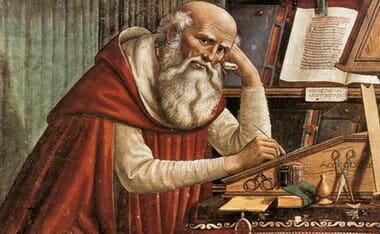
Taking Physicist Stephen Barr to Task Over St. Augustine
(Originally posted in February of 2011 – refreshed in 2015 – Updated in 2021)
In a recent interview by Dinesh D’Souza (President of Kings College at the time, as well as being a favorite author of mine) of physicist Stephen Barr (Professor of Particle Physics at the Bartol Research Institute and the Department of Physics and Astronomy at the University of Delaware). What was otherwise a good interview and overview of philosophical naturalism’s metaphysical positions in contradistinction to true science and religion’s metaphysical outlook, took a historical turn for the worse when Augustine was used as defense in the “old-earth/young-earth” debate.
(Thank you for Uncommon Descent’s link to my story!)
In this next portion you will hear the portion of the interview I wish to weigh in on. We pick up the conversation as it happens coming in from the break:
The problem with Dr. Barr’s summation is that he has failed to take into account that people’s views on matters change over time. (This wasn’t intentional… we are finite beings and cannot know all things to bring to bare in conversation.) For instance, R.C. Sproul (evangelical scholar, professor, and President of Ligonier Ministries) mentioned that through most of his teaching career he accepted the old-age position. However, late in his career he changed his position to that of the young earth creationists.
For most of my teaching career, I considered the framework hypothesis to be a possibility. But I have now changed my mind. I now hold to a literal six-day creation, the fourth alternative and the traditional one. Genesis says that God created the universe and everything in it in six twenty-four–hour periods. According to the Reformation hermeneutic, the first option is to follow the plain sense of the text. One must do a great deal of hermeneutical gymnastics to escape the plain meaning of Genesis 1–2. The confession makes it a point of faith that God created the world in the space of six days. [emphasis in original, indicating these words are part of the Confession] (pp. 127–128).[1]
ST. AUGUSTINE (PART 1)
Similarly, Augustine, early in his life, was very allegorical[2] in his attempt to interpret and define Scripture and events in it. Later however, he changed his position in much the same way Dr. Sproul did. Therefore, to quote Sproul or Augustine as old-earth creationists supporting the views of professor Barr would not do the position justice.

As his theology matured, Augustine abandoned his earlier allegorizations of Genesis that old-earth creationists and theistic evolutionists have latched onto in an attempt to justify adding deep time to the Bible. Furthermore, he always believed in a young earth (painting by Sandro Botticelli, c. 1480)
An example of Augustine’s allegorical uses comes from the journal Church History by way of Mervin Monroe Deems (Ph.D., past Samuel Harris Lecturer on Literature and Life at Bangor Theological Seminary, Maine) in which he points out Augustine’s use of allegory in interpreting “paradise” in Genesis:
But let us get back to the Paradise of Genesis. As Augustine put it, “. .. some allegorize all that concerns Paradise itself”: the four rivers are the four virtues; the trees, all knowledge, and so on. But to Augustine these things are better connected with Christ and his Church. Thus, Paradise is the Church; the four rivers, the four gospels; the fruit-trees, the saints; the tree of life, Christ; and the tree of knowledge, one’s free choice. And he closes the paragraph thus:
These and similar allegorical interpretations may be suitably put upon Paradise without giving offense to anyone, while yet we believe the strict truth of the history, confirmed by its circumstantial narrative of facts.[3]
To put this closing remark in slightly updated English, it reads as follows:
No one should object to such reflections and others even more appropriate that might be made concerning the allegorical interpretation of the Garden of Eden, so long as we believe in the historical truth manifest in the faithful narrative of these events.[4]
To be clear, Augustine was still holding to the literal meaning in the Genesis narrative even during his use of allegory in rendering extra meaning to the idea of paradise in Genesis. Again, professor Deems:
Augustine’s approach to the scriptures was gradual. At the time that he came across the Hortensius he turned to the Scriptures, only to turn away again, for in his estimation they could not compare with the writings of Cicero. Later at Milan following the advice of Ambrose he started to read Isaiah but found this too difficult and turned to the Psalms. The period of retirement and the months immediately following, which produced the philosophic treatises, were devoted to the classics rather than to the Bible. But increasingly Augustine studied and meditated upon the Scriptures, with the result that his writings are filled with Scriptural quotation and references…. The use of allegory by Augustine was not only a means of making Scripture say something, it was also a technique for bringing Scripture down to date, by forcing ancient words to minister, through prophecy, to the weaving of present patterns of behavior or through the summoning to higher ideals. But it was also dangerous for it came close to making Scripture say what he wanted it to say (through multiplicity of allegories of identical Scripture), and it prepared the way for Catholic or Protestant, later, to find in Scripture what he would.[5]
And this is key, as Professor Benno Zuiddam (Benno Zuiddam is research professor [extraordinary associate] for New Testament Studies, Greek and Church History at the faculty of Divinity at North West University, Potchefstroom, South Africa) points out,
As Augustine became older, he gave greater emphasis to the underlying historicity and necessity of a literal interpretation of Scripture. His most important work is De Genesi ad litteram. The title says it: On the Necessity of Taking Genesis Literally. In this later work of his, Augustine says farewell to his earlier allegorical and typological exegesis of parts of Genesis and calls his readers back to the Bible. He even rejected allegory when he deals with the historicity and geographic locality of Paradise on earth.[6]
The professor points out as well that from Augustine’s City of God, we can begin to see this literalism in the evolution of his responses to pagans. Dr. Zuiddam asks:
3) Isn’t it obvious from his City of God (De Civitate Dei) that Augustine believed that God created Man 6000 years ago?
Not quite, but a young earth definitely. Augustine wrote in De Civitate Dei that his view of the chronology of the world and the Bible led him to believe that Creation took place around 5600 BC [Ed. note: he used the somewhat inflated Septuagint chronology—see Biblical chronogenealogies for more information.]. One of the chapters in his City of God bears the title “On the mistaken view of history that ascribes many thousands of years to the age of the earth.” Would you like it clearer? Several pagan philosophers at the time believed that the earth was more or less eternal. Countless ages had preceded us, with many more to come. Augustine said they were wrong. This goes to show that theistic evolutionists who call in Augustine’s support do so totally out of context. All they allow themselves to see is his symbolic use of “day” in Genesis, and a very difficult philosophical doctrine of creation with ideas that develop. “Wonderful!” they think, “Augustine really supports our post-Darwinian theories!” It takes a superficial view of Genesis and Augustine to arrive at such conclusions. His instant creation, his young earth and immediate formation of Adam and Eve rule out Augustine’s application for this purpose.[7]
An example of this can be seen here with Augustine himself saying:
“They are also still being led astray by some false writings according to their claim to the history of the times many thousands of years to take, as we do from the Bible to calculate that since the creation of man, not quite six thousand years have expired ” (XII, 11).[8]
Non-literalist Professor James Barr (Professor of Hebrew Bible at Vanderbilt University and former Regius Professor of Hebrew at Oxford University in England) in a letter to David C.C. Watson, 23 April 1984 wrote this:
Probably, so far as I know, there is no professor of Hebrew or Old Testament at any world-class university who does not believe that the writer(s) of Genesis 1-11 intended to convey to their readers the ideas that (a) creation took place in a series of six days which were the same as the days of 24 hours we now experience; . . . Or, to put it negatively, the apologetic arguments which suppose the “days” of creation to be long eras of time, the figures of years not to be chronological, and the flood to be a merely local Mesopotamian flood, are not taken seriously by any such professors, as far as I know.[9]
As one can see from here and following the links to the larger articles, Dr. Stephen Barr may want to revise his position on some of the church fathers and their views in regards to the age of the earth and hence creation. A good resource for reading their thoughts on the matter — the early church fathers that is — can be FOUND HERE.
[1] Tas Walker, “Famous evangelical apologist changes his mind: RC Sproul says he is now a six-day, young-earth creationist,” Creation Ministries International, published May 21st, 2008, found at URL:
http://creation.com/famous-evangelical-apologist-changes-his-mind-rc-sproul
[2] Allegory:
Allegory is primarily a method of reading a text by assuming that its literal sense conceals a hidden meaning, to be deciphered by using a particular hermeneutical key. In a secondary sense, the word “allegory” is also used to refer to a type of literature that is expressly intended to be read in this nonliteral way. John Bunyan’s Pilgrim’s Progress is a well-known example of allegorical literature, but it is doubtful whether any part of the Bible can be regarded as such. The parables of Jesus come closest, but they are not allegories in the true sense. The apostle Paul actually used the word allegoria, but arguably this was to describe what would nowadays be called “typology” (Gal. 4:24). The difference between typology and allegory is that the former attaches additional meaning to a text that is accepted as having a valid meaning in the “literal” sense, whereas the latter ignores the literal sense and may deny its usefulness altogether. Paul never questioned the historical accuracy of the Genesis accounts of Hagar and Sarah, even though he regarded them as having an additional, spiritual meaning as well. Other interpreters, however, were often embarrassed by anthropomorphic accounts of God in the Bible, and sought to explain away such language by saying that it is purely symbolic, with no literal meaning at all. It is in this latter sense that the word “allegory” is generally used today.
Kevin J. Vanhoozer, Gen Ed., Dictionary for Theological Interpretation of the Bible, Grand Rapids, MI: Baker Books, 2005), cf. Allegory, 34-35.
[3] Mervin Monroe Deems, “Augustine’s Use of Scripture,” Church History Vol. 14, No. 3 (Sep., 1945), 196. Published by: Cambridge University Press on behalf of the American Society of Church History (Stable URL: http://www.jstor.org/stable/3160307) (emphasis added).
[4] Saint Augustine, City of God (New York, NY: Image Books, 1958), 288; or, Book XIII, 21 (emphasis added).
[5] Mervin Monroe Deems, “Augustine’s Use of Scripture,” Church History Vol. 14, No. 3 (Sep., 1945), 188-189 (emphasis added).
[6] Benno Zuiddam, “Augustine: young earth creationist — [How] theistic evolutionists take Church Father out of context,” Creation Ministries International, published October 8th, 2009, found at URL (emphasis added):
http://creation.com/augustine-young-earth-creationist
[7] Ibid.
[8] Benno Zuiddam, “Adjust the lighting was dark,” Reformatorisch Dagblad (Reformed Daily), published April 15th, 2009, found at URL:
http://www.refdag.nl/nieuws/pas_met_de_verlichting_werd_het_donker_1_324668
(will need Google to translate).
[9] Henry Morris, “The Literal Week of Creation,” ICR, found at URL:
...POSTSCRIPT
May I remind those who may not understand this critique that it [the critique] has nothing to do with said physicists faith. This is merely a challenge to his understanding of a historical figure and where he [Stephen Barr] separates his understanding of Augustine and what Augustine believed. We know Augustine, from his later writings specifically, rejected the spiritualistic aspect he once placed on the Genesis account and accepted the plain understanding as paramount. This critique neither places young-earth creationism as a litmus test for faith or some standard one must reach to be “holier” than thee. One may wish to read my footnote #18 to understand my position on this.
THREE OLD EARTH CHURCH FATHERS
This is an update to respond not in the intended spirit of unity in the Body of Christ – but in response to the misinformation that CONTINUES to permeate this debate. The article posted in an Apologetics group on Facebook was this one:
The short answer is “yes,” when good church history is shared within the debate. When bad points of history are inserted into the debate, a pause and reflection and secondary debate needs to be undertaken. (you can enlarge the picture below by clicking it. It is just to show I have the books some of the following quotes are coming from.)
ST. AUGUSTINE (Part 2)
ANSWERS IN GENESIS notes the following, “[Augustine] believed that God created everything in an instant and that He described it for us as being completed in six normal days for the sake of our understanding.” They continue with the quote:
Perhaps we ought not to think of these creatures at the moment they were produced as subject to the processes of nature which we now observe in them, but rather as under the wonderful and unutterable power of the Wisdom of God, which reaches from end to end mightily and governs all graciously. For this power of Divine Wisdom does not reach by stages or arrive by steps. It was just as easy, then, for God to create everything as it is for Wisdom to exercise this mighty power. For through Wisdom all things were made, and the motion we now see in creatures, measured by the lapse of time, as each one fulfills its proper function, comes to creatures from those causal reasons implanted in them, which God scattered as seeds at the moment of creation when He spoke and they were made, He commanded and they were created. Creation, therefore, did not take place slowly in order that a slow development might be implanted in those things that are slow by nature; nor were the ages established at plodding pace at which they now pass. Time brings about the development of these creatures according to the laws of their numbers, but there was no passage of time when they received these laws at creation.
Augustine, The Literal Meaning of Genesis, Vol 1, translated by John Hammond Taylor (New York, N.Y.: Paulist Press, 1982), 141-142.
Continuing, AIG notes:
- “Augustine believed the genealogies given in Genesis to be literal chronologies and that the pre-Flood patriarchs lived to be around 900 years” — The City of God, Book 15, Chapters 11–12 (read here)
- He also stated, “Unbelievers are also deceived by false documents which ascribe to history many thousand years, although we can calculate from Sacred Scripture that not 6,000 years have passed since the creation of man” — Augustine, The City of God, translated by G. G. Walsh and G. Monahan (1952), Book 12, Chapter 11, p. 263. Washington, D.C.: Catholic University of America Press.
One summary of Augustine’s work the writer comments: “Interestingly, Augustine supports a young earth or at least a young humanity view, believing man was created 5000 years previously” (Whole Reason – scroll down to 4 Books 11-14: The Origins of the City of God)
One must remember that Augustine believed, wrongly, that all six days of creation happened on one day. But he did not ascribe long ages before or after that, that we know. Don Batten adds to this thought: “Even Augustine cannot remotely be used in support of old-earth beliefs. Even though he allegorized the Days of Creation (and lots of other passages—he was no Hebrew scholar), he tried to compress the days into an instant, which is diametrically opposite to what long-agers claim!”
In another critique of James Mook’s chapter in the young earth creationist book, Coming to Grips with Genesis: Biblical Authority and the Age of the Earth, Dr. John Millam admits the following:
- By my own research, none of the fathers taught an old earth.
And Dr William Dembski opines as well:
- Let me concede that young earth creationism was largely the position of the church from the Church Fathers through the Reformers
THOMAS AQUINAS
WORKING ON UPDATE

Tough Questions Christians Face (Ligonier Ministries) Q&A session 1 & 2
Carts vs. Ferrari’s~Theology in the Fast Lane
- 3 of 3
- « Previous
- 1
- 2
- 3