- “If total depravity were defined only as humans are sinners in need of God’s grace in Christ, then doctrinal differences would not emerge” (page 40, page 20 of this PDF);
- “I also argued for total depravity as the inability to save oneself rather than the inability to repent and believe in Jesus” (page 48 of book, page 27 in this PDF)
Harwood, Adam. “A Critique of Total Depravity.” In Calvinism: A Biblical and Theological Critique, edited by David L. Allen and Steve W. Lemke, 15–48. Nashville: B&H Academic, 2022.
Total Depravity: Inability to Save Oneself vs. Inability to Believe
One of the fundamental disagreements between Calvinism and non-Calvinistic theology concerns the doctrine of Total Depravity. Both sides affirm that humanity is fallen, sinful by nature, and in need of God’s grace for salvation. However, they disagree over precisely what man’s fallen condition prevents him from doing.
The disagreement is not simply whether man is a sinner. It is whether man’s sinful condition renders him incapable of responding to God’s gracious invitation to repent and believe in Jesus Christ until he has first been regenerated.
This distinction is addressed directly by Adam Harwood in Chapter One, “A Critique of Total Depravity,” in Calvinism: A Biblical and Theological Critique (2022).
1. ADAM HARWOOD: TOTAL DEPRAVITY AS THE INABILITY TO SAVE ONESELF
Harwood challenges the Calvinistic definition of Total Depravity when it is extended to include Total Inability.
He writes:
“If total depravity were defined only as humans are sinners in need of God’s grace in Christ, then doctrinal differences would not emerge.”¹
Harwood recognizes that humanity is sinful and incapable of saving itself. However, he disputes the additional Calvinistic assertion that fallen humanity is incapable of repenting and believing in Christ unless God first regenerates the individual.
He summarizes his position in the conclusion of his chapter:
“I also argued for total depravity as the inability to save oneself rather than the inability to repent and believe in Jesus.”²
In other words, man cannot save himself, earn salvation, or establish righteousness before God through his own works. Salvation is entirely dependent upon God’s grace through Jesus Christ.
However, Harwood does not believe that man’s fallen condition makes him incapable of responding to God’s gracious invitation through repentance and faith.
2. THE REFORMED CALVINIST POSITION: TOTAL DEPRAVITY AS TOTAL INABILITY
Traditional Reformed Calvinism goes further than simply affirming that man is sinful and unable to save himself. It teaches that fallen man is spiritually dead, hostile toward God, and incapable of exercising saving faith unless God first regenerates him.
This position is commonly described as Total Inability or Total Spiritual Inability. Two historical Reformed confessions illustrate this position.
A. Westminster Confession of Faith (1647), Chapter 9, Section 3
The Westminster Confession states:
“Man, by his fall into a state of sin, hath wholly lost all ability of will to any spiritual good accompanying salvation: so as a natural man, being altogether averse from that good, and dead in sin, is not able, by his own strength, to convert himself, or to prepare himself thereunto.”
Notice the language: man has lost all ability of will to any spiritual good accompanying salvation.
This goes beyond saying that man cannot save himself. It describes an inability to exercise the will toward spiritual good associated with salvation.
B. Canons of Dort (1618–1619), Third and Fourth Heads, Article 3
The Canons of Dort describe fallen humanity this way:
“Without the grace of the regenerating Holy Spirit they are neither willing nor able to return to God, to reform their distorted nature, or even to dispose themselves to such reform.”
The important expression is “the grace of the regenerating Holy Spirit.”
According to this formulation, regeneration is necessary before the sinner can return to God. The Calvinist position is therefore not merely that man needs God’s grace to be saved. It is that God’s regenerating work must first occur before man can exercise saving faith.
3. REGENERATION BEFORE FAITH: THE CENTRAL CALVINIST DISTINCTION
Adam Harwood cites several prominent Reformed theologians to demonstrate this position.
John Piper writes:
“Faith is the evidence of new birth, not the cause of it.”
R. C. Sproul explains:
“We do not believe in order to be born again; we are born again in order to believe.”
These statements express a central teaching of Reformed soteriology:
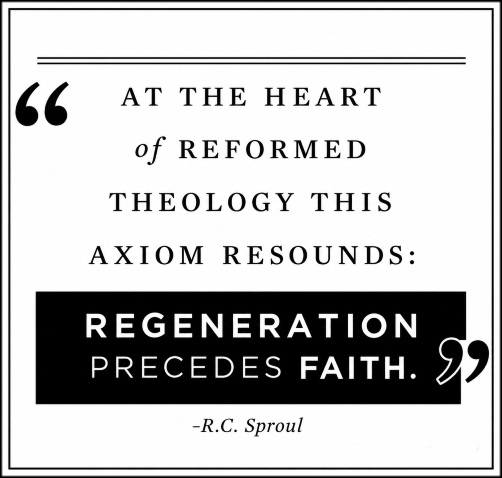
In the Calvinistic understanding, the Holy Spirit first regenerates the spiritually dead sinner. The newly regenerated individual then exercises repentance and faith.
Harwood discusses these statements in Chapter One, pages 42–43.³
This is where the disagreement becomes particularly significant. The question is not whether God’s grace is necessary. Both sides affirm that it is. The question is whether regeneration must occur before a person can believe, or whether a sinner can respond to God’s gracious call through repentance and faith and thereby receive salvation.
4. COMPARING THE TWO POSITIONS
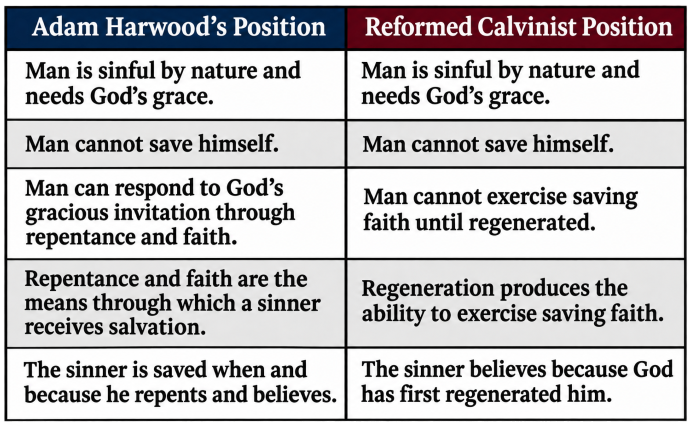
The fundamental disagreement is therefore not over whether man is depraved. It concerns the extent and implications of that depravity.
5. AN IMPORTANT QUALIFICATION:
DOES TOTAL DEPRAVITY MEAN MAN CAN DO NOTHING GOOD?
There is an important distinction that needs to be made when discussing Total Depravity. Total Depravity does not mean Absolute Depravity. It does not mean that every unbeliever is as wicked as he could possibly be, that every action he performs is evil, or that he is incapable of recognizing and choosing between good and evil.
Through Adam’s Fall, humanity inherited a sinful nature. Sin has affected every aspect of man’s being, including his mind, desires, conscience, and will. Man is inclined toward sin, separated from God, and incapable of saving himself, earning righteousness, or overcoming his fallen condition through his own efforts.
However, the fact that man’s entire nature has been affected by sin does not mean that he has lost every capacity for moral judgment or every ability to make choices contrary to his sinful inclinations.
An unbeliever can demonstrate kindness, compassion, generosity, charity, courage, and concern for others. He can feed the hungry, help someone in distress, care for his family, and perform actions that are genuinely beneficial to other people. These actions do not establish spiritual righteousness before God or earn salvation, but neither should they be dismissed as though an unbeliever is incapable of doing anything beneficial or morally commendable.
The distinction is between outward moral goodness and spiritual righteousness before God. An action can be genuinely beneficial to another human being without earning salvation or establishing a right standing with God.
But there is another important consideration: man’s ability to respond to God does not originate in an independent or unassisted human will. It originates in God’s grace.
God’s Grace Enablements
Although fallen humanity does not naturally seek God (Romans 3:11), God has graciously provided the means by which individuals can genuinely respond to His offer of salvation.
These grace enablements include, but are not limited to:
- God’s salvific love for all humanity: John 3:16.
- The manifestation of God’s power and sovereignty: Isaiah 45:21–22; Romans 1:18–20.
- Christ’s provision for the sins of the world: John 1:29.
- The conviction of the Holy Spirit: John 16:7–11.
- The working of the Holy Spirit: Hebrews 6:1–6.
- The enlightening ministry of the Son: John 1:9.
- God’s teaching: John 6:45.
- God opening minds and hearts: Luke 24:45; Acts 16:14; 26:17–18.
- The power of the gospel: Romans 1:16.
- God’s providential workings: People, circumstances, opportunities, and events through which individuals encounter the truth.
These provisions are grace enablements because they originate in God, are undeserved by humanity, and provide the means through which people can genuinely respond to His offer of salvation.
This is an essential distinction:
Man does not possess an autonomous ability to overcome his fallen nature and independently seek God. God must graciously enable him to respond.
Scripture makes clear that no one comes to the Father unless drawn by Him (John 6:44). Yet Jesus also declares:
“And I, if I be lifted up from the earth, will draw all men unto me.” (John 12:32)
God’s gracious initiative is not absent from the non-Calvinistic understanding of salvation. Rather, it is central to it. God calls, draws, convicts, enlightens, teaches, and opens hearts. Through these gracious provisions, individuals can seek and find Him (Jeremiah 29:13; Acts 17:11–12).
The question, therefore, is not whether man needs God’s grace to respond. He absolutely does. The question is whether God’s enabling grace makes a genuine response of repentance and faith possible for fallen humanity, or whether God must first regenerate an individual before that person can believe.
Grace-Enabled Faith: The Means of Receiving Salvation
The gospel is freely offered, but God has sovereignly established that its benefits are received through faith.
Faith is not a meritorious work, an independent human achievement, or something that obligates God to save. Rather, it is the God-appointed means through which a sinner receives His gracious gift of salvation (Ephesians 2:8–9).
Faith is the means of receiving salvation,
not the merit or reason for which salvation is granted.
This distinction is fundamental.
God is the source of salvation, Jesus Christ is its provision, the Holy Spirit works to convict and draw sinners, and faith is the means through which the individual receives the offered gift. In this understanding, regeneration does not have to precede faith. Rather, God graciously enables the sinner to respond through faith, and the sinner is regenerated and saved when and because he believes in Jesus Christ (John 1:12; Acts 16:31; Ephesians 1:13).
This does not diminish God’s sovereignty or make Him dependent upon human decisions. It recognizes that God sovereignly established salvation through Christ and determined that its benefits would be received through grace-enabled faith.
The Actual Point of Disagreement
The distinction between these positions should now be clear.
Reformed Calvinism: Man is fallen, spiritually dead, and incapable of exercising saving faith until God first regenerates him. The Holy Spirit must first change his heart, giving him the ability and disposition to believe.
The grace-enabled response position: Man is fallen, sinful by nature, and incapable of saving himself. However, God graciously provides the necessary enablements for him to respond to the gospel through repentance and faith. Regeneration follows that response rather than preceding it.
The disagreement is not whether man is depraved, whether he needs God’s grace, or whether salvation is entirely dependent upon Christ. Both positions affirm those truths.
The disagreement is whether man’s inherited sinful condition makes him incapable of believing the gospel until he has first been regenerated.
Man is a sinner by nature, but his sinful nature does not mean that he is incapable of responding to God’s gracious invitation. His ability to respond is itself dependent upon the grace and enablement of God.
That is the distinction between affirming man’s total depravity and insisting upon total inability.
6. The Biblical Question: What Does God Require of Fallen Man? 6,7
Consider the following passages:
John 3:16
“For God so loved the world, that he gave his only begotten Son, that whosoever believeth in him should not perish, but have everlasting life.”
John 3:18
“He that believeth on him is not condemned: but he that believeth not is condemned already.”
Acts 17:30
“God … now commandeth all men every where to repent.”
Acts 16:31
“Believe on the Lord Jesus Christ, and thou shalt be saved.”
Romans 10:9
“That if thou shalt confess with thy mouth the Lord Jesus, and shalt believe in thine heart that God hath raised him from the dead, thou shalt be saved.”
Ephesians 2:8–9
“For by grace are ye saved through faith; and that not of yourselves: it is the gift of God: Not of works, lest any man should boast.”
These passages establish the necessity of God’s grace, the universal call to repentance, and salvation through faith rather than human works.
- ONE CONDITION. About 115 passages condition salvation on believing alone, and about 35 simply on faith. There are certain things, however, often added by man to this one and only condition, like the following: believe and repent, believe and be baptized, believe and confess sin, believe and confess Christ publicly, believe and promise a better manner of life, believe and pray for salvation.
Lewis Sperry Chafer, Systematic Theology, vol. VII, (Grand Rapids, MI: Kregal Publications, 1976), 273-274.
The interpretive question is whether the commands and invitations to repent and believe presuppose an ability supplied through God’s gracious work, or whether they can only be obeyed after an individual has first been regenerated.
That is the theological question Harwood is challenging.
Conclusion: What Exactly Does Total Depravity Mean?
Both positions affirm that man is fallen, sinful by nature, and incapable of saving himself.
But they differ substantially in their understanding of man’s spiritual inability.
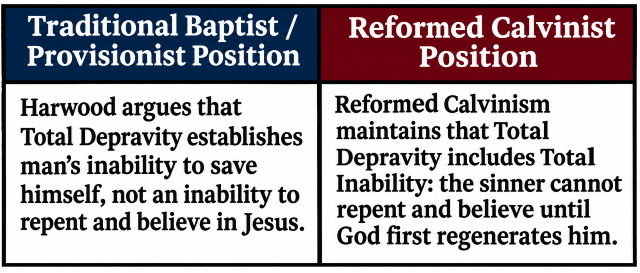
This is not a minor distinction. It affects how we understand the new birth, the work of the Holy Spirit, the nature of saving faith, and the relationship between God’s grace and man’s response to the gospel.
The central question remains:
Does man’s fallen nature make him incapable of saving himself, or does it also make him incapable of believing the gospel until he has first been regenerated?
That is the disagreement at the heart of this debate.
Sources and References
- Adam Harwood, “A Critique of Total Depravity,” in Calvinism: A Biblical and Theological Critique, ed. David L. Allen and Steve W. Lemke (Nashville: B&H Academic, 2022), 40.
- Harwood, “A Critique of Total Depravity,” 48.
- Harwood, “A Critique of Total Depravity,” 42–43.
- The Westminster Confession of Faith (1647), chap. 9, sec. 3.
- The Canons of Dort (1618–1619), Third and Fourth Heads of Doctrine, art. 3.
- Laurence M. Vance, The Other Side of Calvinism. Rev. ed. (Pensacola, FL: Vance Publications, 1999).
- Papa Giorgio, “Never Does the Bible Say, ‘Be Saved in Order to Believe,’” Religio-Political Talk, February 6, 2026, updated March 12, 2026.
FURTHER READING:
Adam Harwood, “A Critique of Total Depravity,” Chapter One, in Calvinism: A Biblical and Theological Critique, pages 15–48. READ CHAPTER ONE (PDF)