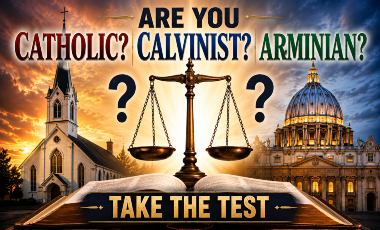
This is from Tom Stegall’s book, “Must Faith Endure for Salvation to Be Sure?
Instructions: For each quotation, identify the theological tradition you think the writer represents:
- C — Calvinist
- A — Arminian
- RC — Roman Catholic
TEST PDF
THE TEST
1.
“There is no valid assurance of election and final salvation for any man, apart from deliberate perseverance in faith.”
Your answer: _______
2.
“The only evidence of election is . . . the production of holiness. And the only evidence of the genuineness of this call and the certainty of our perseverance, is a patient continuance in well-doing.”
Your answer: _______
3.
“There is no cleansing from sin, and no salvation, without a continual walking in God’s light.”
Your answer: _______
4.
“Let us not then take refuge in our sloth or encouragement in our lust from the abused doctrine of the security of the believer. But let us . . . recognize that we may entertain the faith of our security in Christ only as we persevere in faith and holiness to the end.”
Your answer: _______
5.
“The Scriptures repeatedly exhort us to persevere, to ‘hang in there.’ It is only the one who endures to the end who will be saved.”
Your answer: _______
6.
“Endurance in faith is a condition for future salvation. Only those who endure in faith will be saved for eternity.”
Your answer: _______
7.
“Believing in Jesus Christ and in the One who sent him for our salvation is necessary for obtaining that salvation. . . . therefore without faith no one has ever attained justification, nor will anyone obtain eternal life ‘but he who endures to the end.’”
Your answer: _______
8.
“Let us hear the conclusion of the whole matter: Objectively, the elect will persevere, and they who persevere are elect. Subjectively, the individual is elect only as he perseveres.”
Your answer: _______
9.
“We can never know that we are elected of God to eternal life except by manifesting in our lives the fruits of election—faith and virtue, knowledge and temperance, patience and godliness, love of brethren. . . . It is idle to seek assurance of election outside of holiness of life.”
Your answer: _______
10.
“And since, without faith, it is impossible to please God, and to attain to the fellowship of his children, therefore without faith no one has ever attained justification, nor will any one obtain eternal life unless he shall have persevered in faith unto the end.”
Your answer: _______
11.
“Holiness in this life is such a part of our ‘salvation’ that it is a necessary means to make us meet to be partakers of the inheritance of the saints in heavenly light and glory.”
Your answer: _______
12.
“In like manner [God] could cause His people to grow in grace, make them fruitful unto every good work, and preserve them from everything injurious to their welfare, without requiring any industry and diligence on their part; but it has not so pleased Him to dispense with their concurrence. Accordingly we find Him bidding them ‘Work out your own salvation with fear and trembling’ (Phil. 2:12), ‘Labour therefore to enter into that rest, lest any man fall after the same example of unbelief’ (Heb. 4:11).”
Your answer: _______
13.
“As the believer’s salvation is received, not by an act of righteousness but by an act of faith, so the believer’s salvation is maintained, not by acts of righteousness but by a life of faith. . . . his security is never in doubt as long as his faith in Christ is steadfast, for he is kept by faith.”
Your answer: _______
14.
“Furthermore, we are protected through faith. Our continued faith in Christ is the instrument of God’s sustaining work. God didn’t save us apart from faith, and He doesn’t keep us apart from faith. . . . It is our faith. We believe. We remain steadfast. We are not passive in the process. The means by which God maintains our faith involves our full participation.”
Your answer: _______
15.
“Having stressed the sovereignty and grace of God, it is also imperative to bring the free will and responsibility of the believer into focus. God does not withdraw the power of choice from the person who believes. By the exercise of free will the believer becomes a child of God, and by the continued exercise of free will he remains a child of God. To keep on believing is the believer’s responsibility.”
Your answer: _______
16.
“The saints are ‘kept by the power of God through faith’ (1 Pet. 1:5). He does not deal with them as unaccountable automatons, but as moral agents, just as their natural life is maintained through their use of means and by their avoidance of that which is inimical to their wellbeing, so it is with the maintenance and preservation of their spiritual lives. God preserves His people in this world through their perseverance—their use of means and avoidance of what is destructive.”
Your answer: _______
17.
“[A]lthough the Bible tells us that we are kept by the grace of God, it does not encourage the idea that God keeps us without constant watchfulness, diligence, and prayer on our part.”
Your answer: _______
18.
“Just as the Bible teaches God’s protection and preservation of His people, it is equally emphatic that only those will be saved who endure to the end, abide in Christ and his Word, and continue in the faith (please read Matt 24:13; John 8:31; John 15:6; 1 Cor 15:1, 2; Col 1:22, 23).”
Your answer: _______
19.
“Saving faith is no simple thing. It has many dimensions. ‘Believe on the Lord Jesus’ is a massive command. It contains a hundred other things. Unless we see this, the array of conditions for salvation in the New Testament will be utterly perplexing.”
Your answer: _______
20.
“The New Testament clearly teaches that bare faith cannot save and that works are necessary for final justification or final salvation.”
Your answer: _______
21.
“Jesus taught salvation to be conditional upon a man denying himself, and taking up his cross, and following Him continuously. . . . True faith reveals itself in continual obedience to Christ’s conditions for salvation.”
Your answer: _______
22.
“It means we obey his commands. It means we are always prayerful, embedded in Christian community, worshiping Jesus in all of life, and living on mission with him every day. In the absence of all this, no one can be assured of salvation.”
Your answer: _______
23.
“These are just some of the conditions that the New Testament says we must meet in order to inherit final salvation. We must believe on Jesus and receive him and turn from our sin and obey him and humble ourselves like little children and love him more than we love our family, our possessions or our own life. This is what it means to be converted to Christ. This alone is the way of life everlasting.”
Your answer: _______
24.
“There is a marked theme in [Jesus’] teachings regarding people who say they believe, or who believe only for a little while, but whose works are false, missing, or incomplete. It is these who are lost. These teachings warn us that people are damned not merely for lack of faith, per se, but for not following through with their faith, i.e., for not doing works of obedience. But most importantly, not once does Jesus say or teach that someone can be eternally saved by a one-time act of faith.”
Your answer: _______
25.
“Salvation for sinners cost God His own Son; it cost God’s Son His life, and it’ll cost you the same thing. Salvation isn’t the result of an intellectual exercise. It comes from a life lived in obedience and service to Christ as revealed in the Scripture; it’s the fruit of actions, not intentions.”
Your answer: _______
26.
“Divine preservation always presupposes human perseverance. Perseverance proves faith’s genuine character, and is therefore indispensable to salvation. To be sure, no one can continue in the faith in his own strength (John 15:5). The enabling grace of God is needed from start to finish (Phil. 2:12, 13). This, however, does not cancel human responsibility and activity. Yes, activity, continuous, sustained, strenuous effort (Heb. 12:14).”
Your answer: _______
27.
“We have seen that God’s salvation covenant is a Continuing Covenant. And it is a monstrous deception to teach that the continual sinner will be saved by a continuing covenant that demands his continual obedience.”
Your answer: _______
28.
“Holiness, which is defined by love of God and neighbor, is usually something that is seen by others rather than by us. Nevertheless, it is the indispensable condition of our glorification: no one will be seated at the heavenly banquet who has not begun, however imperfectly, in new obedience.”
Your answer: _______
29.
“We cannot ‘earn’ our salvation through good works, but our faith in Christ puts us in a special grace-filled relationship with God so that our obedience and love, combined with our faith, will be rewarded with eternal life.”
Your answer: _______
30.
“[Christians] are to refrain from speaking evil and from guile so that they will obtain the eschatological reward, eternal life itself. We must insist again that such a theology is not works righteousness, nor does it compromise the theme that salvation is by grace. Peter believed that those who have received new life from God will live transformed lives and that such lives provide evidence (necessary evidence!) that they have been converted.”
Your answer: _______
31.
“There is a deadly and damnable heresy being widely propagated today to the effect that, if a sinner truly accepts Christ as his personal Saviour, no matter how he lives afterwards, he cannot perish. That is a satanic lie, for it is at direct variance with the teaching of the Word of truth. Something more than believing in Christ is necessary to ensure the soul’s reaching heaven.”
Your answer: _______
ANSWER KEY
# Classification Author / Source
- Arminian Robert Shank, Life in the Son
- Calvinist Charles Hodge, Commentary on Romans
- Arminian Guy Duty, If Ye Continue
- Calvinist John Murray, Redemption—Accomplished and Applied
- Roman Catholic Joseph Kindel, What Must I Do to be Saved?
- Calvinist R. C. Sproul, Grace Unknown
- Roman Catholic Catechism of the Catholic Church
- Arminian Robert Shank, Life in the Son
- Calvinist Benjamin B. Warfield, quoted by Lorraine Boettner
- Roman Catholic Vatican I, Dogmatic Constitution on the Catholic Faith
- Calvinist Walter Marshall, quoted by A. W. Pink
- Calvinist A. W. Pink, The Saint’s Perseverance
- Arminian Assemblies of God, The Security of the Believer
- Calvinist John MacArthur, Faith Works
- Arminian Assemblies of God, The Security of the Believer
- Calvinist A. W. Pink, The Saint’s Perseverance
- Calvinist Louis Berkhof, Systematic Theology
- Roman Catholic JustForCatholics.org
- Calvinist John Piper, Desiring God
- Calvinist Thomas R. Schreiner, Faith Alone
- Arminian Guy Duty, If Ye Continue
- Calvinist Sam Storms, Kept for Jesus
- Calvinist John Piper, Desiring God
- Roman Catholic Robert A. Sungenis, How Can I Get to Heaven?
- Calvinist John MacArthur, Hard to Believe
- Calvinist William Hendriksen, Exposition of Colossians and Philemon
- Arminian Guy Duty, If Ye Continue
- Calvinist Michael Horton, Introducing Covenant Theology
- Roman Catholic Pillar of Fire, Pillar of Truth
- Calvinist Thomas R. Schreiner, 1, 2 Peter, Jude
- Calvinist A. W. Pink, quoted by Iain H. Murray, The Life of Arthur W. Pink
TOTALS
- Calvinist: 19
- Arminian: 6
- Roman Catholic: 6
Total: 31
________________
Footnote
- Thomas L. Stegall, Must Faith Endure for Salvation to Be Sure? (Grace Gospel Press, 2016), 44–50, PDF. Online PDF