I am leading at a small group this next week, and this is my outline (PDF) for the group to read. What follows after that is an excerpt from a larger post I put up every Fourth of July.
On April 18, 1775, a British soldier ordered John Hancock and others to “disperse in the name of George the Sovereign King of England”; John Adams responded to him:
“We recognize no sovereign but God, and no king but Jesus!”
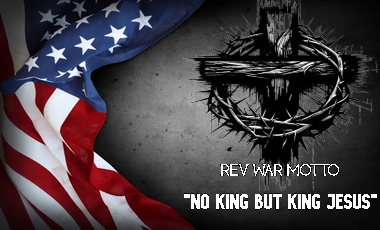
Most wars have a motto. The motto of World War II was “Remember Pearl Harbor.” The motto during the Texas war for independence was “Remember the Alamo.” The spiritual emphasis, directed towards King George III who violated God’s laws, gave rise to a motto during the American Revolution: “No King but King Jesus.” Many in the colonies used the phrase to reject the crown in conversation.
KING of the JEWS
- After Jesus was born in Bethlehem of Judea in the days of King Herod, wise men from the east arrived in Jerusalem, saying, “Where is he who has been born king of the Jews? For we saw his star at its rising and have come to worship him.” (Matthew 2:1-2a)
- Pilate also had a sign made and put on the cross. It said: Jesus of Nazareth, the King of the Jews. Many of the Jews read this sign, because the place where Jesus was crucified was near the city, and it was written in Aramaic, Latin, and Greek. So the chief priests of the Jews said to Pilate, “Don’t write, ‘The king of the Jews,’ but that he said, ‘I am the king of the Jews.’ ” Pilate replied, “What I have written, I have written.” (John 19:19-22)
So, for all time, there stands the truth of God that the Jews crucified their king! God has His way of mocking those who mock Him! In other words, God often fashions what is meant for evil and mockery and creates a good out of it to save those whom He loves: “You planned evil against me; God planned it for good to bring about the present result—the survival of many people” (Genesis 50:20)
At the beginning of the Passion week, the multitudes had cried, “Blessed is the King of Israel!” (John 12:13). Before Pilate, Christ himself bore witness to his “kingdom” (18:36–37). And now His royal title was affixed to His very “gallow.”
Zechariah 9:9 notes the humble form of transportation of the Savior: “… your King is coming to you; he is righteous and victorious, humble and riding on a donkey, on a colt, the foal of a donkey.”
This humble nature of the Sovereign of the Universe is noted in Philippians 2:6-8
PART 1 OF PHIL
… who, existing in the form of God, did not consider equality with God as something to be exploited. Instead, he emptied himself by assuming the form of a servant, taking on the likeness of humanity. And when he had come as a man, he humbled himself by becoming obedient to the point of death— even to death on a cross.
As well as in John 13:1-2; 4-8
Now before the Passover Festival, Jesus realized that his hour had come to leave this world and return to the Father. Having loved his own who were in the world, he loved them to the end. [….] Because Jesus knew that the Father had given everything into his control, that he had come from God, and that he was returning to God, therefore he got up from the table, removed his outer robe, and took a towel and fastened it around his waist. Then he poured some water into a basin and began to wash the disciples’ feet and to dry them with the towel that was tied around his waist.
Then he came to Simon Peter, who asked him, “Lord, are you going to wash my feet?”
Jesus answered him, “You do not realize now what I am doing, but later on you will understand.”
Peter told him, “You must never wash my feet!”
Jesus answered him, “Unless I wash you, you cannot be involved with me.”
This is another version [the original real story — I contend, told to Paul by the council in Jerusalem and rewritten under Devine guidance] of God disrobing divinity, and coming to die as ransom for us, like Philippians:
Many take the story [John 13:1-2; 4-8] as no more than a lesson in humility, quite overlooking the fact that, in that case, Jesus’ dialogue with Peter completely obscures its significance! But those words, spoken in the shadow of the cross, have to do with cleansing, that cleansing without which no one belongs to Christ, that cleansing which is given by the cross alone. As Hunter says, “The deeper meaning then is that there is no place in his fellowship for those who have not been cleansed by his atoning death. The episode dramatically symbolizes the truth enunciated in I John 1:7, ‘We are being cleansed from every sin by the blood of Jesus’.” *[1] * See my post for further notes on this verse: “The Totality of God’s Work at Calvary (Grace)” [1] Leon Morris, The Gospel according to John, The New International Commentary on the New Testament (Grand Rapids, MI: Wm. B. Eerdmans Publishing Co., 1995), 544–545.
In Revelation however, we see a shift – Jesus’ “ride” even got upgraded yo! [“yo” — by Josh Goertzen]
Then I saw heaven opened, and there was a white horse. Its rider is called Faithful and True, and with justice he judges and makes war. His eyes were like a fiery flame, and many crowns were on his head. He had a name written that no one knows except himself. He wore a robe dipped in blood, and his name is called the Word of God. The armies that were in heaven followed him on white horses, wearing pure white linen. A sharp sword came from his mouth, so that he might strike the nations with it. He will rule them with an iron rod. He will also trample the winepress of the fierce anger of God, the Almighty. And he has a name written on his robe and on his thigh: KING OF KINGS AND LORD OF LORDS. (Revelation 19:11-16).
This picture of a returning King is found in the 2nd half of that early church creedal statement we read in part via Philippians:
PART 2 OF PHIL
For this reason, God highly exalted him and gave him the name that is above every name, so that at the name of Jesus every knee will bow— in heaven and on earth and under the earth— and every tongue will confess that Jesus Christ is Lord, to the glory of God the Father. (2:9-11)
Psalm 2:6-9; 110:1-3 reads:
“I have installed my king on Zion, my holy mountain.” I will declare the LORD’s decree. He said to me, “You are my Son; today I have become your Father. Ask of me, and I will make the nations your inheritance and the ends of the earth your possession. You will break them with an iron scepter; you will shatter them like pottery.” [….] This is the declaration of the LORD to my Lord: “Sit at my right hand until I make your enemies your footstool.” The LORD will extend your mighty scepter from Zion. Rule over your surrounding enemies. Your people will volunteer on your day of battle. In holy splendor, from the womb of the dawn, the dew of your youth belongs to you.
Jeremiah 23:5-6 reads,
“Look, the days are coming”—this is the LORD’s declaration— “when I will raise up a Righteous Branch for David. He will reign wisely as king and administer justice and righteousness in the land. In his days Judah will be saved, and Israel will dwell securely. This is the name he will be called: The LORD Is Our Righteousness.
He who gives his testimony to all this says,
“Yes indeed! I am coming soon!”
So be it. Come, Lord Jesus!
In a book by C.S. Lewis called Prince Caspian, a girl named Lucy sees a lion named Aslan [representing Christ]. She hadn’t seen him in many years. He has changed; he is bigger.
“Aslan, you’re bigger,” she says. The lion can talk. He replies: “That is because you are older, little one.”
“Not because you are?”, she asks. “I am not. But every year you grow, you will find me bigger.”
So it is with Jesus in our lives. The more we trust him, the bigger he gets. Well, he doesn’t get bigger in a physical sense (Hebrews 13:8). But the more we know him, the bigger we know him to be.
In considering last week’s study on faithfulness and obedience….
QUESTIONS
- to whom are we being faithful to?
- A lowly humble figure or the Lion of Judah?
- Is this dichotomy better viewed as-a-whole to meet the needs of the Body of Christ [His subjects] in our fallen world?
- Our Healer and Counselor at times; and in others, the conquering King?
- Is this Ruler one whom we can be faithful in?
- When I say that I have faith in God, I mean that I place my trust in God based on what I know about him.[2] What do we know of our Messiah?
- Is He trusted by His words and deeds?
- We have a picture of a future ruler and King over a kingdom healed, how does Christ ruling from heaven NOW affect your understanding of your walk?
- Your growth?
- Your view of our promised land?
[2] “Certain words can mean very different things to different people. For instance, if I say to an atheist, ‘I have faith in God,’ the atheist assumes I mean that my belief in God has nothing to do with evidence. But this isn’t what I mean by faith at all. When I say that I have faith in God, I mean that I place my trust in God based on what I know about him.” — William A. Dembski and Michael R. Licona, Evidence for God: 50 Arguments for Faith from the Bible, History, Philosophy, and Science (Grand Rapids, MI: Baker Books, 2010), 38.

CORONATION OF THE SON (Psalm 2)
1 Why do the nations rage
and the peoples plot in vain?
2 The kings of the earth take their stand,
and the rulers conspire together
against the Lord and his Anointed One:
3 “Let’s tear off their chains
and throw their ropes off of us.”
4 The one enthroned in heaven laughs;
the Lord ridicules them.
5 Then he speaks to them in his anger
and terrifies them in his wrath:
6 “I have installed my king
on Zion, my holy mountain.”
7 I will declare the Lord’s decree.
He said to me, “You are my Son;
today I have become your Father.
8 Ask of me,
and I will make the nations your inheritance
and the ends of the earth your possession.
9 You will break them with an iron scepter;
you will shatter them like pottery.”
10 So now, kings, be wise;
receive instruction, you judges of the earth.
11 Serve the Lord with reverential awe
and rejoice with trembling.
12 Pay homage to the Son or he will be angry
and you will perish in your rebellion,
for his anger may ignite at any moment.
All who take refuge in him are happy.
MORE VIA PREVIOUS POST:
With thanks to the Heritage Foundation:
During the 1700s, Philadelphia was an unpleasant place in the summer. Malaria and yellow fever were rampant. There were no cures and no known ways to prevent infection. Most people of means tried to escape the city, if they could.
But in the scorching summer of 1776, scores of our country’s leading men remained behind closed doors in Philadelphia. They were kept there by their work. And what a monumental work it turned out to be.
The 56 leaders, representing all 13 British colonies, signed a declaration that would birth a great nation and illuminate the very future of humankind. It’s this Declaration of Independence that Americans celebrate each July 4.
The document’s first job was to officially announce to the world that all the colonies had decided to declare themselves free and independent states, absolved from any allegiance to Great Britain. That was momentous enough for the years ahead, since in order to make good on that declaration, the colonies would have to defeat the British in a war that stretched until 1783.
But the greater meaning of the Declaration — then as well as now — is as a statement of the conditions that underlie legitimate political authority and as an explanation of the proper ends of government.
The signers proclaimed that political power would spring from the sovereignty of the people, not a crowned hereditary monarch. This idea shook Europe to its very core.
The Declaration appealed not to any conventional law or political contract but to the equal rights possessed by all men and “the separate and equal station to which the Laws of Nature and nature’s God” entitled them.
What is revolutionary about the Declaration of Independence is not that a particular group of Americans declared their independence under particular circumstances. It’s that they did so by appealing to –and promising to base their particular government on — a universal standard of justice.
It is in this sense that Abraham Lincoln praised “the man who, in the concrete pressure of a struggle for national independence by a single people, had the coolness, forecast, and capacity to introduce into a merely revolutionary document, an abstract truth, applicable to all men and all times.”
Of course, it required another war to extend those rights to all Americans, but the fact that they were written down in the Declaration was crucial in 1865, in 1965 and remains so today as well.
“If the American Revolution had produced nothing but the Declaration of Independence,” wrote noted historian Samuel Eliot Morrison, “it would have been worthwhile.”
As Thomas Jefferson, lead author of the Declaration, put it in 1821, “The flames kindled on the 4th of July 1776, have spread over too much of the globe to be extinguished by the feeble engines of despotism; on the contrary, they will consume these engines and all who work them.”
Those flames, the flames of freedom and opportunity, continue to spread. That’s a truth worth celebrating on the Fourth — and all year ’round.

From, The Spirit of the American Revolution:
Even the Minutemen reflected strong religious involvement. While they are generally recognized for their exploits as a group, few today know many specifics about them. For example, these men who stood to fight for their liberties and defend their town were often groups of laymen from local congregations led either by their pastor or a deacon! Records even indicate that it was not unusual that following their militia drills they would go to church “where they listened to exhortation and prayer.”
The spiritual emphasis manifested so often by the Americans during the Revolution caused one Crown-appointed British governor to write to Great Britain complaining that:
If you ask an American who is his master, he’ll tell you he has none. And he has no governor but Jesus Christ.
Letters like this, coupled with statements like that delivered by Ethan Allen, and sermons like those preached by the Reverend Peter Powers (“Jesus Christ the King”), gave rise to a motto of the American Revolution. Most of us are unaware that the American Revolution even had a motto, but most wars do (e.g., World War II—”Remember Pearl Harbor”; the Texas’ war for independence—”Remember the Alamo”; etc.). The motto of the American Revolution was directed against King George III—considered the primary source of the conflict; for it was he who was arbitrarily, capriciously, and regularly violated “the laws of nature and of nature’s God.” The motto was very simple and very direct:
No King but King Jesus!
See also
Were the Founders Religious? Was America Founded to Be Secular?