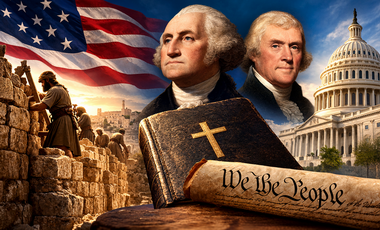
BEFORE THE VIDEO LECTURE… WHO IS RENE DIAZ?
Former District Judge Rene Diaz is a speaker for WallBuilders, a national pro-family organization that presents America’s forgotten history and heroes, with an emphasis on our moral, religious and constitutional heritage.
WallBuilders is a name taken from the Old Testament story of Nehemiah, who led a grassroots movement to rebuild the walls of Jerusalem and restore its strength and honor. In the same way, WallBuilders seeks to energize people today to become involved in strengthening their communities, states, and nation. WallBuilders has been nationally recognized for its work in education, history, law, and public policy, integrating the elements of Biblical faith and morality throughout all aspects of American life and culture.
Rene is the CEO of the Diaz Mediation & Arbitration Center, and works as a peacemaker by trying to amicably resolve legal disputes referred to him by the courts or directly by the parties. With over twenty-eight years of civil litigation experience in state and federal courts, he has handled a wide variety of cases all over the State of Texas. In 2004, he was appointed by Texas Governor, Rick Perry as the Presiding Judge for the 224th District Court of Bexar County. Judge Diaz has achieved the highest possible peer review rating of “AV – Preeminent” by Martindale-Hubbell for his ethical standards and legal ability, and he has been repeatedly listed as among the Best Lawyers in San Antonio, Texas by the Scene in SA Magazine for the last ten years.
Before becoming a judge, he served as a Texas Commissioner of the OneStar National Service Commission, the state agency that oversees AmeriCorp Volunteers as well as the Texas Office of Faith Based and Community Initiatives. He also served as General Counsel for the Republican Party of Texas and currently serves as Chairman of Habitat for Humanity of San Antonio and as a Board Member for the Bexar County Dispute Resolution Center. A frequent lecturer for the State Bar of Texas and San Antonio Bar Association, he has also volunteered with the Community Justice Program and the San Antonio Young Lawyers, who awarded him the “Honorary Young Lawyer of the Year Award” as the jurist who contributed most to the professional development of the young attorneys.
Born in Virginia, Judge Diaz attended the University of Virginia for his Bachelor’s Degree in International Relations and Latin American Studies and received both his Master’s Degree in Public Policy and his Law Degree from Regent University. During law school he met and married the love of his life, Cynthia Smith. They have been married for thirty years and currently reside in San Antonio, Texas.
Adapted but pretty close transcript.
WallBuilders — Session 2 of 3
November 20, 2021 — René Diaz
In the last session, I introduced WallBuilders and explained that our name comes from the Book of Nehemiah. When the children of Israel returned from Babylon, they found Jerusalem in ruins, and Nehemiah proved to be a remarkable leader. He brought the Jewish families together, and each family worked on the portion of the wall in front of its house while carrying weapons because they were attacked as they built. By cooperating and following Nehemiah’s leadership, they rebuilt the wall in 52 days. I like to say that Nehemiah tells the story of patriots who loved their country and were willing to defend it by rebuilding the foundations and protections of their homeland after they had been torn down, neglected, and forgotten.
That theme runs through today’s presentation because much of what I will share has been neglected or forgotten in elementary schools, high schools, universities, and even law schools. I am going to discuss the separation of church and state and what the founders actually meant by that concept. First Amendment cases over the last 50 years have been groundbreaking, but they have also departed dramatically from the founders’ intentions. During that period, the text of the First Amendment to the U.S. Constitution has been cited in roughly 3,000 cases, while the metaphor “separation of church and state,” which does not appear in the amendment, has been cited in roughly 4,000 cases.
Courts often rely more heavily on the separation metaphor they encountered in law school and university than on the actual text of the First Amendment. The religion clauses have two parts: “Congress shall make no law respecting an establishment of religion, or prohibiting the free exercise thereof.” The first part is called the Establishment Clause, and it prohibits Congress from establishing a national religion. The second part is called the Free Exercise Clause, and “thereof” refers to religion. Together, the clauses prohibit Congress from establishing religion or restricting its free exercise.
I became fascinated by the First Amendment in law school while earning both a Juris Doctor and a master’s degree in public policy. Because the joint-degree program required a thesis combining law and public policy, I chose the First Amendment and devoted two full chapters to its legislative history. The amendment was proposed by the First Congress, whose official proceedings were recorded as required by Article I of the Constitution. Court reporters used reporting machines to record members’ speeches, and everything that occurred during an official session of the House of Representatives had to be written down. To understand what Congress meant, I read every recorded word that the 90 members of the First Congress said about the Bill of Rights and the First Amendment.
The amendment we now call the First Amendment was originally the third of 12 proposed amendments; the first two were not ratified by the states, so the remaining 10 became the Bill of Rights. Congress debated the proposal from June 7 through September 25, 1789, a period of about four months that included committee work and debate on the floor. In that entire record, no one arguing for or against the amendment used the phrase “separation of church and state.” That absence made a great impression on me and challenged me to determine what the members of Congress actually intended.
A biblical principle is that one can understand people by examining the fruit of their lives, so let us examine the actions of the First Congress. One of its earliest laws was the Northwest Ordinance, which set rules for admitting future states from the territory extending through the Ohio River Valley toward Illinois, Minnesota, Wisconsin, and Michigan. President George Washington signed the ordinance on August 7, 1789, and its text remains part of the U.S. Code. I encourage you to verify what I am saying by reading it for yourself. The ordinance states that “religion, morality, and knowledge” are necessary to good government and human happiness and that schools and the means of education should therefore be encouraged.
The ordinance provided for schools throughout the territory and reflected the view that religion should be taught in the schools of the future United States. The same 90 members of Congress who passed the Northwest Ordinance also passed the Bill of Rights. At about the time the amendments were sent to Washington, he prepared one of the nation’s first Thanksgiving proclamations. In it, he called on citizens to set aside a day to pray, give thanks for God’s blessings, and remember divine guidance through the Revolutionary War and the establishment of the new constitutional government.
Washington declared that it is the duty of all nations “to acknowledge the providence of Almighty God, to obey His will, to be grateful for His benefits, and humbly to implore His protection and favor.” The word “duty” carried a strong sense of obligation for Washington, a military man; it described something mandatory rather than merely a personal preference. He identified four duties: to acknowledge God, obey His will, express gratitude, and seek His protection and favor. He also described these as duties of nations, not merely of individuals. In my view, this shows that Washington believed religion belonged in the public square and that a nation should publicly acknowledge God.
The legislative purpose of the First Amendment was therefore clear: Congress was to establish no national religion and enact no law restricting, inhibiting, or prohibiting the free exercise of religion. The question is how to establish legislative intent. Thomas Jefferson advised that, when interpreting a law, we should return to the time of its adoption, recall the spirit expressed in the debates, and conform our interpretation to the most probable meaning in which the law was passed rather than inventing a meaning against its text. James Madison likewise wrote that the Constitution is legitimate in the sense in which it was accepted and ratified by the nation. Without that historical guide, he warned, there can be no secure, consistent, stable, and faithful exercise of constitutional power.
For roughly the first 150 years of the nation, the U.S. Supreme Court followed a comparatively uniform approach to the First Amendment. In Church of the Holy Trinity v. United States (1892), the Court explained that constitutional interpretation requires identifying the evil a law was intended to remedy. The key question, then, is what evil the First Amendment was designed to address. To answer it, we must examine the history the founders themselves read.
From the seventeenth into the eighteenth century, one influential work was John Wise’s treatise, A Vindication of the Government of New England Churches, Drawn from Antiquity, the Light of Nature, Holy Scriptures, Its Noble Nature, and the Dignity Divine Providence Has Put upon It. Wise wrote it in Ipswich and also preached on the subject. The speaker hesitated over the printed date, reading it first as 1720 and then correcting himself to “72.” Wise described three broad periods of church history, and I am presenting his interpretation because it was widely understood during the founding era, not because every listener must share it. He called the first three centuries of Christianity the “period of purity,” when the church dealt with theology and doctrine while civil government enforced civil law. In his account, these distinct roles most faithfully followed Christ’s teachings.
Wise taught that the roles became confused and then reversed from the fourth century through roughly the fifteenth century, a period he called the “period of apostasy” and associated with the Dark Ages. Civil government began determining theology, while church authority became entangled with the enforcement of civil law. The state declared Christianity its official religion, and rulers placed the sword at the service of the church. Government enforced attendance, doctrine, and participation in practices such as Holy Communion. This merger became brutal because civil power was used to enforce doctrinal conformity.
During the Reformation, reformers promoted literacy so individual believers could read Scripture for themselves, an idea that was illegal in some jurisdictions. William Tyndale, Martin Luther, John Wycliffe, Thomas Cranmer, and others taught that each believer should have a copy of Scripture, be able to read and understand it, and have a direct relationship with God without relying on church leaders to read Scripture or mediate communion with God. Many kings resisted these teachings and persecuted reformers. In England, people were required to acknowledge Henry VIII as head of both church and government, while those who refused were labeled dissenters. Figures such as Erasmus, Zwingli, John Knox, and John Calvin became associated with dissent; some were martyred, and Henry VIII was responsible for the martyrdom of some of these believers.
Later English monarchs continued efforts to suppress dissent, and John Wise described cruel tortures and persecutions intended to stop renewed biblical teaching. These pressures contributed to mass migration to America, including an estimated 400,000 Huguenots who fled France. In England, Edward VI, Mary I, Elizabeth I, and later monarchs continued policies that punished dissenters. James I advanced the divine right of kings and demanded complete submission and nonresistance to royal authority. The Pilgrims, followed by the Puritans, were among the dissenting groups that settled New England, where Wise later preached and published.
This history explains what the founders sought to prevent through the Establishment Clause: a union of civil government with a single church or denomination like the one they knew from England. The concise point is that Congress could not elevate one denomination above the others or make it the national church. Several colonies, and even some states after independence, still maintained official churches. In Virginia, for example, the Anglican, later Episcopal, Church received public support, and tax dollars helped fund its institutions and teaching.
In the 1850s, the National Liberal League promoted a much broader separation of religion from the federal government. A League flyer called for a constitutional amendment guaranteeing total separation of church and state, equitable taxation of church property, secularization of public schools, repeal of Sabbatarian laws, abolition of government chaplaincies, prohibition of public appropriations for religious purposes, and other measures toward the same end. The movement gained enough influence that Congress held hearings on whether this program reflected the First Amendment’s original intent. An 1853 U.S. Senate report concluded that the founders meant to prohibit an establishment like the English church, not to foster hostility or indifference toward religion. The report said they neither feared religion itself nor wished the United States to become an irreligious people, and that they did not intend to spread over public authority “the dead and revolting spectacle” of atheistic apathy.
A House report the following year likewise concluded that, when the Constitution and its amendments were adopted, the prevailing sentiment was that Christianity should be encouraged without preferring any denomination. It stated that an effort to discard religion would have met widespread indignation and that religion was regarded as foundational to the national structure. This parallels Washington’s description of religion and morality as indispensable supports of constitutional government. Yet today, I believe this understanding is often dismissed or turned upside down.
Modern courts frequently treat Thomas Jefferson as the chief authority on the First Amendment, even though he did not frame either the Constitution or the amendment. Jefferson told Dr. Joseph Priestley that he had been serving as an ambassador in Europe when the Constitutional Convention was planned and did not see the Constitution until after it was published. He appears prominently in the famous painting of the signing of the Declaration of Independence because he was its principal author, but he is not among the signers depicted at the Constitutional Convention. He did not claim to be the controlling authority on the Constitution or the First Amendment.
Jefferson nevertheless played a role in planning Washington, D.C., and his religious practices are instructive. Congressional records show that chaplains proposed holding divine services in the Capitol. On January 1, 1802, Jefferson wrote his famous letter to the Danbury Baptist Association, a document now held by the University of Virginia. When I attended the university in the 1980s, students could request supervised access to examine the letter while wearing protective gloves.
The Danbury Baptists admired Jefferson because he had authored the Virginia Statute for Religious Freedom and opposed state support for the Anglican Church. They nevertheless worried that the First Amendment might give Congress power over religious practice. Jefferson reassured them that Congress could never enact a law restricting their free exercise of religion, describing an enduring wall of separation between church and state. Read in full, I believe the letter refers to the Free Exercise Clause and describes a wall protecting religious exercise. Later courts, however, extracted the metaphor from its context and applied it to the Establishment Clause.
The full Danbury letter was first quoted in Reynolds v. United States (1878), not in Church of the Holy Trinity v. United States (1892), as I misspoke earlier; Church of the Holy Trinity later discussed the same history. In Everson v. Board of Education (1947), however, the Court quoted only the sentence about a wall of separation rather than reproducing the whole letter. The dates surrounding Jefferson’s letter are also revealing. He wrote it on Friday, January 1, 1802, and on Sunday, January 3, he attended a religious service in the Hall of the House of Representatives. Because the Danbury letter, the Congressional Record, and the published Capitol sermons are dated, we know what Jefferson was doing on that Friday, Saturday, and Sunday. The sermon that Sunday was preached by the Reverend John Leland, who published it as a sermon delivered in the House chamber on January 3, 1802.
We know about Jefferson’s attendance partly from the diary of Manasseh Cutler, a Federalist minister and political opponent of Jefferson. Cutler sarcastically remarked that Jefferson’s “ardent zeal” brought him through the rain on horseback to worship in the House chamber, and he recorded that Jefferson and his family regularly attended services there. Jefferson reportedly explained that no nation had existed or been governed without religion, that Christianity was the best religion given to humanity, and that as chief magistrate he was bound to sanction it by his example. He also considered the music inadequate and directed the Marine Band to provide music for services in the Capitol.
Public worship in the Capitol began shortly after the building opened in 1800 and continued for nearly 70 years, until 1867. At its height, about 2,000 people attended weekly, and four congregations met in different parts of the building. WallBuilders holds copies of sermons preached in the Hall of the House of Representatives, including examples from 1822, 1826, 1860, and 1864. These records raise an important question: if Jefferson meant separation as modern courts often define it, why did his public conduct look so different?
The turning point came with Everson v. Board of Education (1947), an opinion written by Justice Hugo Black. Black was appointed by Franklin Roosevelt. He had been Roosevelt’s political lawyer, had represented his campaign, and was serving in Congress at the time. His appointment to the U.S. Supreme Court was highly controversial because he had been a lawyer for and a member of the Ku Klux Klan. Let me say that again: the justice nominated by Franklin Roosevelt was Hugo Black, who had been a lawyer for and a member of the Ku Klux Klan. He wrote the opinion that, in my view, misquoted and took out of context Jefferson’s letter to the Danbury Baptists, applying the wall-of-separation metaphor to the Establishment Clause rather than the Free Exercise Clause. He did not publish the complete letter; he published only that one sentence. So, in my view, he knew what he was doing.
That precedent was later taken up by Earl Warren, the longtime governor of California. The speaker noted that Warren served four terms, was unopposed in his first two reelection campaigns, and in 1947 was nominated for governor by both the Republican and Democratic parties. Warren had been educated nearby at Stanford University and Stanford Law School. Fifteen years after Hugo Black’s Everson opinion, Warren wrote that the Constitution “must draw its meaning from the evolving standards that mark the progress of a maturing society.” The speaker described this as the living-Constitution approach taught in many law schools and contrasted it with a biblical view of law as fixed, uniform, and universal.
Did the justices know what they were doing? I think they did. Anyone researching whether Jefferson’s letter had been quoted before would have been directed by law clerks to Reynolds v. United States (1878), Church of the Holy Trinity v. United States (1892), and the other First Amendment opinions issued during the nation’s first 150 years. In the speaker’s view, those precedents showed that the wall metaphor had been turned on its head under an evolving-standards approach.
This approach shaped Engel v. Vitale (1962), which prohibited state-sponsored prayer in public schools, and Abington School District v. Schempp (1963), which prohibited school-sponsored Bible reading. In my view, those decisions relied on a wall-of-separation metaphor that had been taken out of context. The justices and their clerks could have reviewed Reynolds, Church of the Holy Trinity, and other earlier First Amendment cases, yet the Court adopted a different interpretation. Those rulings became the foundation for later restrictions involving Bible classes, Bibles in school libraries, displays of the Ten Commandments, religious artwork, student religious expression, prayers at graduations and athletic events, Christmas displays, and Christmas cards in public schools.
The modern position is often summarized as a wall between Christian faith and the public square, with faith permitted inside a church but excluded from public life. I call this compartmentalization: practice faith privately, but never publicly. In my view, that is the opposite of Jefferson’s assurance to the Danbury Baptists and of the founders’ purpose. The text says that Congress shall make no law respecting an establishment of religion or prohibiting its free exercise; by its terms, it speaks specifically to Congress. Courts and legislatures have often moved away from that text and from Jefferson’s instruction to interpret a law according to the historical debates and the meaning understood when it was adopted.
Like Jerusalem’s walls while Israel was in Babylon, the foundations of our religious liberty have, in my view, been neglected and abandoned by many courts, legislatures, and even churches. When I was in law school, we watched Ronald Reagan’s farewell address on January 11, 1989. He warned, “If we forget what we did, we won’t know who we are,” and spoke of an eradication of American memory that could erode the American spirit. Too many judges, lawyers, and patriots have forgotten the history of the First Amendment. ….