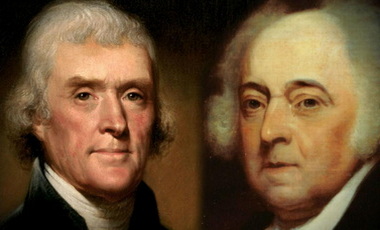
In John Adams letter to Thomas Jefferson he opens with this — and I have GROK put the old English into more modern terms.
The green box that follows the original text is GROK modernizing it
The sight of your well known hand writing in your favour of 25. Feb. last, gave me great pleasure, as it proved your arm to be restored and your pen still manageable—may it continue till you shall become as perfect a calvinist as I am in one particular. Poor Calvins infirmities his rheumatism his gouts and sciatics made him frequently cry out Mon dieu Jusque au quand Lord how long! Prat once Chief Justice of new york always tormented with infirmities dreamt that he was situated on a single rock in the midst of the Atlantick ocean, He heard a voice. “Why mourns the bard Apollo bids thee2 rise, renounce the dust,3 and claim thy native skies.”—
Here’s a modern English update of the excerpt from John Adams’s letter to Thomas Jefferson (dated March 10, 1823), keeping the original meaning, tone, and humor intact while making the language clearer and more contemporary:
Seeing your familiar handwriting in your letter from February 25th gave me great pleasure. It showed that your arm has recovered and you can still write easily—may that continue until you become as much of a Calvinist as I am in one respect. Poor Calvin’s ailments—his rheumatism, gout, and sciatica—often made him cry out, “Mon Dieu, jusqu’à quand?” which means “Lord, how long!” Pratt, who was once Chief Justice of New York and always plagued by health problems, dreamed that he was stranded on a lone rock in the middle of the Atlantic Ocean. Then he heard a voice say:
“Why does the bard mourn? Apollo bids you rise, renounce the dust, and claim your native skies.”
(For context: Adams is playfully teasing Jefferson about enduring old-age infirmities with Calvinist patience, referencing John Calvin’s sufferings and a poetic anecdote about Benjamin Pratt, an 18th-century New York judge known for his poetry and health issues.)
Here is the response to Adams via Jefferson:
The wishes expressed, in your last favor, that I may continue in life and health until I become a Calvinist, at least in his exclamation of ‘mon Dieu! jusque à quand’! would make me immortal. I can never join Calvin in addressing his god. he was indeed an Atheist, which I can never be; or rather his religion was Dæmonism. if ever man worshipped a false god, he did. the being described in his 5. points is not the God whom you and I acknolege and adore, the Creator and benevolent governor of the world; but a dæmon of malignant spirit. it would be more pardonable to believe in no god at all, than to blaspheme him by the atrocious attributes of Calvin.
[….]
Of the nature of this being we know nothing. Jesus tells us that ‘God is a spirit.’ 4. John 24. but without defining what a spirit is. ‘πνευμα ὁ θεος.’ down to the 3d century we know that it was still deemed material; but of a lighter subtler matter than our gross bodies. so says Origen. ‘Deus igitur, cui anima similis est, juxta Originem, reapse4 corporalis est; sed graviorum tantum ratione corporum incorporeus.’ these are the words of Huet in his commentary on Origen. Origen himself says ‘appellatio ασωματον apud nostros scriptores est inusitata et incognita.’ so also Tertullian ‘quis autem negabit Deum esse corpus, etsi deus spiritus? spiritus etiam corporis sui generis, in suâ effigie.’ Tertullian. these two fathers were of the 3d century. Calvin’s character of this supreme being seems chiefly copied from that of the Jews. but the reformation of these blasphemous attributes, and substitution of those more worthy, pure and sublime, seems to have been the chief object of Jesus in his discources to the Jews: and his doctrine of the Cosmogony of the world is very clearly laid down in the 3 first verses of the 1st chapter of John, in these words, ‘εν αρχη ην ὁ λογος, και ὁ λογος ην προς τον θεον και θεος ην ὁ λογος. οὑτος ην εν αρχη προς τον θεον. παντα δε αυτου εγενετο, και χωρις αυτου εγενετο ουδε ἑν ὁ γεγονεν.’ which truly translated means ‘in the beginning God existed, and reason [or mind] was with God, and that mind was God. this was in the beginning with God. all things were created by it, and without it was made not one thing which was made.’ yet this text, so plainly declaring the doctrine of Jesus that the world was created by the supreme, intelligent being, has been perverted by modern Christians to build up a second person of their tritheism by a mistranslation of the word λογος. one of it’s legitimate meanings indeed is ‘a word.’ but, in that sense, it makes an unmeaning jargon: while the other meaning ‘reason,’ equally legitimate, explains rationally the eternal preexistence of God, and his creation of the world. knowing how incomprehensible it was that ‘a word,’ the mere action or articulation of the voice and organs of speech could create a world, they undertake to make of this articulation a second preexisting being, and ascribe to him, and not to God, the creation of the universe. the Atheist here plumes himself on the uselessness of such a God, and the simpler hypothesis of a self-existent universe. the truth is that the greatest enemies to the doctrines of Jesus are those calling themselves the expositors of them, who have perverted them for the structure of a system of fancy absolutely incomprehensible, and without any foundation in his genuine words. and the day will come when the mystical generation of Jesus, by the supreme being as his father in the womb of a virgin will be classed with the fable of the generation of Minerva in the brain of Jupiter. but we may hope that the dawn of reason and freedom of thought in these United States will do away all this artificial scaffolding, and restore to us the primitive and genuine doctrines of this the most venerated reformer of human errors.
So much for your quotation of Calvin’s ‘mon dieu! jusqu’a quand’ in which, when addressed to the God of Jesus, and our God, I join you cordially, and await his time and will with more readiness than reluctance. may we meet there again, in Congress, with our antient Colleagues, and recieve with them the seal of approbation ‘Well done, good and faithful servants.’
Here’s a modern English update of this excerpt from Thomas Jefferson’s letter to John Adams (dated April 11, 1823), preserving the original meaning, passion, and philosophical tone while making the language clearer and more accessible:
The wishes you expressed in your last letter—that I might live long and healthy until I become a Calvinist, at least in crying out “My God! How long?!”—would make me immortal if they came true. But I can never join Calvin in addressing his god that way. He was essentially an atheist (which I could never be), or rather, his religion was daemonism. If any man ever worshiped a false god, it was him. The being described in his five points is not the God whom you and I acknowledge and adore—the Creator and benevolent governor of the world—but a daemon with a malignant spirit. It would be more forgivable to believe in no god at all than to blaspheme the true God by attributing such atrocious qualities to Him.
[….]
Of the true nature of this Being, we know nothing. Jesus tells us that “God is a spirit” (John 4:24), but without defining what a spirit is—”πνεῦμα ὁ θεός” (pneuma ho theos). Down to the 3rd century, it was still considered material, though of a lighter, subtler substance than our gross bodies. So says Origen: “Therefore God, to whom the soul is similar, according to Origen, is actually corporeal, but incorporeal only in comparison to heavier bodies.” These are the words of Huet in his commentary on Origen. Origen himself says that the term “incorporeal” (ἀσώματον) is unusual and unknown in our [Christian] writers. Tertullian says the same: “Who will deny that God is a body, even though God is a spirit? For spirit is a body of its own kind, in its own form.” Both of these Church Fathers were from the 3rd century.
Calvin’s portrayal of the Supreme Being seems mostly copied from the Jewish conception. But reforming those blasphemous attributes and replacing them with ones more worthy, pure, and sublime appears to have been Jesus’s main goal in his discourses with the Jews. His doctrine of the world’s creation is very clearly stated in the first three verses of the Gospel of John:”Ἐν ἀρχῇ ἦν ὁ λόγος, καὶ ὁ λόγος ἦν πρὸς τὸν θεόν, καὶ θεὸς ἦν ὁ λόγος. Οὗτος ἦν ἐν ἀρχῇ πρὸς τὸν θεόν. Πάντα δι’ αὐτοῦ ἐγένετο, καὶ χωρὶς αὐτοῦ ἐγένετο οὐδὲ ἕν ὃ γέγονεν.”Which, truly translated, means: “In the beginning, God existed, and reason (or mind) was with God, and that mind was God. This was in the beginning with God. All things were created by it, and without it not one thing that was made came into being.” Yet this text—so plainly declaring Jesus’s doctrine that the world was created by the supreme intelligent Being—has been twisted by modern Christians to build up a second person in their tritheism through a mistranslation of the word λόγος (logos). One of its legitimate meanings is indeed “word,” but in that sense it produces meaningless nonsense. The other equally legitimate meaning—”reason”—explains rationally God’s eternal preexistence and His creation of the world. Knowing how incomprehensible it was that a mere “word”—the simple action of voice and speech organs—could create a world, they instead turn this “word” into a second pre-existing being and attribute the creation of the universe to him rather than to God. The atheist here boasts about the uselessness of such a God and prefers the simpler idea of a self-existent universe. The truth is that the greatest enemies of Jesus’s doctrines are those who call themselves their interpreters, who have perverted them to build a system of fantasy that is utterly incomprehensible and has no foundation in his actual words. And the day will come when the mystical story of Jesus being generated by the Supreme Being as His father in the womb of a virgin will be classed with the myth of Minerva springing from the brain of Jupiter. But we may hope that the dawn of reason and freedom of thought in these United States will sweep away all this artificial scaffolding and restore to us the primitive and genuine doctrines of this most venerated reformer of human errors. So much for your quotation of Calvin’s “Mon Dieu! jusqu’à quand!” When addressed to the God of Jesus—and our God—I join you in it wholeheartedly, and I await His time and will with more readiness than reluctance. May we meet again there, in a heavenly Congress with our old colleagues, and receive with them the seal of approval: “Well done, good and faithful servants.”
And here GROK did a redo making it :”more concise”
Here’s a more concise modern English version of Jefferson’s response (April 11, 1823):
Your wish that I live long enough to become a Calvinist—at least in crying “My God! How long?”—would make me immortal. But I can never pray to Calvin’s god. He was essentially an atheist, or his religion was daemonism. If anyone worshiped a false god, it was him. The being in his five points is not the God we both acknowledge—the benevolent Creator and governor of the world—but a malignant daemon. It is more forgivable to believe in no god than to blaspheme the true one with Calvin’s atrocious attributes.
We know nothing of this Being’s nature. Jesus said “God is a spirit” (John 4:24), but did not define it. Until the 3rd century, Christians considered spirit material, though subtler than flesh—as Origen and Tertullian both affirmed.
Calvin’s image of God largely copies the harsh Jewish portrayal. Jesus’s main mission seems to have been correcting those blasphemous attributes and teaching purer, more sublime ones. His cosmology is clearly stated in John 1:1–3:“In the beginning was the Logos, and the Logos was with God, and the Logos was God… All things were made through it.”
Properly translated, Logos means “reason” or “mind”: In the beginning God existed, reason was with God, and reason was God. All things were created by it. Modern Christians, however, mistranslate Logos as “word” to invent a second divine person and build their tritheism. This turns a rational account of creation into incomprehensible jargon—and gives atheists an easy target.
The worst enemies of Jesus’s teachings are the so-called experts who have twisted them into a fanciful, groundless system. One day, the virgin birth of Jesus will be ranked with Minerva springing from Jupiter’s head. But I hope the spread of reason and free thought in America will sweep away this artificial scaffolding and restore Jesus’s original, genuine doctrines—the work of the greatest reformer of human errors.
As for Calvin’s “My God! How long?”—when addressed to the God of Jesus, our God—I join you wholeheartedly. I await His will with more readiness than reluctance. May we meet again in a heavenly Congress with our old colleagues and hear together: “Well done, good and faithful servants.”
GROK offered to explain Jefferson’s “5-Points Critique,” here that is:
Thomas Jefferson’s critique of Calvinism’s “five points” appears in his April 11, 1823, letter to John Adams. He did not break it down point-by-point but offered a sweeping condemnation, calling the God portrayed in these doctrines a “daemon of malignant spirit” rather than the benevolent Creator he and Adams revered. Jefferson viewed Calvin’s theology as blasphemous, arguing it would be better to believe in no God at all than to attribute such “atrocious” qualities to the divine. The Five Points of Calvinism (TULIP)These points, formalized after John Calvin’s death at the Synod of Dort (1618–1619) in response to Arminianism, summarize key Reformed doctrines on salvation:
- Total Depravity: Humanity is utterly corrupted by sin, incapable of choosing God or doing spiritual good without divine intervention.
- Unconditional Election: God chooses (elects) certain individuals for salvation based solely on His will, not on any foreseen merit or faith.
- Limited Atonement (or Particular Redemption): Christ’s death effectively atones only for the sins of the elect, not for all humanity.
- Irresistible Grace: God’s grace effectively calls the elect to faith; they cannot ultimately resist it.
- Perseverance of the Saints: The elect will persevere in faith and cannot finally lose salvation.
Jefferson’s Core Objection
Jefferson, influenced by Enlightenment rationalism, Deism, and Unitarian leanings, emphasized a God of benevolence, reason, and moral governance. He saw Calvinism’s emphasis on God’s absolute sovereignty—especially in predestination (including “double predestination,” where God decrees both election to salvation and reprobation to damnation)—as portraying a tyrannical, arbitrary deity. This God predestines most of humanity to eternal punishment without regard to their actions, which Jefferson found cruel and incompatible with divine goodness. He contrasted this with Jesus’s teachings, which he believed focused on moral reform, free will, and a loving God. Jefferson also linked Calvinism to historical intolerance (e.g., Calvin’s role in the execution of Michael Servetus) and saw it as a perversion of true Christianity. In essence, Jefferson rejected the five points not for subtle theological nuances but because they collectively depicted a God he considered morally repugnant—a “malignant” being closer to a demon than the rational, kind Creator revealed (in his view) by nature and Jesus’s ethical teachings. This reflected his broader anti-Trinitarian, anti-orthodox stance, favoring a simplified, moralistic Christianity over doctrinal systems like Calvinism.
Keep in mind GROK is not a theologian. I asked GROK about John Adam’s views of Calvinism, this was the short answer:
John Adams, raised in a Puritan New England Congregationalist family with strong Calvinist roots, ultimately rejected core Calvinist doctrines and evolved into a Unitarian Christian.
Early Rejection of Calvinism
He rejected key Calvinist tenets early in life, including:
- Predestination
- Total depravity
- Limited atonement
- Eternal damnation for most
He called Calvinism “frigid,” irrational, and marked by a “domineering and persecuting spirit.” Influenced by liberal Congregationalist preachers and Enlightenment rationalism, Adams viewed strict Calvinism as incompatible with a benevolent God and human free will. He leaned toward Arminianism (emphasizing free choice in salvation) before fully embracing Unitarianism.
Self-Identification as Unitarian
In later years, Adams explicitly identified as a Unitarian, writing to his son John Quincy Adams in 1816: “We Unitarians, one of whom I have had the Honour to be, for more than Sixty Years…” He rejected the Trinity, the divinity of Jesus, original sin, and salvation by arbitrary grace alone, favoring a rational, moral Christianity focused on benevolence, good works, and the Sermon on the Mount.
Playful Teasing in Correspondence
In his famous 1823 correspondence with Thomas Jefferson (the letters you referenced earlier), Adams playfully teased Jefferson about old-age sufferings, joking that Jefferson might yet become “as perfect a Calvinist as I am in one particular”—referring only to enduring infirmities with stoic patience (echoing John Calvin’s own cries of “Mon Dieu! Jusqu’à quand?”). This was ironic humor, not an endorsement of Calvinism. Adams shared Jefferson’s disdain for Calvin’s “atrocious attributes” and predestinarian God, aligning with Jefferson’s view of a benevolent Creator.
Overall Religious Outlook
Adams remained deeply religious—a “church-going animal” who believed in divine providence, prayer, and morality’s role in society—but his faith was liberal, tolerant, and anti-dogmatic. He saw religion as essential for public virtue yet warned against ecclesiastical tyranny. Historians describe him as a blend of Puritan heritage and Enlightenment reason, ultimately a conservative Unitarian who retained belief in Jesus as a moral teacher (though not divine) and an active God.
In short, Adams was emphatically not a Calvinist; he detested its harsher doctrines and spent much of his life moving away from them toward Unitarian rationalism.
Mind you, I am not a Unitarian whatsoever, but needless to say not only would Calvin had burned Christ at the stake in Geneva, he would have done the same to the Founders of America!

BAPTIST MARTYRS
This Baptist History is brought to you by Steve Brady at Fairhaven Baptist Church in Chesterton, Indiana. (Full playlist of 50 Baptists You Should Know here)

Here is what was said in a post that included the above drawing via Facebook:
It has been decreed this day by the Council of the Two Hundred (of Zurich) that the leaders of the Catabaptists shall be cast into the Tower, in which they formerly lay, and allured by bread and water diet until either they give up the ghost or surrender. It is also added that he who after this is dipped shall be submerged permanently (qtti posthac tingatur, prossus mcrgatur); this is not published (Zwingli, Opera, vii. 477).
This is but one of numerous decrees by city councils in Calvinist principalities levied against “Catabaptists”. This word means someone who opposes baptism, but even in their usage of the term the Calvinists reveal themselves to be liars. The Baptists didn’t oppose baptism, they opposed infant baptism, which is nowhere evidenced in Scripture. The Calvinists knew Baptists baptized believing adults – that’s one of the reasons they murdered them – “submerged permanently,” as opposed to submerged briefly, in baptism.
Note that in his final comment, Zwingli writes that this is “not published”. He wanted the homicidal order to remain a secret. So he knew that what he was doing was immoral. He just didn’t want the general population to know about it.
Zwingli and the Calvinists were murderers. They knew they were murderers. They congratulated themselves on being murderers. And history has preserved the evidence of their murders.
I asked GROK to explain the above a little more and then GROK offered up info on Felix Manz
Key Historical Context
In 1525, a group of Zwingli’s former followers (including Conrad Grebel and Felix Manz) broke away because they believed Zwingli and the Zurich authorities were reforming the church too slowly and compromising with civil government. They rejected infant baptism (paedobaptism) as unscriptural, insisting baptism should be for believing adults only—who could consciously confess faith. On January 21, 1525, they performed the first adult baptisms in Zurich, marking the start of the Anabaptist movement (from Greek ana- meaning “again,” implying “re-baptizers” in the eyes of critics, since they viewed infant baptism as invalid).Zwingli strongly defended infant baptism (seeing it as the New Testament equivalent of Old Testament circumcision, a covenant sign for children of believers). After public debates in 1525 failed to resolve the issue, the Zurich Council sided with Zwingli and began cracking down on the Anabaptists, viewing their separatism, refusal of oaths/civic duties, and defiance of authority as threats to social and religious order.
The Decree and Quote Explained
The decree Zwingli describes had two parts:
- Leaders of the Anabaptists (called “Catabaptists” here—see below) were to be imprisoned in the tower on bread-and-water rations until they recanted or died.
- Anyone who continued to perform adult (“re-“)baptism would be executed by drowning (a grim, ironic punishment: “whoever dips shall be dipped/submerged permanently”).
This was an escalation from earlier penalties (fines, banishment). A similar but formalized mandate followed shortly after, and the first execution under it was Felix Manz, drowned in the Limmat River on January 5, 1527. Several others followed in Zurich before the movement was suppressed there.
Regarding your quote’s final line: “this is not published (Zwingli, Opera, vii. 477).” Most historical sources (including direct translations of the letter) actually read that the decision was published—or at least do not mention secrecy. It’s possible this is a transcription/translation variant in the specific edition you referenced, or a slight misremembering. Zwingli’s letter was private correspondence, not a public statement, and he expresses approval of the council’s action without hinting at shame or secrecy. The drowning penalty was openly enforced later, so it wasn’t kept hidden long-term.
On “Catabaptists”
This was a term Zwingli and some allies (like Oecolampadius) briefly used in Latin writings around 1525–1527 (e.g., in his 1527 book In Catabaptistarum Strophas Elenchus—”Refutation of the Tricks of the Catabaptists”). From Greek kata- (down/against), it carried a double meaning:
- “Against baptism” (implying they undermined true [infant] baptism).
- Ironically, “down-dipper” or “one who submerges/drowns” (playing on immersion baptism and foreshadowing the drowning punishment).
It was a derogatory label, not what the group called themselves (they preferred “Brethren” or similar). The more common term “Anabaptist” stuck. You’re correct that they didn’t “oppose baptism” outright—they practiced believer’s baptism (often by immersion or pouring)—but critics framed it as rejecting the established sacrament.
Broader Perspective
The Anabaptists were seen as dangerous radicals in the 16th century (both by Catholics and magisterial Protestants like Zwingli/Calvin/Luther) because their ideas challenged the unity of church and state. Persecution was harsh and widespread: drowning in Protestant Zurich, burning/beheading elsewhere. Modern historians view this as a tragic episode where Reformation leaders, fearing anarchy, used state power to enforce orthodoxy—similar to how Catholics persecuted Protestants.
From a Baptist perspective (as your text seems to reflect), Anabaptists are often seen as forerunners of believer’s baptism and church-state separation. Zwingli and the Zurich Reformed tradition defended infant baptism and a closer church-government alliance.
This event highlights the deep divisions within the early Reformation—Zwingli started as a bold reformer against Catholic practices but ended up opposing those he saw as going “too far.”
[….]
Background on Felix Manz
Felix Manz (c. 1498–1527) was a Swiss Anabaptist leader and co-founder of the Swiss Brethren, the earliest Anabaptist congregation. Initially a follower and collaborator of Huldrych Zwingli (helping with Bible translation), Manz broke away over theological differences, particularly the rejection of infant baptism in favor of believer’s baptism (adult baptism upon confession of faith). He participated in the first adult baptisms on January 21, 1525, at his mother’s home in Zurich, marking the birth of the Anabaptist movement.Manz was arrested multiple times between 1525 and 1527 for preaching and performing adult baptisms, seen by Zurich authorities as seditious and threatening to social order.
The Decree Leading to Execution
On March 7, 1526, the Zurich City Council—aligned with Zwingli’s Reformed position—issued an edict making adult “re-baptism” punishable by drowning. This ironic penalty (“a third baptism”) was intended to mock Anabaptist views on immersion baptism.
Details of the Execution: January 5, 1527
Manz was rearrested in December 1526 while baptizing in the Grüningen region and imprisoned in Zurich’s Wellenberg Tower. He refused to recant during interrogation.On January 5, 1527, around 3 p.m., he was sentenced to death for persisting in Anabaptism, separatism, and defiance of authority. Led in procession from prison through the fish market to the Limmat River (flowing through central Zurich), Manz praised God and preached to onlookers.
Contemporary accounts (e.g., from Heinrich Bullinger, Zwingli’s successor) describe:
- His hands bound behind his knees with a pole inserted (a common binding for drowning executions).
- Placed in a boat and rowed to mid-river (near a fishing hut/platform).
- Pushed into the icy water to drown.
A Reformed preacher accompanied him, urging recantation, but Manz remained steadfast. Crowds lined both banks.
Family Presence and Last Words
Manz’s mother (Anna Manz) and brother were present on the shore, encouraging him to stay firm in his faith—her cries reportedly rang out across the water.
As he was thrown in, Manz sang loudly in Latin: “In manus tuas, Domine, commendo spiritum meum” (“Into Thy hands, O Lord, I commend my spirit”—echoing Jesus’ words on the cross, Luke 23:46).His property was confiscated, and he was buried in a common grave.
Zwingli’s Role
Zwingli, once Manz’s mentor, debated against the Anabaptists publicly (e.g., 1525 disputations) and supported the council’s measures. While he did not personally order the execution, sources indicate he approved of the edict and viewed Anabaptism as heretical and anarchic. No record shows him opposing the drowning.
Legacy and Memorial
Manz became the first Anabaptist martyr executed by Protestants (predating radical events like the Münster Rebellion). His death inspired the movement rather than suppressing it.A memorial plaque on the Limmat River wall at Schipfe (opposite No. 43) commemorates Manz and other drowned Anabaptists (1527–1532):The plaque reads (in translation): “Here in the middle of the Limmat from a fishing platform were drowned Felix Manz and five other Anabaptists during the Reformation 1527 to 1532.”This event highlights the tragic intolerance within the early Reformation, where theological disputes led to state-enforced executions.