Contents (Jump To):
Letters to:
God In The Dock Chapter 11:
- Priestesses in the Church?
- Myth Became Fact (in another post)
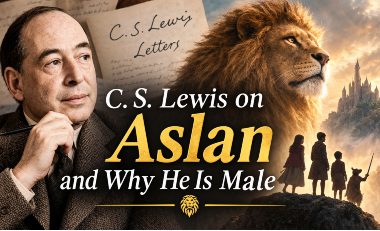
Aslan is far more than a memorable character in C. S. Lewis’s The Chronicles of Narnia. Lewis deliberately conceived of him as a divine figure, imagining what it would be like if the eternal Son of God entered another world and became incarnate as a lion, just as Christ became a man in our world. In a 1954 letter to a fifth-grade class, Lewis explicitly distinguished this idea from ordinary allegory: he was not simply using a lion to represent Jesus, but imagining Christ Himself entering a world like Narnia. Lewis took this distinction seriously. In a letter concerning a proposed adaptation, he warned that treating Aslan in a comic or irreverent manner would be “simple blasphemy.” Aslan’s identity, therefore, is central to understanding Narnia; he is not merely a character whose appearance can be changed without considering the theological meaning Lewis invested in him.
Lewis’s understanding of Aslan also connects with his convictions about masculine imagery in Christian theology. In his essay “Priestesses in the Church?”, Lewis argued that the biblical language of Father and Son is not an arbitrary convention that can be freely exchanged for Mother and Daughter without changing the meaning conveyed. He maintained that God has revealed Himself through particular imagery, and that this imagery matters to how Christians understand Him. Applied to Aslan, Lewis’s reasoning is significant: if Aslan is Lewis’s imaginative presentation of the incarnate Son of God, then Aslan’s maleness is not simply a superficial detail of the character. It belongs to the way Lewis chose to portray Christ in Narnia. Andy Shurson develops this argument in his article, “Greta Gerwig’s Aslan Would Have Horrified C. S. Lewis”, examining Lewis’s own letters and theological writings to argue that the question of Aslan’s gender is inseparable from Lewis’s understanding of the Incarnation and Christian imagery.
LOUDER w/CROWDER:
Netflix just dropped the trailer for Greta Gerwig’s “Narnia: The Magician’s Nephew,” with Meryl Streep voicing Aslan, the lion who represents Christ in C. S. Lewis’s series. Hollywood can remake a classic, but it can’t change the meaning of a Christian story and still claim to be telling the same one.
0:00 Coming Up
0:37 Intro
02:04 Narnia: The Magician’s Nephew Trailer
03:54 The Christ Figure Is a 77-Year-Old Woman
05:49 C. S. Lewis on Aslan as Christ
09:22 Jesus Is Intentionally Not a Woman
14:30 A Female Christ Is a Different Religion
17:56 Greta Gerwig Is a Feminist
24:41 Conclusion
I highly suggest reading this posting by Andy Shurson, titled: “Greta Gerwig’s Aslan Would Have Horrified C. S. Lewis“, at The L. Russ Bush Center for Faith and Culture. This is where this short letter was found from:
TO JANE DOUGLASS
Magdalen College, Oxford.
19th June 1954.
Dear Miss Douglas,
I have heard nothing from Jocelyn Gibb. I am sure you understand that Aslan is a divine figure, and anything remotely approaching the comic (above all anything in the Disney line) would be to me simple blasphemy. But how are you going to manage any of the animals? I would welcome a fuller account. Thanks for the kind things you say.
Yours sincerely,
C. S. Lewis
Over the next few days Jocelyn Gibb wrote to Douglass and Lewis, and in a letter to Lewis of 21 June 1954 he said:
The trouble about these Radio and Television adaptations is that whereas you have some control over them in this country, you have very little in the United States. In fact I suggest you would not wish to commit yourself without knowing what would be involved and that you could not know until the whole thing was irretrievably on its course towards production. However, you might like to know a little more if you think there is anything in the idea, and I will willingly write to Miss Douglas asking her for further and fuller particulars. Of course she still has to arouse someone’s interest on the Radio and Television side in a country where a good deal of both is intensely commercial.
TO JOCELYN GIBB
Magdalen College Oxford
22nd June 1954
Dear Mr. Gibb
- I wrote to Miss Douglass emphasising the fact that Aslan is a divine figure and I should regard any comic element in the treatment of him as blasphemous. For the rest, I left it to you. I feel we shd. allow it only under safeguards which the T.V. people will almost certainly not give us: i.e. specimen photos of the characters and a full script with a right of veto on our part.
- I don’t see that the play cd. do any harm and it might do good. So ‘Yes’ as far as I’m concerned. I think Monopods & even the Mouse will be rather beyond the amateur producer, but that’s their funeral.
Yours
C. S. Lewis
P.S. I’ve made two small corrections to their script.
I hunted down some of the letters Steven mentioned in the video and more that touch on the issue. Sources used for the above and below are:
Lewis, C. S. C. S. Lewis’ Letters to Children. Edited by Lyle W. Dorsett and Marjorie Lamp Mead. New York: Touchstone, 1995.
Lewis, C. S. The Collected Letters of C. S. Lewis. Vol. 3, Narnia, Cambridge, and Joy, 1950–1963. Edited by Walter Hooper. San Francisco: HarperSanFrancisco, 2007.
TO A FIFTH GRADE CLASS IN MARYLAND
Magdalen College, Oxford.
May 29th 1954
Dear Fifth Graders
I am so glad you liked the Narnian books and it was very kind of you to write and tell me. There are to be 7 of them altogether and you are already one behind. No. 4, The Silver Chair, is already out.
You are mistaken when you think that everything in the book ‘represents’ something in this world. Things do that in The Pilgrim’s Progress but I’m not writing in that way. I did not say to myself ‘Let us represent Jesus as He really is in our world by a Lion in Narnia’: I said ‘Let us suppose that there were a land like Narnia and that the Son of God, as He became a Man in our world, became a Lion there, and then imagine what would happen.’ If you think about it, you will see that it is quite a different thing.
So the answer to your first two questions is that Reepicheep and Nick-a-brick don’t, in that sense, represent anyone. But of course anyone in our world who devotes his whole life to seeking Heaven will be like R., and anyone who wants some worldly thing so badly that he is ready to use wicked means to get it will be likely to behave like N.
Yes, Reepicheep did get to Aslan’s country. And Caspian did return safely: it says so on the last page of the Dawn Treader. Eustace did get back to Narnia, as you will find when you read The Silver Chair. As for who reigns in Narnia to-day, you won’t know till you have had the seventh and last book.
I’m tall, fat, rather bald, red-faced, double-chinned, black-haired, have a deep voice, and wear glasses for reading.
The only way for us to Aslan’s country is through death, as far as I know: perhaps some very good people get just a tiny glimpse before then.
Best love to you all. When you say your prayers sometimes ask God to bless me.
C.S. Lewis
TO MRS HOOK
Magdalen College, Oxford.
29 Dec 1958
Dear Mrs Hook
By an allegory I mean a composition (whether pictorial or literary) in wh. immaterial realities are represented by feigned physical objects e.g. a pictured Cupid allegorically represents erotic love (which in reality is an experience, not an object occupying a given area of space) or, in Bunyan, a giant represents Despair.[1]
If Aslan represented the immaterial Deity in the same way in which Giant Despair represents Despair, he would be an allegorical figure. In reality however he is an invention giving an imaginary answer to the question, ‘What might Christ become like if there really were a world like Narnia and He chose to be incarnate and die and rise again in that world as He actually has done in ours?’ This is not an allegory at all. So in ‘Perelandra’. This also works out a supposition. (‘Suppose, even now, in some other planet there were a first couple undergoing the same that Adam and Eve underwent here, but successfully.’)
Allegory and such supposals differ because they mix the real and the unreal in different ways. Bunyan’s picture of Giant Despair does not start from supposal at all. It is not a supposition but a fact that despair can capture and imprison a human soul. What is unreal (fictional) is the giant, the castle, and the dungeon. The Incarnation of Christ in another world is mere supposal: but granted the supposition, He would really have been a physical object in that world as He was in Palestine and His death on the Stone Table would have been a physical event no less than his death on Calvary.
Similarly, if the angels (who I believe to be real beings in the actual universe) have that relation to the Pagan gods which they are assumed to have in Perelandra, they might really manifest themselves in real form as they did to Ransom.
Again, Ransom (to some extent) plays the role of Christ not because he allegorically represents him (as Cupid represents falling in love) but because in reality every real Christian is really called upon in some measure to enact Christ. Of course Ransom does this rather more spectacularly than most. But that does not mean that he does it allegorically. It only means that fiction (at any rate my kind of fiction) chooses extreme cases.
There is no conscious connection between any of the phonetic elements in my ‘Old Solar’ words and those of any actual language. I am always playing with syllables and fitting them together (purely by ear) to see if I can hatch up new words that please me. I want them to have an emotional, not intellectual, suggestiveness: the heaviness of glund for as huge a planet as Jupiter, the vibrating, tintillating quality of viritrilbia for the subtlety of Mercury, the liquidity (as I thought) of Maleldil. The only exception I am aware of is hnau[2] which may (but I don’t know) have been influenced by Greek nous.
Thank you for the kind things you say about my other works.
Yours sincerely
C. S. Lewis
[1] Bunyan, The Pilgrim’s Progress, First Part, p. 113.
[2] This is the Old Solar word used in Out of the Silent Planet, ch. 11, p. 68, meaning ‘rational creatures’, such as humans and the three rational animal species on Malachandra.
HILA
[One of C. S. Lewis’s early fan letters on The Chronicles of Narnia came from the United States. Hila was eleven years old when she wrote this letter, complete with a watercolor painting that she had done of all the characters in The Lion, the Witch and the Wardrobe. Her first reading of this story was three years earlier, when she experienced what she described years later as “an indefinable stirring and longing.”
At the time this letter was written, The Lion, the Witch and the Wardrobe (1950), Prince Caspian (1951), and The Voyage of the “Dawn Treader” (1952) were the only books published; The Silver Chair would appear later in 1953. However, Lewis had actually finished writing all seven volumes a year earlier, in 1952.]
June 3rd, 1953
Dear [Hila],
Thank you so much for your lovely letter and pictures. I realised at once that the coloured one was not a particular scene but a sort of line-up like what you would have at the very end if it was a play instead of stories. The Voyage of the “Dawn Treader” is not to be the last: There are to be 4 more, 7 in all. Didn’t you notice that Aslan said nothing about Eustace not going back? I thought the best of your pictures was the one of Mr. Tumnus at the bottom of the letter. As to Aslan’s other name, well I want you to guess. Has there never been anyone in this world who (1.) Arrived at the same time as Father Christmas. (2.) Said he was the son of the Great Emperor. (3.) Gave himself up for someone else’s fault to be jeered at and killed by wicked people. (4.) Came to life again. (5.) Is sometimes spoken of as a Lamb (see the end of the Dawn Treader). Don’t you really know His name in this world. Think it over and let me know your answer!
Reepicheep in your coloured picture has just the right perky, cheeky expression. I love real mice. There are lots in my rooms in College but I have never set a trap. When I sit up late working they poke their heads out from behind the curtains just as if they were saying, “Hi! Time for you to go to bed. We want to come out and play.”
All good wishes,
C. S. Lewis
[6 May 1955]
Dear Mrs. K . . . ,
Tell Laurence from me, with my love:
1/ Even if he was loving Aslan more than Jesus (I’ll explain in a moment why he can’t really be doing this) he would not be an idol-worshipper. If he was an idol-worshipper he’d be doing it on purpose, whereas he’s now doing it because he can’t help doing it, and trying hard not to do it. But God knows quite well how hard we find it to love Him more than anyone or anything else, and He won’t be angry with us as long as we are trying. And He will help us.
2/ But Laurence can’t really love Aslan more than Jesus, even if he feels that’s what he is doing. For the things he loves Aslan for doing or saying are simply the things Jesus really did and said. So that when Laurence thinks he is loving Aslan, he is really loving Jesus: and perhaps loving Him more than he ever did before. Of course there is one thing Aslan has that Jesus has not—I mean, the body of a lion. (But remember, if there are other worlds and they need to be saved and Christ were to save them as He would—He may really have taken all sorts of bodies in them which we don’t know about.) Now if Laurence is bothered because he finds the lion-body seems nicer to him than the man-body, I don’t think he need be bothered at all. God knows all about the way a little boy’s imagination works (He made it, after all) and knows that at a certain age the idea of talking and friendly animals is very attractive. So I don’t think He minds if Laurence likes the Lion-body. And anyway, Laurence will find as he grows older that feeling (liking the lion-body better) will die away of itself, without his taking any trouble about it. So he needn’t bother.
3/ If I were Laurence I’d just say in my prayers something like this: “Dear God, if the things I’ve been thinking and feeling about those books are things You don’t like and are bad for me, please take away those feelings and thoughts. But if they are not bad, then please stop me from worrying about them. And help me every day to love you more in the way that really matters far more than any feelings or imaginations, by doing what you want and growing more like you.” That is the sort of thing I think Laurence should say for himself; but it would be kind and Christian-like if he then added, “And if Mr. Lewis has worried any other children by his books or done them any harm, then please forgive him and help him never to do it again.”
Will this help? I am terribly sorry to have caused such trouble, and would take it as a great favor if you would write again and tell me how Laurence goes on. I shall of course have him daily in my prayers. He must be a corker of a boy: I hope you are prepared for the possibility he might turn out a saint. I daresay the saints’ mothers have, in some ways, a rough time!
C. S. Lewis
Priestesses in the Church?
Chapter 11 (PDF) from “God in the Dock”, by C. S. Lewis
“I should like balls infinitely better,” said Caroline Bingley, “if they were carried on in a different manner . . . It would surely be much more rational if conversation instead of dancing made the order of the day.” “Much more rational, I dare say,” replied her brother, “but it would not be near so much like a Ball.”1 We are told that the lady was silenced: yet it could be maintained that Jane Austen has not allowed Bingley to put forward the full strength of his position. He ought to have replied with a distinguo. In one sense conversation is more rational for conversation may exercise the reason alone, dancing does not. But there is nothing irrational in exercising other powers than our reason. On certain occasions and for certain purposes the real irrationality is with those who will not do so. The man who would try to break a horse or write a poem or beget a child by pure syllogizing would be an irrational man; though at the same time syllogizing is in itself a more rational activity than the activities demanded by these achievements. It is rational not to reason, or not to limit oneself to reason, in the wrong place; and the more rational a man is the better he knows this.
These remarks are not intended as a contribution to the criticism of Pride and Prejudice. They came into my head when I heard that the Church of England2 was being advised to declare women capable of Priests’ Orders. I am, indeed, informed that such a proposal is very unlikely to be seriously considered by the authorities. To take such a revolutionary step at the present moment, to cut ourselves off from the Christian past and to widen the divisions between ourselves and other Churches by establishing an order of priestesses in our midst, would be an almost wanton degree of imprudence. And the Church of England herself would be torn in shreds by the operation. My concern with the proposal is of a more theoretical kind. The question involves something even deeper than a revolution in order.I have every respect for those who wish women to be priestesses. I think they are sincere and pious and sensible people. Indeed, in a way they are too sensible. That is where my dissent from them resembles Bingley’s dissent from his sister. I am tempted to say that the proposed arrangement would make us much more rational “but not near so much like a Church.”
For at first sight all the rationality (in Caroline Bingley’s sense) is on the side of the innovators. We are short of priests. We have discovered in one profession after another that women can do very well all sorts of things which were once supposed to be in the power of men alone. No one among those who dislike the proposal is maintaining that women are less capable than men of piety, zeal, learning and whatever else seems necessary for the pastoral office. What, then, except prejudice begotten by tradition, forbids us to draw on the huge reserves which could pour into the priesthood if women were here, as in so many other professions, put on the same footing as men? And against this flood of common sense, the opposers (many of them women) can produce at first nothing but an inarticulate distaste, a sense of discomfort which they themselves find it hard to analyse.
That this reaction does not spring from any contempt for women is, I think, plain from history. The Middle Ages carried their reverence for one Woman to a point at which the charge could be plausibly made that the Blessed Virgin became in their eyes almost “a fourth Person of the Trinity.” But never, so far as I know, in all those ages was anything remotely resembling a sacerdotal office attributed to her. All salvation depends on the decision which she made in the words Ecce ancilla,3 she is united in nine months’ inconceivable intimacy with the eternal Word; she stands at the foot of the cross.4 But she is absent both from the Last Supper5 and from the descent of the Spirit at Pentecost.6 Such is the record of Scripture. Nor can you daff it aside by saying that local and temporary conditions condemned women to silence and private life. There were female preachers. One man had four daughters who all “prophesied,” i.e. preached.7 There were prophetesses even in Old Testament times. Prophetesses, not priestesses.
At this point the common sensible reformer is apt to ask why, if women can preach, they cannot do all the rest of a priest’s work. This question deepens the discomfort of my side. We begin to feel that what really divides us from our opponents is a difference between the meaning which they and we give to the word “priest.” The more they speak (and speak truly) about the competence of women in administration, their tact and sympathy as advisers, their national talent for “visiting,” the more we feel that the central thing is being forgotten. To us a priest is primarily a representative, a double representative, who represents us to God and God to us. Our very eyes teach us this in church. Sometimes the priest turns his back on us and faces the East—he speaks to God for us: sometimes he faces us and speaks to us for God. We have no objection to a woman doing the first: the whole difficulty is about the second. But why? Why should a woman not in this sense represent God? Certainly not because she is necessarily, or even probably, less holy or less charitable or stupider than a man. In that sense she may be as “God-like” as a man; and a given women much more so than a given man. The sense in which she cannot represent God will perhaps be plainer if we look at the thing the other way round.
Suppose the reformer stops saying that a good woman may be like God and begins saying that God is like a good woman. Suppose he says that we might just as well pray to “Our Mother which art in heaven” as to “Our Father.” Suppose he suggests that the Incarnation might just as well have taken a female as a male form, and the Second Person of the Trinity be as well called the Daughter as the Son. Suppose, finally, that the mystical marriage were reversed, that the Church were the Bridegroom and Christ the Bride. All this, as it seems to me, is involved in the claim that a woman can represent God as a priest does.
Now it is surely the case that if all these supposals were ever carried into effect we should be embarked on a different religion. Goddesses have, of course, been worshipped: many religions have had priestesses. But they are religions quite different in character from Christianity. Common sense, disregarding the discomfort, or even the horror, which the idea of turning all our theological language into the feminine gender arouses in most Christians, will ask “Why not? Since God is in fact not a biological being and has no sex, what can it matter whether we say He or She, Father or Mother, Son or Daughter?”
But Christians think that God Himself has taught us how to speak of Him. To say that it does not matter is to say either that all the masculine imagery is not inspired, is merely human in origin, or else that, though inspired, it is quite arbitrary and unessential. And this is surely intolerable: or, if tolerable, it is an argument not in favour of Christian priestesses but against Christianity. It is also surely based on a shallow view of imagery. Without drawing upon religion, we know from our poetical experience that image and apprehension cleave closer together than common sense is here prepared to admit; that a child who has been taught to pray to a Mother in Heaven would have a religious life radically different from that of a Christian child. And as image and apprehension are in an organic unity, so, for a Christian, are human body and human soul.
The innovators are really implying that sex is something superficial, irrelevant to the spiritual life. To say that men and women are equally eligible for a certain profession is to say that for the purposes of that profession their sex is irrelevant. We are, within that context, treating both as neuters. As the State grows more like a hive or an ant-hill it needs an increasing number of workers who can be treated as neuters. This may be inevitable for our secular life. But in our Christian life we must return to reality. There we are not homogeneous units, but different and complementary organs of a mystical body. Lady Nunburnholme has claimed that the equality of men and women is a Christian principle.8 I do not remember the text in scripture nor the Fathers, nor Hooker, nor the Prayer Book which asserts it; but that is not here my point. The point is that unless “equal” means “interchangeable,” equality makes nothing for the priesthood of women. And the kind of equality which implies that the equals are interchangeable (like counters or identical machines) is, among humans, a legal fiction. It may be a useful legal fiction. But in church we turn our back on fictions. One of the ends for which sex was created was to symbolize to us the hidden things of God. One of the functions of human marriage is to express the nature of the union between Christ and the Church. We have no authority to take the living and semitive figures which God has painted on the canvas of our nature and shift them about as if they were mere geometrical figures.
This is what common sense will call “mystical.” Exactly. The Church claims to be the bearer of a revelation. If that claim is false then we want not to make priestesses but to abolish priests. If it is true, then we should expect to find in the Church an element which unbelievers will call irrational and which believers will call supra-rational. There ought to be something in it opaque to our reason though not contrary to it—as the facts of sex and sense on the natural level are opaque. And that is the real issue. The Church of England can remain a church only if she retains this opaque element. If we abandon that, if we retain only what can be justified by standards of prudence and convenience at the bar of enlightened common sense, then we exchange revelation for that old wraith Natural Religion.
It is painful, being a man, to have to assert the privilege, or the burden, which Christianity lays upon my own sex. I am crushingly aware how inadequate most of us are, in our actual and historical individualities, to fill the place prepared for us. But it is an old saying in the army that you salute the uniform not the wearer. Only one wearing the masculine uniform can (provisionally, and till the Parousia)9 represent the Lord to the Church: for we are all, corporately and individually, feminine to Him. We men may often make very bad priests. That is because we are insufficiently masculine. It is no cure to call in those who are not masculine at all. A given man may make a very bad husband; you cannot mend matters by trying to reverse the roles. He may make a bad male partner in a dance. The cure for that is that men should more diligently attend dancing classes; not that the ballroom should henceforward ignore distinctions of sex and treat all dancers as neuter. That would, of course, be eminently sensible, civilized, and enlightened, but, once more, “not near so much like a Ball.”
And this parallel between the Church and the Ball is not so fanciful as some would think. The Church ought to be more like a Ball than it is like a factory or a political party. Or, to speak more strictly, they are at the circumference and the Church at the Centre and the Ball comes in between. The factory and the political party are artificial creations—“a breath can make them as a breath has made.” In them we are not dealing with human beings in their concrete entirety—only with “hands” or voters. I am not of course using “artificial” in any derogatory sense. Such artifices are necessary: but because they are our artifices we are free to shuffle, scrap and experiment as we please. But the Ball exists to stylize something which is natural and which concerns human beings in their entirety—namely, courtship. We cannot shuffle or tamper so much. With the Church, we are farther in: for there we are dealing with male and female not merely as facts of nature but as the live and awful shadows of realities utterly beyond our control and largely beyond our direct knowledge. Or rather, we are not dealing with them but (as we shall soon learn if we meddle) they are dealing with us.
NOTES
1 Pride and Prejudice, ch. xi.
2 Called the Episcopal Church in the United States.
3 After being told by the angel Gabriel that she has found favour with God and that she should bear the Christ Child, the Virgin exclaims “Behold the handmaid of the Lord” (Luke i. 38). The Magnificat follows in verses 46–55.
4 Matthew xxvii. 55–6; Mark xv. 40–1; Luke xxiii. 49; John xix. 25.
5 Matthew xxvi. 26; Mark xiv. 22; Luke xxii. 19.
6 Acts ii. 1 et seq.
7 Acts xxi. 9.
8 Lady Marjorie Nunburnholme, “A Petition to the Lambeth Conference,” Time and Tide, vol. XXIX, No. 28 (10 July 1948), p. 720.
9 The future return of Christ in glory to judge the living and the dead.