Originally Posted December 2019 (Updated with some graphics and editing)
A HISTORICAL FACT-CHECK:
- Who really deserves credit for women’s suffrage, civil rights, social security, medicare, and environmental legislation?
A graphic attributed to Lawrence O’Donnell presents a familiar political narrative: liberals won women the right to vote, secured Black voting rights, ended segregation, created Social Security and Medicare, and passed the Clean Air and Clean Water Acts—while conservatives opposed these accomplishments.
[The fixed graphic will be before the APPENDIX – JUMP]
There are important historical facts behind several of these claims. But the presentation leaves out essential context, overlooks significant Republican contributions, and treats political parties as though their identities and coalitions have remained unchanged throughout American history.
The historical record is considerably more complicated. Let’s examine the claims individually.
“Liberals got women the right to vote.”
The Nineteenth Amendment was the culmination of decades of activism by women who organized, marched, petitioned, lobbied, and endured imprisonment to secure voting rights. No political party can fairly claim sole ownership of that movement.
However, the congressional history does not support the implication that Democrats were primarily responsible for its passage.
- The proposed amendment was introduced in the Senate in 1878 by Republican Senator Aaron A. Sargent of California.
- The Republican Party’s 1872 platform had already expressed support for women’s demands for additional rights.
- In 1919, Republicans controlled both the House and Senate when the amendment finally passed Congress.
- The Senate approved it 56–25. According to Washington Post fact-checker Glenn Kessler, 36 Republicans and 20 Democrats voted in favor; eight Republicans and 17 Democrats voted against it.
- President Woodrow Wilson, a Democrat, eventually supported the amendment, but his support came after years of opposition and pressure from suffrage activists.
The Washington Post’s 2015 fact-check of Carly Fiorina’s claim that Republicans were the party of women’s suffrage concluded that the Republican Party was generally more supportive of suffrage, particularly its progressive wing, while acknowledging that Republican support had often been symbolic and inconsistent.
The point is not that every Republican championed women’s rights or that Democrats contributed nothing. The point is that the congressional record does not support assigning this achievement exclusively to liberals or Democrats.
Historical source:
Additional documentation:
“Liberals got Black Americans the right to vote.”
This claim leaves out one of the most consequential developments in Republican history: Reconstruction.
Following the Civil War, Republicans in Congress spearheaded the effort to abolish slavery, establish citizenship, and protect the civil and political rights of formerly enslaved Americans.
The Fifteenth Amendment, ratified in 1870, prohibited denying or abridging a citizen’s right to vote on account of race, color, or previous condition of servitude.
The Republican Party played a central role in passing the Reconstruction amendments and the legislation intended to protect the rights of Black Americans. Black Americans subsequently served in Congress, state legislatures, and local offices during Reconstruction.
That history is documented by the U.S. House of Representatives’ own historical archives.
Of course, the Fifteenth Amendment did not end discrimination. Southern states later employed poll taxes, literacy tests, intimidation, and other methods to disenfranchise Black voters. The federal government would eventually have to intervene again.
The Voting Rights Act of 1965, signed by Democratic President Lyndon B. Johnson, was a major achievement in that later struggle. It also received bipartisan congressional support.
The honest historical account includes both chapters: Republican leadership during Reconstruction and the bipartisan coalition that helped enact modern voting-rights protections.
Historical sources:
“Liberals ended segregation and passed the Civil Rights Act.”
The Civil Rights Act of 1964 was one of the most important legislative achievements in American history. President John F. Kennedy proposed the legislation, and President Lyndon B. Johnson used considerable political influence to secure its passage.
But the voting record reveals something missing from the graphic: Republicans supported the legislation at a higher percentage than Democrats did.
According to The Daily Signal’s examination of congressional voting records:
House of Representatives:
- Democrats: 152 voted in favor, approximately 60% of their party.
- Republicans: 138 voted in favor, approximately 78% of their party.
Senate:
- Democrats: 46 voted in favor, approximately 69% of their party.
- Republicans: 27 voted in favor, approximately 82% of their party.
Both parties supplied votes, but the percentage of Republicans supporting the legislation was higher.
The Senate filibuster is particularly important. Southern Democrats organized the opposition and attempted to prevent the bill from reaching a final vote. Republican Senate Minority Leader Everett Dirksen worked with Democratic leaders Hubert Humphrey and Mike Mansfield to negotiate a compromise and secure the Republican votes needed to invoke cloture.
On June 10, 1964, the Senate voted 71–29 to end the filibuster. Twenty-seven Republicans and 44 Democrats supported cloture.
Without those Republican votes, the necessary supermajority would not have been reached.
The Civil Rights Act was ultimately passed through a bipartisan coalition, with important leadership from Democratic presidents and legislators as well as Republican lawmakers.
It is therefore misleading to present it as an accomplishment belonging exclusively to liberals.
Historical sources:
- The Daily Signal – More Republicans Voted for the Civil Rights Act as a Percentage Than Democrats Did
- U.S. Senate – The Civil Rights Act of 1964: Cloture and Final Passage
- National Archives – Civil Rights Act of 1964
“Liberals created Social Security.”
Franklin D. Roosevelt and the Democratic Congress deserve recognition for establishing Social Security in 1935. That was a major New Deal legislative accomplishment.
But the claim that Republicans opposed it or contributed nothing to its passage is not supported by the voting record.
The Social Security Administration’s historical congressional tally records the following votes on the original House bill:
- 284 Democrats voted in favor.
- 81 Republicans voted in favor.
- 15 Democrats voted against.
- 15 Republicans voted against.
In the Senate, 60 Democrats and 16 Republicans voted in favor, while one Democrat and five Republicans voted against.
Republican support was substantial. The legislation was a Democratic-led initiative, but it was not passed without Republican votes.
Historical source:
“Liberals created Medicare.”
Medicare was established under President Lyndon B. Johnson in 1965, and the Democratic administration deserves credit for its passage.
But, once again, the congressional voting record shows bipartisan support. According to the Social Security Administration’s historical tally for the final Medicare legislation:
House of Representatives:
- Democrats: 237 in favor, 48 opposed.
- Republicans: 70 in favor, 68 opposed.
Senate:
- Democrats: 57 in favor, 7 opposed.
- Republicans: 13 in favor, 17 opposed.
This is an important distinction. Medicare was primarily a Democratic legislative achievement, but a substantial number of Republicans supported it. In the House, Republican votes were almost evenly divided.
The historical record should not be rewritten to suggest that every Republican opposed Medicare or that the legislation passed without Republican participation.
Historical source:
“Liberals passed the Clean Air Act and Clean Water Act.”
This is another example of how political labels can obscure the actual historical record.
The Clean Air Act of 1970 was signed into law by Republican President Richard Nixon. Nixon also signed the reorganization plan that established the Environmental Protection Agency.
The New Atlantis article, “The Conservative Record on Environmental Policy,” by Jonathan H. Adler, points out that the modern federal environmental regulatory structure was largely established during Republican administrations, particularly under Nixon.
There is an important distinction regarding the Clean Water Act.
The 1972 amendments that became known as the modern Clean Water Act passed Congress with broad bipartisan support. However, Nixon vetoed the legislation. Congress overrode his veto by votes of 247–23 in the House and 52–12 in the Senate.
So it would be inaccurate to say Nixon signed the Clean Water Act. It would also be inaccurate to erase the bipartisan congressional support behind it.
The environmental record does not fit neatly into the claim that liberals accomplished everything while conservatives opposed everything.
It is true that modern conservatism became increasingly skeptical of expansive federal environmental regulation. That ideological development deserves acknowledgment. But it does not erase the environmental legislation enacted under Republican administrations or the role Republican lawmakers played in establishing the federal environmental framework.
Historical sources:
- The New Atlantis – The Conservative Record on Environmental Policy
- EPA – Origins of the Environmental Protection Agency
- EPA – History of the Clean Water Act
- U.S. Senate – Nixon’s Presidential Vetoes
The missing historical context: Political parties and their coalitions changed over time.
See Appendix
A final problem with the graphic: It treats political history as a partisan trophy case.
There is a difference between acknowledging that a political party led a particular legislative initiative and claiming that an entire political movement or party deserves exclusive credit for the achievement.
Democrats deserve credit for the New Deal and Social Security. Johnson and Democratic congressional leaders deserve credit for Medicare and for their work securing the Civil Rights Act of 1964 and Voting Rights Act of 1965.
But Republicans also played consequential roles:
- Republican leadership in Reconstruction and the Fifteenth Amendment.
- Republican sponsorship and congressional support for women’s suffrage.
- Republican votes that helped pass the Civil Rights Acts of the 1950s and 1960s.
- Republican Senate Minority Leader Everett Dirksen’s pivotal role in breaking the 1964 filibuster.
- Republican votes supporting Social Security and Medicare.
- Republican President Richard Nixon’s role in signing the Clean Air Act and establishing the EPA.
None of this means Republicans were consistently on the right side of every civil-rights question. They were not. Nor does it mean Democrats were uniformly opposed to civil rights. They were not.
The history is more complicated than either party’s preferred political narrative.
THE BOTTOM LINE: If we are going to discuss American history, we should discuss the actual votes, legislation, party platforms, regional divisions, and political coalitions—not selectively assign historical achievements to whichever modern political label best serves an argument.
History is not a partisan trophy case. And historical accuracy should not depend on which political party happens to benefit from the telling.
FIXED GRAPHIC:

APPENDIX
For more, see my “Racial Mantra Page“
- “…virtually every significant racist in American political history was a Democrat.” — Bruce Bartlett, Wrong on Race: The Democratic Party’s Buried Past (New York, NY: Palgrave MacMillan, 2008), ix;
- “…not every Democrat was a KKK’er, but every KKK’er was a Democrat.” — Ann Coulter, Mugged: Racial Demagoguery from the Seventies to Obama (New York, NY: Sentinel [Penguin], 2012), 19.
The Evolution of the Two Major Political Parties: A Realignment, Not an Overnight Switch
Perhaps the most important omission in the original graphic is its failure to explain how the two major political parties actually evolved.
It is tempting to take today’s political labels and apply them indiscriminately to people and political movements from the 1800s and early 1900s. That creates a distorted picture. The Republican Party of Abraham Lincoln’s era, the Democratic Party of Andrew Jackson’s era, and the political coalitions of the 1930s, 1950s, and 1960s cannot simply be treated as identical to today’s parties.
There were conservative Democrats, liberal Democrats, conservative Republicans, and liberal Republicans. Regional divisions were especially important. The Democratic Party, in particular, contained increasingly divergent Northern and Southern factions. Northern Democrats were becoming more supportive of civil rights, while influential Southern Democrats continued defending segregation.
The historical record demonstrates that the parties’ coalitions and positions changed. But that is not the same thing as claiming that every segregationist Democrat became a Republican or that the parties simply exchanged identities in 1964.
To understand what happened, we need to distinguish among four different developments: individual politicians changing party affiliation, voters changing their electoral preferences, state and national party platforms evolving, and the ideological coalitions within the parties changing over time.
The 1948 Dixiecrat revolt: A Democratic Party rebellion, not a Republican migration
The 1948 election is an important starting point.
President Harry Truman’s Democratic Party adopted a stronger civil rights plank at its national convention. This angered segregationist Southern Democrats, several of whom walked out and organized the States’ Rights Democratic Party, commonly known as the Dixiecrats.
They nominated South Carolina Governor Strom Thurmond for president and Mississippi Governor Fielding L. Wright for vice president.
Their platform was not ambiguous about segregation. It explicitly defended racial segregation, opposed federal civil rights enforcement, and rejected federal anti-lynching and anti-poll-tax legislation. The movement was a rebellion within the Democratic Party against the national party’s increasingly pro-civil-rights direction.
The Dixiecrats carried Alabama, Louisiana, Mississippi, and South Carolina, receiving 39 electoral votes. But their third-party organization did not survive as a continuing national political party after the election.
This distinction is crucial:
- the Dixiecrats did not collectively transfer their organization into the Republican Party.
According to historian Kari Frederickson’s entry in the South Carolina Encyclopedia, some former Dixiecrats returned to the Democratic Party, while others remained politically independent. In South Carolina, many former Dixiecrats joined the Independents for Eisenhower movement in 1952. Some of those independents eventually joined the Republican Party during the 1960s.
The movement therefore became a transitional stage in Southern politics. Former Dixiecrats did not all follow the same political path.
Source: Kari Frederickson, “Dixiecrats,” South Carolina Encyclopedia.
Strom Thurmond: The famous exception—and the 16-year gap
Strom Thurmond is the most prominent example used to support the popular party-switch narrative.
But the chronology is important.
Thurmond ran for president as a segregationist Democrat on the Dixiecrat ticket in 1948. After losing, he returned to Democratic politics. He was elected to the United States Senate as a Democrat and continued serving in the Democratic Party for years.
He did not become a Republican until September 16, 1964.
That was 16 years after his 1948 Dixiecrat presidential campaign.
His 1948 running mate, Fielding L. Wright, remained a Democrat until his death in 1956. The official U.S. Senate biography confirms Thurmond’s party history, including his September 1964 change of affiliation.
Source: U.S. Senate, “Strom Thurmond: A Featured Biography”.
Thurmond’s career is historically significant, and there is no reason to minimize it. He was a segregationist Democrat who later became a Republican. But one prominent politician’s eventual party change cannot establish that an entire political movement changed parties.
What do the four books actually say about the number who switched?
Several of the books examining the Democratic Party’s segregationist history address this question directly. Their numbers are useful, but their denominators must be understood correctly.

Dinesh D’Souza — Hillary’s America: The Secret History of the Democratic Party (2016), pp. 23–24
D’Souza says he assembled a list of approximately 1,500 people he classified as racist Democrats, including members of Congress, governors, judges, and other political figures. He reports that 14 eventually switched to the Republican Party—less than one percent.
That is D’Souza’s own tally, not a published, independently audited database. It is a broader category than the formal 1948 Dixiecrat leadership.
Dinesh D’Souza — Death of a Nation: Plantation Politics and the Making of the Democratic Party (2018), pp. 233–235
D’Souza makes a more specific argument about the Dixiecrats and segregationist politicians. He identifies Strom Thurmond as the sole defection in a group he describes as numbering more than 200.
However, his discussion combines the 1948 Dixiecrat movement with a wider collection of segregationist politicians and opponents of civil rights legislation. It should not be mistaken for a verified census of every person who participated in the 1948 convention.
Ann Coulter — Mugged: Racial Demagoguery from the Seventies to Obama (2012), pp. 189–192
Coulter makes a related argument using Southern segregationist senators. She identifies 12 other segregationist senators besides Thurmond and documents that they remained Democrats. Among the 13 senators discussed in her account, Thurmond was the only one who changed his affiliation from Democrat to Republican. Her argument concerns this specific group of senators, not every segregationist politician or every participant in the 1948 Dixiecrat movement.
Her list is a comparison of segregationist senators, not a complete roster of the 1948 Dixiecrat organization.
Bruce Bartlett — Wrong on Race: The Democratic Party’s Buried Past (2008), especially pp. 143–145 and 171–176
Bartlett documents the 1948 Dixiecrat revolt, the continuing influence of segregationist Democrats, and the gradual political changes that followed. His discussion of the Southern realignment is particularly useful because it considers economic development, the changing Democratic coalition, and the impact of civil rights legislation rather than reducing the entire process to one cause.
Taken together, these books support an important conclusion: the familiar claim that segregationist Dixiecrats simply moved en masse into the Republican Party is not supported by the political careers of the prominent figures these authors examine.
But there is a necessary qualification. Thurmond was not the only segregationist Southern Democrat who ever became a Republican. There were later party changes among other Southern politicians. Those individuals should not automatically be counted as formal members of the 1948 Dixiecrat Party.
For example, Mills E. Godwin Jr. was a segregationist “Byrd Democrat” who later became a Republican and was elected governor of Virginia again in 1973. Jesse Helms was a conservative Democrat who later switched to the Republican Party before his 1972 Senate campaign. Neither should be casually presented as a leader of the 1948 Thurmond-Wright ticket.
This is why the definition of the group matters. A formal 1948 Dixiecrat, a segregationist Democrat, a conservative Southern Democrat, and a politician who changed parties in the 1970s are not necessarily the same category.
Sources: Library of Virginia biography of Mills Godwin; William J. Clinton Presidential Library biography of Jesse Helms.
What happened to the 1948 Dixiecrat voters?
This is another area where political commentary frequently confuses election results with individual voter behavior.
Thurmond received more than one million votes in 1948 and carried four Southern states. But the secret ballot means we cannot simply follow every individual who voted for Thurmond in 1948 and determine how that same person voted in 1952, 1956, 1960, or 1964. Election returns show how states and counties voted. They do not, by themselves, establish that the same individuals changed party affiliation. What we can establish is that Southern voting patterns began changing well before 1964.
Republican presidential gains were already evident during the 1920s, 1930s, and 1940s. Dwight Eisenhower made substantial inroads in 1952 and 1956. In 1956, he became the first Republican since Reconstruction to win a plurality of the Southern vote.
Political analyst Sean Trende documents this longer development in his RealClearPolitics article, “Southern Whites’ Shift to the GOP Predates the ’60s.” He notes that the Republican presidential vote in the South had been increasing for decades before the Civil Rights Act of 1964.
That does not prove that racial politics played no role in later Republican gains. It demonstrates that the Southern political transformation was already underway.
The 1948 Dixiecrat vote did not simply turn into a Republican vote in 1964. Some former Dixiecrat supporters returned to the Democrats. Others voted independently. Some supported Eisenhower. Over time, subsequent generations of Southern voters increasingly supported Republican candidates.
The 1968 presidential election provides another useful example. Richard Nixon did not simply inherit the entire segregationist Southern vote. George Wallace ran as an independent and carried Alabama, Arkansas, Georgia, Louisiana, and Mississippi. Nixon’s Southern support was concentrated elsewhere.
The election returns demonstrate that the Southern electorate was divided among competing political coalitions rather than moving as one unified bloc.
Source: American Presidency Project, 1968 Presidential Election Results.
Economics, race, and the Southern realignment: The evidence is not one-dimensional
One of the more interesting aspects of this debate is that researchers have reached different conclusions about the relative importance of economic and racial motivations.
Bruce Bartlett emphasizes economic development and the growing appeal of Republican economic policies. His account describes how the postwar South became more industrialized, wealthier, and increasingly receptive to Republican positions on taxes, government spending, and economic policy.
Bartlett also recognizes that civil rights legislation changed the political environment. The dismantling of segregation weakened the old political structures that had maintained Democratic dominance, while increased Black political participation changed the Democratic Party’s electoral coalition.
D’Souza draws heavily on the work of political scientists Byron E. Shafer and Richard Johnston, particularly their 2006 study, The End of Southern Exceptionalism: Class, Race, and Partisan Change in the Postwar South. Their research lends substantial support to D’Souza’s argument that economic development and the emergence of class-based politics were the primary engines driving partisan change in the postwar South. That is a significant finding—and one that is often minimized by accounts that reduce the entire Southern realignment to racial politics.
In other words, economics mattered, but race did not disappear from the equation. And there is important research that directly challenges the claim that Southern white voters changed their political identification for racial reasons rather than economic ones. The most responsible conclusion is that the Southern realignment involved both changing political coalitions and changing voter preferences. The precise weight assigned to economics, race, cultural conservatism, and party leadership remains a subject of scholarly debate.
The Southern Strategy: A real debate, not an excuse to erase the earlier history
The Republican Southern Strategy is often presented as the single event that transformed the Republican Party into the party of segregationists.
That explanation is too simplistic.
There is another distinction worth making: the existence of a political strategy does not automatically establish that every voter attracted by that strategy shared the same motivations. Some Southern voters were influenced by racial attitudes and opposition to federal civil-rights policies. Others were attracted by economic conservatism, religious and cultural issues, anti-communism, national defense, or dissatisfaction with the changing Democratic Party.
These motivations could overlap, but they should not be treated as interchangeable.
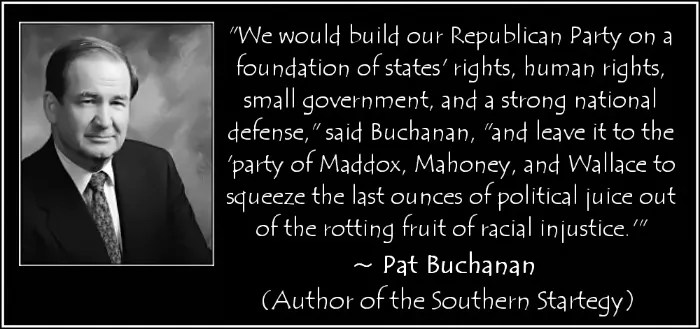
Pat Buchanan’s own description of the strategy is revealing. He spoke of building the Republican Party around states’ rights, human rights, limited government, and national defense, while contrasting that approach with openly segregationist Democratic politicians. That statement does not settle the debate over racial appeals, but it illustrates why the strategy should be examined in its historical context rather than reduced to a single explanation.
This is the “Southern Strategy” explained by it’s author at the time he fashioned it. Below that is an adaptation by Larry Elder of what Pat Buchanan was saying at the time.
Translation via Larry Elder: (here and here)
- Pat Buchanan, former Richard Nixon speechwriter, invented the term “Southern strategy.” “We would build our Republican Party,” he said, “on a foundation of states’ rights, human rights, small government, and a strong national defense, and leave it to the ‘party of [Democratic Georgia Gov. Lester] Maddox, [1966 Democratic challenger against Spiro Agnew for Maryland governor George] Mahoney and [Democratic Alabama Gov. George] Wallace to squeeze the last ounces of political juice out of the rotting fruit of racial injustice.’”
Here is a summary of the article
“Nixon’s ‘Southern Strategy’ and a Liberal Big Lie“
Pat Buchanan’s Defense of Nixon and the Southern Strategy
In his 2014 article, “Nixon’s ‘Southern Strategy’ and a Liberal Big Lie,” former Nixon speechwriter Pat Buchanan challenges the popular account that Richard Nixon simply exploited racial resentment to transfer the segregationist South into the Republican Party.
Buchanan points to the Democratic Party’s long history of segregationist political power, including the Southern Manifesto of 1956, the actions of segregationist Democratic governors, and the continued influence of Southern segregationists within the national Democratic coalition.
He also highlights Nixon’s civil-rights record. Nixon supported the Civil Rights Acts of 1964, 1965, and 1968, criticized segregationist candidates during the 1966 campaign, and presided over significant federal school-desegregation efforts. Buchanan argues that Nixon attracted Southern voters through a broader appeal to patriotism, conservatism, and opposition to liberal policies—not simply through racial politics.
Buchanan’s perspective deserves consideration, particularly given his experience inside Nixon’s political circle. However, his defense should not be mistaken for proof that racial appeals played no role in Nixon’s electoral strategy. A president’s civil-rights record and the political calculations of his campaign are related, but they are not identical questions.
The historical record therefore requires more than either simplified explanation. Nixon’s Southern appeal cannot be understood solely as a campaign to attract segregationists, but neither can the racial dimensions of Republican electoral strategy be dismissed. The broader realignment involved changing party coalitions, civil-rights conflicts, economic development, ideology, and the gradual movement of Southern voters away from their traditional Democratic identification.
His argument has several parts:
- The Democratic Party had a substantial segregationist history. Buchanan points to Woodrow Wilson, Franklin Roosevelt, Southern segregationist governors, the 1956 Southern Manifesto, and Democratic congressional opposition to civil-rights measures.
- Nixon had a documented civil-rights record. Buchanan notes Nixon’s support for the Civil Rights Acts of 1964, 1965, and 1968, his criticism of segregationist candidates in 1966, and his administration’s civil-rights enforcement and school-desegregation efforts.
- Nixon’s Southern appeal was broader than race. Buchanan argues that Nixon attracted Southern voters through patriotism, conservatism, and opposition to what those voters viewed as liberal hypocrisy.
- The Democratic Party’s historical record complicates the popular narrative. Buchanan challenges the idea that Democrats were uniformly the party of civil rights and Republicans simply inherited the segregationist electorate.
The Claremont Review of Books essay “The Myth of the Racist Republicans” makes an argument against treating the Southern Strategy as the defining explanation for modern Republican politics. Importantly, the essay acknowledges that Republicans pursued a Southern Strategy and that local Republican candidates sometimes worked with segregationist elements in the 1960s.
That acknowledgment matters. A credible historical argument should not deny inconvenient evidence simply because it complicates the conclusion.
Likewise, Bruce Bartlett’s Wrong on Race argues that economic development and the growing ideological divide between conservative Southern Democrats and the national Democratic Party were important factors in the movement toward Republicanism. Bartlett also documents Nixon’s civil rights policies, including school desegregation and affirmative action.
The competing interpretations should be evaluated against the evidence rather than reduced to slogans.
The Southern Strategy was part of the realignment, but it was not the entire realignment. Nor can the realignment be explained without considering the civil rights movement, racial attitudes, the collapse of segregationist political structures, economic changes, and the changing positions of both national parties.
Sources: “The Myth of the Racist Republicans,” Claremont Review of Books; Bruce Bartlett, Wrong on Race, pp. 171–176.
What actually changed?
When we put the evidence together, several developments become clear.
- The Democratic coalition changed. Northern Democrats increasingly supported civil rights, while segregationist Southern Democrats continued to wield considerable influence.
- The Republican coalition changed. Republicans attracted increasing numbers of conservative Southern voters, and the party’s positions on civil-rights-related policies evolved over time.
- African American voters changed their political allegiance. The movement toward Democratic presidential candidates began during the New Deal era, well before the 1960s.
- Southern white voters changed their political allegiance. Republican presidential gains began before 1964 and continued over several decades.
- Some segregationist Democrats became Republicans. Thurmond is the most prominent example from the 1948 Dixiecrat leadership. Other Southern Democratic politicians changed parties in later decades, but they should not automatically be labeled 1948 Dixiecrats.
- Many segregationist Democrats remained Democrats. Politicians such as George Wallace, James Eastland, John Stennis, and Robert Byrd did not become Republicans.
- The Southern Strategy became part of the later Republican electoral story. Its racial implications and its importance relative to economic, cultural, and ideological factors remain subjects of historical debate.
These developments are connected, but they are not interchangeable.
The bottom line
Did every Dixiecrat, every segregationist Southern politician, or every Southern white voter suddenly become a Republican in 1964? Not even close
The historical record does not support that simplistic account.
The 1948 Dixiecrat movement was a rebellion within the Democratic Party. Its formal organization did not survive beyond that election. Some of its supporters returned to Democratic politics, some became independents, only a small minority of the segregationist Democrats discussed in these accounts eventually changed their party affiliation to Republican. Thurmond’s eventual party change was important, but it occurred 16 years after his presidential campaign.
Meanwhile, the broader Southern realignment unfolded over decades. It involved economic development, changing racial attitudes, civil rights legislation, new generations of voters, and changing national party coalitions.
We should acknowledge the Democratic Party’s historical responsibility for slavery’s political defense, segregationist Southern power, and Jim Crow. We should also acknowledge the Republican Party’s historic role in abolition, Reconstruction, and major civil rights legislation.
Neither party gets to erase its history. Neither party gets to claim that its identity has remained unchanged for two centuries.
The parties experienced a genuine realignment. But a realignment is not a mass conversion, and it is not a historical eraser.
The facts deserve better than the slogan that “the parties switched.”
Sources and Further Reading
The four books examined
- Dinesh D’Souza, Hillary’s America: The Secret History of the Democratic Party (Regnery, 2016), especially pp. 23–25.
- Dinesh D’Souza, Death of a Nation: Plantation Politics and the Making of the Democratic Party (All Points Books, 2018), especially pp. 233–236.
- Ann Coulter, Mugged: Racial Demagoguery from the Seventies to Obama (Sentinel, 2012), especially pp. 189–192.
- Bruce Bartlett, Wrong on Race: The Democratic Party’s Buried Past (Palgrave Macmillan, 2008), especially pp. 143–145 and 171–176.
RPT.NET resources
- Did the Party’s Switch?
- U.S. Racial History
- Radical Groups Support the Democrats — Even the KKK
- An Open Letter to Those Struggling with President Trump
Historical and political analysis supplied for this research
- Rick Chromey, “The Big Switch That Wasn’t: The Dixiecrats, Race and 1964”.
- Scott Spiegel, “The Civil Rights Legacy Democrats Stole from Republicans, Part 1”, Washington Examiner, April 14, 2014.
- Scott Spiegel, “The Civil Rights Legacy Democrats Stole from Republicans, Part 2”, Washington Examiner, April 15, 2014.
- “The Myth of the Racist Republicans”, Claremont Review of Books.
- Sean Trende, “Southern Whites’ Shift to the GOP Predates the ’60s”, RealClearPolitics, April 30, 2013.
- Kevin D. Williamson, “The Party of Civil Rights”, National Review, May 2012.
- John Fonte, “After Lott”, National Review, January 2003.
Academic research and primary historical records
- Brian D. Feinstein and Eric Schickler, “Platforms and Partners: The Civil Rights Realignment Reconsidered”, Studies in American Political Development 22, no. 1 (Spring 2008): 1–31.
- Byron E. Shafer and Richard G. C. Johnston, “The Transformation of Southern Politics Revisited: The House of Representatives as a Window”, British Journal of Political Science 31, no. 4 (2001): 601–625.
- Kari Frederickson, “Dixiecrats”, South Carolina Encyclopedia.
- U.S. Senate: Strom Thurmond — Featured Biography.
- U.S. Senate: Senators Who Changed Parties During Senate Service.
- The 1948 States’ Rights Democratic Party Platform, American Presidency Project.
- 1968 Presidential Election Results, American Presidency Project.