This has been updated (7/24/2026)
This is the thumbnail in my “slider” for the curious
This first graph is what got me thinking about this update, and I will fix what I see is wrong with it in a bit:
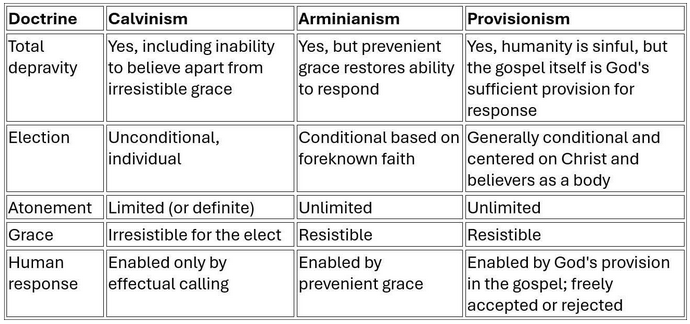
One of the most common misconceptions about Provisionism—and one of the reasons I’ve updated this post—is the assumption that Provisionists believe the Gospel alone functions as the only means by which God graciously enables people to respond to Him. While the Gospel is God’s supreme and saving revelation, Provisionism has always affirmed that God graciously reveals Himself and calls humanity through multiple means, including creation, conscience, providence, the convicting work of the Holy Spirit, Scripture, and ultimately the proclamation of the Gospel.
The disagreement with Calvinism and Arminianism is not whether God enables, but what Scripture teaches about the nature of that enabling and whether mankind is born with an inherited inability that requires a special grace before one can respond in faith.
The issue is that the above column subtly reduce Provisionism’s doctrine of grace to “the Gospel alone” as though the Gospel were merely information that unaided sinners evaluate. That’s not how Leighton Flowers or most thoughtful Provisionists describe it.
Provisionism doesn’t deny that God enables; it denies that He gives a special, universally distributed prevenient grace that restores a lost faculty of faith. Instead, God has provided a multitude of gracious means by which He reveals Himself and calls sinners.
For example, God’s gracious revelation includes:
- Creation (Romans 1:18–20)
- Conscience (Romans 2:14–15)
- Providence and God’s kindness (Acts 14:17; Romans 2:4)
- The convicting ministry of the Holy Spirit (John 16:8–11)
- The inspired Word of God (2 Timothy 3:15; Hebrews 4:12)
- The preaching of the Gospel (Romans 10:14–17)
- The testimony of believers (2 Corinthians 5:20)
- God’s patient appeals throughout history (Acts 17:26–31)
The Gospel is the climax of God’s provision, not the entirety of it.
Provisionists argue that God has graciously provided everything necessary for people to respond to Him through His self-revelation in creation, conscience, providence, the convicting ministry of the Holy Spirit, the inspired Scriptures, and especially the proclamation of the Gospel. Rather than a universal prevenient grace restoring an innate inability, Provisionists see these God-ordained means as sufficient to render every person genuinely accountable before Him.
Soteriology 101 is right when they emphasizes the Gospel because Romans 10 and the Great Commission are about how people come to saving faith:
Article Two says:
“We deny that any sinner is saved apart from a free response to the Holy Spirit’s drawing through the Gospel.”
Article Four says:
“…providing atonement, in freely offering the Gospel in the power of the Holy Spirit…“
Article Eight says:
“…accepting or rejecting God’s gracious call to salvation by the Holy Spirit through the Gospel.”
Article Ten says:
“…the proclamation of the Gospel is God’s means of bringing any person to salvation.”
Amen!
I am angling a slightly different question that Soto 101’s Statement of Faith, which simply asks [even if unsaid]: “How does God save people?”
What I am saying retroactively applies to times prior to Calvary and the Gospel and the spread of it across the world, as well as to those who have not heard the Gospel presented. This is RPT’s question:
- How has God graciously revealed Himself throughout history so that every person is morally accountable before Him while also providing His saving revelation according to His redemptive plan?
Those are not identical questions. Romans 1 and Romans 2 aren’t explaining how someone is regenerated. They’re explaining why everyone is “without excuse.”
This covers:
- Adam through Noah.
- Abraham and the patriarchs.
- Israel under the Law.
- Native Americans before European contact.
- Modern unreached people groups.
- Those of us who have heard the Gospel.
Your Native American article raises precisely the kind of question that illustrates this continuity: What about those who lived centuries before the Gospel reached the Americas? The New Testament doesn’t give a detailed answer about every case, but it consistently affirms two truths:
- God has never left Himself without witness (creation, conscience, providence, etc.). Acts 14:17 is especially explicit: “Yet He did not leave Himself without witness…” Romans 1–2 makes the same point regarding accountability.
- The Gospel is God’s appointed means of proclaiming salvation under the New Covenant (Romans 10), while salvation itself has always been through Christ, even for those who lived before His incarnation (Hebrews 11).
MORE HERE:
- What About Those Who Never Hear the Gospel? (Apologetic Press)
- What About Those Who’ve Never Heard the Gospel? (Be Thinking)
- Are Those Who Have Not Heard the Gospel Damned? RPT Q&A +More (RPT)
Provisionism’s doctrine of divine provision is not limited to the post-Pentecost proclamation of the Gospel. Throughout redemptive history, God has graciously revealed Himself through creation, conscience, providence, and His promises, rendering humanity accountable while progressively revealing His plan of redemption. Though salvation has always been through Christ alone, the Gospel is God’s appointed means of bringing people to saving faith under the New Covenant.
My Re-Write:

Provisionists affirm that the Holy Spirit draws sinners through the Gospel unto salvation. At the same time, Provisionism recognizes that God has never left Himself without witness. Through creation (Rom. 1:18–20), conscience (Rom. 2:14–15), providence (Acts 14:17; 17:24–31), the convicting ministry of the Holy Spirit (John 16:8–11), and ultimately the proclamation of the Gospel, God graciously reveals Himself, rendering every person without excuse and genuinely responsible for his or her response to His revelation. Saving faith comes through the Gospel (Rom. 10:17), but God’s gracious self-revelation is broader than the Gospel alone.
 This is how I describe it on my X ARTICLE to bolster the idea:
Throughout history, God has graciously revealed Himself in many ways, including:
- Creation
- Conscience
- Providence
- Covenants
- The Prophets
- The convicting work of the Holy Spirit
- The incarnation of Christ
- The proclamation of the gospel
These expressions of God’s self-revelation are not rigid stages through which every person passes in the same sequence. Rather, they represent the many ways God has made Himself known throughout redemptive history, often overlapping in a person’s life and always finding their fullest expression in the person and work of Jesus Christ. At Calvary, God’s self-revelation reached its clearest expression, where His holiness, justice, love, and grace were displayed in the sacrificial death and victorious resurrection of His Son.
Physicist Michael Guillen’s testimony illustrates this beautifully. As a committed atheist, it was not one isolated event that brought him to Christ. Rather, his understanding was gradually shaped by the wonder of creation, the limits of scientific materialism, his search through competing worldviews, meaningful relationships, and ultimately the witness of Scripture.
His journey reminds us that God often draws people through many converging streams of revelation, each pointing beyond itself until they find their fulfillment in Jesus Christ.
(I just want to give a shout out to Provisionist Perspective for encouraging me to do an X version of my post)
- Within the Non-Calvinist camp, there are at least two nuanced views on how God allows sinners to respond in faith. The first view is the Arminian view — which says that God’s work of grace (prevenient grace) for all people is needed to enable any sinner to freely choose to respond in faith to the Gospel message. The second view is the Provisionist View — which says that the Gospel message itself [see more below] is God’s work of grace so that when it is preached to all people, any sinner can freely choose to respond in faith. The proclamation of the Gospel is powerfully sufficient enough to bring salvation to those who will believe. While the Arminian and the Provisionist each have a different take on why all humans can respond to God’s offer, these two views both affirm the importance of God’s initiative of grace to invite all sinners to salvation. (from the book Grace For All: Understanding God’s Plan of Salvation).
— Michael R. Cariño
The “More Below”
Grace Enablements
Includes but are not limited to: God’s salvific love for all (John 3:16), God’s manifestation of his power so that all may know he is the Sovereign (Isa 45:21–22) and Creator (Rom 1:18–20), which assures that everyone has opportunity to know about him. Christ paying for all sins (John 1:29), conviction of the Holy Spirit (John 16:7–11), working of the Holy Spirit (Heb 6:1–6), enlightening of the Son (John 1:9), God’s teaching (John 6:45), God opening minds and hearts (Luke 24:45; Acts 16:14; 26:17–18;), and the power of the Gospel (Rom 1:16), without such redemptive grace, no one seeks or comes to God (Rom 3:11).
Because of these gracious provisions and workings of God, man can choose to seek and find God (Jer 29:13; Acts 17:11–12). Moreover, no one can come to God without God calling (Acts 2:39), drawing (John 6:44), and that God is drawing all individuals (John 12:32). The same Greek word for draw, helkuō, is used in both verses. “About 115 passages condition salvation on believing alone, and about 35 simply on faith.” Other grace enablements may include providential workings in and through other people, situations, and timing or circumstances that are a part of grace to provide an opportunity for every individual to choose to follow Christ.
These are grace enablements in at least three ways; first, they are provided by God’s grace rather than deserved by mankind; second, the necessary components for each and every individual to have a genuine opportunity to believe unto salvation are provided or restored by God; third, they are provided by God without respect to whether the individual will believe or reject, which response God knew in eternity past.
The offer of the Gospel is unconditional, but God sovereignly determined to condition the reception of the offer upon grace-enabled faith; therefore, faith is not reflective of a work or virtue of man, but of God’s sovereign plan of salvation by grace through faith (Eph 2:8). This indicates faith is the means to being regenerated and saved, not the reason for being saved. This truth of Scripture does not imply God is held captive to the choice of man, but rather it demonstrates God in eternity coextensively determined to create man with otherwise choice and provide a genuine offer of salvation, which can be accepted by grace-enabled faith or rejected. Additionally, to fulfill this plan, God is not obligated to disseminate the Gospel to people he knows have rejected the light he has given them (Rom 1:18–23) and will also reject the Gospel; although he may still send the Gospel to them.
IMPORTANT?
Why I think this is important. The North American Missions Board (NAMB) essentially states:
People have not heard the Gospel.
Therefore, they are condemned because they never heard it.
Provisionism does not begin by asking, “What happens to those who never hear the Gospel?”
It first asks, “Has God graciously revealed Himself sufficiently to every person to hold them morally accountable?”
Scripture repeatedly answers that He has. From creation and conscience to providence and the convicting work of the Holy Spirit, God has never left Himself without witness (Acts 14:17). The Gospel is God’s appointed means of proclaiming salvation through Christ, but His gracious self-revelation has never been limited to the Gospel era or to places where missionaries have already arrived.
NAMB says:
- “people who never have an opportunity to hear the Gospel stand condemned.”
To which I ask: Are they condemned because they never heard the Gospel?

Another version (thanks B.J.)
William Lane Craig:
WLC’s view is anathema to NAMB, sadly. And this is the evidence of the rot of Calvinism.
Here is my chart on the differences broadly speaking:
CLICK TO ENLARGE – right click and choose:
“Open Image In New Tab” and it be at it’s largest
