In discussion with a friend who seemed like he did not watch the below video, I noted:
Calvinistic historian, Loraine Boettner, concedes that the concept of individual effectual election to salvation “was first clearly seen by Augustine” in the fifth century. John Calvin admits that his theology was first clearly seen in Augustine. Many reformers stood against many of these ideas… the scholar/Greek reader of the bunch, Phillipe Melanchthon, as well. Others were killed, like my homeboy Hubmaier.
We know currently – not standing in heaven after we pass, by Scripture – that God has allowed His prevenient grace to work thru Scripture [sharper than any two-edged sword] to change minds.
For the word of God is living and effective and sharper than any double-edged sword, penetrating as far as the separation of soul and spirit, joints and marrow. It is able to judge the thoughts and intentions of the heart.
In the 5-point system God chooses wholly who believes and who does not. In other words, I do not believe God chose before creation who would be saved and who would not. It would be like the evil guy in the Incredibles – Omnidroid – who made the evil robots to destroy them in order to look like the good guy. When people realize the 5-points do this to the God of the Bible [Augustinianism], they understand how shallow the God of those points are.
Dr. Leighton Flowers, Director of Evangelism and Apologetics for Texas Baptists, gives a history lesson on the soteriological influence of Augustine and the Reformers in contrast to the Earlier church leaders and apologists. For more on Dr Ken Wilson’s work: Did the Early Church Fathers teach “Calvinism?”
There has been an attempt to respond to this, however, as you will see some misquoting is going on
Dr. Leighton Flowers, Director of Evangelism and Apologetics for Texas Baptists, is joined by Dr. Ken Wilson to discuss the history of Determinism in the church.
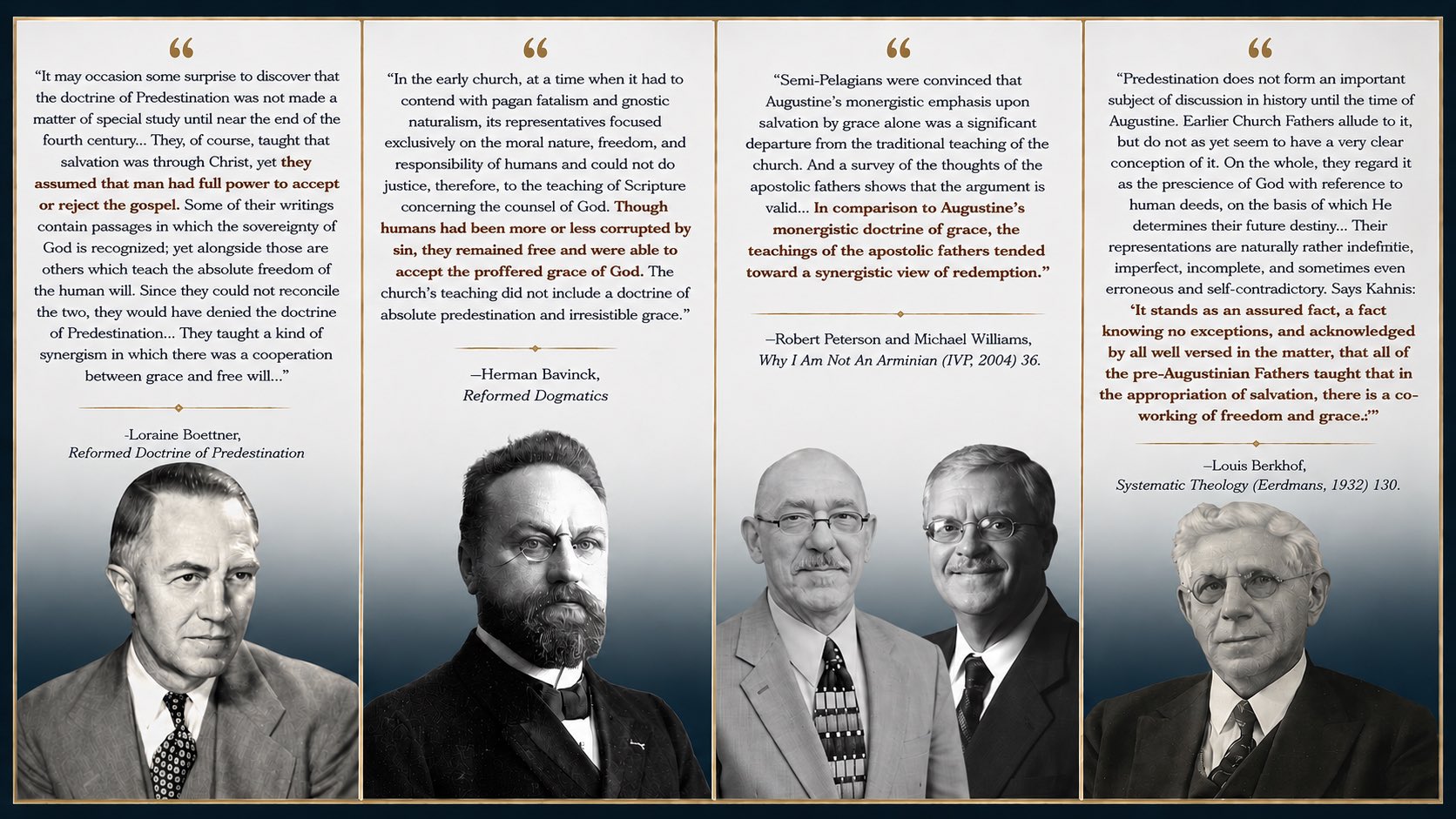
Here are quotes from Reformed historians who validate the foundational claims of Wilson’s work:
Herman Bavinck:
- In the early church, at a time when it had to contend with pagan fatalism and gnostic naturalism, its representatives focused exclusively on the moral nature, freedom, and responsibility of humans and could not do justice, therefore, to the teaching of Scripture concerning the counsel of God. Though humans had been more or less corrupted by sin, they remained free and were able to accept the proffered grace of God. The church’s teaching did not include a doctrine of absolute predestination and irresistible grace.
Loraine Boettner:
- “It may occasion some surprise to discover that the doctrine of Predestination was not made a matter of special study until near the end of the fourth century….They of course taught that salvation was through Christ; yet they assumed that man had full power to accept or reject the gospel. Some of their writings contain passages in which the sovereignty of God is recognized; yet along side of those are others which teach the absolute freedom of the human will. Since they could not reconcile the two they would have denied the doctrine of Predestination… They taught a kind of synergism in which there was a co-operation between grace and free … this cardinal truth of Christianity was first clearly seen by Augustine…“
Robert Peterson and Michael Williams of Covenant Theological Seminary:
- “The Semi-Pelagians were convinced that Augustine’s monergistic emphasis upon salvation by grace alone represented a significant departure from the traditional teaching of the church. And a survey of the thought of the apostolic father’s shows that the argument is valid… In comparison to Augustine’s monergistic doctrine of grace, the teachings of the apostolic fathers tended toward a synergistic view of redemption” (36).
Louis Berkhof [in The History of Christian Doctrines]:
- “Their representations are naturally rather indefinite, imperfect, and incomplete, and sometimes even erroneous and self-contradictory. Says Kahnis: “It stands as an assured fact, a fact knowing no exceptions, and acknowledged by all well versed in the matter, that all of the pre-Augustinian Fathers taught that in the appropriation of salvation there is a co-working of freedom and grace.”
Berkhof goes on to admit that “they do not hold to an entire corruption of the human will, and consequently adhere to the synergistic theory of regeneration…” (130).
In other words, despite Calvinists claims and assertions to the contrary, there were no “monergists” before Augustine.
Dr. Leighton Flowers, Director of Evangelism and Apologetics for Texas Baptists, answers a listener submitted question about whether Calvinism is a form of Gnosticism.